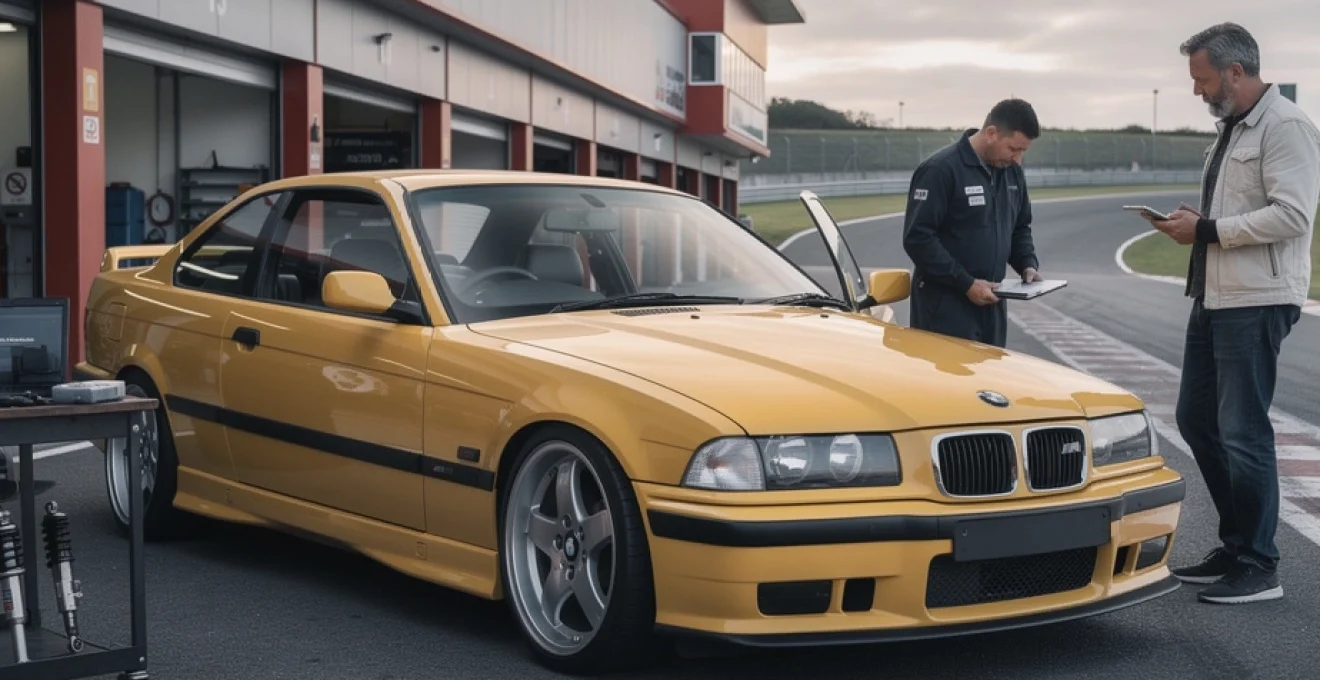
The 1995 BMW M3 coupe sits at a fascinating crossroads in performance-car history. It bridges the raw, motorsport-led ethos of the E30 with the more refined, everyday usability that defines modern M cars. Three decades on, an E36 M3 in good condition still feels disarmingly quick, resolutely analogue, and surprisingly civilised in daily use. For anyone looking at a usable modern classic, the 1995 M3 coupe delivers a rare mix of character, speed and practicality that newer machinery often dilutes with weight and electronics. Values are rising, but the car remains one of the most accessible ways to experience an authentic, naturally aspirated M straight‑six and a chassis that rewards proper driving technique rather than electronic safety nets.
1995 BMW M3 coupe overview: E36 chassis, model years, and UK-specification details
E36 M3 coupé production timeline: pre-facelift vs 1995 model-year updates
The E36 M3 launched in Europe in 1992, initially as a 3.0‑litre coupe developing 286bhp from the S50B30 engine. Early cars established the template: a subtly flared two-door shell, lowered suspension and a straight‑six that revved beyond 7,000rpm. By the 1995 model year, BMW had already refined a number of details. UK‑market coupes of that year still used the 3.0‑litre engine, but benefitted from incremental improvements in build quality, trim and corrosion protection as the E36 range matured.
Pre‑facelift cars (up to 1995) feature the original, slimmer kidney grilles and early interior switchgear, giving a slightly more “old‑school” feel. From late 1995 into 1996, BMW began rolling out mild cosmetic and equipment updates across the 3 Series range, which gradually filtered into the M3, culminating in the 3.2‑litre Evolution model. For many enthusiasts, the 1995 coupe represents the sweet spot: the purer 3.0‑litre engine with much of the early teething trouble already resolved at the factory level.
Uk-market 1995 BMW M3 coupe vs US-spec and euro-spec differences
For buyers cross‑shopping international cars, the differences between UK, US and continental European E36 M3s in 1995 are critical. UK‑spec cars share their specification with other Euro‑market models: a high‑revving S50B30 with individual throttle bodies, single‑VANOS on the inlet, and a factory output of around 286bhp and 236lb ft. By contrast, the 1995 US‑spec M3 uses the S50 based on the 325i engine: 3.0 litres, 240hp and 225lb ft, with simpler valve gear and without the full motorsport hardware of the Euro engine.
This leads to a very different driving character. The US car, as contemporary tests noted, trades outright power for a broader torque plateau and lower running costs, better suited to low speed limits and poor road surfaces. The UK / Euro 3.0‑litre M3 offers a sharper top‑end rush, more frenetic throttle response and a stronger sense of “race‑bred” DNA. For a driver in Britain looking for the most authentic, high‑revving M3 experience, a 1995 UK‑market coupe is far closer to the original European vision than the American variant.
Factory trim levels, option packs, and individual programme configurations
The 1995 BMW M3 coupe in the UK was offered with a relatively simple core specification, then a variety of option packs. Standard equipment included sports seats, M‑Technic suspension, ABS, a driver‑focused dashboard and 17‑inch wheels. Popular options were the Luxury Pack (leather upholstery, on‑board computer, upgraded audio), the electric tilt/slide sunroof, and dual‑zone air conditioning, which many buyers still value for regular use.
BMW’s Individual programme allowed more adventurous combinations. Period cars can be found with unusual paint shades – such as Avus Blue, Dakar Yellow or more bespoke Individual colours – teamed with contrasting leather and unique interior trims. If you are hunting a collectible 1995 M3 coupe, factory documentation confirming Individual options and rare colour/trim pairings can add significant desirability. However, for fast-road driving, condition and maintenance history invariably matter more than exotic specification.
Real-world used market overview: current pricing, mileage bands, and value trends
In the current market, the E36 M3 remains one of the most attainable M3 generations, but the window is narrowing. Heavily used or cosmetically tired coupes with over 120,000 miles often sit in the £10,000–£15,000 bracket, sometimes less if rust and deferred maintenance are obvious. These cars can still drive well, but you should factor in substantial spending on suspension, cooling and bodywork within the first two years of ownership.
Well‑kept, largely original 1995 coupes with under 90,000 miles tend to fall in the £18,000–£25,000 range, especially if accompanied by thick service histories and minimal modifications. At the top end, low‑mileage or rare‑spec cars can reach £30,000–£35,000, with ultra‑rare Individual builds and Lightweight‑style specials now commanding far more. Recent auction data shows hammer prices for clean E36 M3s rising steadily over the last five years, mirroring the earlier surge in E30 and now E46 M3 values. For anyone considering a 1995 M3 coupe as a modern classic investment, the trend is clearly upward.
S50 straight-six engine: technical specification and real-world performance of the 1995 M3
S50B30 vs S50B32 comparison: 3.0‑litre vs 3.2‑litre engines in the E36 M3 range
The 1995 BMW M3 coupe is powered by the S50B30, a 3.0‑litre DOHC inline‑six with 24 valves, individual throttle bodies and single‑VANOS on the inlet cam. In UK and European trim it produces around 286bhp at 7,000rpm and 236lb ft at 3,600rpm, enough for a 0–62mph time of roughly 5.5 seconds in period testing. A 7,200rpm redline and a wonderfully free‑reving nature give the 3.0‑litre M3 its distinctive character.
The later 3.2‑litre S50B32 (M3 Evolution) adds double‑VANOS and more capacity, lifting power to 321bhp and torque to 258lb ft. It is objectively faster, but also more complex and more expensive to rebuild. Many experienced owners describe the 3.0‑litre engine as slightly more “eager” and less temperamental, with a simpler VANOS system and a more playful delivery. For fast‑road use in the UK, the 3.0‑litre car feels more than quick enough, and arguably offers a purer driving experience.
Throttle response, VANOS behaviour, and power delivery curve from 2,000–7,000rpm
What defines the 1995 M3 coupe on the road is the linear surge from 2,000 to 7,000rpm. Below 2,000rpm the engine is smooth but modest; from 2,500rpm it pulls like a small turbocharged unit, building intensity as revs rise. The single‑VANOS system advances the inlet cam to broaden the mid‑range, resulting in strong thrust from 3,000 to 6,000rpm, ideal for overtakes and B‑road bursts.
From around 5,500rpm onward the engine note hardens into an angry yowl and the car races towards the limiter. Contemporary testers often drew comparisons with smaller displacement racing engines, thanks to the crisp throttle response and immediate reaction to small pedal inputs. When healthy, there is no pronounced step in power delivery; instead, the M3 pulls with an almost elastic consistency right up to the redline, rewarding committed use of the gearbox.
Dyno-tested outputs vs factory figures: bhp, torque, and typical age-related losses
Three decades on, very few 1995 M3 coupes will still produce their full factory 286bhp without careful maintenance and occasional refresh work. Independent rolling‑road sessions on well‑serviced cars typically show 260–280bhp at the flywheel equivalent, with torque figures of 225–235lb ft. Age‑related losses of around 5–10% are normal, especially if the VANOS, ignition and fuelling components are original.
Interestingly, many owners report that a properly set‑up S50B30 feels quicker than the raw numbers suggest, largely because of its short gearing, relatively low kerb weight (around 1,450kg for a UK coupe) and strong mid‑range torque. A dyno chart tends to reveal a very flat torque curve from 3,000 to 6,000rpm, which explains why the car accelerates so decisively in third and fourth gear without needing downshifts every few seconds.
Fuel system, lubrication, and cooling considerations for fast road and track use
If you plan to use a 1995 M3 for fast road or track days, the supporting systems deserve respect. The standard fuel system – with its in‑tank pump and return line – is generally robust, but age can weaken pumps and clog filters, leading to lean running under high load. Replacing the pump and filter preventatively on a higher‑mileage car is cheap insurance, especially when combined with fresh injectors or ultrasonic cleaning.
The cooling system, as with many 1990s BMWs, is a known weak link. Plastic radiator necks, brittle expansion tanks and ageing thermostat housings can fail without much warning. A sensible track‑day preparation list includes a new aluminium‑cored radiator, fresh hoses, a metal‑impeller water pump, and a new thermostat every 60,000 miles. Using a high‑quality synthetic oil of the correct viscosity and changing it every 5,000–6,000 miles keeps the S50’s lubrication system happy, particularly when the engine regularly sees 7,000rpm.
Common engine issues on 1995 cars: VANOS seals, big-end shells, and head gasket weak points
Every 1995 M3 coupe now counts as a classic, so some age‑related issues are inevitable. VANOS units can rattle at idle or fail to advance properly at higher revs, leading to flat spots and loss of mid‑range. Rebuild kits with uprated seals and revised bolts address this, and an overhauled VANOS often restores lost performance and smoothness. Listening for excessive mechanical noise and checking for associated fault codes is essential during any pre‑purchase inspection.
Another known concern on hard‑driven cars is big‑end bearing wear, especially if oil changes were stretched. A preventive big‑end shell and bolt replacement at around 120,000 miles, combined with regular oil analysis, can significantly extend engine life. Head gaskets are not as fragile as some internet folklore suggests, but overheating quickly changes that. Any signs of emulsion, unexplained coolant loss or pressurised hoses should trigger further investigation. Many of these issues are manageable once understood; the key is to buy on condition and history, not purely on odometer reading.
Chassis, suspension, and handling characteristics of the 1995 BMW M3 coupe
Front MacPherson struts and rear multi-link ‘z-axle’ geometry: E36 M3 setup explained
The E36 platform marked a major leap for BMW’s chassis engineering. At the front, the 1995 M3 coupe uses MacPherson struts with revised geometry, stiffer springs and unique M‑tuned dampers. At the rear sits the sophisticated multi‑link “Z‑axle”, designed to keep the tyre contact patch stable under load while allowing precise control of toe and camber changes. Together, they deliver the fabled 50:50 weight distribution that defines the car’s balance.
The M3’s suspension sits approximately 30mm lower than a standard E36 3 Series, with firmer anti‑roll bars and reinforced mounting points. On the road, this translates into a front end that responds quickly to steering inputs, a rear axle that follows faithfully, and a neutral balance that can be nudged into gentle oversteer with throttle. On poor surfaces, the structure absorbs bumps with surprising composure, helped by relatively generous tyre sidewalls compared with modern performance cars.
Standard springs, dampers, and anti-roll bars vs bilstein, H&R, and KW coilover upgrades
The factory suspension on a 1995 BMW M3 coupe offers an excellent compromise between comfort and control, especially when refreshed with new bushes, dampers and top mounts. However, many owners choose to upgrade to high‑quality aftermarket kits. Bilstein B8 dampers with Eibach or H&R springs remain a popular fast‑road set‑up, tightening body control without wrecking ride quality. For track‑biased use, adjustable coilovers from KW, Bilstein PSS or similar brands allow custom ride heights and damping curves.
When considering upgrades, the key is to maintain the car’s natural balance rather than chasing extreme stance or ultra‑stiff rates. A sensible combination of slightly firmer springs, modern dampers, fresh OEM bushes and maybe adjustable rear camber arms yields a chassis that feels like a sharpened factory car rather than something “aftermarket” and brittle. Excessively stiff or budget coilovers often spoil the M3’s fluidity, making it skittish on B‑roads and fatiguing on longer journeys.
Steering feel, front-end bite, and mid-corner balance on b-roads and circuits
One of the enduring reasons drivers seek out an E36 M3 is the steering. The hydraulic rack is relatively quick but not hyper‑aggressive, with a delicate self‑centring action and genuine feedback as the front tyres approach their limits. Compared with many modern electric systems, the steering feels like a direct conversation between your fingertips and the road surface. On a typical British B‑road, this inspires confidence to use the full width of the lane and place the car precisely.
Mid‑corner, the 1995 M3 coupe exhibits a near‑neutral stance. If you trail‑brake into a bend, the rear rotates progressively; if you pick up the throttle early, the limited‑slip differential digs in and gently tightens your line. On circuit, the car’s limits are surprisingly high, yet the transition from grip to slip is smooth and predictable. Drivers used to modern stability control might be shocked at how much adjustability is available on the throttle alone, but that is exactly what makes the E36 such a satisfying tool for training technique.
Braking system performance: OEM calipers and discs vs brembo and AP racing conversions
The standard braking system – 12.4‑inch vented front discs, 12.3‑inch vented rears and ABS – was strong for the mid‑1990s. Period testing recorded 70–0mph stops in around 158ft, comparable to contemporary sports cars and still respectable today. For everyday road use, fresh OEM‑quality discs and pads, braided lines and high‑boiling‑point fluid are typically sufficient. Many owners underestimate how much performance is unlocked simply by renewing tired components.
On track, sustained hard use can expose the limitations of the factory calipers, especially with road‑biased pads. This is where four‑ or six‑piston upgrades from Brembo or AP Racing come into play, providing greater thermal capacity and more consistent pedal feel. The trade‑off is cost and, in some cases, additional unsprung weight. For a mixed‑use 1995 M3 coupe, a well‑sorted OEM system on performance pads is often the best compromise unless you plan to spend a large proportion of your time lapping circuits.
Interior, ergonomics, and daily usability of the 1995 M3 coupe
Slip into the cabin of a 1995 BMW M3 coupe and the first impression is how compact and focused everything feels by modern standards. The dashboard arcs slightly towards the driver, with clear analogue instruments and simple rotary controls for climate and ventilation. Visibility is excellent thanks to thin pillars and a relatively upright glasshouse, making urban driving and tight parking manoeuvres less stressful than in many current sports coupes. The steering wheel rim is thinner than contemporary designs, further enhancing steering feedback and delicacy.
For everyday use, the E36 M3 is more practical than its performance credentials might suggest. There is genuine space for four adults, a decently sized boot and useful cubbies around the cabin. Period options such as heated seats, cruise control, an on‑board computer and a tilt/slide sunroof make long‑distance touring comfortable. Road and wind noise are well suppressed for a car of this age, with the engine settling into a relaxed hum at motorway speeds. Headroom in the rear is slightly compromised by the sloping roofline, but for most journeys it remains adequate.
Age does show in a few places: headliners can sag, door cards may delaminate and some plastic trims become brittle. Electrical niggles – such as slow window regulators or intermittent central locking – are not unusual. However, these issues are generally straightforward to rectify with widely available parts. For daily usability in 2025, the biggest consideration is not comfort but urban regulations; no UK‑market E36 M3 is ULEZ‑exempt, so city‑centre drivers must budget for potential emissions charges.
Period-correct performance metrics: 0–60mph, in-gear acceleration, and track lap examples
Independent road test data: autocar, evo, and car magazine 0–60mph and 0–100mph times
Contemporary road tests paint a consistent picture of the 1995 M3 coupe’s straight‑line performance. Independent figures from respected magazines recorded 0–60mph in approximately 5.5–5.7 seconds and 0–100mph in the mid‑14 to high‑15‑second range. One US‑spec test even quoted 5.6 seconds to 60mph and 14.3 seconds for the quarter mile at 98mph, despite the lower power rating, underlining the car’s efficient gearing and strong launch traction.
These numbers placed the E36 M3 squarely in the company of serious performance machinery of the day. Only more exotic or specialised models, such as lightweight Japanese sports cars or high‑end German rivals, could reliably out‑drag it. What surprises many first‑time drivers today is how relevant those figures still feel; in real traffic, the M3’s ability to maintain momentum and exploit gaps often matters more than headline 0–62mph times.
In-gear acceleration comparisons vs E36 328i sport and porsche 911 (993) carrera
Comparing the 1995 M3 coupe with its 3 Series stablemates and period rivals highlights its breadth of ability. An E36 328i Sport – with around 193bhp – is no slouch, yet in‑gear acceleration tests show the M3 opening a clear gap, especially from 50–70mph in fourth and 60–100mph in fifth. The S50’s extra 90‑plus horsepower and broader torque band make overtakes less of a calculation exercise; you simply squeeze the throttle and the car surges past slower traffic.
Against a contemporary Porsche 911 (993) Carrera, the story is nuanced. The rear‑engined Porsche often edges the M3 in raw acceleration by a small margin, particularly from a standing start thanks to superior traction. Yet in real‑world rolls and on twisty roads, the BMW’s more approachable chassis and better ride quality arguably make it easier to exploit for an average driver. If you value usable performance over ultimate bragging rights, the M3 holds its own remarkably well.
Track-day benchmarks: lap times at silverstone, brands hatch, and nürburgring nordschleife
Track‑day data for standard 1995 M3 coupes varies with conditions and driver skill, but some patterns emerge. On UK circuits such as Brands Hatch Indy, a healthy car on modern tyres typically laps in the 55–60 second region in competent hands, roughly on par with contemporary hot hatches and lighter track specials. At Silverstone National, times in the 1:10–1:15 window are common for lightly modified examples.
On the Nürburgring Nordschleife, period industry laps for stock E36 M3s clustered around 8:30–9:00 Bridge‑to‑Gantry, depending on tyres and traffic. While modern super‑hatches can now eclipse those times with relative ease, the experience is very different. The M3’s long‑legged gearing and linear power delivery reward a smooth, flowing style, and the car communicates its limits clearly through seat and steering rather than flashing stability‑control lights.
Top speed, gearing, and real-world motorway cruising characteristics
Officially, the 1995 BMW M3 coupe is limited to 155mph where derestricted, though some markets imposed lower electronic cut‑offs. Independent tests occasionally saw indicated top speeds in the 160mph range with limiters removed. In stock UK form, the five‑speed manual gearbox features a direct fifth gear and relatively short overall ratios, enabling quick in‑gear response but still allowing relaxed cruising.
At 70mph in fifth, the engine turns at a little over 3,000rpm, comfortably within its torque band but not excessively busy. This makes the M3 a capable long‑distance car; the engine settles into a smooth hum, wind noise remains moderate, and the seats offer enough support for multi‑hour stints. Real‑world fuel economy in mixed driving hovers around 22–27mpg, with motorway runs at legal speeds edging closer to 30mpg if you drive with a light foot.
Reliability, rust hotspots, and maintenance priorities for a 1995 E36 M3 coupe
Reliability of a 1995 BMW M3 coupe depends far more on maintenance history than age alone. Mechanically, the S50 engine and Getrag manual gearbox are robust if serviced correctly. The main pitfalls arise from neglected cooling systems, tired suspension and accumulated rust. For any potential purchase, a thorough inspection on a lift is non‑negotiable. Pay close attention to front and rear jacking points, inner and outer sills, rear wheel arches, boot floor and the area around the fuel filler neck. Corrosion here can be extensive but not immediately obvious from above.
Suspension components also deserve scrutiny. Rear trailing arm bushes, ball joints, front control arm bushes and rear shock mounts wear out relatively quickly on UK roads, leading to vague handling, clunks and uneven tyre wear. Budget for a full suspension refresh on cheaper cars; the transformation in precision and ride quality is dramatic. Brake lines can corrode, particularly around the rear axle and underbody clips, and should be replaced with copper‑nickel lines if in doubt. Electrical issues such as pixelated instrument clusters, intermittent ABS sensors and aging alarm systems can usually be sorted methodically with patience and access to wiring diagrams.
For ongoing ownership, three maintenance priorities stand out. First, adopt a strict fluid‑change regime: engine oil, gearbox oil, differential oil and coolant all benefit from more frequent intervals than the original factory schedule. Second, tackle rust early, especially on arches and underside seams, using proper cutting and welding rather than surface treatments alone. Third, approach modifications critically. Quality parts such as Bilstein or KW dampers, stainless brake lines and reinforced rear shock towers enhance reliability and performance, whereas cheap coilovers or questionable engine remaps can create more problems than they solve.
Collectability and classic status: where the 1995 BMW M3 coupe sits among M3 generations
The 1995 BMW M3 coupe now occupies a distinct niche in the M3 lineage. It follows the homologation‑led E30 – widely considered the definitive 1980s driver’s car – and precedes the V8‑engined and turbocharged generations that pushed performance into supercar territory. For many enthusiasts, the E36 is the first “real‑world” M3: fast enough to feel special, comfortable enough for commuting, and still relatively affordable to buy and maintain compared with the iconic E30 and later E46 CSL. Production numbers north of 70,000 units worldwide also mean parts support remains excellent.
As other M3 generations climb beyond the reach of many buyers, interest in the E36, and particularly in clean 1995 coupes, has increased sharply. The car’s blend of analogue feedback, naturally aspirated power and practical packaging appeals to drivers who feel alienated by the complexity and size of current performance models. Industry events such as major classic car shows and track‑day festivals increasingly highlight E36 M3s, and specialist insurers now often categorise them explicitly as “modern classics” with agreed‑value policies. For someone considering a 1995 M3 coupe today, the car offers more than nostalgia: it provides a tangible link to an era when the “Ultimate Driving Machine” tagline accurately described how the car felt from behind the wheel.