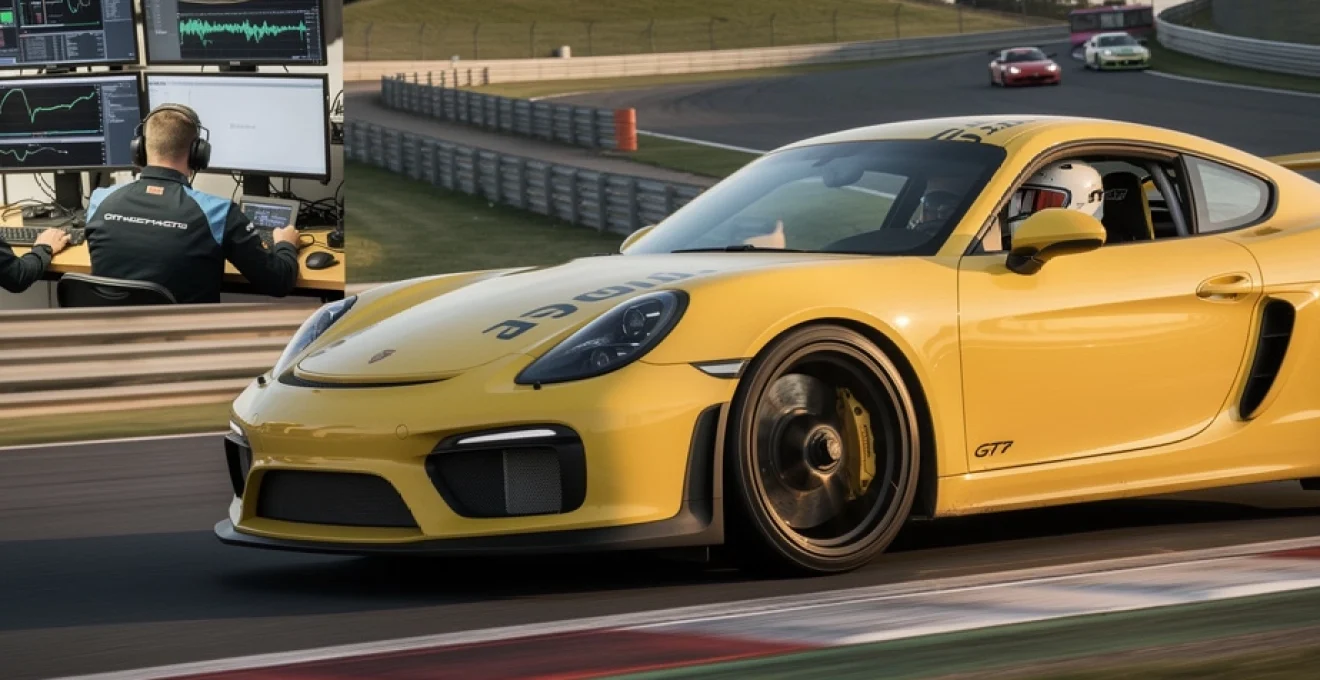
The 2016 Porsche Cayman GT4 is one of those rare cars that bridges a gap enthusiasts often talk about but seldom experience: a road‑legal, naturally aspirated, manual‑only coupé that behaves like a junior racing car without destroying day‑to‑day usability. It arrived at a turning point for Porsche, just as turbocharged 911s and four‑cylinder 718s were reshaping the range, and it quickly became a reference point for analogue, mid‑engined performance. If you care about steering feel, brake consistency, weight distribution and lap‑time data as much as straight‑line speed, the 981‑generation Cayman GT4 is still a benchmark you cannot ignore.
2016 porsche cayman GT4 in context: weissach’s analogue track weapon in the 981 lineage
Placed within the 981 Cayman family, the GT4 is the ultimate expression of what that aluminium mid‑engined platform could deliver. Regular 2.7 and 3.4‑litre models already offered superb balance, while the GTS sharpened responses and added power. Yet the GT4 goes far beyond an incremental upgrade. It borrows its engine from the 991 Carrera S, its front axle and brakes from the 991 GT3, then overlays GT department tuning for geometry, aero and software. The result is a Nürburgring Nordschleife lap of around 7:40–7:42 minutes, on par with a 2011 997 GT3 and faster than many contemporary supercars.
Production volumes were low (around 2,500 units worldwide), which, combined with the one‑year model run, has ensured strong residual values. At launch in 2015, UK list pricing sat near £64,000, yet used values have often exceeded that, especially for low‑mileage cars with Clubsport pack and PCCB. That resilience reflects more than scarcity; it reflects how the GT4 feels from behind the wheel. Compared with a contemporary 991.1 GT3, the Cayman GT4 is slightly slower in a straight line but more exploitable on typical B‑roads, encouraging you to rev out second and third without immediately straying into licence‑losing territory.
The 2016 Cayman GT4 distilled the GT department ethos into a more attainable, mid‑engined package, at a time when analogue driver’s cars were already becoming an endangered species.
Engine and drivetrain engineering: 3.8‑litre MA1 flat‑six, 981 vs 991 carrera S architecture
Ma1.01-derived 3.8 flat‑six: internal codes, compression ratio and torque curve characteristics
At the heart of the 2016 Cayman GT4 sits a 3.8‑litre naturally aspirated flat‑six from the MA1 engine family. Internally, the unit is closely related to the 991.1 Carrera S’s MA1.01, but adapted for a mid‑engined installation with revised intake plumbing and ancillaries. Output stands at 385–380 bhp (depending on market rating) at 7,400 rpm and 420 Nm (309 lb ft) around 4,750 rpm. Compression ratio is a high 12.5:1, supporting crisp throttle response and strong mid‑range pull on premium unleaded.
On the road, the key difference versus a 3.4‑litre Cayman S or GTS is torque density in the mid‑range. Where the smaller engine feels flat below 4,000 rpm, the GT4 builds speed decisively from 3,000 rpm, then pulls hard and linearly to the 7,600–7,800 rpm redline. Long gearing (around 82 mph in second) means the engine often operates between 3,000 and 6,500 rpm on spirited drives, and that fatter torque curve makes all the difference. For you as a driver, that translates into less need to chase the top 1,000 rpm to make rapid progress, but with a meaningful reward when you do.
High‑rev calibration: throttle mapping, 7,800rpm redline and motorsport‑inspired oiling system
The GT4’s engine calibration is unashamedly high‑rev focused compared with a regular Carrera S. Throttle mapping in Sport and Sport Plus sharpens the pedal‑to‑butterfly relationship, reducing dead travel and delivering a more immediate response. At the same time, the ECU tune encourages the engine to spin freely to 7,600–7,800 rpm, where peak power is delivered. There is no turbo surge; instead you experience a steady swelling of thrust, accompanied by a rising, mechanical howl that becomes properly intense above 6,500 rpm.
A critical part of that high‑rev reliability is the oiling system. While not a full dry‑sump like the Mezger GT3 engines, the MA1 uses an integrated dry‑sump‑style architecture with multiple scavenging stages. In the GT4, this is combined with baffled sumps and additional cooling to tolerate sustained lateral loads experienced on circuits such as Spa‑Francorchamps or Silverstone GP. Track drivers routinely report 20‑minute sessions on slick or Cup 2 tyres with stable oil pressure and temperatures, which is not something every performance coupé manages.
Six‑speed manual gearbox: shortened ratios, reinforced internals and mechanical limited‑slip differential
The only transmission available in the 2016 Cayman GT4 is a six‑speed manual, internally coded G87 in this guise. No PDK, no paddles, no dual‑clutch shortcuts. Compared with a standard Cayman, the GT4 uses strengthened internals, a shorter final drive and a mechanical limited‑slip differential with asymmetrical locking (typically 27% on acceleration, 22% on deceleration). Gear spacing itself remains relatively long, but the reinforced architecture ensures durability under repeated high‑load track use.
From the driver’s seat, shift quality is a highlight. Throws are short and well defined, weighting is positive without being heavy, and the gate is accurate enough that you can attack fast third‑to‑fourth changes over crests with confidence. Heel‑and‑toe downshifts are encouraged by well‑spaced pedals, although auto rev‑matching can be activated via the Sport button if you prefer the car to handle throttle blips. For track‑day coaches, that feature can be a valuable tool when introducing less experienced drivers to manual GT driving without overloading them.
Dynamic transmission mounts (PADM): stiffness variation under load and impact on lap consistency
The GT4 benefits from Porsche Active Drivetrain Mounts (PADM), shared with other GT models. These are fluid‑filled mounts whose stiffness changes via magnetic or electro‑hydraulic control depending on load and selected drive mode. Under light cruising they remain soft, isolating engine vibration from the cabin. Under high lateral or longitudinal loads they stiffen considerably, tying the powertrain to the chassis and reducing mass movement.
On circuit, that translates into more consistent shift quality and better stability when you load the car hard in fast direction changes. The driveline does not rock back and forth under throttle transitions, helping you place the car accurately at corner entry and exit. For you, that extra precision often shows up as more repeatable lap times; data from track users frequently shows improved consistency in sector splits once PADM is in its stiffer calibration.
Exhaust and intake flow: GT‑spec manifolds, sound tuning and back‑pressure management
Breathing hardware plays a significant role in how the Cayman GT4 feels and sounds. Compared with regular 981 models, the GT4 uses freer‑flowing exhaust manifolds and a specific sports exhaust system with active valves. These open more fully in Sport and Sport Plus, reducing back‑pressure at high rpm and giving the car its signature metallic wail. Intake routing is also revised, with enlarged side intakes feeding the 3.8‑litre engine; at full load you can hear induction roar building behind your ears, especially if the rear carpet and sound deadening are minimal.
From a performance perspective, the combination of low back‑pressure exhaust and efficient intake maintains power at the top of the rev range, where restrictive systems would otherwise see output tail off. From an experiential standpoint, it turns every tunnel run into a moment of theatre without descending into artificial pops and bangs. Many owners consider the factory acoustic balance close to ideal for a dual‑purpose car, and aftermarket systems often chase weight saving more than decibel levels.
Chassis and suspension: GT3‑derived front axle, adjustable geometry and nürburgring‑ready setup
Macpherson strut front axle from 991 GT3: uprights, control arms and steering kinematics
One of the defining engineering choices on the 2016 Cayman GT4 is the adoption of the 991 GT3’s front axle hardware. This is not marketing fluff; the car genuinely uses GT3‑derived uprights, control arms and many associated components. Geometry is optimised for increased negative camber potential, reduced dive under braking and more linear steering response. The steering rack itself is an electric power‑assisted unit but tuned by the GT department, giving a more natural build‑up of effort around centre compared with standard 981 racks.
On a technical circuit, the advantage is immediately obvious. Turn‑in is cleaner and more decisive than on a Cayman S, and the front end resists washing wide even under heavy trail‑braking. For you as the driver, that means confidence to brake late and carry speed into blind apexes, knowing the chassis will communicate early if the front tyres are starting to slide rather than snapping unexpectedly.
PASM dampers and spring rates: factory ride heights, rebound/compression tuning and track alignment
The GT4 rides 30 mm lower than a regular Cayman and about 20–25 mm lower than a Cayman with the optional x73 sports suspension. Spring rates increase significantly, while PASM adaptive dampers control body movements in Normal or Sport modes. Factory ride height is already aggressive enough for most circuits, yet still clears everyday speed bumps with care.
Rebound and compression damping are tuned to keep the car settled over kerbs and compressions. On a fast lap, the body remains impressively flat, especially in mid‑ to high‑speed direction changes. On the road, Normal mode offers more compliance than you might expect for a track‑focused car; Sport is best reserved for very smooth surfaces. If you intend to chase serious lap times, a proper track alignment—slightly more front and rear negative camber, a touch more rear toe‑in—unlocks another layer of precision without ruining road manners.
Adjustable camber, toe and anti‑roll bars: factory settings vs aggressive track‑day geometry
Out of the box, the Cayman GT4 offers a level of chassis adjustability usually reserved for full track specials. Camber and toe can be altered at both axles using eccentric bolts, while the anti‑roll bars offer multiple stiffness positions. Factory geometry is conservative, aimed at balanced behaviour on road and track with even tyre wear. That is ideal if you mix daily driving with occasional circuits.
For dedicated track‑day use, many owners dial in more front negative camber (around ‑2.0 to ‑2.5 degrees) and a smidge more rear toe‑in to enhance stability under power. Combined with the standard limited‑slip differential, that setup allows you to lean on the front axle aggressively at turn‑in without provoking understeer, then put power down cleanly at exit. The adjustability also means you can reverse changes for road trips, an appealing flexibility if you use one GT4 for both roles.
Hydraulic steering feel: rack ratio, feedback characteristics and comparison with electric PAS systems
Although the GT4 uses electric power‑assisted steering, the tuning is noticeably different from regular 981 Caymans. The rack ratio is quick enough for small inputs to yield significant response, yet there is no nervousness at motorway speeds. Effort builds naturally as lock is applied, and there is more genuine feedback than in many later EPAS systems, including those on some 718 models.
Compared with the hydraulic rack on a 997 GT3, the GT4’s steering does not transmit the same fine‑grained texture of tarmac or engine vibration through the rim. However, it clearly relays changes in lateral load and tyre grip, especially on Michelin Cup 2 tyres. If you arrive at a corner slightly too hot, you feel the front contact patches scrub and lighten, giving you the chance to adjust. For someone stepping up from an M2 or TT RS, the clarity of this mid‑engined steering will feel like a revelation.
Uniball bearings and bushings: compliance reduction and high‑frequency chassis feedback
To deliver consistent geometry under high loads, the GT4 adopts stiffer bushings and uniball (spherical) joints in key suspension locations. These replace some of the rubber compliance of regular Caymans, reducing unwanted toe and camber changes under cornering and braking. The trade‑off is an increase in high‑frequency vibration transmitted into the cabin, especially over sharp ridges and expansion joints.
On track, that reduced compliance pays dividends. The car feels locked down, with steering inputs producing immediate, proportional changes in yaw. At circuits like the Nürburgring, where compression, camber changes and bumps can upset softer cars, the GT4 stays composed and predictable. For you, this means more mental bandwidth left to focus on braking points and lines rather than constantly correcting small, unexpected body movements.
Braking system and tyre package: PCCB, steel rotors and michelin pilot sport cup 2 performance
Standard steel braking hardware: 380mm rotors, four‑piston callipers and pad compound choices
Standard brakes on the 2016 Cayman GT4 comprise 380 mm steel rotors front and rear, clamped by aluminium monobloc four‑piston callipers derived from the 991 GT3. Factory pad material provides a strong initial bite with progressive modulation, suitable for both road and occasional circuit use. Brake pedal travel is short, and resistance rises firmly as you push harder, which makes threshold braking and heel‑and‑toe downshifts intuitive.
For heavy track use, many owners switch to more temperature‑resistant pad compounds and high‑boiling‑point fluid. With such upgrades, the steel setup copes well with repeated high‑energy stops at circuits like Road Atlanta or Silverstone. Pad life varies with driving style, but a shared pattern emerges: front pads typically last 3–5 hard track days on sticky tyres, rears somewhat longer.
Porsche ceramic composite brakes (PCCB): unsprung mass reduction and fade resistance on track
Porsche Ceramic Composite Brakes were a popular option on GT4 build sheets. PCCB uses carbon‑ceramic rotors paired with specific pads, cutting unsprung mass by several kilograms at each corner. That reduction improves suspension response over bumps and aids both ride quality and grip. Rotors are 410 mm front, 390 mm rear, offering increased thermal capacity and outstanding fade resistance under repeated heavy braking.
On track, the main benefit you notice is consistency. Lap after lap, the pedal remains firm and the car stops with the same authority, even when you are braking from 160+ mph repeatedly. For many private owners, PCCB rotors last the life of the car if not abused or chipped by gravel, although replacement costs are substantial. For that reason, a number of track‑focused drivers still prefer steels plus motorsport pads as a more economical consumable package.
Michelin pilot sport cup 2 vs pilot super sport: heat cycles, grip envelope and wet performance
Tyres are central to the GT4’s character. Factory fitment was usually Michelin Pilot Sport Cup 2, sized 245/35 ZR20 front and 295/30 ZR20 rear (some markets used 235/35 and 265/35). Cup 2s offer exceptionally high dry grip once warm, with a broad operating window ideal for track days. Their stiffer sidewalls complement the GT3‑derived front axle, delivering razor‑sharp turn‑in and minimal squirm under load.
The downsides? Cup 2s are more sensitive to standing water and low temperatures than road‑focused options like Pilot Super Sports or Pilot Sport 4S. On a cold, wet B‑road you must dial back commitment and drive with smooth, measured inputs. Heat cycle degradation is also a factor; a set can feel comparatively tired after 10–12 hard track sessions. For mixed road and occasional track use, many owners run PS4S and keep a second set of wheels shod with Cup 2s for circuit duty.
ABS calibration and brake balance: intervention thresholds and trail‑braking behaviour
The GT4’s ABS and PSM (stability control) are tuned with track use in mind. Intervention thresholds are higher than on regular Caymans, allowing you to brake very hard without the system jumping in prematurely. When ABS does activate, the pulses are fine and rapid, maintaining direction stability rather than unsettling the car. Brake balance out of the box leans slightly towards the front, providing strong front‑end support under late braking.
This calibration suits advanced techniques such as trail‑braking. You can carry substantial brake pressure past turn‑in, feeling the front tyres dig in and rotate the car, then smoothly release as you approach apex. For drivers still learning, PSM Sport mode offers a good compromise; it leaves enough slip angle for modest oversteer yet steps in early enough to catch bigger mistakes before they become expensive spins.
Track consumables: pad wear, disc cracking and tyre longevity at circuits like spa and silverstone
Hard track usage always turns consumables into significant cost items, and the Cayman GT4 is no exception. On circuits with heavy braking zones such as Spa’s Les Combes or Silverstone’s Stowe, pad life on steel brakes can shrink to 2–3 days if you drive at 9/10ths or above. Discs can develop surface cracking around drilled holes; replacing with two‑piece aftermarket rotors is a popular path to reduce long‑term expenditure.
Tyre longevity depends heavily on alignment and driving style. With aggressive camber and Cup 2s, expect 3–5 serious track days from a set before outer shoulders begin to grain or heat cycle out. Running hot pressures around 2.0–2.2 bar (28–32 psi) is generally optimal; anything significantly above that overheats the centre tread. Budgeting properly for these consumables is essential if you plan to exploit the GT4’s capabilities regularly.
Aerodynamics and cooling: fixed rear wing, front splitter and underbody airflow management
Aerodynamics on the 2016 Cayman GT4 are far from cosmetic. For the first time on a Cayman, Porsche engineered genuine downforce at both axles. The large fixed rear wing sits on aluminium struts and, together with a deeper front splitter and reprofiled front bumper, generates up to around 100 kg of downforce at high speed. This aero balance is intentionally mild; it adds grip and stability without demanding race‑car ride heights or spring rates.
Underneath, the car features a smoothed underbody and rear diffuser elements to reduce lift and channel air cleanly. Airflow management also serves cooling: large front intakes feed additional radiators, while the vented front bumper helps evacuate hot air from the brakes and coolant system. In sustained track running, coolant and oil temperatures stay within safe zones even on hot days, a testament to the integrated cooling strategy. For you, that means confidence to run full sessions without constantly backing off for temperature management.
Weight, balance and structural rigidity: centre of gravity, bracing and material selection
Kerb weight of the manual Cayman GT4 is around 1,340–1,350 kg (DIN), depending on options such as air‑conditioning and audio. That places it roughly 80 kg lighter than a comparable 991 GT3. Porsche achieved this through careful material selection—aluminium body panels, lightweight seats, optional smaller fuel tank—and by deleting non‑essentials in some builds, like rear wiper or heavy sound insulation.
More important than absolute mass is weight distribution and centre of gravity. The mid‑engine layout delivers an almost ideal 45:55 front:rear balance, while the low‑mounted flat‑six drops mass close to the road. Additional bracing in the front and rear subframes, along with the optional Clubsport roll cage, increases torsional rigidity. On circuit, this manifests as immediacy; when you turn the wheel or apply throttle, the chassis responds without delay, much like a tightly strung instrument reacting to the lightest touch.
Interior, ergonomics and driver interfaces: carbon buckets, sport chrono and data logging
Inside, the GT4 blends minimalism with enough comfort for long journeys. Deep carbon‑fibre bucket seats—borrowed from the 918 Spyder in some specifications—anchor you in place with firm bolsters and a fixed backrest angle. They are superb for track work, though taller drivers may prefer the standard sports seats for additional adjustability and lumbar support. Alcantara appears on the steering wheel, gearlever and armrests, enhancing grip and reducing glare.
The driving position is fundamentally sound: low‑set seat, reach‑ and rake‑adjustable steering wheel, and clear sightlines over the sculpted front wings. Analogue dials dominate, with a large central rev counter reminding you that this is a driver’s car first. The Sport Chrono package adds a dash‑top stopwatch and a Track Precision app, allowing you to log lap times and basic telemetry via smartphone. While far from full data‑logging systems used in professional motorsport, it provides a useful gateway into performance analysis if you are learning new circuits.
On‑track performance and lap‑time data: nürburgring nordschleife, silverstone GP and laguna seca benchmarks
Officially, the 2016 Cayman GT4 recorded a Nürburgring Nordschleife lap of 7 minutes 40 seconds. That places it alongside a 2011 997 GT3 and just behind the more powerful 991 GT3. At circuits like Silverstone GP, independent testing has shown lap times in the 2:10–2:15 range on Cup 2 tyres in capable hands, depending on weather and traffic. At Laguna Seca, US tests have produced laps around 1:35–1:37, again close to much more powerful machinery.
What these numbers only hint at is accessibility. The GT4’s combination of naturally aspirated power delivery, progressive grip and transparent feedback allows you to approach its limits gradually. You do not need a racing driver’s reflexes to manage the car on the edge; instead, it encourages you to build speed lap by lap, learning how it communicates weight transfer and slip. For ambitious track‑day drivers, that makes it an exceptional tool for skill development as well as outright pace.
| Car | Power | 0–62 mph | Top speed | Nordschleife lap |
|---|---|---|---|---|
| 2016 Cayman GT4 (981) | 385 bhp | 4.4 s | 183 mph | 7:40–7:42 |
| 2011 997 GT3 | 435 bhp | 4.1 s | 194 mph | 7:40 |
| 2016 991 GT3 | 475 bhp | 3.5 s (PDK) | 196 mph | 7:30 |
On many modern circuits, driver confidence and consistency erase a surprising amount of the raw power deficit between a Cayman GT4 and more exotic GT machinery.
2016 cayman GT4 vs rivals: BMW M2, lotus exige, 997 GT3 and 718 cayman GT4 comparison
When considering a 2016 Cayman GT4 today, you are likely cross‑shopping alternatives like the BMW M2, Lotus Exige, older 997 GT3 or newer 718 Cayman GT4. Each brings a different flavour. A BMW M2 is front‑engined and turbocharged, with more everyday practicality and easier low‑speed torque; yet it cannot match the mid‑engined balance, steering purity and track durability of the Porsche. The Lotus Exige offers similar focus and low weight, but with a more spartan cabin and less long‑distance comfort.
Against a 997 GT3, the 981 GT4 trades some engine exoticism—the Mezger flat‑six remains a legend—for greater compliance and approachability. The 997’s hydraulic steering and 8,000+ rpm frenzy deliver unmatched theatre, but the Cayman’s mid‑engine layout gives it a different sort of magic, particularly on tighter circuits. Compared to the later 718 Cayman GT4, the 2016 car gives you a slightly less powerful but more characterful naturally aspirated engine without particulate filters, and a purer, simpler cabin. The 718 is objectively faster, especially in Clubsport and RS variants, yet many enthusiasts still prefer the original GT4’s rawness and analogue vibe.
Buying guide and long‑term ownership: known issues, maintenance schedules and modification paths
Buying a 2016 Cayman GT4 today requires equal parts diligence and realism. Most cars have lived at least some of their life on track, as intended, so careful pre‑purchase inspection is non‑negotiable. Key areas to assess include front radiators and condensers (stone damage and debris build‑up), brake disc thickness and cracking, pad life, clutch wear and tyre condition. Suspension arms and uniball joints can develop play after repeated hard use; listen for knocks and feel for vagueness over rough surfaces.
Routine servicing follows Porsche’s typical two‑year/20,000‑mile schedule, but track‑driven GT4s benefit from more frequent oil changes, brake fluid refreshes and alignment checks. Budget for higher running costs than a standard Cayman: tyres, pads and discs are more expensive, and insurance often reflects GT badge status. That said, the MA1 engine has proven robust when maintained properly, and there are far fewer horror stories than with earlier intermediate shaft‑bearing engines. From an ownership perspective, you are looking at a car that can genuinely handle thousands of hard circuit kilometres with only consumable replacement.
- Use high‑quality 5W‑40 or 0W‑40 oil and shorten intervals if you track the car regularly.
- Flush brake fluid with a high‑boiling‑point product at least annually for consistent pedal feel.
- Check and clean front radiators frequently to prevent overheating and corrosion.
- Monitor tyre pressures hot, aiming for an optimal track window to avoid excessive wear.
Modification paths are plentiful but benefit from restraint if you care about residual values. Popular upgrades include more aggressive track pads, two‑piece steel rotors, adjustable top mounts for extra camber and minor weight‑reduction measures such as lithium batteries. Some owners fit coilover kits for finer control over corner weights and damping, though the factory PASM setup already delivers a sophisticated compromise. Exhaust changes can enhance sound, but over‑loud systems risk breaching modern noise limits at UK and European circuits, so a balanced approach is wise.
A well‑maintained, lightly modified Cayman GT4 remains one of the most complete track‑day and road tools available, combining long‑term durability with immersive, analogue driving involvement.
For long‑term ownership, the key is honest assessment of how you will use the car. If you plan frequent European track trips, focus on reliability upgrades and consumable budgeting rather than cosmetic tweaks. If most drives are Sunday blasts and occasional road trips, preserving originality and keeping mileage reasonable will help maintain the car’s strong market position. Either way, understanding how the 2016 Cayman GT4 was engineered—from its MA1 engine and GT3‑derived chassis to its carefully tuned aero and braking systems—allows you to unlock more of its potential every time you strap in and head for the horizon.