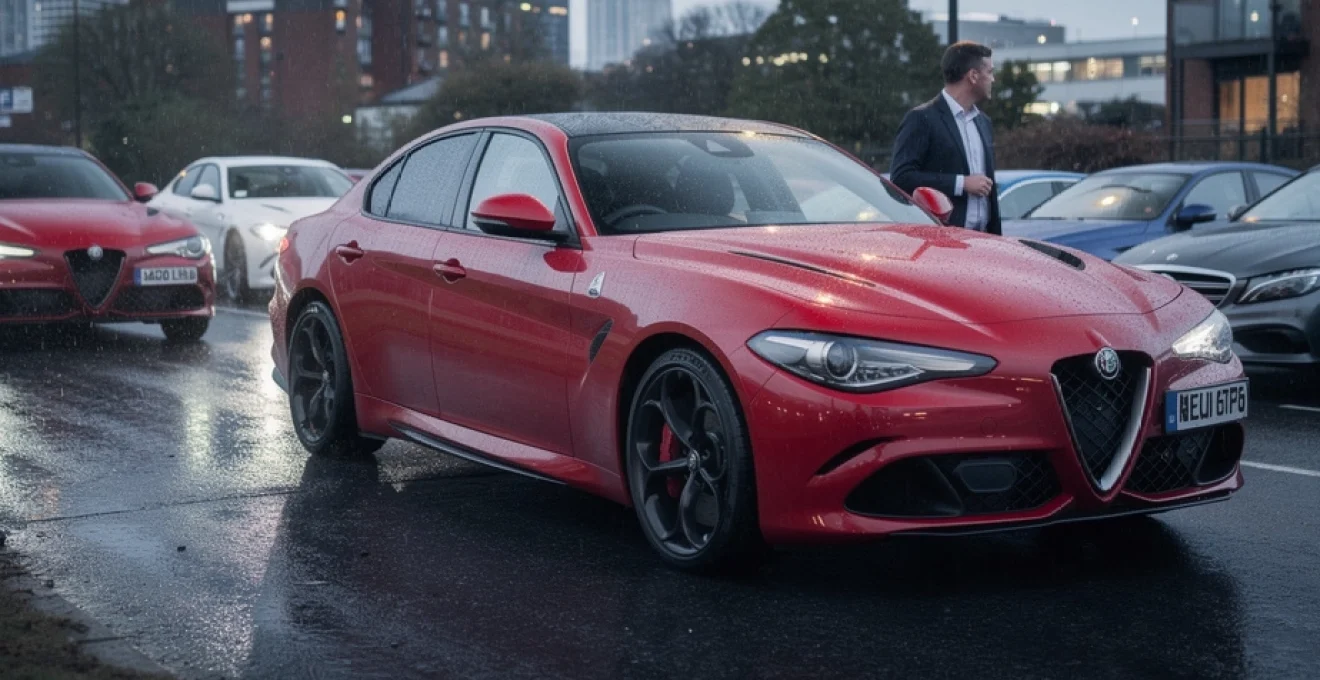
The 2024 Alfa Romeo Giulia is one of the last traditional sports saloons in a market rushing towards hybrids, plug‑ins and SUVs. Rear‑wheel drive, relatively light, and engineered with a clear focus on handling balance, it targets drivers who still care about steering feel as much as screen size. For anyone used to the polished efficiency of a BMW 3 Series or Audi A4, the Giulia’s approach can feel like a welcome jolt of espresso: sharper, more emotional, and less obsessed with digital gimmicks. That character matters in 2024, especially as the combustion‑engined Giulia is entering the final chapter of its life before full electrification. If you enjoy a twisty B‑road as much as a smooth motorway cruise, this is a car worth understanding in detail.
2024 alfa romeo giulia model range overview: sprint, veloce, competizione and quadrifoglio
The 2024 Alfa Romeo Giulia range for the UK centres on a single 2.0‑litre turbo petrol engine in mainstream trims, flanked by the range‑topping Quadrifoglio with its famed 2.9‑litre V6 bi‑turbo. Historically, some markets also saw a 2.2 JTD diesel, and understanding how these powertrains differ helps you choose the right balance of performance, economy and running costs. The core trim walk runs from Sprint to Veloce and then Competizione, each adding more equipment, styling upgrades and chassis hardware. Above them sits the Giulia Quadrifoglio, effectively a super‑saloon that shares DNA with Ferrari powertrains and makes very few compromises in the name of comfort.
Engine line-up comparison: 2.0 turbo petrol vs 2.2 JTD diesel vs 2.9 V6 Bi-Turbo quadrifoglio
The 2.0 MultiAir turbo petrol is the most relevant engine for UK buyers in 2024. It delivers around 280 hp and 306 lb ft of torque, sending the Giulia from 0–62 mph in about 5.5–5.7 seconds depending on spec. Power arrives smoothly and the engine feels eager, although some testers note a touch of low‑end lag and a soundtrack that is more efficient than evocative. For most drivers, this powertrain offers the best blend of strong performance and acceptable fuel consumption, with official WLTP combined figures hovering around 37–39 mpg.
The older 2.2 JTD diesel, where still available in some fleets or used examples, majors on long‑distance efficiency rather than excitement. Outputs of 158–187 bhp made it quick enough, but the character is less aligned with the Giulia’s agile chassis. It can exceed 50 mpg on a steady motorway run, which is why it appealed to high‑mileage drivers. At the other extreme lies the 2.9‑litre V6 Bi‑Turbo in the Giulia Quadrifoglio: 520 PS in the latest UK‑spec cars, 600 Nm of torque and 0–62 mph in 3.9 seconds. Here, the experience is pure super‑saloon, with ferocious mid‑range punch and a top speed nudging 191 mph.
Trim level equipment breakdown: ADAS packs, lusso pack, performance pack and carbon options
Choosing between Sprint, Veloce and Competizione has a big impact on everyday usability and driver‑assistance technology. Sprint already brings 18‑inch alloys, adaptive cruise control, dual‑zone climate control, wireless phone charging, parking sensors and the 8.8‑inch infotainment screen with Apple CarPlay and Android Auto. Veloce builds on that with 19‑inch wheels, sportier bumpers, heated and electrically adjustable leather seats, and crucially a limited‑slip differential that unlocks more of the Giulia’s rear‑drive handling.
Competizione goes further, often bundling what many consider the essential options: a Harman Kardon premium sound system, leather‑wrapped dashboard, privacy glass and sometimes adaptive suspension. Optional packs such as Performance Pack (where offered) historically brought the limited‑slip differential and paddle shifters to lower trims, while Lusso‑style packages added extra leather and comfort features. Carbon packs introduce exposed carbon fibre on the mirror caps, front splitter and spoiler, tying the look more closely to the Quadrifoglio. Advanced ADAS bundles add lane‑keep assist, more sophisticated adaptive cruise and traffic‑jam assist, edging the Giulia closer to Level 2 assisted driving.
UK market positioning against BMW 3 series, audi A4 and mercedes C-Class
In the UK, the Alfa Romeo Giulia competes head‑on with the BMW 3 Series, Audi A4 and Mercedes‑Benz C‑Class, but its positioning is subtly different. Pricing for a 2.0‑litre Giulia starts above some lower‑powered German rivals, reflecting its standard powerful engine and generous base specification. Compared on like‑for‑like equipment, the Giulia often undercuts a similarly specified BMW 3 Series or Mercedes C‑Class, although the Skoda Superb remains noticeably cheaper.
Residual values and perceived reliability historically favour the German brands, which is important if you rely on strong resale or finance deals. The Giulia’s counter‑argument lies in its driving experience and styling: it is consistently rated as the most engaging saloon to drive in this segment and arguably the best‑looking. For drivers who prioritise steering feel over the latest infotainment graphics, that trade‑off can be compelling. Company‑car users, however, may still gravitate towards plug‑in hybrid 3 Series or C‑Class models because of lower Benefit‑in‑Kind liabilities.
Facelift updates for 2024: matrix LED headlamps, digital cluster and software revisions
The 2024 facelift for the Alfa Romeo Giulia is subtle on the outside but more meaningful from the driver’s seat. Externally, the biggest visual change is the adoption of new matrix LED headlights, with a three‑element signature that echoes the Tonale SUV and replaces the old arrow‑shaped DRLs. These adaptive units automatically adjust the beam pattern, improving night‑time visibility and allowing the high beam to remain on more often without dazzling other road users.
Inside, the analogue‑style dials give way to a new 12.3‑inch fully digital instrument cluster housed in Alfa’s signature “cannocchiale” binnacle. It offers three layouts – Evolved, Relax and Heritage – letting you prioritise performance data, simplicity or retro‑inspired graphics. The central 8.8‑inch infotainment system gains software updates and a more modern interface, though resolution and outright speed still trail the class leaders. Minor material upgrades, such as the tactile 3D carbon fibre trim in Quadrifoglio models, further lift perceived quality, and over‑the‑air update capability begins to address concerns about software ageing.
Powertrain engineering and performance metrics in the 2024 alfa romeo giulia
2.0 MultiAir turbo petrol tuning, torque curves and drive-by-wire throttle calibration
The core 2.0‑litre turbocharged petrol in the 2024 Giulia uses Alfa’s MultiAir technology, which offers sophisticated control of intake valve timing for improved efficiency and responsiveness. Output stands at roughly 280 hp and 306 lb ft, delivered through an eight‑speed ZF automatic gearbox. The torque curve is broad, with peak torque available from around 2,000 rpm, giving the car strong mid‑range shove for overtakes without constant downshifts.
Throttle response is governed by a drive‑by‑wire system that changes character depending on the DNA mode selected. In Advanced Efficiency, the calibration softens initial throttle tip‑in to encourage smoother, more economical driving. Natural mode offers a progressive, linear response well‑suited to everyday use. Switch to Dynamic and the mapping sharpens noticeably, with the first part of pedal travel becoming more sensitive, making the car feel lighter on its feet. Some drivers describe a fraction of turbo lag off the line, but once on boost the engine feels keen and projects a purposeful, if not especially loud, exhaust note.
Alfa romeo giulia quadrifoglio 2.9 V6 Bi-Turbo: ferrari-derived architecture and mapping
The Giulia Quadrifoglio’s 2.9‑litre V6 bi‑turbo remains one of the most charismatic engines in any current sports saloon. Closely related in architecture to Ferrari’s V8 used in models such as the California T, this 90‑degree V6 effectively removes two cylinders and adapts the design for a compact saloon layout. It produces 520 PS (382 kW) and 600 Nm, revving freely and delivering an intoxicating soundtrack when pushed beyond 5,000 rpm, especially through the optional Akrapovič exhaust.
Engine mapping in the latest Quadrifoglio has been refined to improve response and drivability. Boost control is calibrated to provide near‑instant torque without an overly sudden hit, and fuelling has been tuned for both emissions and longevity. In the 2024 update, power increases by around 10 PS over earlier versions, but the real transformation comes from the mechanical limited‑slip differential and revised suspension tune. Together, they translate the V6’s output into cleaner traction and less frantic wheelspin out of tight junctions, while still allowing adjustable oversteer if you deliberately provoke it.
Eight-speed ZF 8HP automatic gearbox ratios, shift logic and launch control behaviour
All UK‑spec Giulias use the proven ZF 8HP eight‑speed automatic gearbox, a transmission widely regarded as one of the best torque‑converter autos available. In the Giulia, ratios are spaced to keep the 2.0 turbo within its torque band while still offering a long top gear for relaxed motorway cruising. In manual mode, those large aluminium paddles fixed to the steering column give a very mechanical, satisfying feel; many drivers find themselves using manual mode by choice simply because the interaction is so enjoyable.
Shift logic varies significantly by mode. In Natural, the gearbox prioritises upshifts for economy and can be a little tardy to kickdown if you suddenly demand full power. Dynamic mode holds gears longer, downshifts more readily and blips on downchanges to keep the engine in the meat of its torque curve. In Quadrifoglio’s Race mode, shift times sharpen again and launch control logic becomes more aggressive, coordinating engine torque, gearbox slip and traction control to deliver repeatable sub‑four‑second 0–62 mph runs when conditions allow.
0–62 mph, in-gear acceleration and v-max data on UK-spec giulia variants
Performance metrics for the 2024 Alfa Romeo Giulia place it squarely in the upper tier of the executive saloon segment. The 2.0‑litre petrol models post 0–62 mph times of about 5.5–5.7 seconds depending on trim and driven wheels, which compares favourably with the BMW 330i and Mercedes C200 despite similar or lower quoted power in those rivals. Top speed is typically electronically limited to around 149 mph, more than sufficient for UK conditions, with strong in‑gear acceleration from 30–70 mph making everyday overtakes straightforward.
The Quadrifoglio raises these numbers dramatically. Officially, 0–62 mph is dispatched in 3.9 seconds, placing it in the same performance ballpark as many supercars from a decade ago. Top speed is quoted at 191 mph where unrestricted, and independent testing often finds 50–70 mph in under 3.0 seconds in the mid‑gears. Interestingly, despite a kerb weight of around 1,660 kg – roughly 100 kg up on earlier cars – the Quadrifoglio remains significantly lighter than hybridised German rivals, which helps it feel more immediate and agile at any speed.
Real-world fuel economy, WLTP CO₂ emissions and BiK implications for UK company-car drivers
On paper, the 2.0 turbo Giulia returns a WLTP‑combined figure of around 37.7–39.2 mpg, with CO₂ emissions close to 169 g/km. Real‑world fuel consumption depends heavily on driving style, but many owners report low‑30s mpg in mixed use and mid‑30s on relaxed motorway runs. These numbers are competitive for a 280 hp petrol saloon, yet still slightly behind the most efficient four‑cylinder BMW and Mercedes rivals, particularly their mild‑hybrid variants.
From a UK tax perspective, the absence of any hybrid or plug‑in hybrid variant is the key drawback. Benefit‑in‑Kind (BiK) bands are driven largely by CO₂ output, and a Giulia at 169 g/km sits much higher than a plug‑in hybrid 330e or C300e. For company‑car drivers, annual tax bills can be significantly higher, eroding any savings from keen transaction prices. The Quadrifoglio, with CO₂ emissions around 228–229 g/km and quoted consumption of about 28 mpg, obviously sits in the highest BiK band, making it more viable as a private purchase or limited‑mileage perk rather than a mainstream fleet choice.
Chassis dynamics, handling and ride quality of the 2024 giulia
Giorgio platform weight distribution, aluminium-intensive structure and torsional rigidity
The 2024 Alfa Romeo Giulia rides on the Giorgio platform, a rear‑drive architecture engineered from day one with dynamics in mind. Aluminium is used extensively in the bonnet, doors, suspension arms and some structural elements, keeping kerb weight lower than most rivals. A typical 2.0‑litre Giulia weighs around 1,500–1,550 kg, while the Quadrifoglio clocks in at approximately 1,660 kg – still around 150 kg lighter than a comparable BMW M3 and up to 400 kg lighter than a plug‑in hybrid Mercedes‑AMG C 63.
Weight distribution is close to the ideal 50:50 front‑to‑rear balance on mainstream models, contributing to the car’s neutral handling. High torsional rigidity allows the suspension to do its job without the body flexing and introducing inconsistencies. In practice, that translates into a saloon that feels planted and predictable, even when pushed hard on a rough B‑road. The relatively low mass also helps the damping cope better with mid‑corner bumps, where heavier rivals can feel more unsettled.
Double wishbone front and AlfaLink multilink rear suspension: geometry and kinematics
Suspension design is one of the Giulia’s biggest technical advantages. Up front, a double wishbone layout with semi‑virtual steering axis geometry keeps the tyre contact patch optimised as the wheels move through their travel. This encourages precise turn‑in and strong front‑end grip without excessive camber gain that would wear the inside edges of the tyres prematurely. The steering rack is mounted for directness, contributing to the car’s notably quick responses.
At the rear, Alfa’s AlfaLink multi‑link arrangement uses multiple arms to manage toe and camber changes more accurately under load. Under hard acceleration out of a corner, the geometry encourages slight toe‑in for stability, while braking and turn‑in phases are tuned for agility. In the Quadrifoglio, the latest move to a mechanical limited‑slip differential rather than an electronically controlled unit further enhances predictability. The result is a chassis that feels almost telepathic when you guide it into a bend: the front bites, the rear rotates just enough, and the whole car pivots around the driver with remarkable clarity.
DNA drive mode selector (dynamic, natural, advanced efficiency, race on quadrifoglio)
The Giulia’s character can be shaped by the familiar DNA drive mode selector on the centre console. In Advanced Efficiency, throttle response is dulled, shift points are optimised for economy, and climate control is relaxed to reduce energy draw. It is the least exciting setting, but useful in heavy traffic or long steady‑state cruising where fuel economy matters most.
Natural is the default and arguably the most rounded mode, balancing reasonable efficiency with a responsive powertrain. Steering weight is moderate, damping remains compliant, and stability control intervenes early enough to keep less experienced drivers comfortable. Dynamic ramps up throttle sharpness, tightens steering, holds gears longer and allows a little more slip at the rear before traction systems intervene. Quadrifoglio models add a Race mode, which relaxes or disables many electronic aids, enhances exhaust sound and transforms the car into something that genuinely feels track‑ready. Used responsibly on UK roads, Dynamic provides more than enough excitement while keeping a safety net in place.
Steering calibration, brake-by-wire braking system and optional brembo performance brakes
Steering feel is where the Giulia most clearly distinguishes itself from German competitors. The steering ratio is extremely quick – about 11.8:1 on certain models, compared with roughly 14.1:1 on a BMW 330i – which means small inputs generate immediate changes in direction. At first, this can feel hyper‑reactive, but once you adapt, the car seems to read your mind, especially on flowing A‑roads. Feedback through the rim is more communicative than many electric‑power‑assisted setups, letting you sense grip levels rather than guess.
The Giulia’s steering calibration sets a benchmark in a class increasingly dominated by numb, over‑assisted racks.
Braking uses a brake‑by‑wire system that blends hydraulic pressure with electronic modulation. Pedal feel is generally natural, with a progressive response that makes smooth stops easy. On high‑performance versions, optional Brembo systems – often with larger discs and multi‑piston calipers – provide formidable stopping power and better resistance to fade in repeated hard use. For spirited road driving, the standard setup suffices, but if track days are part of your plan, the performance brakes are a worthwhile upgrade.
UK road test impressions: b-road agility, motorway refinement and wet-weather traction
On a typical UK B‑road, the Giulia shines. The suspension is firm but controlled, allowing the body to remain flat through corners while still absorbing sharp ridges and bumps with reasonable compliance. Compared with a BMW 3 Series, the Alfa feels more alert and playful, encouraging you to explore its balance. On the Veloce and higher trims with a limited‑slip differential, you can feel the rear axle actively helping the car rotate through a bend, especially in Dynamic mode.
Refinement on the motorway is better than earlier Alfa saloons, with wind noise well suppressed and only modest tyre roar depending on wheel size. Test results show that at a constant 70 mph, cabin noise is actually slightly lower than some German rivals, despite what perception of “sportiness” might suggest. Wet‑weather traction is generally secure thanks to stability systems that are calibrated more progressively than before. In the Quadrifoglio, the shift to a mechanical differential and revised damping for 2024 tames the previous car’s tendency to light up its rear tyres at the slightest provocation, creating a more confidence‑inspiring experience in typical British drizzle.
Even on a cold, damp morning, the updated Giulia Quadrifoglio now feels adjustable rather than intimidating, letting you enjoy its power instead of fearing it.
Interior design, infotainment and driver-assistance systems in the 2024 alfa romeo giulia
The cabin of the 2024 Giulia blends driver‑focused ergonomics with a more understated aesthetic than the exterior might suggest. The seating position is low and sporty, with plenty of adjustment in both seat and steering column, allowing taller drivers to sit “in” the car rather than on it. Physical controls for climate functions are retained, avoiding the common frustration of digging through touchscreen menus just to alter the temperature. Material quality has improved since launch, with more soft‑touch plastics and more solid switchgear, although the best BMW and Mercedes interiors still feel a notch more substantial.
Infotainment duty falls to an 8.8‑inch central touchscreen supported by a rotary controller. The system offers integrated navigation, DAB, Bluetooth and full smartphone mirroring, but graphics and response times lag behind class‑leading setups. It is fully usable – especially if you lean on Apple CarPlay or Android Auto – yet anyone coming from a high‑end German car will notice the difference. The new 12.3‑inch digital instrument cluster, by contrast, is a highlight: crisp, configurable and neatly integrated into the traditional dual‑hood binnacle, it allows you to prioritise navigation, performance data or minimalist layouts according to preference.
In terms of space, the front row offers generous head and legroom, while the rear bench is adequate for adults under six feet but tighter than in the most accommodating rivals. The 480‑litre boot matches the BMW 3 Series on capacity but has a relatively small opening and a pronounced load lip, making it a little less practical for bulky items. For everyday use – shopping, luggage, pushchairs – it remains perfectly workable, especially with the 40/20/40 split‑fold rear seats that allow long loads such as skis.
Driver‑assistance technology has steadily improved since launch. All models now feature autonomous emergency braking, lane‑departure warning, blind‑spot monitoring, traffic‑sign recognition and adaptive cruise control as standard. Optional Level 2 systems add lane‑keeping assist and traffic‑jam assist, where the car can control steering, acceleration and braking in defined scenarios while still expecting you to supervise. The matrix LED headlights introduced for 2024 are also a real upgrade, automatically dipping individual segments to avoid dazzling oncoming traffic while preserving as much illumination as possible. For long‑distance commuters, these technologies materially reduce fatigue.
Build quality, reliability trends and ownership experience in the UK
Alfa Romeo’s historic reputation for fragility lingers in the minds of many UK buyers, and the Giulia has not fully escaped that legacy. Reliability surveys place the brand near the lower end of the rankings; one recent UK survey ranked Alfa Romeo 30th out of 31 manufacturers, with only MG scoring lower. Within the executive‑car segment, the Giulia itself has also tended to appear in the bottom half of the table, behind the BMW 3 Series and Mercedes C‑Class. Common complaints include minor electrical gremlins, infotainment glitches and occasional trim rattles rather than catastrophic drivetrain failures.
On the positive side, reported issues have reduced as the model has matured, and build quality on later cars is noticeably improved over early examples. Owners often highlight the solidity of the chassis and the durability of core mechanical components, especially the 2.0 turbo engine and ZF gearbox combination, both of which are widely used across the industry. Alfa Romeo provides a three‑year, unlimited‑mileage warranty in the UK, along with roadside assistance, while the body is covered for corrosion for eight years. For higher‑mileage drivers or those planning to keep the car beyond the warranty period, extended coverage can be a prudent investment.
Running costs sit at the sportier end of the segment. Servicing intervals and costs are broadly similar to German rivals, but depreciation is steeper, which particularly affects private buyers and those on PCP plans. Insurance groupings reflect the car’s performance and repair costs, so premiums may sit slightly higher than an equivalent‑power Skoda or mainstream saloon. Tyre wear depends heavily on driving style; the combination of rear‑wheel drive, strong torque and relatively soft summer rubber on Veloce and Quadrifoglio trims can see rear tyres needing replacement sooner than in a front‑drive diesel. For many enthusiasts, the trade‑off is acceptable given the enjoyment on tap.
Ownership satisfaction among enthusiasts often runs higher than reliability scores suggest, because the Giulia trades a little rational sense for a lot of emotional appeal.
2024 alfa romeo giulia value analysis and rivals comparison for performance-focused buyers
Evaluating the 2024 Alfa Romeo Giulia from a value perspective depends heavily on what you prioritise. If the goal is the lowest total cost of ownership or the most advanced infotainment, an Audi A4 or plug‑in hybrid BMW 3 Series will probably serve you better. However, if the primary focus is driving enjoyment, steering precision and distinctive design, the Giulia becomes far more compelling. Entry‑level Sprint models already include a strong 2.0‑litre engine and solid standard kit, meaning you do not have to pay extra to avoid a weedy base powertrain, as you might with some rivals.
| Model (UK, 2024) | Power | 0–62 mph | WLTP combined mpg | Starting price (approx.) |
|---|---|---|---|---|
| Alfa Romeo Giulia 2.0 Turbo | 280 hp | 5.7 s | 37–39 mpg | £43,750 |
| BMW 330i | 245–258 hp | 5.8–6.0 s | 43–45 mpg | ~£42,000 |
| Audi A4 45 TFSI | 265 hp | 5.6 s | 39–41 mpg | ~£42,000 |
| Mercedes‑Benz C 200 | 204 hp (MHEV) | 7.3 s | 45–47 mpg | ~£44,000 |
As the table suggests, the Giulia is priced broadly in line with premium German saloons but offers more power and quicker acceleration in its standard petrol guise. Fuel economy trails mild‑hybrid rivals slightly, and the lack of a low‑CO₂ plug‑in option hurts its appeal to company‑car users. For private buyers or those funding a car via PCP with a capped mileage, manufacturer incentives and slightly lower list prices compared with a similarly specified BMW or Mercedes can tip the scales back in Alfa’s favour, especially if you place a value on driving engagement that is hard to quantify but very easy to feel.
For performance‑focused buyers considering the Quadrifoglio, the value proposition is particularly interesting. With a UK OTR price in the region of £86,885, it undercuts some German super‑saloons while matching or beating them for power‑to‑weight ratio and subjective driver enjoyment. Standard equipment includes 19‑inch wheels, carbon fibre aero components, a limited‑slip differential, advanced adaptive suspension and a full suite of driver aids, so there is less need to plunder the options list. Residuals on such halo models often hold up better than on mainstream trims, partly offsetting higher initial outlay and running costs.
For you as an enthusiast, the key question is whether the Giulia’s unique combination of agility, styling and character outweighs its drawbacks in infotainment sophistication and brand reliability perception. If most journeys are urban and tech‑focused, a quieter, plusher 3 Series or C‑Class might suit daily life better. However, if weekend drives on empty roads matter just as much as weekday commuting, the Giulia offers a level of driver involvement that few rivals can match. Think of it as the automotive equivalent of a tailored Italian suit: perhaps not the most sensible choice on paper, but one that makes every outing feel a little more special.