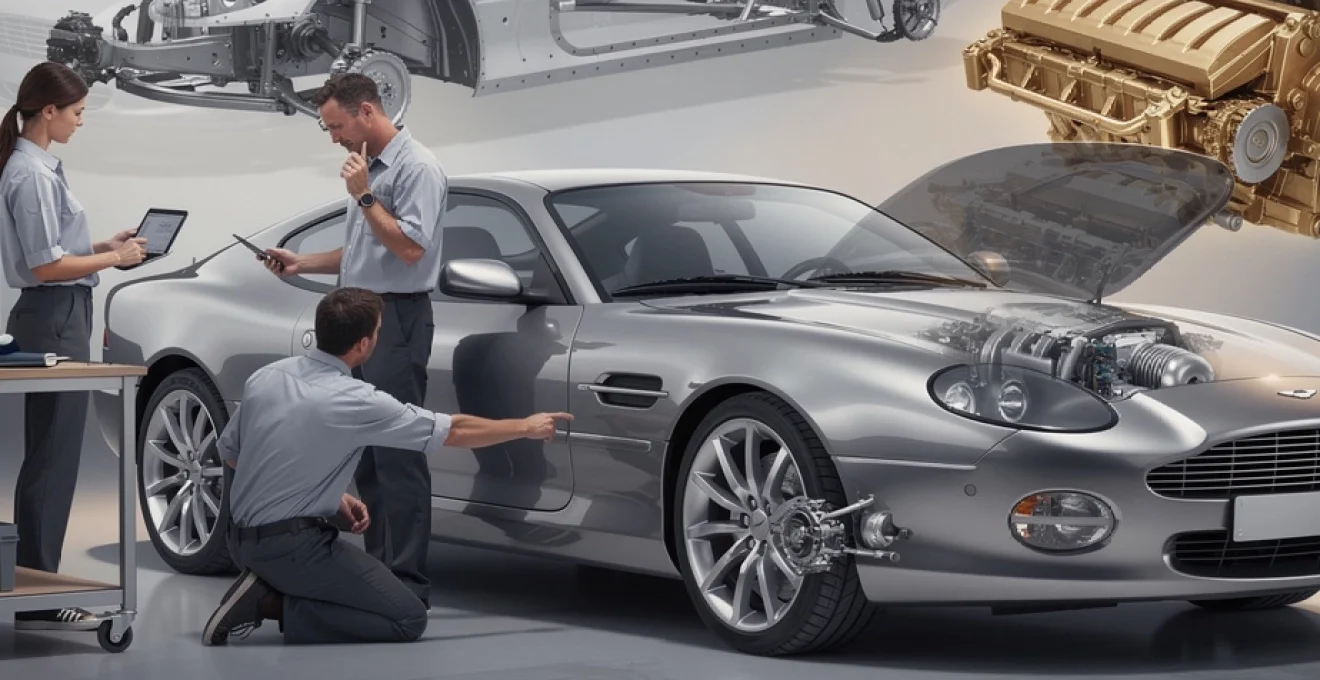
The Aston Martin DB7 marked a turning point not just for a historic British marque, but for the entire 1990s grand tourer landscape. Here was a car that bridged hand‑built, low‑volume tradition and modern platform engineering, wrapped in what many regard as one of the most beautiful shapes ever to wear a number plate. If you are considering buying a DB7, researching its development story, or simply fascinated by how a “Jag in drag” became an icon, understanding the technical detail behind the romance matters just as much as admiring the curves.
Under the Callum styling and Connolly leather lies a complex blend of Jaguar hardware, Tom Walkinshaw Racing know‑how and Ford-era pragmatism. That blend explains why a DB7 can feel both old‑school and surprisingly usable today: charismatic engines, honest steering and proper GT comfort, but also ABS, modern rust‑proofing techniques for the era and crash protection unthinkable in classic DB5 or DB6 metal. Look closely and the DB7 is less a compromised parts-bin special and more a cleverly packaged gateway that saved Aston Martin and set the template for the VH-era cars that followed.
Aston martin DB7 genesis: from jaguar XJ-S underpinnings to ian callum’s design breakthrough
Ford-era platform engineering: adapting the jaguar XJ-S chassis and suspension architecture for the DB7
The DB7’s story starts in the late 1980s, as Ford acquired first Aston Martin and then Jaguar. Rather than bankroll a completely clean-sheet platform, Ford looked for cost-effective ways to create a new entry‑level Aston Martin. The answer lay in the ageing but still capable Jaguar XJ‑S architecture. The DB7 uses a steel semi‑monocoque with a 2591mm wheelbase – exactly the same as the XJ‑S – combined with bespoke front and rear subframes, new crash structures and re-engineered suspension pick‑up points.
Independent double‑wishbone suspension all round, coil springs and gas‑filled Bilstein dampers gave the DB7 a far more modern dynamic baseline than the big V8 Astons of the 1980s. Front anti‑dive geometry and an anti‑roll bar improved stability under braking, while a rear anti‑roll bar was introduced from chassis 100172 to sharpen balance. If you drive an XJ‑S back‑to‑back with a DB7, the family resemblance is obvious in the relaxed GT gait, yet the Aston feels tighter, more precise and more eager to change direction.
From an engineering perspective, using the XJ‑S base was like building a modern townhouse on a solid Victorian foundation. The core structure had proven long‑term durability and refinement, but the new upper body, suspension hardware and geometry brought the DB7 firmly into the 1990s. Critically, the decision also kept development costs under control, allowing Aston Martin to price the DB7 at roughly two‑thirds of a Virage and chase volumes of 500–600 cars a year – ambitious by Newport Pagnell standards.
Tom walkinshaw racing (TWR) collaboration: engineering, prototyping and production at bloxham
The other pillar of the DB7 project was Tom Walkinshaw Racing (TWR). When Ford cancelled Jaguar’s over‑budget XJ41/XJ42 “F‑type” programme, TWR had already reworked the concept into “Project XX” and was ready to build it. Jaguar said no, but Walter Hayes at Aston Martin saw the potential. TWR was commissioned to transform Project XX into an Aston Martin – internally dubbed NPX.
TWR handled design, development and type approval from its Kidlington facility. A running prototype was ready by November 1992 and the DB7 was revealed at the 1993 Geneva Motor Show to an overwhelmingly positive reception for both engineering concept and styling. Crucially, because Newport Pagnell did not have the capacity to build a higher‑volume steel monocoque car, production moved to TWR’s Bloxham factory in Oxfordshire, originally constructed for the Jaguar XJ220.
Engines for the early DB7 i6 models were also built by TWR, giving the car a strong motorsport‑derived engineering pedigree. This TWR connection explains why the DB7, despite its mixed parentage, feels more resolved than many limited‑budget projects. Calibration of the supercharged straight‑six, the integration of ABS (Teves MkII, later MkIV), and the option packs such as Driving Dynamics (AP Racing brakes, Koni dampers) all bear the hallmark of a race engineering outfit applying its knowledge to a road‑going GT.
Ian callum’s exterior design language: proportions, surfacing and the transition to the VH-era aesthetic
Ask ten enthusiasts why the DB7 matters and most will start with the styling. Designed by Ian Callum with input from Keith Helfet, the DB7 is often described as “the most beautiful car in production” of its time. The proportions are classically front‑engined GT: long bonnet, set‑back cabin, short rear overhang and muscular rear haunches. Yet the surfacing is remarkably soft and organic for the early 1990s, anticipating the more fluid Aston Martin DB9 and V8 Vantage that arrived a decade later.
Fixed headlamps under oval glass covers replaced the pop‑up units so common in 1980s sports cars, giving a cleaner, more timeless face. The traditional Aston grille was integrated into the bumper, above three subtle lower intakes. Most aerodynamic work went into reducing drag rather than chasing downforce, resulting in a very low drag coefficient of 0.31 without the need for wings or splitters. Where other GTs of the period wore spoilers, the DB7 relied on pure form.
Callum’s work here effectively defined the visual language of the early VH‑era Astons. The way the front wings flow back into the doors, the rear haunches swell over the wheels, and the minimal use of hard lines became Aston hallmarks. Tail lamps and door handles were cleverly borrowed from volume cars (Mazda 323, for example), but integrated so well that you rarely notice. For you as a buyer, this design coherence is one reason the DB7 still looks modern on the road today.
Market positioning in the 1990s GT segment: benchmarking against porsche 911 (993), ferrari 456 GT and jaguar XK8
In market terms, the DB7 sat in a fascinating niche. It was priced above the contemporary Jaguar XK8 but below a Ferrari 456 GT, with performance broadly comparable to a Porsche 911 (993) Carrera. The six‑cylinder DB7 i6 coupe could hit 0–62mph in around 5.7–5.8 seconds and reach 161mph – more than enough to qualify as a genuine super GT, if not an out‑and‑out supercar.
Compared with a 993, the DB7 traded a little ultimate agility for ride comfort and long‑legged refinement. Against a 456 GT, it offered similar presence for significantly less money and running costs, albeit with two fewer cylinders in early form. Versus the XK8, it justified its premium with that badge, the hand‑finished interior and a much more exotic silhouette. This positioning still influences today’s used values: you can often buy a DB7 for entry‑level Porsche Boxster money, yet live with something that feels far closer to the Ferrari end of the spectrum in charisma.
DB7 powertrains in detail: AJ6 inline‑six, supercharged i6 and V12 engine evolution
3.2‑litre supercharged AJ6 i6: eaton M90 blower, intercooling strategy and bosch engine management
The original DB7 i6 engine is based on Jaguar’s robust AJ6 straight‑six, reworked extensively by TWR. Displacement is 3239cc, with a bore and stroke of 91mm x 83mm. The key addition is an intercooled Eaton M90 Roots‑type supercharger driven by a toothed belt from the dual overhead camshafts. With a modest compression ratio of 8.3:1 and four valves per cylinder, the engine produces 335bhp at 5500rpm and 360lb ft at 3000rpm.
Early literature references Zytek engine management, although later cars were more commonly associated with advanced Bosch or Ford‑era systems. Either way, relative to early‑1990s rivals the DB7’s fuel and ignition mapping is sophisticated, managing boost, fuelling and knock control effectively for both performance and emissions. A fully catalysed stainless steel exhaust helps the i6 achieve contemporary emissions standards while delivering a distinctive, slightly hard‑edged straight‑six soundtrack overlaid with supercharger whine.
The induction and intercooling layout is compact but generates considerable under‑bonnet heat. That is one reason bonnet vents feature on later high‑performance derivatives and some carefully executed owner upgrades. If you are buying an i6 today, pay close attention to cooling performance and signs of heat‑soak related ageing in hoses, plastic fittings and wiring looms.
DB7 i6 performance metrics: torque curve, 0–60 mph figures and real‑world drivability analysis
On paper, the DB7 i6 manual’s 0–62mph time of 5.7 seconds and 161mph top speed look solid rather than spectacular by modern standards. In reality, the way the torque arrives makes the car feel much stronger than the headline figures suggest. Peak torque at just 3000rpm, combined with a relatively short final drive, gives the i6 muscular mid‑range pull ideal for overtaking on A‑roads and effortless motorway cruising.
Automatic cars (using the GM 4L80‑E four‑speed) are around 50kg heavier and a second slower to 62mph, yet even these feel brisk thanks to the torque plateau. Period road tests speak of a relaxed yet rapid cross‑continental character rather than a car that eggs you on to chase the red line. If you are coming from a high‑revving naturally aspirated engine, the DB7 i6’s low‑down boost may feel more like a turbodiesel in the way it surges from middling revs than a screaming sports car, but that trait fits the GT brief perfectly.
Fuel consumption, according to contemporary tests, could reach 24mpg on a gentle run, dipping into the mid‑teens when driven hard. For a 1990s supercharged petrol GT weighing 1700kg in manual form and 1750kg as an automatic, those numbers are competitive. The torque‑rich delivery also means you can lope along in a higher gear than you might expect, further enhancing real‑world economy if you drive sympathetically.
5.9‑litre V12 development: cosworth involvement, block architecture and valvetrain configuration
The second phase of DB7 powertrain development produced the 5.9‑litre V12 used in the DB7 Vantage and later VH‑platform cars. Although myths persist that Cosworth “designed” the engine, the reality is more nuanced. A Ford powertrain team in Dearborn created the basic architecture by effectively pairing two Duratec V6 assemblies on a common crankcase, sharing piston and valvetrain components to reduce cost and complexity.
The resulting all‑alloy 60‑degree V12 uses double overhead camshafts per bank and four valves per cylinder, with chain‑driven cams and modern hydraulic lifters. Output in DB7 Vantage form is 420bhp at around 6000rpm and approximately 400lb ft of torque, enough for 0–60mph in about 4.9 seconds and a top speed in the 185mph region. Later DB7 GT and GTA models gained a mild power bump to around 435bhp.
Cosworth’s role came primarily in prototype build and early development support rather than clean‑sheet design. Nevertheless, that involvement, coupled with Aston Martin calibration, delivered a refined yet charismatic unit. The V12 revs more freely than the old Aston 5.3 V8, sounds richer than the supercharged i6 and – thanks to modern management – meets late‑1990s emissions and drivability standards comfortably.
DB7 V12 vantage vs GTA: manual vs touchtronic gearboxes, final drive ratios and acceleration data
The DB7 V12 Vantage arrived in 1999 with two transmission choices. The six‑speed manual used a Tremec gearbox sending power through a conventional clutch to the GKN Powerlock limited‑slip differential. The automatic, badged Touchtronic on later cars, employed a ZF or GM‑derived unit with steering‑wheel buttons for manual override, again driving through a limited‑slip diff.
Manual cars are lighter and marginally quicker: independent tests recorded 0–60mph in under 5 seconds and strong in‑gear acceleration thanks to shorter gearing. Automatic Vantages sacrifice a few tenths in the sprint but remain very rapid, with the added benefit of relaxed cruising. Owners who have later upgraded to six‑speed autos with modern 6L80 hardware and bespoke calibration report significantly improved flexibility and fuel economy, underlining how transformative gearing can be in a torquey GT.
Final drive ratios varied slightly between manual and auto to balance launch, flexibility and economy. If you value involvement and plan to use the DB7 for weekend drives and track days, the manual Vantage or GT makes sense. If you prefer smooth, one‑handed progress on long journeys, a well‑maintained Touchtronic can be more satisfying day‑to‑day despite being technically slower.
Emissions and reliability considerations: cooling system, head gasket issues and preventative maintenance
From an emissions perspective, both i6 and V12 DB7s were designed to meet increasingly stringent 1990s regulations, with full catalytic converters and advanced engine management. However, age introduces its own challenges. Cooling systems on all variants demand close attention. Radiators with integrated automatic transmission fluid (ATF) coolers can develop internal leaks; when that happens, coolant contaminates the ATF, leading to expensive gearbox damage. Proactively replacing original radiators on older cars, especially if they still have plastic end tanks, is strongly recommended.
Unlike some contemporary performance engines, the DB7 powerplants do not have widespread systemic head gasket issues, but overheating from neglected cooling systems can still provoke failures. Regular coolant changes, inspection of hoses, thermostats and fans, and ensuring the viscous coupling (where fitted) works correctly are essential preventative steps. Treat the cooling system as a safety-critical component rather than an afterthought.
For emissions test success and smooth running, lambda sensors, catalytic converters and vacuum lines should be checked periodically. Age‑hardened rubber can cause subtle air leaks that upset fuelling, especially in the supercharged i6. Investing in a thorough pre‑purchase inspection by an Aston specialist with marque‑specific diagnostics can save you from chasing intermittent faults later.
Chassis, suspension and braking: GT grand tourer dynamics of the DB7
Underlying monocoque and subframe design: steel construction, corrosion points and structural rigidity
The DB7’s steel semi‑monocoque offers a good compromise between stiffness, weight and repairability for a 1990s GT. Composite panels are used for the nose, bonnet, front wings, sills, boot lid and rear bumper to save weight and resist minor corrosion, while the core structure remains predominantly steel. The Volante adds extra reinforcement around the windscreen frame, sills and rear bulkhead to compensate for the loss of roof, yet still weighs about 150kg more than the coupe.
Corrosion is a key concern for any prospective owner. While the basic shell was well protected for the time, common rust points include the lower edges of the front and rear screen apertures (especially after poor glass replacement), front jacking points, rear wheel arch lips and subframe mounting areas. Cars that have lived in damp climates or seen winter use without proper Waxoyl or similar treatment can hide expensive rot beneath seemingly tidy paint.
Checking underneath on a lift, inspecting the scuttle panel, sill ends and the tray beneath the windscreen, and probing for bubbling at panel edges will give you a realistic picture. The good news is that DB7 corrosion is usually repairable by a competent body shop; the bad news is that labour time adds up quickly. A structurally solid shell is worth paying extra for compared with a cheaper car needing major metalwork.
Front and rear suspension geometry: double wishbones, anti‑roll bars and damper tuning across model years
All DB7s use double wishbone suspension front and rear, which inherently controls camber and toe changes more precisely than a simple MacPherson strut or live axle arrangement. Early i6 cars were tuned for a supple, slightly soft ride befitting their GT remit. When the Volante arrived in 1996, Aston softened spring rates to reduce scuttle shake but also stiffened certain structural areas. Those revisions later fed into the “Series 2” updates introduced for the 1997 model year.
Series 2 cars received further tweaks to damper tuning, bush compounds and anti‑roll bar calibration, resulting in more consistent body control without sacrificing ride. Drivers who have sampled both often describe early cars as more “old‑school GT” and later cars as closer to the sharpness of the forthcoming V12 Vantage. Optional Driving Dynamics packs introduced Koni dampers, stiffer springs and rose‑jointed links, transforming the DB7 into a more agile machine at the expense of some compliance.
For you as a buyer, the key is deciding what kind of experience suits your roads and driving style. A standard suspension DB7 is already capable and enjoyable at normal speeds. A Driving Dynamics or GT‑spec car feels more locked down and confidence‑inspiring at high speeds, but may seem busy on broken British B‑roads. Ageing dampers and bushes can also make any DB7 feel looser than intended, so budgeting for a suspension refresh is wise.
Braking systems: girling vs brembo hardware, ABS calibration and DB7 GT brake upgrades
Early DB7 i6 models use 284mm ventilated front discs with four‑piston calipers and 295mm solid rear discs with sliding aluminium calipers. Teves MkII ABS manages wheel lock‑up. For the time, this Girling hardware was more than adequate, but heavy use on track or fast Alpine passes can reveal thermal limitations. Series 2 updates brought ventilated rear discs and Teves MkIV ABS, improving both fade resistance and pedal feel.
V12 Vantage models, and especially the DB7 GT, benefit from larger, more powerful braking systems. The GT often features AP Racing‑branded components with bigger ventilated discs, stronger calipers and performance pads. Retrofitting these parts, or similar Brembo/AP kits, has become a popular upgrade route for owners who drive enthusiastically. The Driving Dynamics Brake option essentially mirrored the supercharged Vantage (V8) system and remains highly regarded.
When inspecting a DB7, look for consistent disc wear, absence of judder and a firm, progressive pedal. Sponginess may indicate old fluid or tired hoses, both easily rectified. A car that has been used but maintained, with regular brake fluid changes every two years, is preferable to a low‑mileage garage queen still on original consumables.
Steering feel and feedback: hydraulic power assistance, rack ratios and subjective road test impressions
The DB7’s hydraulically assisted rack‑and‑pinion steering is one of its dynamic highlights. The rack ratio is relatively quick for such a large car, giving eager turn‑in, while assistance levels are well judged. Period reviewers noted a “slight clumsiness” at parking speeds due to a large wheel and wide tyres, but praised the steering’s accuracy once on the move.
On a twisting B‑road, you can place a DB7 with more confidence than its 1700kg kerb weight suggests. Feedback through the rim is not as crystalline as a 993 Porsche 911, but it is far superior to many contemporary luxury coupes. The Volante’s added stiffness from Series 2 onwards also helps reduce scuttle shake and vagueness, making later convertibles more satisfying to steer quickly.
Test‑driving more than one example will give you a baseline for what a healthy system should feel like. Excessive play, inconsistent weighting or groans on lock are warning signs. Correct wheel alignment is critical too; DB7s are sensitive to poor geometry, which can make them feel nervous and eat expensive tyres.
DB7 model variations: i6, V12 vantage, volante, GT and zagato compared
DB7 i6 coupé and volante: early production features, equipment levels and collector desirability
Six‑cylinder DB7s represent the purest original vision of the model and are becoming appreciated in their own right. Production of the i6 ran from 1994 to 1999, with 2484 cars built: 1578 coupes and 879 Volantes. Manual gearboxes are rarer (about a third of coupes), while roughly 80% of Volantes are automatics. Early cars feature composite bonnets, Teves MkII ABS and slightly simpler interiors without airbags until mid‑1996.
Standard equipment includes full Connolly leather, burr walnut, Wilton carpets, electric seats and mirrors, air conditioning and a quality audio system. Options were surprisingly limited: a 10‑disc CD changer and some cosmetic choices, with metallic paint and automatic transmission often available at no extra cost. Today, well‑kept i6 manuals have a distinct charm, lighter nose feel and slightly better steering purity than the V12 cars.
From a collector perspective, special editions such as the Alfred Dunhill (78 cars), Stratstone (19), Beverly Hills (6) and Neiman Marcus (10) Volantes add rarity and bespoke trim details. These typically feature unique paint, interior colourways, badging and accessories like fitted luggage or cigar humidors. If you value exclusivity and story as much as raw performance, these editions are worth seeking out.
DB7 V12 vantage and vantage volante: cosmetic updates, power increase and interior refinements
The DB7 V12 Vantage launched in 1999 transformed the model’s performance and market perception. Externally, Vantage cars gained revised bumpers, larger wheels and subtle aerodynamic tweaks, while retaining the core Callum shape. Under the bonnet, the 5.9‑litre V12 delivered a dramatic performance uplift and a more cultured exhaust note.
Inside, the Vantage benefitted from improved seats, better switchgear layout, a wider pedal box and higher‑quality audio options. Twin airbags became standard, and some of the Ford Scorpio‑derived plastic switchgear was replaced or better integrated. These refinements, combined with the powertrain, make the Vantage and Vantage Volante particularly attractive if you want a DB7 that feels closer to the later DB9 in character.
Prices reflect that desirability, but the gap to i6 cars is often smaller than the experiential difference suggests. For many enthusiasts, a V12 Vantage manual coupe in a classic Aston colour, with documented history, sits in the DB7 sweet spot between usability, performance and long‑term collectability.
DB7 GT and GTA: uprated suspension, larger brakes and limited‑slip differential specification
The DB7 GT and GTA, introduced in 2002, represent the ultimate factory evolution of the model. The GT is a more focused, manual‑only variant with 435bhp, revised intake and exhaust, shorter final drive, uprated suspension and the most powerful brakes fitted to any DB7. The GTA pairs the same general chassis and brake upgrades with an automatic gearbox calibrated for more responsive shifts.
Both GT and GTA receive visual cues such as a mesh grille, unique wheels and, in many cases, a subtle ducktail bootlid. Underneath, stiffer springs, retuned dampers and revised geometry give a noticeably sharper driving experience without turning the DB7 into a track refugee. A standard limited‑slip differential enhances traction out of tight bends and makes the car more adjustable on the throttle.
Production numbers are low – only a few hundred worldwide – making the GT and GTA particularly sought‑after by collectors. If you find one, expect to pay a premium, but also to own one of the best‑resolved DB7s dynamically. As always, condition and maintenance history matter more than mileage alone.
DB7 zagato and DB AR1: limited‑run coachbuilt bodies, weight reduction and bespoke trim details
At the very top of the DB7 tree sit the coachbuilt specials: the DB7 Zagato coupe and DB AR1 (American Roadster 1). Produced in tiny numbers (typically around 99 examples for the Zagato), these cars wear radically reworked aluminium bodies by Italian design houses. The Zagato is shorter, lighter and more overtly styled, with the signature double‑bubble roof and a truncated tail. The AR1 is an open‑top, strictly two‑seat roadster aimed largely at sun‑belt markets.
Mechanically, both share core V12 hardware with other DB7 Vantage models, often with bespoke suspension tuning and lighter wheels. Weight savings over standard cars can be significant, improving agility and response. Interiors are trimmed to order, with unique leathers, stitching patterns and badging that underline their coachbuilt status.
If you are considering one of these ultra‑rare variants, you are already deep into collector territory. Values reflect that, but so does the experience: these cars feel special even among Astons and represent the final flourish of the DB7 era before the fully modern DB9 took over.
Interior craftsmanship and ergonomics: connolly leather, jaguar switchgear and 1990s luxury cues
Open the door of any DB7 and the first impressions are dominated by Connolly leather, burr walnut (or brushed aluminium in some editions), thick carpets and an overall sense of being in a traditional British GT. The hides are usually beautifully stitched and, in many cars, still smell distinctive decades later. Alcantara headlinings and Wilton carpet reinforce the luxury ambience, especially on V12 Vantage and later cars.
Ergonomically, the DB7 reveals its 1990s origins. The driving position is low and cosy, with a relatively high scuttle and a long bonnet stretching ahead. Taller drivers may find legroom adequate but headroom marginal in coupes. Switchgear borrowed from Ford and Jaguar – window switches, column stalks, some HVAC controls – can jar when contrasted with the handcrafted surroundings, yet it also makes day‑to‑day operation familiar and replacement parts easier to source.
Instrumentation is clear and classically styled, with large speedometer and rev counter flanked by smaller auxiliary gauges. Early cars lack airbags and have simpler steering wheels; later Series 2 and Vantage models add twin airbags, better column adjustment and more modern audio units with CD changers, and in some owner‑updated examples, DAB and Bluetooth. If you value discreet modern conveniences, there is scope to integrate them without spoiling the period feel, much as you might retrofit a modern movement into a vintage watch while keeping the original dial.
Production data, pricing history and current DB7 market values
Across both six‑cylinder and V12 variants, total DB7 production reached approximately 7091 cars between 1994 and 2004. Of the supercharged straight‑six i6 models, 2484 were built before production ended in June 1999. As noted earlier, 1578 were coupes (about one‑third manuals) and 879 were Volantes (around 80% automatic). The V12 Vantage, GT, GTA, Zagato and AR1 make up the remaining volume, with the GT/GTA subset numbering roughly 302 cars.
At launch, a DB7 i6 coupe cost around the price of a three‑bedroom semi‑detached house in many parts of the UK, with US‑market cars retailing in the $120,000–$130,000 range. V12 Vantage pricing was aggressive relative to rivals: the combination of 420bhp and Aston badge prestige undercut some Ferraris and high‑end Porsches of the day, helping drive volumes. In their final years, list prices for special variants climbed, but depreciation soon brought many into more attainable territory.
Today, DB7 i6 values in the UK often start around the cost of a well‑specced modern hot hatch, with usable examples available for less than an early Porsche 996. V12 Vantage cars command more, especially manuals and special colours. GT and GTA models, plus coachbuilt Zagato and AR1s, sit in a different bracket entirely, with strong six‑figure asking prices not uncommon for low‑mileage, well‑documented cars. As with any modern classic, the best examples are beginning to separate from average cars, and there is a growing recognition of the DB7’s historical importance as Aston’s renaissance model.
Buying guide and common issues: inspection checklist for prospective aston martin DB7 owners
Approaching a DB7 purchase with clear eyes and the right inspection checklist will significantly improve your ownership experience. These cars are not fragile, but they do punish neglect. A properly maintained example will feel like a sophisticated, characterful GT; a tired one can rapidly drain a bank account.
Start with the body and structure. Look for rust at the base of the windscreen and rear screen apertures, sill ends, jacking points and rear wheel arch lips. Check the boot floor and beneath the removable panel over the fuel tank. Uneven panel gaps, mismatched paint or overspray on trim can indicate poor past repairs. Inspect composite panels (nose, bonnet, boot lid) for cracking; they are often replaced rather than repaired, and costs can run into four‑figure sums per panel.
Mechanically, focus on cooling and transmission health. Confirm whether the radiator has been replaced with the later all‑aluminium type and ask for evidence of coolant and ATF changes. Listen for whining or clunking from the differential, which may signal lack of lubrication. On i6 cars, supercharger whine should be present but not excessive; rattles or grinding noises are red flags. V12s should idle smoothly with no misfire; coil pack and plug replacement is a known maintenance item and not cheap, so invoices here are reassuring.
Electrics and trim deserve time too. Check that all windows, mirrors, seat motors, HVAC functions and the fuel filler release work correctly. Headlamp units for early cars are extremely expensive to replace, and some first‑generation parts are no longer available, forcing owners to retrofit later units at substantial cost. Inside, inspect leather for wear, especially on bolster edges and lighter-coloured seats, and ensure the headlining is secure.
On the road, pay attention to ride and steering. A tight DB7 should feel composed, with no crashing over bumps or floating at speed. Any knocking from the suspension is likely to be worn bushes or ball joints, fixable but labour‑intensive. Brakes should pull the car up straight with a firm pedal; ABS warning lights or odd pulsation underfoot justify further investigation. The gearbox, whether manual or automatic, ought to engage gears cleanly without graunching or flaring shifts.
Finally, consider running costs realistically. Budget for an annual service at a specialist, periodic larger jobs such as suspension refresh or coil pack replacement, and comprehensive insurance. Treat the DB7 as a fine mechanical watch rather than an appliance: if you put in the time, attention and the right preventative maintenance, it will repay you with a uniquely satisfying blend of style, performance and heritage every time you press the starter button.