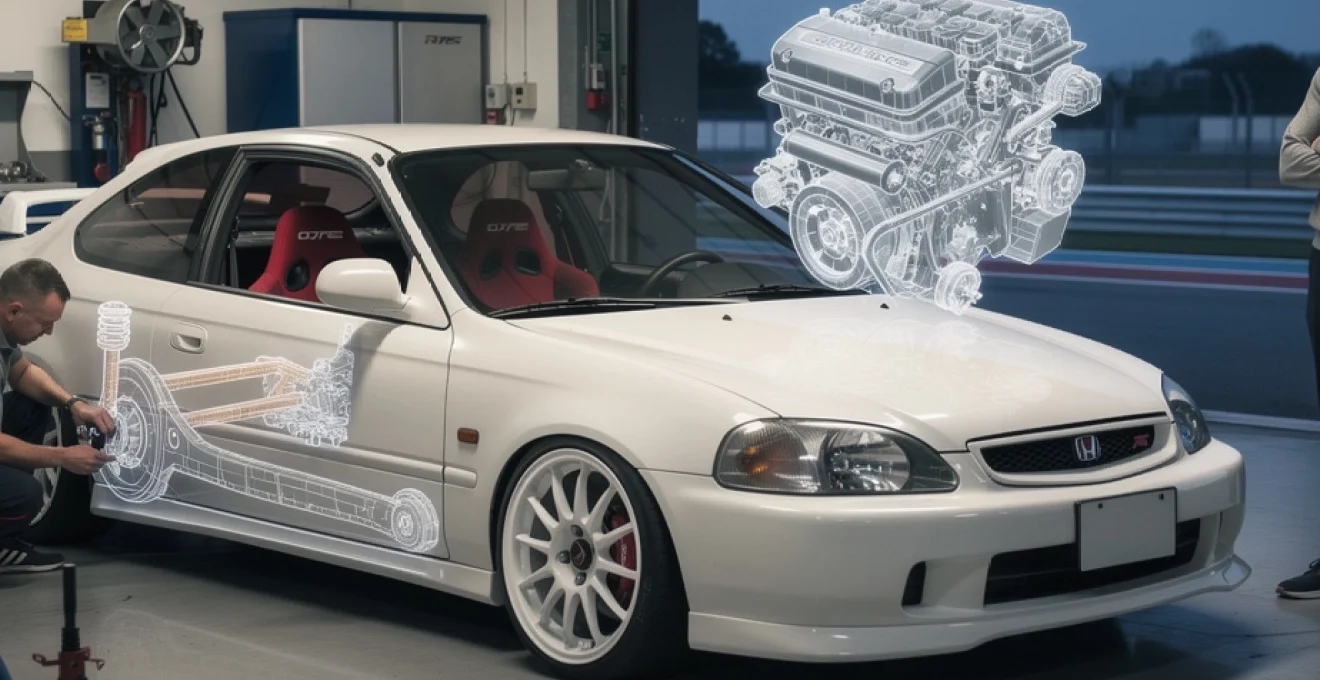
The 2000 Honda Civic Type R, chassis code EK9, sits at an interesting crossroads in hot hatch history. It blends old-school, high-revving VTEC character with a level of chassis focus that would not look out of place on a modern track special. Long before turbocharged hot hatches started chasing Nürburgring lap records, the EK9 showed how far a lightweight body, a highly tuned naturally aspirated engine and clever suspension geometry could go.
If you care about driver involvement more than straight-line numbers, this final-year Civic Type R offers a compelling case study. It is a car that asks you to work for its performance, to chase that 8,400rpm redline and to feel how the seam‑welded shell and helical differential claw for grip. For anyone considering an EK9 today—as a track toy, a collection piece or a carefully tuned street car—understanding what makes the 2000 model unique is essential.
EK9 chassis overview: how the 2000 honda civic type R redefined the hot hatch benchmark
Underneath the familiar three-door Civic shape, the EK9 shell differs significantly from a standard EK. Honda treated the Civic Type R more like a touring car homologation special than a warmed-over hatchback, focusing on structural rigidity, weight and suspension pick-up points. The result is a compact car that still feels remarkably sharp and communicative, even compared with many later performance models.
Monocoque EK9 body shell, seam welding and structural rigidity upgrades over standard EK civic
The EK9 uses the same basic monocoque layout as lesser EK Civics, but key areas of the body shell are heavily reinforced. Honda applied extensive seam welding to the chassis, especially at the suspension turrets, sills and rear arches. Where a regular Civic relies mainly on spot welds, the Type R stitches those seams continuously, increasing torsional rigidity by an estimated 30–40% over the base shell according to period engineering data.
Additional bracing was added around the rear shock towers and in the lower front structure. This extra stiffness allowed engineers to run more aggressive spring and damper rates without the car feeling nervous or unpredictable. For you as a driver, the benefit is clear: steering inputs translate more directly into chassis response, and mid-corner bumps upset the car less than on an ordinary EK hatchback.
Honda’s philosophy with the EK9 chassis was simple: build a body strong enough that the suspension can do its work with maximum precision.
The result is a hot hatch that feels more like a compact race car in the way it changes direction and holds a line, especially noticeable if you regularly drive other period Civics back-to-back.
Weight reduction strategy: 1,050 kg target, sound deadening removal and thin-gauge glass
Structural rigidity is only half of the EK9 story; the other half is mass. Honda targeted around 1,050 kg kerb weight for the 2000 Civic Type R, an impressive figure for a car with full interior trim and road equipment. To get there, engineers took a methodical approach to weight reduction that rivals any lightweight track special today.
Much of the standard Civic’s sound deadening was deleted, including thick insulation in the floorpan, firewall and boot area. Thinner-gauge glass was used for certain windows, and lighter panels were specified where possible. Even small parts such as the steering wheel, seats and spare wheel were chosen or deleted with mass in mind. If you are used to modern hot hatches at 1,350–1,500 kg, the way an EK9 responds to throttle and steering inputs feels instantly more vivid.
On the road, this weight saving translates to better power‑to‑weight performance and a sense of agility that no bolt‑on power upgrade can replicate. On track, you notice shorter braking distances, less tyre and brake wear, and a car that dances rather than bludgeons its way through a corner.
Comparing EK9 to EK4 VTi and EG6 SiR: geometry, torsional stiffness and suspension pick-up points
It is tempting to think of the EK9 as a slightly uprated EK4 VTi, but the differences go far beyond the engine. The EK4 VTi and earlier EG6 SiR already featured capable double-wishbone suspension, yet the Type R sits on subtly revised pick-up points and bushings. Honda tweaked roll centre heights and geometry to keep camber more consistent under load, giving the car crisper turn‑in and more neutral mid-corner balance.
Compared with an EK4, the EK9 benefits from stiffer subframe mounts and harder suspension bushes, plus a different front knuckle design to suit the uprated brakes and hubs. The torsional stiffness advantage from the seam‑welded shell also allows the geometry to stay stable under heavy cornering forces. Versus an EG6 SiR, the EK9 feels less soft and more immediate, with less body flex and a more focused, track-biased alignment from the factory.
If you currently drive an EK4 or EG6 and are considering an EK9 swap or full shell upgrade, this underlying chassis difference is worth remembering. It is not just a matter of bolting on EK9 parts; the whole platform is engineered differently for higher sustained loads and more demanding driving.
Production data: final-year 2000 EK9 chassis codes, facelift vs pre-facelift identification
The 2000 model year represents the last chapter for the EK9 before the EP3 Civic Type R took over. EK9 production ran from 1997 to 2000, all as right‑hand‑drive, Japanese‑market cars. Final-year chassis numbers typically fall in the EK9-120 and later range, though precise sequences vary by batch.
Facelift EK9s (often called later-spec or 99‑00 models) can be identified by clear front indicators, redesigned bumpers and lights, and minor interior trim changes. Mechanically, the updates are subtle rather than radical: small ECU calibration tweaks, some detail changes in suspension valving and trim, and the final evolution of the Type R aesthetic. For collectors, late‑2000 cars with original panels and matching numbers are increasingly sought after, reflecting the rising interest in JDM heroes of the late 1990s and early 2000s.
B16B engine engineering: inside the 1.6-litre VTEC powerplant of the 2000 civic type R
The heart of the 2000 Civic Type R is the legendary B16B engine, a 1.6‑litre DOHC VTEC four‑cylinder rated at 185 PS (around 182 bhp) at 8,200 rpm and 160 Nm at 7,500 rpm. At the time, this made it one of the most powerful production 1.6‑litre engines in the world, with a specific output exceeding 110 bhp per litre. Even today, its blend of razor‑sharp throttle response, screaming top end and mechanical durability sets a benchmark for naturally aspirated performance.
B16B vs B16A and B18C: stroke, compression ratio and internal component differences
Many enthusiasts assume the B16B is simply a high‑revving version of the familiar B16A, but the reality is more complex. The B16B uses the same 81.0 mm bore and 77.4 mm stroke as the B16A, yet internal components are heavily revised. The crankshaft is hand‑balanced, the conrods are stronger and lighter, and the pistons raise the compression ratio to around 10.8:1 (up from roughly 10.4:1 on many B16A variants).
Interestingly, much of the B16B’s architecture borrows from the larger B18C Integra Type R engine. Rod length and pin height relationships echo the 1.8‑litre unit, sacrificing some low‑end torque for high‑rpm breathing and durability. This is one reason the B16B tolerates extended time near the limiter better than a typical B16A, provided you keep oil levels in check and maintenance up to date.
| Engine | Displacement | Compression ratio | Power (factory) |
|---|---|---|---|
| B16A (EK4) | 1,595 cc | ~10.4:1 | ~160 PS |
| B16B (EK9) | 1,595 cc | ~10.8:1 | 185 PS |
| B18C (DC2 ITR) | 1,797 cc | ~11.1:1 | 200 PS |
If you are choosing between building a B16A or sourcing a B16B/B18C for a high‑revving project, this comparison highlights why many tuners still rate the Type R engines as a more robust starting point.
Ported DOHC VTEC cylinder head, high-lift cam profiles and 8,400 rpm redline tuning
Honda did not stop at bottom‑end upgrades. The B16B cylinder head receives hand‑finished ports, reshaped combustion chambers and more aggressive high‑lift cam profiles. VTEC transitions the engine from a mild low‑rpm cam to an aggressive high‑rpm profile, effectively giving you two cylinder heads in one casting.
The factory redline of 8,400 rpm reflects this race‑inspired approach. Peak power occurs just below the cut‑off, encouraging you to keep the engine on the boil. Compared with a B16A, valvetrain components are stiffened and balanced more carefully, reducing valve float at very high engine speeds. Think of the B16B as a road‑legal touring car engine: happiest when revved, slightly grumpy when lugged in high gears, and unbelievably rewarding when used properly.
The B16B demonstrates how clever headwork and precise valvetrain control can extract race‑car character from a small‑capacity road engine.
Intake and exhaust flow: dual-stage intake manifold, 4-1 header and 57 mm exhaust system
Airflow is critical to any naturally aspirated engine, and the 2000 Civic Type R is a masterclass in how to optimise it from factory. The dual‑stage intake manifold uses long, narrow runners at low rpm to improve torque, with a secondary path opening at higher revs to support the engine’s high‑rpm appetite. A large‑volume airbox and low‑restriction filter feed this system, and many owners only see modest gains when switching to aftermarket intakes if the rest of the setup is stock.
On the exhaust side, the EK9 runs a 4‑1 tubular header and a 57 mm (approx. 2.25‑inch) cat‑back system, again tuned for high‑rpm flow. The 4‑1 design sacrifices some mid‑range torque for peak‑power breathing, which suits the car’s short gearing and track‑focused nature. If you plan to upgrade the exhaust, sticking close to this diameter preserves drivability; going too large can hurt the all‑important mid‑range where you spend much of your time on real roads.
ECU mapping (PCT-J01), VTEC engagement point and ignition timing characteristics
The standard EK9 ECU, typically labelled PCT‑J01, is a surprisingly sophisticated unit for its era. VTEC engagement on the 2000 Civic Type R occurs around 5,800–6,000 rpm, though the exact point can vary slightly depending on load and conditions. Below this threshold, the engine runs on the mild cam lobes; above it, the ECU switches to the aggressive profile and adjusts fuelling and ignition timing to suit.
Ignition advance in the PCT map is relatively aggressive, especially in the high‑rpm zone, taking advantage of the engine’s high octane requirements (Japanese premium fuel is typically RON 100). If you run an imported EK9 on European or UK fuel, using the highest available octane and ensuring the mapping is checked can protect against knock. For many owners, a modern programmable ECU with a conservative road map and a high‑octane track map offers the best of both worlds.
Dyno-proven performance: stock wheel horsepower figures and real-world 0–100 km/h data
On paper, the EK9’s 185 PS rating may not sound spectacular in a world of 300 bhp hot hatches, yet real‑world performance tells a more nuanced story. Healthy, unmodified cars typically show around 155–165 wheel horsepower on a conservative chassis dyno, implying driveline losses of roughly 10–15%. Given the low kerb weight, 0–100 km/h times of around 6.5–7.0 seconds are achievable with a skilled driver.
More importantly, in‑gear acceleration once you are in the VTEC zone feels ferocious for a 1.6‑litre engine. On tight circuits and twisty B‑roads, drivers frequently find that an EK9 can keep pace with or even embarrass heavier, more powerful machinery, especially if the other driver is reluctant to use their car’s full potential. If you enjoy extracting every last tenth from a naturally aspirated engine, the EK9 remains one of the most satisfying platforms available.
Type r-specific drivetrain, suspension and braking hardware on the 2000 EK9
A great engine demands an equally sharp drivetrain and chassis. Honda understood this and specified the 2000 Civic Type R with parts that, even now, enthusiasts retrofit to other Civic models. Short gearing, a mechanical limited‑slip differential, bespoke suspension rates and uprated brakes combine to create a cohesive, track‑ready package from the showroom.
S4C gearbox ratios, helical LSD and 4.4 final drive for track-focused acceleration
The EK9’s transmission is a close‑ratio S4C five‑speed manual paired with a 4.4 final drive. First through fourth gears are tightly stacked to keep the engine in its VTEC power band when shifting at or near redline. Fifth remains short enough to support brisk acceleration on faster circuits, though cruising rpm is higher than most modern hot hatches.
A factory helical limited‑slip differential transforms how the car puts power down. Under hard acceleration out of tight bends, you feel the inside front wheel pulling rather than spinning uselessly. This improves traction, reduces lap times and gives the EK9 its signature “point and go” corner‑exit behaviour. For any EK‑chassis track build, an S4C gearbox with LSD and suitable final drive remains a highly desirable upgrade.
Macpherson front and double-wishbone rear suspension with bespoke EK9 spring and damper rates
Contrary to some assumptions, the EK9 retains the Civic’s traditional double‑wishbone layout at both ends rather than switching to a cheaper torsion beam. However, the spring and damper rates are exclusive to the Type R, significantly stiffer than those on an EK4 VTi. The firmer setup supports higher cornering loads and reduces roll, allowing the car to feel flatter and more controlled on track.
On typical UK or European roads, you will notice the firm ride, especially over broken surfaces, but the damping quality prevents it from becoming unbearable. Think of it like a well‑set‑up coilover kit straight from the factory: firm but not crashy, and always encouraging you to attack the next corner rather than back off.
Chassis tuning: thicker anti-roll bars, front strut brace and factory alignment settings
The EK9 chassis tune builds on that suspension hardware with thicker anti‑roll bars and additional bracing. A front strut brace ties the turrets together, further boosting rigidity in a high‑stress area. Compared with a regular Civic, the Type R typically runs more negative front camber and slightly more toe‑out, contributing to its alert turn‑in and willingness to rotate under trail braking.
From a tuning perspective, these factory alignment settings provide an excellent base. If you use your EK9 mainly on track, a touch more negative camber at both ends, combined with slightly reduced front toe‑out, can improve tyre wear and stability. For mainly road driving, aligning to the original specifications preserves the authentic steering feel and balance that made the car so revered.
Braking package: 282 mm front discs, 5-lug hub conversion and OEM wheel fitment (15-inch enkei)
Brakes are often the weak point on older performance cars, but the 2000 Civic Type R arrives well equipped. The front axle uses 282 mm ventilated discs with larger calipers, a significant step up from the 262 mm setup on many lesser Civics. At the rear, solid discs handle braking duties and contribute to a stable pedal feel under repeated heavy stops.
A key difference is the 5‑lug hub pattern, shared with some Integra Type R models. This allows fitment of stronger hubs and a broader range of performance wheels. The factory wheels are lightweight 15‑inch Enkei alloys, chosen to balance unsprung mass, tyre sidewall compliance and brake clearance. For modern track tyres, staying at 15 or 16 inches keeps rotational mass low and preserves that signature, agile turn‑in.
Interior and exterior specification: how the 2000 civic type R EK9 differed from regular civics
Step inside a 2000 Civic Type R and the motorsport influence is immediately apparent. Deep‑bolstered red Recaro bucket seats hold you in place during hard cornering, while a matching red‑trimmed interior—carpets, door inserts and headliner—creates a distinctive Type R environment. The steering wheel is smaller and lighter than in a regular Civic, and the titanium gear knob sits within easy reach, encouraging fast, precise shifts.
Luxury equipment is deliberately sparse. Many EK9s came without air conditioning, sound systems or electric extras, particularly in the most hardcore variants. This minimalism is not just about weight saving; it also focuses your attention on driving. Every time you grab that gear lever or feel the car vibrate slightly at idle, you are reminded that the Civic Type R is closer to a road‑going race car than to a family hatch.
Visually, the EK9 distinguishes itself through subtle but purposeful changes. Colour‑coded bumpers with integrated lips, a larger rear spoiler, side skirts and unique grille treatment all contribute to a more aggressive stance without tipping into the overly ornate designs seen on some later hot hatches. Facelift 2000 models gain updated headlamps and rear lights, sharpening the look further. If you see a Championship White three‑door Civic with red badges, red Recaros and a factory‑style rear wing, chances are you are looking at an EK9—or a very dedicated replica.
2000 model year updates: late EK9 changes before the EP3 civic type R transition
By 2000, Honda was preparing to introduce the EP3 Civic Type R, built initially in the UK and offering a very different take on the hot hatch formula. The final‑year EK9 therefore represents the most mature evolution of the original Type R concept, incorporating several subtle updates accumulated across the model run. Suspension valving was refined to balance high‑speed stability with better compliance on typical Japanese roads, and small revisions to engine calibration improved drivability in stop‑start traffic without diluting the high‑rpm fireworks.
Interior trim materials were updated slightly for better durability, addressing wear areas around the steering wheel and gear knob that showed up quickly on early cars. Some late EK9s also benefitted from improved corrosion protection, though any 2000 Civic Type R today still demands careful inspection for rust in common EK‑chassis weak points such as rear arches and sills. From a market perspective, these late cars sit at the intersection of old‑school VTEC purity and the broader global recognition of the Type R brand, making them particularly desirable among enthusiasts who value both driving feel and collectability.
Collector status, market values and tuning culture around the 2000 honda civic type R
In the mid‑2000s, EK9s were relatively affordable imports, often bought to be daily driven, modified heavily or tracked hard. Many were crashed, rusted or parted out, which is one reason surviving original cars are now commanding strong prices. In several European markets, values for clean, unmodified EK9s have doubled or even tripled over the past five to seven years, mirroring the wider boom in 1990s and early‑2000s Japanese performance cars. Good‑condition examples regularly exceed the cost of newer hot hatches, reflecting their emerging status as modern classics.
If you intend to enter the 2000 Civic Type R market, a few practical tips can protect your investment and your enjoyment:
- Prioritise structural condition over cosmetic perfection; a rust‑free, straight shell is far more valuable than fresh paint over hidden corrosion.
- Verify engine health with compression and leak‑down tests, particularly if the odometer suggests more than 150,000 km of spirited use.
- Check for genuine Type R parts—Recaros, S4C gearbox, 5‑lug hubs, B16B block and head—to avoid paying Type R money for a cloned Civic.
Tuning culture around the EK9 remains incredibly active. Common upgrades include modern coilover kits, improved brake pads and lines, and ECU remaps that account for local fuel quality. Some owners pursue period‑correct modifications—JDM wheels, titanium exhausts, roll cages—echoing iconic builds from Japan and the US. Others go further, swapping in K‑series engines for big naturally aspirated power or even turbocharging the B16B, though this inevitably moves the car away from its original character.
One of the EK9’s enduring strengths is its reliability under hard use when maintained correctly. Regular high‑quality oil changes, valve clearance checks and cooling‑system maintenance allow the B16B to survive frequent excursions to the limiter. This robustness, combined with the car’s light weight and crisp responses, explains why so many track‑day enthusiasts still seek out an EK9 as a dedicated circuit car even in an era of vastly more powerful machinery. For drivers who want a compact, focused machine that rewards skill and commitment rather than raw horsepower, the 2000 Honda Civic Type R remains one of the purest expressions of the hot hatch formula.