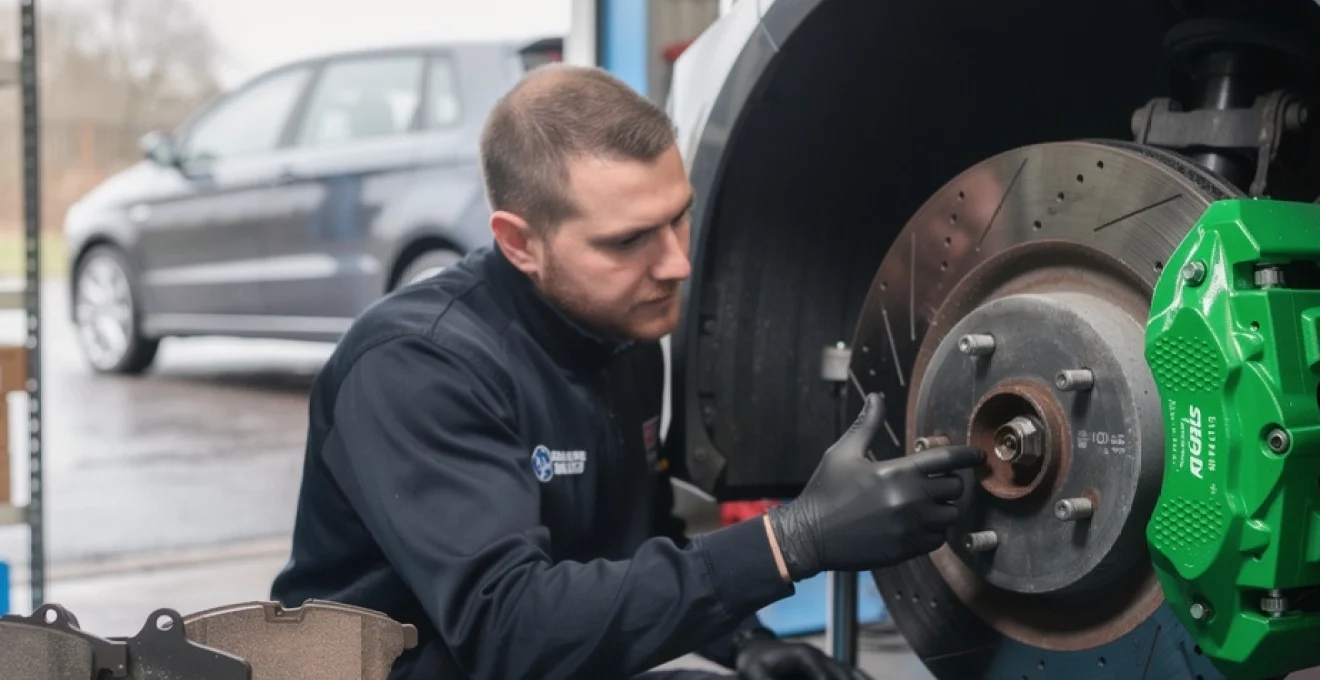
If you are upgrading the brakes on a fast road car, hot hatch or heavier daily driver, EBC Green Stuff pads will appear on almost every shortlist. The marketing promises stronger stopping power, less dust and eco‑friendly construction, yet owner feedback can be mixed. Some drivers report sharper pedal feel and noticeably cleaner wheels, while others complain about weak cold bite and squeal on lighter cars. Sorting genuine benefits from forum noise is essential if you want a brake setup that matches how you actually drive. Understanding what Green Stuff pads are designed to do, and equally what they are not designed for, helps you decide whether they are a smart upgrade or an unnecessary compromise.
Green stuff brake pads overview: EBC compound technology, intended use and vehicle compatibility
EBC greenstuff compound generations (2000, 6000, 7000 series) and formulation differences
Under the Greenstuff name there are several compounds, each tuned for different types of vehicle. For European and UK‑market cars, the best known is the Greenstuff 2000 series, aimed at light performance cars and hot hatchbacks used on the road. For heavier 4x4s and pickups, EBC offers DP6000 Elite Green pads, while certain regions also see the 7000 formulations for specific SUV platforms. All share a non‑asbestos organic base with aramid fibres, but metallic content and resin mixes vary to tune bite, noise and wear. The 2000 compound is biased towards progressive road manners, whereas the 6000/7000 variants are more robust under heavy loads and higher temperatures typical of SUVs and light trucks.
Recommended applications: hot hatchbacks, light performance cars and daily drivers
EBC explicitly positions Green Stuff pads as an upgrade over basic OEM friction material rather than an all‑out track compound. The 2000 series is recommended for cars such as Golf GTI, Fiesta ST, BMW 1 Series, MX‑5 and similar enthusiast models that spend most of their time on the road. The official literature highlights spirited street use, B‑road driving and occasional hard stops from motorway speeds. Green Stuff is also marketed as a good match for tuned daily drivers where the owner wants a bit more confidence without harsh race‑pad behaviour. If your goal is repeated lapping at Brands Hatch or long sessions at Nürburgring, EBC itself points drivers towards Redstuff or Yellowstuff instead.
Friction coefficient, operating temperature range and ECE R90 road homologation
On paper, EBC Greenstuff offers a nominal friction coefficient around 0.55, which is comparable with many OE performance pads. The compound is designed to work from cold for normal urban driving while maintaining stability up to typical fast road temperatures. EBC emphasises improved resistance to fade compared with many basic OEM pads, particularly in the 100–400°C range reached during repeated high‑speed stops. An important detail for UK drivers is ECE R90 approval on many Greenstuff references, which confirms suitability as a legal road pad matching original equipment performance within a defined tolerance. For owners who combine modest upgrades with MOT compliance, this homologation is a strong practical advantage.
Comparison with OEM pads from BMW, VW, ford and toyota in typical UK road use
Against factory pads from marques such as BMW, VW, Ford and Toyota, Greenstuff typically aims to deliver a 10–15% improvement in effective braking performance. Independent tests on road‑style dynamometers show shorter stopping distances from 100 km/h in the region of 2–3 metres in some applications, although results vary widely by vehicle weight and tyre quality. Many owners notice that once bedded in, pedal response is more linear than with some softer OE compounds, which can feel vague at high temperature. However, anecdotal reports from lightweight cars like Lotus Elise or kit‑car builds indicate that Greenstuff may feel underwhelming because those cars never generate the heat the pads are designed around. Heavier saloons and hot hatches in everyday UK conditions tend to see the most benefit.
Material composition and braking performance characteristics of green stuff pads
Kevlar and aramid fibre matrix, semi‑metallic content and non‑asbestos organic (NAO) design
Greenstuff pads use a non‑asbestos organic base with a mix of Kevlar and other aramid fibres, combined with selected semi‑metallic particles. This hybrid design balances low noise and comfort with the heat stability needed for performance driving. The aramid matrix acts a little like reinforcement in concrete, keeping the friction surface stable under high load while resisting cracking and chunking. The semi‑metallic content improves thermal conduction and bite but is kept moderate, which helps reduce harshness and disc wear compared with very aggressive race compounds. EBC also advertises the absence of copper, lead and toxic sulphides, giving the material an environmentally friendly profile that aligns with increasingly strict friction material legislation in Europe and North America.
Initial cold bite versus fade resistance under repeated high‑speed stops
A common question is whether Greenstuff pads have enough cold bite for real‑world commuting. In properly bedded sets, initial response from ambient temperature is generally similar to a decent OEM pad, with some drivers reporting a slightly softer first touch followed by stronger mid‑pedal power. Where Greenstuff stands out is fade resistance during repeated heavy stops, such as several 70–0 mph braking events in quick succession. Dyno testing and independent magazine reviews often show much smaller friction drop‑off than typical budget OE materials. If you rarely brake hard, you may not feel a huge difference; if you regularly drive quickly on B‑roads or mountain passes, the extra margin against fade can be noticeable and reassuring.
Pedal feel, modulation and stopping distances on dry and wet tarmac
Pedal feel with Greenstuff is often described as more progressive than with some factory pads, especially on cars known for grabby OEM setups. The compound allows decent modulation, which helps you avoid triggering ABS too early when braking hard on dry tarmac. On wet roads, where tyre grip is the limiting factor, outright stopping distance differences between quality pads are naturally smaller, but controlled modulation still matters. Several road tests report consistent braking performance in both dry and damp conditions, without the sudden friction spikes sometimes found in cheaper aftermarket pads. For drivers who value smooth, predictable braking rather than on‑off race‑pad behaviour, this characteristic is a strong point.
Performance comparison with EBC redstuff, yellowstuff and ferodo DS2500
In the EBC range, Greenstuff sits below Redstuff and Yellowstuff in ultimate temperature capability. Redstuff is a low‑dust ceramic pad aimed at heavier and faster road cars, offering stronger high‑speed bite but slightly less cold feel than Greenstuff on lighter vehicles. Yellowstuff is a semi‑race compound with excellent fade resistance and is widely used for track days, but it can feel overkill and wear discs faster on normal road use. Compared with popular alternatives such as Ferodo DS2500, Greenstuff is usually quieter, kinder to rotors and more civilised in daily driving, although DS2500 typically delivers better outright performance on circuit. Your choice depends on whether road comfort or track capability matters more in your braking priorities.
Dust, noise and rotor wear: real‑world behaviour of green stuff brake pads
Brake dust volume, particle size and wheel cleaning frequency versus OEM pads
Many drivers move to Greenstuff primarily to reduce the stubborn black dust that plagues some OEM pads, particularly on German cars. EBC claims medium to low dust levels, and owner experience often supports this, with reports of significantly cleaner front wheels after a few weeks of use. The dust that is produced tends to be lighter in colour and finer in particle size, making it easier to wash off during regular cleaning. For drivers who care about wheel appearance or run intricate alloys, this can translate into noticeably less cleaning effort. From a technical perspective, lower abrasive content and optimised resin systems help minimise pad and rotor debris under normal braking.
Squeal, low‑speed noise and judder: causes, bedding‑in errors and mitigation
Noise behaviour is one of the most divisive aspects of Greenstuff pads. On many heavier saloons and hot hatches, they run quietly once properly bedded in. On lighter cars, especially where the brakes are seldom driven hard, owners sometimes report squeal or low‑speed chirping. In the majority of cases this relates to incomplete bedding‑in, glazed pad surfaces or minor vibration issues rather than the compound itself. Careful preparation of pad backing plates, use of high‑temp anti‑squeal compound, and correct chamfering where recommended can transform noise levels. Regularly performing a few firm stops to keep the pad surface fresh also helps prevent the light glazing that often triggers squeaks.
Many “noisy pad” complaints trace back not to the friction compound, but to poor installation practices, missing shims, contaminated discs or incomplete bedding‑in.
Disc wear rates on vented vs solid rotors from brembo, bosch and pagid
Greenstuff is designed as a relatively rotor‑friendly pad, making it suitable for standard vented or solid discs from brands such as Brembo, Bosch or Pagid. Wear studies in mixed city and motorway use typically show disc life comparable to or slightly better than with many stock pads, especially on vented rotors where heat dissipation is superior. Solid rear discs usually experience light, even wear provided the braking system is healthy and pad deposits are kept under control. Because aramid‑based NAO pads are less abrasive than some sintered or high‑metallic race pads, disc scoring is usually minimal, which can delay the need for rotor replacement and reduce overall running costs.
Impact on drilled, slotted and grooved discs such as EBC GD sport rotors
Greenstuff pads are compatible with drilled, slotted and grooved rotors, including EBC’s own GD Sport designs. The combination of a moderately aggressive pad with performance discs can sharpen response and help evacuate gases and water under heavy braking. However, any slotted or drilled disc will increase pad wear compared with a plain rotor because the pad is being continually “planed” by the slots. If you are considering such a setup, it is sensible to budget for slightly shorter pad life in exchange for improved bite and more consistent braking at high speed. For daily drivers used mostly in urban traffic, plain or lightly grooved discs may offer a better compromise between noise, comfort and longevity.
Lifespan, heat management and fade resistance for road and spirited driving
Pad wear rates in city commuting, motorway cruising and b‑road spirited runs
Pad life with Greenstuff is highly usage‑dependent, but typical figures reported in UK forums range from 20,000 to 35,000 miles on front axles used mostly for commuting and motorway journeys. In purely urban stop‑start driving, expect the lower end of that range, while gentle motorway cruising can easily see lifespans similar to or slightly above OEM pads. Drivers who frequently exploit B‑roads and country lanes at higher speeds will see faster wear, especially on heavier performance cars, but still generally within acceptable road‑pad norms. Think of Greenstuff as a performance‑biased OE replacement rather than an ultra‑long‑life fleet pad; it trades some ultimate longevity for improved friction and fade control.
Heat soak, brake fade and fluid boiling when descending alpine passes or UK mountain roads
Long downhill sections, such as Alpine passes or steep UK mountain roads, are a tough test for any road pad. Greenstuff compounds manage heat better than most entry‑level OEM materials, delaying the onset of pad fade during repeated heavy applications. For many drivers, the limiting factor becomes brake fluid boiling or caliper heat soak rather than the pad itself. Using a quality DOT 4 or DOT 5.1 fluid with a higher dry boiling point, along with good airflow around the brakes, can significantly extend safe performance. Still, it is important to use engine braking and lower gears; no friction material is a substitute for correct driving technique on prolonged descents.
Even the best performance road pad can be overwhelmed by sustained heavy braking if fluid quality, cooling and driving technique are ignored.
Suitability for occasional track days at circuits like brands hatch and silverstone
Can Greenstuff handle the odd track session at Brands Hatch or Silverstone? For a novice driver doing a few gentle sessions, especially in a lighter hot hatch, the pads may cope reasonably well if supported by fresh high‑boiling‑point fluid and proper cool‑down laps. However, experienced drivers or those in heavier, more powerful cars are likely to encounter fade and accelerated wear during longer stints. EBC itself nudges such users towards Yellowstuff or dedicated track compounds. Think of Greenstuff as a pad that survives occasional fun runs rather than a true “track day pad”. If track driving becomes a regular habit, moving to a more temperature‑resistant compound is a logical upgrade.
Comparison of service life with greenstuff vs OEM, mintex M1144 and brembo HP2000
Compared with typical OEM pads, Greenstuff often matches or slightly exceeds service life in mixed road use, thanks to its balanced friction and moderate aggressiveness. Against Mintex M1144, which is a popular fast‑road choice, Greenstuff can last a little longer and is usually kinder to discs, but M1144 tends to offer stronger bite and better consistency if pushed hard. Brembo HP2000 sits in a similar category to M1144, leaning more towards performance at the cost of somewhat faster wear. If your priority is maximum lifespan, a softer OE‑style compound or a touring‑oriented aftermarket pad may be better, but for those wanting a blend of performance and reasonable life, Greenstuff generally hits a useful middle ground.
Installation, bedding‑in procedure and common fitment pitfalls
Preparation of calipers, slider pins and disc surfaces before installation
Proper installation is crucial to get the best from Greenstuff pads. Before fitting, calipers should be cleaned thoroughly, with particular attention to slider pins and pad abutment points. Corroded or sticky sliders can cause uneven wear, pulling and noise regardless of pad brand. Disc surfaces must be free of heavy lip ridges, rust and contamination; lightly sanding or using new rotors where needed avoids early judder and hotspots. Applying a thin layer of high‑temperature brake grease to pad ears and contact points reduces the risk of squeal, while ensuring the pad can move freely. Skipping these basics is a major reason why some owners experience disappointing results after an upgrade.
Correct greenstuff bedding‑in cycle: heat cycling, glazing avoidance and transfer layer formation
Bedding‑in Greenstuff pads correctly involves controlled heat cycling to create an even transfer layer on the disc face. A typical procedure includes:
- Perform 6–10 light stops from 30–40 mph down to walking pace, allowing the brakes to cool slightly between each stop.
- Follow with 4–6 medium‑force stops from 50–60 mph, again avoiding complete stops to prevent pad imprinting.
- Drive gently for 10–15 minutes to let the brakes cool gradually, avoiding heavy braking or handbrake application while the discs are very hot.
This process helps avoid glazing, reduces the risk of uneven pad deposits and stabilises friction characteristics. Rushing straight into emergency‑style stops or aggressive mountain driving on brand new pads is a reliable way to create vibration issues later.
ABS, ESC and brake bias considerations on vehicles with upgraded front pads only
Many owners fit Greenstuff pads only on the front axle, leaving standard pads on the rear. On modern cars with ABS and ESC, this is generally acceptable, but it can subtly change brake balance. Stronger front friction can cause the ABS to intervene a little earlier at the front, with rear brakes doing relatively less work under hard stops. For everyday road use this is usually manageable, but drivers should be aware of the altered feel. On older performance cars without sophisticated electronic aids, a more noticeable forward bias can lead to longer stopping distances on loose or wet surfaces. Matching pad characteristics front and rear, or at least staying within a similar performance envelope, is good practice.
Typical issues: uneven pad deposits, disc “warping” complaints and how to diagnose them
Many complaints of “warped discs” after fitting performance pads are in fact uneven pad deposits rather than true rotor distortion. If you experience steering vibration or pulsing under braking, check for thickness variation on the disc surface and look for visible patches of darker pad transfer. Light judder that appears after a hard stop and then fades often indicates temporary pad imprinting. Addressing this can be as simple as performing a controlled re‑bedding cycle, or in more severe cases having the discs skimmed or replaced. Ensuring wheel hub faces are clean and free of rust, torquing wheel bolts evenly and avoiding prolonged stationary clamping on hot brakes all reduce the risk of these issues recurring.
Cost analysis and value assessment: are green stuff pads worth it for your use case?
Price comparison against OEM, EBC ultimax, redstuff and yellowstuff pads in the UK market
In the UK, Greenstuff pads typically sit above entry‑level EBC Ultimax pads and most plain OEM replacements in price, but below Redstuff and Yellowstuff performance compounds. For many common hot hatches and saloons, a front axle set of Greenstuff may cost 20–40% more than budget aftermarket pads, but often similar to or slightly less than genuine dealer pads. Redstuff can add another 15–25% on top, while Yellowstuff is generally the priciest of the three. When factoring cost, it helps to consider not just pad price but the total braking package, including discs, fluid and potential labour if a professional workshop handles installation and bedding‑in.
Total cost of ownership: pad life, disc replacement intervals and labour costs
Total cost of ownership for Greenstuff pads depends on mileage and driving style, but several factors tend to work in their favour. Firstly, rotor wear is relatively modest, so disc replacement intervals are often similar to OEM setups, avoiding hidden costs. Secondly, pad life in mixed road use is usually adequate, so the slightly higher upfront price is spread across a decent service interval. Labour costs are the same regardless of pad brand, meaning the incremental expense lies mainly in the pads themselves. For enthusiasts who value improved feel and lower dust, the marginal price increase can be justified as part of an overall safety and enjoyment upgrade rather than a simple consumable.
Use‑case scenarios: commuter cars, fast road builds, heavy SUVs and tuned hot hatches
Whether Greenstuff pads are worth it depends strongly on how you use your car:
- For mainly urban commuter cars with light braking and modest speed, Greenstuff offers small gains; a high‑quality OE‑style pad may be more cost‑effective.
- For fast road builds and tuned hot hatches driven enthusiastically, Greenstuff provides a strong balance of bite, fade resistance and comfort.
- For heavy SUVs, 4x4s and light trucks, the 6000‑series Greenstuff can improve high‑load braking while keeping dust and rotor wear in check.
- For cars used regularly on track, Greenstuff is better seen as a civilised road pad; Yellowstuff or a proper track compound is usually a wiser investment.
Thinking carefully about your own pattern of use, not just headline power figures, is key to making a rational choice. A 300 bhp saloon that spends 90% of its life on the motorway has very different needs from a 200 bhp hatch driven hard on twisty B‑roads every weekend.
Owner feedback and test data from forums, magazine reviews and YouTube dyno‑brake tests
Real‑world feedback on EBC Greenstuff pads is varied but follows some consistent trends. Owners of heavier cars and hot hatches often praise reduced dust and more confident stopping once up to temperature. Drivers of very light cars sometimes complain of poor initial bite, supporting the idea that the compound prefers a certain load and heat window. Independent magazine tests and YouTube dyno‑brake demonstrations typically show measurable gains in fade resistance compared with cheaper OE replacements, especially under repeated high‑speed stops. Taking these data points together suggests that for a typical UK driver of a modern hot hatch, sports saloon or mildly tuned daily, Greenstuff can deliver a tangible improvement in braking consistency and cleanliness, provided installation and bedding‑in are handled correctly and expectations around track performance remain realistic.