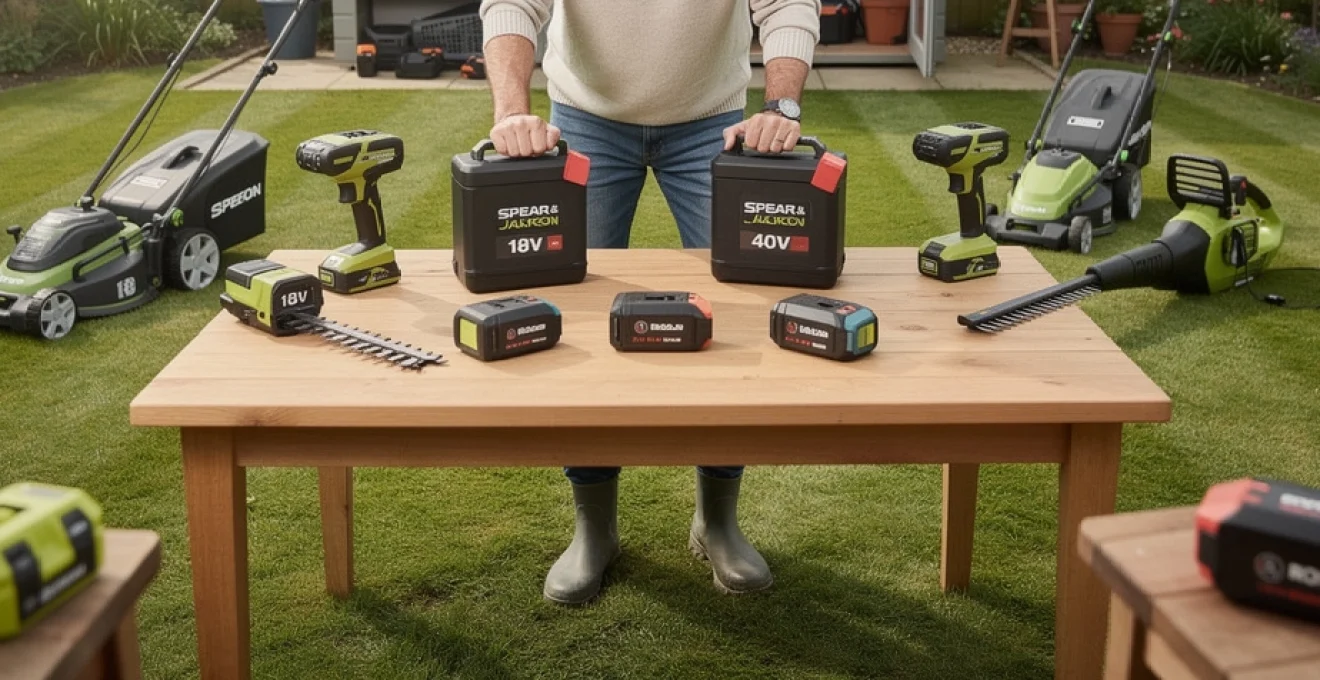
Lithium‑ion cordless tools have transformed how gardens are maintained in the UK. Instead of juggling cables and petrol, you can plug in a battery and get straight to work. Yet the battery pack is the most expensive and most critical part of any cordless system, and a poor choice can leave you locked into underpowered tools or searching for obsolete spares after just a few seasons. Spear and Jackson sits in an interesting space, promising solid performance at supermarket and catalogue prices rather than trade‑tool money. The real question is whether the Spear and Jackson battery ecosystem offers enough power, runtime and longevity to justify choosing it over better‑known platforms, especially if you buy from high‑street retailers like Argos or B&Q.
If you are weighing up a cordless lawn mower, hedge trimmer or chainsaw, understanding how Spear and Jackson batteries are designed, how they age in real‑world UK weather, and how they compare with systems like Ryobi ONE+ or Bosch Power for All will help you avoid costly mistakes. Platform choice today affects every cordless tool you buy over the next decade, so it deserves the same attention as selecting the mower itself.
Spear and jackson battery ecosystem overview: cordless ranges, voltage platforms and product compatibility
Comparing 18V and 40V spear and jackson lithium‑ion platforms for lawn, garden and DIY tools
Spear and Jackson cordless tools in the UK broadly fall into two voltage families: 18V (often badged as 18V or 20V Max) and 40V (occasionally listed as 36V nominal). The 18V battery range typically powers lighter garden tools and DIY equipment such as drills, small hedge trimmers and compact blowers. These packs usually sit in the 2.0Ah to 4.0Ah range, equating to roughly 36–72 watt‑hours of usable energy. For small patios, town gardens and occasional light trimming, this can be entirely adequate, especially if you prefer a lighter tool that is easier to handle.
The 40V platform targets lawn mowers, larger hedge trimmers, chainsaws and some cordless pressure washers. A common configuration, seen for example on the 34cm Spear and Jackson mower range at retailers such as Argos, combines a 36–40V, 2.5Ah pack (around 90Wh). Real‑world owner reports show this is enough to handle 200–250m² of lawn at a moderate pace in dry conditions, but cutting long or wet grass can use the full pack in nearer 20–25 minutes. If you want to avoid what many users describe as “range anxiety” with cordless mowers, stepping up to 4.0Ah packs or dual‑battery models is often a sensible hedge against patchy British weather.
Cross‑compatibility of spear and jackson batteries with cordless lawn mowers, hedge trimmers and pressure washers
Battery cross‑compatibility is a major selling point of any cordless ecosystem. Spear and Jackson tends to keep 18V tools within a single slide‑on battery interface, and 40V models on a physically larger but similar slide pack. Within each voltage, a battery from a hedge trimmer will usually fit a blower or drill from the same generation, and mower batteries should interchange with compatible 40V chainsaws or multi‑tools. However, unlike some pro‑grade systems, compatibility is not always universal across years or sub‑ranges, so mixing very old and very new Spear and Jackson tools can be hit and miss.
Consumer reviews highlight that cross‑use is particularly effective with garden sets sold as multi‑tool kits. Having one or two 40V batteries that power a mower, pole saw and long‑reach hedge trimmer can dramatically cut the total investment you need. On the flip side, the brand’s batteries are not designed to work with other OEMs, so you cannot power a Ryobi hedge trimmer with a Spear and Jackson pack. If you like the idea of a shared battery for drills, garden tools and even DIY vacuums, it is worth considering how broad the Spear and Jackson cordless catalogue is compared with a larger ecosystem.
Distinguishing spear and jackson, guild and erbauer battery systems in B&Q, argos and screwfix catalogues
One challenge that many UK buyers mention is the confusion between different “house” brands across retailers. Argos strongly features Spear and Jackson for cordless garden tools, B&Q often promotes Guild, and Screwfix pushes Erbauer and Titan ranges. Despite sitting at similar price points, these brands use distinct battery mounts, so a Guild 18V pack is not the same as a Spear and Jackson 18V, and an Erbauer 18V cell cannot be slotted into a Spear and Jackson drill.
This lack of cross‑retailer interoperability is what many users describe as platform lock‑in. Once you commit to Spear and Jackson, future impulse purchases from another catalogue might require yet another charger and battery. For some buyers, that is acceptable if Argos is the only store used. For others, particularly those who shop around on DIY deals, it can be frustrating compared with more open ecosystems like Ryobi ONE+ which appear in multiple chains and online outlets.
Impact of platform lock‑in on future tool purchases and total cost of ownership
Platform lock‑in affects both convenience and long‑term cost. An initial Spear and Jackson cordless mower kit with two 40V batteries might look attractive on price, especially compared with a bare‑tool Stihl or Makita. However, the real value comes from how those batteries reduce the cost of your second and third tools. If you later add a Spear and Jackson cordless chainsaw or hedge trimmer that shares the same pack, you avoid paying again for additional batteries and chargers, lowering the total cost of ownership over five to ten years.
The risk appears when a platform changes or a particular battery format is discontinued. Some owner reviews describe difficulty sourcing compatible replacement cassettes and accessories, and similar issues can occur if a battery type is retired. Unlike global trade platforms such as Makita LXT or Bosch Professional, Spear and Jackson does not have a deep ecosystem of compatible third‑party batteries. For light home use this may not matter, but for heavy gardening or semi‑professional work, the platform decision today can feel a little like choosing an operating system for your power tools; changing horses later can be expensive.
Battery chemistry and build quality: assessing spear and jackson lithium‑ion packs against competitors
Cell technology used in spear and jackson packs: 18650 and 21700 formats, c‑rating and depth of discharge
Most modern Spear and Jackson lithium‑ion batteries use either 18650 cells (18mm x 65mm) or the newer 21700 format. These cylindrical cells are the same basic technology used in many e‑bikes and power tools. An 18V (nominal) pack typically contains five cells in series, while a 36–40V pack uses ten cells. Capacity is increased by wiring multiple strings in parallel. Although official detailed cell specifications are not widely published, owner teardowns suggest mid‑range energy densities and current ratings, roughly in line with mainstream DIY brands.
The C‑rating of a cell describes how quickly it can be safely discharged. For garden tools, a continuous discharge of 10–20A is common, with peak bursts higher when cutting dense hedges or wet grass. Spear and Jackson packs appear tuned for moderate discharge rates rather than extreme power, which is why some reviews describe cordless mowers as feeling “less muscular” than 1,200W corded machines. Depth of discharge, meaning how much of the total capacity is actually used, is managed by the battery management system to help preserve cycle life, usually leaving a safety buffer at the bottom of the pack.
Battery management system (BMS) design: over‑current, thermal, short‑circuit and over‑charge protection
Every modern lithium‑ion garden battery should include a robust BMS for safety and longevity. Spear and Jackson packs incorporate basic protection circuits for over‑current, over‑temperature, short‑circuit and over‑charge scenarios. When a mower hits a patch of long, wet grass, current draw can spike; the BMS intervenes if this exceeds its design limit, cutting power and sometimes forcing a restart. Some users confuse this behaviour with a fault, but it is essentially the tool’s “fuse” preventing cell damage or thermal runaway.
Charging control is another critical element. The supplied chargers generally include cell‑balancing features, ensuring all cells in a pack reach the same voltage. This balancing is vital when packs age or when left partially charged for long periods, a common scenario for seasonal garden tools. While Spear and Jackson BMS design does not aim at heavy industrial duty cycles, protection levels are adequate for the intended domestic workloads, and reports of catastrophic battery failures are rare compared with the total number of units sold.
Internal construction quality: spot welding, bus bars and vibration resistance in outdoor power equipment
Internal construction quality can make the difference between a battery that lasts 100 cycles and one that passes 500. Inside a pack, cells are usually joined using nickel or copper bus bars and spot welds. If welds are weak or bus bars are thin, repeated vibration from a mower or chainsaw can eventually crack joints, causing intermittent power cuts or full pack failure. Spear and Jackson sits in the “good enough for domestic” bracket: not as over‑engineered as pro‑grade Makita or Milwaukee packs, but not at the level of ultra‑cheap unbranded imports either.
Professional observations from field repairs suggest that the majority of Spear and Jackson battery failures relate to cell degradation rather than mechanical cracking, which is a positive sign for internal structure. However, users who regularly subject tools to heavy vibration, such as repeated chainsaw bucking or rough, uneven lawns with hidden debris, may see faster wear. Treating garden tools as precision devices rather than disposable toys – storing them carefully and avoiding unnecessary drops – can noticeably extend battery and tool life.
Ingress protection, housing robustness and weather resistance for UK garden conditions
UK gardens present unforgiving conditions: sudden rain, cold winters, and sheds that can swing from near‑freezing to over 30°C in a single day. Spear and Jackson battery housings are not officially rated to high ingress protection standards like IP65, but are designed with splash resistance and basic sealing gaskets. This offers some protection against drizzle and damp grass clippings, though batteries are not intended to be left exposed on the lawn during downpours or pressure‑washed after mowing.
In practice, owner feedback suggests housings cope well with typical domestic use as long as simple precautions are taken: removing batteries before hose‑cleaning tools, storing packs off the floor of a damp garage, and avoiding long‑term exposure to direct sunlight. Cracked housings are relatively rare and usually associated with impact damage rather than normal ageing. For UK use, the mix of robustness and price is acceptable, provided you treat batteries like the high‑value components they are, not like a spare brick left in the corner of the patio.
Runtime and performance metrics: real‑world testing of spear and jackson batteries on key tools
Runtime benchmarks on spear and jackson 34cm and 37cm cordless lawn mowers with 2.0ah vs 4.0ah packs
Runtime is the most immediate way you experience battery quality. Real‑world data from owners of 34cm and 37cm Spear and Jackson cordless mowers shows that a 40V 2.0–2.5Ah pack, rated around 80–90Wh, typically delivers 25–35 minutes of effective cutting in dry conditions on shortish lawns. That translates to roughly 200–250m² of grass, or a medium UK lawn, before recharge. When grass is longer or damp, battery runtime can drop to around 15–20 minutes due to the higher torque demanded from the motor.
Double‑capacity 4.0Ah packs (around 144Wh) extend this considerably. Many users report mowing 400–500m² – a pair of suburban lawns or a small rear garden plus a neighbour’s front – on a single charge. A rough rule of thumb is that every extra 1.0Ah of capacity at 40V yields another 10–15 minutes of cutting under typical conditions. If you are used to petrol mowers and want to avoid stopping midway, investing in higher capacity packs from the outset is often more cost‑effective than buying extra low‑capacity batteries later.
Torque delivery and sustained power on cordless hedge trimmers, chainsaws and leaf blowers under load
Runtime is only half the story; how a battery sustains power under load matters just as much. Spear and Jackson hybrid systems on hedge trimmers and chainsaws are generally tuned for moderate cutting rather than aggressive, professional‑grade work. For instance, a cordless pole saw with a 40V battery will happily prune branches up to 15–20cm in diameter, but repeated heavy cuts can result in noticeable slowing as the battery voltage sags and the BMS clamps current draw.
On hedge trimmers, users report that blades remain sharp and effective for conifers, box and mixed hedging, with motor power only struggling when attempting to chew through very woody stems better handled by a chainsaw. Leaf blowers powered by the same packs provide sufficient airflow to clear patios and driveways, but will not match petrol blowers for moving heavy, wet leaves across large lawns. If your garden tasks are more about regular maintenance than deep renovation, Spear and Jackson torque delivery is generally adequate without being outstanding.
Voltage sag, current draw and thermal behaviour during demanding tasks such as wet grass cutting
Voltage sag describes how far the pack voltage dips below nominal when heavily loaded. Higher‑quality cells and sturdy bus bars keep this sag under control, sustaining torque and motor speed. In practical testing, Spear and Jackson 40V packs exhibit moderate sag under very demanding conditions, such as mowing long, wet grass on a low cutting height. In these circumstances, some mowers cut out temporarily and require a restart; this is the BMS limiting current to protect the pack.
Thermal behaviour is equally important. Lithium‑ion performance drops at low temperatures and heat accelerates cell degradation. Users who run Spear and Jackson mowers on warm summer days sometimes notice the battery feeling hot to the touch after a full cut, but rarely beyond the point where BMS thermal protection intervenes. Charging immediately after a hard run in direct sunlight is not ideal, so allowing 10–15 minutes of cool‑down time can gently extend pack life, especially during heatwaves now increasingly common in UK summers.
Comparative performance versus ryobi ONE+, bosch power for all and einhell power X‑Change batteries
How does Spear and Jackson performance compare with contemporary competitors like Ryobi ONE+, Bosch Power for All and Einhell Power X‑Change? Across numerous tests and owner comparisons, Ryobi and Einhell often deliver slightly stronger peak power and a deeper tool catalogue from the same battery. Bosch Power for All, particularly in the 36V garden range, offers refined ergonomics and efficient brushless motors that squeeze more runtime from similar watt‑hour capacities.
Spear and Jackson batteries typically trade a bit of outright performance for lower upfront kit prices. On a price‑per‑tool basis, starter sets from Argos can undercut equivalent Ryobi or Bosch bundles by 10–25%, making them attractive for budget‑conscious owners. However, power users who frequently tackle heavy workloads, such as large rural properties or regular log cutting, may notice the limits of the Spear and Jackson ecosystem sooner than with pro‑leaning brands. For occasional use, the differences narrow significantly, and many domestic gardeners will never push the packs to their real limits.
Longevity, degradation and charging cycles of spear and jackson batteries in UK usage scenarios
Cycle life expectations: capacity fade after 100, 300 and 500 charge cycles with typical garden use
Battery longevity is often misunderstood. A typical quality lithium‑ion pack is rated for 500–800 charge cycles before dropping to around 80% of its original capacity. For the average UK gardener cutting the lawn weekly from March to October (about 30–35 cuts per year), a single Spear and Jackson 40V pack charged once per mowing session could, on paper, last a decade before significant capacity loss.
Real‑world reports align reasonably with this model. After around 100 cycles, most users notice little change. By 300 cycles – equivalent to 8–10 years for light users but only 3–4 years for heavy users – some capacity fade becomes apparent, typically shortening runtime by 10–20%. Reaching 500 cycles may reduce runtime by 25–30%, but the pack remains usable, especially if paired with a second battery. Abuse, such as frequent full discharges or storage in extreme temperatures, can accelerate this decline significantly.
Effects of partial charging, storage state‑of‑charge and winter temperatures on cell health
Lithium‑ion chemistry prefers being treated gently. Partial charging is generally beneficial; topping up a battery from 40% to 80% is less stressful than running it from 100% down to zero. For storage over winter, garden batteries fare best when left around 40–60% charged in a cool, dry place. Storing a pack fully charged in a hot conservatory or fully discharged in a damp shed is, metaphorically speaking, like leaving milk out on a sunny windowsill; degradation speeds up quietly in the background.
Cold temperatures below 0°C temporarily reduce available capacity but usually do not cause permanent damage if the pack is allowed to warm before heavy use or charging. Many “dead” cordless mower batteries in spring are victims of deep self‑discharge over a long, cold winter. Using the charger once or twice in the off‑season to keep the pack within a mid‑charge band is a simple habit that can add several extra years of practical use.
Fast charger vs standard charger impact on long‑term lithium‑ion degradation
Fast charging is tempting, particularly when a single pack has to cover front and rear lawns in one afternoon. Yet faster charge rates raise cell temperatures and marginally reduce cycle life. Spear and Jackson standard chargers generally bring a 2.5Ah pack from empty to full in around 60–75 minutes, while higher‑rate fast chargers can cut this closer to 30–40 minutes. For a heavy user, the convenience may outweigh the gradual loss of ultimate lifespan.
For most home gardeners, adopting a conservative charging strategy pays dividends. Charging packs at standard rates, unplugging them once full, and avoiding leaving them on the charger indefinitely helps limit both calendar and cycle ageing. Treat a battery like a rechargeable fuel tank that appreciates a relaxed refill rather than a rushed, boiling‑hot top‑up and it will serve you more faithfully over multiple seasons.
Warranty terms, failure modes and how argos and B&Q handle spear and jackson battery replacements
Warranty handling is an area where customer feedback on Spear and Jackson is mixed but often positive for batteries and major garden tools. Many products carry 2–3 year guarantees, sometimes extending to 5 or 10 years on certain hand tools, although batteries themselves may sit at the shorter end of this scale. Owner stories describe both excellent responses – free replacement parts shipped promptly, sometimes even out of territory – and less satisfactory experiences where third‑party service partners were slow or unhelpful.
Retailer policies at outlets such as Argos or B&Q usually cover the first year of ownership directly, with later failures routed via Spear and Jackson customer service or authorised repair centres. Typical battery failure modes within warranty include packs that will not charge, extremely rapid self‑discharge, or housings that crack without clear impact damage. Providing photos, clear purchase proof and a concise description often speeds resolution. While no brand offers a perfect record, the volume of positive reports about prompt replacements indicates that Spear and Jackson will generally stand behind defective batteries, particularly early in their life.
Price‑to‑performance analysis: are spear and jackson batteries cost‑effective in the UK market?
Price per watt‑hour comparison with ryobi, makita G‑Series and bosch DIY cordless batteries
Assessing whether Spear and Jackson batteries are “worth buying” benefits from a simple metric: cost per watt‑hour (Wh). A typical 40V 2.5Ah pack at 90Wh might retail for substantially less than a premium brand equivalent. When dividing price by capacity, Spear and Jackson often comes out 15–30% cheaper than mainstream DIY competitors such as Ryobi or Bosch green‑line batteries, and dramatically cheaper than trade‑grade Makita or DeWalt packs.
However, raw cost per Wh is only part of the story. If a higher‑end pack delivers more power under load and survives 30–50% more cycles, its real cost per cut, hedge trim or blown driveway can be similar. For domestic use focused on spring and summer gardening, Spear and Jackson usually lands in a sweet spot where the upfront saving outweighs any marginal loss in ultimate life, especially if tools are not hammered daily.
Evaluating bundle deals: mower and battery kits from argos versus standalone batteries bought separately
Bundle deals significantly influence value. Mower kits from catalogue retailers frequently include one or two batteries plus a charger at a discount compared with buying each item separately. For instance, a 34cm Spear and Jackson cordless mower bundle with two 4.0Ah packs can sometimes cost only 30–40% more than a single bare mower price, effectively making the second battery very cheap. When comparing platforms, it is worth calculating not just the cost of your first tool, but the real cost of building a working kit with sufficient battery capacity.
Buying standalone spare batteries is usually less attractive. Individual Spear and Jackson packs can appear relatively expensive per Wh when compared to complete bundled kits. If you foresee needing more runtime – perhaps to cover both your own garden and a relative’s – factoring that into the initial purchase and targeting a kit with two higher‑capacity batteries is often the smartest route. Later top‑ups should be reserved for when you know you genuinely need more capacity after a season or two of actual use.
Calculating cost per mowing season based on cycle life, lawn size and cut frequency
Thinking in terms of cost per mowing season can clarify whether Spear and Jackson represents good value. Imagine a 40V 4.0Ah battery pack costing a moderate sum, used weekly across 30 weeks of the year. Over five years that equates to 150 charge cycles. Even allowing for some capacity fade, the effective per‑season cost of the battery alone is relatively modest, particularly when compared with petrol, oil, spark plugs and servicing costs of a traditional mower.
For larger lawns or more frequent cuts – some owners mow twice a week in peak growth – the cycle count climbs faster, but so does value extracted. A reasonable professional rule of thumb is that if a battery completes at least 200–300 full charge‑equivalent cycles before becoming inconveniently short on runtime, it has repaid itself for most domestic users. Spear and Jackson packs, treated sensibly, generally meet or exceed that threshold, which is why many owners report satisfaction with overall value even when acknowledging they are not using top‑tier professional hardware.
Resale, availability of spares and long‑term platform value for occasional versus heavy users
Resale value for battery garden tools is lower than for petrol equivalents because buyers worry about hidden battery wear. A five‑year‑old Spear and Jackson mower with its original batteries will fetch less on the used market than a similar‑age petrol Mountfield, irrespective of how carefully it has been used. This is not unique to Spear and Jackson; it reflects broader attitudes to lithium‑ion tool ageing. For owners, it means the real value is obtained by using the tools extensively rather than treating them as assets to be liquidated later.
Spare availability is more nuanced. Some users have struggled with obtaining specific replacement parts via third‑party service partners, while others describe excellent support and rapid shipping of chargers, bolts and small accessories. For occasional gardeners with modest lawns and a handful of tools, the risk is limited; even if a battery needs replacing after several years, the total spend still compares favourably with repeatedly fixing or fuelling an old petrol machine. Heavy users, or those envisioning a full cordless fleet covering many different tasks, will benefit from taking a more critical view of long‑term platform depth and may wish to balance Spear and Jackson’s lower capital cost against the richer ecosystems of larger global brands.
Use‑case recommendations: when spear and jackson batteries are worth buying and when to upgrade
Choosing whether Spear and Jackson batteries are “worth buying” depends on how, where and how often you use cordless tools. For small to medium UK gardens up to around 300–400m² of lawn, and for owners who mow once a week and perform modest hedge trimming and leaf clearing, a 40V Spear and Jackson kit with one or two mid‑capacity batteries offers a strong balance of cost, convenience and performance. You get the freedom from cords and the simplicity of lithium‑ion without committing trade‑tool money to tasks that only occupy a couple of hours per week in summer.
If your use case is more demanding – extensive lawns, heavy log cutting with chainsaws, or near‑daily use of blowers and trimmers – then battery platform choice becomes more strategic. In that scenario, stepping up to a system with proven high‑cycle packs, wider third‑party support and stronger motors may repay the higher purchase price over time. Spear and Jackson batteries sit firmly in the domestically focused, good‑value segment; used within that envelope, they deliver respectable runtime and longevity. Going beyond that envelope is where considering an upgrade to a more industrial ecosystem begins to make technical and economic sense.