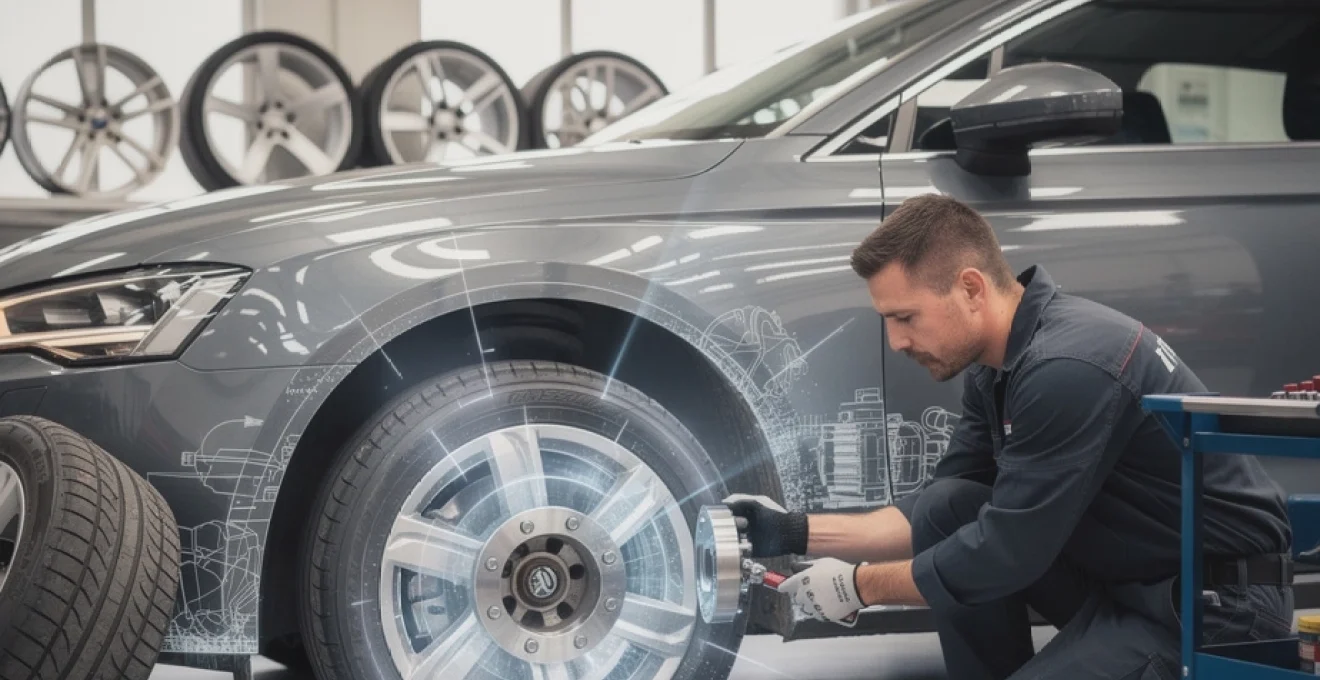
Wheel spacers divide opinion more than almost any other bolt-on modification. Some drivers use them for years without a single issue, while others share horror stories of wheels parting company with the car on the motorway. If you hate the look of sunken wheels and want a flush stance, the question is simple: are wheel spacers actually safe for everyday driving, including wet B-roads, speed bumps and long-distance commuting? The honest answer is that they can be *very* safe – or genuinely dangerous – depending on design quality, installation and how the car is used. Understanding how spacers interact with suspension geometry, wheel bearings and tyres helps you make an informed decision instead of relying on internet myths.
How wheel spacers work: track width, scrub radius and load paths in everyday road use
At the most basic level, a wheel spacer is a precisely machined disc that sits between the hub and the wheel. By moving the wheel mounting face outward by 5–30 mm, it increases the car’s track width and effectively changes the wheel offset (`ET`). That simple change has multiple consequences for daily road use: it alters load paths through the hub, adjusts scrub radius and subtly shifts steering geometry. Think of the wheel spacer as adding a short extension to a spanner – the same force applied at the end now creates more leverage on the nut. For a road car used in mixed conditions, getting that leverage increase under control is the key to safe, reliable performance.
Axial and radial load transfer through wheel spacers on MacPherson strut and multi-link suspensions
Under normal conditions, the majority of the vehicle’s weight passes axially through the hub face into the wheel, with radial forces generated during cornering, braking and acceleration. On a MacPherson strut front end, common on modern hatchbacks and saloons, the hub assembly supports both vertical load and steering forces. Adding a wheel spacer does not suddenly transfer the car’s weight into the wheel bolts; in a correctly designed hub-centric system, the hub lip continues to locate and support the wheel, with the spacer acting as a solid extension of that hub. The clamping force from the wheel bolts or studs simply locks the stack of components together. For multi-link rear suspensions, the principle is the same: the spacer becomes part of a rigid sandwich, so long as surfaces are flat and the spacer bore matches the hub spigot precisely.
Impact of increased track width on scrub radius, steering geometry and torque steer
Increasing track width with 10–20 mm spacers on each side slightly changes scrub radius – the distance between the tyre contact patch centre and the point where the steering axis meets the road. A small positive increase can sharpen steering feel and reduce body roll in everyday cornering because the tyres now operate with a wider stance. However, aggressive spacer sizes can over-extend scrub radius and produce heavier steering, bump-steer and more pronounced tramlining. On front-wheel-drive platforms prone to torque steer, extra track combined with wide tyres can exaggerate steering tug under hard acceleration. For daily driving, many chassis engineers consider 5–15 mm per side a sensible range, especially if you value predictable steering feel in the wet and on uneven road surfaces.
Changes in wheel offset (ET), backspacing and leverage on hub and bearing assemblies
From an engineering perspective, a wheel spacer is simply altering `ET` and backspacing. Reducing offset by 15 mm with a spacer moves the tyre contact patch outwards by the same amount, increasing the bending moment on the hub and bearing. Industry data from several OE suppliers suggests that a 20 mm outward move can raise bearing load by around 8–12% in typical cornering situations. That does not instantly destroy components, but it can shorten bearing life if combined with heavy wheels, low-profile tyres and poor-quality roads. For an everyday commuter, it makes sense to treat thick spacers like wider wheels: choose modest sizes, use quality hubs and monitor any increase in bearing noise or play over time.
Effect on unsprung mass, rotational inertia and ride comfort in daily commuting
Most forged aluminium spacers in the 10–20 mm range add roughly 0.6–1.2 kg per corner. In terms of unsprung mass and rotational inertia, that is comparable to moving from a light OE wheel to a slightly heavier aftermarket alloy. You may notice a marginal difference in ride sharpness over potholes, but on a typical UK B-road this is usually overshadowed by tyre choice and wheel size. The crucial factor is material: forged or billet aluminium keeps weight low, whereas steel spacers can add 2–3 kg per corner and noticeably dull suspension response. For an everyday-driven car, especially an EV or crossover already carrying more mass, opting for lightweight `forged aluminium` spacers helps preserve both comfort and efficiency.
Types of wheel spacers for road cars: bolt-on, slip-on and hub-centric designs compared
Wheel spacers for daily-driving road cars fall into a few main categories, and choosing the right design has more impact on safety than almost any other decision. The two most common formats are slip-on spacers, which slide over existing studs or hub spigots, and bolt-on spacers, which secure to the hub with one set of fasteners and present a new set of studs or threaded holes for the wheel. Within those, the distinction between hub-centric and lug-centric construction determines how loads are shared. Selecting a well-engineered solution that matches the wheel, hub and driving style is more important than chasing the maximum possible spacer thickness for an aggressive stance.
Hub-centric vs lug-centric spacers and their role in preventing vibration at motorway speeds
Hub-centric spacers use a machined centre bore that matches the hub diameter and a raised lip that replicates the original spigot for the wheel. This ensures that the wheel is centred on the hub, not on the bolts, maintaining concentricity and greatly reducing the chance of vibration above 60 mph. Lug-centric spacers, often branded as “universal”, rely on the wheel bolts alone to centre the assembly. That might be acceptable for a track-only car checked after each session, but for a road car used on motorways and dual carriageways it is a recipe for steering shake and uneven tyre wear. For everyday driving, hub-centric design is effectively non-negotiable if smoothness and long-term reliability matter to you.
Slip-on spacers with extended wheel studs: use cases for OEM wheels from BMW, audi and Mercedes-Benz
Slip-on spacers in the 3–12 mm range are common on BMW, Audi and Mercedes-Benz platforms where the hub spigot is long and OE wheel design allows extra space. With these, the spacer slides over the hub, and the wheel bolts or studs simply need to be extended by the exact spacer thickness to maintain correct thread engagement. An OE BMW bolt with 25 mm of thread paired with a 10 mm spacer, for example, requires a 35 mm threaded section to preserve at least 1.5× diameter of engagement. When fitted correctly, this approach works extremely well for daily-driven cars wanting a subtle stance improvement while retaining factory alloys and tyre sizes.
Bespoke bolt-on spacers for aftermarket alloys from BBS, OZ racing and rotiform
For thicker applications – typically 15–30 mm – bolt-on spacers are often safer and easier to package, especially with aftermarket wheels from brands like BBS, OZ Racing and Rotiform. These spacers bolt to the original hub using dedicated bolts or nuts and then present new studs or threaded holes positioned to match the wheel’s `PCD`. Properly engineered bolt-on systems are designed so that the original studs do not protrude beyond the spacer’s rear face, allowing the wheel to sit completely flush. On daily-driven performance cars, this approach offers robust load transfer and reduces the risk of insufficient thread engagement, provided all torque specs are observed religiously.
Spacer materials and coatings: forged aluminium, billet alloy, steel and anodised finishes
Material choice is central to spacer safety under everyday loads. High-quality spacers use `6061‑T6` or `6082‑T6` forged aluminium, or precision billet alloy, delivering tensile strengths in the 280–320 MPa range with low weight and excellent fatigue resistance. By contrast, cheap cast spacers can have less than half that strength and inconsistent density, increasing the risk of cracking or deformation over potholes and speed bumps. Steel spacers, although strong, are heavy and can accelerate bearing wear. Surface treatments also matter: hard anodising improves corrosion resistance and reduces galling between spacer and hub, which is particularly valuable on cars used through salty UK winters. A clean, smooth anodised finish also helps achieve uniform clamping when the wheel bolts are tightened.
Engineering risks: bearings, wheel studs and hub assemblies under daily driving loads
From an engineering standpoint, the core question is not whether wheel spacers can be used, but how they change the stress state of bearings, studs and hub flanges under thousands of real-world load cycles. Everyday driving in the UK means potholes, speed cushions, hard braking for roundabouts and extended high-speed cruising. Under those conditions, even a modest 10 mm spacer will subtly increase bending loads and fatigue on critical components. Understanding these risks allows you to stay within safe margins and choose spacer sizes and materials that reflect how the car is actually used, rather than how it looks parked at a meet.
Increased bending moments on wheel bearings and hub flanges with 5–30 mm spacers
Wheel bearings are designed around an expected range of offsets and tyre sizes, with OEMs building in a safety margin for optional wheels. Adding spacers increases the moment arm from the bearing centre to the tyre contact patch. Data from several bearing manufacturers suggests that each additional 10 mm of offset can increase bearing load by roughly 6–8% in typical cornering at 0.5g. At 30 mm, that could be a 20% rise, especially on heavy SUVs and EVs. On a lightly driven hatchback with 10 mm spacers, the effect on service life may be negligible. On a two-tonne EV running 25 mm spacers and 20‑inch wheels, expect bearings and hub flanges to experience meaningfully higher fatigue, making regular inspection very important.
Wheel stud and bolt tensile stress, fatigue and shear failure scenarios
Correctly installed spacers keep wheel bolts and studs primarily in tension from the clamping force, with minimal shear load. Problems arise when thread engagement is too short, bolts are under‑torqued, or surfaces are dirty or uneven. Studies of wheel retention failures show that insufficient torque is responsible for a large majority of incidents, often above 70%. Under-torqued fasteners lose clamping force, allowing micro-movement between hub, spacer and wheel, which then cycles the studs in bending and shear instead of pure tension. Over-torquing can be just as dangerous, stretching bolts past their elastic limit and reducing their fatigue life. Using high-grade `10.9` or `12.9` hardware, matched to the spacer and torqued accurately, is critical for safety in daily use.
Corrosion, galling and fretting between spacer, hub face and wheel mounting pad
In a UK climate, corrosion is a long-term enemy of safe wheel spacer use. Bare aluminium spacers mounted to rusty steel hubs can suffer galvanic corrosion, causing the spacer to seize onto the hub and compromising flatness over time. Fretting – tiny relative movements between metal faces under load – can create fine debris that further reduces friction and clamping stability. For a car that sees all-weather daily use, preparing the hub face properly and using anti-seize compounds sparingly on the hub spigot (not the friction faces) goes a long way to controlling corrosion and ensuring the spacer continues to sit flat for years rather than months.
NVH (noise, vibration, harshness) issues: wheel wobble, steering shake and brake judder
Noise, vibration and harshness issues are often the first sign that something is wrong with a wheel spacer installation. Slight off‑centre mounting can show up as a steering wheel shimmy at 60–70 mph, sometimes misdiagnosed as wheel balance problems. If a spacer is not perfectly concentric, even a 0.1 mm runout at the hub can translate into noticeable vibration. Over time, this can accelerate tyre wear and induce brake judder as discs see uneven loading. For everyday driving comfort, it is essential that spacers are machined to tight tolerances and that hub faces are free from rust and debris so the assembly runs true at motorway speeds.
Interaction with run-flat tyres, low-profile setups and heavy EV battery platforms
Modern run-flat tyres and low-profile performance tyres already transmit more impact energy into suspension and hub components than taller conventional tyres. Adding spacers to a car running 30‑ or 35‑profile tyres on large-diameter wheels concentrates loads even more sharply, especially over potholes. Heavy EVs compound this: with battery packs often pushing kerb weights above 2,000 kg, the additional leverage from spacers can significantly raise peak loading on bearings and control arms. For a daily-driven EV or plug-in hybrid, modest spacer widths, forged aluminium construction and frequent checks for bearing noise provide a more sustainable compromise between stance and durability.
Quality and certification: how to choose safe wheel spacers for UK road use
Choosing safe wheel spacers for everyday road use in the UK is largely a question of quality assurance, certification and compatibility with the specific hub platform. Not all spacers are created equal: reputable manufacturers invest in material testing, finite element analysis and independent approval processes, while cheap imports may rely on basic casting techniques and vague specifications. For a car that carries family, friends and luggage at 70 mph in the rain, investing in documented quality and proven design is not just a performance choice; it is a safety decision with direct consequences over the vehicle’s lifetime.
Tüv-certified wheel spacers from H&R, eibach and BIMECC for daily-driven vehicles
One of the strongest indicators of quality in the spacer world is TÜV certification. Brands such as H&R, Eibach and BIMECC submit their products to rigorous testing, including material analysis, fatigue cycles and fitment checks on specific vehicles. While TÜV approval is not mandatory for UK use, it demonstrates that the spacer has been evaluated against recognised engineering standards rather than built purely to a price. For a daily-driven vehicle that sees long motorway journeys and occasional emergency manoeuvres, TÜV‑certified spacers offer reassurance that geometry changes remain within safe engineering limits and that hardware specifications are appropriate for repeated high-load cycles.
CNC machining tolerance, concentricity and surface flatness for secure clamping
High-quality spacers are produced on modern CNC machines to tight tolerances for bore diameter, `PCD`, stud positioning and surface flatness. Typical premium products target concentricity values under 0.02 mm and surface flatness within a few hundredths of a millimetre. That precision matters because any deviation increases runout and creates uneven clamping, both of which can lead to vibration and premature component wear. When evaluating spacers, visible machining quality, sharp edges around the centre bore and inconsistent anodising can signal poor process control. In contrast, cleanly chamfered edges, crisp bolt holes and a uniform finish usually reflect better tooling and inspection standards.
High-tensile hardware specifications: 10.9 / 12.9 wheel bolts, studs and nuts
The best spacer systems use high-tensile bolts and studs explicitly rated at `10.9` or `12.9` to handle the increased tensile stress from thicker spacers and heavy wheels. These classes specify minimum yield and tensile strengths, offering a predictable safety margin compared to unmarked or low-grade hardware. For road use, matching bolt grade to the car’s weight and intended spacer thickness is vital. Lightweight hatchbacks on 8–12 mm spacers may be adequately served by 10.9 hardware, whereas large SUVs or EVs on 20–25 mm spacers benefit from 12.9 studs and nuts torqued accurately using a calibrated wrench to maintain consistent clamping load.
Verifying compatibility with OEM hubs on VW MQB, BMW g-series and ford focus platforms
Modern platforms such as VW MQB, BMW G‑series and the latest Ford Focus use specific hub diameters, bolt patterns and wheel bolt lengths that must be matched exactly. Even a 0.1 mm discrepancy in centre bore size can compromise hub-centric location, while incorrect `PCD` will prevent full contact across the hub face. Before selecting spacers for daily use, checking that the product is listed specifically for the exact model, year and brake package is essential. Mixing and matching generic designs increases the risk of vibration, interference with calipers or insufficient thread engagement, any of which can turn a straightforward stance upgrade into a long-term reliability issue.
Installation best practice: torque procedures and inspection intervals for everyday driving
A significant proportion of wheel spacer incidents have nothing to do with the spacers themselves and everything to do with installation. For a car that covers thousands of miles per year, correctly preparing the hub, tightening fasteners in the right sequence and re-checking torque after an initial bedding-in period are fundamental habits. Treating spacer installation like any other critical safety task – comparable to fitting brake components – dramatically reduces the chance of vibration, loosening or hardware failure on fast A-roads and motorways.
Correct use of torque wrenches, torque specs and tightening sequences for PCD patterns
Wheel bolts and spacer fasteners should always be tightened using a quality, calibrated torque wrench, set to the vehicle or spacer manufacturer’s recommended specification. For most modern road cars, this falls between 100 and 140 Nm, but referring to the specific handbook or technical data is important. Bolts must be tightened in a star or criss-cross pattern across the `PCD` to distribute clamping force evenly. Spinning all bolts in by hand first, then tightening them in stages – for example, 50%, 80%, then 100% of final torque – helps seat the spacer and wheel correctly without introducing distortion or uneven stresses.
Hub and spacer preparation: cleaning, rust removal and application of anti-seize compounds
A clean, flat hub face is one of the most overlooked aspects of safe spacer use. Before fitting, the hub surface should be wire-brushed to remove rust, scale and old paint, then wiped clean so the spacer contacts metal uniformly. Any raised corrosion can create a high spot, leading to runout and vibration. A very thin smear of copper grease or anti-seize on the hub spigot (not on the friction faces where the spacer and wheel clamp) helps prevent corrosion and seizure, especially on cars driven through winter. This simple preparation step can make the difference between a smooth, trouble-free setup and repeated wheel wobble diagnoses.
Post-install torque checks, periodic inspections and MOT preparation in the UK
After fitting spacers, re-checking torque after 50–100 miles of mixed driving is widely recommended. During this period, minor settling of paint, coatings or debris can slightly reduce clamping force. For a daily driver, periodic checks every 6 months or 5,000 miles provide additional assurance that nothing has loosened. From an MOT perspective in the UK, testers focus on wheel security, tyre coverage and interference with suspension or bodywork. Spacers themselves are not prohibited, provided wheels sit within the arches and there is no evidence of contact or excessive play. A quick visual inspection before the test, ensuring clean hardware and correct torque, helps avoid advisory notes related to wheel fitment.
Common installation errors causing wheel loss, stud failure and vibration on dual carriageways
Most dramatic spacer failures can be traced back to a small set of repeatable mistakes. Typical errors include using stock wheel bolts with slip-on spacers, leaving too few threads engaged; failing to remove rust from the hub, causing the spacer to sit off-centre; mixing tapered and ball-seat bolts, which prevents proper seating; and using impact guns at random power settings instead of a torque wrench. Any of these can result in a gradual loosening of the assembly, leading first to mild vibration and, in worst cases, to broken studs or wheel loss at speed. Recognising these pitfalls and avoiding “near enough” shortcuts is essential for anyone relying on spacers in everyday driving.
Legal and insurance considerations for wheel spacers on UK roads
In the UK, wheel spacers are legal for road use as long as overall wheel and tyre fitment complies with Construction and Use Regulations. The primary legal requirement is that the tyre tread does not protrude beyond the outer edge of the bodywork or arch extensions. For everyday use, this means selecting spacer sizes that create a flush appearance without pushing the tyre beyond the arch line. During an MOT, testers check for fouling on bodywork or suspension at full lock and under load; any evidence of rubbing can result in a fail or advisory, particularly where spacers have been used to force an inappropriate wheel offset.
From an insurance perspective, spacers are classed as a modification and must be declared, even if the car is otherwise stock. Many mainstream insurers treat properly fitted hub-centric spacers as a minor handling or cosmetic alteration, with negligible premium impact when disclosed truthfully. However, case studies show that undeclared modifications can lead to claims being refused, even where the spacer played no role in an accident. For a daily-driven vehicle, especially one used to carry family or for commuting, listing wheel spacers accurately on the policy documentation is a simple but vital safeguard against post-incident disputes.
Professional installation or, at minimum, documented adherence to manufacturer instructions, also strengthens your position if a claim is investigated. Keeping receipts for TÜV‑certified spacers, high-tensile hardware and any workshop labour provides evidence that the modification was engineered responsibly rather than improvised. As cars become heavier, faster and more electronically controlled, insurers increasingly expect that geometry changes such as altered offset and track width have been considered carefully. Treating wheel spacers as part of a holistic wheel and tyre package – matched to the hub, suspension and intended use – ensures that both legal and insurance requirements remain satisfied throughout daily driving.