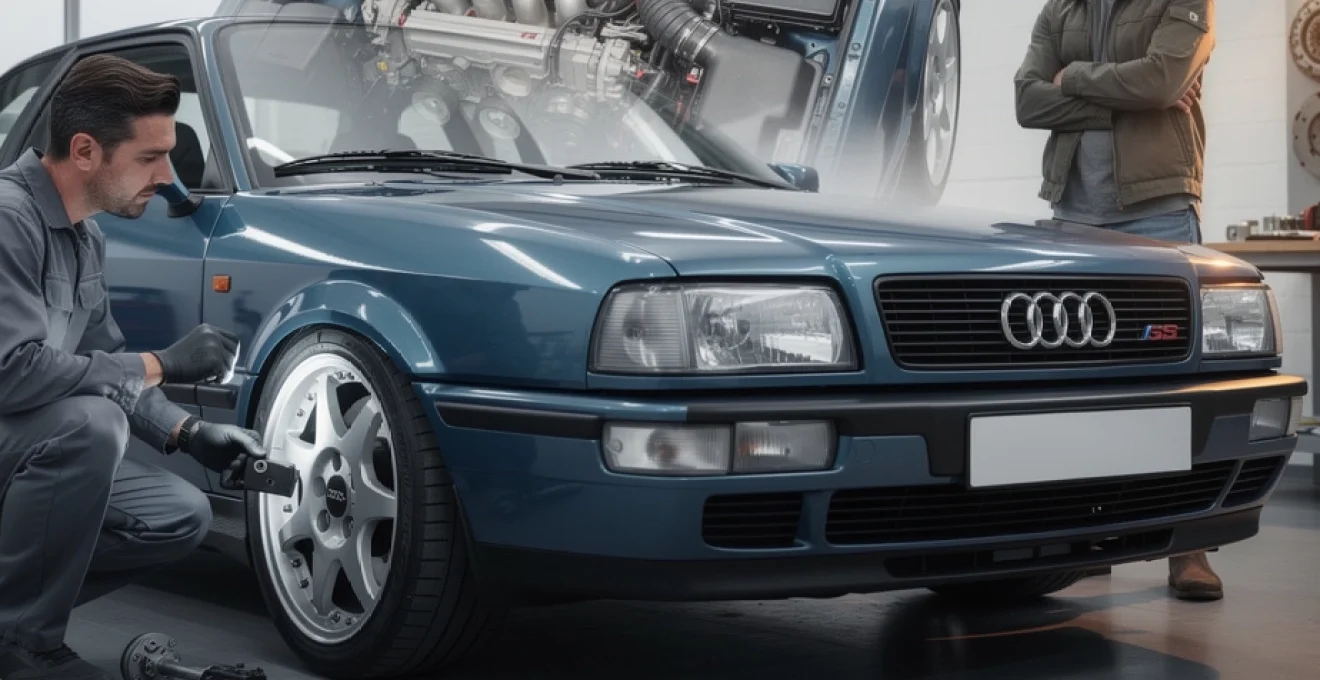
The Audi S2 Coupé quattro sits at a fascinating crossroads in performance car history. Born at the tail end of Group B rally glory and the rise of sophisticated all-wheel-drive road cars, it blends the raw character of the original Ur‑quattro with the refinement of Nineties executive machinery. For anyone who wants a usable modern classic that still feels genuinely special on a wet B‑road, the S2 Coupé delivers a mix of pace, build quality and under‑the‑radar appeal that newer cars often struggle to match. Values remain relatively sensible compared with the iconic Quattro, yet the engineering depth, tuning potential and long‑term collectability make it a deeply rewarding choice if you know what to look for.
Audi S2 coupé quattro development history and position in the B3/B4 performance lineage
From audi 80 B3 to S2: internal project typ 8C and the influence of the ur‑quattro
The S2 Coupé emerged from the late‑Eighties Audi 80 B3 programme, internally coded Typ 8C for the coupé derivative. While the Audi 80 platform prioritised refinement and crash safety, engineers were under pressure to retain the character that had made the Ur‑quattro such a cult hero. The solution was a more rigid shell, improved aerodynamics (drag coefficient cut to about 0.32) and the familiar 2.2‑litre 20‑valve five‑cylinder turbo. If you trace the body side profile, you can see the visual lineage: broad shoulders, relatively upright glass and that slightly formal roofline that makes the coupé practical as well as stylish.
Where the Ur‑quattro felt like a road‑legal rally car, the S2 was conceived as a more rounded GT. Noise insulation, better HVAC, and more sophisticated electronics all pushed it upmarket. That repositioning explains why some early reviewers felt it had “gone soft”, yet for today’s enthusiast looking for a fast road car that can cover serious mileage, that original development intent is a real advantage. In many ways it is the missing link between the brutal Eighties turbo era and the polished early‑2000s S and RS models.
Model years, chassis codes (8C, B3, B4) and key production changes 1990–1995
The S2 Coupé was launched in 1990 with the 3B engine and a five‑speed gearbox, based on the B3 platform. In 1992/93 it received a major mechanical makeover, effectively moving to B4 architecture beneath broadly similar bodywork. The facelift brought the ABY engine with 230 bhp, a six‑speed transmission and numerous detail upgrades to suspension, electronics and safety systems. Top speed climbed to around 150 mph, and the extra ratio lowered cruising revs, turning the car into a more relaxed long‑distance companion.
Production of the S2 Coupé ran until 1995, but volumes were always modest compared with mainstream Audi 80 saloons and estates. For context, only around 306 S2 saloons were ever built worldwide, illustrating how niche the performance quattro line still was at that point. For a buyer today, understanding the split between early 3B and late ABY cars is essential, because it affects tuning options, gearbox strength and even insurance classification. Service records that reference the exact PR‑codes and VIN build data can help decode which specification you are actually looking at.
Relationship to contemporary models: audi 80 competition, S4 C4, RS2 avant and early s‑cars
The S2 Coupé quattro did not exist in isolation. It was part of a broader performance ecosystem that included the C4 S4 (later badged S6), the Audi 80 Competition for touring car homologation, and ultimately the legendary RS2 Avant. The 2.2 20V turbo engine formed the backbone of this family, allowing Audi to share development costs while tailoring character to each bodystyle. Where the S4 C4 felt like a continent‑crushing express and the RS2 Avant a practical supercar, the S2 Coupé occupied the role of compact, premium driver’s car.
For anyone looking at the wider Nineties quattro landscape, this interconnected line‑up is one reason why the S2’s long‑term significance is only now being properly recognised. It was the first road car to wear the S badge, making it the spiritual ancestor of every S3, S4, S5 and S6 since. Enthusiasts who want a coherent garage of early S and RS models often start with an S2 Coupé as the purest expression of that early philosophy.
UK and european market differences in trim, equipment and option codes (PR‑codes)
Market‑specific trim and PR‑codes can dramatically change the feel and value of an Audi S2 Coupé quattro. UK cars typically arrived with generous standard equipment – ABS, quattro drivetrain, electric windows and often leather or half‑leather upholstery. Continental European cars sometimes offered more choice in suspension tuning, seat fabrics and climate control packages. Certain options, such as factory sport seats, headlamp washers and sunroof delete, are now particularly prized by collectors.
When you inspect a potential purchase, decoding the option sticker in the boot or service book offers insight into how the car left the factory. For example, cars specified with winter packs, heated mirrors and upgraded audio systems can feel far more modern in daily use. On the other hand, a lighter, less optioned S2 may appeal if you value a more focused driving experience. Understanding these differences helps you judge whether the asking price reflects genuine rarity or just cosmetic extras added later in life.
2.2 20V turbocharged five‑cylinder engine (3B and ABY) and tuning potential
3B vs ABY engine codes: mechanical differences, ECU architecture and boost control strategies
The heart of the S2 Coupé quattro is the 2.2‑litre 20‑valve five‑cylinder turbo, an engine with roots in the Sport Quattro and Group B rallying. Two main codes matter here: 3B and ABY. Early 3B units produce around 217 bhp and use a distributor ignition system with Bosch Motronic control. Later ABY units deliver 230 bhp, feature coil‑on‑plug ignition and use more advanced Motronic architecture with improved diagnostics and knock control. That shift to individual coils not only enhances reliability but also opens the door to more sophisticated remapping strategies.
Boost control on 3B engines tends to be a little more old‑school in feel, with a pronounced surge when the turbo comes on song. ABY mapping smooths the torque curve and offers better part‑throttle behaviour, making the car feel less peaky in everyday driving. For a long‑term keeper, an ABY‑powered S2 often makes more sense, especially if 300+ bhp is on the horizon. However, enthusiasts who enjoy a slightly wilder character may prefer the earlier 3B with its classic turbo punch.
K24 vs K24‑7200 turbochargers, wastegate configuration and spool characteristics
Both 3B and ABY engines use variants of the KKK K24 turbocharger, but the details matter if you are chasing specific power goals. The earlier K24 unit offers strong mid‑range torque and acceptable lag by Nineties standards, but the later K24‑7200 introduced on ABY and RS‑derivatives can sustain higher boost more efficiently. Think of it as moving from a simple hammer to a more precise, yet still very tough, tool. Wastegate configuration and boost control valve tuning also evolved, giving the ABY setup finer control and slightly better response.
On the road, a healthy stock S2 spools by around 2500–2800 rpm, delivering a thick wave of torque that suits British A‑roads and autobahn cruising alike. If you are used to modern twin‑scroll units, the initial lag may feel old‑fashioned, but it quickly becomes part of the car’s charm. For those considering turbo upgrades, understanding how the K24 behaves provides a useful benchmark against which to judge hybrid or larger framed alternatives.
Bosch motronic mapping, knock control and safe power limits on stock internals
Bosch Motronic management on the S2 Coupé quattro is robust, especially on ABY cars with enhanced knock sensing and adaptive strategies. Factory mapping is conservative, reflecting the fuel quality and warranty expectations of the early Nineties. On quality 98 RON fuel, an unmodified engine in good health can reliably handle modest increases in boost and timing via a stage 1 remap, typically lifting power to around 260–280 bhp. Well‑documented builds and dyno charts over the last decade show that stock internals can comfortably cope with 320–340 bhp if tuning is executed with care.
Detonation is the primary risk when pushing these engines. Keeping intake temperatures under control, maintaining a healthy fuel system and respecting knock sensor feedback are non‑negotiable. Professional tuners often log parameters like ignition advance, lambda and charge temperature to ensure the calibration stays on the safe side. If you are ambitious, setting a clear target – for example “safe 300 bhp road map” vs “occasional 400 bhp track use” – makes it easier to choose the right components and avoid chasing numbers at the expense of longevity.
Stage 1–3 remaps, larger injectors and intercooler upgrades for 300–400 bhp builds
For many owners, a stage 1 remap on a largely standard Audi S2 Coupé quattro provides the best balance of performance and reliability. Expect improved throttle response, stronger mid‑range and a little more top‑end urgency, transforming the car without compromising daily drivability. Stage 2 packages usually add a freer‑flowing exhaust, panel filter or intake improvements and sometimes a modest intercooler upgrade. Power in this range typically sits around 300 bhp, enough to embarrass many modern hot hatches in real‑world conditions.
Stage 3 S2 builds aiming for 350–400 bhp require more serious hardware: larger injectors, uprated fuel pump, significantly improved intercooling and often a hybrid or larger turbo. At this point, clutch and drivetrain upgrades become essential, as do brakes and suspension improvements. Approach such builds as a system rather than a collection of parts. A well‑engineered 380 bhp S2 with balanced cooling and fuelling will feel far more satisfying – and far less fragile – than a peaky 420 bhp car built purely for headline dyno figures.
Common failure points: head gasket, distributor vs coil‑on‑plug, breather and PCV system
Despite its reputation for toughness, the 2.2 20V turbo engine has a few known weak spots that you should factor into any pre‑purchase inspection. Head gasket failures are not endemic but can occur if the engine has been overheated or run with marginal cooling for long periods. Milky oil, pressurised coolant hoses and unexplained coolant loss warrant further investigation. On early 3B engines, distributor ignition adds another potential failure point, whereas coil‑on‑plug ABY setups generally prove more reliable over high mileage.
The breather and PCV system is another area that deserves attention. Sludged‑up breathers can cause increased crankcase pressure, oil leaks and even smoking under boost. Many long‑term owners proactively refresh hoses, check valves and separators as preventative maintenance. Oil leaks from cam cover gaskets and front crank seals are common age‑related issues rather than signs of fundamental engine weakness. As with any classic turbocharged motor, frequent oil changes with quality synthetic lubricant and a sensible warm‑up and cool‑down routine pay dividends in engine life.
quattro drivetrain, gearbox variants and differential technology in the audi S2 coupé
Torsen centre differential behaviour, torque split and impact on handling balance
The Audi S2 Coupé quattro uses a mechanical Torsen centre differential, a cornerstone of the brand’s all‑wheel‑drive reputation. Under normal conditions the torque split is roughly 50:50 front to rear, but the Torsen can bias up to around 75% of torque to the axle with more grip. Think of it as a self‑balancing system of gears that constantly shuffles power to where it can be used most effectively, without waiting for electronics to intervene. The result is secure traction in poor weather and a distinctive, slightly nose‑led handling balance in the dry.
On a twisty B‑road, you can lean on the mechanical grip and traction, using the torque of the five‑cylinder motor to pull the car out of slower corners with authority. The S2 is not an oversteer hero by default; instead, it rewards smooth inputs and careful weight transfer. Upgraded suspension and tyres can coax a more neutral balance from the chassis, but the underlying Torsen behaviour remains an integral part of the car’s character and appeal.
5‑speed 3B gearbox vs 6‑speed ABY/ADZ units: ratios, strength and motorway cruising
Transmission choice is another key split between early and late S2 Coupé models. The five‑speed 3B gearbox offers wider ratios and a more old‑school feel, with slightly higher revs at motorway speeds and a more pronounced step between gears. Road tests from the period praised its light, precise shift quality, and many owners still regard it as one of Audi’s best Nineties gearboxes from an engagement point of view. That said, it can feel a touch busy at modern cruising speeds compared with later units.
The six‑speed ABY/ADZ gearbox brings closer ratios for spirited driving and a longer top gear, dropping revs and noise on the motorway. This makes the later S2 an excellent long‑distance car, capable of sustained high‑speed cruising where legal without feeling stressed. In tuning circles, both gearboxes are considered strong, but once torque exceeds around 450–500 Nm, sympathetic driving and regular oil changes become increasingly important for longevity. Many owners treat a gearbox oil change every 40,000 miles as cheap insurance.
Rear differential lock: vacuum‑actuated locker, switchgear and diagnostics
One of the more charming period features of the S2 Coupé quattro is the vacuum‑actuated rear differential lock. Operated via a cabin switch, it locks the rear diff at low speeds to improve traction on slippery surfaces such as snow, mud or wet grass. Once speed rises above a preset threshold, the system automatically disengages for safety. It is a reminder of the car’s rally‑inspired heritage and can be genuinely useful in challenging conditions or when manoeuvring on steep, low‑grip driveways.
However, age can take a toll on the vacuum lines, actuators and dashboard switchgear. During any pre‑purchase test drive, engaging the diff lock on a safe, low‑speed surface provides a quick diagnostic. Indicator light behaviour, audible changes in tyre scrub and the feel of the drivetrain as you turn a tight circle can all confirm whether the system still functions correctly. Repairs are usually straightforward but require methodical tracing of vacuum hoses and careful attention to perished rubber components.
Clutch, flywheel and propshaft upgrades for high‑torque S2 builds
Once power levels climb beyond standard output, drivetrain upgrades become essential for a reliable, high‑torque Audi S2 Coupé quattro. The stock clutch is adequate for stage 1 levels, but sustained use at 330+ bhp and 450 Nm will eventually highlight its limits, especially if launch control or aggressive standing starts are involved. Many tuners recommend a performance clutch and, in some cases, a single‑mass flywheel conversion to improve response and heat resistance. This does introduce more drivetrain noise, so consider your personal tolerance for NVH.
The propshaft and centre bearing mount can also suffer with age and increased torque. Vibration under load, droning at specific speeds or visible play when the car is on a lift suggest that attention is due. Upgrading mounts, renewing universal joints where possible and ensuring correct alignment can transform refinement. Treat the quattro system as an integrated whole: clutch, gearbox, propshaft, diffs and driveshafts all share the load, and neglecting one link in the chain can compromise the entire driving experience.
Chassis, suspension and braking: transforming the S2 coupé quattro on road and track
Macpherson strut and rear trailing arm geometry, bump‑steer and camber considerations
The S2 Coupé quattro uses a front MacPherson strut layout combined with a rear trailing arm and subframe arrangement, derived from the Audi 80 platform. As standard, geometry targets stability and comfort rather than razor‑sharp turn‑in. Age‑related wear in bushes and ball joints can introduce play, dulling steering response and causing uneven tyre wear. Bump‑steer can also become more noticeable if ride height is altered without correcting geometry, especially at the front axle.
For an enthusiast‑focused setup, a modest drop in ride height combined with slightly increased negative camber and refreshed bushes works wonders. Adjustable top mounts, uprated anti‑roll bars and careful alignment can deliver a front end that feels significantly more alert without sacrificing the planted, confidence‑inspiring character that defines the quattro platform. Think of it as moving the needle from “GT” towards “fast road”, rather than trying to turn the car into a track‑only weapon.
Suspension upgrades: bilstein B6/B8, koni, H&R, eibach and coilover conversions
Suspension choice has a huge influence on how your Audi S2 Coupé quattro feels. Popular damper options include Bilstein B6/B8 and Koni adjustables, often paired with H&R or Eibach springs for a firmer, lower stance. These combinations offer a well‑judged balance between comfort and body control, ideal for fast road use and occasional track days. Ride quality on poor UK surfaces remains acceptable, especially if you avoid extreme drops or ultra‑stiff spring rates.
Coilover conversions provide more adjustability for ride height and damping but can easily compromise everyday usability if specified purely for looks or maximum stiffness. Before committing, ask what you really want the car to do. Is the goal a daily‑driven modern classic capable of long trips, or a primarily weekend machine optimised for dry‑weather blasts? Matching damper and spring choice to that use case pays off far more than chasing the most aggressive catalogue setup.
Brake systems: girling G60, HP2 calipers and porsche brembo 4‑pot swap options
Braking is often cited as one of the S2 Coupé’s weaker areas in standard form, particularly under sustained hard use. Many cars left the factory with Girling G60 front calipers and relatively modest disc sizes by modern standards. For everyday driving, these are adequate if in top condition with quality pads and fluid. However, repeated high‑speed stops or track days quickly expose their limitations, leading to fade and longer pedal travel.
Upgrades range from OEM‑plus HP2 calipers from later Audis to popular Porsche Brembo 4‑pot swaps, often using 968 Clubsport or 993 components with suitable brackets and discs. These conversions significantly improve bite, modulation and resistance to fade, especially when combined with performance pads and high‑temperature fluid. Rear brakes are less critical for outright stopping power but should not be ignored; a balanced setup that maintains proper brake bias is vital for stability under heavy braking.
Wheel and tyre setups: 16‑inch OEM avus vs 17‑inch and 18‑inch performance fitments
Wheel and tyre choice can subtly, but decisively, alter the way an Audi S2 Coupé quattro behaves. Factory 16‑inch Avus alloys with quality 205 or 225‑section tyres offer good ride comfort and period‑correct styling. Sidewall compliance helps the suspension cope with broken tarmac, and the steering often feels more communicative than with larger, heavier wheels. For many owners, a refreshed OEM set with modern performance tyres is the sweet spot for real‑world driving.
Moving to 17‑inch or even 18‑inch wheels allows wider rubber and increased brake clearance, but unsprung mass and ride quality can suffer. If you choose larger wheels, prioritise lighter designs and avoid excessively stretched tyres. A carefully selected 17‑inch setup on 225/45 rubber can deliver sharper turn‑in and more grip without ruining comfort, whereas some 18‑inch configurations introduce harshness that clashes with the car’s GT character. Alignment and tyre pressures should be tuned to match any new wheel package.
Interior, ergonomics and audi 90‑era build quality
Sport seats, steering wheels and interior trim options specific to S2 coupé models
The cabin of the Audi S2 Coupé quattro reflects Audi’s early‑Nineties reputation for solid, conservative luxury. Sport seats with deeper bolstering, three‑spoke steering wheels and S‑specific trim inserts distinguish it from lesser 80 coupés. Materials – from the soft‑touch plastics to the switchgear – generally age well when compared with many period rivals, which is one reason owners report that these cars still feel reassuringly dense and well screwed together even at 150,000 miles.
Trim options included full leather, half‑leather/velour and various colour schemes, with darker combinations generally hiding wear better over time. Finding an S2 with its original steering wheel, gearknob and unmodified dashboard adds to the sense of authenticity and can enhance resale value. If you are tall, seat adjustment and the relatively upright driving position often prove more comfortable than in later, more coupe‑styled Audis, making the S2 a surprisingly practical long‑distance car.
Instrumentation, boost gauges and integrating modern digital displays (AEM, zeitronix)
Instrumentation in the S2 Coupé quattro is functional rather than flashy, with clear analogue dials and basic warning lights. Factory boost indication is limited, so many enthusiasts add aftermarket boost gauges or multi‑function digital displays from brands such as AEM or Zeitronix. The challenge is integrating these without spoiling the period aesthetic. Discreet vent‑mounted or ashtray‑mounted solutions can provide vital data – boost, AFR, EGT – while remaining reversible for purists.
When planning such upgrades, think in terms of an OEM‑plus philosophy. Matching illumination colour, using factory‑style fonts where possible and routing wiring tidily helps maintain the sense that the cabin belongs to a premium German coupé. From a practical perspective, accurate boost and mixture information can also act as an early warning system for vacuum leaks, failing injectors or ignition issues, potentially saving significant repair costs down the line.
Common interior wear issues and OEM‑plus restoration strategies
Despite strong base quality, age inevitably takes its toll on S2 interiors. Common issues include sagging headliners, worn driver’s seat bolsters, cracked leather and failing foam beneath frequently used cushions. Switchgear for electric windows and mirrors can become intermittent, and heater control panels sometimes suffer from faded icons or sticky controls. Sunroof mechanisms, if fitted, also benefit from periodic cleaning and lubrication to avoid expensive failures.
For an OEM‑plus restoration, focus on subtle, high‑impact improvements. Professional leather recolouring, new floor mats in original patterns and careful plastic detailing can transform the atmosphere of the cabin. Replacement parts from donor Audi 80/90 models sometimes provide cost‑effective solutions for non‑S2 specific items. Aim to enhance rather than modernise; the S2’s slightly understated, analogue ambience is a significant part of its charm in a world of touchscreens and configurable ambient lighting.
Buying guide, rust hotspots and long‑term ownership of an audi S2 coupé quattro
Body and corrosion checks: rear inner arches, sills, jacking points and front subframe
While the Audi S2 Coupé quattro benefits from typically strong German build quality, no Nineties car is immune to corrosion. Rust is not as rampant as on some contemporaries, but UK climate and poor past repairs can create problem areas. Key hotspots include rear inner wheel arches, lower edges of the front wings, sills around the jacking points and the front and rear subframes. The join between bumper and front wing is a known trouble spot, especially if previous accident damage has been poorly addressed.
A thorough inspection should involve getting the car on a lift or at least safely raised to inspect underneath. Look for bubbling paint, underseal that appears freshly applied only in certain areas, and evidence of previous welding. Doors, boot lid and bonnet edges deserve attention, as do drainage channels around the sunroof and windscreen. Audi’s galvanisation helps, but three decades of British winters and road salt can defeat even the best factory protection if maintenance has been neglected.
Mechanical inspection checklist: turbo health, drivetrain noises and vacuum leaks
A structured mechanical checklist is invaluable when assessing an S2 Coupé quattro. Turbo health is a priority: excessive smoke on overrun, noticeable shaft play (if checked carefully with the intake off) and weak boost suggest either wear or control system issues. Boost leaks are common due to aged hoses and clamps; a car that feels flat or inconsistent may simply need a methodical pressure test to restore performance. Listen for misfires under load or at high rpm, which can hint at ignition or fuelling problems.
Drivetrain noises also tell a story. A whining rear differential or propshaft bearings, clunks when taking up drive and vibration under acceleration all warrant further investigation. During the test drive, pay attention to clutch bite point, gear engagement and any crunching when shifting quickly. ABS warning lights, intermittent speedometer operation and non‑functioning diff lock switches can indicate electrical or sensor issues that may be simple – or more involved – to remedy.
Service intervals, timing belt, auxiliary belts and 20V turbo‑specific maintenance
Evidence of correct servicing is perhaps the single most important factor in long‑term S2 ownership. Dedicated owners typically change engine oil every 5000–6000 miles using quality synthetic, well ahead of original factory intervals. Timing belt and associated tensioners should be replaced roughly every 60,000 miles or 5 years, along with the water pump for peace of mind. Pre‑ignition episodes due to timing or belt issues can be catastrophic, so documentation here is essential.
Auxiliary belts, crankshaft pulleys and the hydraulic system for power steering and brake assistance also need periodic attention. Many owners treat gearbox and differential oil changes at around 40,000‑mile intervals as prudent, even if official schedules were more relaxed. Spark plugs in these 20V turbo engines work hard; replacement roughly every 20,000 miles with correct heat range items keeps combustion healthy. A well‑maintained S2 can comfortably exceed 150,000 miles without major engine work, provided it has not been subjected to poorly executed tuning.
Parts availability, NLA components and specialist suppliers in the UK and europe
Parts availability for the Audi S2 Coupé quattro is a mixed picture. Service items such as filters, belts, many suspension components and general hardware remain readily available through main dealers and aftermarket suppliers. However, some model‑specific parts – trim pieces, unique interior plastics, certain body panels and specialist drivetrain components – are now NLA (no longer available) from Audi. This is where specialist breakers and enthusiast‑run businesses in the UK and Europe prove invaluable.
Planning for long‑term ownership means accepting that some items will require patience to source, and that buying a more complete, well‑cared‑for car often works out cheaper than rescuing a neglected example. Building a relationship with marque specialists, joining dedicated S2 and quattro forums and keeping an eye on used parts listings can significantly reduce stress when the time comes for bigger jobs. Treat the car as a long‑term project, and incremental improvements become part of the enjoyment rather than a chore.
Icon status, motorsport links and future collectability of the audi S2 coupé quattro
Connection to group B and group A rally heritage alongside ur‑quattro and S1 E2
The S2 Coupé quattro carries a direct bloodline to some of rallying’s most evocative machinery. The 2.2 20V five‑cylinder turbo traces its lineage back to the Sport Quattro and S1 E2, cars that defined the Group B era and reshaped the concept of all‑wheel‑drive performance. While the S2 itself never competed at the highest levels in factory hands, its technology and philosophy were shaped by lessons learned on gravel, snow and tarmac stages across the world. The soundtrack alone – that distinct warbling growl building to a hard‑edged howl – evokes an era when turbo flames and towering rear wings were commonplace.
For enthusiasts, owning an S2 Coupé offers a more accessible connection to that heritage than the increasingly unobtainable Ur‑quattro. Period marketing leaned heavily on rally imagery and the “win on Sunday, talk about it on Monday” ethos, even as the car itself evolved into a more civilised road machine. In today’s classic scene, that subtle motorsport DNA gives the S2 a depth of character beyond its spec sheet figures.
The Audi S2 Coupé quattro blends rally‑inspired engineering with grand tourer refinement, creating a modern classic that feels authentic rather than nostalgic.
Period road tests vs modern reviews: performance metrics and real‑world drivability
Period road tests often praised the S2 Coupé’s build quality, straight‑line performance and all‑weather security while criticising somewhat numb steering and a lack of excitement compared with rear‑drive rivals. Figures around 0–60 mph in 5.7–6.0 seconds and top speeds of 150 mph were impressive for the early Nineties, especially given the car’s refinement and practicality. Fuel economy in the mid‑20s mpg on mixed roads was typical, with low‑30s achievable on gentle motorway runs – still respectable today for a 2.2‑litre turbocharged performance coupé.
Modern reviewers, revisiting the S2 with three decades of hindsight, often take a more sympathetic view. Compared with contemporary hot hatches and turbocharged saloons, its steering and chassis feel honest, if not razor‑sharp. Real‑world drivability – the ability to deploy torque on a wet road without traction issues, the comfort on a 300‑mile trip, the sense of solidity – now stands out more clearly. The car invites a flowing, measured driving style rather than aggressive, point‑and‑squirt antics, which many owners find more rewarding on today’s crowded roads.
Judged against current machinery, the Audi S2 Coupé quattro feels like a fast analogue tool in a digital age – less instant, but more involving once you understand its rhythm.
Market values, limited‑run editions and investment outlook for well‑kept S2 coupés
Market values for the Audi S2 Coupé quattro have risen steadily over the last decade, but still lag far behind those of the Ur‑quattro. That gap reflects both the older car’s Group B icon status and the S2’s more subtle image, but it also creates opportunity. Clean, unmolested S2 Coupés with sensible mileage, comprehensive service history and factory‑correct specification are increasingly sought after. Late ABY cars, rare colour combinations and examples with desirable period options tend to command a premium.
From an investment perspective, the key is quality rather than chasing the cheapest entry point. Cars with evidence of meticulous maintenance, sympathetic upgrades – such as improved brakes and OEM‑plus suspension – and no significant rust will almost always hold value better than cosmetically tidy but mechanically tired examples. As parts for restoration become harder to find and interest in Nineties performance cars continues to grow, the S2’s role as the first S‑badged Audi and spiritual successor to the Quattro positions it well for further appreciation among informed enthusiasts.
Choose wisely, treat the S2 Coupé quattro as a long‑term companion rather than a flip, and it offers not only fast‑road enjoyment but also a credible case as a appreciating modern classic.