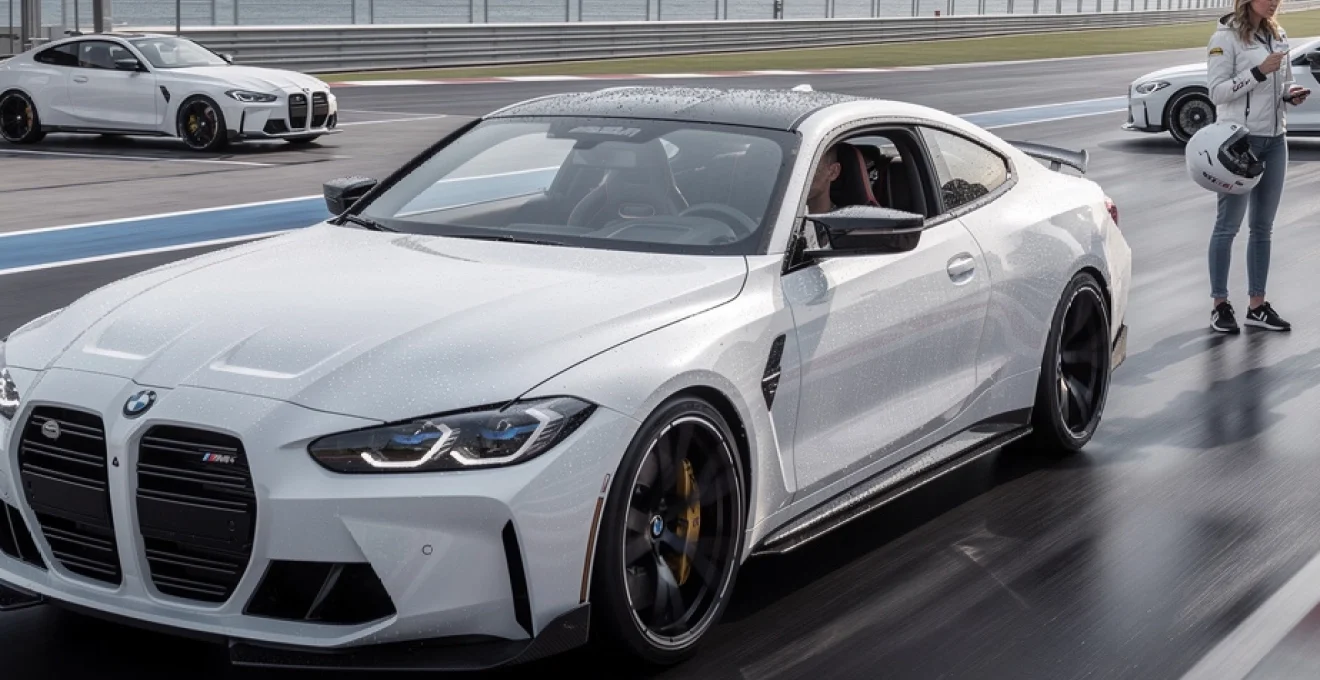
The BMW M4 in white has become something of a modern icon. The strong surfacing of the G82 body, the dramatic grille and the motorsport-inspired aero details all look sharper when framed by a pale paintwork. On UK roads crowded with grey and black cars, a white M4 stands out without feeling excessive, blending motorsport aggression with an almost architectural purity. For drivers who care as much about aesthetics as they do about lap times, a carefully specified white coupé can feel like a rolling business card that signals taste, intent and a serious interest in driving.
Colour choice also affects day-to-day usability, resale value and even perceived speed and safety in traffic. A white BMW M4 is more visible in poor light than darker cars, helps hide minor wash marring and, with the right detailing routine, can look freshly detailed even after a tough winter. Combine that visual clarity with the 390 kW (530 hp) output of the latest M4 Competition Coupé and you get a car that works equally well as a track-day weapon and an understated long-distance GT.
Design language of the white BMW M4: frozen brilliant white vs alpine white vs mineral white
Factory paint codes and finishes for the G82 BMW M4 in white (solid, metallic, BMW individual)
For the current G82 BMW M4, white paint is available across three main categories: solid, metallic and BMW Individual finishes. Alpine White is the classic non-metallic option, traditionally coded as A96. It delivers a clean, bright, almost clinical white that suits drivers who want a motorsport look and who enjoy regular detailing. Mineral White metallic, typically code A96’s metallic counterpart in earlier generations, adds pearl and metallic flake, giving the coupe more depth and a warmer tone under street lights.
BMW Individual takes things further with finishes such as Frozen Brilliant White, a matte or satin-style paint that transforms the M4 into something closer to a concept car. This kind of Frozen finish amplifies the sharp creases around the front arches and rear haunches, but it does require more careful maintenance to avoid shiny patches from incorrect polishing. For buyers building a truly bespoke M4, BMW Individual paint is also available alongside tailored interior trims and Merino leather combinations, turning a fast coupé into a highly personal object.
Contrasting elements: shadowline trim, black kidney grilles and carbon roof against white bodywork
White paint gives contrasting dark details a huge amount of visual impact. The optional BMW Individual High Gloss Shadow Line with extended contents adds gloss black treatment to the window surrounds, mirror caps, rear spoiler and tailpipes. Against Alpine or Mineral White, these deep black accents frame the car like a monochrome sketch. The frameless design of the G82 doors and the dark side glass line help lower the visual centre of gravity, emphasising the coupé’s stance.
The enlarged vertical kidney grille is especially sensitive to colour choice. On a white M4, gloss black grilles with Shadow Line surrounds help balance the proportions and visually narrow the nose. Add the carbon-fibre roof, standard on many M models, and the car becomes a striking two-tone composition without any need for decals. This dark upper section also reads as a motorsport cue, echoing the look of GT3 race cars with exposed composite roof panels.
Aerodynamic styling cues highlighted by white paint: front splitter, side skirts, rear diffuser and ducktail spoiler
Aerodynamic features tend to disappear on darker colours but become design highlights on white M4 models. The sculpted front bumper, with its large intakes and integrated air curtains, looks more technical because every edge throws a visible shadow line. When an M4 is fitted with the full M Performance body kit—front carbon splitters, side skirt extensions, rear diffuser and a ducktail or Gurney-style spoiler—the contrast between white bodywork and dark aero parts suggests track preparation even on a road car.
On Alpine White, these elements look crisp and almost surgical, while on Frozen Brilliant White they gain a softer, stealthier emphasis. For an owner planning track days at circuits such as Silverstone or the Nürburgring, this visual clarity is not just cosmetic. It makes it easier to spot stone chips, inspect aero components and quickly see if a splitter has made contact with an apex kerb or a steep driveway.
Visual impact of wheel designs on a white M4: 825M, 826M, 963M and forged M performance rims
Wheel choice dramatically alters the character of a white BMW M4. Factory 825M wheels, often in a bicolour finish, give a technical, multi-spoke look that works well with Mineral White’s metallic sparkle. The 826M design, with its more aggressive Y-spoke structure, suits drivers who want a motorsport visual language, especially in full Jet Black against a gloss white body. The optional 963M wheels, introduced on later M4 models and specials, appear lighter and more sculptural, emphasising the car’s width.
For enthusiasts chasing performance as well as style, forged M Performance wheels or aftermarket forged rims reduce unsprung mass by several kilograms per corner compared with some cast designs. On a white car, their intricate spoke designs are much easier to see, revealing big M Compound or M Carbon Ceramic brake hardware. This becomes part of the visual theatre: you are effectively showcasing the functional engineering of the car through a carefully chosen set of wheels.
Aerodynamics and chassis dynamics of the BMW M4 in white for road and track use
Active aerodynamics: air curtains, brake cooling ducts and underbody airflow management
The colour of the car does not change the underlying aerodynamics, but the details are easier to appreciate against white paintwork. The BMW M4 uses air curtains around the outer edges of the front bumper to guide airflow cleanly past the front wheels, reducing turbulence and drag. Integrated brake cooling ducts feed air directly towards the discs, essential for repeated high-speed stops during track days at places like Brands Hatch or Donington Park.
Underbody airflow management is handled by a largely flat floor and sculpted diffusers at the rear, which help lower pressure under the car and reduce lift at speed. For speeds approaching the 155 mph (250 km/h) limited top speed—or the higher Vmax available with an optional package—this careful aero work supports stability and driver confidence. On a white M4, stone strikes and track debris marks on the lower front bumper and splitter are more visible, making proactive inspection and maintenance easier for owners who use the car hard.
M-specific chassis tuning: adaptive M suspension, camber settings and anti-roll bar calibration
The current BMW M4 range is underpinned by M-specific chassis tuning, with Adaptive M suspension as a key differentiator compared with standard 4 Series coupés. Electronically controlled dampers adjust in milliseconds, changing compression and rebound based on driving mode, steering input and road surface. Comfort mode offers a surprisingly compliant ride for a 390 kW coupé, while Sport and Sport+ modes are better suited to smooth tarmac and circuit use.
Factory geometry, including camber settings and anti-roll bar calibration, gives the M4 a neutral balance with predictable rotation at the limit. Enthusiasts aiming for Nürburgring track driving often increase negative camber at the front to improve turn-in and reduce outer shoulder tyre wear. Anti-roll bar stiffness, particularly at the rear, can then be fine-tuned to match tyre choice and driving style, ensuring the car remains exploitable rather than snappy when exiting faster bends.
Traction control and M xdrive behaviour on dry, wet and low-visibility surfaces with a white exterior
With 510–530 hp in Competition and M xDrive variants, traction management is critical. BMW’s M xDrive system combines rear-biased all-wheel drive with an active M differential and sophisticated traction control logic. In 4WD mode, torque is distributed to maximise grip in wet conditions or on cold UK B-roads, while 4WD Sport and 2WD modes allow progressively more rear-driven behaviour for experienced drivers.
A white exterior actually has a subtle safety advantage in poor visibility, especially in heavy rain or mist, because it stands out more clearly than dark colours in the headlights of following traffic. On greasy or damp tarmac, the traction systems work in the background to trim wheelspin, managing the S58’s torque curve so you can concentrate on vision and braking points. In low-visibility motorway conditions, the combination of LED or Laserlight units, bright bodywork and active safety systems creates a reassuringly secure package.
High-speed stability and lift reduction compared between standard M4 and M4 competition models
High-speed stability is where the subtle aero work and chassis changes between the standard M4 and M4 Competition become apparent. The Competition models, often delivered with M xDrive and slightly different damper tuning, feel more planted when approaching autobahn speeds. BMW quotes 0–62 mph in around 3.5 seconds for the latest M4 Competition Coupé with M xDrive, demonstrating how quickly the car reaches the aerodynamic region where lift management becomes vital.
Measured lift values are not always published, but internal data and independent testing suggest that the M4’s aero package significantly reduces front-axle lift compared with a regular 4 Series coupé. When combined with wide-track suspension, stiff body structure and performance tyres, the result is a car that feels notably calmer during high-speed lane changes than many rivals. On a white M4, you might also feel more encouraged to keep the car pristine, prompting regular wheel alignment checks that further support stability and tyre longevity.
Powertrain performance of the S58 engine in the BMW M4: outputs, tuning headroom and drivability
Stock S58 specifications: twin mono-scroll turbochargers, intercooling and fuel injection strategy
The heart of the BMW M4 is the S58 3.0-litre straight-six engine, a high-performance evolution of BMW’s modular turbocharged architecture. In current M4 Competition Coupé guise with M xDrive, it delivers up to 390 kW (530 hp) and 650 Nm of torque. Two mono-scroll turbochargers feed pressurised air through a sophisticated intercooling system, maintaining charge-air temperatures even during sustained high-load driving on track.
Direct fuel injection operates at very high pressure to ensure fine atomisation, supporting both power and emissions performance. Variable valve timing and lift allow the engine to breathe efficiently at low and high rpm, helping to minimise lag and give a broad torque plateau. For daily driving, this means effortless overtakes and strong in-gear acceleration from around 2,000 rpm upward, turning even a congested A-road into an opportunity to enjoy the powertrain without constantly revving to the limiter.
Performance figures for M4 vs M4 competition vs M4 xdrive: 0–62 mph, in-gear acceleration and top speed
Performance figures underscore why the M4 remains a benchmark in the high-performance coupé class. Earlier rear-drive M4 Competition models produced around 450 hp, with 0–62 mph times typically quoted in the low four-second range. With the latest evolution of the S58 and the adoption of M xDrive all-wheel drive, the M4 Competition Coupé with M xDrive now achieves around 3.5 seconds for the 0–62 mph sprint, on par with many supercars.
Top speed is electronically limited to 155 mph (250 km/h) as standard, but optional packages raise this to approximately 180 mph (290 km/h). In-gear acceleration, such as 50–75 mph in fourth or fifth gear, is where the car feels devastatingly fast in real-world overtakes. For UK motorway use, this combination of instantaneous torque and high-speed composure makes the white BMW M4 feel like a very serious long-distance machine hiding behind a relatively understated appearance.
ECU remapping, stage 1–3 tunes and hardware upgrades (downpipes, intercoolers, intakes) on the S58
For many enthusiasts, stock power is only the starting point. The S58 responds well to ECU remapping, with reputable tuners often quoting Stage 1 figures in the 580–620 hp range on 99 RON fuel without major hardware changes. Stage 2 setups typically add high-flow downpipes, upgraded intercoolers and freer-flowing intakes, pushing outputs closer to 650–700 hp while improving thermal headroom for repeated pulls or track work.
Stage 3 builds may include hybrid turbos, strengthened drivetrain components and revised fuel systems. At this level, careful calibration is essential to preserve drivability and avoid over-stressing pistons, rods or cooling systems. For a white M4, the visual contrast of larger intercoolers behind the front grille or carbon intakes in the engine bay adds to the sense of a well-engineered project, turning the car into both a performance tool and a showpiece at cars-and-coffee events.
Exhaust systems for white BMW M4 builds: M performance, akrapovič, remus and sound character
Exhaust choice has a huge influence on character. The factory system on the G82 already delivers a complex, turbocharged straight-six note, but many owners opt for M Performance, Akrapovič or Remus systems to add volume and tone. M Performance exhausts typically combine reduced backpressure with flaps that allow a quieter mode for long trips and a more aggressive bark in Sport or Sport+.
Akrapovič systems, often constructed from titanium, can shave several kilograms from the rear of the car and give a sharper, more metallic timbre to the exhaust note. Remus offers a deeper, bass-heavy sound that suits drivers seeking a more muscular presence. On a white M4, dark or carbon-fibre exhaust tips stand out visually, especially when paired with BMW Individual Shadow Line and a carbon diffuser, reinforcing the link between form and function.
Thermal management, oil cooling and track reliability for tuned white M4 track-day setups
High power and repeated lapping on circuit place enormous demands on thermal management. The S58 uses multiple coolers—engine coolant, engine oil, charge-air and often an auxiliary radiator—to maintain stable temperatures under load. For tuned white M4 track-day setups, monitoring coolant and oil temperatures on the digital cluster becomes as important as watching lap times. Data from owners suggests that, when properly maintained, the S58 is robust at power levels up to around 600–650 hp for frequent track use.
Upgraded radiators, additional oil coolers and improved ducting can help if you plan intensive use at hot events like summer track days in southern Europe. A white body colour does offer a slight real-world benefit here: it absorbs less solar heat than darker paint on very sunny days, helping cabin and possibly underbonnet temperatures stay fractionally lower. Although the effect is modest, every marginal gain counts when chasing consistent lap performance and long-term reliability.
Interior configurations that complement a white BMW M4 exterior
Merino leather colourways (silverstone, kyalami orange, yas marina blue, black) with white paintwork
Interior configuration can make or break the atmosphere of a white M4. BMW Individual Merino leather options include Silverstone (a pale grey), Kyalami Orange, Yas Marina Blue and full Black, each creating a distinct character. Silverstone over Alpine or Mineral White gives a cool, high-tech, almost Scandinavian ambiance, particularly effective if you also choose aluminium weave or Piano Black trim inlays.
Kyalami Orange offers a bold, motorsport-inspired contrast that echoes racing harness colours and brings warmth to an otherwise monochrome palette. Yas Marina Blue interiors, though more niche, produce a striking, almost concept-car feel when paired with Frozen Brilliant White. A full Black Merino leather cabin remains the most understated option, ideal if you plan heavy usage or regular track days where dark materials better hide wear.
Carbon bucket seats vs standard M sport seats for fast road and nürburgring track driving
The choice between carbon bucket seats and standard M sport seats is central to how the car feels on fast road and track. Carbon buckets offer superb lateral support and weight savings of several kilograms, which improves both feedback and lap times. Their distinctive cut-outs and carbon shells also transform the cabin visually, complementing a white exterior by adding a purposeful, race-car aesthetic.
Standard M sport seats, by contrast, provide easier ingress and egress and remain more comfortable for daily commuting or long motorway drives. For Nürburgring or regular track visits, the extra support of the buckets helps you stay braced during high lateral loads, allowing more precise steering and pedal inputs. The trade-off is that very tall drivers or those using the car primarily in urban traffic may find standard seats the more practical option.
M-specific digital interfaces: M mode, M setup, HUD and configurable driving profiles
BMW’s M-specific digital interfaces allow you to tailor the white M4’s behaviour to your preferred driving style. M Mode adjusts the instrument cluster and Head-Up Display (HUD), prioritising key performance information such as gear, revs and shift lights when set to Track. M Setup offers granular control over engine response, steering weight, brake feel, suspension firmness and, on M xDrive cars, torque distribution.
Two red M buttons on the steering wheel can store favourite profiles. For example, you might set M1 for fast road driving with a more compliant suspension, full powertrain response and medium traction intervention, while M2 could be reserved for circuit work with firmer damping and more rearward bias. This ability to reconfigure the car at a finger press makes the M4 feel like several cars in one: a refined GT, a daily driver and a track tool.
Ambient lighting, trim inlays and carbon fibre packs to match frozen or gloss white exteriors
Ambient lighting and trim finishes play a subtle but important role in tying the interior to the white exterior. Configurable ambient LEDs allow you to choose cooler blue or white tones to echo Alpine White, or warmer hues to complement Mineral White’s pearlescent warmth. For Frozen Brilliant White owners, a combination of carbon-fibre interior trim and dimmer lighting creates a focused, cockpit-like environment.
Full carbon fibre interior packs, including dashboard, centre console and door inlays, reinforce the motorsport message. Alternatively, high-gloss Piano Black and brushed aluminium trim give a more contemporary luxury feel. Because white paint tends to show every exterior detail, a cohesive interior design with echoing materials and colours can make the whole car feel more deliberately curated, rather than simply optioned from a list.
Wheel, tyre and brake setups for optimising performance on a white BMW M4
OEM wheel sizes and offsets vs aftermarket forged options from BBS, HRE and apex
From the factory, G82 BMW M4 models typically run staggered setups such as 19-inch front and 20-inch rear wheels, with widths around 9.5J front and 10.5J rear. Offsets are chosen to maintain clearance for large brakes and suspension components while filling the arches. For owners who want to fine-tune stance and performance, forged wheels from brands like BBS, HRE and Apex offer significant benefits.
Forged wheels can cut 1–3 kg per corner compared with some OEM cast wheels, improving ride quality and turn-in. On a white M4, the combination of light-coloured paint and darker rims puts the focus on wheel design, so careful choice of spoke pattern and finish is essential. Many track-focused owners move to a square setup—same width front and rear—to allow tyre rotation and more neutral handling, particularly with semi-slick tyres.
Tyre selection for UK roads and circuits: michelin pilot sport 4S, cup 2 and pirelli P zero trofeo R
Tyre choice shapes the M4’s character more than almost any other bolt-on change. Michelin Pilot Sport 4S remains one of the best all-round choices for UK conditions, balancing strong wet grip, respectable wear rates and good road manners. For drivers prioritising lap times, Michelin Pilot Sport Cup 2 or similar semi-slicks offer significantly higher dry grip and better heat resistance, at the cost of more noise and a narrower operating window in cold or wet weather.
Pirelli P Zero Trofeo R tyres sit even closer to a full track tyre, providing exceptional dry traction and steering response. However, they can be challenging on damp autumn B-roads. Because a white M4 tends to highlight brake dust and road grime, regular wheel cleaning becomes part of the tyre strategy: stickier compounds generate more debris, which will quickly show up on light-coloured paint and bright wheels.
M compound vs M carbon ceramic brakes: fade resistance, pedal feel and unsprung mass
Standard M Compound brakes with large steel discs already deliver serious stopping power, but repeated heavy braking can eventually induce some fade during aggressive track sessions. BMW’s optional M Carbon Ceramic brakes address this with superior heat resistance, often allowing session after session with consistent pedal feel. The ceramic setup also cuts several kilograms of unsprung mass, improving both ride quality and steering response.
For daily-driven white M4 models, M Compound brakes are usually sufficient, especially if combined with high-quality pads and fresh brake fluid before track days. M Carbon Ceramic systems, while more expensive, have very long disc life under normal road use and add visual drama, particularly with gold or coloured calipers behind dark wheels. The trade-off is that ceramic brakes can be noisier at low speeds, which some owners accept as a small price for the performance advantages.
Winter wheel and tyre packages for a white BMW M4 in snowy or coastal environments
A rear-drive or rear-biased M4 on summer tyres is not ideal for snow or very cold, wet conditions. Dedicated winter wheel and tyre packages transform usability. A square 18- or 19-inch setup with narrower winter tyres improves traction, slush clearance and braking on cold tarmac. For coastal or high-salt environments, a durable finish on winter wheels—such as powder-coated silver or grey—helps resist corrosion.
On a white BMW M4, darker winter wheels can look particularly purposeful, creating a “rally” stance that suits snowy photo opportunities while keeping the expensive OEM wheels safe from pothole damage. Regular rinsing of arches and underbody sections is important in winter, as road salt and grime show clearly against white paint and can accelerate corrosion of exposed metal and fasteners over time.
Detailing, ceramic coating and maintenance strategies for a white BMW M4
Paint protection film (PPF) coverage strategies: full front, track pack and complete car wraps
Protecting white paint from chips and staining begins with a smart paint protection film strategy. A popular option for M4 owners is a full-front PPF package, covering the bonnet, front bumper, wings and mirror caps. This shields the most exposed areas from stone strikes at motorway speeds and rubber pickup during track days. For more intensive use, a “track pack” can add sills, rear arch sections and lower doors, where gravel and tyre debris tend to hit.
A full-car PPF wrap offers the highest level of protection, especially for Frozen Brilliant White and other matte finishes that cannot easily be machine polished. Although initial cost is higher, long-term benefits can include significantly reduced paint correction requirements and improved resale value. On a white M4, high-quality PPF also helps resist staining from bug splatter and tar, which can be more visible on light paint if left untreated.
Ceramic coating options for white paint: hydrophobic behaviour, gloss enhancement and self-cleaning
Ceramic coatings have become standard practice among enthusiasts who want an easy-to-maintain, high-gloss finish. On Alpine and Mineral White, a good ceramic layer increases clarity and depth, making the paint look almost wet under sunlight. Hydrophobic behaviour—the tendency of water to bead and sheet off—reduces dirt adhesion and speeds up drying after hand washes, important if you prefer contact-wash methods that minimise swirl risk.
Many modern coatings also offer chemical resistance against bird droppings, tree sap and road tar, giving you more time to safely remove contaminants. Some coatings are optimised specifically for light colours, enhancing brightness rather than just gloss. On Frozen finishes, dedicated matte-safe coatings preserve the satin sheen without adding unwanted shine, while still offering some self-cleaning behaviour in rain.
Decontamination and washing routines to prevent swirl marks on alpine and mineral white finishes
Effective washing routines matter even more on white paint, where every swirl and scratch is eventually visible in direct sunlight. A safe process usually starts with a pre-wash snow foam to loosen dirt, followed by a pressure rinse and then a two-bucket hand wash with a high-lubricity shampoo. For periodic decontamination, iron fallout removers and clay bars or synthetic clay mitts help remove embedded particles before any machine polishing is considered.
Microfibre drying towels and careful technique reduce the risk of marring during drying. Regular use of quick detailer or ceramic top-up sprays after washing maintains slickness, making future washes easier. For Alpine and Mineral White M4 models, even a modest investment in quality washing gear and a disciplined technique can keep the car looking showroom-fresh for many years, protecting both enjoyment and long-term value.
Brake dust control and wheel sealants for M4 performance brakes on light-coloured paint
High-performance brakes generate plenty of brake dust, and on a white M4 the contrast is unforgiving. Wheel sealants or ceramic wheel coatings form a sacrificial layer on the rims, making it far easier to remove baked-on dust with a mild wheel cleaner. Sealing the inner barrels as well as the faces helps maintain a consistently clean appearance, especially on open-spoke designs like 825M or 826M wheels where the inner surfaces remain visible.
Regular wheel cleaning—ideally every one or two washes—prevents corrosive contaminants from etching into the lacquer. For owners using track pads or carbon-ceramic brakes, dust composition can be more aggressive, so pH-neutral cleaners and soft brushes are recommended. Protecting the wheels in this way also reduces the risk of dark streaks accumulating on the lower side panels, a common cosmetic issue on light-coloured, powerful cars.
Resale value and long-term appearance of a white BMW M4 in the UK used car market
White remains one of the most sought-after colours in the UK used performance car market, especially for halo models such as the BMW M4. Dealer listings consistently show strong demand and competitive pricing for well-maintained Alpine and Mineral White examples, particularly those with full service history and tasteful options such as carbon packs and M xDrive. From a residual-value perspective, white tends to age better than some trend-driven colours, offering a good balance of desirability and broad appeal.
For long-term appearance, regular detailing, proper wash technique, and strategic use of PPF and ceramic coatings can keep a white M4 looking close to new even after several years and tens of thousands of miles. Prospective buyers often gravitate towards examples that present cleanly in photographs, and white paint, when cared for properly, photographs extremely well. Investing in protection and upkeep therefore acts as both an aesthetic choice and a rational financial decision over the lifecycle of the car.