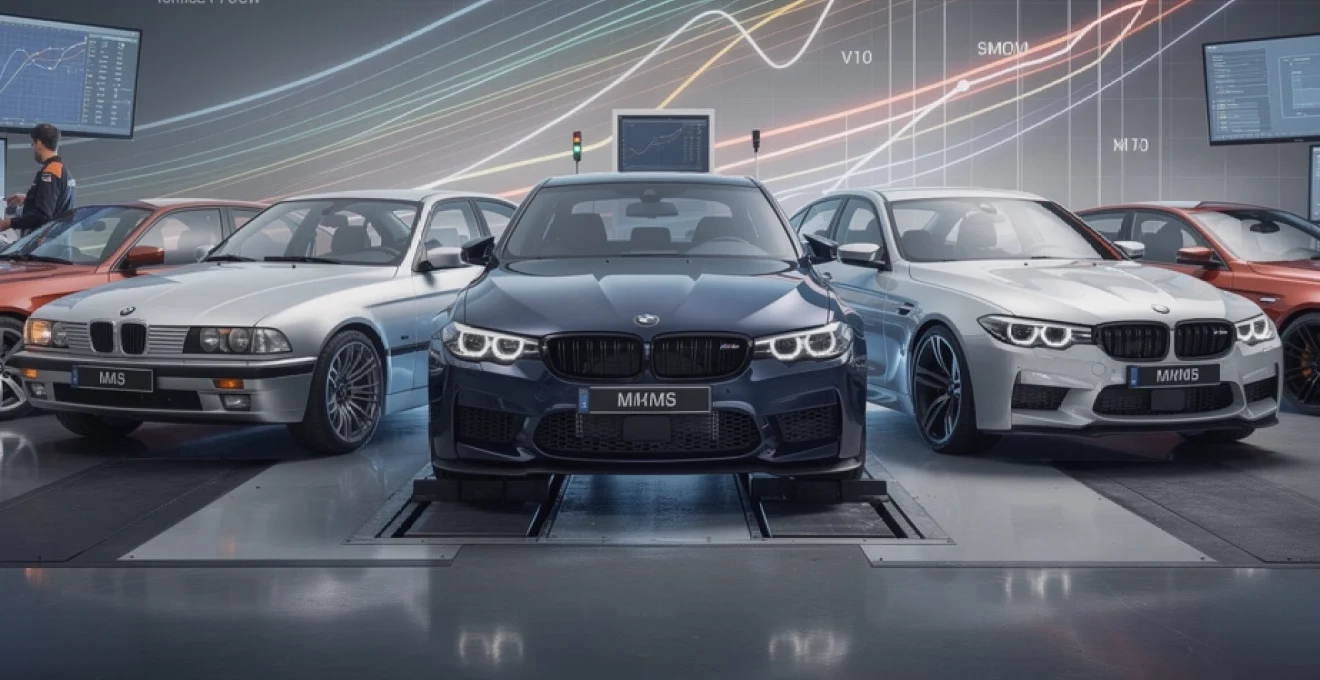
The BMW M5 has always lived and died by its brake horsepower figures. From the original E28 to the latest G90 plug‑in hybrid super saloon, each generation has redefined how much power a practical four‑door can realistically use on the road. For anyone comparing performance cars, understanding how M5 bhp has evolved, how it is measured and how much actually reaches the wheels makes it far easier to judge real‑world pace and tuning potential. The numbers have escalated from a little over 280 bhp to well above 700 bhp, but the way that power is delivered has changed just as dramatically, shaped by emissions rules, fuel quality, turbocharging and now electrification.
Looking closely at brake horsepower across M5 generations also reveals a clear story about engineering priorities. Early cars chased high revs and razor‑sharp throttle response, later models leaned on huge torque from turbochargers, and the newest plug‑in hybrid combines electric shove with a powerful V8. Whether you are shopping for a used E39, considering an F90 Competition, or eyeing the latest G90 with its 717 bhp system output, knowing how the bhp numbers stack up – and what they really mean – helps you choose the M5 that best fits how you like to drive.
BMW M5 brake horsepower evolution from E28 M5 to G90 M5
E28 M5 (M88/3) brake horsepower output and period rivals
The story starts with the E28 M5, launched in 1984, which used the M88/3 inline‑six derived from the legendary M1 supercar. In European trim it produced around 282 bhp (286 PS), an extraordinary figure for a four‑door saloon at the time. That output came from high compression, individual throttle bodies and a free‑revving character, rather than from forced induction. Period tests regularly measured 0–60 mph in the mid‑6‑second range, making the E28 M5 one of the fastest sedans in the world, despite relatively modest power by modern standards.
Against its rivals, the E28 stood apart. Contemporary Mercedes W124 300E models offered around 180–220 bhp, and even tuned “wolf in sheep’s clothing” saloons were usually below the 250 bhp mark. The E28 M5 effectively invented the template for the premium sports saloon segment. If you drive one today, the bhp figure feels less important than the way the engine spins eagerly to its redline and how directly it responds to small throttle inputs, a trait that many enthusiasts still prefer over pure headline power.
E34 M5 (S38B36/S38B38) incremental bhp increases and technical changes
The E34 M5 took the same basic formula and refined it. Early cars used the S38B36 3.6‑litre inline‑six with around 311 bhp (315 PS), while later 3.8‑litre S38B38 versions pushed output to roughly 335–340 bhp depending on market. The incremental bhp increase came from a capacity bump, higher compression and refinements to the intake and exhaust, all aimed at improving volumetric efficiency rather than adding boost. Rev limits sat around 7000 rpm, and torque increased by about 10–15%, giving the heavier E34 the mid‑range pull it needed.
Compared directly to the E28, the E34’s extra brake horsepower translated to barely a second’s improvement in 0–60 mph times, but real‑world in‑gear acceleration was noticeably stronger. You could overtake in a higher gear without needing to chase the redline quite as aggressively. The E34 era still prioritised naturally aspirated smoothness and linearity over outright numbers, and many owners value the combination of usable bhp and classic analogue driving feel.
E39 M5 (S62B50) 394 bhp and naturally aspirated V8 power delivery
The E39 M5 marked a dramatic step up in bhp and character. The 4.9‑litre S62B50 V8 deliveredabout 394 bhp (400 PS) and 500 Nm of torque, allowing 0–60 mph times around 4.8 seconds and an electronically limited top speed of 155 mph. For the late 1990s, those numbers put the M5 straight into supercar territory while retaining full four‑door practicality. The average M5 in the UK market from this era still sits close to that 400 bhp marker, underlining how far ahead of the curve it was.
What makes the E39’s brake horsepower particularly appealing is the way it arrives. The S62 uses double VANOS variable valve timing and individual throttles to blend torque and top‑end power. Power builds smoothly from low revs, surging through the mid‑range before hitting peak bhp at around 6600 rpm. For many drivers, this generation remains the sweet spot: enough power to feel genuinely rapid without relying on turbo lag or hybrid complexity, and a soundtrack that rewards using all of the rev range.
E60/E61 M5 (S85B50) 500 bhp V10 and f1-derived engineering
The E60 and E61 M5 models escalated the bhp war dramatically with the 5.0‑litre S85B50 V10 producing around 500 bhp (507 PS) at a stratospheric 7750 rpm. Inspired by BMW’s Formula 1 programme of the era, the engine featured a 90‑degree block, individual throttle bodies and an 8250 rpm redline. Specific output jumped to roughly 100 bhp per litre, a figure still impressive today for a naturally aspirated road engine. Period tests recorded 0–60 mph in 4.1–4.5 seconds and quarter‑mile times in the low 12s.
This high‑rev V10 redefined what a performance saloon could feel like. Below 4000 rpm the car was quick; above 6000 rpm it transformed into something that genuinely felt like a detuned race engine. Owners who love revs and track driving often gravitate towards the E60 precisely because its bhp is concentrated in that top‑end surge. However, the price for this F1‑derived engineering is greater complexity and higher maintenance requirements, especially if you plan to run the engine frequently near its redline.
F10/F90/G90 M5 turbocharged bhp gains and power curve characteristics
With the F10 M5, BMW M switched to a twin‑turbocharged S63 V8, initially rated around 552–560 bhp in standard form and up to 567 bhp with the Competition Package. Later F10 special editions pushed close to 600 bhp. The F90 generation arrived with roughly 591–600 bhp in standard trim and around 616–625 bhp for Competition models, while the M5 CS hit approximately 626 bhp and trimmed significant weight. Finally, the G90 plug‑in hybrid M5 and M5 Touring combine a 4.4‑litre V8 with an electric motor to achieve a system output of about 717–727 bhp and up to 1000 Nm of torque.
Turbocharging fundamentally altered the M5’s power curve. Instead of chasing high rpm, the S63 delivers most of its bhp from the mid‑range upwards, with a huge plateau of torque from roughly 1800 to 5600 rpm. The G90’s hybrid setup adds an electric motor that fills any remaining gaps in the torque curve, giving near‑instant low‑rpm response and maintaining thrust even as the V8 shifts gears. This is why modern M5 models can hit 60 mph in around 3.0 seconds despite carrying more weight; the combination of turbo torque and electric assistance makes their power delivery relentless, even if some drivers miss the purity of the old naturally aspirated engines.
Factory bhp ratings by engine code: M88, S38, S62, S85, S63 and S68 compared
M88/3 and S38 inline-six bhp figures, rev limits and torque curves
Looking at the factory ratings by engine code helps you compare generations at a glance. The M88/3 in the E28 M5 produced roughly 282 bhp with a rev limit around 6900 rpm, while the S38B36 delivered about 311 bhp and the later S38B38 around 335–340 bhp with similar rev ceilings. Torque figures rose from roughly 340 Nm in the early engine to around 400 Nm in the 3.8‑litre version, all delivered with a naturally aspirated, linear feel.
These inline‑sixes share a characteristic “rising” torque curve: modest pull below 3000 rpm, building steadily to a strong mid‑range and then tapering gently as peak bhp arrives near the redline. For everyday driving, you feel encouraged to work the gearbox and keep the engine on cam. If you are choosing between an E28 and E34, the extra brake horsepower of the S38B38 makes the later car more flexible, but purists often enjoy the slightly more raw character of the earlier M88/3.
S62 V8 bhp, VANOS calibration and specific output (bhp per litre)
The S62 4.9‑litre V8 in the E39 M5 is rated at about 394 bhp and 500 Nm, giving a specific output of roughly 80 bhp per litre. That may seem modest next to turbo and hybrid units, but for a naturally aspirated V8 designed in the 1990s, it remains highly respectable. Double VANOS variable valve timing allows the ECU to optimise cam timing across the rev range, improving both low‑end torque and high‑rpm bhp. In simple terms, the engine can “breathe” more efficiently at different speeds, which is why it feels so strong from 2500 rpm upwards.
For you as an enthusiast, this translates to a powertrain that is both tractable in traffic and eager on an open road. The factory calibration balances emissions, fuel economy and throttle response, but tuners often adjust VANOS mapping to extract a few extra bhp and sharpen mid‑range torque. Gains are smaller than on turbo engines, yet a well‑mapped S62 can feel noticeably more urgent without sacrificing reliability.
S85 V10 high-rev bhp, volumetric efficiency and throttle response
The S85 V10’s 500 bhp headline figure is only part of the story. More important is how that power is produced. With an 8250 rpm redline, a high compression ratio and highly optimised intake and exhaust systems, the S85 achieves excellent volumetric efficiency at high revs. In other words, it fills its cylinders with air extremely effectively, which is the key to its exceptional brake horsepower per litre.
Throttle response is almost instantaneous thanks to ten individual throttle bodies and very light rotating internals. When you press the pedal, the engine reacts more like a superbike than a typical saloon, a trait that many drivers find addictive on track days or mountain passes. The price of this razor‑sharp response is that the engine delivers less torque at low rpm than the later turbocharged V8s, so you need to work the SMG or manual gearbox to stay in the power band if you want maximum acceleration.
S63 twin-turbo V8 bhp levels, boost pressure and intercooling architecture
The S63 twin‑turbo V8 powers the F10 and F90 M5 generations, with outputs ranging from around 552 bhp in early F10 models to roughly 625–626 bhp in later F90 Competition variants, and up to about 635 bhp in some special editions. These figures are achieved through a combination of higher boost pressure, refined intercooling and sophisticated fuel and ignition mapping. The “hot‑V” layout places the turbochargers between the cylinder banks, shortening exhaust paths and helping the turbos spool quickly.
Charge‑air coolers integrated into the intake system reduce air temperature after compression, allowing more oxygen‑rich air into the cylinders and supporting both higher bhp and better consistency during repeated hard runs. For you as a driver, this means a broad, almost flat torque band and very strong mid‑range acceleration. The engine’s relative understress at factory power levels also explains why simple ECU tuning can unlock substantial extra bhp without hardware changes.
S68 mild-hybrid V8 projected bhp, e-boost integration and WLTP constraints
The latest S68 mild‑hybrid V8, used in the new G90 M5 family, integrates an electric motor into the transmission housing and works with a relatively small battery compared with the full plug‑in hybrid system in the 7‑Series. Combined system output for the M5 Saloon and Touring is quoted around 717–727 bhp and up to 1000 Nm, with an electric‑only WLTP range of roughly 25–41 miles depending on body style and market. Official figures must comply with stringent WLTP test procedures, which partly dictate the calibration of both combustion and electric components.
The e‑boost function effectively fills in torque at very low rpm and during gear changes, smoothing the power delivery and helping the V8 stay within its optimal efficiency window more of the time. From a bhp perspective, this allows BMW engineers to meet Euro 6d and upcoming emissions thresholds without sacrificing the headline numbers that M5 buyers expect. If you are considering this generation, expect instant low‑speed response, strong real‑world economy for the performance on offer and a very different character to the earlier purely combustion‑driven M5 models.
European vs US-spec BMW M5 bhp ratings and emissions-driven detuning
DIN vs SAE bhp measurement standards and their impact on quoted power
When comparing European and US‑spec BMW M5 bhp figures, the first complication is how power is measured. Europe typically quotes DIN horsepower (sometimes PS), while North America uses SAE net horsepower. Both measure brake horsepower at the crankshaft, but the testing conditions and accessory loads differ. For most modern engines, DIN and SAE ratings end up within a few bhp of each other, yet the discrepancy can confuse buyers comparing brochures.
Think of DIN vs SAE a bit like weighing yourself on two different scales: both are broadly accurate, but small differences are inevitable because the reference conditions change. Air temperature, atmospheric pressure and the accessory drive configuration all have subtle effects. As a result, an M5 rated at 600 bhp DIN might show 592–598 bhp SAE on paper, despite being mechanically identical. Understanding this nuance avoids assuming one market’s car is genuinely detuned when sometimes it is simply a testing methodology variance.
Catalytic converters, secondary air injection and bhp loss in US-spec E34/E39 M5
In earlier eras, particularly with the E34 and E39 M5, US emissions regulations were often stricter than European ones, forcing BMW to fit more restrictive catalytic converters, additional oxygen sensors and secondary air injection systems. These components increased exhaust back‑pressure and sometimes required less aggressive ignition timing, which in turn reduced peak bhp. US‑spec E34 M5 models typically produced slightly less power than their European counterparts, and similar small differences appeared in some E39 markets.
On the road, the bhp loss might only amount to 10–15 bhp on paper, yet enthusiasts sensitive to throttle response and high‑rpm pull could feel a subtle difference. Many owners in markets with more lenient regulations have later upgraded to freer‑flowing exhausts and recalibrated ECUs, reclaiming that lost bhp while still retaining functional emissions control. If you are evaluating a US‑spec car, it is worth checking whether the factory exhaust and catalysts are still in place or whether a previous owner has already optimised the setup.
Fuel octane (RON vs AKI) and ECU ignition mapping differences in F10/F90 M5
Fuel quality has become an increasingly important factor in how much bhp manufacturers can safely extract. European pump fuel is typically labelled using RON (Research Octane Number), while the US uses AKI (Anti‑Knock Index), which averages RON and MON. A 98 RON fuel in Europe broadly corresponds to 93 AKI in North America. The F10 and F90 M5 engines are designed to adapt to different octane levels via knock sensors and multiple ignition maps stored in the ECU.
On higher‑octane fuel, the engine can run more advanced ignition timing and, in some cases, slightly higher effective boost, leading to closer real‑world bhp to the official rating or even slight over‑performance on a dyno. On lower‑octane fuel, the ECU retards timing to prevent knock, which reduces peak power and torque. For you as a driver, consistently using top‑tier premium fuel is one of the simplest ways to ensure your M5 is delivering all of its promised brake horsepower and maintaining safe combustion temperatures under sustained load.
OPF/GPF particulate filters, euro 6d emissions and bhp impacts on later M5 models
Recent Euro 6d emissions regulations introduced the need for OPF/GPF particulate filters on many petrol performance cars, including later F90 and G90 M5 models. These filters trap fine particulates in the exhaust, significantly reducing harmful emissions but adding back‑pressure and slightly altering the exhaust pulse characteristics. Manufacturers have responded with more sophisticated turbocharger sizing, exhaust tuning and software calibration to preserve bhp.
While some early OPF‑equipped performance cars showed modest drops of 5–10 bhp versus pre‑filter versions, BMW has largely maintained the quoted power figures for the M5 line by adjusting boost pressure and combustion parameters. In practical terms, you are unlikely to feel a loss in straight‑line speed, but there can be subtle changes in exhaust sound and very high‑rpm breathing. For tuning, OPF‑equipped cars require more careful calibration and sometimes hardware modifications if targeting very high bhp levels.
BMW M5 competition, CS and special editions: bhp differentials and hardware changes
F10 M5 competition package bhp increase and revised software calibration
The F10 M5 Competition Package illustrated how BMW could extract extra bhp largely through software. Standard F10 models produced around 552–560 bhp, while Competition Package cars gained roughly 15 bhp, reaching approximately 575 bhp in some markets. This came primarily from revised ECU mapping that allowed slightly higher boost pressure and more aggressive ignition timing within safe limits, plus tweaks to throttle response and transmission logic.
Beyond the extra brake horsepower, the package also included firmer suspension, a revised differential calibration and often a sportier exhaust, helping you exploit the extra power more effectively. The difference in outright speed is modest – tenths of a second rather than whole seconds – but on a circuit or fast B‑road, the sharper reactions and more involving handling make the Competiton Package feel like a more focused, cohesive car than the standard F10.
F90 M5 vs M5 competition vs M5 CS (600, 625, 635 bhp) side-by-side power comparison
The F90 generation offered a clear hierarchy of brake horsepower. The standard M5 produced around 600 bhp, the M5 Competition increased that figure to roughly 616–625 bhp, and the limited‑run M5 CS pushed to approximately 626–635 bhp depending on market quoting conventions. Torque remained broadly similar at around 750 Nm across all three, but the power curves and weight figures differed enough to create distinct driving experiences.
| Model | Factory bhp | Torque | 0–60 mph (approx.) |
|---|---|---|---|
| M5 (F90) | ≈600 bhp | 750 Nm | 3.2 s |
| M5 Competition | ≈625 bhp | 750 Nm | 3.1 s |
| M5 CS | ≈635 bhp | 750 Nm | ≈2.9–3.0 s |
The M5 CS paired its extra brake horsepower with a weight reduction of around 70 kg, stiffer engine mounts, unique suspension tuning and upgraded tyres. On track, independent testing often found the CS several seconds quicker per lap than the already rapid Competition model. If you value ultimate pace and track‑day capability, the CS demonstrates how relatively small bhp increases, when combined with chassis and weight optimisation, can translate into a much larger real‑world performance delta.
Limited editions such as M5 30 jahre and M5 edition 35 jahre bhp and boost maps
BMW has also produced several limited‑edition M5 models such as the F10‑based M5 “30 Jahre” and later M5 Edition “35 Jahre”. These cars typically feature modest increases in quoted bhp – for example, around 592–600 bhp for the 30 Jahre – achieved via more assertive boost and ignition maps. In some cases, overboost functions provide short bursts of higher torque in specific gears or driving modes, effectively giving transient bhp spikes beyond the nominal rating.
From a driver’s perspective, these editions feel particularly potent in mid‑range overtakes and short sprints, where the more aggressive mapping wakes the engine up even further. However, higher boost also raises intake temperatures and mechanical stress, which is why these maps usually operate within carefully defined temperature and time thresholds. If you are considering such a model, regular oil analysis and attentive warm‑up habits are sensible practices to protect the engine at sustained elevated bhp levels.
Cooling upgrades, oil system revisions and their role in sustaining higher bhp
Higher brake horsepower brings extra heat, and cooling capacity often marks the difference between a durable performance car and one that fades on a hot track day. Competition and CS variants frequently add larger radiators, uprated intercoolers, additional transmission coolers and revised oil sumps with better baffling. These hardware changes do not increase peak bhp directly but allow the car to sustain that power output for longer without triggering protective limp modes.
For repeated high‑load driving – fast autobahn runs, track days or Alpine passes – thermal stability can matter more than the last 10 bhp on a spec sheet.
If you plan to use your M5 hard, looking for models with factory cooling upgrades or budgeting for aftermarket radiators and oil coolers is sound advice. Treat bhp as part of a complete performance package that includes brakes, tyres and thermal management, especially once you move beyond the standard factory tune.
Dyno-tested wheel horsepower vs quoted brake horsepower in BMW M5 models
Chassis dynamometer methodologies (dynojet, maha, mustang) and drivetrain loss
Quoted brake horsepower figures are measured at the crankshaft, while real‑world dyno tests usually record power at the driven wheels (whp). The difference between the two is drivetrain loss through the gearbox, differential and tyres. Various chassis dynamometers – Dynojet, Maha, Mustang and others – use different methods (inertial vs load‑bearing) and correction factors to estimate crank bhp from wheel power readings.
As a rule of thumb, rear‑wheel‑drive manuals often lose around 12–15% of power through the drivetrain, while automatic and all‑wheel‑drive systems can lose 18–25% depending on design. However, these are only guidelines. Tyre pressure, strap tension, cooling airflow and even how the car is tied down on the dyno can all subtly affect readings. Treat dyno figures as comparative tools – useful for measuring gains before and after a tune – rather than as precise absolute values.
Real-world whp figures for E39, E60, F10 and F90 M5 compared to factory bhp
Real‑world dyno testing has shown that many BMW M5 models actually exceed their official bhp ratings. E39 M5s, for example, often record around 320–340 whp on a conservative dyno. Applying a 15% drivetrain loss suggests true crank outputs closer to 380–400 bhp, broadly matching factory claims. Well‑maintained E60 M5s typically produce approximately 380–410 whp, indicating a healthy 500 bhp at the crank even years after leaving the factory.
Turbocharged F10 and F90 M5s can be even more impressive. Stock F10 cars frequently show 500+ whp, while standard F90 models have been recorded at 540–560 whp on some dynos. With a 20% drivetrain loss assumption for xDrive and automatic transmission, that equates to 650+ crank bhp in certain cases, suggesting BMW has been intentionally conservative in official ratings. For you as a buyer or tuner, this “hidden” bhp provides a strong baseline before any modifications are even considered.
Automatic, SMG and xdrive torque converter losses and effective bhp at the wheels
Transmission type also influences how much of the M5’s brake horsepower reaches the tarmac. Traditional manual gearboxes in older models like the E39 tend to have lower parasitic losses, especially in higher gears. The SMG single‑clutch automated manuals used in the E60 introduce slightly more drag, while modern torque‑converter automatics paired with xDrive, as found in the F90 and G90, can have higher baseline losses but benefit from smarter lock‑up strategies.
Once the torque converter locks, drivetrain efficiency improves, meaning a greater proportion of bhp reaches the wheels during steady acceleration. All‑wheel‑drive systems like xDrive add extra mechanical drag but dramatically improve traction, so effective usable bhp on launch and in poor conditions is often higher than a more powerful rear‑drive setup spinning its tyres. When you look at dyno graphs, consider both the absolute whp number and how that power translates into real‑world acceleration, especially off the line.
Tuning potential and bhp ceilings for turbocharged and naturally aspirated BMW M5 engines
Stage 1 and stage 2 ECU remaps on S63 F10/F90 M5: typical bhp gains and boost levels
The twin‑turbo S63 V8 is extremely responsive to software tuning. A typical Stage 1 ECU remap on a stock F10 or F90 M5, running high‑octane fuel, often lifts power from around 600 bhp to 680–720 bhp at the crank with no hardware changes, simply by raising boost pressure and optimising ignition and fuel maps. Torque increases proportionally, with many tuned cars producing 850–900 Nm while staying within conservative limits for the stock internals and gearbox.
Moving to Stage 2 – usually combining an ECU tune with freer‑flowing downpipes and intake – can push bhp further into the 740–780 range depending on turbo health and fuel quality. At this level, careful thermal management becomes critical, especially on track. Think of it like giving an athlete more oxygen and a higher‑energy diet; performance improves noticeably, but sustained maximum effort requires better cooling and recovery.
NA tuning of S62 and S85: intake, exhaust and camshaft changes for incremental bhp
Naturally aspirated engines like the S62 and S85 offer less dramatic, but still meaningful, tuning potential. Gains come mainly from reducing pumping losses and improving airflow rather than adding boost. A well‑developed package of performance exhaust manifolds, high‑flow cats, a less restrictive rear section and an optimised intake can typically free up 20–40 bhp on the S62 and 25–45 bhp on the S85, especially when combined with a tailored ECU remap.
More aggressive camshafts and higher compression pistons can unlock further bhp, yet these modifications often compromise idle quality, fuel economy and long‑term durability. For a road‑driven M5 used daily, focusing on high‑quality breathing mods, precise ECU calibration and meticulous maintenance tends to yield the best balance. You gain a more responsive, keener‑revving engine without significantly shortening its lifespan or making it tiring in traffic.
Hybrid turbo, methanol injection and E85 fuel conversions on S63 for 800+ bhp builds
For those chasing truly extreme figures, the S63 platform supports 800+ bhp and, in some builds, well over 900 bhp. Achieving this safely requires a combination of hybrid turbos with larger compressor and turbine wheels, upgraded high‑pressure fuel pumps, enlarged intercoolers and often water‑methanol injection or E85 ethanol fuel conversions. These changes increase the amount of cool, dense air and high‑octane fuel the engine can ingest, which in turn allows much higher boost and more aggressive ignition timing without detonation.
At this level, the M5 moves firmly into supercar or drag‑car territory, where traction, braking and chassis setup become just as critical as the bhp headline.
Such builds are not trivial. You will need a tuner experienced with S63 engines, rigorous datalogging and a clear understanding that drivetrain components – from the ZF gearbox to driveshafts and differentials – are being pushed closer to their limits. For a street‑driven car, a more modest 700–750 bhp target often provides a better balance of reliability and performance.
Reliability thresholds: piston, rod and gearbox limits at elevated bhp outputs
Every M5 engine has practical reliability thresholds. The S62 and S85, being naturally aspirated and already highly optimised, tolerate only modest additional bhp before long‑term stress rises sharply, particularly on connecting rods, rod bearings and valve‑train components. Keeping increases below 10–15% over stock and maintaining excellent oil quality helps preserve engine health. Regular bearing inspections are sensible on high‑rev S85 builds.
The S63’s forged internals handle significant extra load, yet most experienced tuners treat around 750–800 crank bhp as the sensible upper limit on stock pistons and rods for regular hard use. Beyond that, upgraded internals become advisable. Gearboxes like the ZF eight‑speed have impressive torque capacity, but repeated launches and aggressive shift strategies at 900+ Nm can shorten their service life. If you plan to exploit very high bhp regularly, budgeting for preventative maintenance – fluids, clutches, mounts and cooling system renewals – turns a high‑power M5 from a fragile toy into a fast, dependable long‑distance weapon.