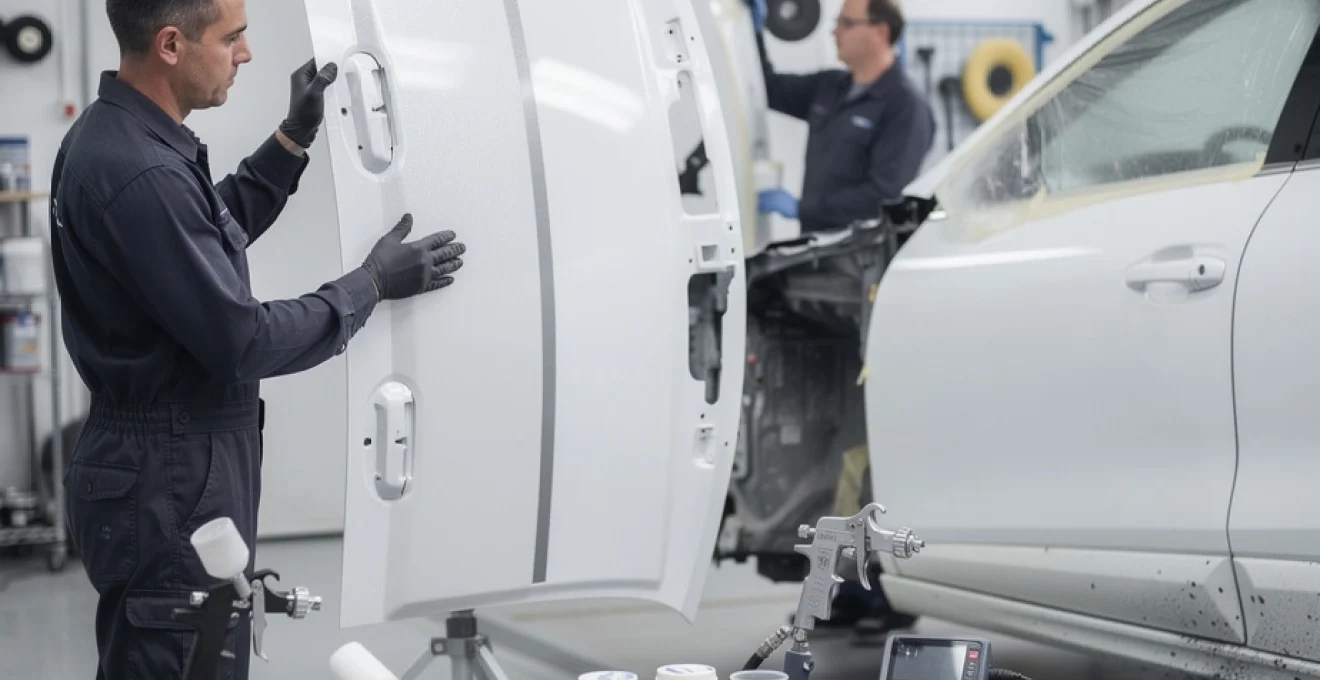
Few panels reveal the quality of a paint job like a car door. Large, flat and constantly in use, door skins show every mismatch, every sanding mark and every shade error in white paint. Choosing the best white paint for car doors is about much more than picking a colour name; it involves understanding how OEM systems are built, how they age, and how replacement products behave once sprayed and cured. When you get it right, the door blends invisibly into adjacent panels, resists chips on the leading edge and keeps its gloss for years. When you get it wrong, the door stands out like a poorly repainted wall under bright showroom lighting, damaging both appearance and resale value.
Understanding OEM white paint systems for car doors: solid, metallic and pearlescent finishes
Modern white car doors rarely use a simple “tin of white” approach. OEM manufacturers rely on highly engineered paint systems that layer primers, basecoats and clear coats to achieve the right brightness, coverage and durability. For car doors, most factories favour solid white, metallic white or pearlescent white finishes, each with different behaviours during repair. Solid whites are common on fleet vehicles and entry-level trims, while metallic and pearl whites dominate premium models because they enhance body lines and hide some surface imperfections. Understanding which system your door left the factory with is the first step in choosing a compatible white refinish product.
Decoding manufacturer colour codes (honda NH-883P, toyota 040, BMW alpine white III, audi ibis white)
Every car door painted in white has a specific manufacturer code that acts like a fingerprint. Codes such as Honda NH-883P (Platinum White Pearl), Toyota 040 (Super White), BMW Alpine White III and Audi Ibis White identify not only hue, but also paint type and finish. These codes are usually found on a body label inside the driver’s door shut, under the bonnet or in the spare wheel well. When you order paint for car door refinishing, the supplier uses that code to mix an accurate formula. However, real-world factors like ageing, UV exposure and past repairs mean that a code-perfect mix can still look slightly off, which is why colour reading and spray-out cards remain essential.
Differences between single-stage solid white and basecoat–clearcoat systems on modern door panels
Older vehicles and some commercial fleets use single-stage solid white systems, where colour and gloss come from the same layer. On these doors, the white topcoat contains resins and pigments plus UV stabilisers, and no separate clear coat is applied. Most modern passenger cars, by contrast, use a basecoat–clearcoat system: a thin white base provides colour and hiding power, then a high-solids clear coat delivers gloss, depth and protection. When choosing the best white paint for car doors, matching this construction is crucial. Using single-stage paint over a door originally finished with basecoat–clear can look dull and will usually weather differently compared to adjacent panels.
Metallic and pearlescent white door paints: mica, aluminium flake and tri-coat layering
Metallic and pearlescent whites on car doors rely on flake technology to create depth and sparkle. Metallic whites incorporate finely milled aluminium flake in the basecoat, bringing a subtle shimmer that changes with viewing angle. Pearlescent or pearl whites use mica or ceramic flakes that both reflect and refract light, producing an iridescent effect often seen on premium SUVs and saloons. Many OEM pearl whites are tri-coat systems: a solid white base, followed by a translucent pearl layer, then clear coat. When refinishing a tri-coat white car door, product selection and application strategy must respect this layering, or the door will appear too milky, too dark or too “sparkly” compared to the factory finish.
Ageing behaviour of OEM white paints: yellowing, chalking and clear coat degradation
White car doors may appear clean and timeless, but they suffer more from ageing than darker colours. UV light gradually breaks down the top layers of resin, leading to yellowing and chalking. Industry data suggests that vehicles parked outdoors full time can lose up to 30% of gloss on horizontal surfaces within five years, and door tops are particularly exposed. Clear coat degradation often starts at door edges, handles and mirror bases where water and contaminants accumulate. When selecting replacement white paint for car doors, UV stability and anti-yellowing properties become critical, especially if the car operates in high-sun regions or covers high annual mileage.
Subtle yellowing on a white car door is often more noticeable than a major colour shift on a darker vehicle, which is why UV-resistant systems deliver such visible long-term value.
Matching factory texture and gloss level on door skins, returns and shut areas
While colour match gets most attention, texture and gloss on a white car door are just as important. OEM doors typically show a fine, even orange peel effect on outer skins, slightly higher texture on lower sections and a flatter appearance in door shuts and returns. A resprayed door with glass-flat clear might look impressive in isolation, yet stand out awkwardly next to factory panels. Choosing the best white paint for car doors therefore extends to compatible clear coats, appropriate hardener selection and spray gun setup that replicate OEM texture. Paying attention to gloss levels in hidden areas, including door jambs and hinge faces, also helps avoid the giveaway contrast between original and repaired paint.
Key technical criteria for choosing white paint for car door refinishing
Once the OEM system is understood, attention shifts to technical performance. The best white paint for car doors combines accurate colour, UV stability, chip resistance and regulatory compliance. Door panels experience constant mechanical stress from opening, closing and contact with clothing, as well as frequent washing. In the UK, roughly 65–70% of insurance-related bodywork involves door and wing repairs, and refinishing products must deliver both speed and durability to satisfy insurers and fleet operators. For an enthusiast working at home, these same criteria matter if you want professional-looking results that last longer than a single winter.
Colour match accuracy: ΔE tolerances, spectrophotometer readings and visual metamerism checks
Colour difference is often expressed as ΔE (Delta E). On white car doors, professional bodyshops typically aim for ΔE values below 1.0–1.5 when measured against adjacent panels, as higher deviations become visible under daylight. Spectrophotometers such as Axalta Acquire or PPG RapidMatch read the colour from surrounding panels and generate variant formulas tailored to the actual condition of the paint. Even with these tools, a final visual check under multiple light sources is essential to avoid metamerism, where a white door matches in sunlight but shifts under LED forecourt lighting. Spray-out cards sprayed next to the vehicle’s wing are invaluable before committing to a full door respray.
UV stability and anti-yellowing additives in white automotive topcoats
UV stability directly affects how long a white car door keeps its bright, clean appearance. Modern 2K clear coats contain advanced UV absorbers and HALS (hindered amine light stabilisers) to slow resin breakdown. Laboratory weathering tests (such as 1,000-hour QUV exposure) show up to 40% better gloss retention for high-grade clear coats versus budget alternatives. For solid white single-stage systems, anti-yellowing pigments and stabilisers are crucial because the colour layer is exposed directly to the elements. When choosing white paint for car doors, investing in a UV-stable system protects against the classic creamy or beige tinge that can appear on poorly formulated whites after a few summers.
Stone-chip resistance and flexibility on door edges, swage lines and lower panels
Driver’s doors in particular suffer constant abuse from stones flicked up by the front wheels and from repeated contact on car parks. High-solids 2K polyurethane topcoats offer excellent chip resistance and flexibility, helping protect vulnerable areas such as leading edges, swage lines and lower door sections. OEM data from fleet studies suggests that unprotected white lower door panels can accumulate visible chips within 10,000–15,000 miles on typical UK roads. Choosing a white system with robust binders, combined with appropriate primers and, where necessary, stone-chip coatings, significantly extends the life of the repair and keeps the paint film intact under daily use.
Solvent-based vs waterborne white systems for door resprays in UK bodyshops
Most professional UK bodyshops now use waterborne white basecoats combined with solvent-based or water-based clears, largely due to environmental regulations. Waterborne whites like PPG Envirobase or Glasurit 90 Line offer excellent hiding power and fast flash-off under proper airflow, making them ideal for large door panels. Solvent-based whites still appear in smaller shops and DIY settings because they are more forgiving of variable workshop conditions and cheaper to set up. For best results on car doors, waterborne whites provide finer metallic control and cleaner solid shades, whereas solvent systems can be advantageous if temperature and humidity are difficult to manage.
Choosing between solvent and waterborne white systems is less about fashion and more about compliance, booth capability and the finish quality required on high-visibility panels such as doors.
Compliance with VOC regulations (EU 2004/42/EC) for refinishing white car doors in the UK
Any professional refinish work on white car doors in the UK must comply with VOC limits set by Directive 2004/42/EC. These regulations cap the amount of volatile organic compounds per litre in basecoats and clear coats, pushing manufacturers towards waterborne technology and high-solids products. Using non-compliant solvent-based whites in a commercial environment can result in regulatory penalties and insurance issues. For home users, compliant systems are still advisable: they reduce solvent odour, lower health risks and often provide better coverage. Checking product technical data sheets for VOC content before purchasing white door paint ensures alignment with both legal requirements and good workshop practice.
Comparing popular automotive white paint products for car doors
The market for automotive white paint includes everything from premium professional systems to budget aerosols. For car doors, product choice has a direct effect on final finish, ease of application and long-term durability. Professional bodyshops favour modular systems that integrate primers, basecoats and clear coats from the same brand, while DIY painters might combine aerosols, 1K primers and small touch-up bottles. Considering the size and visibility of door panels, a mid- to high-grade system usually provides far better value than the cheapest options, especially once labour time and rework risk are factored in.
Professional-grade systems: PPG envirobase, glasurit 90 line, standox standoblue and spies hecker permahyd
Professional waterborne basecoat ranges dominate modern UK bodyshops for white door refinishing. PPG Envirobase and Glasurit 90 Line are widely used on insurance and fleet repairs, offering extensive variant libraries for whites such as Toyota 040 and BMW Alpine White III. Standox Standoblue and Spies Hecker Permahyd follow a similar approach, focusing on rapid coverage, clean colour and consistent metallic laydown. In comparative tests, these systems typically reach hiding in two to three coats on prepared doors, with excellent blending characteristics into adjacent panels. The higher material cost is offset by reduced rework and predictable drying behaviour in temperature-controlled spray booths.
Diy-friendly aerosols and touch-up kits: halfords white car paint, hycote, simoniz and colour mix
For smaller white door repairs or budget-conscious projects, DIY aerosols and touch-up kits can be viable. Brands such as Halfords, Hycote, Simoniz and Colour Mix offer coded whites matched to common UK models. These products are convenient for chips around door handles, mirror mounts and door edges. On a full door respray, however, aerosols struggle to deliver consistent film build and texture, especially with metallic or pearl whites. The best approach for DIY painters often involves using aerosols only for minor areas and relying on a proper spray gun and 2K clear for larger sections to maintain durability and uniform appearance.
High-solids 2K polyurethane white topcoats for door resprays with spray guns
High-solids 2K polyurethane topcoats remain a popular choice for refinishing solid white doors, particularly on commercial vehicles and older cars. These paints combine colour and gloss in one layer, curing via a hardener to form a chemical-resistant, flexible film. When sprayed correctly with HVLP or LVLP guns, 2K whites provide good coverage, chip resistance and gloss retention. On modern cars originally finished in basecoat–clear systems, 2K topcoats can still be used in door shuts and inner faces while a separate clear coat is applied to outer skins for a closer OEM appearance. Proper respirator protection is essential, as is adherence to pot life and mixing ratios.
High-build white primers and surfacers (U-POL, novol, lechler) for dent and scratch repair on doors
Before any white topcoat touches the door, high-build primers and surfacers from brands such as U-POL, Novol and Lechler prepare the surface. These products fill sanding scratches, minor ripples and old stone chips, levelling the panel and providing a uniform base colour. White or light-grey primers are particularly important under white topcoats; dark primers can cause the finished door to appear slightly dirty or grey. Proper use of high-build materials reduces the amount of topcoat needed, improves colour accuracy and minimises the risk of sinkage around previous repairs, which can otherwise telegraph through bright white finishes after a few months.
Comparative durability and gloss retention tests on frequently used driver’s doors
Durability tests on frequently used driver’s doors show clear differences between product tiers. Independent studies often report that premium refinish systems retain 80–90% gloss after 2–3 years of real-world use, while cheaper 1K acrylic whites can drop below 60% in the same period. Driver’s doors open and close thousands of times per year, and the leading edge constantly meets airflow and road debris. Choosing a high-grade white paint system – even for a private car – therefore makes practical sense: fewer touch-ups, less visible wear and better trade-in value. When in doubt, testing a small section or spare panel with the chosen product helps gauge performance before committing to a full door respray.
Surface preparation of car doors prior to applying white paint
Preparation determines at least half of the final quality of a white door refinish. Even the most advanced paint system will highlight poor sanding, hidden rust or badly feathered edges, especially on bright whites. Because car doors combine large, flat areas with intricate folds at edges and seams, preparation must address both cosmetic smoothness and structural protection. A methodical approach – assess, repair, sand, clean and mask – ensures that the chosen white paint for car doors bonds properly, lays evenly and maintains its appearance after repeated washes and weather cycles.
Assessing existing coatings: OEM paint, previous repairs, corrosion and filler work
The first step is to assess what already exists on the door. Look for signs of previous repairs such as differing orange peel, overspray on rubbers, tape lines in shuts or inconsistent gloss. Check the lower seams and window frame for corrosion, pinholes or bubbling under the paint. A paint thickness gauge, if available, can reveal heavy filler or multiple refinishes. Any unstable old coatings must be removed back to sound substrate, whether that is OEM paint, e-coat or bare metal. This assessment phase guides the choice of primers and surfacers and helps avoid costly surprises once sanding starts.
Abrasion protocols for door skins and edges: P320–P800 grit, DA sanding and hand-blocking
Consistent sanding on door skins is vital for an even white finish. A common protocol uses P320–P400 grit on damaged or filler areas, followed by P500–P800 grit for final preparation before basecoat. Dual-action (DA) sanders speed up work on large flat sections, while hand-blocking is preferred around swage lines and door edges to maintain shape. The aim is to create a smooth, keyable surface without deep scratches that will show under bright white. For existing clear coat blends, finer grades like P800 wet or equivalent pads help maintain a transition area where white basecoat and clear can fuse seamlessly during spraying.
Rust treatment and epoxy priming on lower door seams and drain holes
Lower door seams and drain holes are notorious rust traps, especially on older vehicles. When refinishing a white car door, any rust here must be properly treated, not just sanded and covered. Mechanical removal with wire wheels or abrasive discs, followed by a phosphoric acid-based rust converter where appropriate, provides a clean base. An epoxy primer is ideal on these areas, as it offers excellent adhesion to bare steel and superior corrosion resistance compared to standard primers. Applying epoxy inside the seam and around drains, then sealing with seam sealer where necessary, prevents rust lines from reappearing under the new white paint film.
Masking door handles, trims, mirrors and window rubbers for clean white paint edges
Clean, sharp paint edges are particularly visible on white doors. Masking must be precise around door handles, trim strips, mirrors and window rubbers. Removing parts such as door mirrors and handle escutcheons, where practical, produces a more OEM-looking result and reduces the risk of hard tape lines. Use fine-line tape for edges that will meet visible white surfaces, and back-mask adjacent panels to allow for blending. For door shuts and hinges, deciding where to stop the new paint is critical: a staged approach where inner faces are refinished separately or lightly blended helps avoid abrupt colour changes when the door is open.
Application techniques for flawless white finishes on car doors
Spraying white on a large, flat door panel exposes any weakness in technique. Patchiness, striping and dry spray are more visible on white than on many colours, particularly under strong daylight. Achieving a flawless finish demands careful setup of spray equipment, control of overlap and fan pattern, and respect for recommended flash-off and curing times. Whether using solvent or waterborne white basecoats, consistent gun movement and distance prevent colour shifts and texture variations that would betray the repair.
Setting up HVLP and LVLP spray guns for white basecoat and clear coat application
For car doors, HVLP and LVLP spray guns provide efficient transfer and good control. A typical setup for white basecoat might involve a 1.2–1.3 mm fluid tip, with pressure set according to manufacturer guidelines, usually around 1.8–2.2 bar at the gun inlet for many systems. Clear coats often perform best with a 1.3–1.4 mm tip to achieve even, high-build coats without runs. Fan width should be wide enough to cover the door height in consistent passes, and the gun should be held roughly 150–200 mm from the surface. Test patterns on masking paper allow fine adjustments before committing to the door itself.
Spray pattern, overlap and flash-off times tailored to white metallic and pearl coats
Metallic and pearl whites are unforgiving of inconsistent technique. Maintaining 70% overlap between passes reduces the risk of striping and mottle. For tri-coat pearl whites, the effect coat must be applied in controlled, even passes, often using a “drop coat” technique on the final layer to align flakes. Respecting recommended flash-off times between coats, especially with waterborne bases, ensures proper levelling and prevents patchiness. Rushing flash-off can trap solvent or water, leading to dieback or uneven sheen after clear application, issues that are very obvious on a bright white door panel.
Avoiding patchiness and striping in solid and metallic whites on large, flat door panels
Patchiness in solid white doors typically stems from inconsistent film build or dry spray at panel edges. Keeping the gun perpendicular to the surface, moving at a steady speed, and beginning and ending passes beyond the panel edges help maintain uniform coverage. For metallic whites, a common technique involves spraying the last basecoat in a slightly lighter, more open pattern to even out flake distribution, followed by a short flash before clear. If climatic conditions are marginal, controlled booth airflow and correct reducer selection are vital to prevent edge mapping and visible blend lines on the finished door.
Think of a door panel like a sheet of paper under a wide marker: any pause, overlap or change of angle leaves a mark that white paint will faithfully reveal once dry.
Baking, forced drying and infrared curing parameters for white automotive topcoats
Once applied, white basecoat and clear must cure under controlled conditions to reach full hardness and gloss. In spray booths, typical baking cycles run at 60°C panel temperature for 20–30 minutes for 2K clears, though exact values depend on product data sheets. Waterborne whites benefit from strong but even airflow before clear application to drive off water rapidly. For smaller workshops or partial door repairs, infrared (IR) curing units can accelerate drying on specific areas like lower sections or freshly primed edges. Correct curing not only speeds up turnaround but also improves solvent release, reducing the risk of later dieback, imprinting or soft edges around door handles and trims.
Colour matching white paint for door repairs and blends
Even the best white paint formula can look wrong if matching and blending are mishandled. Doors sit between front wings and rear quarter panels, so any mismatch becomes obvious from multiple viewing angles. Effective colour matching for white car doors combines instrument readings, tinting skills and blending strategies that respect how human eyes perceive subtle differences in hue and brightness. Ageing, previous resprays and variations between production batches all influence the apparent colour of a door, making real-world verification essential.
Using spectrophotometers (axalta acquire, PPG RapidMatch) to read adjacent panels
Spectrophotometers such as Axalta Acquire or PPG RapidMatch give a data-driven starting point for matching white doors. The device reads the colour from an adjacent panel – often the front wing – and compares it with a database of known formulas and variants. For popular whites like Audi Ibis White or Toyota 040, multiple variants may exist to account for factory and ageing differences. Once a candidate formula is chosen, a small spray-out panel is prepared and held adjacent to the car in natural and artificial light. This combination of digital measurement and human evaluation provides a robust foundation for accurate white door matching.
Blending techniques into front wings and rear quarter panels for white shades
On many repairs, a perfect butt match on a single door edge is unrealistic, particularly with metallic or pearl whites. Blending into the front wing and rear quarter allows the eye to transition gradually between old and new paint. A typical process involves applying white basecoat over the repaired door area, fading it softly into adjacent panels, then clearing the entire door and blend zones. For tri-coat whites, the pearl layer may also be blended onto neighbouring panels to avoid a hard transition in effect. Careful sanding preparation and masking strategy ensure that these blends remain invisible even under strong showroom lighting.
Tinting white basecoats with black, ochre or blue to correct hue and value shifts
Factory formulas sometimes need fine adjustment, especially on older cars or vehicles exposed to harsh climates. Tinting white basecoats with minute amounts of black, ochre or blue can correct slight hue or value shifts. For example, adding a trace of blue can cool a white that appears too creamy, while a hint of ochre may warm an overly stark tone. Because white is so sensitive to contamination, any tinting must be extremely precise; a fraction of a gram too much can send the colour off. Mixing is usually performed in controlled mixing rooms using calibrated scales, and every adjustment should be validated with a fresh spray-out before spraying the door.
Dealing with aged, oxidised or resprayed white doors on used vehicles
Used vehicles often present the hardest challenges. An aged white door may have oxidised, been machine-polished several times or already resprayed in the past. In such cases, the current door colour may no longer represent the true OEM shade. One effective strategy is to polish a small section of adjacent panels to reveal the original depth of colour, then take spectrophotometer readings there instead of on the oxidised area. If the door itself has been repainted poorly, stripping back to sound layers and refinishing with a correctly matched white restores consistency across the side of the car. Taking time at this stage reduces future colour disputes and ensures that the door, once finished, looks like it has always belonged on the vehicle.