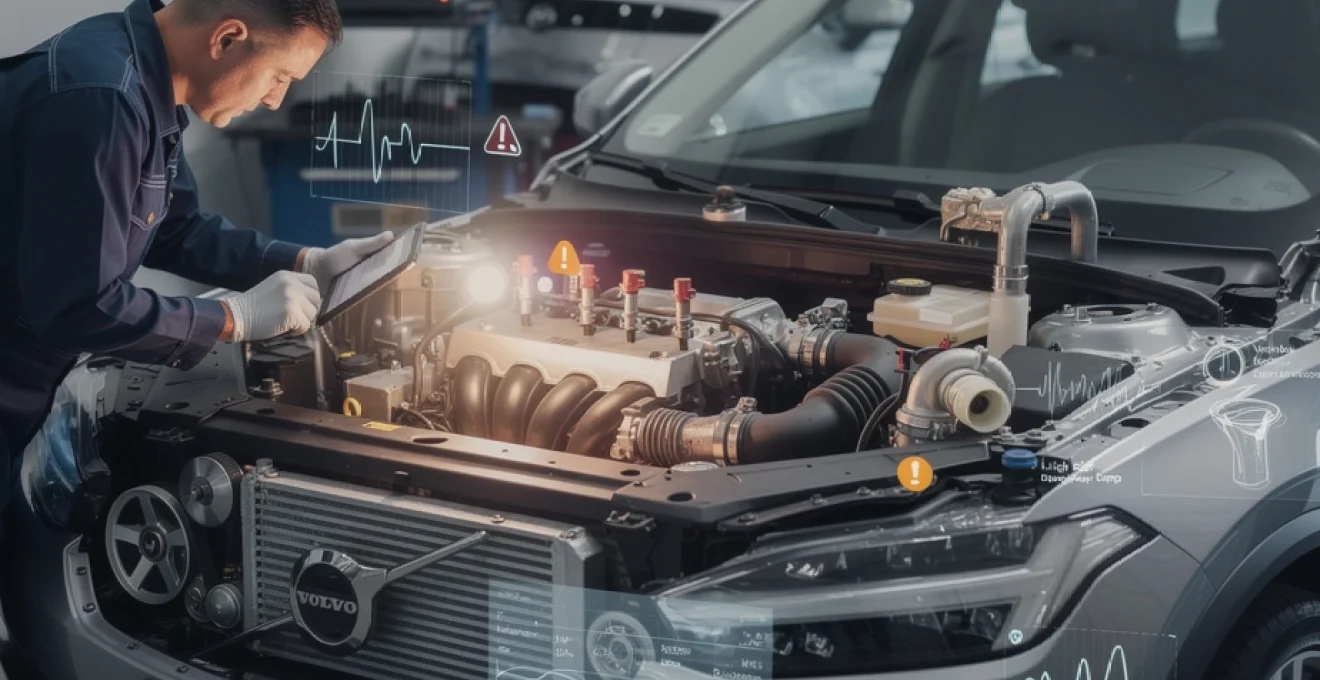
The Volvo D5 five‑cylinder diesel has a reputation for being almost “bomb‑proof”, with many examples comfortably passing 300,000 km and even 300,000 miles. Yet if you spend any time on owner forums, it can seem as though every D5 engine is on the brink of injector failure, turbo collapse or timing belt disaster. The reality sits somewhere in the middle: the D5 is fundamentally a robust, long‑life powerplant, but like any complex common‑rail diesel, it has a set of recurring problems that appear once mileage and age creep up.
If you understand the typical weak points of each D5 generation and keep ahead of preventative maintenance, you stand a far better chance of enjoying that legendary torque and relaxed cruising without wallet‑busting surprises. Whether you drive an early 163 bhp S60, a high‑mileage V70 D5 estate or a later twin‑turbo Euro 5 XC90, knowing what fails, why it fails and how to diagnose it puts you in control instead of at the mercy of warning lights and limp‑home mode.
Overview of volvo D5 engine variants, generations and known weak points (euro 3–euro 6)
The original 2.4‑litre Volvo D5 (engine code D5244T) arrived around 2001, replacing the older Audi‑sourced TDi. Early Euro 3 engines produced 163 bhp and quickly earned a reputation for durability; it is common to see these units with over 400,000 km on the clock, still on original bottom ends and turbos. Later Euro 4, Euro 5 and Euro 6 versions brought more power (up to 205 bhp and beyond), particulate filters and complex emissions hardware. With each step, performance and refinement improved, but so did the number of potential failure points that can affect long‑term Volvo D5 engine reliability.
Broadly, D5 engines fall into several groups. Euro 3 units (roughly 2001–2005) are mechanically simpler: no DPF on most markets, fewer sensors and a more basic EGR system. Their main weak spots are injector leak‑back on some early Delphi‑equipped cars, auxiliary belt tensioners and ageing rubber boost hoses. Euro 4 engines (about 2005–2009) moved to 185 bhp with a revised head, swirl flaps in the inlet manifold and, often, a DPF. These give stronger mid‑range grunt but introduce swirl arm breakage, DPF blockage and extra stress on turbos and injectors.
Euro 5 and Euro 6 D5 engines add twin‑turbo setups, more sophisticated EGR cooling and, on some applications, complex aftertreatment such as SCR and AdBlue. While power and efficiency improve, owners start to see issues such as balance shaft bearing wear, high‑mileage DPF saturation and more frequent EGR cooler blockages. It is worth remembering that criticism often reflects the sheer number of these later engines on the road: when a platform is produced in large volumes, even a small failure rate generates a lot of forum traffic.
Viewed in isolation, the D5’s failure stories can sound worrying; viewed in context, the core engine design is among the most durable common‑rail diesels of its era.
Fuel system faults on volvo D5 engines: injectors, high‑pressure pump and swirl flaps
Modern diesel engines live or die by the health of their fuel systems. The D5 relies on high‑pressure common‑rail injection, with pressures up to 1600 bar on early units and higher on later variants. Any weakness in injectors, the high‑pressure fuel pump or return lines can cause hard starting, rough running, excessive smoke or full non‑start situations. As mileage climbs, systematic attention to fuel delivery becomes essential for dependable Volvo D5 long‑term ownership.
Delphi and bosch injector failures on early D5244T D5 engines: leak‑back, rough idle and black smoke
Early Euro 3 D5 engines used mainly Delphi injectors, with later units moving towards Bosch. A small but noticeable percentage of Delphi injectors suffer from leak‑back, where internal wear allows too much fuel to return to the tank. Symptoms include long cranking when hot, lumpy idle and a distinct diesel knock. You may also see black smoke under load as fuelling becomes uneven across cylinders, making the engine feel hesitant below 2,000 rpm.
A simple leak‑back test with clear pipes into measuring bottles can confirm injector condition. Anything significantly out of line with the others usually indicates a failing injector. Replacement is not cheap, but many owners report 200,000–300,000 km from original items when fuel quality and filter changes are kept on top of. If you are inspecting a high‑mileage Volvo V70 D5 for sale, paying attention to cold and hot start behaviour gives a quick sense of whether injectors are still healthy.
High‑pressure fuel pump (HPFP) wear, rail pressure loss and non‑start issues on XC90 and V70 D5 models
The high‑pressure fuel pump on the D5 is generally reliable, but on engines that have seen poor maintenance, contaminated diesel or extremely high mileage, internal wear can drop rail pressure below the threshold needed to start. The result is long cranking or complete non‑start, often without clear fault codes. On some XC90 and V70 D5 engines, early symptoms appear under heavy load: loss of power, “Engine Service Required” messages and stored low fuel pressure codes.
Diagnosis involves checking commanded vs actual rail pressure with a scan tool during cranking and wide‑open throttle. If the pump cannot reach target pressure despite good injectors and no obvious leaks, replacement or professional overhaul may be required. Leaving HPFP issues unresolved can, in extreme cases, generate metal particles that migrate into the rail and injectors, turning a manageable problem into a full fuel system rebuild costing several thousand pounds.
Swirl flap linkage breakage on euro 4 D5 (D5244T4/T5) and associated swirl arm repair kits
Euro 4 D5 engines use swirl flaps in the inlet manifold to optimise air swirl at different engine speeds. The plastic arm that links the actuator to the swirl shaft is a well‑known weak point; age, heat and oil vapour make the joint sloppy, until it eventually pops off. Drivers notice reduced low‑down torque, flat spots and, in many cases, error codes for swirl control or air flow mismatch. A quick look under the engine cover often reveals the arm hanging loose.
Fortunately, this particular Volvo D5 swirl flap problem is often repairable without replacing the entire manifold. Aftermarket swirl arm repair kits provide metal ball joints and stronger arms that last far longer than the factory plastic. Ignoring broken swirl linkages for too long can contribute to sooty intake build‑up and poor fuel economy, so it is worth addressing even if the car still feels acceptable around town.
Diesel return line leaks, fuel filter housing cracks and air ingress causing hard starting
Age and vibration can also affect the low‑pressure side of the D5 fuel system. Small leaks on return pipes, cracked fuel filter housings or hardened O‑rings allow air to enter the system, especially after an overnight stand. The classic symptom is hard starting after several hours parked, followed by fine performance once the engine finally fires and purges the air. In some cases the engine cuts out shortly after starting, only to restart again after extended cranking.
Visual inspection can be tricky, as leaks are often small and evaporate, leaving little in the way of visible diesel staining. Clear fuel lines, vacuum tests and temporarily bypassing suspected sections can help isolate the issue. Replacing the fuel filter housing and brittle plastic lines is inexpensive compared to many other D5 repairs and can restore instant starting, even at high mileage.
ECU fuel metering and fuel pressure sensor faults leading to limp‑home mode under load
Even with perfect mechanical components, a misleading fuel pressure or metering signal can cause the ECU to cut power. On some D5 engines, a failing rail pressure sensor or metering valve (often referred to as the IMV or MPROP) generates erratic readings. The engine management system interprets this as over‑pressure or under‑pressure and responds with limp‑home mode to protect the system. Drivers experience sudden loss of power at motorway speeds, usually accompanied by a message and stored fault codes.
Because these components are relatively inexpensive and easy to access, many specialists replace the rail sensor or metering valve once other causes of low or high rail pressure have been ruled out. From an ownership point of view, this is where good diagnostics pay off; guessing and swapping parts quickly gets costly, while a methodical, data‑driven approach keeps D5 engine running issues under control.
Turbocharger, intercooler and boost control problems on the volvo D5 platform
The D5’s strong, effortless performance comes largely from its turbocharging system. Early engines use a single variable‑geometry turbo, while later Euro 5 and Euro 6 units employ a twin‑turbo arrangement for sharper response and higher peak power. As with any forced‑induction diesel, the health of the turbo, intercooler and boost control hardware has a direct effect on both drivability and Volvo D5 fuel efficiency.
Variable geometry turbo (VNT) vane sticking on D5 engines and over/under‑boost fault codes
The single turbo on earlier D5 engines uses variable nozzle technology to balance low‑rpm spool with high‑rpm flow. Over time, carbon deposits and corrosion can cause the VNT mechanism to stick. When this happens, the turbo may over‑boost at low engine speeds or under‑boost at higher revs, depending on where it is stuck. Drivers notice surging, hesitation and intermittent limp‑home mode, especially under sustained acceleration.
Diagnostic trouble codes often reference over‑boost or under‑boost conditions. In some cases, careful cleaning of the VNT assembly restores smooth movement, but on heavily worn units, a rebuilt or replacement turbo is the only reliable fix. As a rule of thumb, if a high‑mileage D5 shows a combination of erratic power delivery and boost‑related codes, assuming the turbo is innocent is rarely a good bet.
Boost control solenoid and vacuum hose degradation on P2 and P3 D5 (S60, V70, XC70, XC90)
Boost pressure is controlled not just by the turbo itself but also by a network of vacuum lines and an electronic boost control solenoid (often labelled TCV or N75 in other brands). On ageing P2 and early P3 Volvo platforms, the small rubber hoses that carry vacuum to the turbo actuator become brittle and may split. When that occurs, the actuator cannot move the vanes correctly, leading to reduced boost, slow pick‑up and frequent fault codes for boost deviation.
Replacing the vacuum hoses with quality silicone or OEM rubber is an inexpensive and effective way to restore consistent boost control. If you are chasing vague, laggy performance on a D5 with 200,000 km or more, treating the vacuum system as a consumable often pays off. The boost control solenoid itself can also fail internally; swapping in a known good unit is a quick way of ruling it out if live data shows erratic duty cycles.
Intercooler core expansion and end‑tank cracking on early XC90 D5 causing loss of boost
One quirk of early XC90 and some V70 D5 models is intercooler expansion. As boost pressure and temperature cycle over years, the intercooler core can balloon and the plastic end tanks may crack. Externally, this sometimes shows up as the intercooler bowing downwards; internally, the result is a persistent boost leak that robs the engine of torque and increases fuel consumption. Owners often notice more turbo whistle, a faint whooshing under load and black smoke under acceleration.
Pressure‑testing the charge‑air system reveals these leaks, but a visual inspection from beneath the front bumper can also show obvious intercooler distortion. Upgraded intercoolers with stronger end tanks are widely available and often cost little more than an OEM replacement, making them a sensible choice for anyone keeping a Volvo XC90 D5 long‑term.
Turbo oil feed and return line coking, blue smoke and turbocharger bearing wear
Turbochargers rely on clean, free‑flowing oil for cooling and lubrication. On D5 engines that have seen extended oil change intervals or poor‑quality oil, the small feed and return lines can develop sludge or coke deposits. The result is restricted oil flow, elevated turbo temperature and accelerated bearing wear. Early signs include blue smoke after idling, increased shaft play and a faint siren noise on spool‑up.
Replacing the turbo oil feed and return lines when changing a worn turbo is standard best practice, but proactively renewing them on very high‑mileage D5s can prevent problems from developing in the first place. Treat the turbo as a precision component that needs a clean lifeline, and it will generally match the rest of the engine in longevity.
EGR cooler clogging, intake manifold carbon build‑up and boost leak diagnostics
Exhaust gas recirculation (EGR) and the associated cooler play a major role in emissions control, especially on Euro 4 and later D5 engines. Over time, soot mixes with oil vapour from the crankcase ventilation system, forming thick carbon deposits inside the EGR valve, cooler and intake manifold. Symptoms range from slightly reduced performance and increased fuel consumption to hesitation, surging and EGR‑related fault codes.
A thorough clean of the EGR valve, pipework and intake manifold can breathe new life into a sluggish D5. Combined with a smoke test to identify any subtle boost leaks, this kind of intake system refresh often restores lost performance on engines above 250,000 km. Leaving heavy build‑up in place puts additional strain on the turbo and raises combustion temperatures, so it is more than just a cosmetic clean‑up.
Timing belt, auxiliary belt and balance shaft issues on high‑mileage volvo D5 engines
The mechanical architecture of the D5 is fundamentally strong, but like any interference engine, it depends entirely on the integrity of its timing belt and auxiliary drive. While failures are not common when maintenance is followed, ignoring belt intervals or neglecting auxiliary components can turn a solid engine into an expensive repair within seconds. For anyone planning long‑term Volvo D5 ownership, this area deserves particular attention.
Timing belt interval, tensioner failure and piston‑to‑valve contact on D5244T engines
The D5 uses a conventional rubber timing belt to drive the camshafts from the crankshaft. Typical replacement intervals are in the 96,000–108,000 mile range (160,000–180,000 km), or around 8–10 years, depending on model and market. While the belt itself is robust, tensioners and idler pulleys can weaken with age. If any of these components fail or seize, the belt can jump or snap, leading to catastrophic piston‑to‑valve contact.
Because the D5 has tight clearances, there is no such thing as a “lucky” timing belt failure; bent valves, damaged guides and occasionally cracked pistons are the norm. When assessing a used Volvo S60 or V70 D5, documented timing belt changes with quality parts are as important as service history. Many owners choose to change the belt earlier than the official interval as cheap insurance, especially once the odometer passes 250,000 km.
Auxiliary belt tensioner collapse on euro 3/euro 4 D5 and risk of cambelt contamination
One of the most widely discussed D5 problems involves the auxiliary (serpentine) belt rather than the cambelt itself. On some Euro 3 and Euro 4 engines, the auxiliary belt tensioner or idler fails, allowing the belt to shred. Loose belt fragments can then be drawn under the timing cover, where they disturb or jam the timing belt. The end result is effectively the same as a snapped cambelt, but caused by a much cheaper component outside the official timing service schedule.
Specialists now strongly recommend treating the auxiliary belt system as critical on these engines. Replacing the auxiliary belt, tensioner and idlers at the same time as the timing belt, and again halfway through the timing interval, dramatically reduces the risk of a “sideways” cambelt failure. It is a classic example of how a £100‑£200 preventative job can save four‑figure repair bills on a supposedly “bulletproof” engine.
Crank pulley (harmonic balancer) delamination and accessory drive vibration symptoms
The crank pulley on the D5 doubles as a harmonic balancer, using a rubber layer to dampen torsional vibrations in the crankshaft. Over time, heat and oil exposure can cause this rubber to crack and delaminate. Early symptoms include a wobbling crank pulley at idle, chirping noises from the front of the engine and, eventually, thrown auxiliary belts. In extreme cases, the outer ring of the pulley can separate completely.
Replacing a failing crank pulley is not especially complex, but catching it before it lets go is crucial. If you notice unusual vibration through the cabin at certain revs, or can see visible run‑out on the pulley with the engine running, treating it as an urgent job is good practice. Similar to the auxiliary belt issue, a degraded harmonic balancer can indirectly trigger much more serious damage if overlooked.
Balance shaft bearing wear and characteristic whine on later twin‑turbo D5 units
Later twin‑turbo D5 engines incorporate balance shafts to smooth out the characteristic five‑cylinder thrum. In most cars this system runs quietly for the life of the engine, but a minority develop bearing wear that produces a high‑pitched whine rising with engine speed. This noise is distinct from turbo whistle and often mistaken for gearbox or alternator issues at first. Left unchecked, severe wear can cause secondary vibration and metal contamination of the oil.
Addressing worn balance shaft bearings is not a small job, usually requiring substantial engine disassembly. For that reason, many owners opt to live with mild noise provided oil pressure and analysis show no signs of debris. If you are considering a later D5 with an unusual whine, having a specialist listen and confirm the source before purchase is very sensible, particularly if aiming for 400,000 km+ usage.
Crankcase, PCV and oil system problems: oil leaks, breather blockages and consumption
A healthy crankcase ventilation system is essential on any turbo diesel, and the D5 is no exception. The positive crankcase ventilation (PCV) setup routes blow‑by gases through an oil separator and into the intake, preventing pressure build‑up and excessive oil vapour. Over time, the separator and associated hoses can clog with sludge, especially on engines that have seen long oil change intervals or mostly short‑journey use. When crankcase pressure rises, the engine starts to force oil past seals and gaskets, leading to wetness around the cam cover, rear main seal and turbo oil return.
Cleaning or replacing the PCV system on high‑mileage Volvo D5 engines is a powerful form of preventative maintenance. Owners often report that persistent minor oil leaks around the top of the engine disappear after restoring proper ventilation. In more extreme cases, excessive crankcase pressure can push oil into the intercooler and intake, increasing the risk of runaway and significant carbon build‑up. Treating the PCV system as part of a 200,000–250,000 km refresh is therefore a smart way to protect the engine for its “second life”.
Some later D5 variants are also known to use small amounts of oil between services, especially when driven hard or used for towing. Consumption of up to 0.5–1.0 litre between 10,000–15,000 km oil changes is not automatically a sign of trouble, provided it is stable over time and there is no blue smoke or contamination of the coolant. Regular dipstick checks become more important when chasing high mileages; running any common‑rail diesel low on oil is one of the fastest ways to undo years of careful maintenance.
DPF, EGR and emissions‑related failures on euro 4, euro 5 and euro 6 volvo D5 engines
Later generations of the Volvo D5 engine must meet ever‑stricter emissions regulations, leading to the adoption of diesel particulate filters (DPF), more active EGR control and, on some Euro 6 units, selective catalytic reduction systems with AdBlue. While these additions make the D5 cleaner and often quieter, they add complexity that can trip up owners who mainly drive short distances or ignore early warning signs. Understanding how these systems work in real‑world use is vital for avoiding repeat DPF blockages and EGR faults.
The DPF relies on regular “regeneration” cycles to burn off accumulated soot. For regeneration to complete, the engine must reach operating temperature and maintain steady load for a period, typically 10–20 minutes. Drivers who mostly do short urban trips deny the system these conditions, causing soot load to approach maximum. At this point, the ECU may trigger limp‑home mode and warning messages, and in severe cases the filter can become so blocked that only professional cleaning or replacement will restore flow. Coupled with an ageing EGR system that is already partially clogged, urban‑use D5s can become noticeably sluggish and smoky long before the engine itself is worn.
Proactive management helps enormously. If usage is primarily city‑based, scheduling a weekly or fortnightly motorway run at steady speed gives the DPF a chance to regenerate. Keeping up with oil changes using low‑SAPs oils reduces ash build‑up in the filter over very long distances. When EGR‑related codes appear, treating them as an invitation to clean the system sooner rather than later avoids knocking‑on effects on the DPF and turbo. From a long‑term reliability perspective, respecting the emissions hardware is now as important as respecting the timing belt.
Diagnostic strategies and preventative maintenance plans for long‑life volvo D5 ownership
Many D5 owners report 300,000–500,000 km from their engines with no major internal work, provided maintenance has been consistent and sensible. Achieving similar results yourself means approaching the engine not just as a consumer of service stamps, but as a system with a few well‑documented failure modes. Instead of waiting for problems to surface, a preventative plan tackles weak points on a mileage and time basis, aligned with real‑world patterns rather than minimum manufacturer recommendations.
For example, pairing timing belt changes with fresh auxiliary belts, tensioners and a crank pulley inspection dramatically reduces the risk of belt‑related disasters. Treating turbo and EGR cleaning as normal at 200,000–250,000 km helps the engine breathe freely into its later years. Planning automatic transmission fluid changes around 60,000 km intervals, especially on TF‑80SC gearboxes, keeps the drivetrain as dependable as the engine itself. Regular use of quality fuel, timely fuel filter replacements and attention to injector leak‑back complete the picture on the fuel system side.
On a high‑mileage D5, smart maintenance is less about chasing perfection and more about controlling known risks before they turn into failures.
Good diagnostics underpin all of this. Investing in a compatible scan tool that can read Volvo‑specific parameters allows you to catch emerging issues before they become obvious on the road. Monitoring live rail pressure, boost control behaviour, DPF soot loading and EGR command versus position helps separate genuine faults from sensor blips. When a warning light appears, having historical data turning vague symptoms into clear patterns makes conversations with specialists far more productive and cost‑effective.
Ultimately, if you treat the Volvo D5 engine as a long‑term partner rather than a disposable appliance, it responds in kind. Attention to its fuel system, belts, boost control and emissions hardware turns what could be a list of common problems into a manageable checklist. With that mindset, the legendary blend of torque, refinement and longevity that made the D5 so popular remains fully within reach for many years and many hundreds of thousands of kilometres.