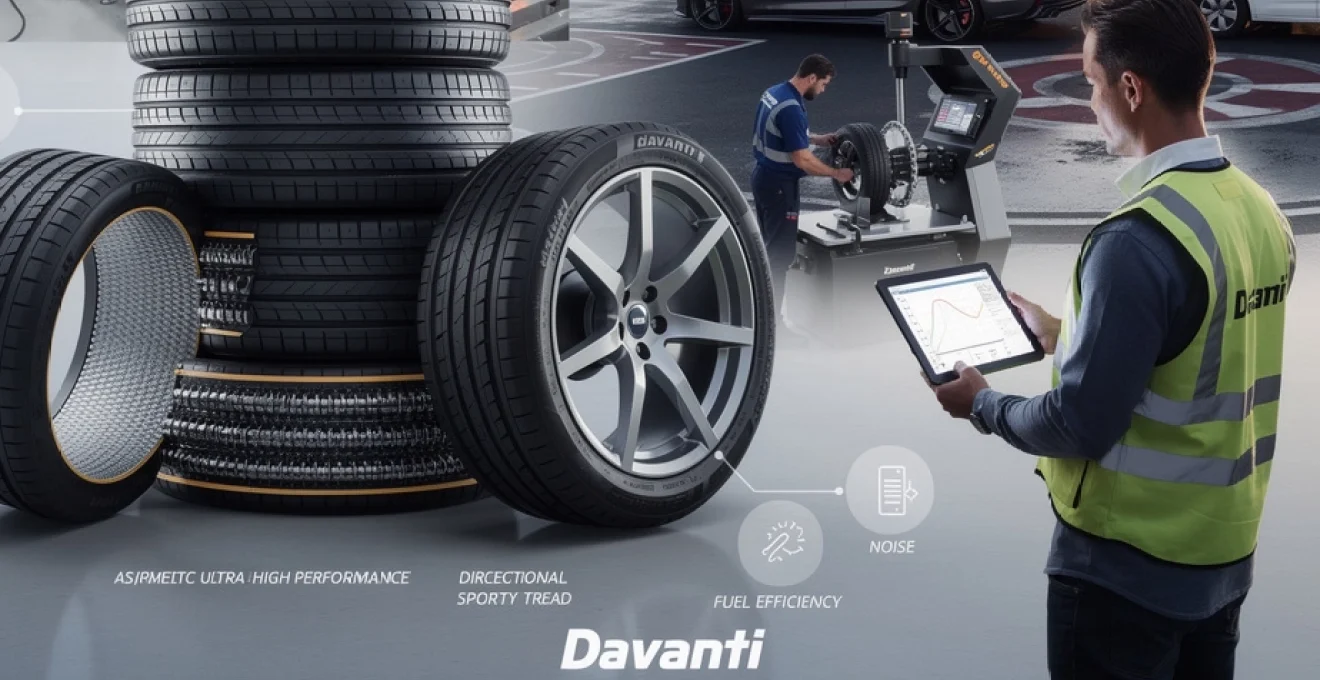
Tyres sit at the centre of every safety, comfort and efficiency decision you make on the road. Choosing a brand such as Davanti means balancing braking performance, noise levels, longevity and cost in real-world driving, not just on a label. For drivers who want something more refined than a budget option but without the price tag of a premium giant, Davanti tyres raise an obvious question: do they genuinely deliver quality and value, or are they just another entry-level name?
Understanding how Davanti develops, tests and manufactures its ranges helps you judge whether they fit your needs, from city commuting and taxi work to performance driving. When you factor in construction, compound technology, independent testing and long-term ownership costs, it becomes much easier to decide if Davanti is the right choice for your car or van and the type of journeys you cover every week.
Davanti tyres brand overview and manufacturing footprint in qingdao and beyond
Ownership structure, R&D partnerships and brand positioning of davanti tyres UK
Davanti is a UK-based tyre brand created in 2015 under DAVANTI TYRES LIMITED, headquartered in the north of England. The company positions itself as an entry-level to lower mid-range tyre brand, targeting drivers who value safety and comfort but have a limited budget for premium tyres. Although the brand sits in what comparison tools call the “entry-level” segment, Davanti promotes a more technical, engineering-led image than many anonymous budget imports.
Research and development are heavily tied to European proving grounds. Davanti works with facilities such as Applus+ IDIADA in Spain, UTAC in Finland and the UK, and Autódromo Internacional do Algarve in Portugal for tyre development and homologation work. These R&D partnerships give Davanti access to high-speed circuits, dedicated wet braking lanes and winter testing tracks, allowing compounds and patterns to be tuned for European climates and UK-style mixed-weather use rather than purely for lab conditions.
This combination of British brand management and international testing is central to Davanti’s positioning. The brand markets itself as a realistic alternative to mid-range players for drivers who want more assurance than a no-name tyre can offer, without crossing into premium price territory dominated by Michelin, Goodyear and Pirelli.
Qingdao factory capabilities, automation level and ISO quality certifications
Production for Davanti tyres is centred around modern plants in and around Qingdao, a major tyre manufacturing hub in China. Rather than relying on purely manual processes, the factories use a high level of automation, including AI-controlled robotic inspection on the production line. Robotic systems scan every casing for structural irregularities or bulges, and uniformity machines check roundness and balance before tyres leave the plant.
These facilities typically hold ISO 9001 quality management and ISO/TS 16949 automotive quality certifications, aligning with global OEM standards. For you as a buyer, that means Davanti tyres are produced under controlled, audited processes, rather than the ad-hoc production sometimes associated with very low-cost brands. The mixture of automated building machines and strict curing control also improves consistency between batches, which is crucial for predictable road behaviour and balanced sets.
The Qingdao base also allows Davanti to scale production quickly when a pattern or size becomes popular in Europe or the Middle East. That flexibility, combined with automated compound mixing and computer-controlled extrusion, underpins the brand’s ability to release new patterns such as Ecoura HP1 while maintaining a competitive price point.
Distribution network in the UK, EU and middle east and impact on tyre availability
Davanti’s distribution network has expanded rapidly since 2015, particularly in the UK where the brand is now a common sight at independent tyre dealers. Significant stock is held in regional warehouses, which shortens lead times and makes same-day fitting possible in many areas. For fleet operators, good local availability reduces downtime when a taxi, van or delivery vehicle needs new tyres at short notice.
In mainland Europe, Davanti tyres are distributed through partners in Spain, Portugal and several central European markets. The brand is also well established in the Middle East, where hot-climate performance and load capacity are important selling points. This broad footprint helps stabilise production volumes and supports ongoing development investments because factories can run at consistent utilisation.
For you, this translates into better availability of popular sizes across DX, Protoura and Wintoura lines, including larger diameters such as 18–20 inch UHP fitments. This also makes it easier to find matching replacements later in a tyre’s life, avoiding the mixed-brand setups that can compromise handling balance and electronic driver aids.
Davanti’s product segmentation versus budget and mid-range competitors such as landsail and kumho
Davanti’s range segmentation is designed to sit between ultra-cheap brands and established mid-range names. Compared with budget competitors such as Landsail, Davanti typically offers more advanced silica-rich compounds, broader wet-grip coverage on EU labels (many sizes rated B for wet), and a stronger emphasis on testing stories and guarantees such as accidental damage cover in certain markets.
Against mid-range brands like Kumho and Falken, Davanti usually undercuts on price while aiming to match them on noise, comfort and straight-line stability, even if ultimate lap-time performance and extreme wet traction can lag slightly. The brand’s clear segmentation into DX (touring/UHP), Protoura (performance), Wintoura (winter/all-season) and Vantoura (van) helps buyers pick the right tyre category for their usage without confusion.
This positioning means Davanti can be an attractive upgrade if you are currently on anonymous budget tyres and want a step up in feel and predictability. However, if you are used to premium tyres and habitually drive at higher speeds or in very demanding conditions, you may still prefer a top-tier brand for maximum performance margins.
Construction, compound technology and tread design in davanti tyre ranges
Silica-enriched tread compounds and polymer blends used in DX, protoura sport and wintoura lines
Davanti uses high-loading silica compounds across its core passenger car tyres. Silica helps reduce rolling resistance and improve wet grip by making the rubber more flexible at lower temperatures. In the DX390 and DX640 touring lines, this translates into shorter wet braking distances than many entry-level tyres and modest gains in fuel economy thanks to lower hysteresis losses.
In the Protoura Sport UHP range, the compound is tuned for high-speed stability and lateral grip, blending functionalised polymers with silica and carefully controlled carbon black. This recipe aims to keep the tread block stable under load, resisting squirm during hard cornering. The Wintoura winter and all-weather patterns use a higher proportion of natural rubber and softer polymers, enabling the tread to remain pliable in winter conditions while packed with multiple sipes for biting edges on snow and ice.
The outcome for you is a family of compounds designed not only around EU label scores, but also around real-life driving: damp B-roads, standing water, and a wide range of temperatures from frosty mornings to summer heatwaves.
Tread pattern engineering: asymmetric, directional and symmetrical designs in DX390, DX640 and vantoura
Davanti uses different tread philosophies across its ranges to balance grip, noise and tyre wear. The DX390, a popular touring tyre, features an asymmetric pattern. The outer shoulder uses larger blocks for dry cornering stability, while the inner area has more grooves and sipes to evacuate water. This asymmetric pattern is common among tyres aimed at balanced all-round performance.
The DX640, Davanti’s high-performance summer tyre, also uses an asymmetric layout but with more continuous ribs to enhance steering response and straight-line stability. Large circumferential grooves manage water clearance at motorway speeds, which is crucial in heavy UK rain. In contrast, many Vantoura and other van tyres rely on more symmetrical or slightly directional designs to promote even wear on heavily loaded axles and frequent stop–start urban driving.
Directional patterns are more common in dedicated winter and all-weather ranges like Wintoura, where V-shaped grooves channel slush and water away from the contact patch. If you drive mostly on motorways and fast A-roads, asymmetric designs like DX640 offer a good balance of agility and comfort; for mixed city and rural routes, DX390’s more comfort-oriented layout can be more appropriate.
Casing construction, steel belting and sidewall stiffness for load and speed ratings
Under the tread, Davanti uses a typical radial construction for passenger tyres: a polyester carcass ply, two steel belts and, in many higher-speed-rated sizes, a nylon or aramid overlay (often referred to as a cap ply). This overlay stabilises the tread at speed and improves heat distribution, which supports high-speed endurance and durability.
Sidewall stiffness is tuned according to the tyre’s role. UHP tyres like Protoura Sport have stiffer sidewalls to sharpen steering and maintain shape under lateral load, which you will feel as more precise turn-in and better feedback through the wheel. Touring patterns such as DX390 use a slightly more compliant sidewall to absorb bumps and imperfections on UK roads, prioritising ride comfort over razor-sharp response.
For Vantoura and van-specific patterns, casing strength is critical. Higher load indices demand reinforced sidewalls and thicker bead areas to cope with constant loading and kerb impacts. If you run a high-load van or people carrier, checking the load index and speed rating on Davanti’s van tyres ensures compatibility with manufacturer recommendations and helps avoid premature wear or heat build-up.
Noise reduction features, variable pitch tread blocks and EU label rolling noise classes
Road noise is a key part of Davanti’s design brief, especially for commuters and family vehicles spending many hours on the motorway. Variable pitch tread blocks are used in patterns like DX640 and Ecoura HP1 to break up harmonic frequencies. By staggering block sizes and angles, the tyre avoids generating a single dominant tone, reducing the “drone” often heard from cheaper tyres.
Compartmentalised grooves and carefully shaped voids also help contain air-pumping noise as the tyre rolls. According to EU label data for the DX640 range, many sizes achieve external rolling noise values around 68–70 dB, which is competitive in the mid-range segment. For you inside the cabin, this often translates into a calmer, less tiring drive, especially at 70 mph on coarse UK asphalt.
If cabin quietness is a priority, looking at both the EU noise label and owner reviews mentioning tyre hum and vibration is essential. Davanti’s focus on comfort has been positively highlighted by numerous driver reviews praising low noise compared with previous budget tyres.
Performance assessment of davanti tyres in independent tests and real-world driving
Dry grip and cornering stability benchmarks for protoura sport and DX640 in auto bild and tyre reviews tests
Independent magazine and online tests give useful benchmarks against premium brands. In comparative testing, Davanti Protoura Sport and DX640 generally sit in the middle of the pack. Dry grip and cornering stability are often described as solid and predictable, though not class-leading. In several Auto Bild and Tyre Reviews-style group tests, Davanti has tended to trail premium brands like Michelin and Goodyear by a few metres in extreme dry braking, but stays ahead of many basic budget options.
For everyday drivers, the key takeaway is that Davanti UHP tyres provide enough dry performance to handle emergency manoeuvres and brisk driving, but they are not intended to win track-day comparisons. If you own a powerful performance saloon or hot hatch and regularly push hard on twisty roads, a top-tier UHP may still be preferable. For normal commuting and motorways, Protoura Sport and DX640 grip levels are typically more than adequate.
Wet braking distance, aquaplaning resistance and EU label wet grip grades across key davanti patterns
Wet performance is often the biggest differentiator between entry-level and premium tyres. Davanti invests heavily in wet testing at facilities like IDIADA and Autódromo Internacional do Algarve, using dedicated wet braking and handling circuits. EU label data for patterns such as DX640 shows wet grip grades ranging from B to A for many popular sizes, which indicates competitive stopping distances on wet asphalt.
Longitudinal aquaplaning resistance is measured by comparing wheel speed to vehicle speed when driving through deep water. A higher onset speed indicates better resistance. Davanti designs use deep circumferential grooves and optimised shoulder channels to delay aquaplaning; some internal testing suggests aquaplaning threshold speeds comparable to mid-range brands. However, user feedback also notes that wet grip can deteriorate as tread depth approaches 4 mm, underlining the importance of timely replacement.
For you as a driver, that means Davanti tyres can offer strong wet grip when new, but monitoring tread depth closely is essential. Replacing at 3–4 mm rather than the legal minimum 1.6 mm is particularly advisable if you frequently drive on fast roads in heavy rain.
Wear rate, tread life and mileage performance from fleet trials and taxi usage data
Tread life is a major component of total tyre value. Reports from taxi drivers and fleet users indicate that Davanti DX390 and DX640 can offer competitive mileage when properly aligned and rotated, often matching or slightly trailing mid-range brands but lasting significantly longer than some very cheap imports. Several long-term reviews mention front-axle life exceeding 15,000 miles on heavy front-wheel-drive vehicles, with even wear patterns when suspension and pressures are maintained.
However, a subset of users with heavier vehicles or very spirited driving styles report faster wear and reduced wet confidence after the tyres reach mid-life. This variability reflects both driving style and compound tuning, which favours comfort and grip over ultra-hard, long-wearing rubber. If you run high-annual-mileage vehicles, tracking your actual miles per set and adjusting rotation intervals can optimise cost per mile.
For mixed-use fleets, a realistic expectation is that Davanti’s average tread life will sit slightly below premium touring tyres but above many anonymous budget brands. When combined with lower purchase prices, this can still translate into competitive overall value.
Ride comfort, cabin noise and steering feel on UK roads and motorway surfaces
Comfort is an area where Davanti tyres often receive strong praise. Many drivers switching from hard, noisy budget tyres to DX390 or DX640 note a noticeable reduction in harshness and a more relaxed feel on patchy tarmac. Variable pitch tread designs and compliant carcass tuning help absorb small imperfections, which is particularly valuable on older UK A-roads and concrete motorway sections.
Steering feel is typically described as stable and predictable rather than razor-sharp. Protoura Sport offers the most direct feedback, catering to drivers of performance saloons and hot hatches who want more connection to the road. For everyday use, DX390’s softer steering response can actually feel more natural, especially if you value relaxed motorway cruising over aggressive turn-in.
If you spend many hours a week commuting, the combination of low cabin noise and forgiving ride makes Davanti a compelling option compared with some harsher mid-range tyres that prioritise sporty feel over comfort.
Owner review trends on blackcircles, tyre reviews and oponeo compared to hankook and falken
Aggregated user reviews paint a nuanced picture of Davanti’s strengths and weaknesses. Across platforms such as Blackcircles, Tyre Reviews and Oponeo, average scores for models like DX640 often sit around 70–75%, with many owners praising quietness, comfort and value for money. Comments frequently highlight a clear improvement over cheaper tyres in both wet grip (when new) and steering stability.
At the same time, owner feedback reveals some polarisation. A minority of users report dissatisfaction with wet performance as the tyres wear, and some mention faster tread wear than expected on heavier cars or powerful diesels. Compared with mid-range brands like Hankook and Falken, Davanti generally trails slightly in overall ratings but often outranks basic budget tyres made by lesser-known manufacturers.
For you as a potential buyer, the pattern in reviews suggests that Davanti performs best for drivers who value comfort and reasonable performance at a fair price, and who are willing to replace tyres before they reach the legal minimum to maintain good wet grip.
Davanti product range breakdown: DX, protoura, wintoura and van-specific patterns
DX390, DX440 and DX640: touring and UHP fitments for everyday passenger cars
The DX range forms the backbone of Davanti’s passenger car offering. DX390 is a fuel-efficient, comfort-oriented summer touring tyre aimed at small to medium hatchbacks and saloons. Its asymmetric tread and silica compound are designed for predictable handling, long-distance comfort and decent wet braking on everyday roads.
DX440 targets SUV and crossover drivers, with larger sizes and higher load ratings. Reinforced sidewalls and more robust shoulder blocks help handle the extra height and weight of SUVs, maintaining stability on motorways and rougher surfaces. For drivers of performance-orientated hatchbacks, coupes and saloons, DX640 sits as a UHP (ultra-high performance) summer tyre, balancing dynamic ability with comfort and low noise.
If you are choosing between these, consider your vehicle’s size and usage. For a family hatch covering mixed motorway and urban miles, DX390 is usually the logical choice; for a powerful rear-wheel-drive saloon, DX640 offers better high-speed stability and steering precision.
Protoura sport and protoura race-inspired technologies for performance saloons and hot hatches
Protoura Sport is Davanti’s flagship performance tyre, inspired by technologies used in more track-focused products such as Protoura Race. It features a more aggressive asymmetric pattern with wide outer shoulders for lateral grip and a stiff construction for enhanced steering accuracy. The compound emphasises high grip across a wide temperature range, making it suitable for fast road driving and occasional track-day use.
Race-derived elements include reinforced bead areas for better rim control and advanced cap-and-base compound layering, where a grippier top compound sits over a cooler-running base. This combination helps manage heat build-up during prolonged spirited driving, maintaining consistent feedback. If you drive a hot hatch or performance saloon and want a tyre that offers more excitement than a typical touring pattern, Protoura Sport is Davanti’s most appropriate option.
However, if you are chasing lap times or run a heavily tuned car, premium UHP tyres may still deliver an extra level of outright grip and stability, at a higher price.
Wintoura winter and all-weather SKUs for cold-climate and alpine-certified applications
Wintoura represents Davanti’s dedicated winter and all-weather range. These tyres use softer compounds and heavily siped tread blocks to maintain flexibility and grip in temperatures below 7°C. The directional or semi-directional patterns channel snow, slush and water away from the contact patch, improving traction and braking in adverse conditions.
Many Wintoura models carry the 3PMSF (Three Peak Mountain Snowflake) symbol, confirming alpine certification. This means they meet minimum performance standards in severe snow tests, making them suitable for drivers who travel to mountain regions or live in parts of Europe with strict winter tyre regulations. For UK drivers, Wintoura can be particularly helpful in rural or hilly areas where untreated roads and early-morning ice are common.
If you prefer not to swap tyres seasonally, Davanti also offers all-weather variants that blend winter traction with acceptable summer performance, although peak wet and dry grip at high temperatures will not quite match a dedicated summer tyre.
Vantoura and commercial van tyres for high-load, stop–start urban delivery fleets
Vantoura and Davanti’s broader van tyre range are engineered for commercial use, where durability and load capacity are paramount. These tyres feature reinforced casings, thicker tread bases and more robust sidewalls to handle high payloads, kerb strikes and constant stop–start usage common in city delivery fleets.
Tread patterns are optimised for even wear and consistent braking, with wide circumferential grooves for water evacuation and closely spaced ribs to maintain contact patch stability. Some Vantoura models also focus on reducing rolling resistance to lower fuel consumption, an important saving for high-mileage fleets.
If you operate vans in densely populated areas, choosing a dedicated van tyre such as Vantoura rather than fitting passenger car tyres is essential for safety, legal compliance and long-term cost control.
Quality control, safety compliance and regulatory standards for davanti tyres
ECE type approval, REACH compliance and UKCA/CE marking procedures
Davanti tyres sold in Europe and the UK must pass a range of regulatory hurdles before reaching your vehicle. All road-legal sizes carry ECE type approval marks, confirming they meet minimum standards for load, speed, endurance and rolling noise. After Brexit, tyres placed on the UK market also require UKCA marking, while CE marks remain relevant for the EU.
In parallel, Davanti must comply with REACH chemical regulations, which restrict the use of certain aromatic oils and hazardous substances in rubber compounds. Compliance ensures that tyres are safer from an environmental and health perspective, both during manufacture and at disposal.
For buyers, these marks provide assurance that Davanti tyres are subject to the same basic regulatory framework as more expensive brands. They do not guarantee premium-level performance, but they do set a safety baseline and confirm that tyres have passed standardised lab tests.
In-factory x-ray inspection, uniformity testing and high-speed endurance tests on davanti casings
Beyond legal requirements, Davanti implements internal quality control processes at its manufacturing plants. X-ray inspection is used on a sample basis to examine internal structure, verifying that belts, plies and beads are correctly positioned without trapped air pockets or overlaps. This reduces the risk of internal failures that might not be visible externally.
Uniformity testing machines spin tyres under load to measure radial and lateral run-out, force variation and imbalance. Tyres that fall outside tolerance are rejected or reworked. High-speed endurance rigs then subject tyres to sustained running at and beyond rated speeds, under specific loads and inflation pressures, to validate structural endurance.
These processes help ensure that when you buy a set of Davanti tyres, they behave consistently on the road, with reduced vibration and better balance. While such procedures are now common in large-scale tyre factories, the emphasis on automated inspection underlines Davanti’s attempt to separate itself from the lowest-cost competition.
Batch traceability, DOT codes and production date verification for buyers
Every Davanti tyre carries a DOT or equivalent production code moulded into the sidewall. This code indicates the plant, size code and the week and year of manufacture. Batch traceability enables the company to track tyres back to specific production runs, which is essential for internal quality analysis and any potential recalls.
For you, checking the four-digit date code (for example, “2524” for week 25 of 2024) is a simple way to ensure you are receiving fresh stock rather than tyres that have spent many years in a warehouse. As a guideline, tyres less than two years old are generally considered fresh for fitting, provided they have been stored correctly.
If you are buying from smaller retailers, asking to see the sidewall codes before fitting is a sensible step in any tyre purchase process, and Davanti tyres provide all the standard markings expected of modern products.
Cost–value analysis: davanti tyres versus premium brands on total cost of ownership
Price comparison by size against michelin primacy, goodyear EfficientGrip and pirelli cinturato
Price is often the decisive factor when selecting tyres. For common mid-size car dimensions such as 205/55 R16 or 225/45 R17, Davanti DX390 or DX640 can be around 30–50% cheaper per tyre than premium options such as Michelin Primacy, Goodyear EfficientGrip or Pirelli Cinturato. For example, if a premium tyre in 225/45 R17 retails at around £110–£130, an equivalent Davanti might sit in the £65–£80 range at many UK retailers.
This gap becomes more pronounced in larger UHP sizes, where premium brands can exceed £200 per tyre. In such cases, Davanti’s UHP offerings like Protoura Sport often remain under £150, significantly reducing the upfront cost of a full set. For drivers on a strict budget, this difference can make the choice between fitting four new safe tyres now or delaying replacement.
| Size | Typical premium price (per tyre) | Typical Davanti price (per tyre) | Approx. saving per set of 4 |
|---|---|---|---|
| 205/55 R16 | £100 | £65 | £140 |
| 225/45 R17 | £120 | £75 | £180 |
| 245/40 R18 | £160 | £105 | £220 |
Such savings are particularly appealing when you consider that many drivers will not exploit the last 10–15% of performance a premium tyre can offer, especially in normal city and motorway use.
Cost per mile calculations based on treadwear, fuel economy and rotation intervals
To understand real value, it helps to calculate cost per mile rather than just purchase price. Suppose a premium tyre lasts 25,000 miles on the front axle at £120 each, giving a cost of about 0.48p per mile. If a Davanti DX640 costs £75 but lasts 18,000 miles, the cost is about 0.42p per mile. Although tread life is shorter, the lower purchase price can still deliver comparable or even slightly better value per mile.
Fuel economy differences between quality mid-range and premium tyres are usually modest in everyday use, often in the region of 1–3% depending on rolling resistance ratings and driving style. Davanti’s silica-enriched compounds and relatively low rolling resistance help keep this gap small, especially in patterns like DX390 and Ecoura HP1 designed with efficiency in mind.
Rotating tyres front to rear every 6,000–8,000 miles can further reduce cost per mile by evening out wear. This is particularly important on front-heavy cars and front-wheel-drive taxis, where front tyres do most of the work. If you combine rotation with regular pressure checks and alignment, Davanti tyres can deliver solid economic performance across their lifespan.
Resale, warranty support and claims handling through UK davanti dealer networks
After-sales support is an often-overlooked aspect of tyre value. Davanti collaborates with UK dealer networks that offer warranty programmes, including accidental damage cover on certain models. This can provide replacement or discounted tyres if you suffer sidewall damage from potholes or kerb impacts, giving you extra peace of mind compared with unbranded tyres without structured support.
Claims handling typically goes through the fitting dealer, who assesses tread depth, damage patterns and proof of purchase before submitting a claim to Davanti. Clear batch traceability and labelling make it easier to process legitimate claims and quickly identify any manufacturing issues that may arise in a particular production run.
Strong dealer support and responsive claims procedures can turn a mid-priced tyre into a genuinely smart purchase by reducing the financial risk associated with everyday road hazards.
When considering total cost of ownership, it is therefore sensible to factor in not just the initial price and expected mileage, but also the presence of any damage guarantees and the convenience of resolving issues through a local Davanti-approved dealer if you ever need assistance.