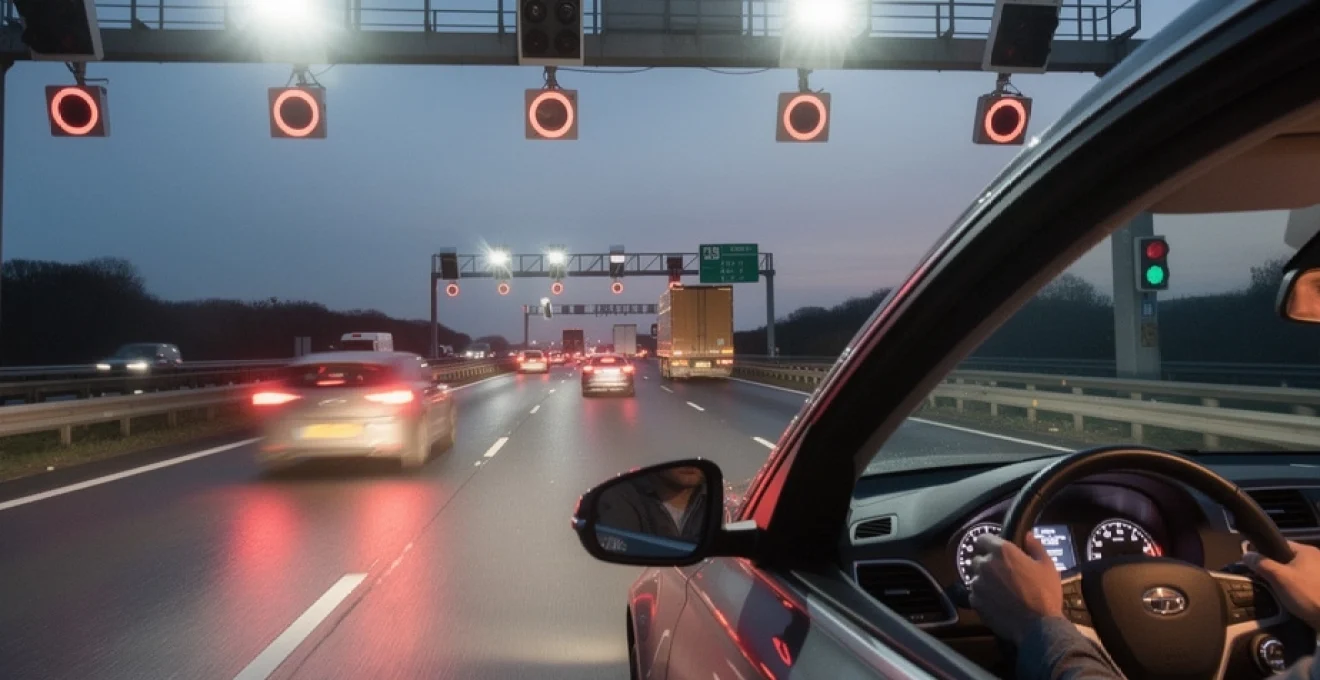
Anyone who spends time on UK motorways has probably wondered what actually happens when driving under variable speed limit signs. Smart motorways, controlled motorways and all‑lane running sections now cover hundreds of miles, and variable speed cameras enforce changing limits 24/7 in many regions. If you use routes such as the M25, M1, M5 or M6, understanding how these systems work is no longer just interesting background knowledge – it directly affects how you drive, how you interpret gantry signs and how you manage the risk of a costly speeding offence.
Confusion is common: some cameras flash, some seem never to flash, and others only trigger in heavy traffic or at night. Add changing limits, red X lane closures and a mix of camera technologies, and it becomes easy to misunderstand when enforcement actually happens. By unpacking how variable speed cameras operate, when they flash and how penalties are processed, you can drive more confidently and stay within the law even on the most complex stretches of smart motorway.
How variable speed cameras operate in the UK: HADECS3, SPECS and VECTOR systems explained
Digital enforcement technology: radar, inductive loops and ANPR integration in variable speed cameras
Modern UK variable speed cameras rely on a blend of radar, inductive loops and ANPR (Automatic Number Plate Recognition). Earlier motorway systems used classic Gatso radar units mounted on gantries, working with white road markings as a secondary check. Newer HADECS3 and VECTOR cameras are fully digital and integrate several technologies into a compact housing.
Radar-based systems send out a radio signal that bounces off your vehicle. The unit measures how the frequency shifts to calculate speed in a fraction of a second. Inductive loops, by contrast, are wires embedded in the carriageway that detect the metal mass of a vehicle and the time taken to pass between multiple loops. This creates a rigid secondary speed measurement that can be used to corroborate the radar reading.
ANPR is central to variable speed enforcement on smart motorways. As the camera measures speed, ANPR software recognises your registration plate, checks the vehicle image and associates it with the correct lane. Where needed, a linked system can even verify whether a vehicle is subject to a lower limit, such as an HGV or coach, although that is still often handled at back-office stage rather than in real time.
Differences between fixed, average speed and variable speed enforcement on smart motorways
On UK roads you will encounter three key enforcement types: fixed speed cameras, average speed cameras and variable speed cameras. Fixed cameras, such as traditional Gatso units, monitor a single point on the road and trigger when a vehicle exceeds a pre‑set threshold, usually in a static limit like 30 mph or 70 mph. They are still used on some smart motorway stretches but are gradually being replaced by HADECS3 or VECTOR devices.
Average speed cameras like SPECS measure the time it takes your vehicle to travel between two or more camera points, often across long distances – for example, through motorway roadworks. If your average speed is above the limit, every second above it counts, not just the moment you pass one camera. This is why “brake for the camera and speed up afterwards” does not work with average enforcement.
Variable speed cameras occupy a slightly different role. They enforce a limit that can change in real time – for instance, from 70 to 60 to 40 mph across three gantries as traffic builds. On smart motorways, the cameras are normally tied directly into a central control system run by National Highways. When a new variable limit is set on the gantry, the linked cameras are automatically re‑armed to enforce that limit plus any tolerance. If no limit is displayed, the default enforcement is usually the national speed limit, subject to system configuration and local policy.
How HADECS3 cameras on the M25, M1 and M6 detect speed in changing limit conditions
Highways Agency Digital Enforcement Camera System 3 – better known as HADECS3 – is the most common variable speed camera on smart motorways such as the M25, M1, M4 and M6. These compact grey or yellow units are often mounted low on a gantry support pole at the left-hand side of the carriageway, yet they can cover three to five lanes thanks to precise lane tracking and wide-angle lenses.
When a control room operator sets or changes a speed limit on an overhead gantry, HADECS3 receives the updated limit almost instantly. The system combines radar detection with distance calibration markers in each lane to work out your speed as you approach and pass underneath. Importantly, HADECS3 also records what was being shown on the gantry at the time, so that any prosecution can prove the limit that applied.
Because HADECS3 is designed specifically for variable limits, it can manage rapid changes. For example, if the limit drops from 60 to 40 mph between gantries, there is a short built‑in grace distance to allow vehicles to slow safely rather than forcing dangerous braking exactly under the sign. If you are still significantly above the displayed limit by the time you reach the next camera‑equipped gantry, enforcement becomes likely.
Role of gantry-mounted lane-specific cameras on controlled motorways and all‑lane running sections
On many controlled motorways, each lane effectively has its own enforcement channel. Older systems place a Gatso-style unit above each lane on the gantry; newer HADECS3 or VECTOR cameras can digitally distinguish lane position from a single physical device, using multiple virtual measurement zones to identify which lane a vehicle is in when it was speeding.
This lane-specific enforcement matters on all‑lane running sections, where the former hard shoulder becomes a live lane. If a red X is displayed above a closed lane, cameras can be configured to capture vehicles ignoring that closure as well as those exceeding a reduced speed limit. A vehicle travelling legally at 50 mph in lane 2 will not be treated the same as one doing 50 mph under a red X in lane 1, even though their speeds match.
Practically, this means you should read each lane signal as a separate, enforceable instruction. The combination of lane‑by‑lane speed limits, red X closures and high‑resolution imaging allows enforcement teams to prove exactly where your vehicle was and what signals were displayed as you passed underneath, even in heavy traffic or poor visibility.
Do variable speed cameras flash in the UK? flash behaviour in day, night and different road conditions
Rear-facing xenon flash units versus non-flash infrared imaging on modern camera models
Many drivers still associate speed cameras with a bright, unmistakable flash. Traditional Gatso cameras use a rear-facing xenon flash unit to illuminate the rear of a vehicle and the calibration lines on the road. On variable speed sections that still use Gatso hardware, you will usually see two quick flashes, taken a fraction of a second apart, when enforcement is triggered.
However, much of the newest motorway enforcement equipment does not rely on a visible flash. Systems such as VECTOR and some HADECS3 configurations use infrared or low‑light imaging that is invisible or barely visible to the human eye. The goal is two-fold: prevent dazzling drivers and capture clear images in all conditions without drawing attention to every single enforcement event.
This is why you may not see any obvious flash even if the camera has recorded an offence. In many cases, there is no direct feedback to the driver at the time – the evidence is captured silently, stored digitally and reviewed later by enforcement staff.
Why some variable speed cameras appear not to flash in daylight on the M4, M20 and M62
On bright days, even cameras that still use xenon flashes can appear not to flash. The flash intensity is calibrated to capture a sharp image of your registration plate and the surrounding markers, not to impress nearby drivers. In strong sunlight, the flash may be completely masked by ambient light, particularly if you are looking forward rather than back towards the camera.
Drivers often report seeing a flash on an adjacent lane or gantry and assuming it related to their vehicle. On multi-lane motorways like the M4 or M62, a camera may be triggered by a vehicle in another lane or by one already past your position, giving the impression of a mysterious flash when you were driving at an indicated 40 or 50 mph. Overread or under‑read speedometers can add to this confusion.
It is also common for testing or maintenance activity to produce one-off flashes. Engineers may manually trigger a device to confirm correct alignment or exposure. These test events are not linked to enforcement data and are filtered out before any Notice of Intended Prosecution is generated.
Dual-lens capture and secondary photographic evidence when a flash is not visible to drivers
To support prosecutions, variable speed enforcement normally relies on dual images or even multiple frames, taken a known time apart. A dual-lens or rapid‑sequence setup allows a back‑office operator or automated software to cross-check the radar or loop‑based speed with visual evidence of how far the vehicle travelled between frames.
Even if no flash was visible, the system will often record at least two images of your vehicle: one at or before the measurement point and one afterwards. These can show your exact lane, position relative to painted calibration lines (where used), and details such as the displayed gantry limit. If you request photographs to “help identify the driver”, these are typically the images you receive.
From a legal perspective, this secondary photographic evidence is crucial. It supports the argument that the device was working correctly and that the recorded speed corresponds to a specific vehicle and plate at a given time. The lack of a visible flash to you as the driver does not weaken that evidence.
How camera housings, visors and anti-dazzle technology affect perceived flashes at night
At night, a bright flash is more noticeable, but variable speed cameras are designed to minimise glare and distraction. Many units sit inside deep housings with visors that shield light from oncoming traffic. Rear-facing units direct the flash away from drivers’ eyes, relying on reflection from the rear of vehicles and road markings.
Some systems combine a weaker visible flash with high‑sensitivity sensors and infrared illuminators. To you, this might look like a faint flicker or no flash at all, even though the sensor received a much stronger infrared pulse. Anti-dazzle engineering is especially important on busy smart motorways, where repeated bright flashes could otherwise present a hazard and trigger shock braking.
If you notice a distant flash at night while maintaining the correct speed under a gantry, it may have been partly masked or reflected by roadside furniture, signs or other vehicles. Human perception of split-second flashes at 70 mph is imperfect, so apparent inconsistencies are not a reliable indicator of whether your vehicle was the target.
Trigger thresholds and enforcement margins: when variable speed cameras actually activate
ACPO / NPCC enforcement guidelines and typical tolerances above a displayed variable limit
Officially, the law allows enforcement from 1 mph over the posted limit. In practice, most UK forces follow guidance issued by the former ACPO and now the National Police Chiefs’ Council (NPCC), suggesting a threshold of 10% plus 2 mph. That means a variable motorway limit of 50 mph might see enforcement starting at around 57 mph.
However, this is only guidance. Individual forces – Avon and Somerset, Metropolitan Police, North Wales and others – confirm through Freedom of Information responses that they may apply 10%+2 but reserve the right to enforce at lower tolerances. As technology and public safety campaigns tighten, several forces have hinted that tolerances on smart motorways could reduce over time, particularly in high‑risk areas.
For example, on a 40 mph variable limit, the commonly cited guidance suggests enforcement around 46 mph. Yet relying on this leeway is risky. Differences between your indicated speed and actual speed, worn tyres and calibration error can easily account for 2–3 mph. If a camera records 48–50 mph in a 40 zone, a Notice of Intended Prosecution is highly likely.
Interaction between temporary variable limits, national speed limit and camera trigger speeds
A frequent question is whether cameras still enforce the national speed limit when no variable limit is displayed. On most smart motorways, the default is that if the gantry shows a blank roundel (or just a motorway symbol), the limit reverts to the national speed limit for that class of road and vehicle – typically 70 mph for cars, 60 mph for light goods vehicles and 60 mph for HGVs on dual carriageways.
Cameras can be configured to enforce these default limits, again applying local tolerance. Anecdotal reports from drivers doing an indicated 80 mph under “no limit shown” gantries and seeing flashes strongly suggest that national speed limit enforcement is active on several M25, M42 and M5 stretches. Heavy goods vehicles in particular may be photographed at speeds that are legal for cars but above the limit for their vehicle category.
Temporary variable limits override the national limit as long as they are displayed in a red circle. When those limits are active, the camera threshold re-bases around the new number. If the limit returns to NSL at the next gantry, the associated cameras usually switch back to national limit enforcement either immediately or within a very short delay, so pushing your luck as the limit rises is rarely a safe tactic.
How dynamic speed setting from national highways control rooms affects camera arming
Variable limits on smart motorways are not random. They respond to real-time traffic data from roadside sensors, CCTV, and sometimes even weather stations. When congestion, incidents or poor conditions are detected, a control room operator or automated system sets reduced limits to smooth traffic flow and reduce collision risk.
When a new limit is confirmed, the associated variable speed cameras are automatically armed at that value plus any configured tolerance. There is usually a short period – often just a few seconds – between the limit being displayed and enforcement commencing, allowing for system checks. However, that grace period is not intended as a window for drivers to ignore the new limit.
In some documented cases, drivers have been recorded exceeding a new 40 mph limit just seconds after it appeared, especially where the limit drop follows a long run at 60 mph or 70 mph. If you see lane signals changing ahead, the safest approach is to start easing off early rather than waiting until the last gantry to brake.
Case examples of enforcement at 40, 50 and 60 mph variable limits on the M42 and M25
Real-world experience on the M42 and M25 shows how consistent variable speed enforcement has become. At 40 mph limits around busy junctions, many drivers report receiving NIPs for recorded speeds in the 48–52 mph range. These speeds are comfortably above the 10%+2 threshold and lead almost automatically to fixed penalties or court summons if especially high.
At 50 mph, recorded speeds of 58–62 mph are frequently cited in NIPs, typically resulting in a conditional offer of three points and a £100 fine, or a speed awareness course offer for eligible drivers. On 60 mph sets, reports of enforcement in the low 70s are common. Crucially, there are almost no verified cases of drivers being prosecuted at exactly the posted limit on these variable sections, supporting the idea that some tolerance is actively used.
Repeating patterns from these stretches highlight a simple principle: aim to be at or just under the posted limit by the time you pass under the gantry, not “averaging down” after you have already passed a camera equipped with HADECS3 or similar technology.
Red ring versus advisory signals: when variable speed cameras are legally enforceable
Distinction between mandatory red-ring speed limits and advisory “amber board” recommendations
On motorways with overhead gantries, understanding the difference between mandatory and advisory signals is essential. A speed inside a red circle is a mandatory limit under the Road Traffic Regulation Act 1984. Exceeding it can lead to prosecution backed by camera evidence. A similar speed shown on a matrix sign without a red ring – often amber text or surrounded by flashing amber lamps – is advisory.
Advisory speeds are used for warnings such as congestion ahead, fog, standing water or incidents on the hard shoulder. Complying with them is strongly recommended for safety, but there is no direct automatic camera enforcement for exceeding an advisory display alone. That said, if driving significantly above an advisory speed and then being involved in a collision, failure to heed the advice could be used as evidence of careless or dangerous driving.
Because both mandatory and advisory speeds can appear on the same gantry layout, it helps to train yourself to look specifically for the red ring. If it is present, enforcement cameras linked to that gantry will almost certainly be armed for that limit or for a corresponding lower one elsewhere on the controlled stretch.
How lane closures, red X signals and reduced speed limits are linked to camera enforcement
Red X signals above individual lanes indicate that the lane is legally closed. Passing under a red X in a running lane is an offence in its own right, regardless of speed. Many smart motorway cameras are configured to capture red‑X violations and speeding offences simultaneously, particularly where an incident or roadworks make lane discipline critical.
Typically, a red X will be accompanied by reduced speed limits on the remaining open lanes. Enforcement teams can then target both drivers ignoring the lane closure and those failing to slow for the hazard ahead. If you stay in a closing lane until the last moment and then cut across solid white lines, there is a real risk of being caught for both offences in one manoeuvre.
Recent UK enforcement campaigns have specifically highlighted red X compliance. Fixed penalties for red X offences can match or exceed those for moderate speeding, and repeated offences can lead to a court appearance. For practical purposes, treat a red X as seriously as a stop sign, especially where cameras are visibly present.
Legal status of overhead gantry signs under the road traffic regulation act 1984
Overhead gantry signs displaying variable limits in red roundels are not just information boards: they are legally enforceable traffic signs authorised under the Road Traffic Regulation Act 1984 and associated regulations. Regulations define exactly how these signs must look, how they should be illuminated and how they must be placed to create a valid limit.
In prosecutions, authorities typically produce not only camera evidence but also documentation showing that the gantry signs were operating correctly and were approved for use at that location. Systems like HADECS3 store an image of the gantry face showing the displayed limit at the moment of the offence, strengthening the legal position.
Attempts to argue that a limit “did not apply” because it was on an overhead gantry rather than a roadside post almost always fail. In legal terms, an illuminated gantry sign with a red‑ring speed limit has the same authority as a standard circular sign by the verge, and sometimes greater, given that it can be positioned directly above the relevant lanes.
Common driver misconceptions about flashing cameras under advisory congestion warnings
Misconceptions often arise when drivers see a flash under what they believe was only an advisory congestion warning. In many cases, a mandatory variable limit is active at the same time but is misread or simply not noticed amid other signs and traffic information. A driver focusing on the carriageway ahead may glance at a “Queues Ahead” message and miss the small red‑ring 50 mph limit directly above the lane.
Another cause of confusion is assuming that any flash must be linked to the gantry directly overhead. In reality, enforcement cameras can be offset from the gantry by several metres and angled to capture vehicles just before or after the sign. A camera at one gantry can record a vehicle that has just passed another limit sign, giving the impression that the flash relates to the wrong message.
A useful habit is to treat every red‑ring limit as enforceable, regardless of what other advisory messages are showing. If amber boards suggest 60 mph but a red ring shows 50 mph, the lower red‑ring value is the one the cameras care about, and the one that counts legally.
Penalty process after a variable speed camera flash: NIP, points, fines and speed awareness courses
Notice of intended prosecution (NIP) timelines and section 172 driver identification
If a variable speed camera records your vehicle above the enforcement threshold, the registered keeper will usually receive a Notice of Intended Prosecution (NIP) within 14 days of the offence. This notice is often combined with a Section 172 request for driver details, requiring the keeper to confirm who was driving at the time.
Failure to respond within 28 days can be treated as a separate offence, often carrying six penalty points and a substantial fine – significantly worse than many original speeding penalties. If multiple people have access to the vehicle, it is wise to keep accurate journey records so you can identify the driver confidently if a notice arrives.
The NIP will usually state the alleged speed, the enforced limit (e.g. 50 mph variable limit), location, date and time. It may also indicate whether photographic evidence is available to assist with driver identification, which you can often request before deciding how to respond.
Fixed penalties, court summons and sentencing band calculations for variable limit offences
For straightforward cases where your speed is within certain bands above the limit, a conditional offer of fixed penalty is common: typically three points and a £100 fine. On variable motorways, this often covers speeds up to around 65–69 mph in a 50 zone, or up to around the high 70s in a 60 zone, though exact cut‑offs vary by force and circumstances.
Higher speeds or aggravating factors – such as very high excess speed in heavy congestion – may lead directly to a court summons. Sentencing guidelines split speeds into bands A, B and C. For example, doing 76 mph or more in a 50 mph limit could fall into band C, where the court can impose a larger fine (often a percentage of weekly income) and 6 points or a short disqualification.
Variable limit offences are treated in the same way as static limit speeding in terms of penalties. However, courts may take a dimmer view where the reduced limit was clearly related to a serious hazard, such as an accident scene or roadworks, especially if other signs or red Xs were being ignored at the same time.
Eligibility criteria for UK national speed awareness courses after smart motorway offences
Many drivers caught just above a variable limit are offered the chance to attend a National Speed Awareness Course instead of accepting points, provided they meet certain criteria. Typically, you must not have attended a similar course for a speeding offence in the previous three years, and your speed must fall within a defined band above the limit – often up to around 10–12 mph over in lower limits and a bit more in higher limits.
For example, in a 50 mph variable limit, an alleged speed of 57–64 mph might attract a course offer, while 65–75 mph might trigger a fixed penalty, and anything higher could move towards court territory. Again, these numbers vary by police area, and there is no absolute right to a course; it is a discretionary educational alternative.
Attendance involves a half‑day session focused on stopping distances, perception of risk and the impact of even small increases in speed. While not a pleasant way to spend a morning, many drivers find the content a useful reset, particularly after being caught out by a rapidly changing smart motorway environment.
How to identify variable speed cameras on UK motorways and a‑roads and check if you were flashed
Recognising variable speed cameras helps you understand when enforcement is likely. On smart motorways, look for compact grey or yellow units mounted on the left-side gantry support pole, angled across the carriageway – these are typical of HADECS3. Older systems use larger yellow Gatso housings directly over individual lanes. On some A‑roads and controlled motorways, VECTOR or similar cameras appear as slim posts with small camera heads monitoring multiple lanes.
If you suspect a camera flashed for your vehicle, the most reliable check is simply to wait the statutory 14 days to see if a NIP arrives at the registered keeper’s address. There is no central hotline to “check” live enforcement data, and operators will not confirm on the phone whether a particular flash was linked to a violation. Some drivers choose to return to the site in daylight to identify exactly which camera was present, which can at least reassure you about the type of system in use.
From a practical perspective, adopting a conservative approach to variable limits is the most effective way to avoid this uncertainty. If a red‑ring 50 mph sign appears, aim to be at an indicated 48–50 mph by the time you pass under the gantry. Treat red Xs as absolute, and remember that the lack of a visible flash – especially on modern infrared‑equipped cameras – does not guarantee that your speed was not recorded for potential enforcement.