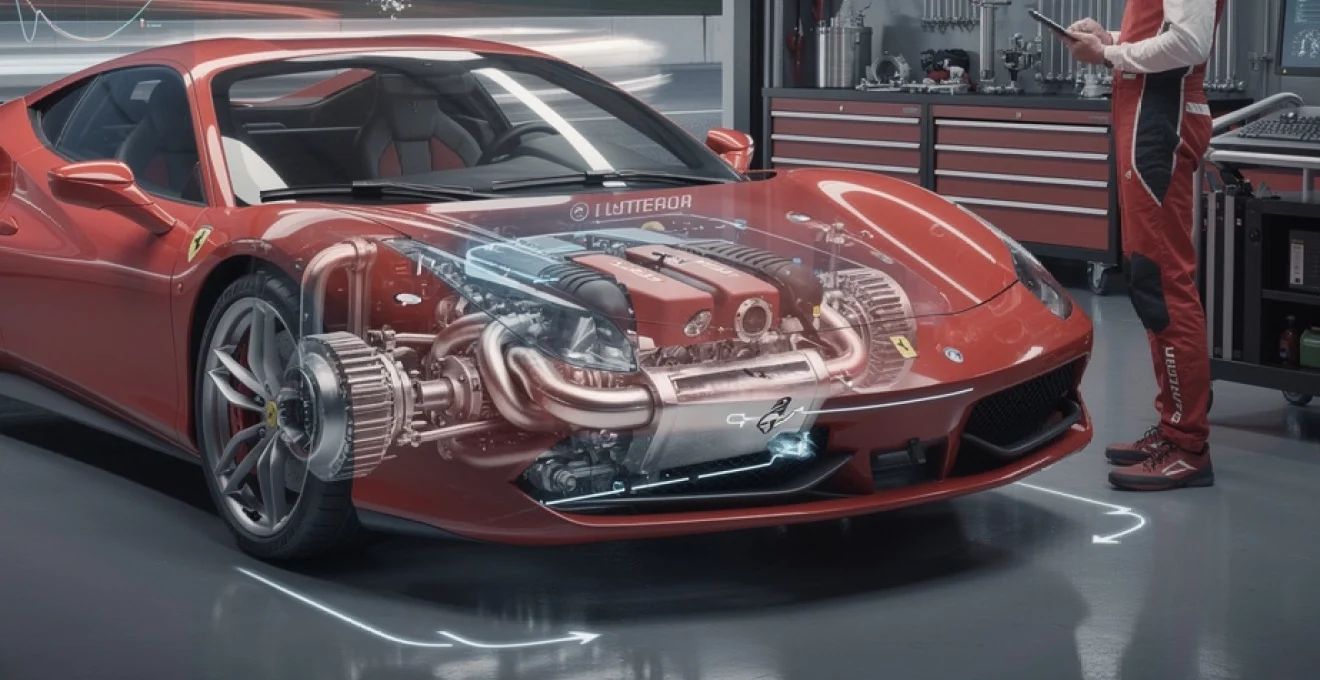
The Ferrari 488 GTB engine is one of the most significant supercar powertrains of the last decade. It marked Ferrari’s move from high-revving naturally aspirated V8s to a new generation of compact, twin-turbocharged units that deliver hypercar levels of thrust with everyday usability. If you care about how performance cars really work, the 3.9‑litre F154 CB V8 is a fascinating case study in how careful engineering can overcome turbo lag, meet strict emissions standards and still feel spine-tingling at 8,000rpm. Understanding the architecture, control systems and durability of this motor helps you appreciate why the 488 GTB still feels ferociously fast and remarkably modern on road and track.
Ferrari 488 GTB engine architecture: 3.9-litre F154 CB V8 layout and core design
90-degree V8 block geometry, bore and stroke (86.5 mm x 83.0 mm) and displacement calculation
At the heart of the Ferrari 488 GTB is the F154 CB engine, a 90‑degree V8 with a 3,902cm³ swept volume. The bore and stroke measure 86.5mm by 83.0mm, a slightly oversquare layout that favours high‑rev breathing without sacrificing mid‑range torque. The displacement is calculated with the standard formula for a multi‑cylinder engine: V = π × (bore² / 4) × stroke × cylinders. Plugging in the figures for this eight‑cylinder unit gives the 3.9‑litre capacity that defines the 488 GTB motor. This combination of relatively large bore and shortish stroke allows generous valve area and stable operation up to the 8,000rpm limiter.
The 90‑degree bank angle is a classic Ferrari geometry. It delivers good primary balance and allows optimal packaging of the twin-turbochargers between the cylinder banks. For you as a driver, that translates into a low centre of gravity and compact engine bay, both critical to the 488 GTB’s agility and weight distribution of 46.5% front / 53.5% rear. Compared with the 4.5‑litre naturally aspirated V8 of the 458 Italia, the 488’s shorter stroke and forced induction make it possible to achieve higher specific output while still meeting Euro 6 emissions standards.
Flat-plane crankshaft configuration, firing order and impact on vibration and sound signature
The 488 GTB retains Ferrari’s trademark flat‑plane crankshaft. Unlike a cross‑plane design common in mainstream V8s, a flat‑plane crank arranges crank pins at 180 degrees. This configuration delivers even firing intervals between the banks and allows a simple, high‑flow exhaust manifold layout. For you, the most obvious result is the engine’s sharp, hard‑edged sound signature that builds from a low growl to an intense howl at high rpm.
Flat‑plane cranks also reduce rotating mass and inertia, aiding throttle response and allowing the V8 to spin eagerly to 8,000rpm. The trade‑off is increased secondary vibration, which Ferrari mitigates through careful balancing and drivetrain isolation. The reward is ultra‑fast response to minor throttle inputs and a direct, motorsport‑like connection between your right foot and the crankshaft. Even in a world of hybrid supercars, the 488’s somehow “mechanical” feel stands out.
Aluminium alloy block and head casting, bedplate design and structural rigidity
To keep weight down and stiffness high, the F154 CB uses aluminium alloy for both block and cylinder heads. The block is closed‑deck with integrated liners and a structural bedplate that ties the main bearing caps into a single, rigid casting. This approach improves crankshaft support and reduces flex under high boost and high rpm, which is critical when an engine is producing 172cv per litre.
The cylinder heads feature four valves per cylinder, with high‑tumble intake ports specifically shaped to optimise mixture motion and combustion efficiency. Roller finger followers in the valvetrain cut parasitic losses by around 10% at low revs, a statistic that directly improves part‑load fuel consumption and emissions. For you as a driver chasing lap times, the stiffer structure means more accurate cam and crank phasing, which in turn gives sharper, repeatable response as temperatures rise during long sessions.
Dry sump lubrication system, scavenging stages and oil aeration control on track
A true supercar engine lives or dies by its lubrication. The 488 GTB uses a sophisticated dry sump system with multiple scavenging stages to ensure a constant oil supply under extreme lateral and longitudinal loads. Instead of storing oil in a conventional pan, the system holds it in a separate tank, while scavenge pumps evacuate oil from the crankcase and cylinder heads. This prevents oil starvation during high‑G cornering and hard braking on track days.
The dry sump also reduces oil aeration, as foam is actively separated and deaerated in the tank. Better control of oil flow stabilises pressure at high rpm and reduces pumping losses. The lower engine mounting made possible by the shallow sump floor contributes to the 488 GTB’s low centre of gravity and agile turn‑in. If you regularly use a 488 GTB on circuit, this race‑derived lubrication layout is a major contributor to long‑term reliability and consistent performance over repeated hot laps.
Twin-turbocharging system: IHI turbochargers, boost control and lag reduction strategies
IHI twin-scroll turbocharger specifications, compressor maps and turbine-wheel materials
The Ferrari 488 GTB’s defining technical feature is its pair of IHI twin‑scroll turbochargers. Each bank of four cylinders feeds its own turbo through carefully separated exhaust runners. The twin‑scroll housing keeps exhaust pulses from interfering with each other, maintaining high energy at the turbine and improving low‑rpm boost. The compressor wheels are made from titanium‑aluminide (TiAl), a lightweight, heat‑resistant alloy that reduces inertia and allows the turbos to spool up about 50% faster than traditional Inconel wheels.
On the compressor side, the turbocharger maps are tuned to deliver up to 1.5 bar of effective boost (absolute pressure varies by market and conditions), but Ferrari uses electronics to manage how much of that is available in each gear. This is where the Variable Torque Management strategy comes in, shaping the torque curve to feel progressive and naturally aspirated‑like rather than peaky. For you, the effect is a linear surge rather than a sudden wall of torque that could overwhelm the rear tyres.
Anti-lag strategies, low-inertia turbine design and transient throttle response tuning
Turbo lag is the enemy of throttle precision, especially on a mid‑engined supercar. The 488 GTB counters lag through a combination of hardware and software. The low‑inertia TiAl turbine wheels and ball‑bearing shafts cut friction by about 30%, helping the turbos react quickly to changes in exhaust flow. On the control side, the engine ECU uses strategies akin to anti‑lag, carefully managing throttle angle, spark timing and wastegate position to maintain turbine speed when you momentarily lift.
Ferrari quotes a throttle response time of just 0.8 seconds at 2,000rpm in third gear, compared with 0.6 seconds for the older naturally aspirated 458 Italia. In real‑world driving, this tiny difference is almost imperceptible. If you drive a 488 GTB hard, you feel a near‑instant surge from 1,500rpm upwards, with the rev limiter at 8,000rpm arriving faster than expected. On track, that ultra‑fast transient response makes the difference between balancing the car delicately on the throttle mid‑corner and fighting against a delayed, on/off surge of boost.
Charge-air cooling: air-to-air intercoolers, intake plenum design and pressure-drop management
High boost pressures raise the temperature of the intake charge, so the 488 GTB uses large air‑to‑air intercoolers fed by the side intakes sculpted into the bodywork. These intercoolers cool the compressed air before it enters the intake plenums above each bank. The plenums themselves are optimised to maintain consistent distribution to each cylinder, with internal volumes and runner lengths tuned for both mid‑range torque and high‑rpm power.
Engineers worked carefully on pressure‑drop management across the intercoolers and intake tract. Excessive pressure drop would mean the turbos have to work harder, increasing turbo lag and pumping losses. By minimising restrictions, the system maintains strong boost while keeping intake temperatures under control. This combination is critical for track durability: lower charge temperatures reduce knock tendency and protect pistons, valves and catalysts from sustained high‑load operation.
Wastegate and boost-pressure management via engine ECU and electronic actuators
Boost control in the Ferrari 488 GTB is fully electronic. Each turbocharger uses an ECU‑controlled wastegate with precise actuators that can modulate boost pressure in fine increments rather than simple open/close behaviour. The Bosch management system calculates target torque based on your throttle position, gear, driving mode and traction conditions, and then commands the wastegates, throttle valves and spark timing to hit that torque request.
This torque‑by‑wire approach allows features such as Variable Torque Management, in which peak torque is held back in lower gears to improve traction and drivability. It also contributes to the engine’s Euro 6 calibration, since the ECU can limit boost under certain temperatures or when catalyst protection is required. For tuned cars where the ECU is remapped, careless changes to boost targets or wastegate duty cycles can quickly exceed the safe operating envelope designed into the F154 CB platform.
Fuel delivery, ignition and emissions: direct injection and euro 6 calibration of the 488 GTB motor
High-pressure direct injection (DI) system, injector layout and spray pattern optimisation
The Ferrari 488 GTB uses a high‑pressure direct injection system operating at up to 200 bar. Injectors are centrally mounted in the combustion chamber and calibrated with multi‑hole nozzles tailored to the pent‑roof chamber shape. The goal is to generate a finely atomised spray and strong mixture motion, working hand‑in‑hand with the high‑tumble intake ports. This combination improves combustion speed, efficiency and knock resistance, which is vital on a high‑boost turbo motor.
The ECU can run multiple injection events per cycle to optimise cold starts, idle stability and part‑load emissions. Under full load, the strategy favours maximum charge cooling and homogeneous mixture formation. For you, the benefits are twofold: the 488 GTB achieves an official combined fuel consumption of around 11.4l/100km and CO₂ emissions of 260g/km (WLTP figures vary by market), while still delivering 670PS and a strong, repeatable power delivery on premium 98 RON fuel.
Ignition system, knock detection and adaptive spark timing under high boost
The ignition system uses individual coil‑on‑plug units controlled by the Bosch ECU, combined with an ion‑sensing function in the spark plugs that can detect knock or misfire by monitoring ionisation currents. This allows the engine to adaptively adjust spark timing cylinder by cylinder in real time, an advantage at high boost where knock risk is elevated. It also supports a multi‑spark strategy at some operating points to stabilise combustion.
Knock detection is crucial for the 488 GTB’s ability to sustain high torque over a wide speed range. The ECU constantly operates as close as possible to the knock limit, maximising efficiency and power. If you run the engine on lower‑octane fuel than recommended or in very hot conditions, the system will pull timing and boost to protect the engine. From a tuning perspective, this safety net should not be relied on as an excuse to run excessive boost; it is a protection feature, not a performance enabler.
Exhaust manifold design, catalytic converters and particulate control for euro 6 compliance
The exhaust manifolds on the Ferrari 488 GTB are equal‑length headers feeding into the twin‑scroll turbines. Longer primary pipes and careful pulse tuning support both performance and the engine’s distinctive soundtrack. Downstream of the turbos sit high‑flow, close‑coupled catalytic converters designed to light off quickly after a cold start, reducing HC and CO emissions to Euro 6 levels.
Unlike later gasoline particulate filter (GPF) systems found on some newer turbocharged supercars, the 488 GTB relies on precise mixture control and combustion efficiency to manage particulate emissions. That keeps back‑pressure lower and helps retain the vivid exhaust note. From an engineering standpoint, it is a delicate balance: enough catalyst volume and precious metals to meet regulations, but not so much restriction that it compromises that famous Ferrari soundtrack or the engine’s ability to breathe at 8,000rpm.
Performance figures: power, torque curve and real-world acceleration of the ferrari 488 GTB
Power output (670 PS at 8,000 rpm) and torque plateau (760 nm) analysis
The headline figures for the Ferrari 488 GTB motor are 670cv (about 661bhp or 492kW) at 8,000rpm and up to 760Nm of torque in seventh gear. That works out to a specific output of 172cv per litre, a record for a road‑going Ferrari V8 at launch. What makes the engine feel so dramatic is how it combines a high‑revving top end with a broad, managed torque plateau. In lower gears, torque is limited to keep traction and drivability under control; in top gear, you experience the full 760Nm sledgehammer.
On the road, that means you can use any gear and still access serious performance. From around 2,000rpm, the engine pulls hard, building to a ferocious rush as it approaches the 8,000rpm limiter. If you are stepping out of a 458 Italia, you notice the 488 GTB’s mid‑range depth is on another level, with Ferrari quoting 20–25% more longitudinal acceleration in the lower gears, up to 40% more in seventh compared with the naturally aspirated predecessor.
0–100 km/h, 0–200 km/h and quarter-mile times compared to ferrari 458 italia and F8 tributo
Officially, the Ferrari 488 GTB sprints from 0–100km/h in 3.0 seconds and 0–200km/h in 8.3 seconds. Independent testing has seen quarter‑mile times in the low‑10s at trap speeds over 135mph, depending on conditions. For context, the 458 Italia needs around 3.4 seconds to 100km/h and over 10 seconds to 200km/h, illustrating just how dramatic the turbocharged advance in performance is.
Compared with the later F8 Tributo, which uses an evolved version of the same basic V8 with around 720cv, the 488 GTB is only marginally slower in real‑world driving. The difference between 3.0s and roughly 2.9s to 100km/h is hard to feel outside controlled tests. What you notice as a driver is the 488’s brutal yet usable surge from low revs and the near‑instant response when you call for an overtake on a motorway or short straight between corners.
Gearbox integration: getrag 7-speed dual-clutch transmission ratios and shift logic
The 488 GTB pairs the F154 CB engine with a Getrag‑supplied 7‑speed dual‑clutch transmission, an evolution of the unit used in the 458. Ratios are deliberately short, particularly in the lower gears, to exploit the turbocharged torque and deliver intense acceleration. Ferrari claims upshifts are around 30% faster and downshifts 40% quicker than the 458, and subjectively the shifts feel almost instantaneous when you pull the long, column‑mounted paddles.
Shift logic is integrated tightly with the engine ECU. In Race mode, full‑throttle upshifts come with a crisp cut in torque and a rapid clutch swap, maintaining boost and momentum. In more relaxed modes, the transmission blends shifts smoothly, ideal if you are commuting or touring. If you keep the throttle pinned from a standstill, the combination of launch control, aggressive gearing and 670cv means the drivetrain goes from first gear to the limiter in fourth in about six seconds – a statistic that underlines how carefully engine and gearbox are matched.
Top speed, in-gear acceleration and elasticity in race vs CT-Off manettino modes
The Ferrari 488 GTB has a claimed top speed of over 330km/h (around 205mph), achieved in seventh gear with the engine near the top of its rev range. Yet top speed figures tell only part of the story. In‑gear acceleration is where the 488 feels exceptional: overtakes from 80–120km/h in third or fourth gear happen in around two seconds, and even in higher gears the car surges forward with authority.
Electronic modes on the manettino influence how that performance is delivered. In Sport and Race, traction and stability systems allow a degree of slip and then intervene progressively; in CT‑Off, lateral slip limits are pushed further, giving you more freedom to exploit the torque. The engine’s torque delivery is subtly reshaped between these modes, so Race feels more immediate and aggressive than Sport. Understanding these differences helps you choose the right setting for a damp B‑road, a smooth circuit or a high‑speed autobahn run.
Engine management, driving modes and electronic torque vectoring in the 488 GTB
Bosch MED engine control unit (ECU) mapping, torque-by-wire strategy and throttle modelling
The 488 GTB’s powertrain brain is a Bosch MED ECU with Ferrari‑specific software. Instead of a direct mechanical link between your right foot and the throttle plates, the system operates on a torque‑by‑wire principle. When you press the pedal, you request a certain torque; the ECU then decides how to deliver it using boost, ignition, fuel and throttle angle. This allows very fine control over both performance and emissions.
Throttle modelling is a subtle art. Ferrari’s calibration team shaped the response curve so that small pedal movements at low openings give precise, predictable changes in torque, while larger inputs provide a dramatic surge without feeling abrupt. If you experiment with pedal input in different modes, you notice how Race mode sharpens the mapping, while Sport keeps it more progressive. Such nuances are a major reason why the 488 GTB engine feels as if it anticipates your intentions rather than just reacting to crude inputs.
Ferrari side slip control 2 (SSC2) integration with engine torque delivery and traction control
The evolved Side Slip Control 2 (SSC2) system is a hallmark of the 488 GTB’s chassis electronics. SSC2 estimates the car’s slip angle in real time and coordinates the engine, E‑Diff and F1‑Trac traction control to maximise corner exit speed. When the system senses that the rear tyres are approaching their grip limit, it modulates engine torque, often within a few milliseconds, to maintain a controllable slide rather than snapping into instability.
Ferrari claims SSC2 improves longitudinal acceleration out of bends by around 12% compared with the previous generation. For you on track, that means the car encourages earlier, harder throttle application, giving faster exits without requiring racing‑driver reflexes. The interplay between the F154 CB engine’s rapid torque delivery and SSC2’s intelligent torque management is one of the reasons why the 488 GTB feels approachable even when it is covering ground at extraordinary speeds.
Manettino modes (sport, race, CT off, ESC off) and engine response reconfiguration
On the steering wheel sits the signature Ferrari manettino switch, which alters the behaviour of the engine, gearbox, differential and stability systems. In Wet and Sport modes, torque delivery is smoothed and traction thresholds are conservative, ideal if you use the car in city conditions or on slippery roads. Race mode sharpens everything: throttle mapping becomes more aggressive, shift speeds increase and SSC2 allows more slip while still providing a safety net.
CT‑Off disables traction control but retains ESC, giving experienced drivers more freedom to rotate the car on the throttle. ESC‑Off switches off both systems, leaving only ABS. In these more permissive modes, the engine mapping still respects some torque limits to protect components and tyres, but the sensation of direct connection between the F154 CB motor and the rear axle intensifies. If you plan a track day, spending time learning how each mode interacts with the engine response will help you get the most from the 488 GTB.
Launch control algorithm, clutch temperature management and repeatability on drag runs
Ferrari’s launch control system in the 488 GTB coordinates engine torque, clutch slip and traction control to deliver optimum acceleration from a standstill. When activated, the ECU holds engine speed at a pre‑set rpm and then modulates clutch engagement to balance torque and grip. The algorithm monitors wheelspin and can adjust torque within fractions of a second to keep the tyres at their ideal slip ratio.
Clutch temperature management is a key consideration. After a few hard launches, the system may reduce torque or display a warning to prevent overheating of the dual‑clutch unit. If you enjoy repeated drag runs, allowing cool‑down periods between attempts will preserve gearbox life. Used responsibly, launch control delivers consistent 0–100km/h times close to the quoted 3.0 seconds and showcases how effectively the 488 GTB puts its 670cv to the ground.
Track durability, maintenance and tuning potential of the ferrari 488 GTB engine
Thermal management: coolant circuit, radiators and heat-soak behaviour in circuit use
High thermal loads are inevitable on a turbocharged track car, so the 488 GTB’s cooling system was engineered with significant headroom. Large front radiators, side intakes for the intercoolers and carefully ducted underbody airflow combine to manage coolant, oil and charge‑air temperatures. The aerodynamic efficiency figure of 1.67, a record for a road‑legal Ferrari at launch, reflects how downforce and cooling are integrated rather than competing.
On circuit, you still need to be mindful of heat‑soak. After several flat‑out laps, intake temperatures can creep up, which in turn encourages the ECU to pull timing and limit boost to protect the engine. Allowing one or two cool‑down laps with reduced throttle and higher gears helps stabilise temperatures. Monitoring tyre and brake condition alongside engine temperatures ensures the 488 GTB can sustain repeated high‑speed sessions without undue stress on the F154 CB motor.
Service intervals, common wear points and ferrari-recommended oil and fluid specifications
Ferrari offers a seven‑year servicing package for the 488 GTB, with routine maintenance every 12,500 miles or once a year, whichever comes first. For intensive track use, more frequent oil changes are sensible. The factory specifies high‑quality synthetic oil in the appropriate viscosity grade, along with dedicated coolants and brake fluids engineered to withstand high temperatures. Sticking to these Ferrari‑approved fluids is strongly recommended if you value longevity and warranty coverage.
Common wear points for a hard‑driven 488 GTB engine and drivetrain include ignition coils, spark plugs, turbocharger wastegate actuators and the dual‑clutch gearbox clutches. Regular inspection of the dry sump system for leaks, careful monitoring of oil levels and adherence to warm‑up procedures are vital. If you plan to use a 488 GTB as a track tool, budgeting for proactive replacement of fluids and consumables will pay off in reliability and consistent lap times.
Factory-approved upgrades (assetto fiorano, factory exhausts) versus aftermarket ECU remaps
Ferrari offers various factory‑approved options and upgrades for the 488 platform, including lighter wheels, uprated brakes and alternative exhaust systems that enhance sound without compromising emissions or durability. While the Assetto Fiorano package is more closely associated with later models, the same philosophy applies: chassis and cooling tweaks that safely unlock more of the platform’s potential without over‑stressing the F154 CB engine.
Aftermarket ECU remaps and exhausts are tempting because the 3.9‑litre V8 clearly has headroom; modest increases in boost can deliver gains of 50–100bhp. However, many off‑the‑shelf tunes alter torque limits and boost targets without recalibrating knock control, exhaust temperature management or gearbox protection adequately. If you decide to tune a 488 GTB, choosing a specialist with deep experience of the Bosch MED system and the dual‑clutch integration is essential. A cautious, data‑driven approach keeps the engine within the thermal and mechanical limits Ferrari designed in.
Reliability considerations when increasing boost pressure on the F154 CB platform
From a reliability standpoint, the F154 CB is a robust platform, proven in thousands of road cars and in competition. But reliability always depends on respecting design margins. Increasing boost raises peak cylinder pressures and exhaust temperatures, which in turn load pistons, rods, head gaskets, turbochargers and catalysts. The dry sump system and stiff block help, but no engine is immune to abuse.
If you intend to increase boost, several best practices apply: stick to high‑octane fuel, maintain conservative air‑fuel ratios under full load, monitor exhaust gas temperature where possible and avoid sustained high‑load operation in very high ambient temperatures. Allowing proper cool‑down after hard use protects turbo bearings and prevents oil coking. Used thoughtfully, the Ferrari 488 GTB engine can cope with occasional power increases and still deliver the sharp response, linear torque and ferocious acceleration that made it a benchmark in the world of turbocharged supercars.