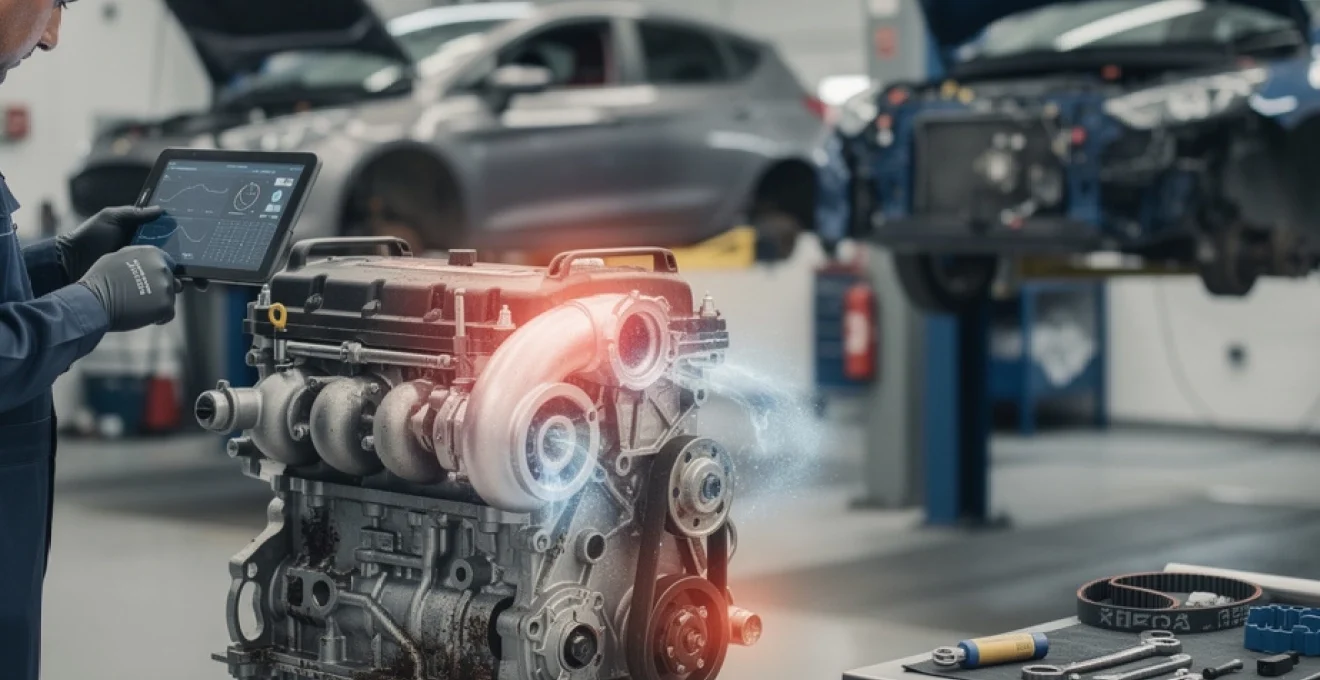
The Ford 1.5 EcoBoost sits in an awkward place in many buyers’ minds. On paper it offers the performance of a larger naturally aspirated petrol with the tax advantages of a downsized turbo engine. In practice, it carries the baggage of earlier EcoBoost cooling and wet-belt problems, along with mixed real-world fuel economy. If you are looking at a Focus, Kuga, Fiesta ST or Mondeo with this engine, you probably want straight answers: how reliable is the 1.5 EcoBoost, what goes wrong, and what can you do to avoid a four‑figure repair bill?
Understanding how the 1.5 evolved from the more troublesome 1.6 EcoBoost, and where it differs from the 1.0 three‑cylinder, helps you judge risk sensibly. Add in real-world data from UK fleets, MOT statistics and owner reports, and you have a far clearer picture than the scare stories or marketing brochures alone can provide.
Ford 1.5 EcoBoost engine overview: generations, codes and key specifications (M8DA, M8DD, UKDA)
Engine architecture and design evolution from 1.6 EcoBoost to 1.5 EcoBoost
The 1.5 EcoBoost four‑cylinder was introduced as a downsized evolution of the earlier 1.6 EcoBoost. Both use an aluminium block and head, twin‑independent variable cam timing and a single turbocharger, but the 1.5 is more than just a bored‑down version. It was engineered to reduce CO₂ and NOx, hit tighter Euro 6 limits and address some of the 1.6’s notorious cooling and head‑cracking concerns.
Engine codes such as M8DA, M8DD and UKDA denote power levels and emission calibrations. Compared with the 1.6 EcoBoost, the 1.5 gained revised coolant passages around the exhaust valves, a reshaped head casting and updated pistons aimed at better thermal control. Bore and stroke (typically 79.0 mm x 76.4 mm) give it an almost square layout, which helps balance low‑down torque with willingness to rev.
Another key difference is the emissions hardware. The 1.6 relied on earlier catalyst designs, while the 1.5 EcoBoost integrated more efficient three‑way catalytic converters and closer‑coupled oxygen sensors. If the 1.6 sometimes felt like an enthusiastic hot‑hatch motor shoe‑horned into family cars, the 1.5 is more clearly tuned as a compromise between economy, reliability and refinement.
Technical specifications: power outputs, torque curves and compression ratios by model
Across different chassis the 1.5 EcoBoost appears in several tunes. In UK and European markets, typical outputs are 148 bhp (150 PS), 158 bhp (160 PS) and around 180–182 bhp. Despite the spread of peak power, most variants share a very similar torque plateau of roughly 240–270 Nm from around 1600–4500 rpm.
The compression ratio is usually in the 10.0:1 region, relatively high for a turbocharged petrol. That allows decent efficiency but demands careful knock control and fuel calibration. Owners often describe the 150 and 160 bhp tunes as feeling like a naturally aspirated 2.0–2.3‑litre: linear rather than punchy, with long gearing, particularly in the Focus and Mondeo. This is partly intentional; torque is electronically limited in lower gears to protect the clutch and transmission.
To give a clearer snapshot, the table below summarises common versions found in the UK market:
| Engine code | Power output | Torque | Typical models |
|---|---|---|---|
M8DA |
148 bhp (150 PS) | 240 Nm | Focus Mk3, Kuga |
M8DD |
158 bhp (160 PS) | 240 Nm | Mondeo, Kuga |
UKDA |
180–182 bhp | 270 Nm | Focus, Fiesta ST, some Kuga |
It is worth noting that although the 182 bhp variant has more peak power, low‑rpm torque is still heavily managed in software. For day‑to‑day driving, the difference between 150, 160 and 180 bhp tunes is often less dramatic than the brochure figures suggest.
Model applications: focus mk3, fiesta ST, kuga, mondeo, ecosport and transit connect
The 1.5 EcoBoost has been used widely across Ford’s European line‑up. Popular applications include the Focus Mk3 and Mk3.5, where it replaced the 1.6 EcoBoost, and the Kuga crossover in both front‑wheel drive and all‑wheel‑drive forms. The Mondeo adopted the 1.5 as a tax‑friendly alternative to the 1.6 and 2.0 petrols, while the Fiesta ST used a specific high‑output three‑cylinder 1.5 EcoBoost, mechanically distinct from the four‑cylinder covered here but often confused with it in online discussions.
You will also find 1.5 EcoBoost units in the Ecosport and Transit Connect, where tuning prioritises torque and drivability over outright power. Gear ratios, final drive and vehicle weight strongly influence how the engine feels. A 150 bhp Focus can feel acceptably brisk, whereas the same tune in a heavier Kuga or Galaxy feels noticeably more lethargic, especially with passengers and luggage on board.
Because of this, two owners with identical M8DA engines can report very different impressions of performance and fuel economy. Before committing to a used 1.5 EcoBoost, it makes sense to test drive the exact body style and transmission combination you are considering.
Euro 6 emissions strategy: direct injection, turbocharging and particulate control
To meet Euro 6 standards, Ford relied on high‑pressure direct injection, efficient turbocharging and precise electronic control rather than more complex exhaust after‑treatment systems. The 1.5 EcoBoost typically uses a 200 bar (or higher) fuel rail, multi‑hole injectors and a small, fast‑spooling turbocharger with an electronically controlled wastegate.
Direct injection creates a fine mist of fuel directly into the combustion chamber, allowing higher compression and leaner mixtures under light load. However, it also has a downside: because there is no fuel washing over the back of the intake valves, carbon build‑up is more likely over time. For drivers mainly doing short urban trips, this can become a long‑term maintenance consideration, particularly beyond 80,000–100,000 miles.
Particulate emissions on petrol turbos became a hot topic around the WLTP and Euro 6c/6d changes. Earlier 1.5 EcoBoost engines did not use a dedicated gasoline particulate filter (GPF), relying instead on precise fuel control and catalytic converters. Later calibrations improved cold‑start fuelling and catalyst light‑off to reduce real‑world NOx and particulate output, but the basic mechanical layout remained the same.
Known reliability record of the ford 1.5 EcoBoost in real-world use
Typical service life and mileage benchmarks in UK fleet and taxi usage
For many buyers, the key question is simple: how long will a 1.5 EcoBoost last if serviced correctly? In UK fleet use, examples with 120,000–150,000 miles are common, particularly among company Focus and Kuga models. When maintained on time with quality oil, the core engine bottom end generally proves robust, often outlasting ancillary components such as turbos, sensors and clutches.
Taxi and private hire usage provides another useful benchmark. Where the 1.5 EcoBoost has been used for mainly motorway and A‑road work, engines reaching 180,000 miles without internal failure are not unusual. Conversely, cars used almost exclusively for short trips around town, with long oil‑change intervals, show higher rates of timing belt‑in‑oil degradation and carbon build‑up earlier in life.
Fuel economy figures in real use vary widely. Owners commonly report mid‑30s mpg in mixed driving for a Focus 1.5 EcoBoost and closer to 30–33 mpg for a Kuga. That is often 8–10 mpg worse than an equivalent diesel, a difference that matters if you cover high annual mileage.
Common MOT failure patterns and DVSA data insights for 1.5 EcoBoost models
DVSA MOT statistics do not isolate the 1.5 EcoBoost as a distinct engine, but patterns for relevant model years of Focus, Kuga and Mondeo provide indirect clues. The most frequent failures relate to suspension wear, tyres and brakes rather than catastrophic engine faults. Where engine‑related issues do appear, they usually involve emissions failures, oil leaks and warning lights rather than seized engines.
One interesting trend is the proportion of emissions fails triggered by misfires or poor combustion, particularly on cars around 7–10 years old. In some cases, that correlates with coil pack wear, injector issues or heavy intake valve deposits on direct‑injection petrols. Statistically, diesel versions of the same cars tend to fail emissions tests more often due to DPF and EGR problems, suggesting the 1.5 EcoBoost is not an outlier for MOT risk when viewed across the whole fleet.
From a prospective buyer’s point of view, an MOT history showing repeated advisories for “engine oil leak” or “coolant leak” is more worrying than a straightforward suspension advisory. Those can hint at looming problems around the timing cover, water pump or thermostat housing that are specific to this engine family.
Owner-reported reliability trends from forums and databases (ford owners club, honest john)
Owner reports from communities such as Ford Owners Club and databases similar to Honest John’s Real MPG give texture that raw statistics cannot. Threads discussing the 1.5 EcoBoost rarely show the volume of horror stories associated with the earlier 1.0 wet‑belt failure wave or the 1.6 EcoBoost head‑cracking saga. Instead, the most common themes are modest oil consumption, occasional coolant loss, and turbo or boost control faults as mileage climbs.
Several owners describe the 1.5 as slightly “gutless” at low rpm, with torque limited in first and second gear. Interestingly, some fleet managers view that as a positive; drivers are less able to shred front tyres or clutches through aggressive launches. As one forum contributor put it, the engine “drives like an n/a 2.3 rather than a turbocharged engine” and can drink noticeably more fuel than rivals “for very little extra speed”.
When looking through anecdotal data, it is important to separate the 1.5 four‑cylinder from the unrelated three‑cylinder 1.5 EcoBoost in the Fiesta ST and Puma ST, as well as from the problematic 1.0 three‑cylinder with its early cooling pipe recall. Many alarming US class‑action references online apply to the 1.6 EcoBoost, not the later 1.5.
Differences in reliability between 1.5 EcoBoost 148 bhp, 158 bhp and 180 bhp variants
Mechanically, the 148 bhp, 158 bhp and 180 bhp 1.5 EcoBoost tunes share most of their hard parts. The higher‑output variants gain different software, potentially different turbo calibrations and, in some cases, minor hardware changes such as intercooler size or fuel pump specification. From a base reliability standpoint, there is no strong evidence that the 182 bhp tune is significantly more fragile in stock form.
However, there are two subtle factors to consider. First, the 180+ bhp engines are more likely to have been driven enthusiastically or modified, which raises the risk of turbo and clutch issues. Second, because the torque limiter strategy is similar at low rpm, drivers often keep these engines in the boost more of the time, generating extra heat. For long motorway journeys that is rarely a problem, but for repeated short trips or stop‑start city use, sustained high boost can accelerate oil degradation and wet‑belt wear.
If you are choosing between power levels for a family car or daily driver, the 150 or 160 bhp variants generally offer the best compromise of performance, insurance cost and long‑term stress on the drivetrain. The 180+ bhp version is better seen as a warm‑hatch choice where you accept a slight increase in mechanical exposure in return for more effortless acceleration.
Frequent mechanical issues and failure modes on ford 1.5 EcoBoost engines
Coolant intrusion and head gasket failure on early 1.5 EcoBoost blocks
Coolant intrusion – where coolant leaks into the combustion chambers – was the signature failure mode of the older 1.6 EcoBoost. On that engine, cracking around the exhaust valve seats and flawed coolant passages led to overheating and, in the worst cases, engine bay fires. The 1.5 EcoBoost four‑cylinder was redesigned to address these weaknesses, and large‑scale systemic failures of the same type have not materialised.
That said, isolated cases of head gasket failure and internal coolant loss do occur, particularly on high‑mileage engines subjected to repeated overheating. Symptoms often begin subtly: a slow drop in coolant level, occasional hard starting and a brief puff of white vapour on first start. If ignored, the risk is that a cylinder fills with coolant overnight, leading to hydro‑lock when you crank the engine, which can bend a conrod instantly.
Compared with the 1.6, the 1.5’s track record on coolant intrusion is markedly better, but it is not immune. Regular checks of coolant level and prompt investigation of unexplained losses are essential preventative steps.
Turbocharger wear, boost control faults and wastegate actuator problems
The single scroll turbocharger on the 1.5 EcoBoost lives a hard life. High exhaust gas temperatures, frequent stop‑start cycles and long oil‑change intervals all contribute to bearing wear over time. In stock form, outright turbo failure before 80,000 miles is uncommon, but by 100,000–120,000 miles many owners see symptoms such as whistling, oil seepage into the intercooler or underboost fault codes.
Boost control issues, including sticking wastegate actuators and failed boost control solenoids, are a recurring theme on owner forums. A sticky actuator can cause erratic boost, surging or limp‑home modes, often accompanied by a dashboard warning. Because these faults can mimic sensor problems, accurate diagnosis using live data and boost pressure logging is crucial before replacing expensive hardware.
From a reliability perspective, the turbocharger is one of the first major components to suffer if oil quality is poor. Using the correct low‑ash, Ford‑approved oil and shortening service intervals is a relatively cheap way to protect a very expensive part.
Timing belt-in-oil degradation, sludge formation and lubrication starvation
The infamous belt-in-oil design is one of the most controversial aspects of small EcoBoost engines. Instead of a traditional dry timing belt or chain, the cam drive belt runs inside the engine, constantly bathed in oil. The idea is to reduce noise and friction, but in practice it introduces a new failure path: oil, especially when contaminated by fuel from short journeys, attacks the rubber compound over time.
As the belt ages, microscopic particles and fibres can shed and accumulate around the oil pickup strainer. If that strainer clogs, oil pressure drops, starving the turbo and top end of lubrication. The catastrophic scenarios widely reported on the 1.0 EcoBoost are less common on the 1.5, but the mechanism is similar. Some 1.5 units also use a wet belt to drive the oil pump, adding another potential debris source.
Regular oil analysis and conservative belt replacement intervals are the most effective tools to prevent belt-in-oil related engine failure.
Official belt replacement intervals can be as long as 10 years or 150,000 miles, but many independent specialists recommend halving that in UK conditions, particularly for cars doing lots of short, cold runs.
High-pressure fuel pump, injectors and carbon build-up on intake valves
The high‑pressure fuel pump (HPFP) on the 1.5 EcoBoost is driven by a cam lobe and must reliably supply fuel at several hundred bar. Genuine pump failures are relatively rare, but leaks, noisy operation and low‑pressure faults do appear on older engines. In many cases, issues blamed on the HPFP turn out to be related to injectors or low‑pressure supply instead.
Direct‑injection injectors themselves can suffer from deposits, leading to poor spray patterns and misfires, especially under cold start or heavy load. Combined with the lack of fuel washing over intake valves, this encourages carbon build‑up. Over 80,000–100,000 miles, some 1.5 EcoBoost engines develop enough intake valve deposits to affect airflow, causing rough idle, hesitation and reduced fuel economy.
Cleaning options range from chemical intake treatments to more invasive walnut‑shell blasting with the manifold removed. While not every 1.5 EcoBoost will need this service, it is a realistic medium‑term maintenance item if you plan to keep the car long‑term and mainly drive in urban conditions.
PCV system, crankcase ventilation faults and oil consumption escalation
The positive crankcase ventilation (PCV) system manages blow‑by gases and oil vapour, feeding them back into the intake to be burned. If PCV valves or separator diaphragms fail, crankcase pressure can rise or excessive oil mist can enter the intake tract. The result is often increased oil consumption, fouled intercoolers and more rapid carbon build‑up on intake valves and turbo compressor blades.
Some owners report rising oil consumption after 60,000–80,000 miles, which may be linked to PCV issues, worn valve stem seals or stuck piston rings. Monitoring oil level regularly and investigating any step change in consumption is vital. Left unchecked, chronic oil burning can damage catalytic converters and spark plugs and increase the risk of low‑speed pre‑ignition (LSPI) at high load.
Compared with many contemporary turbocharged petrols, the 1.5 EcoBoost does not have an extreme oil consumption reputation, but it is sensitive to neglected maintenance and poor‑quality oil.
Cooling system vulnerabilities: overheating, coolant loss and cylinder head cracking
Design of the coolant passages and head casting versus 1.0 and 1.6 EcoBoost
The 1.5 EcoBoost’s cooling system was reworked after Ford’s experiences with the 1.0 and 1.6 EcoBoost engines. The notorious 1.0 used a fragile degas pipe that could fail and dump coolant rapidly, while the 1.6’s head casting had hot spots that encouraged localised overheating and cracking. In the 1.5, coolant passages around the exhaust valves and between cylinders were redesigned for better flow and more even temperature distribution.
As a result, widespread cylinder head cracking is not a hallmark fault of the 1.5 four‑cylinder engine. However, like any modern aluminium turbo engine, it is sensitive to chronic overheating. A sticking thermostat, blocked radiator or low coolant level can still cause warping or gasket failure if ignored.
Because the cooling layout varies slightly between models (for example, packaging differences between Focus and Kuga), some platforms are more prone to localised leaks than others, particularly around plastic housings and quick‑release connectors.
Water pump and thermostat housing leaks on focus and kuga 1.5 EcoBoost
On Focus and Kuga models with the 1.5 EcoBoost, water pump and thermostat housing leaks are among the more common cooling‑system issues. Both components typically use plastic housings and seals that age with heat cycling. Over 5–8 years, these seals can harden and shrink, leading to slow weeping that often goes unnoticed until the coolant level drops far enough to trigger a warning.
Tell‑tale signs include dried pink or orange coolant residue around the housing, a sweet smell after a run, or an unexplained need to top up the expansion tank every few weeks. Because these leaks are “external” rather than inside the head, they are usually inexpensive to fix if caught early, but they are a frequent source of owner anxiety about potential head gasket problems.
Replacing the water pump and thermostat housing preventively when carrying out other major work (such as a timing belt service) is a sensible strategy if you plan to keep the car beyond 100,000 miles.
Symptoms of internal coolant loss: white smoke, misfire on cold start and hydro-lock risk
Internal coolant loss, where coolant enters the combustion chamber or oil system, is more serious. If you notice white steam from the exhaust on a fully warm engine, a sweet smell and a gradual drop in coolant level with no visible leaks, internal ingress is a possibility. A misfire on cold start that clears after a few seconds can indicate a small amount of coolant leaking into a cylinder overnight.
Left unchecked, this can progress to hydro‑lock, where a cylinder fills with enough liquid to stop the piston moving when you start the engine. Because liquids are incompressible, something must give – usually a conrod, which results in a destroyed engine. Hydrolock is still rare on the 1.5 EcoBoost compared with the worst‑affected 1.6 engines, but the risk reinforces the importance of taking coolant loss seriously.
If coolant is disappearing with no obvious leaks, a pressure test and combustion gas check in the expansion tank should be done before the car is driven hard again.
Oil that looks milky or mayonnaise‑like on the dipstick is another red flag, although that can also result from repeated short journeys where condensation never fully evaporates. A proper diagnosis is essential before assuming the worst.
Updated ford technical service bulletins (TSBs) and revised parts for cooling issues
Ford has issued various technical service bulletins (TSBs) over the life of the 1.5 EcoBoost addressing minor cooling‑related concerns. These include revised thermostat housings with improved seals, updated coolant level sensors and revised bleeding procedures to remove trapped air pockets. In some markets there have been dealer campaigns to inspect and, where necessary, replace specific hoses or clamps.
Although there has not been a high‑profile, large‑scale recall for the 1.5 four‑cylinder comparable to that of the 1.0’s degas pipe, software updates have tweaked fan control, temperature thresholds and warning strategies. If you are considering a used 1.5 EcoBoost, asking a Ford dealer to check that all outstanding TSBs and campaigns have been applied is a worthwhile step, especially on early production years.
These incremental updates do not magically eliminate risk, but they do reduce the chance of known issues recurring and often include revised parts that are more durable than the originals.
Maintenance strategy to maximise ford 1.5 EcoBoost reliability
Oil specification, change intervals and sump capacity considerations
Oil quality is where you have the most direct influence on the 1.5 EcoBoost’s longevity. Ford specifies low‑SAPs synthetic oils meeting its WSS-M2C948-B or later standards for most 1.5 EcoBoost units. These oils are formulated to handle high temperatures, resist LSPI and remain stable in the presence of fuel dilution. Sticking rigidly to the correct specification is more important than chasing a boutique brand name.
Official service schedules often quote change intervals of around 18,000 miles or two years. In UK stop‑start driving, that is optimistic. A more conservative 10,000–12,000 miles or annual change is a practical compromise that reduces wet‑belt exposure to degraded oil and protects the turbocharger. Given the relatively small sump capacities on these engines, oil degrades more quickly than on a large‑capacity unit.
If you mainly make short trips where the oil rarely gets fully hot, you might consider even shorter intervals. Think of oil changes not as a cost, but as cheap insurance against a £2000–£5000 engine replacement.
Timing belt-in-oil replacement schedules and best practice for UK driving profiles
Ford’s official timing belt‑in‑oil replacement intervals for the 1.5 EcoBoost can be 10 years or 150,000 miles, whichever comes first. However, those figures assume ideal conditions and high‑quality fuel. Many UK independent specialists now advise replacing the belt closer to 7–8 years or 80,000–100,000 miles, particularly for cars used mostly for urban and suburban trips.
Best practice when planning a belt service includes replacing associated components at the same time: tensioners, idlers, oil pump belt (if fitted), water pump and relevant seals. Because the belt runs in oil, the job is more involved than a traditional dry‑belt swap and should be entrusted to a workshop familiar with EcoBoost engines.
After a belt change, it is important to use fresh, correct‑specification oil and a genuine or high‑quality filter. The first few hundred miles are when any residual debris from the old belt is most likely to circulate, so a follow‑up oil change sooner than usual can be a sensible extra precaution for long‑term ownership.
Cooling system inspections, pressure testing and proactive component replacement
A structured cooling system inspection every year dramatically reduces the odds of a surprise overheat. At a minimum, that means checking coolant level and concentration, looking for dried residue or staining around hoses and housings, and confirming the radiator fan cuts in as expected. On higher‑mileage engines, a pressure test can reveal slow leaks that are not yet obvious externally.
For cars approaching 8–10 years old, proactively replacing known weak points such as plastic thermostat housings, ageing hoses and old radiator caps can save headaches. When combined with a fresh coolant flush using the correct Ford‑approved antifreeze, this helps the engine maintain stable temperatures and prevents internal corrosion.
Because the 1.5 EcoBoost relies on precise temperature control for emissions and knock management, a well‑maintained cooling system also supports better performance and fuel economy.
Fuel quality, injector cleaning and mitigation of LSPI (low-speed pre-ignition)
Low‑speed pre‑ignition (LSPI) is an abnormal combustion event that can occur in small, high‑boost turbo petrol engines under high load and low rpm. It resembles a violent knock and can, in extreme cases, damage pistons and rings. The 1.5 EcoBoost’s calibrations and oil specifications are designed to minimise LSPI risk, but driving style and fuel quality also play a part.
Using quality fuel from reputable brands, ideally 95 RON or higher, helps provide consistent combustion. Avoiding full‑throttle, high‑load operation at very low rpm – for example, flooring it in a high gear at 1200–1500 rpm – is another simple mitigation. If you keep the engine above 1800–2000 rpm when asking for strong acceleration, LSPI risk remains very low.
Periodic injector cleaning, either via in‑tank additives approved for GDI engines or professional on‑car cleaning, can maintain good spray patterns and reduce deposits. That, in turn, supports smoother combustion and better fuel economy over time.
ECU software updates, dealer campaigns and extended warranty checks
Because the 1.5 EcoBoost’s behaviour is heavily governed by software, keeping the engine control unit (ECU) up to date is more than a nicety. Updates can refine cold‑start fuelling, adjust boost and torque limits, improve knock control and tweak fan operation. Over the life of the engine family, Ford has released multiple calibration revisions addressing drivability, emissions and durability refinements.
When buying used, asking a Ford dealer to check for outstanding campaigns and software updates is worthwhile. Some extended warranty or goodwill schemes have existed in certain markets for specific EcoBoost issues, although they are usually tied to strict service‑history requirements. Having evidence of main‑dealer or reputable independent servicing, using the correct parts and fluids, strengthens any later claim if something major goes wrong just outside the standard warranty.
If you experience drivability issues such as hesitation, inconsistent boost or unexpected limp‑mode events, confirming that the ECU carries the latest calibration is a sensible diagnostic step before chasing hardware faults.
Tuning, remapping and performance upgrades: impact on 1.5 EcoBoost reliability
Stage 1 and stage 2 remaps from mountune, revo and DreamScience: risk assessment
The 1.5 EcoBoost responds well to mapping. Stage 1 remaps from well‑known tuners can lift power into the 200 bhp region with torque increases of 50–80 Nm, often while claiming to improve mid‑range response and, on paper, part‑throttle economy. Stage 2 packages add hardware such as freer‑flowing exhausts and larger intercoolers to support sustained high‑load use.
From a reliability standpoint, a mild Stage 1 on an otherwise healthy engine, run on good‑quality fuel, is unlikely to cause immediate problems. However, any increase in boost raises thermal and mechanical stress on the turbocharger, pistons, rods and clutch. The margin for error narrows if cooling or lubrication is less than perfect. For daily drivers expected to cover high mileages, staying conservative with torque limits is wise.
If you are considering a tuned 1.5 EcoBoost on the used market, look for evidence of professional installation, supporting hardware and meticulous servicing. A home‑flashed, high‑boost map on a neglected engine is a very different proposition from a carefully calibrated tune on a well‑maintained car.
Aftermarket intercoolers, induction kits and their effect on charge temperatures
Upgraded intercoolers are a popular modification because they help keep intake air temperatures (IATs) lower under sustained boost. Cooler charge air reduces knock tendency and allows more stable power delivery on spirited drives or track days. For a tuned 1.5 EcoBoost, an efficient front‑mount intercooler can be seen as a reliability upgrade as much as a performance part.
Induction kits are more of a mixed bag. While a well‑designed system can reduce restriction slightly, open cone filters positioned in hot engine bays may actually increase intake temperatures in traffic, offsetting any theoretical gains. The factory airbox is not as restrictive as many think and provides decent cold‑air feed, so any aftermarket intake should be chosen for proven performance and filtration rather than just noise.
Remember that any modification affecting airflow can also influence fuelling and MAF readings. Ensuring that the ECU calibration matches the hardware is crucial to avoid lean running or unstable idle behaviour.
Clutch, gearbox and driveshaft stress when increasing torque outputs
Even in standard form, the 1.5 EcoBoost’s torque is deliberately limited in first and second gears to protect the clutch and transmission. Remaps that remove or raise those torque limits can transform the way the car feels off the line but inevitably increase stress on driveline components. Clutches that last 80,000–100,000 miles on a stock tune may wear significantly faster with a high‑torque map, particularly if driven enthusiastically.
Manual gearboxes and driveshafts in the Focus and Kuga platforms are generally robust, but aggressive launches, wheel hop and repeated power‑shifting place strain on CV joints and differential bearings. For automatic transmissions, extra heat is the main enemy; frequent fluid changes become more important as torque and power rise beyond stock levels.
If you want more performance without sacrificing longevity, focusing on mid‑range torque gains and keeping low‑gear torque limits sensible is often a smarter approach than chasing headline dyno numbers.
Data-logging, AFR monitoring and knock control when running higher boost
With any tuned 1.5 EcoBoost, data‑logging becomes an invaluable tool. Monitoring parameters such as boost pressure, ignition timing, air‑fuel ratio (AFR) and intake temperature helps ensure the engine is operating within safe margins. Modern ECUs have sophisticated knock control, pulling timing when knock is detected, but that is a safety net, not a licence to run marginal calibrations.
Using high‑quality fuel – ideally super unleaded when running higher boost – gives the knock system more headroom. Periodic logs on a healthy engine provide a baseline, so if performance later feels off, new logs can reveal changes in knock activity, airflow or fuel delivery that might indicate emerging issues such as a failing HPFP or clogged intercooler.
Treating extra power as something to manage, rather than simply exploit, is the mindset that keeps a tuned 1.5 EcoBoost reliable over the long term, especially if you intend to keep the car beyond the typical three‑year PCP window.