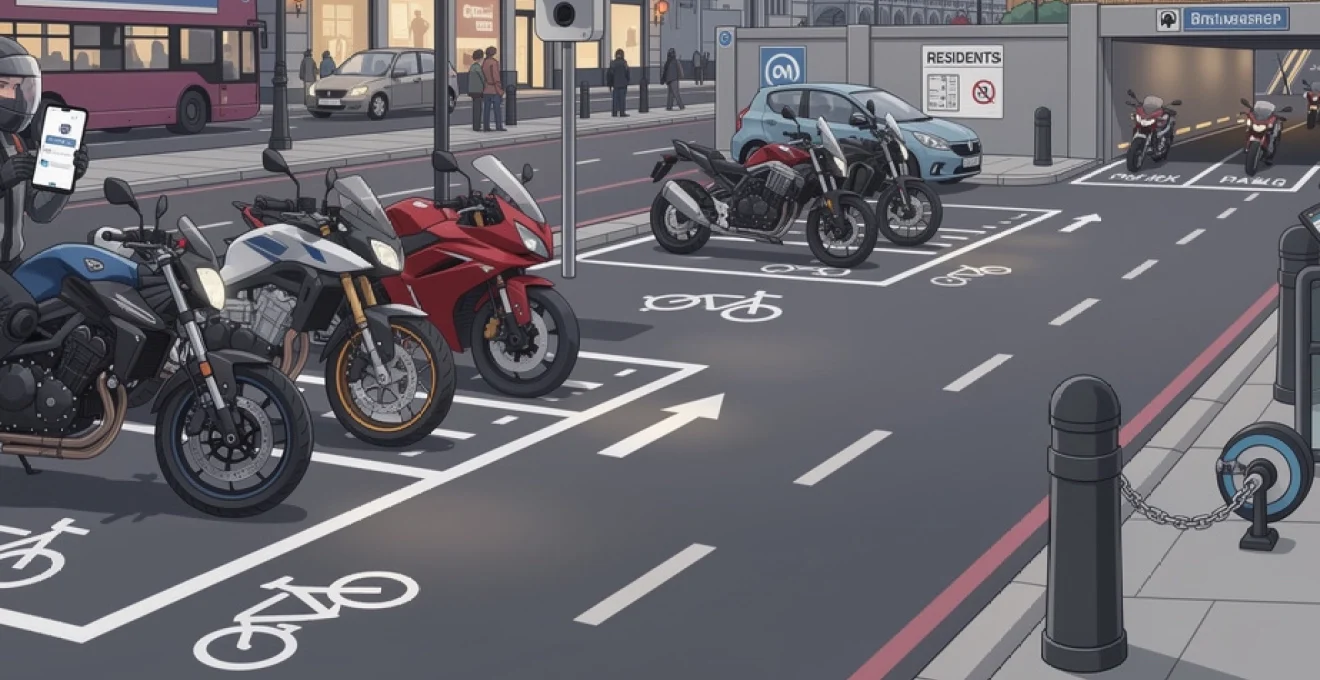
Riding a motorcycle into Westminster saves time, cuts congestion and makes central London feel much smaller. Yet the moment you start thinking about where to leave the bike, things can become stressful very quickly. Different rules for solo motorcycle bays, residents’ bays, car parks and red routes mean that a simple mistake can turn a cheap commute into a £130 Penalty Charge Notice (PCN). If you understand how Westminster structures its motorcycle parking, how digital permits work, and how enforcement officers think, you gain back control of both your time and your wallet.
Westminster is also unique: it is the only London borough that charges consistently for most on‑street solo motorcycle bays, while neighbouring areas remain largely free. Add in Ultra Low Emission Zone (ULEZ) and Congestion Charge boundaries, constant roadworks and high theft risk, and informed choices become essential. With the right approach, you can move confidently between Soho, Victoria, Oxford Circus and Whitehall, park legally, and keep your bike safe.
Legal framework for motorcycle parking in westminster: TfL, westminster city council and highway code rules
Understanding westminster city council traffic management orders (TMOs) for solo motorcycle bays
Motorcycle parking in Westminster rests on a legal foundation of Traffic Management Orders, often shortened to TMOs. These are the formal legal documents that create solo motorcycle bays, set their hours of operation, and specify which vehicles can use them. When you pay £1 for a daily motorcycle permit, the charge, the permitted times and the allowed vehicle class all exist because a TMO says so.
TMOs define a solo motorcycle bay as a place reserved for a powered two‑wheeler or a vehicle in the tax class bicycle, which includes mopeds and scooters but not trikes or quads. That distinction matters: a three‑wheeler parked in a solo bay can lawfully receive a PCN even if it is neatly within the markings. TMOs also set the controls by zone: in Westminster’s A, B, C and D zones, solo motorcycle bays are for motorcycles only at all times, while in E, F and G, the motorcycle‑only restriction normally applies 7am–7pm, Monday to Saturday.
When you challenge a PCN, the relevant TMO is often the crucial evidence. If the bay layout or signing does not match what the TMO authorises, or if the restrictions on the street differ from those in the order, that inconsistency can be a strong ground of appeal.
Applying the highway code and road traffic regulation act 1984 to powered two‑wheelers
Although Westminster’s day‑to‑day rules come from local orders, the national framework still matters. The Highway Code and the Road Traffic Regulation Act 1984 underpin how parking controls apply to motorcycles. For example, yellow line restrictions and loading bans apply to powered two‑wheelers in exactly the same way as to cars, so you cannot simply slip a 125cc scooter onto a double yellow outside Covent Garden and hope it is treated differently.
The Highway Code also reinforces that parking on the pavement in London is generally prohibited where there are waiting restrictions, and Transport for London (TfL) red routes have their own controls. Even if a short stretch of private forecourt looks tempting near Oxford Street, the key question is whether it forms part of the highway. If it does, normal enforcement powers apply. Treat the Code as the baseline, and Westminster‑specific rules as an extra layer on top.
For practical purposes, assume that any place where a car could be ticketed or towed in Westminster is equally risky for a motorcycle, unless there is clear signage to the contrary.
Differentiating westminster motorcycle parking rules from neighbouring boroughs (camden, kensington & chelsea)
Motorcycle riders often get caught out at borough boundaries. Camden, Kensington & Chelsea and the City of London still offer a large volume of free solo motorcycle bays, and in some cases allow free use of pay‑and‑display bays for bikes. Westminster, by contrast, charges for most solo motorcycle bays between 8.30am and 6.30pm, Monday to Saturday, even though electric motorcycles park free.
Cross Oxford Street from Westminster into Camden or Marylebone Road into Camden, and the rules can switch from paid to free instantly. Signs and bay legends change subtly, but enforcement officers will not accept confusion over borough lines as mitigation. When you plan a regular commute, it is worth mapping which side of a main road sits in which local authority, and favouring free boroughs when you have a choice.
How london’s ultra low emission zone (ULEZ) and congestion charge interact with motorcycle parking
Motorcycle parking rules in Westminster operate independently from ULEZ and the Congestion Charge, yet in practice you feel their combined effect. Most modern motorcycles are ULEZ‑compliant, but older machines built before 2007 may pay £12.50 a day. That charge applies whether you park for ten minutes or ten hours, and whether the motorcycle sits in a free Q‑Park bay or a paid on‑street solo bay.
Motorcycles are currently exempt from the Congestion Charge, which remains a major reason many riders choose two wheels for central London. However, it is easy to confuse parking charges with ULEZ or Congestion Charge obligations. Think of it like this: ULEZ is about emissions, the Congestion Charge is about vehicle type and time of entry, and Westminster motorcycle parking fees are simply a local kerbside management tool. You might tick all three boxes—ULEZ‑compliant, Congestion Charge‑exempt and still required to pay £1 for a solo motorcycle bay.
Types of motorcycle parking in westminster: solo bays, shared bays, residents’ zones and car parks
Solo motorcycle bays on key corridors: strand, victoria street, oxford street and soho
Solo motorcycle bays are the backbone of motorcycle parking in Westminster. Marked Solo M/Cs Only, they run along the main arteries such as the Strand, Victoria Street, around Soho and parallel routes to Oxford Street. For most riders, the flagship benefit is cost: £1 for a whole day, £3.50 for a week, £13.50 for a month, £33.50 for a quarter or £100 for a year, with electric motorcycles parking free.
When you buy a daily or longer permit for these solo bays, you can move between any Westminster solo motorcycle bays in the same charging period without extra payment. That flexibility is invaluable if work or social plans shift between Soho, Covent Garden and St James’s during the day. Always check the local sign: it shows the payment hours and confirms whether motorcycles have priority 24/7 or only during specific times.
Shared-use motorcycle and car bays near major hubs: paddington, marylebone, charing cross and pimlico
Around stations and busy junctions—Paddington, Marylebone, Charing Cross and parts of Pimlico—shared‑use bays combine resident, pay‑to‑park and sometimes motorcycle permissions. These spaces are more complex. A sign might read Resident permit holders or pay‑by‑phone with additional wording about motorcycles. In many cases, a resident motorcycle permit allows you to use these bays in your home zone without extra charge.
For visiting riders, the safest assumption is that a motorcycle parked in a shared‑use bay without a valid permit must pay the standard zonal motorcycle tariff. A solo motorcycle bay permit does not normally cover parking in a shared car bay. Because shared‑use kerbside space is under pressure, CEOs patrol these locations frequently.
Underground and off‑street motorcycle parking in Q‑Park and NCP facilities (leicester square, chinatown, marble arch)
Off‑street motorcycle parking offers two main advantages in Westminster: improved security and protection from the weather. Q‑Park car parks provide dedicated motorcycle bays that are free of charge for bikes in most Westminster locations, excluding Soho. That makes underground facilities near Leicester Square, Chinatown and Marble Arch attractive for overnight or long‑stay parking.
Some NCP and other commercial car parks also offer free or discounted motorcycle spaces, while others charge standard car rates. Off‑street bays often provide anchor rails or hoops, making it easier to secure the bike with a chain and lock. For a high‑value machine left for several hours near Theatreland, paying slightly more for a monitored underground facility is usually a smart trade‑off against theft risk.
Resident motorcycle bays in controlled parking zones (CPZs) such as maida vale, bayswater and st john’s wood
Westminster’s controlled parking zones include dedicated resident motorcycle bays and mixed use bays that residents can use with the right permit. If you hold a resident motorcycle permit, you gain several privileges within your zone: you can park at no additional charge in any Westminster motorcycle bay, in residents’ bays and shared‑use bays in your permit zone, and in paid‑for bays in that zone during the first and last hour of controlled hours.
In residential districts such as Maida Vale, Bayswater and St John’s Wood, that effectively turns most kerbside space into low‑cost or free motorcycle parking for local riders. For regular commuting into the West End, pairing a resident permit with a season motorcycle bay permit gives the flexibility to leave the bike either near home or near the office without juggling multiple payment systems.
Free versus charged motorcycle bays and time‑limited kerbside parking in westminster
Although the headline rule is “£1 per day in solo motorcycle bays”, there are still pockets of free or time‑limited motorcycle parking in Westminster. Electric motorcycles enjoy free parking in solo motorcycle bays at all times. Some off‑street car parks, especially Q‑Park sites outside Soho, also allow motorcycles to park free in designated bays.
In zones E, F and G, controls usually run 7am–7pm Monday to Saturday, so parking in motorcycle bays outside these hours is free. Additionally, some short‑stay kerbside places have maximum stay limits but no specific motorcycle charge; in those cases, complying with the time limit is the key requirement. Always read both the upright sign and the bay marking because Westminster’s mix of residential, commercial and tourist demand means restrictions change from one block to the next.
Pay‑by‑phone and digital permits: using RingGo and westminster’s online parking systems for motorcycles
Setting up a RingGo account and registering a PTW VRM (e.g. honda PCX125, yamaha MT‑07)
To use Westminster solo motorcycle bays, you need a digital permit, usually managed through a pay‑by‑phone operator such as RingGo, PaybyPhone or JustPark. Setting up a RingGo account is straightforward and works well for everyday commuter bikes like a Honda PCX125 or Yamaha MT‑07. Download the app, create an account with your email and mobile number, then add your payment card details.
Next, register your motorcycle’s Vehicle Registration Mark (VRM). The system treats a powered two‑wheeler exactly like a car for account purposes, even though tariffs differ. From 1 October 2025, an end‑user charge of up to 30p per transaction may apply, set by each operator. For frequent riders, a longer‑term permit (month, quarter or year) often proves cheaper than daily sessions once usage exceeds a couple of days a week.
Selecting the correct westminster RingGo location codes for solo motorcycle bays
Westminster simplifies motorcycle location codes by using a single code for all solo motorcycle bays. When paying by phone, you enter location 6789 and then select the duration, such as 1 day or 1 week, from the menu. That makes life much easier than having to key in a different number for every street.
Using the wrong code is one of the quickest ways to earn a PCN, especially if you accidentally pay for a car bay instead of a solo motorcycle bay. Civil Enforcement Officers check the virtual permit database against location and vehicle type. Before confirming the session, double‑check that the app shows the motorcycle tariff and the correct length of stay, especially if you manage several vehicles in one account.
Purchasing visitor motorcycle sessions and virtual scratchcards for short stays
If you only ride into Westminster occasionally, visitor motorcycle sessions are an efficient option. These are short‑term, pay‑as‑you‑go permits activated on the day via app, text or phone. Instead of traditional paper scratchcards, Westminster uses virtual records, so there is nothing to display on the bike.
For example, to buy one day of solo motorcycle parking by text, you send a message to the RingGo text number with the location, duration and the three‑digit CVV code from your payment card in the format 6789 1d 123. The system replies to confirm the session, and enforcement officers see the active permit against your VRM. For quick errands around Soho or Charing Cross, these digital sessions are far more convenient than hunting for a machine or printed voucher.
Applying for westminster resident motorcycle permits and visitor vouchers online
Resident motorcycle permits are applied for online through Westminster’s parking portal. You supply proof of residence, proof of ownership or use of the motorcycle, and the vehicle registration details. Once approved, the permit is held virtually; there is no physical disc. The process is similar to a car resident permit, but the cost structure and entitlements reflect motorcycle‑specific policies.
Visitor vouchers can also be arranged digitally, giving friends or family who ride into the borough the same parking privileges for a limited time. For multi‑bike households in areas like Pimlico or Little Venice, combining one or more resident motorcycle permits with occasional visitor sessions is often the most cost‑effective way to manage changing parking needs.
Parking rules around westminster landmarks: soho, covent garden, westminster abbey and oxford circus
High‑demand motorcycle parking hotspots in soho, chinatown and theatreland
Soho, Chinatown and Theatreland concentrate entertainment, hospitality and late‑night activity into a very compact area. Motorcycle bays around Old Compton Street, Dean Street and Shaftesbury Avenue fill quickly, especially Thursday to Saturday evenings. Arriving after 7pm often means circling several streets before finding a legal gap.
For nightlife rides, a smart tactic is to target slightly less obvious bays on the fringes, for example closer to Covent Garden or north of Oxford Street, then walk a few minutes. Off‑street options in nearby Q‑Park facilities offer more predictable availability and higher security. Because enforcement in this area is strict, squeezing a bike half onto the pavement or into a loading bay is more likely than not to attract a PCN.
Motorcycle access and parking constraints near westminster abbey, houses of parliament and whitehall
The security‑sensitive triangle around Westminster Abbey, the Houses of Parliament and Whitehall has tighter controls than most of the borough. Road closures for state events, demonstrations and construction can change normal access patterns with little warning. Solo motorcycle bays exist on streets a short walk away, but kerbside space directly adjacent to these landmarks is rare and heavily patrolled.
When you plan a visit to this area, think in terms of a parking halo: aim for bays around Millbank, Victoria Street or St James’s Park and walk the final distance. Avoid red route clearways on nearby bridges and junctions; stopping even briefly on a TfL‑controlled red route can result in a camera‑enforced PCN separate from Westminster’s own regime.
Finding secure motorcycle bays around oxford circus, regent street and bond street
Oxford Circus and the surrounding West End shopping streets combine very high footfall with a dense mix of deliveries, taxis and buses. Motorcycle bays near Regent Street, Bond Street and Oxford Street itself are busy throughout the day. Crime data repeatedly shows that high‑value motorcycles left in this area are a prime target for thieves using vans or scooters.
For that reason, secure parking strategy matters as much as legality. Choosing a bay with railings or anchors, or using an underground Q‑Park or similar facility, significantly reduces risk. Where no formal motorcycle infrastructure exists, position the bike under CCTV, in line of sight of staffed shopfronts, and combine a heavy chain with a disc lock. Treated correctly, a short walk from a safer bay is a better deal than a slightly closer but exposed space.
Parking strategies for events and demonstrations in trafalgar square and parliament square
Trafalgar Square and Parliament Square are frequent venues for large demonstrations, charity events and ceremonial parades. On those days, motorcycle access routes can change rapidly, and previously available bays may be suspended. Suspension signs are usually placed on the post for the bay, but in crowded conditions they are easy to miss.
Always assume that event days around Trafalgar Square and Parliament Square will bring extra bay suspensions, longer walks and more intensive enforcement.
For predictable events such as marathons or New Year celebrations, plan to park further out—perhaps in Victoria, Marylebone or Pimlico—and continue the journey by foot or public transport. If you ride into the immediate vicinity, check each bay’s suspension notices and times carefully before leaving the bike; parking in a suspended bay is one of the fastest ways to receive a high‑level PCN, even if a normal permit is active.
Enforcement, PCNs and appeals: motorcycle fines in westminster explained
Common motorcycle parking contraventions in westminster (code 21, code 12, code 16)
Westminster uses standard civil parking contravention codes when issuing PCNs to motorcycles. Code 21—Parked in a suspended bay or space—is common around event areas and roadworks. Code 12 usually covers parked in a residents’ or shared‑use parking place without clearly displaying a valid permit, which applies equally to motorcycles if a resident or visitor permit is required but not in force.
Code 16—parked in a permit space without displaying a valid permit—can also arise where a bay is for permit holders only and a motorcycle has no appropriate entitlement, even if it has paid for a separate solo motorcycle session. Knowing the wording of these codes helps you understand exactly what the council believes happened and whether evidence exists to counter that version of events.
How civil enforcement officers (CEOs) assess solo bays, bay markings and signage for PTWs
Civil Enforcement Officers follow a structured process when deciding whether to issue a PCN to a motorcycle. First, they confirm the vehicle type is eligible for the bay—powered two‑wheeler, not a trike or car. They then check bay markings and signs to ensure that the restriction is clear and valid. If the bay is a solo motorcycle bay, they use handheld devices to query whether the VRM has an active permit for that location and time.
CEOs photograph the bike from several angles, usually including the VRM, the sign, the bay markings and any relevant context (such as a suspension notice or yellow line). For motorcycles, the absence of a windscreen ticket does not indicate free parking; most of Westminster’s system is now digital. From an enforcement point of view, motorcycles are treated with the same seriousness as cars for bay contraventions.
Understanding penalty charge notices (PCNs), notice to owner (NtO) and charge certificate stages
The life cycle of a Westminster motorcycle PCN mirrors that of any civil parking ticket. After a PCN is issued, there is usually a 14‑day period for payment at the discounted rate (often 50% of the full £130 charge). If you make an informal challenge within this period and it is rejected, councils frequently—but not always—re‑offer the discount.
If the PCN remains unpaid, a Notice to Owner (NtO) is sent to the registered keeper. At this point, a formal representation can be made. If that is rejected, the case can be appealed to the independent adjudicator. Failure to respond leads to a Charge Certificate, increasing the amount by 50%, and ultimately registration as a debt. Understanding these stages helps you decide when to fight and when to pay a motorcycle parking PCN.
Building a motorcycle parking PCN challenge: photographic evidence, TROs and signage defects
A strong challenge to a motorcycle PCN rests on evidence. Start by collecting your own photographs of the bay, sign, any suspension notice and the surrounding area. If the markings are worn, the sign twisted away from the carriageway, or the suspension notice absent or ambiguous, those facts can undermine the contravention. Compare your images to those taken by the CEO, which are usually accessible online.
In more complex cases, referencing the underlying TMO or Traffic Regulation Order (TRO) for the bay can be powerful. If the order describes a different restriction or layout than what exists on the ground, there may be a legal defect. Quote specific clauses rather than making general complaints. Clear, concise arguments focused on law and evidence tend to succeed more often than emotional narratives about how short the stop was or how confusing central London feels.
Security and best practice: locking, anchoring and storing motorcycles in central london
Using thatcham‑approved disc locks, chain locks and ground anchors in westminster bays
Legal parking is only half the battle in Westminster; security is the other half. Official figures from recent years show thousands of powered two‑wheelers stolen annually across Greater London, with hotspots concentrated in central boroughs. A layered defence strategy dramatically improves the odds that your motorcycle will still be where you left it.
Thatcham‑approved disc locks and heavy chain locks are the basics. A disc lock on its own may delay an opportunist thief, but pairing it with a 16mm chain looped through the rear wheel and then around a lamppost, rail or official ground anchor makes removal much harder. Many Westminster bays now include racks or anchor points for exactly this purpose. From a thief’s perspective, a chained bike is slower and noisier to steal, increasing the risk of interruption.
Choosing higher‑security motorcycle parking locations near victoria, paddington and marylebone stations
Major rail hubs like Victoria, Paddington and Marylebone attract both commuters and thieves. Bikes are often left for hours while riders are on trains, giving criminals plenty of time to observe patterns and return with tools or a van. Choosing where to park can be as important as how to lock the motorcycle.
When practical, prefer monitored car parks, Q‑Park facilities with CCTV and staffed entrances, or clearly lit bays directly under cameras and near busy building entrances. Some riders treat station‑area parking like leaving valuables in a car: the more hidden the bike is from the main flow, the easier it is to attack unnoticed. A visible, slightly busier bay with good lighting and surveillance usually offers better real‑world protection.
Reducing theft risk for high‑value models (BMW GS, triumph bonneville, ducati panigale) in busy areas
High‑value motorcycles such as BMW GS models, Triumph Bonnevilles and Ducati Panigales are catnip for organised theft crews. These bikes can be stripped for parts or shipped abroad quickly, so thieves accept higher risk for higher reward. Thinking like a thief is the best way to counter that threat. What would make your bike the least attractive target in a row of five similar machines?
Simple measures make a disproportionate difference: use a plain cover to hide the model and accessories; anchor the rear wheel to street furniture; add an alarmed disc lock for audible deterrence; consider a tracker for asset recovery. As an analogy, imagine two houses side by side: one with open windows, no alarm and tools in the garden, the other with lights on timers, visible alarm box and locked gates. Criminals gravitate to the easiest option. The same logic applies to motorcycle parking in Westminster’s busiest streets.