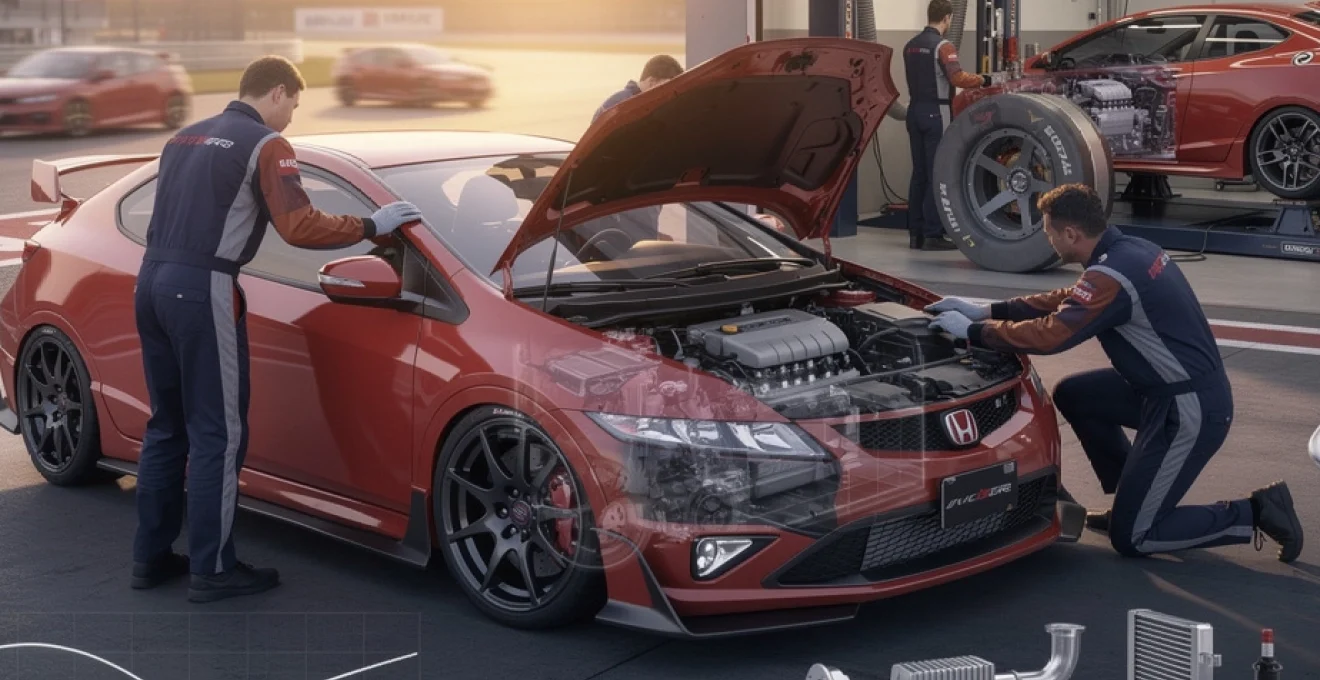
The Honda Civic Type R FN2 has moved from “controversial new kid” to cult modern classic. As values of EP3 and FK2 models climb, the FN2 sits in a sweet spot: the last naturally aspirated Civic Type R sold in Europe, with a screaming K20Z4 engine and a huge tuning scene behind it. Whether you want a fast-road daily or a track day car, understanding how the FN2 is built – and where it responds best to upgrades – is the key to extracting its full potential.
On paper the numbers look modest next to modern turbo hot hatches, yet the way an FN2 delivers performance is very different. The chassis rewards commitment, the VTEC crossover still feels special, and the platform accepts everything from 220 bhp NA builds to 500+ bhp turbo conversions. This performance guide focuses on technical detail and real-world experience so you can decide how far to push your own Civic Type R FN2.
Honda civic type R FN2 technical overview: K20Z4 engine, chassis, and drivetrain architecture
K20Z4 2.0 i-VTEC engine specifications, compression ratio, and euro 5 emissions package
The FN2’s K20Z4 2.0 i-VTEC is an evolution of the EP3’s K20A2. Capacity remains 1998 cc with an 86 mm bore and 86 mm stroke, but the FN2 uses a higher compression ratio of about 11.0:1, revised intake and exhaust manifolds, and a different ECU calibration to meet stricter Euro 4/early Euro 5 emissions targets. Official output is 198 bhp at 7800 rpm and 142 lb ft at 5600 rpm, with a 7800 rpm redline and fuel cut just beyond 8000 rpm.
The emissions package combines a close-coupled primary catalyst integrated into the exhaust manifold, a secondary underfloor cat, and a wideband lambda sensor for precise fuelling control. This makes the FN2 slightly more restrictive than the EP3 in stock form, which is why intake and exhaust upgrades tend to show stronger gains on the later car when combined with ECU tuning. The VTEC switchover is typically around 5400 rpm from the factory, lower than the EP3’s 6000 rpm, giving a broader, more flexible powerband while keeping that high-rpm character that so many enthusiasts value.
FN2 torsion beam rear suspension vs EP3 multi-link: handling and ride implications
The famous change from the EP3’s independent rear suspension to a torsion beam on the FN2 is at the heart of the handling debate. The rear of the FN2 uses a simple beam axle with trailing arms and a Panhard-rod style location, chosen for packaging, cost, and boot space. On a perfectly smooth circuit, the difference feels small; on typical UK B-roads, the FN2 can feel more unsettled over mid-corner bumps.
From a tuning perspective, this “limitation” is also an opportunity. The beam responds well to stiffer bushes, quality dampers, and especially a thicker rear anti-roll bar that effectively increases roll stiffness without making the ride excessively harsh. With good coilovers and a proper fast-road alignment, an FN2 can feel sharper and more confidence inspiring than its reputation suggests, particularly if you are used to more modern, heavier hot hatches.
6-speed manual gearbox, helical limited-slip differential, and final drive ratios
All FN2 Civic Type R models use a close-ratio 6-speed manual transmission with cable shift and a final drive around 4.7:1. Gear spacing keeps the engine between 5500 and 8000 rpm under full-throttle upshifts, which is ideal for naturally aspirated performance. Early UK cars did not all receive a limited-slip differential as standard; the LSD was factory-fitted to Championship White models and all post-April 2010 cars, while earlier examples rely on an open differential unless already upgraded.
The helical LSD used by Honda is similar in concept to aftermarket units from Quaife and MFactory. Under power it transfers torque to the wheel with more grip, which dramatically improves traction and stability out of tight corners. For anyone planning serious track work or high-power builds, fitting a quality helical or plated diff is one of the most transformative drivetrain upgrades available on the FN2 platform.
Braking system hardware: OEM discs, single-piston callipers, and ABS calibration
The FN2 shares much of its braking hardware with the EP3: 300 mm front discs with single-piston floating callipers and 260 mm solid rear discs. The system is assisted by ABS and EBD, with calibration biased towards stability and safety in emergency stops rather than late-braking track aggression. On the road, the standard setup feels adequate; on circuit, you will quickly discover its thermal limits.
The usual symptoms are long pedal travel and fade after a few hard laps. However, the factory callipers respond extremely well to performance pads, high-boiling-point fluid, and quality grooved discs. For many fast-road builds, this combination, plus braided lines, strikes a good balance between cost and performance. Only when slick tyres or forced induction are on the table does a big brake kit become essential rather than optional.
Body-in-white, weight distribution, and FN2-specific rigidity enhancements
The FN2’s “spaceship” body hides a relatively stiff body-in-white with extensive use of high-tensile steel and additional bracing around the bulkhead and rear hatch area. Kerb weight is quoted at around 1267 kg, roughly 70–90 kg heavier than an EP3, with a front-biased weight distribution of approximately 63:37. That forward weight bias can accentuate understeer on standard suspension, particularly on entry and when trail braking.
This is another area where set-up makes a huge difference. Lowering the centre of gravity with quality coilovers, adding rear roll stiffness, and introducing additional negative camber at the front all help rotate the car and make it feel more agile. Aftermarket front upper braces, rear strut braces, and subframe reinforcement kits work with the existing rigidity to improve steering response without turning the chassis into a bone-shaker.
Stock honda civic type R FN2 performance metrics: power, acceleration, and track capability
Factory power and torque curves: 198 bhp K20Z4 vs 197 bhp K20A2 in EP3
On paper, the FN2’s 198 bhp is just 1 bhp up on the EP3’s 197 bhp, and peak torque is virtually identical. The more meaningful difference lies in the shape of the curves. The K20Z4 delivers its torque more progressively, with VTEC engaging earlier and smoothing the transition from low- to high-lift cam profiles. This creates a broader plateau from around 5500 rpm to the 7800 rpm redline.
Dynamometer runs on Dyno Dynamics and Maha LPS test benches typically show healthy, stock FN2s producing 185–195 bhp at the wheels, corresponding to roughly 200–210 bhp at the crank when drivetrain losses are accounted for. In other words, Honda’s factory numbers are conservative. This headroom is part of the reason naturally aspirated tuning to 230–240 bhp is achievable with sensible supporting mods and ECU calibration.
0–60 mph, 0–100 mph, in-gear acceleration, and real-world roll-on performance
Independent performance testing generally reports 0–60 mph times for the Civic Type R FN2 in the 6.6–6.9 second range and 0–100 mph in around 16 seconds. Those figures place the car broadly in line with period rivals like the Mk5 Golf GTI and the Focus ST, despite the FN2 lacking turbocharged torque. Where the Honda feels different is in the way performance builds: mid-range pull is adequate, but from 5500 rpm to the limiter, acceleration becomes urgent and highly engaging.
Real-world roll-on performance, such as 30–70 mph in third or fourth gear, depends heavily on how willing you are to use the revs. Keeping the engine in the VTEC zone is critical. Driven in this way, the FN2 can comfortably keep up with more powerful but heavier modern hot hatches on twisty roads. For motorway overtakes without downshifting, turbo rivals feel stronger, but enthusiasts rarely buy a Civic Type R for lazy torque.
Top speed, gearing limitations, and VTEC crossover behaviour under load
The official top speed for the FN2 is 146 mph, limited mostly by gearing and aerodynamics rather than power alone. In sixth gear, the engine is ticking over at roughly 4000 rpm at 80 mph, which gives a useful compromise between refinement and instant response. On track, the gearing works well for UK circuits such as Brands Hatch Indy and Donington Park, where fifth is sufficient for most straights.
Under load, the VTEC crossover at around 5400 rpm is less abrupt than on older B-series engines but still noticeable, particularly if the intake and exhaust are opened up. An ECU remap can lower the switchover point and blend the cam profiles, creating a flatter torque curve and a more linear surge to the limiter. This is especially valuable for track work, as it reduces the need to “hunt” for VTEC mid-corner.
Official nürburgring and circuit lap time benchmarks (bedford autodrome, brands hatch indy)
While the FN2 never chased Nürburgring records in the way the FK8 and FL5 later did, independent testing provides some useful benchmarks. Period tests at Bedford Autodrome saw stock FN2s lapping the West Circuit in roughly 1:32–1:34 in the hands of experienced drivers, with Championship White LSD-equipped cars around 3 seconds faster thanks to improved traction and corner exit speed.
At Brands Hatch Indy, standard cars on OE tyres recorded laps in the low 57 to high 56 second range in dry conditions, with mildly modified examples (pads, fluid, tyres, geometry) dropping into the 54s. These numbers highlight how much lap time is on the table with relatively modest tweaks, particularly to tyres, brakes, and alignment.
Dyno-tested baseline figures on dyno dynamics and maha LPS test benches
For tuning, a reliable baseline is crucial. On reputable Dyno Dynamics equipment, stock FN2s generally show 185–190 bhp at the wheels, while Maha LPS systems sometimes read slightly higher due to different correction factors. Torque figures of 125–130 lb ft at the wheels are common, with a characteristic climb from 3000 rpm and a pronounced lift from 5400 rpm onward.
Any significantly lower reading should trigger basic health checks: compression test, leak-down test, oil consumption monitoring, and inspection of the intake/exhaust for restrictions. The K20Z4 is robust, but cars that have spent their life bouncing off the limiter with minimal servicing will inevitably show wear. Ensuring a strong baseline before chasing extra power always saves money in the long run.
Engine tuning paths for the FN2 K20Z4: NA, bolt-on upgrades, and ECU calibration
Intake system upgrades: GruppeM, HKS RSK, and tegiwa carbon airbox comparisons
Opening up the intake is usually the first step on any FN2 tuning journey. The standard airbox is not terrible, but it is tuned for noise suppression and emissions, not maximum flow. Popular upgrades include the GruppeM ram-air system, HKS RSK Racing Suction Kit, and Tegiwa carbon airbox. Each has a distinct character and sound profile.
The GruppeM offers an OEM-plus appearance with a carbon housing and a dedicated scoop feeding cool air; it typically gives excellent mid-range response and top-end flow but commands a premium price. The HKS RSK is famous for its aggressive induction roar and mushroom filter, providing a visceral experience that some owners love on track days. The Tegiwa carbon airbox sits between the two in cost, combines a sealed design with improved flow, and is widely regarded as the best bang-for-buck option for a street-driven FN2 targeting around 230 bhp NA.
Exhaust and manifold tuning: toda, DC sports, and supersprint 4-2-1 headers with sports cat
On a naturally aspirated K-series, the exhaust manifold is arguably the most important hardware upgrade. The restrictive cast OEM header incorporates catalytic converters that choke high-rpm flow. Replacing this with a well-designed 4-2-1 system from Toda, DC Sports, or Supersprint unlocks both power and throttle response. These manifolds optimise exhaust pulse timing to improve scavenging, particularly in the mid-range.
A 4-2-1 header paired with a high-flow 200-cell sports cat and a 63–70 mm cat-back system (from brands like Tegiwa, Japspeed, Cobra, or Milltek) typically yields 10–15 bhp when mapped correctly. Track-only cars sometimes run decat pipes for maximum flow, but this is not road-legal and can introduce drone. For a fast-road FN2, a quality sports cat and resonated system strike a good balance between legality, noise, and performance.
ECU remapping: hondata FlashPro, K100, and CPL racing calibrations for K20Z4
Without ECU work, bolt-on mods will never reach their full potential. For the FN2, the gold standard is Hondata FlashPro, which allows full access to fuelling, ignition, cam angles, rev limits, and VTEC crossover through the OBD2 port. Earlier solutions like K100 piggybacks are still around but offer less flexibility and support. A reputable tuner familiar with K-series engines, such as CPL Racing in the UK, can tailor maps to specific hardware combinations and fuel quality.
A well-mapped K20Z4 with intake, manifold, cat-back, and stock cams will often produce 220–225 bhp at the flywheel with a noticeably fatter torque curve. VTEC can be blended smoother, part-throttle drivability improved, and rev limits raised safely to around 8200 rpm if the engine is healthy. For those targeting regular track days, adding features like knock control logging and oil temperature monitoring via FlashPro is a valuable safeguard.
High-lift camshafts, valve train upgrades, and raised rev limit strategies
For power beyond ~225 bhp, higher-lift, longer-duration camshafts become necessary. Drop-in profiles from brands such as Skunk2, Toda, and Drag Cartel are engineered to work with the FN2 valvetrain, though uprated valve springs and retainers are strongly recommended once rev limits go beyond 8500 rpm. Think of cams as “lungs” for the engine: the more aggressively air and fuel can be moved in and out, the more power at high rpm – but at the cost of low-speed smoothness.
A cammed FN2 with the right supporting mods, tuned on 99 RON fuel, can safely run to 8600–8800 rpm provided oiling is addressed. Many builders convert to an FD2-style oil pump to reduce cavitation risks at sustained high revs. Pushing beyond 9000 rpm belongs firmly in race-car territory and requires blueprinting, forged internals, and meticulous assembly, so is not recommended for typical fast-road users.
NA power goals: realistic 230–250 bhp street builds and supporting modifications
For most owners, a realistic naturally aspirated power target is 230–240 bhp on pump fuel, with 250 bhp achievable on more aggressive, higher-compression builds or with K24/K20 hybrid “Frankenstein” engines. A typical 230–240 bhp FN2 street build includes: high-flow intake, 4-2-1 sports manifold with 200-cell cat, 70 mm exhaust, high-lift drop-in cams, uprated valve springs, FD2 oil pump conversion, and a custom Hondata calibration.
Supporting mods become critical at this level. A stronger clutch, lightweight flywheel, improved engine mounts, and an LSD all help transfer new-found power to the tarmac. Cooling and lubrication also matter; even naturally aspirated K20s can experience oil temperature creep on long summer sessions at circuits like Silverstone and Donington Park, so planning the package as a whole rather than chasing a single dyno number yields a far more satisfying car to drive.
Forced induction options for civic type R FN2: supercharger and turbocharger packages
Rotrex supercharger kits (TTS, HKS) for 300–400 bhp road and track applications
When naturally aspirated headroom has been explored, forced induction offers huge gains. Rotrex-based supercharger kits from UK specialists like TTS and global brands like HKS are the most established route. These centrifugal chargers behave somewhat like a belt-driven turbo: boost builds with rpm, preserving much of the K20’s rev-happy nature while adding significant torque across the range.
Entry-level non-intercooled kits at ~7 psi typically add around 100 bhp at the wheels, taking an FN2 into the 300–320 bhp zone. Intercooled “Supersport” packages with higher boost (10–12 psi) can reliably deliver 350–380 bhp on stock internals when combined with a high-flow fuel pump, upgraded injectors, and meticulous tuning. Beyond this, forged pistons and rods are strongly advised, especially if the car will live on track.
Turbo kits from TD04 to GTX30: spool characteristics, 350–500 bhp configurations
Turbocharging the FN2 offers even more flexibility. Off-the-shelf and custom kits range from compact TD04-based setups to larger GTX30-series units. A small-frame turbo with a responsive turbine can deliver full boost by 3500–3800 rpm and 340–380 bhp on pump fuel, ideal for a fast-road car that still feels eager and controllable.
Larger turbos push 450–500+ bhp but introduce more lag and demand serious traction and drivetrain upgrades. For reference, a well-built 400 bhp FN2 on semi-slicks is already capable of embarrassing supercars in-gear. Matching turbo size, boost target, and compressor map to your intended use is critical; a “dyno hero” graph that looks impressive but drives poorly on circuit is rarely satisfying.
Fuel system upgrades: 1000 cc injectors, walbro 255/DeatschWerks pumps, and return-line conversions
Both supercharged and turbocharged FN2s require significant fuelling upgrades. Stock injectors run out of headroom long before 300 bhp; 550–650 cc/min units cover most mild forced-induction builds, while 1000 cc injectors provide ample safety margin for 400+ bhp setups and E85 experimentation where available. High-flow in-tank fuel pumps from Walbro or DeatschWerks, such as the popular Walbro 255, are a minimum requirement.
For more advanced builds, converting the returnless FN2 fuel system to a return-style layout with an adjustable regulator allows finer control of base fuel pressure and reduces the risk of pressure drop under sustained high-load conditions. A wideband AFR gauge and fuel pressure monitoring are strongly recommended so you can keep an eye on mixture safety during hard use.
Heat management: front-mount intercoolers, oil coolers, and knock control under boost
Boost adds heat, and heat kills reliability. A properly-sized front-mount intercooler is non-negotiable for any serious forced-induction FN2. Oversizing can add lag, while undersizing leads to heat soak after a few pulls, so quality bar-and-plate cores from reputable manufacturers are worth the investment. On the oil side, sandwich-plate thermostatic coolers help maintain temperatures in the 100–120°C range, even during 20-minute sessions at track days like Japfest or TRAX.
Modern ECU strategies use knock sensors to trim ignition timing, but relying on knock control as a “safety net” rather than a tuning tool is poor practice. A conservative ignition map, properly gapped spark plugs, and consistent use of high-octane 97–99 RON fuel are the foundation of reliable forced-induction operation. Monitoring intake air temperature, oil temperature, and knock levels via Hondata datalogs gives you the data needed to keep the engine safe over the long term.
Chassis and handling setup: suspension, geometry, and track-focused alignment
Coilover choices for FN2: BC racing BR, bilstein B14, and öhlins road & track kits
The right suspension transforms how a Civic Type R FN2 feels. Quality coilovers offer independent height adjustment and, in many cases, damping adjustment too. BC Racing BR coilovers are popular as a cost-effective option with 30-way adjustable damping, making them suitable for mixed road and occasional track use. Spring rates around 6–8 kg/mm front and 4–6 kg/mm rear work well for a dual-purpose car.
Bilstein B14 kits offer fixed damping with superb control and durability, ideal if you value “fit and forget” reliability over constant adjustment. At the higher end, Öhlins Road & Track coilovers use sophisticated DFV (Dual Flow Valve) technology to combine excellent body control with surprisingly compliant ride quality. For anyone chasing lap time at circuits like Silverstone while still using the car daily, Öhlins are arguably one of the best investments you can make.
Camber arms, adjustable toe, and caster optimisation for turn-in and mid-corner balance
Once quality dampers and springs are in place, fine-tuning geometry unlocks the FN2’s front-end grip. The stock car runs relatively conservative camber, which leads to understeer and shoulder wear on the front tyres. Adjustable front camber bolts and rear camber arms allow you to introduce more negative camber, keeping the tyre contact patch flatter when loaded through fast corners.
Optimising caster – the fore/aft tilt of the steering axis – improves self-centring and turn-in feel. While the FN2 does not have factory-adjustable caster, some aftermarket top mounts and polyurethane bushes can add a small increase. Combined with mild toe-out at the front, this creates a sharper initial response, while a neutral or slight toe-in rear maintains stability at high speed.
Fast-road vs track alignment specs: -2.0° camber setups and toe settings for UK circuits
Alignment is one of the most cost-effective upgrades you can make. As a starting point for fast-road use on 225/40R18 tyres, many specialists recommend something like:
- Front camber: -1.5° to -2.0°, front toe: 0 to 0.5 mm total toe-out
- Rear camber: -1.0° to -1.5°, rear toe: 1–2 mm total toe-in
- Ride height: 15–25 mm lower than stock, maintaining rake (front slightly lower)
For a more track-focused Honda Civic Type R FN2 alignment at circuits such as Brands Hatch Indy or Donington Park National, front camber in the -2.0° to -2.5° range and slightly more front toe-out improve bite and mid-corner balance. The trade-off is increased tyre wear and tramlining, so it makes sense to keep a dedicated track alignment saved with your preferred geometry specialist.
Anti-roll bars, strut braces, and subframe bracing to stabilise the torsion beam rear
An uprated rear anti-roll bar is almost mandatory on a tuned FN2. Because of the torsion beam design, adding roll stiffness at the rear has a dramatic effect on rotation and reduces the car’s tendency to wash wide on corner exit. Whiteline and other brands offer bolt-on bars that can be installed with basic tools and immediately sharpen the balance.
Front and rear strut braces help tie the suspension mounting points together, reducing flex under high loads. Subframe braces add further rigidity, particularly in the rear beam area. The goal is not to make the car uncomfortably stiff but to remove unwanted movement so the dampers and tyres can do their job consistently. Think of these braces as “clarifying” the chassis response rather than simply making it harder.
Braking and wheel/tyre packages: FN2 stopping power and grip optimisation
Big brake kits: brembo 4-pot, AP racing pro 5000R, and K-Sport setups for FN2
For repeated hard stops on semi-slick tyres, the stock brakes become the limiting factor. Big brake kits from Brembo, AP Racing (Pro 5000R), K-Sport and others replace the front callipers with 4- or 6-piston fixed units and increase disc diameter to 320–330 mm or more. The advantages are better heat capacity, more consistent pedal feel, and improved pad wear.
A popular configuration for track-focused FN2s pairs a 4-pot Brembo or AP calliper with a 330 mm two-piece disc and aggressive pads such as Ferodo DS1.11. These systems are often lighter than the OE setup despite the larger rotors, thanks to aluminium callipers and floating bells. As with any major modification, matching front and rear brake bias with pad choice is crucial to avoid instability under heavy braking.
Performance pads and discs: ferodo DS2500, pagid RS29, and grooved rotor options
Not every Civic Type R FN2 needs a six-piston kit. For many owners, upgrading pads, discs, and fluid is sufficient. Ferodo DS2500 pads offer an excellent compromise for fast-road and occasional track work, with strong cold bite and good fade resistance. Pagid RS29 is a more track-biased compound, capable of surviving repeated high-temperature cycles at the expense of more dust and noise.
Pairing these pads with quality grooved or dimpled discs improves gas evacuation and pad refresh. Braided stainless-steel lines remove some of the “spongy” pedal feel caused by expanding rubber hoses. High-performance brake fluid with a dry boiling point above 300°C – for example, Motul RBF600 or Castrol React SRF – is highly recommended for any car that will see circuit use.
Wheel fitment: 17 vs 18 inch, offset, and unsprung weight with enkei, rota, and OZ racing
Wheel choice affects not just aesthetics but also ride, steering feel, and grip. The factory 18×7.5J ET55 wheels weigh around 11.8 kg each. Lightweight aftermarket options from Enkei, Rota, OZ Racing, and WedsSport can save 3–4.5 kg per corner, significantly reducing unsprung weight. This improves damping control and responsiveness, especially over rough surfaces.
Many enthusiasts move to 17x8J with an offset around ET45 for track use. This allows the use of slightly taller-sidewall tyres while maintaining clearance, and 17-inch tyres are generally cheaper. For a street/track compromise, 18x8J ET45 with 225/40R18 or 235/40R18 rubber works well, provided arch clearance and steering lock are checked. Avoid excessively low offsets unless the car runs significant camber, as rubbing and tramlining become more likely.
Track-day tyre choices: michelin pilot sport 4, yokohama AD08R, and nankang AR-1 in 225/40R18
Tyres are the only contact between your Civic Type R FN2 and the road, so choosing the right compound matters more than almost any other single upgrade. For predominantly road use with occasional spirited driving, Michelin Pilot Sport 4 or PS4S in 225/40R18 provide outstanding wet and dry grip with good mileage. They are forgiving at the limit and well-matched to UK conditions.
For more committed track work, semi-slick options like Yokohama AD08R (or its successors) and Nankang AR-1 offer substantially higher dry grip and sharper response. The trade-offs are increased road noise, reduced wet performance, and faster wear. Running a dedicated set of track wheels and tyres allows you to enjoy these benefits without compromising daily usability, and also protects your road tyres from the rigours of kerb-hopping at places like Donington Park.
Daily drivability vs track build: reliability, maintenance, and known FN2 weak points
Clutch, synchros, and gearbox wear on tuned K20Z4 FN2s
The FN2 gearbox is generally robust, but certain weak points appear on higher-mileage or heavily tuned cars. Third-gear synchro wear is well documented, particularly on early 2007 models, leading to notchy shifts or popping out of gear under load. Hard launches and repeated missed shifts accelerate this wear. If you are planning 300+ bhp, budgeting for a gearbox refresh at some stage is sensible.
The stock clutch copes with mild NA tuning but tends to slip once torque exceeds ~220–230 lb ft, especially on older units. Uprated organic or stage 2 clutches paired with a 3.2 kg lightweight chromoly flywheel sharpen response and cope with the extra load without making the car undrivable in traffic. Monitoring for release bearing noise, pedal squeaks, or changes in bite point gives early warning of issues before they become expensive failures.
Engine health checks: compression, oil consumption, and timing chain stretch diagnostics
A healthy K20Z4 should show even compression across all four cylinders, typically in the 200+ psi range depending on the gauge and test conditions. Moderate oil consumption is common, especially on engines that have lived at high rpm, but anything more than a litre per 1000 miles warrants investigation. Blue smoke on overrun or under prolonged VTEC use suggests worn rings or valve stem seals.
The FN2 uses a timing chain rather than a belt, designed for the life of the engine, but chain stretch can occur if oil changes have been neglected. Symptoms include rattling on cold start and erratic timing values on a diagnostic scan. Regular high-quality 5W-40 fully synthetic oil, changed at 5–6k mile intervals rather than the extended factory schedule, is one of the simplest ways to prolong chain and tensioner life, particularly on engines that see frequent track use.
Cooling system upgrades for repeated track sessions at silverstone and donington park
On road, the FN2 cooling system is more than adequate. Sustained laps at high-speed circuits expose its limits. Coolant temperatures creeping beyond 100–105°C and oil temperatures climbing towards 130°C are a sign that additional capacity is needed. Upgraded aluminium radiators increase surface area and thermal mass, while high-flow thermostats and fans help manage temperatures during pit-lane idling.
For cars doing multiple track days a year, pairing a larger radiator with a thermostatic oil cooler is highly recommended. This keeps both fluids in the optimal operating window, reducing thermal stress on head gaskets, seals, and bearings. Bleeding the cooling system properly after any work, checking for trapped air, and regularly inspecting hoses and the expansion tank for cracks form part of a sensible preventative maintenance routine.
Regular servicing schedule, OEM vs uprated fluids, and long-term reliability trends
The long-term reliability of the Honda Civic Type R FN2 is one of its strongest selling points, provided maintenance is kept on top of. Shortening service intervals to suit how you drive is a smart move: 5–6k miles or annually for oil and filter on a performance-driven example, with gearbox oil every 30–40k miles using a quality MTF that maintains shift quality when hot. Brake fluid should be renewed at least every 2 years on road cars, and before the start of each track season for those attending events.
Uprated fluids – high-spec engine oil, performance brake fluid, quality coolant – act as cheap insurance compared with the cost of an engine or gearbox rebuild. Keeping records of valve clearance checks (ideally every 25k miles), recall work (such as the MICU box and headlight loom routing), and corrosion inspections around the windscreen and door seals also helps preserve value. Approached with this mindset, an FN2 can cover 150,000+ miles of mixed road and track use while remaining a sharp, rewarding hot hatch that still feels far more special than many newer, heavier turbocharged alternatives.