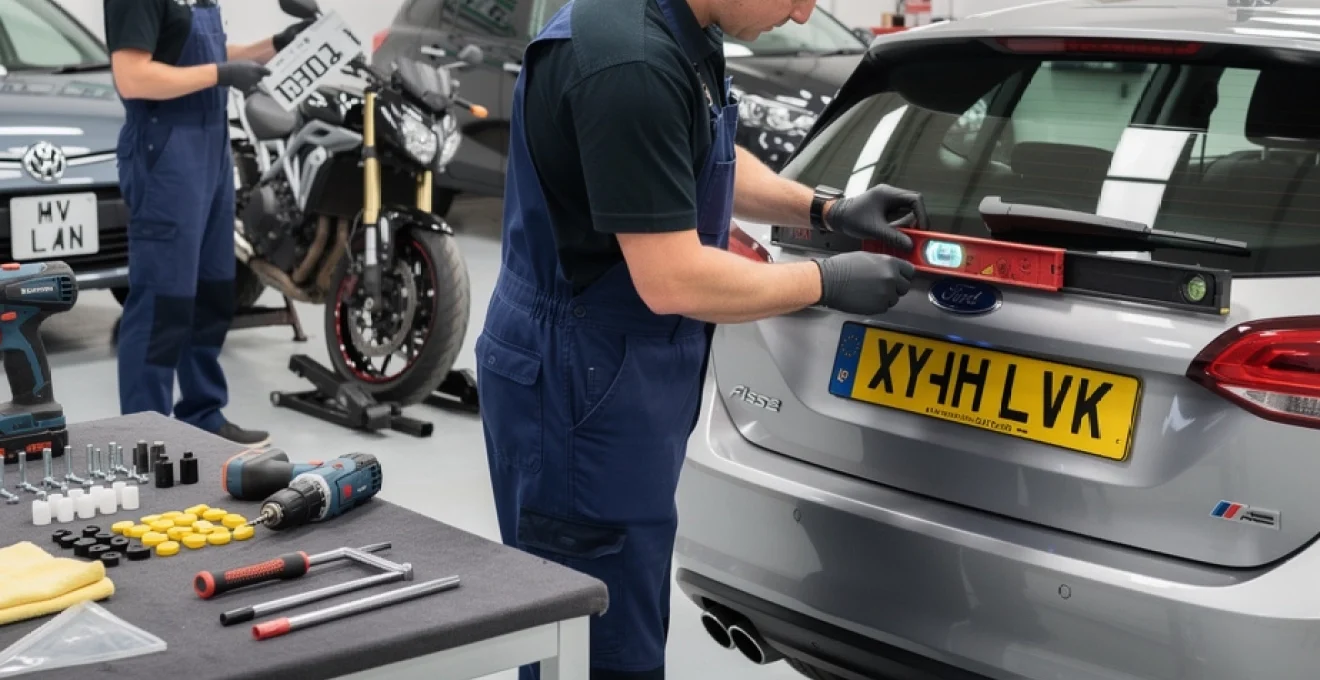
Correctly fixing number plates in the UK is about far more than cosmetic detail. If a registration plate falls off at speed, is difficult to read, or fails the MOT, the result can be points on your licence, a fine of up to £1,000, or even an invalid insurance claim. At the same time, modern plates, including 3D and 4D designs, are now an important styling element, so you want them secure, straight and entirely legal. Understanding the balance between aesthetics, engineering and regulation helps you fit plates once and fit them properly.
Whether you are upgrading to a private registration, replacing damaged plates, or refitting after bodywork repairs, the way you prepare the surface, choose fixings and apply adhesives has a direct impact on longevity and compliance. Think of a number plate as a safety‑critical component: small in size, but closely scrutinised by ANPR cameras, MOT testers and law enforcement every time you drive.
UK legal requirements for displaying number plates under the road vehicles (display of registration marks) regulations 2001
BS AU 145e compliance, character spacing and font rules for UK registration plates
The foundation for legal registration plates in Great Britain is the Road Vehicles (Display of Registration Marks) Regulations 2001, updated in recent years to incorporate the BS AU 145e standard. Any plate fitted today must be marked with BS AU 145e and manufactured by a supplier who meets this specification. The standard covers impact resistance, weathering, reflectivity and toughness; tests simulate UV exposure, pressure washing and temperature cycles to replicate several years of use.
Character rules are equally strict. The prescribed Charles Wright font must be used, with character height of 79mm, width of 50mm (except the digit 1), and a stroke width of 14mm on standard car number plates. Spacing between characters must be 11mm and the gap between the two groups (age identifier and random letters) must be 33mm. Altering spacing is one of the most common reasons for a registration plate fine and is a fast route to an MOT failure, particularly on private plates where owners sometimes try to “spell” names.
From a practical fitting perspective, this means screw holes or caps must not interfere with legibility. If you position a fixing so that it visually alters a character (for example, a black screw cap in a way that makes a “C” look like an “O”), the plate can be deemed illegal even if everything else is to standard.
Rules for front (white) and rear (yellow) plates, reflective materials and visibility
Every car, van and most light commercial vehicles must display a white retro‑reflective plate at the front and a yellow retro‑reflective plate at the rear. Both plates must have black characters only, without any background pattern. The reflective layer is engineered to return light towards its source; poorly fitted plates that flex excessively, delaminate or are partly obscured can reduce this effect and compromise readability at night.
Regulations require that plates remain easily readable in normal daylight and under dipped headlights at night from a reasonable distance. That is one reason why dirt‑resistant materials and secure fixings matter. If your adhesive fails and the plate lifts at one corner, headlight beams may “flare” off the warped surface, making characters harder to read and inviting attention during roadside checks.
Any decorative borders or dealer logos must sit within strict margins and must not intrude into the character area. When drilling or screwing, leave sufficient clear margin so the reflective background remains intact and large enough around the digits for ANPR cameras to work reliably.
Positioning regulations for cars, vans and motorcycles: height, angle and curvature
For cars and vans, regulations state that number plates must be fixed in a vertical or near‑vertical plane and positioned so they are clearly visible from the front and rear. In practice, MOT testers typically accept a slight angle, but not so extreme that the plate cannot be read from a normal standing height at a reasonable distance. Import‑style “show plates” tucked into grilles or offset deep into bumpers frequently fail this test.
Motorcycles must display a rear plate only, mounted centrally as far as is reasonably practicable. The plate must be vertical or near vertical and no more than 1.5m from the ground. Some riders try to mount small plates on swingarms or extreme tail tidies; if the angle or height prevents clear reading, the bike will not pass the MOT and may attract immediate roadside enforcement.
Curved bumpers and aerodynamic fascias on modern vehicles pose a specific challenge. A plate can follow a gentle curve, but excessive curvature can distort character spacing and reflection. For that reason, any adhesive‑only installation on curved surfaces needs careful planning and, ideally, a plate designed for that application rather than forcing a standard flat plate to bend.
Restrictions on tinted covers, vinyl wraps, 4D gel digits and non‑standard designs
Styling trends such as smoked covers, tinted overlays and fully wrapped plates are tightly restricted by DVLA rules. Any tinted plate cover that reduces reflectivity or makes characters harder to read is prohibited on road‑going vehicles. Clear acrylic protectors can be acceptable if they are colourless, non‑patterned and securely fitted so they do not create additional glare or distortion.
3D and 4D plates with raised acrylic or gel digits can be legal, but only if they are fully compliant with BS AU 145e and use the correct font, colour and spacing. The raised elements must be securely bonded; loose gel characters or poorly aligned digits are grounds for rejection. A common fitting error is attempting to drill through 4D or gel digits, which can crack the acrylic characters and instantly render the plate unroadworthy.
Vinyl “stick‑on” plates applied directly to bodywork or bonnets are generally only legal where specifically permitted (for example, on some historic or imported vehicles that were registered with that arrangement). For most modern cars registered in the UK, a rigid plate with the correct reflective backing is mandatory, so any vinyl‑only solution risks both enforcement action and an MOT fail.
MOT test criteria for number plate condition, legibility and illumination
During an MOT test, number plates are checked for security, condition and legibility. The plate must be present, firmly attached, and not excessively damaged, delaminated or faded. Cracks that cut through characters, peeling reflective film or severely scuffed plates can all lead to failure. Illumination of the rear plate is also required: the lamp must work, emit white light and not show a visible light source directly to following traffic.
If you fit a plate in a way that allows it to vibrate, rattle or flex excessively, long‑term damage is almost guaranteed. Repeated stress from washing, motorway speeds and daily bumps will eventually cause micro‑cracks and edge lifting. A professional‑standard installation aims to prevent any movement, dampen vibration and protect the reflective and acrylic layers from mechanical stress.
Legal number plate fitting is judged not only on how the plate looks on day one, but on whether it is likely to remain secure, readable and intact for years of everyday use.
Selecting compliant UK number plates from DVLA‑registered suppliers
Using DVLA’s “find a number plate supplier” tool and checking supplier registration
To ensure any registration plate fitted is fully compliant, start with a DVLA‑registered supplier. The Driver and Vehicle Licensing Agency maintains an online “find a number plate supplier” tool listing businesses authorised to produce road‑legal plates. Registration means the supplier has demonstrated it can manufacture to BS AU 145e and keep appropriate records of plates issued.
When you visit or order online, look for the supplier’s name and postcode printed at the bottom of the plate, as required by law. That identifier is a quick sanity check that the plate has been produced within the regulations. If a seller offers plates with non‑standard fonts, mis‑spaced characters or novelty backgrounds, treat that as a red flag for on‑road use, even if the marketing emphasises “show use only”.
Using a reputable supplier also makes it easier to obtain exact replacements in future. If a plate is damaged or stolen, a like‑for‑like replacement from the same source will reduce the risk of minor layout differences that may attract unwanted attention.
Choosing between acrylic, high‑impact polycarbonate and 3D/4D raised letter plates
Most UK number plates are manufactured from acrylic, which offers a good balance of clarity, durability and cost. High‑impact polycarbonate plates are more resilient against stone chips and cracking; they can be worth considering if you cover high motorway mileage or use a lot of automatic car washes. When fitting, both materials behave similarly, but polycarbonate is slightly more forgiving to small flexing forces.
3D gel and 4D acrylic plates add raised characters on top of a standard reflective substrate. When sourced from a compliant supplier, they meet legal standards, but they require more care during installation. You must avoid drilling through any raised character and ensure adhesives or fixings do not interfere with the bonding between the character layer and the backing.
From an engineering perspective, think of 3D/4D digits as an additional component bonded to the main plate. Any torsion, over‑tightening of screws or uneven adhesive pads can cause localised stress around those bonds, so careful torque control and even pressure distribution become especially important.
Specifying legal flags, identifiers and spacing for UK, scotland, wales and EVs
Modern UK registration plates can incorporate certain permitted identifiers, such as Union Flag with “UK”, “GB”, “SCO”, “CYM” or “ENG” text, and, for zero‑emissions vehicles, the green flash on the left-hand side. These features must follow strict dimensions and positioning rules and may only appear in approved colours. When ordering, specify clearly that you need a road‑legal design for UK use, not a show plate.
Electric vehicles can display a vertical green band indicating their zero‑emission status, which some local authorities use to enable specific parking or lane privileges. The presence of this band does not change fitting requirements, but you should avoid placing screw caps through it, as this can look untidy and may slightly disrupt the visual indicator.
Spacing is always generated automatically by a compliant supplier’s software. If you are tempted to ask for altered spacing to emphasise a name or word, remember that enforcement cameras and ANPR systems are calibrated for standard layouts. An apparently small stylistic tweak can be interpreted as deliberate misrepresentation of a registration mark.
Ordering replacement plates: V5C, V750, V778 and identity documentation requirements
By law, a registered supplier must verify entitlement before issuing a registration plate. Typically, you need original documents such as a V5C logbook, V750 certificate of entitlement for a private plate, or a V778 retention document, along with proof of identity. Photocopies or phone photos are usually not sufficient because suppliers are required to hold physical or secure digital records.
This documentation process protects you from cloning and fraud. If your plate is stolen, established records make it easier for authorities to trace where duplicates have been issued. From a practical perspective, bring the necessary paperwork when you go to collect plates so that you can fit them straight away without having to return later.
For fleet managers, maintaining a file of entitlement documents for each vehicle helps streamline bulk plate orders and reduces downtime when replacing damaged or corroded plates across a fleet.
Surface preparation and cleaning before fixing number plates to bodywork or bumpers
Degreasing with isopropyl alcohol and avoiding silicone‑based cleaners and waxes
A secure installation starts with surface preparation. Any grease, wax or polish between the bodywork and adhesive pads will dramatically reduce bond strength. Use isopropyl alcohol (IPA) or a dedicated panel wipe to degrease the area; apply it to a clean microfibre cloth and work the surface until existing residues are lifted. IPA flashes off quickly, leaving a clean, dry substrate that allows adhesive tapes to achieve their rated strength.
Silicone‑based cleaners, quick detailer sprays and waxes should be avoided directly under the plate. Silicone is particularly problematic because it creates a very low‑energy surface that most adhesives struggle to bond with. If the car has just been valeted or ceramic‑coated, take extra care; more than one plate has been lost on the motorway because it was stuck to a heavily waxed bumper rather than bare paint.
Think of adhesive bonding like painting a wall. If the wall is greasy or dusty, even the best paint will peel. The same principle applies here: preparation accounts for most of the long‑term reliability of your number plate attachment.
Assessing substrates: painted metal, plastic bumpers, GRP and carbon fibre finishes
Modern vehicles present a variety of substrates: painted steel or aluminium, plastic bumper covers, GRP splitters and carbon fibre components. Each material behaves differently. Painted metal usually offers the most stable base and works well with both screws and adhesives. Plastic bumpers can flex more, which is fine if the curvature is gentle but problematic if the plate is forced to bend sharply.
GRP and carbon fibre finishes are often found on performance cars and aftermarket body kits. These surfaces may be more brittle and sometimes finished with thinner clear‑coat, so aggressive scraping tools can easily cause damage. When assessing where to fix a plate, look for the flattest possible area with good structural support behind it, even if that means deviating slightly from the original factory position on a modified bumper.
If you are unsure about adhesion on an unfamiliar surface, a small test strip of the chosen tape applied for 24 hours can give an early indication of bond strength and compatibility.
Checking for existing adhesive residue, corrosion, lacquer damage and surface defects
Removing old plates often reveals adhesive residues, corrosion spots or flaking lacquer. All of these must be addressed before fitting new plates. Use a plastic scraper or fishing line to remove stubborn foam pads, then soften any remaining residue with a tar and glue remover that is safe on clear‑coat. Work slowly; rushing with metal tools risks deep scratches that are hard to correct.
Corrosion around screw holes is especially common on older vehicles. Surface rust should be sanded back gently and treated with a rust converter or primer before re‑fixing the plate. Leaving rust untreated means it will continue to spread under the paint and can eventually weaken the mounting area. Lacquer damage should be carefully polished or, if severe, professionally repaired to avoid moisture ingress.
Uneven surfaces, raised adhesive lumps and paint defects all reduce the effective contact area for adhesive pads. The aim is a flat, clean section of bodywork so the plate makes uniform contact, minimising stress points.
Dry‑fit alignment using masking tape guides and spirit level before permanent fixing
Before committing to screws or adhesive, carry out a dry‑fit. Hold the plate in position and stand several metres back to judge alignment relative to the grille, bumper and body lines. A spirit level can help, but remember that some bumpers are not perfectly horizontal, so trust the visual relationship to the car’s main styling features rather than relying on the ground.
Once happy with the position, use masking tape to mark the top edge of the plate and, if needed, lightly mark the centre point on both car and plate. These guides ensure that when you apply adhesive or insert screws, the plate ends up exactly where intended. A skewed plate is one of the most obvious giveaways that a fitting job was rushed.
Spending five extra minutes on dry‑fit alignment can save an hour of rework and the cost of new adhesive pads or even new plates.
Fixing number plates using screws and caps: drill patterns, torque and corrosion control
Selecting correct screw types: self‑tapping, machine screws and anti‑theft fasteners
Screw‑mounted plates remain popular because they offer a very secure mechanical fixing. The correct screw type depends on what lies behind the mounting area. Many vehicles use plastic mounting panels, where self‑tapping screws are appropriate. Others have threaded metal inserts requiring machine screws. Always inspect existing fixings and replicate the original type where possible.
Anti‑theft fasteners, which use special heads or one‑way drives, can reduce the risk of plate theft. However, they must still allow controlled tightening. Overtightening any screw into a brittle substrate is likely to crack the plate or deform the bumper. Stainless steel or zinc‑plated screws help minimise corrosion around the fixing points, particularly important in high‑salt winter environments.
If there is no existing mounting provision behind the target area, consider using a purpose‑made bracket or plate holder rather than drilling random holes into structural metal or thin plastic.
Marking and drilling number plates without damaging reflective and acrylic layers
When drilling plates, always drill from the back to the front. Place the old plate over the new one and use it as a template, marking the hole centres with a fine marker. To prevent the drill bit from “walking”, create a small indentation with a punch or a sharp screw. Then, using a suitably sized bit (commonly 4–5mm), drill slowly through the backing material.
Masonry bits are often recommended because their blunter tips tend to melt rather than cut the acrylic, reducing the risk of cracking. Allow the bit to do the work and avoid forcing it; too much pressure can delaminate the reflective layer. Critically, never drill through 4D or gel characters. If the existing hole position conflicts with raised digits, adjust the mounting method rather than compromising the plate.
After drilling, clean away swarf and lightly deburr the holes. Any sharp edges left in contact with screws can act as crack starters under vibration.
Using rubber grommets, nylon spacers and torque control to prevent cracking and warping
Rubber grommets and nylon spacers are simple additions that significantly improve longevity. Grommets cushion the interface between screw and plate, reducing stress concentrations and dampening vibration. Spacers can be used where the mounting surface is uneven, ensuring the plate sits flat without being bent to match a warped bumper.
Torque control is critical. Tighten screws until the plate is secure and does not move when pushed, but stop before the plate visibly flexes or indents around the fixing. A small hand screwdriver provides far more feedback than a powerful cordless drill. If using a drill/driver, set a very low torque setting and finish by hand.
On vehicles frequently exposed to high‑pressure jet washing, correctly torqued screws plus cushioning grommets provide excellent resistance to dynamic water loads that can otherwise work adhesive‑only plates loose over time.
Colour‑coded caps (white, yellow, black) and maintaining character legibility
Screw caps serve two purposes: they improve aesthetics by hiding screw heads, and they provide a small extra layer of protection against corrosion. Choose caps that match the background colour (white at the front, yellow at the rear) or black where alignment with characters is unavoidable. Caps should be sized correctly so they clip firmly and do not rattle loose.
Position fixings away from character strokes as far as possible. Where original factory plates used fixings through characters, ensure the cap colour does not visually alter the digit. For example, a black cap placed in the middle of a “B” or “8” can subtly change its appearance and invite unnecessary scrutiny.
Before finally tightening, step back and assess the symmetry of cap positions; a neat, symmetrical layout is a hallmark of professional plate fitting and suggests careful workmanship elsewhere on the vehicle.
Securing plates on specific models (e.g. ford fiesta, VW golf, BMW 3 series) with existing mounts
Many popular models such as the Ford Fiesta, VW Golf and BMW 3 Series include dedicated mounting bosses or factory brackets. Whenever possible, use these existing mounts rather than drilling fresh holes. On some Golfs and BMWs, plastic frames clip into the bumper and the plate then clips or screws into the frame, allowing removal without disturbing the bumper itself.
On certain Fiestas and other superminis, the front bumper may have only two central mounting points. In such cases, combining screws with a couple of discreet adhesive pads at the outer edges can prevent plate vibration at speed. Always check behind the drilling point to avoid piercing air‑con condensers, intercoolers or wiring looms; a quick look or feel behind the panel can prevent an expensive mistake.
If the existing frame is damaged or warped, replacement frames are inexpensive and provide a more stable platform than trying to compensate with additional screws or thicker pads.
Fixing number plates using automotive adhesives and double‑sided tapes
Comparing 3M VHB, unibond, and halfords‑branded tape systems for exterior use
Adhesive pads and automotive tapes offer a clean, drill‑free solution that many modern manufacturers favour. High‑quality acrylic foam tapes such as 3M VHB, Unibond automotive tape or reputable retail brands are designed to withstand outdoor conditions, including temperature swings from –30°C to +90°C and repeated exposure to water and UV.
Lower‑cost generic foams may hold initially but often degrade after a year of weather and washing. Industry testing shows that premium automotive tapes can retain over 90% of their bond strength after thousands of hours of accelerated weathering, whereas non‑specialist tapes can lose more than half their strength in the same period. Choosing the right tape is therefore as important as correct application.
When purchasing, look for tapes explicitly labelled for exterior automotive trim, with data on shear strength and recommended load per square centimetre. This information is valuable for calculating how many strips to apply.
Calculating adhesive area and load for high‑speed motorway and wash‑jet resistance
A standard car plate has a surface area of roughly 520mm × 111mm. At motorway speeds, aerodynamic loads can reach several kilograms of equivalent force, particularly on front plates protruding into the airflow. To ensure a safety margin, treat the expected load like hanging a heavy picture: spread it across a generous adhesive area.
If the tape manufacturer specifies, for example, a safe working load of 0.4kg/cm², and you estimate a potential peak load of 4kg on the plate, you need at least 10cm² of bonded area. In practice, most fitters use several strips across the full width of the plate, often totalling 40–60cm² or more, giving a substantial safety margin for pressure washing and occasional impacts.
This type of calculation may sound technical, but it underlines why using a single pad in each corner is risky; the bond becomes too localised, inviting early failure at one edge which then cascades across the rest of the plate.
Step‑by‑step bonding process: application pressure, curing times and temperature ranges
For adhesive‑only mounting, a methodical approach is essential:
- Clean and degrease both the vehicle surface and the back of the plate with IPA.
- Apply parallel strips of tape vertically or horizontally, leaving small gaps for any trapped air to escape.
- Remove the backing film and offer the plate up, using masking tape guides for alignment.
- Once aligned, press firmly across the entire surface for 10–30 seconds, applying strong, even pressure.
- Allow the bond to cure; many acrylic tapes reach 50% strength within an hour but may take 24 hours to reach full performance.
Temperature is a critical factor. Most tapes prefer installation between 15°C and 30°C. In cold conditions, the adhesive can become stiff and fail to “wet out” on the surface, leading to weak initial adhesion. In winter, fitting in a heated garage or gently warming the panel (not the tape) with a hairdryer can dramatically improve bond quality.
Adhesive‑only mounting on curved bumpers: flex control and edge‑lift prevention
Curved bumpers introduce a flex dimension that adhesives must accommodate. If the plate is forced to follow a tight curve, the constant tension will work against the bond. Where curvature is modest, using multiple narrower strips can help the plate conform without excessive stress. For more pronounced curves, consider a slightly shorter plate (if legally permissible) or a discrete mounting plinth that provides a flatter interface.
Edge‑lift is a common failure mode, where water and road grime gradually work under a slightly raised corner, reducing adhesion. To minimise this, place tape close to the plate’s edges so that they are held firmly down, and ensure no old adhesive lumps or dirt keep the edge propped up. If you notice any early lifting, address it promptly rather than waiting for the entire plate to detach.
On vehicles frequently subjected to high‑pressure jet washes, standing a little further back when directing the lance at the plate area reduces the peak impact load and prolongs adhesive life without compromising overall cleaning.
Specialised mounting solutions for motorcycles, import plates and short plates
Motorcycle plates experience far higher vibration and direct airflow than car plates, so relying on adhesive pads alone is rarely advisable. Best practice is to use mechanical fasteners into an appropriate bracket, supplemented by adhesive if needed to stop rattles. Many aftermarket tail tidy kits include dedicated plate carriers; always check these keep the plate within legal size and angle limits.
Import vehicles sometimes require non‑standard plate sizes, such as square rear plates for some Japanese models. In those cases, use brackets or holders designed specifically for the aperture rather than trimming a standard plate or improvising with partially supported edges. A fully supported backing spreads load evenly and prevents cracking along unsupported sections.
Short plates for registrations with fewer characters can be legal if manufactured to the correct standards. However, the smaller overall area reduces the maximum available adhesive footprint. On such plates, combining adhesive with small, well‑placed screws can be a sensible compromise to maintain both aesthetics and security without overloading a minimal bonding area.
Common fitting mistakes, penalties and MOT failures linked to incorrect plate fixing in the UK
Several recurring mistakes lead to penalties or MOT failures. Mis‑spaced or distorted characters due to poor fitting, cracked plates from overtightened screws, and crooked or loosely attached plates are among the most frequent issues testers report. Police forces across the UK routinely run operations targeting illegal or unreadable registrations, with ANPR systems flagging plates that do not conform to expected patterns.
Another common error is using indoor foam pads or household double‑sided tape rather than automotive‑grade products. These may hold for a few weeks before exposure to rain, heat and road salt causes rapid deterioration. A detached plate on the motorway is not only illegal; it becomes a road hazard capable of damaging following vehicles.
| Issue | Likely Cause | Possible Outcome |
|---|---|---|
| Plate falls off at speed | Inadequate adhesive area or poor surface prep | Road hazard, fine up to £1,000, MOT fail |
| Cracked around screw holes | Overtightened screws, no spacers or grommets | Replacement required, MOT advisory or fail |
| Illegible at night | Faded reflective layer, warped plate | Enforcement action, MOT fail |
| Crooked or tilted plate | No dry‑fit alignment, rushed fitting | Potential police stop, MOT advisory |
From a professional standpoint, treating number plate fitting with the same care as any other safety‑relevant task pays off. Use compliant plates from registered suppliers, prepare the mounting surface thoroughly, and choose a fixing method that suits both the vehicle and how you use it. By applying basic engineering principles—load distribution, material compatibility and torque control—you give your plates the best chance of remaining secure, legal and presentable for the long term.