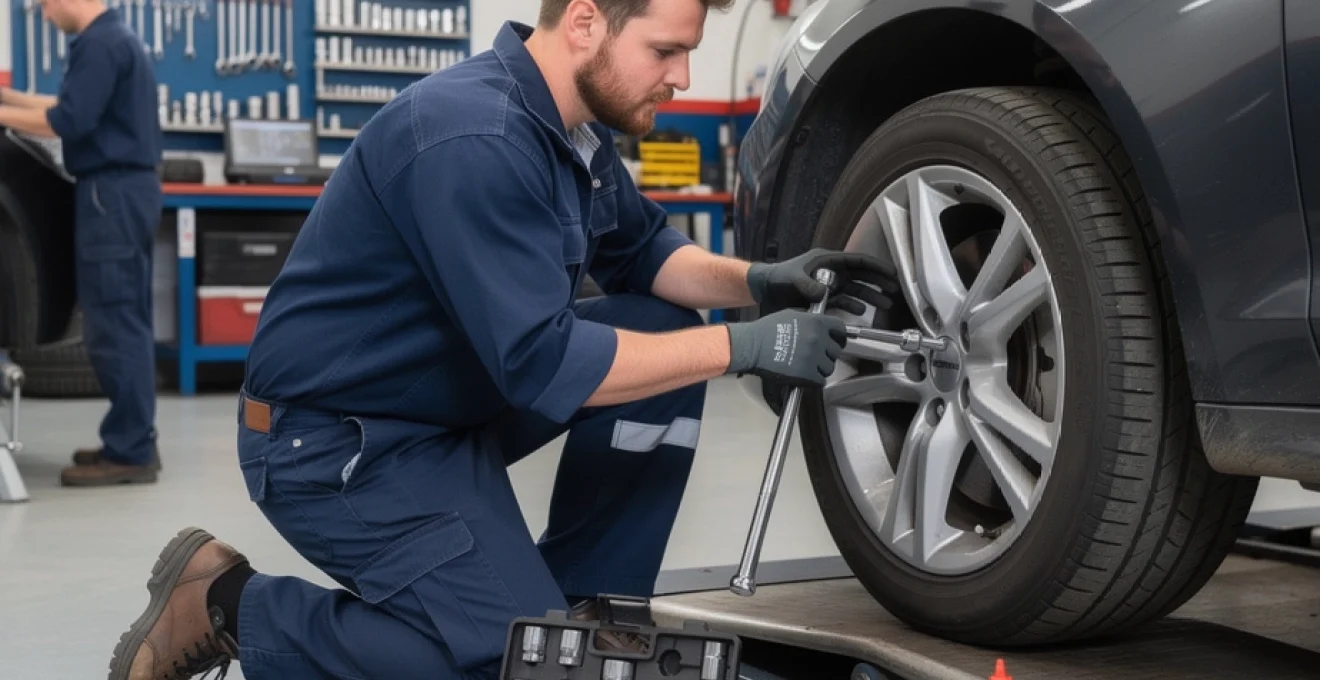
Locking wheel nuts are designed to protect expensive alloys, yet for many drivers they end up causing more stress than thefts ever would. A lost key, a snapped adaptor or a rounded locking bolt can stop a routine tyre change, delay an MOT, or leave you stranded at the roadside with a puncture. Removal needs the right tools, solid technique and a methodical approach, especially in a busy workshop environment like Kwik Fit where technicians deal with hundreds of different locking systems each week.
If you have ever watched someone attack a stubborn locking nut with the wrong socket, you already know how quickly a simple job can become a costly wheel repair. Modern vehicles use a mix of OEM and aftermarket systems, from spline-style tuner nuts to complex McGard designs with rotating collars. Understanding how these work, how Kwik Fit technicians assess them, and which removal methods are approved can help you make better decisions, reduce damage risk and avoid unnecessary removal charges.
Understanding locking wheel nuts and key systems used at kwik fit
Most cars that arrive at Kwik Fit today are fitted with some type of locking wheel nut system, either from the factory or added later by a previous owner. Industry data suggests that over 70% of new vehicles in the UK leave the production line with locking wheel bolts or nuts as standard, mainly to protect alloy wheels that can cost £400–£1,000 each to replace. At the same time, national crime statistics show wheel thefts have dropped significantly compared with the early 2000s, but the complexity of wheel locking systems has increased, which is why professional tyre centres treat them as a specialist task rather than a routine fastening.
Kwik Fit technicians typically see a mix of original equipment manufacturer (OEM) locks and popular aftermarket brands. Each system has its own pattern design, removal key and specific failure modes. Some keys shear easily, others round off the pattern, and some will seize completely if previously overtightened with a high-powered impact gun. Understanding these differences is essential for safe removal and for choosing whether to replace locking nuts with standard wheel bolts after the job is complete.
Standard McGard, farad and OEM locking wheel nut patterns commonly seen at kwik fit
McGard and Farad are two of the most common aftermarket locking wheel nut manufacturers in the UK, and their products are often fitted from new by brands such as BMW, Mercedes-Benz, VW Group, Ford and Vauxhall. McGard security bolts are known for their intricate swirl or flower-style patterns and, on many versions, a spinning collar that freewheels when a generic socket is hammered on. Farad systems use deeply cut pattern keys and are frequently seen on Italian and French marques.
OEM sets typically use simpler patterns but still rely on a unique key code. For example, many VAG (VW, Audi, Skoda, SEAT) vehicles share a family of pattern codes, with perhaps 15–20 different designs across a large fleet. This is why some independent garages keep master key kits that cover a wide range of OEM profiles. However, once a key has been damaged by misuse or an adaptor has cracked under impact gun torque, technicians often have to move to more advanced removal methods, particularly if the pattern recess is shallow or full of brake dust.
Differences between spline, tuner, rotating collar and security-bolt style wheel locks
You will encounter four broad types of locking wheel nut when visiting a chain like Kwik Fit. Spline-style or tuner nuts use a narrow multi-spline key that slides deep into the nut, common on aftermarket alloys; they are relatively easy to remove with the right key but extremely vulnerable to rounding if a cheap adaptor is used. Traditional security bolts use a shaped pattern on the face, sometimes described as a star, flower or dimpled design, and rely heavily on precise key alignment to avoid damage.
Rotating collar styles, often associated with McGard, add a free-spinning ring that prevents a standard socket from biting into the nut body. These are excellent for theft prevention but can be a real challenge when the key is missing or destroyed. Finally, there are security-bolt style systems that look like conventional bolts but use slightly altered head profiles; these often lure DIY drivers into trying a “close enough” socket, which deforms the head and makes professional extraction the only safe route.
How kwik fit technicians identify manufacturer‑specific locking nuts on BMW, audi, ford and vauxhall wheels
When a vehicle rolls into a Kwik Fit bay, technicians start by visually identifying the locking nut type and brand. BMW, Audi, Ford and Vauxhall all use recognisable OEM locking hardware, including McGard-based systems and house-branded kits that share pattern families. The technician will usually remove any plastic caps, clean the bolt head area and check for tell-tale logos, such as small stamped codes or distinctive knurling, before attempting removal.
For common OEM systems, many centres keep pattern identification charts or master reference boards. These allow staff to match the visible shape on the wheel lock to a corresponding key pattern, either from the manufacturer or from a dedicated aftermarket key kit. If the lock appears to be a generic aftermarket product from previous ownership, pattern identification becomes trickier, and technicians may have to skip directly to extraction tools when a suitable key cannot be matched quickly or safely.
OEM vs aftermarket locking wheel nuts and how this affects removal procedures
OEM locking wheel nuts are generally better engineered and more consistent in quality, which gives technicians a better chance of safe removal using the correct key. Manufacturers publish torque values, key codes and replacement options, so if you lost a BMW or VW key, a dealer or specialist can often supply a new one by code or visual match. Aftermarket locks vary widely in hardness, pattern depth and steel quality; cheaper sets can deform easily, increasing the risk of key breakage or pattern rounding during removal.
This distinction matters because Kwik Fit staff must choose between continued attempts with a marginal key or switching early to controlled extraction methods. Professional judgement is important here: a slightly deformed OEM lock might still come off safely with careful torque control, whereas a soft-budget aftermarket nut may fail catastrophically under the same load. From a customer perspective, replacing poor-quality aftermarket locks with OEM or Thatcham-approved alternatives after removal is often the most cost-effective long-term decision.
Diagnostic checks before attempting to remove locking wheel nuts at kwik fit
Before any serious force is applied, technicians perform diagnostic checks to understand why a locking wheel nut might be reluctant to move. Industry research shows that around 30–40% of locking nut problems at tyre centres are caused by overtightening with impact guns, while approximately 25% are due to corrosion, especially on vehicles that see winter road salt or irregular maintenance. Early diagnosis can save you time, reduce the likelihood of snapped studs and dramatically lower the chance of cosmetic damage to high-value alloys.
These checks also ensure the car is properly supported and that any removal attempt does not create a secondary safety issue. A locking nut is part of the vehicle’s primary safety system, and weakening or snapping a stud can lead to wheel loss if not handled correctly. This is why reputable providers use documented procedures, torque specifications and calibrated tools rather than “best guess” methods when loosening or retightening locking wheel bolts.
Visual inspection for rounded heads, swollen caps and corrosion on locking wheel bolts
A skilled eye will immediately spot tell-tale signs of trouble. A rounded head, where the pattern edges have already been chewed up, indicates previous unsuccessful attempts with the wrong key or incorrect alignment. Swollen caps, common on some OEM bolts where a thin stainless cap covers a mild steel core, can create a size mismatch between the key and nut. Corrosion rings around the seat area show where water and road salt have crept in, effectively gluing the bolt to the hub.
At this stage, technicians may apply penetrating lubricant and allow it to soak while carrying out other checks. If the pattern appears marginal, many will photograph the locking nut for evidence before attempting removal, particularly if overtightening is suspected. This helps support later conversations about liability if the key snaps or the nut disintegrates under reasonable torque, which is not uncommon on heavily corroded or badly fitted wheels.
Assessing alloy wheel design, hub depth and access clearance for removal tooling
Alloy wheel design plays a huge role in how practical locking wheel nut removal will be. Deep-dished or heavily sculpted wheels can limit access, especially for large spiral sockets or extraction sleeves. Thin-spoke designs might provide better visual access but offer minimal side clearance, making it difficult to position impact tools square to the nut without risking cosmetic damage to lacquer or diamond-cut faces.
Technicians will check hub depth and recess diameter to decide which removal tools can safely fit without scraping the wheel. On some premium OEM rims, there is so little clearance that traditional hammered-on sockets are not recommended at all, forcing the use of key-based removal or precision drilling methods instead. Understanding these physical constraints in advance helps avoid the classic problem of a socket wedged tightly in the wheel recess with no easy way to remove it.
Torque settings, thread pitch and seat type (tapered, radius, flat) verification
Correct torque and seat matching are not just academic details; they directly affect how easily a locking nut can be removed and reinstalled. Most passenger vehicles use torque settings around 110–140 Nm, although some heavy vehicles and performance models specify closer to 150 Nm. Where garages previously used impact guns alone, studs can be tightened to over twice their specified torque, greatly increasing future removal difficulty and the risk of sheared fixings.
Technicians at reputable centres verify thread pitch and seat type—tapered, radius or flat—before fitting replacement bolts. A mismatched seat can dig into the alloy, binding the nut into place over time and stressing the wheel. Checking these details when working on locking wheel nuts reduces the chance of repeat problems and ensures that wheels are correctly clamped for safe high-speed driving.
Safety checks on jacking points, axle stands and wheel chocks in kwik fit bays
Before loosening any wheel fixings, technicians must stabilise the vehicle. Incorrect jacking or inadequate chocking can allow the car to shift as a stubborn locking nut suddenly frees, potentially damaging brake components, wheel arches or even causing personal injury. The car is positioned on a lift or jack at designated jacking points, and axle stands or built-in safety locks are engaged where appropriate.
Wheel chocks are then applied, especially when only one side of the vehicle is raised. This prevents any rolling movement as torque is applied to the locking nut. It might seem like a small detail, but for a driver watching a mechanic lean into a 600 mm breaker bar, the reassurance that the vehicle is correctly supported is significant, and it reflects a professional approach to both safety and controlled force application.
Kwik fit approved methods for removing locking wheel nuts with the correct key
When the correct locking wheel nut key is available and in good condition, removal should be straightforward. Yet a surprising number of damaged nuts and broken adaptors arise from simple issues like poor key alignment or excessive use of impact tools. Industry experience suggests that up to 50% of broken locking keys are the result of impact gun abuse rather than genuine defects. Using a key correctly is therefore the first line of defence against expensive wheel lock failures.
Think of the locking key as a precision tool rather than a disposable accessory. It is designed to transmit torque evenly across a complex pattern; if it is cocked at an angle or only partially engaged, the load concentrates on a few small points, quickly rounding both the key and the nut. Technicians focus on three fundamentals: alignment, controlled torque and consistent retightening to specification, particularly on vehicles equipped with run-flat tyres where wheel removal is more frequent.
Aligning and seating the locking wheel nut key to avoid spline or pattern damage
Correct alignment begins with clean contact surfaces. Any debris inside the pattern—mud, brake dust, corrosion or even small stones—can prevent full engagement. Technicians typically use a small pick or brush to clean out the pattern, then lightly tap the key into place by hand to confirm full seating. Only once the key is firmly and squarely seated against the face of the nut is any torque applied.
This might feel slow compared with simply pushing a key in and hitting it with a gun, but the payoff is substantial. A properly seated key spreads load evenly across all the pattern surfaces, greatly reducing wear and preventing the small “slip and chew” events that eventually lead to unusable locking bolts. If the key itself shows signs of twisting or cracking, a responsible technician will pause and consider whether alternative techniques are safer than forcing the issue.
Using calibrated torque wrenches and impact guns under controlled torque limits
Impact guns are not banned tools, but on locking wheel nuts they need careful control. Many professional centres use torque-limited impact sockets or dial back the air pressure on guns when working on locks. Removal is often attempted with a hand-operated breaker bar first; if the nut moves smoothly, a low-power gun may then be used to speed up the process. The final tightening, however, should always be done with a calibrated torque wrench to the manufacturer’s specified setting.
Recent industry audits show that garages using strictly calibrated torque tools see fewer than 5% of subsequent locking nut failures, compared with over 15% in workshops relying mainly on impact guns. Treating locking nuts with the same respect as head bolts or brake components is a simple but powerful way to improve safety and reduce the risk of you facing a seized wheel bolt during a roadside tyre change.
Step‑by‑step procedure for loosening and re‑torquing locking nuts on run‑flat tyres
Run-flat equipped vehicles are often heavier and may use stiffer suspension components, increasing load on wheel fixings. A typical step-by-step approach used by professional technicians looks like this:
- Confirm the correct locking wheel nut key and clean both key and nut pattern thoroughly.
- Crack the locking nut loose with a breaker bar while the wheel is still on the ground, using controlled, steady pressure.
- Raise the vehicle on the lift or jack, secure with safety locks or stands, and remove the locking nut fully.
- After tyre or brake work, refit the locking nut by hand, ensuring the seat engages correctly and threads spin freely.
- Use a torque wrench to tighten to the specified setting, usually in a star pattern for multi-bolt wheels to ensure even clamping.
This structured process ensures the locking nut is neither cross-threaded nor overtightened, safeguarding both the hub and the future serviceability of the wheel.
Post‑removal inspections of studs, hubs and alloy wheel bolt holes
Once the locking nuts are off, inspection continues behind the scenes. Technicians check wheel studs or hub threads for signs of stretching, galling or thread stripping. Any physical damage, such as a stud that has necked down under previous overtightening, is a red flag that should be addressed before the vehicle returns to the road. Alloy wheel bolt holes are inspected for elongation, cracking or fretting marks that might indicate movement between wheel and hub.
Where heavy corrosion is found on the hub face, it is usually cleaned back to bare metal with a wire brush or abrasive pad. This ensures the wheel sits flat and prevents false torque readings caused by rust compressing under load. A thin smear of appropriate anti-seize on the hub spigot—not the bolt threads—can help prevent future bonding between wheel and hub, which is a common issue after several winters of road salt exposure.
Professional techniques kwik fit uses to remove lost‑key or damaged locking wheel nuts
Lost-key or damaged locking wheel nuts shift the task from straightforward servicing to remedial engineering. At this point, technicians move from key-based removal to controlled extraction, blending mechanical leverage, special sockets and, in extreme cases, drilling. Surveys from UK tyre centres suggest that around 10–15% of vehicles booked for tyre replacement require some form of non-standard locking nut removal, with a smaller fraction needing advanced techniques such as drilling or stud replacement.
Professional judgement becomes critical here. Applying excessive force too early can snap a stud, distort a wheel seat or trap a socket irretrievably in a tight recess. Conversely, overly cautious approaches can waste labour time and still end with damaged hardware. The goal is always the same: remove the locking nut with the least possible damage to surrounding components, while providing you with clear information on risks, costs and outcomes.
Use of master key sets and pattern identification tools for common UK locking nuts
Many centres keep master key sets covering common OEM and aftermarket locking systems. These kits contain dozens or even hundreds of pattern adaptors, each corresponding to known lock designs used across BMW, Audi, Ford, Vauxhall and other manufacturers. Technicians test-fit candidates by hand, listening and feeling for solid engagement rather than forcing marginal matches.
Pattern identification tools might include printed charts, digital reference guides or dedicated boards showing sample lock heads. If a secure engagement is found, the master key is used cautiously to remove the nut under controlled torque, often combined with penetrating oil to minimise resistance. This stage can feel like a puzzle-solving exercise, but when successful it avoids more invasive methods such as hammered-on sockets or drilling.
Employing spiral removal sockets, impact extractors and reverse‑threaded removers
When keys fail or are unavailable, spiral removal sockets and reverse-threaded extractors come into play. These tools use hardened, tapered flutes that bite into the locking nut as torque is applied in the loosening direction. The more the nut resists, the harder the tool grips, much like a self-tightening clamp. Technicians select a socket slightly smaller than the nut’s external diameter and carefully hammer it onto the head to obtain a tight interference fit.
Impact extractors can be driven with a low-power impact gun or breaker bar. The critical point is to apply progressive torque and monitor movement. Any sign of stud twisting or wheel deformation triggers a reassessment of the method. Spiral sockets are powerful but can leave deep bite marks on the nut, which is why they are typically used when the customer has already accepted that the locking nuts will be discarded and replaced with standard bolts.
Drilling strategies for severely rounded or seized locking wheel bolts
Drilling is a last-resort technique for locking wheel nut removal when patterns are completely destroyed or corrosion has fused the threads. The process usually starts with a hardened pilot drill to establish a central guide hole, followed by progressively larger bits to thin the nut wall. In some cases, reverse-rotation drill bits are used in the hope that the remaining shell will spin out once enough material is removed.
Care must be taken not to damage the wheel seat or hub threads behind the nut. Technicians often use depth-stop collars on drill bits and continuously check alignment. On vehicles with studs rather than bolts, drilling might sacrifice the stud entirely, requiring a replacement to be pressed or screwed into the hub flange. This may sound drastic, but compared with the cost of a high-end OEM alloy, a new stud is often a minor expense.
Heat, penetrant lubricants and controlled impact to free corroded wheel fixings
Heat is a powerful ally when corrosion has effectively welded a locking nut to its seat. By applying localised heat to the nut body, the metal expands slightly, breaking the rust bond and allowing penetrating lubricant to wick into the thread interface. In a controlled workshop environment, small induction heaters or gas torches are sometimes used, followed by a waiting period for penetrant to do its work.
Controlled impact, such as sharp blows from a brass hammer on the head of the nut, can also help fracture corrosion layers. This might seem counterintuitive, but the micro-shockwaves loosen the rust bond much like tapping a stuck jar lid frees the threads. The key is moderation; too much impact risks deforming the nut or damaging wheel seats, while gentle, repeated tapping combined with lubricant can dramatically reduce removal torque.
Protecting diamond‑cut and gloss‑black alloys from cosmetic damage during removal
High-end wheels with diamond-cut, polished or gloss-black finishes demand extra protection during locking nut removal. Any slip of a tool can create visible gouges that require costly refurbishment. Technicians commonly use protective sleeves over sockets, masking tape around bolt recesses and soft-faced hammers when seating extraction tools to minimise direct metal-to-metal contact.
Some workshops also place thin plastic or nylon guards between sockets and wheel faces when clearance allows. During spiral socket work, a steady hand and precise alignment are essential; the socket must be driven straight onto the nut without scraping the surrounding alloy. For you as a driver, choosing a centre that takes cosmetic protection seriously is particularly important if the wheels are part of a PCP or lease agreement where end-of-term condition charges can be significant.
Costs, timeframes and policy considerations for locking wheel nut removal at kwik fit
Locking wheel nut removal costs at large chains are influenced by labour time, tool wear and risk. Across the UK, standard lost-key removals using master keys or simple extraction sockets typically start from around £35–£45 per wheel, while complex cases involving drilling or stud replacement can push total costs towards £100 or more for a full set. Quotes such as “£100 removal + replacement” from well-known names reflect both the time and the need to supply new locking or standard bolts afterwards.
Timeframes vary from a quick 10-minute job using a matched key to over an hour of careful work on a single severely seized bolt. Drivers often underestimate how much of this time is spent on protection and diagnosis rather than brute-force removal. Transparency about pricing tiers and policies helps you decide whether to authorise work locally or travel to a specialist locking wheel nut removal service, particularly if your car has previously suffered from overtightened or cross-threaded fixings.
Typical pricing structure for standard vs complex locking wheel nut removals
Many centres operate a tiered pricing structure. A “standard” removal refers to situations where the key is missing but the nuts are in good condition and respond quickly to master keys or basic extraction sockets. “Complex” or “specialist” removals involve rounded patterns, spinning collars, heavy corrosion or wheels that restrict tool access, requiring more time and advanced techniques such as drilling.
It is common for quotes to bundle removal and replacement, supplying either a new set of locking nuts or, increasingly, standard OEM wheel bolts for customers who no longer want locks. When comparing prices between providers, it is worth asking whether the quote covers all four wheels, includes new hardware, and what happens if one nut proves vastly more difficult than the others. Clear expectations on both sides help avoid surprises at the payment stage.
How removal complexity, corrosion and wheel design influence labour time
Labour time is the single biggest variable in locking wheel nut removal costs. A clean, easily accessible nut on a simple five-spoke alloy might come off in minutes, while the same nut on a deep-dish, narrow-recess wheel could take significantly longer to address safely. Corrosion adds another layer of complexity; heavily rusted hubs may require cycles of lubricant, heat and impact, interspersed with other work while products soak in.
From a technician’s perspective, the “worst case” scenario is a corroded locking nut on a tightly recessed, diamond-cut alloy that has already seen a few failed DIY attempts. In such cases, each additional slip increases the likelihood of wheel damage and pushes the job further into specialist territory, justifying higher labour charges. Being upfront about any previous attempts you or other garages have made can help staff choose the most efficient route from the outset.
Kwik fit policies on liability, damaged nuts and previously overtightened wheel bolts
Liability policies exist to divide responsibility between pre-existing conditions and workshop actions. If a locking nut key snaps under torque well within the manufacturer’s specification and the nut shows signs of prior overtightening, centres will often argue that the underlying fault lies with whoever previously fitted the wheels. This can be frustrating from a customer point of view, yet it reflects the reality that metal components weakened by past abuse may fail unpredictably during later service.
Professional tyre centres typically accept responsibility for damage they directly cause through negligence or incorrect procedure, but not for failures arising from historic overtightening, cheap aftermarket hardware or severe corrosion.
Stores may ask customers to sign a disclaimer acknowledging the risk of damage or stud breakage during advanced removal attempts. Reading these carefully and asking questions about alternative options—such as referral to a specialist—can help you feel more comfortable with the process and the potential outcomes.
When kwik fit may recommend referral to a specialist wheel engineering service
Not every locking wheel nut problem is best solved in a high-throughput tyre bay. When risk to the wheel or hub becomes disproportionate, referral to a specialist wheel engineering service is often the most sensible path. These specialists may use custom jigs, CNC drilling guides or advanced welding techniques to remove destroyed nuts and repair associated damage with millimetre precision.
Referral is more likely on rare, high-value wheels, severely seized fixings that have resisted multiple professional attempts, or when structural wheel damage is suspected. Though this can mean extra inconvenience, it can also prevent the far higher cost of a replacement alloy or hub assembly. From a long-term perspective, accepting a specialist referral is similar to seeing a consultant for a complex medical issue rather than insisting everything be handled in a GP surgery.
Preventing future locking wheel nut problems after visiting kwik fit
Once the immediate problem of removing stubborn locking wheel nuts is resolved, prevention becomes the priority. After all, no driver wants to revisit the same issue months later during a puncture or MOT. The combination of appropriate hardware, correct torque application and simple storage habits can almost eliminate repeat incidents. Industry figures suggest that drivers who switch to quality hardware and follow proper torque procedures experience less than 2% incidence of future locking nut failures, compared with rates approaching 10% among those using low-cost, unbranded locks tightened with generic air guns.
Thinking of locking wheel nut care as part of routine maintenance—much like oil changes or brake inspections—helps keep your wheels serviceable and reduces the risk of being stranded. Small choices, such as replacing a suspect key promptly or cleaning hub faces during tyre rotations, have outsized effects on future convenience and safety, especially if you often drive long distances or at motorway speeds.
Selecting new locking wheel nut sets from thatcham‑approved or OEM suppliers
If replacement is necessary, choosing a high-quality locking wheel nut set is crucial. Thatcham-approved or OEM-supplied locks are manufactured to tighter tolerances and usually offer better key durability and corrosion resistance than budget alternatives. While initial cost can be higher—perhaps £40–£70 versus £15–£25 for cheaper sets—the reduction in failure risk and improved resale value of the vehicle often justify the difference.
When selecting a set, match the seat type, thread pitch and overall length to existing wheel bolts. A mismatch can cause wheel vibration, uneven brake disc wear or even stud failure. For drivers of older cars or models that are not commonly targeted by wheel thieves, an increasing number of professionals recommend dispensing with locking nuts entirely and using standard OEM bolts, particularly if you have already been through one removal headache.
Anti‑seize compounds, correct torque application and service‑interval checks
Preventive maintenance techniques make a dramatic difference to how easily locking wheel nuts can be removed later. A light smear of copper or ceramic anti-seize on the hub spigot helps prevent wheels bonding to hubs but should never be applied liberally to threads, as this can alter friction characteristics and effectively increase clamp load at a given torque. Instead, threads should remain clean and dry unless a manufacturer specifies a particular lubricant.
Regular service-interval checks that include loosening and re-torquing wheel bolts to specification can reveal emerging problems long before an emergency roadside tyre change exposes them.
Many technicians recommend a re-torque check after the first 50–100 miles following wheel removal, especially if new hardware has been fitted. Incorporating this into your routine service schedule aligns wheel care with other safety-critical checks and significantly reduces the chance of surprise failures.
Best practices for storing the locking wheel nut key in the vehicle for roadside use
Even the best locking system is useless if the key is missing when needed. The most reliable place to store a locking wheel nut key is in a consistent, easily accessible location inside the vehicle—commonly in the glovebox, boot storage tray or alongside the jack and spare wheel. Avoid leaving it loose in door pockets or centre consoles where it can rattle, wear or disappear under trim panels.
Attaching a discreet label or tag noting the vehicle registration and a reminder of the key code can be helpful if a replacement is ever required. Some drivers keep a second key at home, particularly if the car is shared between family members. Treat the key as an essential emergency tool, on par with a first-aid kit or breakdown number; if you would not drive without a spare tyre solution, you should not drive without knowing exactly where the locking key is located.
Scheduled wheel rotation, tyre replacement and alignment visits to reduce seizure risk
Regular wheel rotation, tyre replacement and alignment checks do more than extend tyre life; they also ensure that locking wheel nuts are periodically removed and refitted under controlled conditions. Each time a wheel comes off and goes back on with correct torque, existing corrosion bonds are broken and fresh seating surfaces are established. This light, repeating disturbance makes it far less likely that a locking nut will fuse to the hub over many years.
Aligning these visits with seasonal tyre changes, long-trip checks or annual services creates a natural cadence for wheel maintenance. In practical terms, this means you are much less likely to face an immovable locking wheel nut during the most inconvenient moment—such as a late-night motorway puncture—because the fixings have been exercised and inspected regularly rather than left untouched for the life of the tyres.