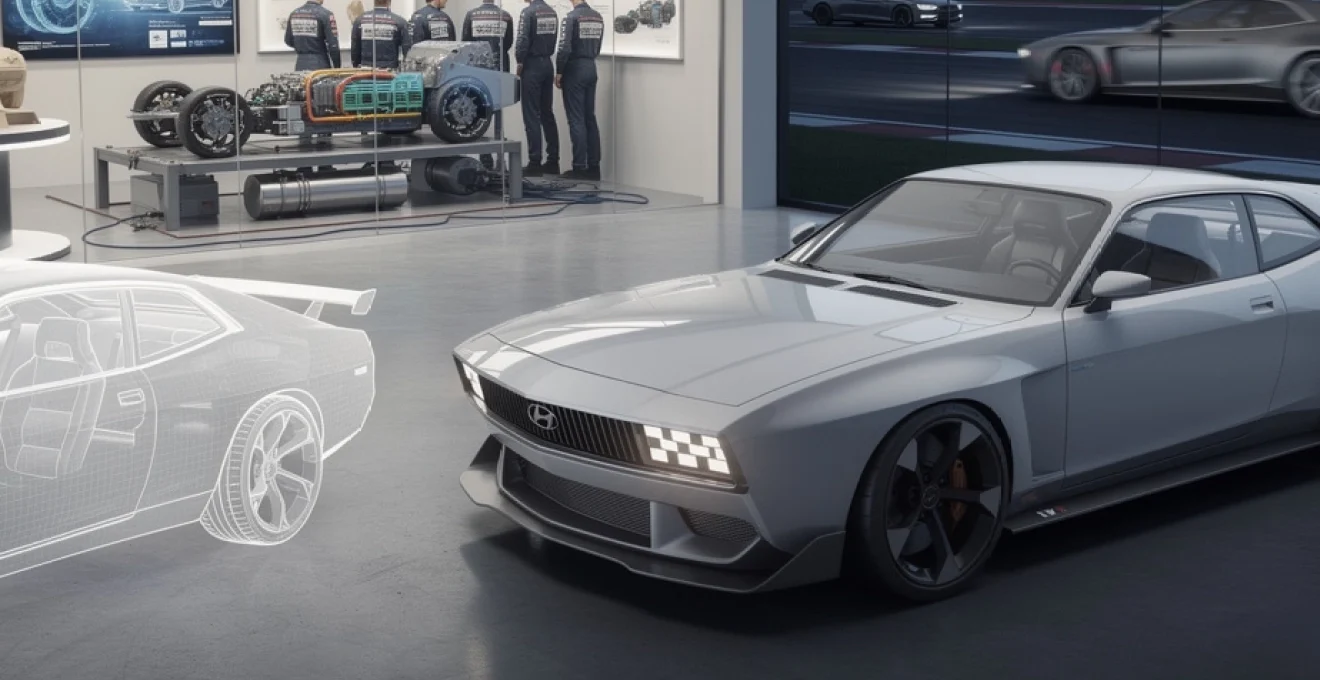
The Hyundai N Vision 74 has become one of the rare concept cars that enthusiasts actively want to see in their driveway, not just on a motor show stand. Blending wedge-era design with a hydrogen fuel cell–electric hybrid powertrain, it challenges the idea that sustainable performance must be sterile, silent or compromised. For anyone tracking the future of driver’s cars, the N Vision 74 is a blueprint for how heritage, hydrogen and high-voltage batteries might converge in a genuinely exciting way.
Beyond the striking silhouette, the car functions as a rolling laboratory for Hyundai N, integrating lessons from touring cars, rally stages and ETCR electric racers. That makes it more than a design fantasy: it is a test case for long-range, repeatable performance without the typical battery EV heat-soak issues. If you are wondering how a hydrogen sports coupé could realistically move from design studio to showroom, the N Vision 74 is the most credible case study on the road today.
Design DNA of the hyundai N vision 74: from pony coupé concept to future production coupé
Giorgetto giugiaro’s 1974 hyundai pony coupé concept: lineage, proportions and wedge-era aesthetics
The N Vision 74 openly acknowledges its roots in the 1974 Hyundai Pony Coupé Concept, penned by Giorgetto Giugiaro when Hyundai was a newcomer on the global stage. That original car never reached series production, yet its long bonnet, cab-backward stance and pure geometric surfacing established a visual language that still looks remarkably contemporary. The N Vision 74 effectively asks: what if that coupé had evolved uninterrupted for fifty years into a hydrogen performance car?
Key proportions are faithfully retained. The low scuttle, slim glasshouse, pronounced C‑pillar and clean beltline all echo the Pony Coupé while scaling up to modern crash and packaging requirements. The result is a car that looks like a time capsule from the wedge era, but sits with the presence of a modern GT. For you as an enthusiast, that continuity matters: it gives Hyundai a genuine design heritage to rival brands that have been building sports cars for decades.
The emotional resonance is no accident either. Designers leaned into Giugiaro’s minimalist philosophy, stripping away excess ornamentation so that the N Vision 74 reads as one coherent object rather than a busy collage of vents and lines. That restraint is a major reason it already feels like a future classic in enthusiast circles.
Aerodynamic surfacing, split rear spoiler and kammback tail for high-speed stability
Underneath the retro surfacing lies a very modern aerodynamic brief. The N Vision 74 uses a near‑Kammback tail, with a sharply truncated rear that cleans up airflow and reduces drag at speed. This is not just a styling wink to 1970s coupés; it directly supports high‑speed stability and WLTP range targets beyond 600 km.
The split rear spoiler works in tandem with the broad rear haunches to manage downforce over the driven axle. At track speeds, the car aims to keep its balance neutral, allowing you to lean on the rear tyres under power without sudden breakaway. Motorsport-inspired details such as the end‑fences on the side skirts and sculpted front splitter are tuned to feed the three‑channel cooling system while trimming lift.
Think of the body as a heat exchanger as much as an aesthetic object. Every vent, cut‑out and negative surface is designed to extract air from the battery, power electronics and PEM fuel cell modules with minimal drag penalty. That integrated thinking is exactly what a production coupé would need to balance efficiency with track performance.
Parametric pixel lighting, side graphic and signature DRL elements for brand identity
Lighting has become central to brand identity, and the N Vision 74 translates Hyundai’s now-familiar parametric pixel signature into a more aggressive, motorsport-adjacent form. Rectangular headlamps and tail-lamps from the Pony Coupé are reinterpreted as grids of individual pixels, instantly linking the car to IONIQ models while marking it out as something more focused.
The horizontal side graphic visually lowers the car and emphasises the rear‑drive stance. In a potential production version, that simple graphic could also carry functional elements such as charge‑port indicators or hydrogen pressure status displays, further blending design and information. For you as a driver, that kind of legible light signature is not just cosmetic; it improves recognition and brand recall in a crowded EV market.
Importantly, the pixel DRLs provide a recognisable face day or night. As regulations tighten around pedestrian safety and visibility, expect those crisp, well-defined lighting elements to be one of the easiest ways to spot the production descendent of N Vision 74 in traffic.
Ergonomic cockpit, yoke-style steering and motorsport-inspired HMI for driver-focused control
Inside, the N Vision 74 adopts a cockpit layout that is unapologetically driver-centric. The architecture channels the Pony Coupé’s straightforward dashboard but overlays it with a digital cluster and motorsport-inspired switchgear. Analogue-style rotary knobs sit alongside a wide digital display, giving you tactile feedback for critical functions such as drive modes, brake regeneration and torque‑vectoring settings.
The yoke-style steering wheel is more than a styling provocation. By opening up the upper arc, it improves sightlines to the HUD and cluster while hinting at the car’s track intentions. Seats borrow heavily from fixed‑back motorsport shells, with integrated headrests and high bolsters that would feel familiar if you already drive an N model to track days.
From an HMI perspective, the most interesting aspect is the way energy management data is surfaced. Real‑time power split between battery and fuel cell, state of charge, hydrogen tank levels and coolant status are presented clearly, allowing you to understand how hard the car is working. In a future production sports coupé, that level of transparency would be a strong selling point for technically minded buyers.
Hybrid powertrain architecture: hydrogen fuel cell, high‑voltage battery and dual-motor RWD layout
PEM fuel cell stack specification, hydrogen storage tanks and thermal management strategy
At the heart of the N Vision 74 lies a second‑generation proton exchange membrane fuel‑cell stack on the front axle. Rated at a net 85 kW (up to 95 kW peak), it acts as a high‑efficiency generator rather than the sole propulsion source. Two 2.1 kg hydrogen tanks (4.2 kg total) are packaged over the rear axle at 700 bar, constructed from ballistic‑grade carbon fibre to withstand extreme pressures and impact loads.
This front‑rear separation of stack and tanks is unusual but strategic. It allows engineers to tailor crash structures independently and fine‑tune weight distribution. A three‑channel cooling system manages heat for the fuel cell, battery and power electronics separately, preventing one subsystem from overheating the others during repeated hot laps.
The N Vision 74’s hybrid hydrogen architecture demonstrates that zero tailpipe emissions can coexist with genuine track durability when thermal management is engineered from the outset.
You can think of the fuel cell as a constant‑output power plant, topping up the battery at a steady rate while the battery handles spikes in demand. That division of labour is a major reason the car can refuel to 80% state of fill in around five minutes yet still deliver the instant response expected from a pure EV.
High‑capacity lithium‑ion battery pack, energy density targets and underfloor packaging
Complementing the fuel cell is a 62.4 kWh high‑voltage lithium‑ion pack with 800 V fast‑charging capability. Instead of a simple skateboard, the pack is arranged in a T‑shape through the central tunnel and under the floor, contributing to a low centre of gravity while leaving room at the rear for the dual‑motor layout. That packaging choice hints strongly at what a future E‑segment hydrogen coupé on a productionised platform might adopt.
Energy density targets are ambitious: the pack must support over 500 kW system output while still enabling a WLTP‑comparable range beyond 600 km when combined with hydrogen. For you as a potential buyer, that translates into grand‑touring capability with fewer compromises than traditional short‑range performance EVs.
Because the battery is expected to survive repeated high‑temperature cycles, Hyundai N leverages experience from its VELOSTER N ETCR and RM20e rolling labs, where packs are routinely stressed on circuit. Expect similar cell chemistries and cooling plate designs to filter into the next wave of N‑branded road cars.
Dual rear electric motor configuration, e‑diff control and torque vectoring logic
The N Vision 74 channels all propulsion to the rear axle through twin electric motors, each delivering around 235 kW to a single wheel. Combined system output tops 500 kW (approximately 670 bhp) and 900 Nm of torque, putting the car firmly in supercar territory. More importantly, the dual‑motor layout enables sophisticated torque‑vectoring that a single-motor setup with a mechanical differential cannot match.
Hyundai refers to this logic as e‑TVTM (electronic Torque Vectoring by Twin Motors). Under cornering, the system can over‑drive the outer wheel or brake the inner wheel to pivot the car, enhancing turn‑in and stability. At the limit, you feel this as a willingness to rotate on throttle rather than push into understeer.
If you enjoy controlled oversteer, the system also supports dramatic, yet predictable, drifts. In Track mode, engineers describe the behaviour as emulating the “best limited‑slip differential in the world”, with near‑instant response and no lag while the system “locks”. The potential for a production sports coupé to offer configurable e‑diff maps would be a compelling differentiator against single‑motor rivals.
Performance metrics: projected kw output, 0–100 km/h, WLTP range and top speed envelopes
Headline numbers are unapologetically bold. System output of over 500 kW and more than 900 Nm drives the N Vision 74 from 0–100 km/h in under four seconds, despite a kerb weight approaching 2,500 kg. Top speed exceeds 250 km/h, aligning it with serious GT machinery rather than conventional EV crossovers.
Range is where the hydrogen‑battery blend really shows its advantage. With 4.2 kg of hydrogen and the 62.4 kWh battery, the car can cover more than 600 km on a mixed cycle, with independent tests and simulations suggesting around 370 miles is realistic even when driven briskly. That figure positions it competitively against long‑range BEVs while offering five‑minute refuelling when hydrogen is available.
For track‑day use, the crucial metric is sustained performance rather than one‑off sprints. Thanks to the multi‑channel cooling and fuel cell support, the N Vision 74 is engineered to resist the aggressive power‑derating that often plagues high‑output EVs after a few hot laps.
Energy management software, drive modes and regenerative braking calibration derived from N brand
Energy management in the N Vision 74 is handled by an integrated control system that decides how much power to draw from the fuel cell versus the battery at any given moment. Under steady motorway cruising, the strategy favours the fuel cell to keep the battery in its optimum state of charge. During overtakes or track sessions, the battery provides the bulk of the power, with the fuel cell acting as an on‑board charger.
Drive modes draw heavily from existing N products. You can expect Eco, Normal, Sport and dedicated Track calibrations, each adjusting throttle mapping, e‑diff behaviour, steering weight and regeneration. In more aggressive modes, regen is tuned not only for energy recovery but also for yaw control, subtly stabilising the car on corner entry.
By treating
regen‑brakingas a handling tool rather than just an efficiency feature, the N Vision 74 hints at how future performance EVs can feel as interactive and adjustable as traditional sports cars.
For daily use, softer regen settings and smoother power delivery will make the car approachable even if you are transitioning from an ICE hot hatch or GT. That dual personality is central to the N brand’s “everyday sportscar” pillar.
Chassis, dynamics and N brand motorsport technology transfer
Electric global modular platform (E‑GMP) adaptations for fuel cell integration and weight distribution
Although the N Vision 74 is not a straightforward E‑GMP derivative, its underpinnings clearly borrow from the same architectural philosophy that supports IONIQ 5, IONIQ 6 and Kia EV6. The floor structure and crash paths are adapted to house both the T‑shaped battery and the front‑mounted fuel cell, a combination that demands meticulous attention to weight distribution.
Engineers aimed for a near‑50:50 balance while accommodating rear hydrogen tanks and twin motors. That is particularly challenging in a long‑bonnet coupé, yet early reports from track tests suggest the mass is well centred between the axles. If a production model emerges, expect a heavily modified E‑GMP or successor platform with reinforced sills and cross‑members to handle the extra mass and point loads from the hydrogen hardware.
From your point of view as a driver, the benefit is predictable behaviour at the limit. Rather than feeling like a nose‑heavy GT or a tail‑happy dragster, the chassis is tuned to remain neutral under combined braking and cornering loads, much like Hyundai’s best N hatchbacks.
Multi-link rear suspension, adaptive dampers and nürburgring-tuned geometry
The rear axle uses a sophisticated multi‑link layout with adaptive dampers, tuned using the same Nürburgring‑based development loops that have shaped i30 N and i20 N. Geometry is set up to provide strong traction on corner exit while maintaining responsive turn‑in, a balance that heavier EVs often struggle to achieve.
Adaptive damping allows the car to soften its ride for daily use yet firm up significantly on circuit. If you have driven any of Hyundai’s recent N models, you will recognise the philosophy: let the driver choose between a comfortable commute and an aggressively tied‑down track setting at the press of a button.
Camber, toe and anti‑squat values are all pushed further towards motorsport norms than in mainstream EVs. For keen track users, that opens up the possibility of running more serious tyres – semi‑slicks or track-biased compounds – without the car feeling under‑damped or nervous.
High‑performance friction brakes, brake‑by‑wire strategies and fade resistance
Stopping a 2.5‑tonne hydrogen hybrid from supercar speeds requires serious hardware. The N Vision 74 uses large‑diameter ventilated discs with multi‑piston calipers, sized to match the braking systems found on 600‑bhp ICE GTs. Unlike some mainstream EVs, which lean heavily on regeneration, this car prioritises consistent friction braking for track durability.
A brake‑by‑wire system blends mechanical braking and regen seamlessly, allowing calibration engineers to adjust pedal feel independently of actual hydraulic pressure. The aim is a firm, confidence‑inspiring pedal that remains consistent lap after lap. Given that Hyundai’s RN22e rolling lab already runs four‑piston monoblock calipers and 400 mm hybrid discs, it is reasonable to expect the N Vision 74’s production cousin to adopt similar or larger hardware.
If you track your cars regularly, this focus on fade resistance and pedal consistency will be reassuring. It signals that Hyundai is thinking beyond Nurburgring lap times and into the day‑to‑day realities of braking from high speed over and over again.
Lessons from hyundai i20 N rally1, TCR touring cars and ETCR electric racers
Hyundai’s motorsport programmes are not just marketing exercises; they are direct pipelines for chassis, cooling and software knowledge. The i20 N Rally1 car, for instance, has taught engineers how to package hybrid components robustly in hostile environments, while TCR touring cars have honed suspension tuning for front‑heavy, high‑grip platforms.
Meanwhile, the VELOSTER N ETCR and other electric racers have highlighted the limits of current battery‑only architectures under race conditions. That data strongly influenced the decision to explore hydrogen hybrid solutions for sustained performance, a direction that culminates in the N Vision 74.
For you as a potential customer, the benefit is subtle but significant: the car’s systems – from cooling to e‑diff logic – have already been stress‑tested in competition before they reach a production sports coupé. That reduces the risk of teething problems and makes the proposition more credible as a long‑term ownership prospect.
From concept car to production feasibility: engineering, cost and regulatory hurdles
Crash structure engineering, pedestrian safety compliance and euro NCAP considerations
Translating the N Vision 74 from concept to series production would require substantial structural re‑engineering. Modern pedestrian safety rules demand deformable bonnets, sufficient crush space between bonnet and hard points, and energy‑absorbing front bumpers. Preserving the low, sharp nose while meeting those requirements is a complex puzzle.
Side‑impact protection is another major challenge, especially with hydrogen tanks located near the rear axle. Additional cross‑members and reinforced sills would add weight and cost. To achieve a strong Euro NCAP rating, engineers must also integrate advanced driver‑assistance systems (ADAS) without spoiling the minimalist design – think discreet radar units and camera pods rather than oversized sensor housings.
From a buyer’s perspective, these compromises are inevitable. The key is whether Hyundai can maintain the car’s dramatic proportions and low seating position while building in the crumple zones and active safety systems regulators expect by the late 2020s.
Hydrogen refuelling standards (SAE J2601), tank homologation and EU type approval
On the regulatory front, high‑pressure hydrogen storage is governed by strict standards such as SAE J2601 for refuelling protocols and UNECE regulations for on‑board storage. Tanks must survive extreme temperature cycles, impact tests and bonfire exposure without catastrophic failure. The ballistic carbon‑fibre vessels used in N Vision 74 already align with the approach taken in current hydrogen models, but a low‑volume sports coupé would still go through full type approval.
Refuelling system design must ensure compatibility with existing 700‑bar dispensers, including accurate pressure ramping and temperature compensation. A mis‑calibrated system can trigger station shutdowns or significantly slow filling times, both of which undermine the promise of five‑minute refuels.
If you plan to be an early adopter of hydrogen performance cars, understanding these standards is useful. Compliance is what separates a show car from something that can legally fill up at public pumps in Germany, Korea or California corridors.
Supply chain for fuel cell stacks, composite tanks and high‑voltage components in europe and korea
Scaling N Vision 74‑style technology into even a limited production run implies a robust supply chain for fuel cell stacks, composite tanks and high‑voltage components. Hyundai already mass‑produces stacks for the Nexo and commercial platforms like the XCIENT fuel cell truck, giving it an industrial base that many rivals lack.
However, sports‑car volumes are small and highly variable, which complicates supplier contracts and unit economics. Composite tank production, in particular, is capital‑intensive, with each tank requiring precision winding and extensive non‑destructive testing. Locating that production close to European or Korean assembly plants could reduce logistics emissions but raises labour‑cost questions.
For you as a customer, the upside of Hyundai’s existing hydrogen programmes is better parts availability and servicing expertise compared with a start‑up brand attempting a similar car. Over a 10‑year ownership period, that ecosystem may prove more important than peak horsepower figures.
Hydrogen ecosystem and infrastructure: positioning N vision 74 in a low‑carbon performance future
Comparison with toyota mirai, hyundai nexo and fuel cell commercial platforms like XCIENT
To understand where the N Vision 74 sits in the hydrogen landscape, it helps to compare it with today’s production FCEVs. The Toyota Mirai and Hyundai Nexo both use fuel cells as primary propulsion sources, with outputs around 130–140 kW and ranges in the 500–650 km bracket. They prioritise efficiency and comfort over outright performance.
By contrast, the N Vision 74 uses its fuel cell mainly as an energy source for a much more powerful electric drivetrain. You could think of it as a Mirai crossed with a 600‑bhp EV drift car. Hyundai’s XCIENT fuel cell trucks demonstrate that high‑duty‑cycle hydrogen operation is already viable in commercial fleets, but they operate at very different duty cycles and cost points.
In that context, the N Vision 74 is a halo product designed to showcase what hydrogen can do when freed from purely utilitarian constraints. If a production car appears, it will likely share stack hardware with Nexo or its successor, lowering costs while pushing calibration towards performance rather than maximum km/kg efficiency.
Refuelling network maturity in the UK, germany, south korea and california corridors
Infrastructure remains the biggest practical barrier for anyone considering a hydrogen sports coupé. As of 2024, the UK has around 15 public hydrogen stations, Germany roughly 90, South Korea over 200 and California approximately 55, with numbers fluctuating as stations open and close. Those figures are dwarfed by high‑speed DC charging networks, but they are not insignificant, especially in certain corridors.
If you live near a hydrogen hub – for example, in parts of Germany’s H2 Mobility network or South Korea’s dense urban clusters – the N Vision 74’s refuelling profile could work surprisingly well. Five‑minute fills restore hundreds of kilometres of range, rivaling petrol refuelling convenience. In regions with sparse coverage, however, the car would need to rely heavily on its battery and 800 V charging.
Strategically, Hyundai appears to be betting on a dual‑track future: hydrogen supporting commercial fleets and niche performance products in certain regions, while BEVs serve mainstream passenger markets globally. For an enthusiast willing to plan journeys around existing hydrogen corridors, that trade‑off may be acceptable.
Well‑to‑wheel CO₂ analysis versus BEVs such as ioniq 5 N and kia EV6 GT
From a pure tailpipe perspective, the N Vision 74 emits only water vapour. The more nuanced question is well‑to‑wheel CO₂ compared with high‑performance BEVs like the IONIQ 5 N or Kia EV6 GT. When hydrogen is produced via steam methane reforming without carbon capture, lifecycle emissions can rival – or even exceed – those of efficient petrol cars.
The picture improves dramatically with green hydrogen generated from renewable electricity through electrolysis. Studies suggest that when powered by 100% renewable hydrogen, a fuel cell vehicle’s well‑to‑wheel emissions can drop below 30 g CO₂‑equivalent per km, compared with 50–70 g/km for BEVs charged from average EU grids. In markets rapidly decarbonising their electricity mix, the gap narrows further.
For you as a sustainability‑minded driver, the key is local hydrogen sourcing. A hydrogen sports coupé makes the most environmental sense when tied to green or at least low‑carbon hydrogen supply, something that several European and Korean industrial clusters are actively scaling over the next decade.
Market strategy, pricing scenarios and collector appeal of a production hyundai N vision 74
Target customer personas: track‑day enthusiasts, early hydrogen adopters and design collectors
A production N Vision 74 would occupy a unique niche. Core buyers are likely to fall into three overlapping groups. First, track‑day enthusiasts who value repeatable performance, rear‑drive dynamics and the novelty of drifting a hydrogen hybrid. Second, early hydrogen adopters already attracted to Nexo or Mirai, but seeking something more emotional and engaging.
Third, design collectors who appreciate the Giorgetto Giugiaro lineage and see the car as a tangible link between 1970s wedge cars and the EV era. If you identify with any of these personas, the car’s blend of heritage styling, advanced powertrain and limited availability could be particularly compelling.
Because the car doubles as a technology demonstrator, Hyundai would also likely court corporate and institutional buyers interested in showcasing hydrogen ecosystems – think tech campuses, energy companies and pilot hydrogen corridors – adding another layer of demand beyond private individuals.
Potential pricing tiers versus porsche taycan, BMW i4 M50 and nissan Z nismo
Positioning a hydrogen sports coupé in the market requires careful comparison with established performance EVs and ICE coupés. A plausible pricing band might sit between high‑spec BEVs like the BMW i4 M50 and halo EVs such as the Porsche Taycan GTS, while also overlapping with upper trims of cars like the Nissan Z Nismo.
| Model | Powertrain type | Approx. power | Indicative price band (Europe) |
|---|---|---|---|
| Hyundai N Vision 74 (projected) | Hydrogen fuel cell hybrid | >500 kW | €90,000–€130,000 |
| Porsche Taycan GTS | Battery electric | 380–440 kW | €140,000+ |
| BMW i4 M50 | Battery electric | 400 kW | €75,000–€85,000 |
| Nissan Z Nismo | ICE twin‑turbo petrol | 313 kW | €70,000–€80,000 |
Those figures are indicative rather than prescriptive, but they reflect the reality that hydrogen hardware still carries a cost premium over batteries alone. In exchange, you gain ultra‑fast refuelling, long touring range and a genuinely unique drivetrain layout. For buyers cross‑shopping a Taycan or high‑spec i4, that differentiation could justify the price.
Limited-series production strategy, VIN numbering and future classic investment potential
Given the engineering complexity and infrastructure limitations, a likely route for Hyundai would be a limited‑series production run rather than a full‑line model. Capping numbers at a few thousand globally – or even a few hundred – would help manage costs, create exclusivity and ensure hydrogen refuelling demand remains realistic.
Enthusiasts already speculate about VIN‑numbered “launch editions” with specific paint, wheel and interior combinations echoing the original Pony Coupé. For you as a potential buyer, such limited runs carry clear future‑classic potential, particularly if the car marks the first – or one of the only – hydrogen performance coupés to reach series production.
Long‑term collectability will depend on how closely the production car hews to the concept’s design, how widely hydrogen infrastructure spreads, and whether subsequent generations follow. Even in a conservative scenario, the N Vision 74 concept and any direct production descendent are likely to be studied and coveted as pivotal milestones in the transition from combustion GTs to genuinely engaging zero‑emission sports cars.