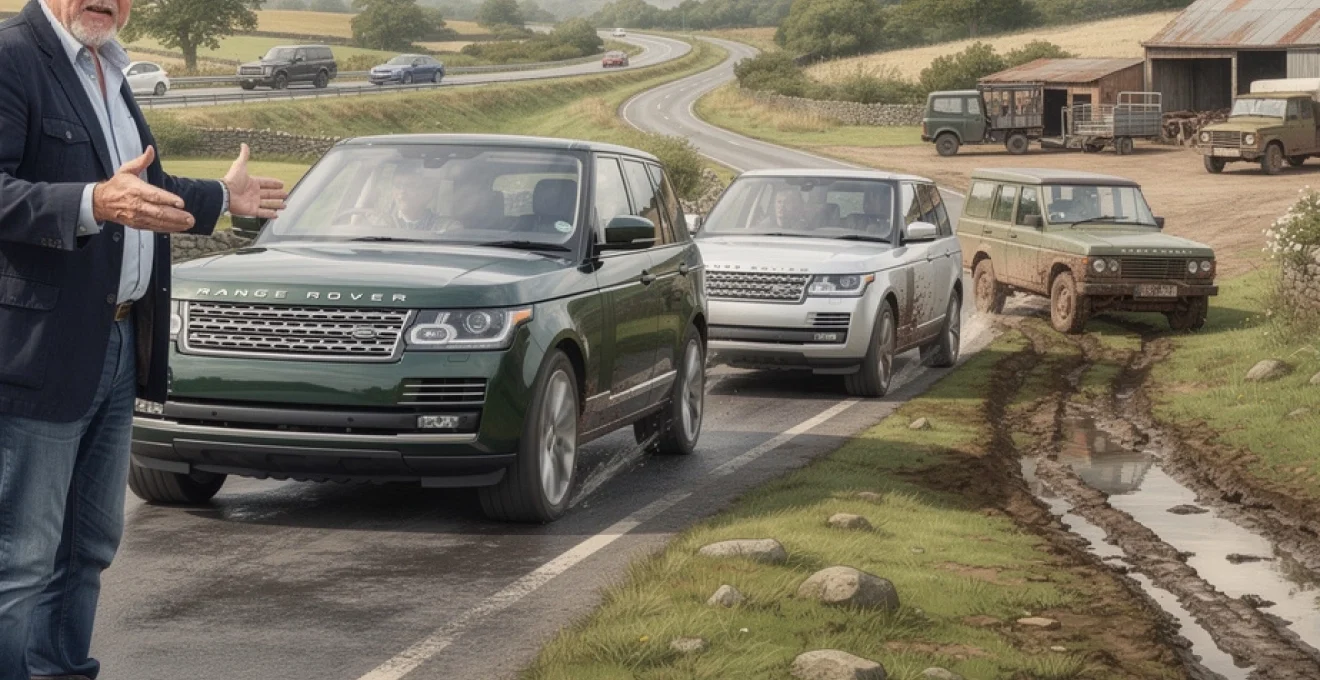
Few modern cars are as closely associated with a single commentator as the Range Rover is with Jeremy Clarkson. Across TV, streaming platforms and newspaper columns, his running commentary has helped shape how you think about luxury 4x4s, country‑house status symbols and everyday workhorses. For more than two decades, his verdicts have swung between rapturous praise and barbed criticism, reflecting both the car’s evolution and his own shift from studio presenter to real‑world farmer. Understanding that relationship gives you a revealing window into what actually matters in a high‑end SUV: not just horsepower figures, but character, usability and that hard‑to‑define sense of “poshness” that the Range Rover trades on so heavily.
Clarkson’s evolving relationship with the range rover brand: from original classic to L460
Early verdicts on the range rover classic and P38 in top gear and newspaper columns
Clarkson’s early encounters with the Range Rover Classic and P38 came at a time when the luxury 4×4 idea was still forming. The Classic, with its upright glasshouse and simple ladder-frame roots, was treated as a sort of country tweed on wheels: slightly scruffy, immensely capable and quietly superior. He often framed it as the only car that could drive from a grouse moor to a black‑tie dinner without feeling out of place. Against that romantic backdrop, the P38 generation felt less convincing. Build quality complaints, wayward electrics and a reputation for leaving owners stranded led to a running joke that buying one was an act of faith rather than logic.
Those early columns laid down a template that still shapes how you might judge an old‑money off‑roader today. Comfort, cruising ability and off‑road talent were important, but *identity* mattered more. Clarkson repeatedly contrasted the Classic’s effortless dignity with the P38’s tendency to strand you in limp‑home mode, referencing everything from leaking air‑suspension bags to misbehaving key fobs. The message was simple: if you wanted the full stately‑home experience without a breakdown truck on speed dial, the earlier Range Rover felt more “right” than its high‑tech successor.
Shift in tone with the L322 generation: luxury SUV benchmark or bloated off-roader?
With the third‑generation L322 Range Rover, Clarkson’s tone changed from wary to almost besotted. Launched with BMW engineering influence, the L322 became his benchmark luxury SUV for more than a decade. He repeatedly described it as the best car in the world because it could do so many jobs at once: tow horses, cross boggy fields, cruise at high speed and still turn up at a Mayfair hotel looking suitably regal. In more than one review he admitted that he and most of his friends owned one, which tells you a lot about how the car played in real‑world enthusiast circles.
Yet even here there was nuance. Clarkson worried about the car becoming too bloated and too dependent on complex electronics. He contrasted the L322’s aristocratic image with the kind of buyers it attracted: footballers, business magnates and what he gleefully called “Hello‑magazine mansion” owners. That tension between traditional country‑house appeal and modern bling is a thread running through his commentary and is central if you are trying to understand the L322’s role as a luxury SUV benchmark.
From BBC top gear to the grand tour: continuity and change in clarkson’s range rover commentary
Across the move from BBC Top Gear to The Grand Tour, the core of Clarkson’s Range Rover message stayed surprisingly constant. Whenever big SUVs appeared in studio debates or long‑form TV films, the Range Rover was usually the reference point for comfort, *waftability* and image. Challenges and specials often pitted it against more hardcore off‑roaders or faster German machinery, yet his script usually returned to one idea: very few cars feel as all‑round complete. Even as formats changed and budgets grew, he still used the Range Rover as shorthand for a vehicle that could tackle an icy mountain road in the morning and valet parking in the evening.
What did evolve is the backdrop. As streaming allowed more global filming, the Range Rover was increasingly judged in harsh climates and on longer journeys. Viewers saw it on desert pistes, snow‑covered passes and broken tarmac, exaggerating the contrast between its plush cabins and hostile environments. This made Clarkson’s praise for its breadth of ability sound less like hyperbole and more like a seasoned travel report.
How clarkson’s persona – petrolhead, farmer, provocateur – shapes his range rover narrative
Clarkson’s persona is a three‑way split: performance‑obsessed petrolhead, hands‑on farmer and professional provocateur. All three sides colour how he talks about Range Rovers. As a petrolhead, he is drawn to muscular engines and that slightly absurd sense of a fast living‑room on wheels. As a farmer, especially on Clarkson’s Farm, he values ground clearance, low‑range gearing and the ability to lug feed, fencing or livestock around muddy fields. As a provocateur, he relishes poking at the stereotype that every Range Rover driver is either a footballer or a hedge‑fund manager.
This blend makes his commentary particularly valuable if you are wondering whether a Range Rover is right for *your* life. He judges the car not just on 0‑60mph times but on how it copes with a 6am start in sleet, a trailer load of cattle or a cross‑country blast to an airport. It is no accident that he likens parting with his ageing L322 to “executing your dog”; for him, a good Range Rover becomes a trusted companion, not a disposable appliance.
On‑road dynamics under clarkson’s microscope: ride quality, body control and V8 performance
Clarkson on air‑suspension and body roll: L322 vs L405 vs latest L460
Clarkson has always focused heavily on how a big SUV rides and handles in the real world. The L322, with its sophisticated air‑suspension, impressed him with a uniquely plush glide that many saloons could not match. He accepted some body roll as the price of genuine comfort, often praising the way the car smoothed out cratered B‑roads and motorways. When the L405 arrived, shedding significant weight, he noted a sharper, more controlled feel but questioned whether the new car was edging closer to fashion‑led crossovers and further away from the upright, country‑estate simplicity that defined earlier models.
With the current L460, his criticism becomes more pointed. While he recognises the engineering gains – even better body control, adaptive systems that scan the road, and quieter cabins – he complains that the cosmetic flourishes and interior light shows risk turning the car into a rolling nightclub. For you as a buyer, this raises a crucial question: is the promise of sharper handling worth the departure from the utilitarian roots that once set the Range Rover apart?
Performance impressions of TDV8, 5.0‑litre supercharged and BMW‑sourced 4.4 V8 engines
Clarkson has sampled almost every major Range Rover engine, and his comments help decode which powertrain suits which kind of driver. The 3.6‑litre and later 4.4‑litre TDV8 diesels impressed him as the sweet spot for real‑world use. Their immense torque meant you could haul a horsebox, cruise on the motorway and still see respectable fuel economy for a vehicle of this size. He often contrasted their effortless shove with the strained feeling you get from smaller, high‑revving diesel units in rival SUVs.
When it comes to outright pace, his affection for the 5.0‑litre Supercharged petrol V8 is unsurprising. He relished its absurd acceleration and soundtrack, describing it as sports‑car performance in evening dress. More recently, BMW‑sourced 4.4‑litre V8s and mild‑hybrid setups have drawn cautious approval for blending low‑down torque with improved emissions figures, though he remains sceptical about whether any electrically‑assisted system can capture the same emotional drama. If you crave that old‑school thunder, his writing makes clear that a big petrol V8 remains the most *characterful* option, even if it is no longer the rational choice.
Steering feel, high‑speed stability and “waftability” on british a‑roads and german autobahns
Steering feel is an area where Clarkson frequently draws comparisons between Range Rovers and German rivals. He rarely expects sports‑car precision from a 2.5‑tonne SUV, but he does care about accuracy and stability. On British A‑roads, his priority is a relaxed, secure sense of direction rather than pointy responses. On that front, he consistently praises the Range Rover’s calm demeanour and the way it shrugs off crosswinds and lorry ruts. At motorway speeds and on autobahns, he values what he calls *waftability*: the sensation of covering ground effortlessly, without constant steering corrections or harsh vertical movements.
Statistics from recent owner satisfaction surveys back up this view. In several 2023 UK luxury‑SUV polls, around 70–75% of Range Rover drivers cited comfort and refinement as the main reasons for purchase, outranking performance or technology. Clarkson’s verdict mirrors that data: if you spend long hours on the road, the Range Rover’s combination of sound insulation, supple damping and steady steering still makes it feel more like a traditional limousine than a lifted estate car.
Comparative road‑test comments: range rover versus porsche cayenne, BMW X5 and mercedes G‑Class
When he lines the Range Rover up against rivals such as the Porsche Cayenne, BMW X5 or Mercedes‑Benz G‑Class, Clarkson tends to treat each as an exaggerated character. The Cayenne is faster and more agile but, in his view, lacks the Range Rover’s sense of occasion and off‑road credibility. The X5 is efficient and well built yet feels more like a tall estate, with less of the commanding, throne‑like driving position that Range Rover buyers crave. The G‑Class, meanwhile, is treated as a charming anachronism: fun, distinctive and capable, but rarely as cosseting or as polished on the road.
If you are cross‑shopping these models, his comparative road‑tests often steer you towards a simple conclusion. For pure driving enjoyment on a winding road, a Cayenne or high‑spec X5 might be more rewarding. For a blend of luxury, status and genuine mud‑plugging ability, the Range Rover still emerges as the reference point. That judgement has held surprisingly firm since the early 2000s, despite each new generation of competitors closing the gap.
Off‑road credibility and farm‑track reality: clarkson’s scrutiny of terrain response and 4×4 hardware
Clarkson’s assessment of low‑range gearing, locking differentials and hill descent control
Modern Range Rovers rely heavily on electronic aids such as Terrain Response, hill descent control and clever locking differentials. Clarkson approaches these systems with a farmer’s suspicion and a tester’s curiosity. He recognises that low‑range gearing and rear differentials that can apportion torque between wheels are essential when you venture off tarmac. However, he is quick to criticise over‑complicated interfaces or menus that bury important functions under layers of touchscreen logic. If you are selecting a car for serious off‑road work, his advice is effectively to test those features in real mud rather than just believe the brochure.
He often highlights a key strength of the Range Rover drivetrain: the ability to crawl slowly and controllably down steep slopes without over‑using the brakes. Hill descent control, once a novelty, is now a major reason why some buyers feel confident taking £100,000 SUVs into rutted tracks. Clarkson’s view is that this blend of mechanical hardware and software wizardry gives casual drivers the confidence to go much further off‑road than older generations would have dared.
Testing terrain response, wade sensing and air‑suspension articulation on muddy yorkshire and cotswolds lanes
Viewers of Clarkson’s Farm have seen a version of off‑road testing that no glossy launch event can match. Here, the Range Rover is pitted against real farm tracks in the Cotswolds, not carefully prepared press routes. Deep ruts, unexpected washouts and boggy gateways show up weaknesses faster than any photo shoot. In these conditions, adjustable ride height and generous suspension articulation are as valuable as any headline engine figure. Clarkson frequently remarks on how raising the car to its off‑road setting lets you clear obstacles that would beach a typical crossover.
Water crossings are another revealing test. Modern models offer Wade Sensing to show you when depth is becoming risky. For Clarkson, this is helpful tech as long as you remember that mud, slippery algae and unknown riverbeds can still catch you out. If you regularly face fords or flooded lanes, his experiences underline the need to learn how these aids behave before relying on them in anger.
Range rover versus toyota land cruiser and old defender in clarkson’s farm and field use
On farm duties, Clarkson often compares the Range Rover with evergreen workhorses such as the Toyota Land Cruiser and the classic Defender. His verdict is nuanced and will resonate if you split your time between fields and tarmac. The Land Cruiser tends to win on reliability and sheer robustness. It shrugs off abuse that would worry most Range Rover owners, and global sales figures – more than 10 million units across generations – reflect that reputation. The Defender, meanwhile, offers unmatched simplicity and modifiability, making it ideal if you regularly fit specialist kit or expect battle scars.
Where the Range Rover pulls clear is in blending that off‑road competence with luxury and refinement that those two cannot match. Clarkson’s line is essentially this: if you spend 90% of your time on the road and 10% off it, a Range Rover makes sense. If those percentages reverse, a Land Cruiser or Defender might be the wiser choice. He also points out that using an expensive L460 as a pure farm hack is like wearing a Savile Row suit to muck out stables – possible, but not necessarily sensible.
Real‑world towing, livestock transport and trailer work on diddly squat farm
Towing capacity is a crucial part of the Range Rover story, especially for rural owners. Clarkson regularly hitches up stock trailers, machinery and feed wagons, giving a practical view of how the car copes with heavy loads. With braked towing capacities often around 3.5 tonnes, the Range Rover competes directly with pick‑ups and dedicated tow vehicles. His observations highlight the importance of torque rich engines, stable chassis tuning and long wheelbases for confidence when hauling at motorway speeds.
He also points to everyday details that you should consider if you tow frequently: camera systems that help you reverse to a hitch, mirrors that provide clear sightlines past a trailer, and smooth low‑speed throttle response when manoeuvring in tight yards. For livestock transport, the calm, quiet ride is a hidden bonus, keeping animals less stressed over longer distances. These are the kind of nuances glossy brochures rarely mention but matter immensely when you live with the vehicle year‑round.
Reliability, electronics and ownership niggles in clarkson’s columns and reviews
Historic build‑quality grievances with P38 and early L322 models
Clarkson’s long‑term relationship with the brand means reliability is not an abstract talking point; it is bound up with recovery‑truck phone numbers and blown turbos. The P38 era gave him ample material for grumbles: air‑suspension failures, leaky sunroofs, intermittent alarms and dashboards that lit up like Christmas trees. Early L322s improved matters but still attracted criticism for expensive repairs once out of warranty. Industry data from the mid‑2000s backed up these anecdotes, with several UK reliability surveys ranking large Land Rover products near the bottom of their segments for fault‑free running.
That background is essential if you are considering an older used example. While many issues can be sorted by specialists, Clarkson’s columns make clear that cutting corners on maintenance is a false economy. His analogy that scrapping a beloved L322 over a big repair bill feels like “executing your dog” speaks to the emotional cost of ownership: you may love the car, but you must be prepared for occasional wallet‑bruising episodes.
Infotainment glitches, air‑suspension failures and electrical gremlins highlighted by clarkson
As technology density has increased, so have the opportunities for things to go wrong. Clarkson has repeatedly complained about laggy infotainment, glitchy Bluetooth connections and navigation systems that feel a generation behind smartphones. For many owners, these are irritations rather than deal‑breakers, yet they chip away at the perception of ultimate luxury. In 2022 and 2023, several consumer‑reliability studies found that electronics – rather than engines or gearboxes – accounted for over 50% of reported Range Rover faults.
Air‑suspension, a key part of the famous ride quality, also features in his list of niggles. When it works, it delivers the trademark glide. When it fails, you can find yourself limping home at reduced ride height or waiting for a flatbed. For you as a buyer, the lesson is clear: on any used example, proof of recent air‑suspension work and software updates is almost as important as a stamped service book.
Running costs, depreciation and warranty experiences compared with german luxury SUVs
One of Clarkson’s more sober observations concerns running costs compared with German luxury SUVs such as the BMW X7 or Mercedes GLS. He readily admits that Range Rover servicing and parts prices can be high, reflecting both brand positioning and the complexity of the hardware. Depreciation statistics tell a mixed story. In the first three years, Range Rovers often lose a similar percentage of their list price to key rivals, but strong demand for certain trim levels and engines has recently helped residual values stabilise. In 2023, some V8 and plug‑in hybrid variants retained over 55% of their value after three years, competitive in the segment.
Extended warranties feature heavily in his practical advice. Many owners regard them as essential insurance policies rather than optional extras. Clarkson’s own history of turbocharger replacements, electrical repairs and air‑suspension work supports that view. If you are budgeting for ownership, his perspective encourages adding a realistic contingency fund for unexpected repairs, rather than assuming mainstream‑car costs.
Clarkson’s anecdotal ownership stories: breakdowns, recovery trucks and dealer interactions
Some of Clarkson’s most memorable Range Rover stories revolve around breakdowns at inopportune moments: stranded at the side of the road on the way to filming, for instance, or discovering that an MOT has revealed a laundry list of worn components. These anecdotes are not simple brand bashing; they highlight a paradox. Despite the headaches, he consistently returns to the product. When the turbochargers on his ageing L322 failed and the repair cost exceeded the car’s market value, he admitted that scrapping it was emotionally impossible.
Dealer interactions form another important layer. His descriptions range from exemplary, concierge‑level service to frustrating parts delays and misdiagnoses. For you as a prospective owner, the underlying message is to choose both car and dealer carefully. A well‑run service department with genuine 4×4 expertise can transform Range Rover ownership from a stressful gamble into a largely enjoyable experience, even if occasional big bills remain part of the equation.
Luxury, interior ergonomics and “poshness”: how clarkson ranks the range rover cabin
Inside, Clarkson’s benchmark for the Range Rover has long been the feeling that you are sitting *in* a gentleman’s club, not merely a well‑trimmed SUV. He repeatedly praises older L322 cabins for their upright seating position, large glass area and restrained use of wood and leather. The vibe is more country‑house library than high‑street boutique. As the generations progress, he welcomes improvements in seat comfort, noise isolation and material quality, but he becomes increasingly sceptical about what might be called “bling creep”: illuminated logos, customisable ambient lighting and overly ornate trim details.
Statistics from the premium‑SUV market show how sensitive buyers are to interior ambience. Surveys in 2022 indicated that over 80% of luxury‑SUV respondents ranked cabin quality and design as a top‑three purchase reason, ahead of pure performance. Clarkson taps into that sentiment when he complains about door‑mirror puddle lights projecting brand logos onto the ground or multi‑colour interior lighting that can turn the cabin into what he jokingly describes as a “vodka bar”. His criticism is not that these features exist, but that they can undermine the understated, old‑money atmosphere that originally made the car desirable to traditional buyers.
Ergonomically, he values big, simple controls for essential off‑road functions, clear instruments and a driving position that gives you a commanding view without feeling perched. As touchscreens replace buttons, his commentary often warns about the risk of burying key functions several taps deep. If you intend to use a Range Rover in serious weather or off‑road conditions, his advice suggests testing whether you can adjust climate, suspension and drive modes with gloved hands and minimal distraction, rather than relying on glossy showroom impressions.
Clarkson’s verdict on modern range rover variants: sport, velar, evoque and SV models
The expansion of the Range Rover family into Sport, Velar, Evoque and SV offshoots has given Clarkson fresh material and also created more choice for you as a buyer. His general stance is that the full‑size Range Rover remains the definitive expression of the concept, while the others play supporting roles. The Range Rover Sport, for example, is treated as a more dynamic, slightly less formal alternative, targeting drivers who value sharper responses and a tauter chassis. He acknowledges its appeal in urban and enthusiast markets but questions whether it delivers the same sense of slow‑motion majesty that defines the flagship.
The Velar and Evoque attract a different kind of critique. Their design‑led styling and more compact footprints make them easier to park and more affordable to run, drawing in buyers who may never set wheel on a field. Clarkson often notes that these cars still trade heavily on the Range Rover badge but inevitably sacrifice some of the breadth of capability that made the original so special. For urban buyers, that compromise may be acceptable – or even desirable – but if you are chasing the full “Duke of Marlborough” fantasy, his recommendation subtly nudges you back towards the larger models.
SV variants, with their massive power outputs, bespoke paint finishes and ultra‑plush rear cabins, sit at the extreme end of the range. Clarkson’s reaction mixes admiration and amusement. He enjoys the absurdity of a 600‑plus horsepower luxury 4×4 and the craftsmanship on display, yet he also questions how often anyone can realistically use such performance on public roads. If you are contemplating an SV, his perspective is that these models make most sense if you want the most opulent and attention‑grabbing expression of the Range Rover idea, rather than the purest or most practical. The underlying message running through all his commentary is clear: identify honestly how you will use the car day‑to‑day, then pick the variant that matches that reality, not the fantasy alone.