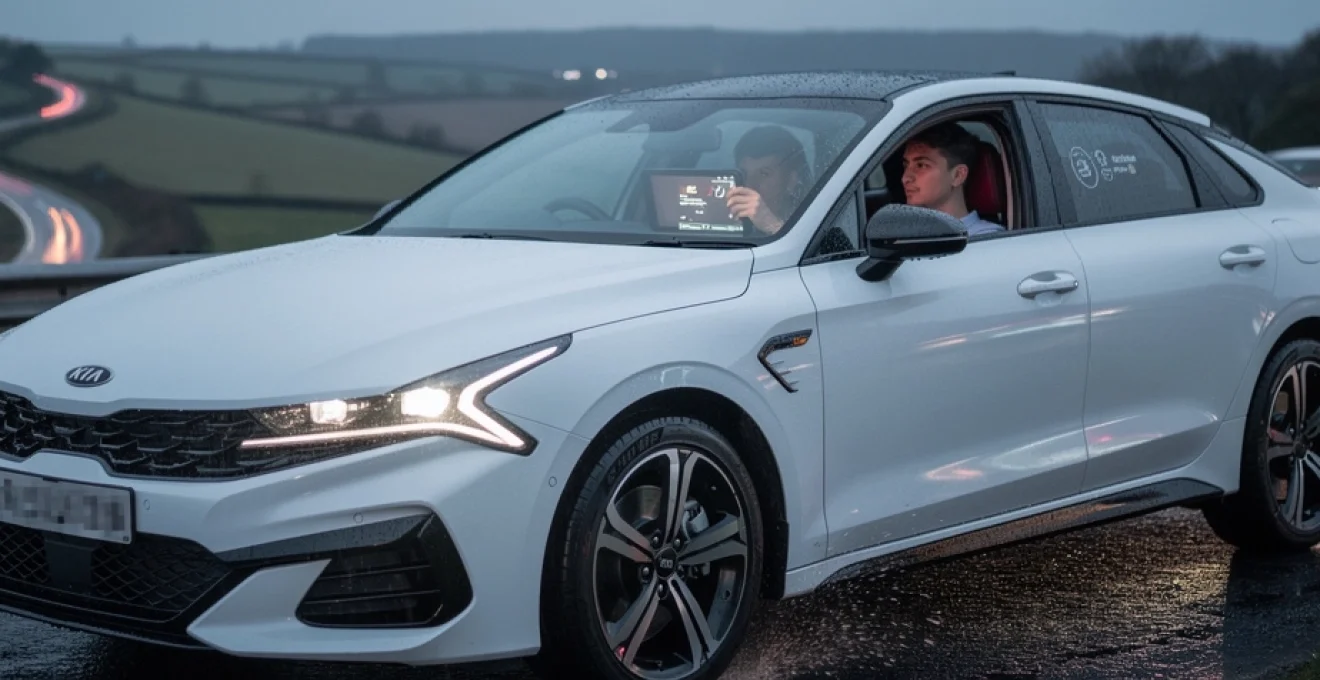
The Kia K5 GT-Line targets drivers who want a genuinely stylish, well-equipped family saloon without paying premium-brand prices or sacrificing everyday comfort. While the full-fat K5 GT grabs headlines with its 290 bhp 2.5‑litre turbo, the GT‑Line quietly hits the sweet spot between efficiency, performance and value. If you like the idea of a sleek fastback-style sedan that looks like a junior sports saloon yet behaves like a relaxed long‑distance cruiser, the GT‑Line deserves close attention. The combination of punchy 1.6‑litre turbo power, generous standard kit and sophisticated chassis tuning makes this mid-size Kia a compelling alternative to more established rivals.
Kia K5 GT-Line overview: UK market positioning, rivals and trim hierarchy
The Kia K5 GT-Line sits near the top of the K5 range, effectively as the “warm” version that borrows styling cues from the K5 GT while retaining the more modest powertrain shared with entry trims. In markets where the K5 replaces the Optima, the GT‑Line functions as the bridge between sensible fleet favourite and enthusiast‑orientated flagship. Prices sit comfortably below equivalent Honda Accord Sport, Toyota Camry SE and Hyundai Sonata N Line models, giving you a strong value proposition without feeling like a budget compromise.
Rival mid-size family saloons generally follow the same template: turbocharged four‑cylinder engine, front‑wheel drive, automatic gearbox and a safety pack full of ADAS features. The K5 GT-Line differentiates itself with particularly bold design, a high‑quality interior ambience and an options structure that makes it easy to spec desirable features such as a panoramic roof, heated steering wheel and Highway Driving Assist without ballooning the price. In some markets, the GT‑Line is also the entry point to all‑wheel drive, something that broadens its appeal for drivers facing wet, cold or occasionally snowy conditions.
Within the trim hierarchy, the K5 LXS and EX (or equivalent base trims) provide more conservative styling and smaller wheels, focusing on efficiency and comfort. The GT‑Line overlays a sportier body kit, 18‑inch alloys, upgraded interior materials and extra technology. Above it sits the K5 GT, which swaps in the 2.5‑litre 290 bhp engine, 8‑speed dual‑clutch gearbox, larger brakes and stiffer suspension, but remains front‑wheel drive only. That makes the GT‑Line the more rounded choice for many drivers who value everyday drivability and running costs as much as raw speed.
1.6‑litre turbocharged performance: real‑world acceleration, in‑gear response and motorway refinement
Smartstream 1.6 T‑GDi powertrain: turbocharger behaviour, torque curve and fuel mapping
Under the bonnet, the Kia K5 GT-Line uses the 1.6‑litre Smartstream 1.6 T‑GDi petrol engine, a turbocharged four‑cylinder that produces around 180 bhp and 195 lb ft of torque. Power figures may not sound dramatic on paper, especially when compared with the K5 GT’s 290 bhp 2.5‑litre unit, yet the delivery is carefully tuned for real‑world drivability. Peak torque arrives low in the rev range, helping the K5 pull strongly from modest speeds without requiring a downshift every time you flex your right foot.
The turbocharger uses modern low‑inertia hardware and smart wastegate control to minimise lag. Around town, response feels brisk rather than explosive, with a smooth swell of torque that suits relaxed driving. Fuel mapping prioritises efficiency in gentle use, with official EPA figures of up to 28 mpg combined for all‑wheel‑drive GT-Line models and over 30 mpg for front‑wheel‑drive versions. On steady motorway runs, 33–37 mpg is realistic with a measured throttle, which places the K5 GT-Line competitively against the latest Honda Accord and Toyota Camry four‑cylinder petrols.
The Smartstream 1.6‑litre turbo focuses on accessible torque and efficiency rather than headline power outputs, delivering a flexible, real‑world powerband that suits everyday commuting and long‑distance touring.
Eight‑speed automatic transmission calibration: shift logic, drive modes and manual override
Power is channelled through an eight‑speed automatic transmission, rather than a CVT, which already gives the K5 GT-Line a more engaging and natural feel. Shift calibration is impressively smooth; in normal driving the gearbox fades into the background, shuffling ratios unobtrusively to keep revs low and refinement high. Selectable drive modes adjust the shift logic: in Eco the transmission upshifts early to maximise fuel economy, while in Sport it holds lower gears longer and responds more keenly to throttle inputs.
Manual override via the steering‑wheel paddles offers extra control when you want to prepare for an overtake or enjoy a twisty B‑road. Response is not dual‑clutch fast, but quick enough for the GT-Line’s character. Downshifts are well‑timed and the gearbox rarely feels caught out. Under heavy acceleration, kickdown is decisive, with the engine quickly landing in the meat of its torque band. Compared to some rival 8‑speed autos that can hunt around for gears, the GT-Line’s calibration feels intuitive and predictable.
0–60 mph and 30–70 mph figures: kia K5 GT-Line vs honda accord sport, hyundai sonata N line and toyota camry SE
Independent testing places the K5 GT-Line’s 0–60 mph time in the mid‑7‑second range, depending on drivetrain configuration and wheel choice. That is brisk enough for confident motorway on‑ramps and short slip roads, even if it will not trouble the 5.2‑second K5 GT or the similarly rapid Hyundai Sonata N Line. In‑gear acceleration, such as 30–70 mph, matters more in typical UK conditions, and here the broad torque plateau helps the K5 feel lively when overtaking slower traffic.
Compared with key rivals, the K5 GT-Line keeps pace with the Honda Accord Sport 1.5T and Toyota Camry SE 2.5 in most real‑world scenarios, even if the stopwatch sometimes favours them by a few tenths. The Sonata N Line, with more than 290 bhp, sits in a different performance class, much closer to the K5 GT. What you gain with the GT‑Line is a calmer, less frenetic character and better fuel consumption, attributes that matter over years of commuting and family trips.
| Model | Engine | Power | 0–60 mph (approx.) |
|---|---|---|---|
| Kia K5 GT-Line | 1.6 T‑GDi | ≈ 180 bhp | ≈ 7.5 s |
| Kia K5 GT | 2.5 T‑GDi | 290 bhp | 5.2 s |
| Hyundai Sonata N Line | 2.5 T‑GDi | 290 bhp | 5.0 s |
| Honda Accord Sport | 1.5T | ≈ 190 bhp | ≈ 7.3 s |
| Toyota Camry SE | 2.5 NA | ≈ 203 bhp | ≈ 7.6 s |
Motorway cruising and overtaking performance: kickdown response, NVH and long‑distance drivability
On the motorway, the Kia K5 GT-Line settles into an easy rhythm. At 70 mph, the engine spins at modest revs in top gear, reducing noise, vibration and harshness (NVH). Wind noise is impressively well controlled for the class, and road roar from the 18‑inch tyres is audible but never intrusive. For long‑distance drivers, this refinement level adds up to reduced fatigue, especially when combined with supportive seats and an intuitive driving position.
Overtaking performance is more than adequate. A firm prod of the throttle triggers swift kickdown, dropping one or two gears and unlocking that 195 lb ft of torque. From 50–70 mph the GT‑Line accelerates with enough urgency to dispatch lorries and slower traffic safely without feeling strained. If you regularly undertake fully‑loaded motorway journeys, this blend of moderate performance and strong refinement is likely to be more satisfying than a higher‑revving naturally aspirated alternative.
Urban stop‑start behaviour: low‑speed throttle modulation, creep control and traffic usability
In urban driving, the 1.6‑litre turbocharged engine behaves predictably and smoothly. The throttle pedal is calibrated to avoid the “on/off” feel that sometimes plagues small turbo motors. That makes it easier for you to modulate acceleration in stop‑start traffic, easing away from junctions without jerky inputs. Turbo lag is well‑suppressed at low revs, and the gearbox’s creep function mirrors the natural behaviour of a traditional torque‑converter auto, allowing gentle inching forward in queues.
For city users, this drivability matters more than outright pace. Parking manoeuvres are simple thanks to light steering at low speeds and a tidy turning circle for a mid-size saloon. The engine’s automatic stop‑start system engages smoothly when conditions allow, helping save fuel in congestion. If you commute daily through dense traffic, the K5 GT-Line proves to be a calm, predictable companion rather than a fussy, over‑eager pseudo‑sports saloon.
Chassis dynamics: suspension tuning, steering feel and GT-Line handling characteristics
Macpherson strut and multi‑link rear setup: spring rates, damping and roll control in the GT-Line
The K5 GT-Line uses a familiar MacPherson strut front and multi‑link rear suspension architecture, but the tuning is subtly sportier than lower trims. Spring and damper rates aim for a slightly firmer baseline, improving body control through quick direction changes and roundabouts. Roll is present but well managed; you always have a sense of what the chassis is doing without the float or wallow sometimes found in softer set‑ups.
Over undulating UK B‑roads, the GT‑Line feels secure and composed. The car settles quickly after crests and compressions, maintaining stability even when you encounter mid‑corner bumps. For a 5‑seat family saloon with a 112‑inch wheelbase, the agility is impressive. If you enjoy a spirited drive now and then, the chassis will happily oblige without sacrificing the calm character expected in daily use.
Electric power steering mapping: on‑centre feel, lane‑change precision and high‑speed stability
The electric power steering system in the K5 GT-Line prioritises lightness in town and a weightier, more reassuring feel at speed. On‑centre, the rack is stable and predictable, helping the car track straight on motorways with minimal correction. Lane changes are executed with confidence‑inspiring precision; initial response is quick enough to feel alert but not darty, suiting the car’s grand‑touring aspirations.
Feedback through the wheel is not as rich as a hydraulic system, but in the context of mid-size front‑wheel‑drive saloons, it is one of the more engaging set‑ups. In Sport mode the steering weight increases slightly, which some drivers will appreciate when pressing on. The mapping also works hand‑in‑hand with lane‑keeping assist and Highway Driving Assist to reduce driver workload on long journeys.
Grip and balance: 18‑inch alloy wheels, tyre compound choices and wet‑weather stability control
The GT-Line rides on 18‑inch alloy wheels shod with performance‑orientated all‑season rubber, often Pirelli P Zero all‑season in the 235/45 R18 size. Grip levels are strong for the segment, and the balance under load is gently understeer‑biased, keeping responses predictable if you over‑commit into a bend. Electronic stability control intervenes progressively, trimming power and applying selective braking rather than abruptly cutting in.
In wet conditions, the combination of wide tyres, well‑tuned traction control and, where fitted, all‑wheel drive provides reassuring stability. Wheelspin is rare unless you provoke it aggressively from a standstill. For typical UK weather—rain, greasy surfaces and occasional standing water—the GT‑Line’s tyre and stability control set‑up provides a good blend of safety and driver confidence.
Brake hardware and pedal modulation: fade resistance and emergency stop performance
Braking hardware on the K5 GT-Line is more modest than the larger discs found on the full GT, yet more than adequate for its performance. Pedal feel is progressive, with a well‑judged initial bite followed by linear response as you push harder. In everyday driving, that makes smooth stops easier to execute, particularly with passengers on board.
Emergency stop performance is strong, with controlled nose‑dive and stable behaviour even under maximum ABS intervention. Repeated heavy braking on a spirited B‑road drive does not quickly lead to fade, thanks to decent cooling and the car’s relatively modest kerb weight of around 1,550–1,600 kg. For family use and occasional enthusiastic driving, the brakes inspire confidence.
Ride comfort vs sportiness: UK b‑road compliance, pothole absorption and body control
Balancing ride comfort and sportiness is a core challenge for any GT‑badged trim. The K5 GT-Line leans towards the firmer end of the comfort spectrum but remains more compliant than many so‑called “sport” saloons. Sharp-edged potholes and expansion joints are felt, particularly at low speed, yet the suspension generally rounds off impacts rather than sending a harsh thud through the cabin.
At higher speeds, the ride smooths out, and the long wheelbase helps iron out surface imperfections. On broken B‑roads, body control is good enough that the car does not feel unsettled by patchy tarmac or mid‑corner bumps. If you are used to a softly sprung crossover, the GT‑Line might feel a touch firmer; if you are stepping out of an older hot hatch, it will likely feel remarkably sophisticated and grown‑up.
The GT-Line’s chassis behaves like a well-tailored suit: neat, supportive and flattering, without the stiffness of full track‑day attire.
Exterior design and aerodynamics: GT-Line body kit, lighting technology and drag efficiency
Tiger nose grille, fastback roofline and GT-Line specific bumpers: visual identity and airflow management
One of the Kia K5 GT-Line’s biggest assets is its exterior design. The latest interpretation of Kia’s Tiger Nose grille stretches across the front fascia, flanked by dramatic “Heartbeat” LED running lights that give the car a distinctive signature. GT‑Line specific bumpers feature larger air intakes, gloss‑black detailing and a rear diffuser‑style lower section, visually referencing the full K5 GT without over‑promising on performance.
The fastback‑style roofline and sweeping chrome window trim lend the K5 a coupé‑like silhouette. This is more than just styling theatre; the smooth roof and carefully sculpted bootlid help manage airflow, reducing turbulence at the rear and contributing to a competitive drag coefficient. Compared with more upright mid-size saloons, the K5 slices through the air with less resistance, which aids both fuel economy and refinement.
LED reflector headlamps, “heartbeat” DRLs and visibility performance in low‑light conditions
Visibility is an important safety and comfort factor, and the K5 GT-Line’s LED reflector headlamps perform well in low‑light and poor‑weather conditions. Beam pattern is broad and even, with good illumination of verges and road signs without excessive glare for oncoming traffic. Automatic high‑beam assist is standard on many GT‑Line cars, further enhancing visibility on rural roads by seamlessly toggling between dipped and main beam.
The distinctive “Heartbeat” daytime running lights not only contribute to the car’s visual drama but also enhance daytime conspicuity, helping other road users spot you sooner. In real‑world night driving, the lighting package feels closer to premium‑segment performance than the K5’s price tag would suggest.
18‑inch GT-Line alloys, tyre sizes and aero influence on fuel economy
The multi‑spoke 18‑inch GT-Line alloys play a role in both aesthetics and aerodynamics. While larger wheels usually increase rolling resistance compared with 16- or 17‑inch options, Kia has designed the GT‑Line’s rims to minimise aero drag where possible. Tyre dimensions of 235/45 R18 strike a balance between grip and efficiency; a slightly narrower or smaller wheel would yield marginally better economy, but at the expense of handling sharpness and stance.
Official figures suggest that stepping up from a lower‑trim K5 on smaller wheels costs only a couple of mpg on the combined cycle. For many buyers, the trade‑off in visual impact and cornering grip is well worth that small penalty. If your priority is maximising fuel economy over long motorway commutes, front‑wheel‑drive GT‑Line models with careful tyre choice offer the most efficient configuration.
Underbody panels, rear diffuser styling and drag coefficient performance vs kia K5 EX and LXS
Kia has worked on smoothing the K5’s underbody airflow using strategically placed panels and covers around the engine bay, floorpan and rear suspension. These elements, combined with the bootlid lip spoiler and diffuser‑style rear bumper, help reduce turbulence and drag. While official Cd figures vary slightly by trim and market, the K5 line generally posts numbers competitive with the latest Accord and Camry, contributing to the car’s strong high‑speed refinement and fuel economy.
Compared to more basic EX or LXS trims, the GT‑Line’s extra styling pieces are carefully integrated so as not to significantly disrupt aerodynamics. Unlike some aggressive body kits that add visual drama but increase drag, the K5 GT‑Line’s additions are more than mere ornament. The result is a family saloon that looks fast even when parked yet still behaves efficiently on the motorway.
Paint finishes, GT-Line badges and exterior option packages for UK and global markets
Paint choices play a subtle role in the K5 GT-Line’s character. Neutral metallics and pearlescent whites emphasise the sculpted bodywork, while bolder shades such as Wolf Grey or deep reds bring out the car’s sportier edge. GT‑Line badges on the front wings and bootlid, along with contrast gloss‑black mirror caps and window surrounds, reinforce the trim’s athletic identity without appearing gaudy.
Depending on market, exterior option packages may bundle features like the panoramic sunroof, black exterior pack, or additional chrome accents. The key is that even in base GT‑Line form, the car already looks “fully dressed”, so you are not forced into expensive upgrades simply to avoid a stripped‑out appearance. That makes the GT‑Line particularly attractive for image‑conscious buyers who still need a sensible family car.
Interior ergonomics and occupant comfort: GT-Line seats, cabin packaging and practicality
Step inside the Kia K5 GT-Line and the first impression is of a cabin that punches above its price point. The dashboard layout is clean and horizontally oriented, with a driver‑centric cockpit that subtly angles key controls towards you. GT‑Line models often feature eye‑catching red SynTex (synthetic leather) upholstery with embossed logos, adding a sporting flourish while remaining entirely vegan. Soft‑touch materials on the upper dash and door tops, plus tasteful metallic or wood‑effect trim, create an ambience that feels more “junior executive” than mid‑price family saloon.
The driving position is generally excellent, although some testers note that the seat sits slightly higher than in certain rivals even at its lowest setting. For many drivers this contributes to good forward visibility; taller enthusiasts who prefer a low, hunkered‑down feel might wish for a little more adjustment. The 10‑way power driver’s seat in GT‑Line trims includes lumbar support and heating, with ventilation available in higher‑spec packages. Bolstering is sportier than in lower trims but far from restrictive, offering a good compromise for both slim and broader‑shouldered occupants.
Rear space is generous, with plenty of legroom and adequate headroom for adults up to around 6 ft, though the fastback roofline can nibble into space for very tall passengers. ISOFIX anchor points on the outer rear seats make fitting child seats straightforward, and wide‑opening rear doors help with loading children or bulky items. The 16‑cubic‑foot boot is one of the largest in the segment, easily swallowing several suitcases or a week’s worth of shopping. When you fold the rear seats, the extended load space will comfortably accommodate bikes, flat‑pack furniture or DIY supplies, underscoring the K5’s versatility.
Practical storage solutions abound: large door bins, a lidded central cubby, a clever drop‑in wireless phone charging slot and extra compartments under the climate controls keep clutter under control. For daily life—school runs, commuting, weekends away—the K5 GT-Line feels thoughtfully designed around real people, not just brochure photography. If you value a cabin that looks special yet remains genuinely usable, this model hits a rare sweet spot.
Infotainment and connectivity: 10.25‑inch touchscreen, kia connect telematics and smartphone integration
The Kia K5 GT-Line continues Kia’s strong track record in in‑car technology. A 10.25‑inch touchscreen sits at the heart of the dashboard, often housed in a wide glass panel that visually links it with the digital or semi‑digital instrument cluster. The interface is clear, responsive and logically laid out, with attractive graphics lifted from newer Kia, Hyundai and Genesis products. Physical shortcut buttons and a separate climate control panel keep essential functions a single press away, so you are not buried in sub‑menus just to adjust temperature or volume.
Smartphone integration is well catered for through Apple CarPlay and Android Auto. In most GT‑Line configurations these are wired rather than wireless, but the connection is stable and mirrors core apps cleanly. A combination of USB‑A ports in both rows ensures passengers can keep devices charged, although the industry shift towards USB‑C means this is an area for future evolution. The standard wireless charging pad uses a vertical, drop‑in design that holds your phone securely, reducing the chance of intermittent contact over bumps.
Kia’s connected services platform, often branded Kia Connect or UVO depending on market, adds a layer of telematics functionality. Features can include live traffic routing, weather updates, parking information and remote vehicle functions via a smartphone app. For tech‑savvy drivers, being able to pre‑check fuel range, lock status or location from a phone becomes surprisingly addictive. Over‑the‑air map and software updates help keep the system current without an annual dealer visit, aligning the K5 with wider industry trends towards software‑defined vehicles.
For audio enthusiasts, the optional 12‑speaker Bose premium sound system is worth seeking out. It delivers a richer, more immersive soundstage than the standard setup, with clearer high frequencies and tighter bass. If you spend a lot of time in the car—long commutes, family road trips or solo night drives—a high‑quality audio system can transform the experience, turning the cabin into a rolling listening room rather than just a means of getting from A to B.
ADAS and safety technology: highway driving assist, forward Collision‑Avoidance assist and crash‑test performance
Active safety is a major selling point for the Kia K5 GT-Line. Standard driver assistance features typically include Forward Collision‑Avoidance Assist (FCA) with pedestrian detection, lane departure warning, lane keeping assist, automatic high beams and a rear seat reminder. The GT‑Line trim adds blind‑spot monitoring and rear cross‑traffic alert, technologies that significantly enhance situational awareness in multi‑lane traffic and busy car parks. For many buyers, these systems are now as important as raw crash‑test scores.
Opting for the Premium Package (or equivalent regional bundle) brings adaptive cruise control with stop‑and‑go functionality and Highway Driving Assist. This combination effectively offers Level 2 driver assistance: the system can control acceleration, braking and steering within a lane on motorways, while still requiring your hands on the wheel and full attention. Used properly, it reduces fatigue on longer journeys by smoothing out speed variations and micro‑corrections.
Highway Driving Assist is not a replacement for a fully engaged driver, but a sophisticated co‑pilot that helps manage routine tasks, leaving you fresher and more focused for complex situations.
Crash‑test performance from organisations such as the NHTSA and IIHS has been strong across the K5 range, with high scores in frontal, side and rollover tests and commendations for headlight performance and crash‑avoidance technology. Kia’s 5‑year/60,000‑mile basic warranty and 10‑year/100,000‑mile powertrain warranty (where offered) provide additional reassurance about long‑term durability and repair costs, particularly compared with some European rivals that offer shorter cover.
From a practical perspective, the best safety system is one that you actually use, and Kia’s implementation is user‑friendly. Menu structures make it easy to adjust sensitivity levels or temporarily disable certain alerts if you find them over‑zealous—for instance, the lane‑keeping system can be a little assertive on poorly marked or temporary road layouts. With sensible configuration, the K5 GT-Line surrounds you with a sophisticated safety net that supports rather than nags, making every journey—from school run to cross‑country trek—more relaxed and secure.