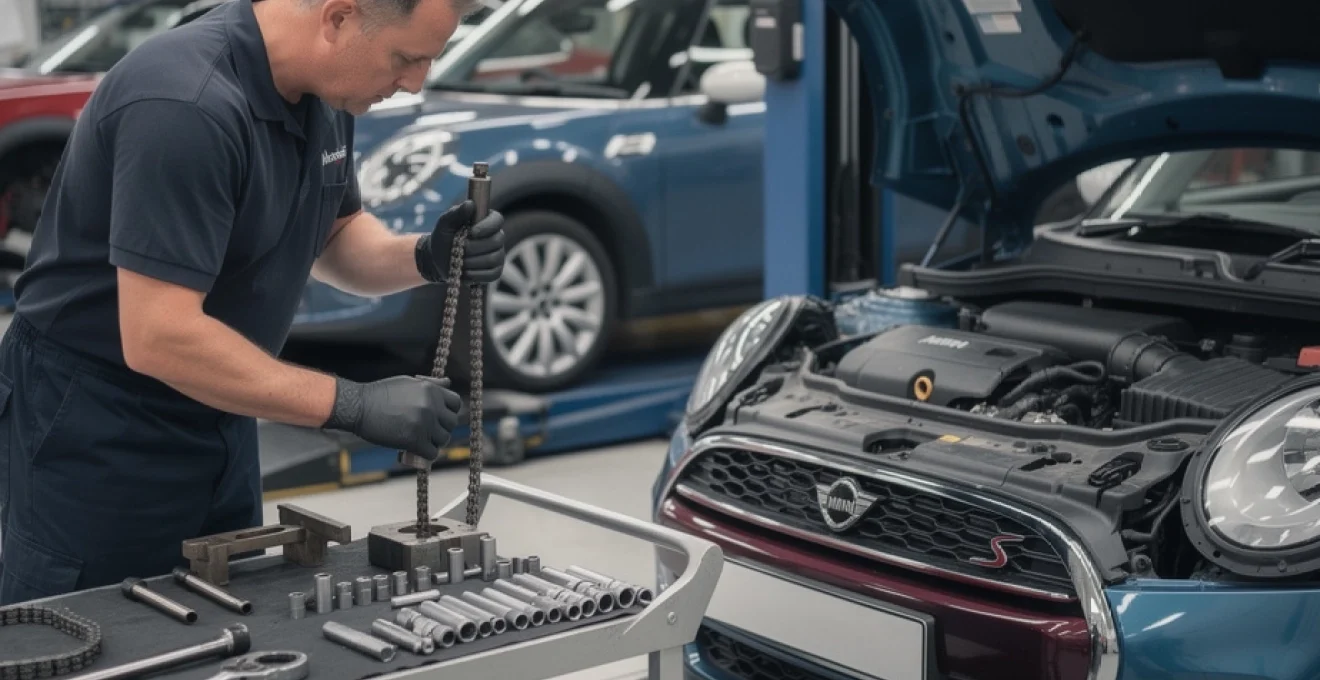
The timing chain on a Mini Cooper S is one of those components most owners never think about until a cold-start rattle suddenly makes the car sound like a diesel taxi. Once that “death rattle” appears, the question becomes very simple: how much is the timing chain replacement going to cost, and is the car still worth keeping? For UK Mini Cooper S owners, timing chain repairs have become a known talking point, especially on the R56 generation. Understanding realistic costs, what drives the price up or down, and how to avoid repeat failures can help you plan maintenance sensibly instead of gambling with a potentially ruined engine.
Costs vary dramatically depending on engine code, garage type and how early you catch the problem. Some owners pay under £600 at a good independent for a chain, guides and fresh oil; others face £1,300+ at a main dealer for a full kit including cam sprockets. Knowing where your Mini sits on that spectrum lets you decide whether to repair, upgrade, or walk away from a bad purchase.
Typical mini cooper S timing chain replacement cost in the UK (R56, R57, F56 models)
Average parts and labour cost breakdown for mini cooper S timing chain replacement
Most Mini Cooper S timing chain jobs in the UK fall between £550 and £1,300, depending on scope and who does the work. Industry labour data for a 1.6 Mini shows typical labour times of 4–5 hours, with independent garage estimates around £380–£420 and franchise dealer estimates around £790–£880 for chain replacement alone. When chain, guides, tensioner, sprocket and an oil service are combined, real-world quotes from Mini specialists often sit around £570–£650 including VAT.
That aligns closely with what many owners report: about £570 from a recognised Mini specialist for chain, guide rails, tensioner and fresh oil, versus £1,300 at a BMW/Mini main dealer for a comprehensive kit including cam sprockets. Back-street garages using budget parts can be cheaper (around £400–£500 all in), but usually sacrifice either depth of work or component quality.
Timing chain kit prices: OEM BMW/Mini vs INA, febi bilstein, FAI, dayco
Parts cost is the first big driver of Mini Cooper S timing chain replacement cost. A bare timing chain kit for an R56 can be sourced from about £75–£200 trade, but the spread is large:
- OEM BMW/Mini kits with chain, guides, tensioner and sprocket typically price at the upper end of the scale.
- Quality OEM-equivalent kits from INA, Febi Bilstein, FAI or Dayco tend to come in at £150–£250 retail, often including bolts and seals.
- Very cheap pattern kits under £80 are common online but are a false saving if you intend to keep the car; premature wear or noisy operation is not unusual.
For a professional job, most reputable Mini specialists favour INA or OEM components. In practice, the difference between a £90 kit and a £180 kit is tiny compared with 5–6 hours of labour, yet the more robust chain and tensioner design can add years of trouble-free running.
Cost differences between N14, N18 and B48 engines on mini cooper S
The engine code has a direct impact on the timing chain bill. The early N14 engine found in 2006–2010 R56 Cooper S models is the most notorious for timing chain issues, with many owners needing replacement between 60k and 100k miles. Costs for an N14 Mini Cooper S timing chain job usually sit at £550–£900 at a specialist, depending on whether oil pump chain and VVT hubs are included.
The revised N18 engine (2010–2013) uses an updated chain and tensioner design that tends to last longer. Replacement costs are similar in labour terms, but chains and associated parts can be slightly less failure-prone, so fewer extras are required. For the later B48-engined F56 Mini Cooper S, timing chain failure is much less common; when it does happen, parts are more expensive and access can be more involved, pushing typical quotes into the £800–£1,400 range.
Main dealer vs independent mini specialist timing chain replacement quotes
Owner reports and estimate tools both highlight a stark divide between main dealer and independent pricing. A BMW/Mini dealership quote of £1,300 all in for a Cooper S chain job (chain, tensioner, guides, sprockets, bolts and labour) is entirely typical. That breaks roughly into £650 parts + £650 labour, using only OEM components and dealer diagnostic time.
By contrast, respected Mini specialists often quote between £570 and £650 including VAT for what they describe as a “death rattle fix”: chain, tensioner, three guide rails, sprocket, rocker cover gasket, crank seal, new bolts, fresh 5W30 fully synthetic oil and filter, and 5 hours of installation labour. Independent garages without Mini specialism might be similar or slightly cheaper but may not include every recommended part or use manufacturer-approved procedures.
Regional price variation: london, manchester, birmingham and rural UK garages
Location has a noticeable effect on Mini Cooper S timing chain replacement cost. In London and the South East, workshop rates exceeding £120 per hour are common at main dealers and £80–£100 per hour at specialists, inflating the final bill. A chain job in central London can therefore easily be £200–£300 higher than an equivalent repair in the Midlands or North.
In cities like Manchester and Birmingham, independent specialists often quote closer to the £550–£750 range for a full kit. Rural garages, where overheads are lower, may offer lower labour rates (sometimes under £60 per hour) but might lack specific Mini experience. If you are balancing cost and quality, travelling an hour to a recommended Mini specialist frequently saves both money and long-term risk compared with the absolute cheapest local option.
Key factors that drive mini cooper S timing chain replacement cost
Engine damage severity: stretched chain only vs bent valves and piston contact
Catching the problem early is the single biggest cost saver. A lightly stretched chain causing a brief cold-start rattle normally requires only a timing kit and associated seals. Once the chain jumps a tooth, valve timing goes out of spec; left long enough, it can lead to piston-to-valve contact. At that point, you are no longer paying for a Mini Cooper S timing chain job; you are paying for an engine rebuild.
Where the chain has snapped or jumped badly, costs can escalate into the £2,000–£4,000 bracket for cylinder head work, valves, guides and potentially pistons – more than many older R56 Cooper S models are worth. That is why many specialists advise acting as soon as you hear the characteristic rattling on start-up instead of waiting until it is constant.
Scope of work: timing chain alone vs full timing kit, guides, tensioner and sprockets
Scope decisions are often where quotes differ most. A bare-bones job might involve replacing only the primary chain and tensioner. This can be done with relatively low parts cost (around £100–£150) and will silence a mild rattle on a budget car, especially if resale is imminent. However, the guides, sprocket and associated bolts will all have worn alongside the chain.
A full Mini Cooper S timing chain kit usually includes:
- Primary timing chain
- Tensioner and slide rail
- Fixed guide rails (large and small)
- Timing chain sprocket and new cam/crank bolts
Add a rocker cover gasket, front crank seal and fresh oil, and the bill increases by £100–£200, but long-term reliability improves dramatically. Main dealers often insist on also replacing cam sprockets as a matter of course, which is one reason their quotes run higher.
Additional components often replaced: oil pump chain, VVT (VANOS) hubs, seals and gaskets
On N14 and N18 engines especially, some garages recommend replacing the oil pump chain, chain tensioner and associated guides at the same time as the main chain. It is a relatively small additional parts cost (often £50–£100) when access is already available. Similarly, high-mileage engines may benefit from refreshed VVT (VANOS) hubs if they show wear or fault codes, though this adds significantly to parts cost.
Seals and gaskets add less individually but still matter. Rocker cover gaskets, front crank seals and timing cover gaskets are often disturbed, and replacing them proactively avoids oil leaks that would otherwise require labour-intensive rework. As a rough guide, every “while you’re in there” component can add £20–£150, but tends to be cheaper now than later.
Labour time variations: front-end strip, subframe drop and engine support requirements
Labour time for Mini Cooper S timing chain replacement typically ranges from 4 to 7 hours, depending on the engine and how the garage approaches access. R56 and R57 models require the front-end carrier to be moved into the “service position” or removed, with engine support in place. Some operations may require a partial subframe drop to create enough clearance for the timing cover and chain assembly.
Specialists familiar with Minis can complete the job more efficiently, often within a day. However, most still keep the vehicle for two days to allow for diagnostic checks, cleaning of mating surfaces and any seized fasteners or ancillary issues. Complexities like corroded bolts, stubborn crank pulleys or additional leaks discovered during disassembly can add an hour or two of billed time.
Cost comparison by mini cooper S generation and engine code
R56/R57 mini cooper S (N14 engine, 2006–2010): common timing chain cost patterns
The R56 and R57 Mini Cooper S with the N14 engine is effectively the textbook case for “death rattle” timing chain problems. Many owners experience chain noise between 60,000 and 90,000 miles, and after 100k miles the risk increases significantly, especially with extended oil change intervals. Typical independent quotes for a full chain kit, guides, tensioner and oil service cluster around £550–£750, depending on location and parts chosen.
Main dealer pricing around £1,300 is common because they often replace cam sprockets and follow the factory schedule strictly. Some budget-conscious owners have bought chains and tensioners for under £100 and paid a local garage £300–£400 labour, but this usually omits sprockets and oil pump chain. For a high-mileage N14 that you plan to keep, a comprehensive kit is a more cost-effective long-term strategy.
R56/R57 mini cooper S (N18 engine, 2010–2013): updated chain design and pricing
The later N18 engine, fitted to facelift R56/R57 Cooper S models, received an improved chain, tensioner and calibration from the factory. As a result, timing chain complaints are less frequent, and failures tend to occur at higher mileages or due to poor servicing. When a timing chain replacement is required, pricing is broadly similar to N14 work: roughly £600–£800 at specialists, more at main dealers.
Some garages will reuse certain components if inspection shows minimal wear, which keeps the bill lower. However, many choose to treat N18 timing chain work just as seriously as N14 because the labour to access the chain is essentially the same. If you are paying for front-end strip and engine support, it makes sense to install as many new timing components as possible while everything is exposed.
F56 mini cooper S (B48 engine, from 2014): revised timing drive layout and typical costs
The F56-era Mini Cooper S with the B48 engine benefits from a thoroughly revised timing drive and lubrication strategy, significantly reducing the incidence of chain stretch compared with the early R56. Timing chain replacement is much less of a “known issue”, and most B48 engines will never require a chain in normal service if kept on sensible oil intervals.
However, when chain or guide wear is suspected – often on very high mileage cars or poorly maintained fleet examples – the cost can be higher due to modern parts pricing and slightly more involved access. Quotes in the region of £800–£1,400 are common, particularly if a main dealer is involved. The upside is that such repairs are relatively rare compared with the R56 era, making them more of an outlier than a routine maintenance item.
JCW variants (R56 and F56): higher performance applications and timing chain pricing
John Cooper Works (JCW) variants of the Mini Cooper S, both R56 and F56, use higher-output versions of the same base engines. The extra stress of higher boost, track use and modifications can accelerate timing chain wear if servicing is not meticulous. From a cost point of view, JCW timing chain replacement is usually within 10–15% of a standard Cooper S, with the same labour times and very similar parts.
The difference is more about risk and expectations. Many JCW owners drive harder and tune engines more aggressively, so a conservative approach – using top-tier OEM or INA kits, replacing sprockets and VVT hubs where recommended and logging all work – is strongly advised. For a tuned JCW that sees track use, timing chain work is cheap insurance against catastrophic engine failure.
Mini cooper S timing chain replacement process and how it affects labour cost
Diagnostic steps: rattling on cold start, fault codes and timing deviation readings
A competent diagnostic process avoids replacing parts blindly. For N14 and N18 engines, the classic symptom is a metallic rattle or clatter for a few seconds on cold start, particularly in freezing weather. As the chain stretches, this rattle can persist into the 1,500–2,000 rpm range under light load, making the car sound like a “diesel tank” when you blip the throttle.
Specialists may combine a physical noise assessment with OBD fault codes, misfire logs and timing deviation readings from the engine ECU. If timing angles are drifting out of tolerance or VANOS actuators have to work harder to maintain target, it suggests chain elongation. Simple checks, such as inspecting the tensioner design (to see if an updated version has been fitted), help guide whether a full chain job is needed or a tensioner-only fix might be justified on a very tight budget.
Required tooling: crankshaft locking pin, camshaft locking plate and timing fixture kits
Mini timing chain work is not a job for guesswork. Proper locking tools are essential to avoid incorrect valve timing. At a minimum, a mechanic needs a crankshaft locking pin, camshaft locking plate and engine-specific timing fixture kit. Even “cheap” timing kits in the £50–£70 range will usually do the job if used correctly, because they are only used to lock components once during setup.
Torque wrenches capable of low torque settings and angle tightening are also necessary, as many bolts in the timing assembly are torque-to-yield and must be replaced. Having the right tools largely explains why quoted labour times converge around the 5-hour mark for experienced technicians: the process is repeatable when the right fixtures are on hand.
Front-end carrier removal, engine support and access to timing cover
Accessing the timing chain on an R56/R57 Mini Cooper S involves moving the front-end “clip” into a service position or removing it fully. Radiator, crash bar and ancillary components need to be shifted aside to create room to remove the upper engine mount and timing cover. The engine is supported from above or below while the mount is removed, adding setup time.
This front-end strip is where novice DIY attempts can quickly turn a winter holiday project into a long, uncomfortable slog. A professional garage with a proper engine support beam and familiarity with the Mini layout can complete this work much more efficiently, which is why cost savings from DIY are smaller than some owners expect once tool purchases are factored in.
Timing chain installation, cam phasing and torque-to-yield bolt procedures
Once access is gained, the old chain, guides and tensioner are removed, and all mating surfaces cleaned. The new chain and rails are routed carefully, with locking tools in place to ensure crank and cam alignment. Correct cam phasing is vital; even a single-tooth error can cause performance issues, misfires or, in the worst case, mechanical contact.
Torque-to-yield (TTY) bolts on the camshaft sprockets and crank pulley are replaced and tightened following the precise torque plus angle specification. Oil is refilled with a suitable 5W30 fully synthetic meeting the correct ACEA spec, and a new filter is fitted. Cutting corners here – such as reusing TTY bolts – might not fail immediately but is not acceptable on a professional repair.
Post-repair validation: timing verification, oil pressure checks and road testing
After reassembly, a good garage will crank the engine without fuel first to build oil pressure and verify mechanical quietness. Once started, idle quality, noise and oil leaks are checked. Timing values on diagnostic equipment should sit back within factory tolerance, and any stored fault codes are cleared and rechecked.
A thorough road test under varied conditions confirms that the death rattle has been resolved, there are no new noises or leaks, and drivability issues such as hesitation or misfires (often present before the repair) have disappeared. This post-repair validation consumes 30–60 minutes but is critical for long-term confidence in the job.
How to reduce mini cooper S timing chain replacement cost without compromising quality
Choosing a reputable mini specialist vs budget generalist garages
If the aim is to keep costs sensible while still protecting the engine, choosing the right workshop is crucial. A reputable Mini or BMW specialist typically charges less per hour than a main dealer while bringing manufacturer-specific experience and tools. That experience translates into fewer mistakes, faster turnaround and better advice on what truly needs changing.
Ultra-cheap, non-specialist garages can appear tempting, but a lack of Mini familiarity may mean incorrect timing setup, missed worn components or the use of substandard parts. In the long run, paying another £100–£200 to a recognised specialist is usually cheaper than rectifying a badly executed chain job or dealing with repeat failures.
Using OEM-equivalent timing chain kits and avoiding low-quality pattern parts
Cutting corners on parts is usually a false economy. Using an OEM or reputable OEM-equivalent kit from INA, Febi Bilstein, FAI or Dayco keeps quality high without the full BMW dealer parts price. The difference between a £90 eBay special and a £180 branded kit might represent less than 10% of the final bill, but drastically changes the likelihood of a quiet, long-lasting repair.
If you intend to keep the car several years, it makes sense to specify high-quality guides, tensioner and sprocket, not just the chain itself. The timing chain is under constant load; treating it like a “lifelong” component again after a professional replacement is reasonable only if quality components are used.
Combining timing chain replacement with clutch, water pump or service intervals
One smart way to manage timing chain replacement cost is to combine it with other labour-intensive work. For example, if the clutch is nearing the end of its life or the water pump is known to be tired, scheduling these alongside a timing chain job can save on overlapping labour. Similarly, including a major service – plugs, coils, oil and filters – makes sense while the engine is already drained and partially stripped.
From a purely financial perspective, this approach can save several hours of duplicated labour over the lifetime of the car. It also delivers a clear “reset point” in the service history, which is attractive to future buyers who are wary of N14 and N18 issues.
Warranty coverage, goodwill gestures from BMW/Mini and aftermarket warranty claims
For lower-mileage or newer Mini Cooper S models, timing chain work might fall under warranty or good-will assistance. Manufacturer warranties, dealer sold extended warranties and third-party policies often cover timing chains where a clear mechanical failure is demonstrated, although wear and tear exclusions can complicate claims. Providing evidence of full service history and prompt attention to early symptoms improves the chances of support.
Some aftermarket warranties, particularly “gold” or comprehensive levels with wear-and-tear cover up to a fixed claim limit, may contribute a substantial portion of the bill, especially if the failure has caused collateral damage. Reviewing the small print before authorising work is essential, as policies vary widely on what constitutes a covered timing chain failure versus normal aging.
Preventive maintenance strategies to avoid future mini cooper S timing chain failure
Oil change intervals, correct ACEA specifications and long-life oil risks on N14/N18
The most effective defence against Mini Cooper S timing chain problems is disciplined oil maintenance. Long-life service intervals of 15,000–20,000 miles, once fashionable in dealer schedules, are particularly harsh on the N14 and N18 engines. Chain tensioners rely on clean, high-quality oil; sludge and varnish from extended intervals accelerate wear and sticking.
Adopting an oil change regime of every 6,000–8,000 miles or 12 months with a proper ACEA-approved, fully synthetic 5W30 or 5W40 is far kinder to the timing hardware. Direct injection petrol engines naturally darken oil faster due to soot and blow-by, so seeing black oil at drain is not automatically worrying. However, frequent changes reduce the abrasive content and help keep the chain and guides cleaner for longer.
Recognising early timing chain stretch symptoms and rattle on cold start-up
Recognising early symptoms lets you intervene before damage occurs. A brief metallic rattle on the first cold start of the day that disappears within a second or two is often the first sign. Over time, this rattle may become longer, louder, or appear on warm restarts, especially after the car has sat for a few hours. Some drivers also notice a coarse, “diesel-like” sound around 1,500–2,000 rpm.
If you hear this behaviour, having the car inspected by a specialist rather than masking it with thicker oil or additives is vital. Delaying attention until the chain jumps a tooth can turn a sub-£1,000 preventative repair into a multi-thousand-pound engine rebuild. Treat the noise as a genuine mechanical warning rather than a simple annoyance.
Software updates, ECU mapping, remaps and their impact on timing chain stress
Software and tuning decisions also influence timing chain life. Manufacturer ECU updates sometimes refine cold-start fuelling and cam phasing strategies, reducing harshness on the chain in certain conditions. On the flip side, aggressive remaps that increase boost and torque, especially at low rpm, can put extra load on the timing drive and VVT system.
If your Mini Cooper S is remapped or used regularly on track, monitoring timing chain noise and oil condition becomes even more important. Choosing conservative tuning targets, maintaining shorter oil intervals and using top-tier fuel all help mitigate additional stresses. Mini engines are robust when looked after, but pushing output without matching maintenance is a common route to premature chain wear.
Service history documentation to protect resale value and future repair costs
Because timing chain issues on the Mini Cooper S are widely known among enthusiasts, prospective buyers look closely at service history and timing chain evidence. A stamped book backed by invoices showing regular oil changes, chain-related repairs and decoking on direct injection engines significantly improves confidence and resale value. This is particularly true for N14-engined cars, where “chain done” is often considered a major selling point.
If you carry out a timing chain replacement, keep all documentation: parts receipts, photos and itemised garage invoices. For buyers comparing two otherwise similar cars, the one with a documented death rattle fix, new tensioner and frequent oil changes is not only more desirable but should attract stronger offers. In practical terms, spending £600–£900 on a quality chain job today may protect far more than that amount in future market value, especially as clean, well-maintained Cooper S and JCW examples become harder to find.