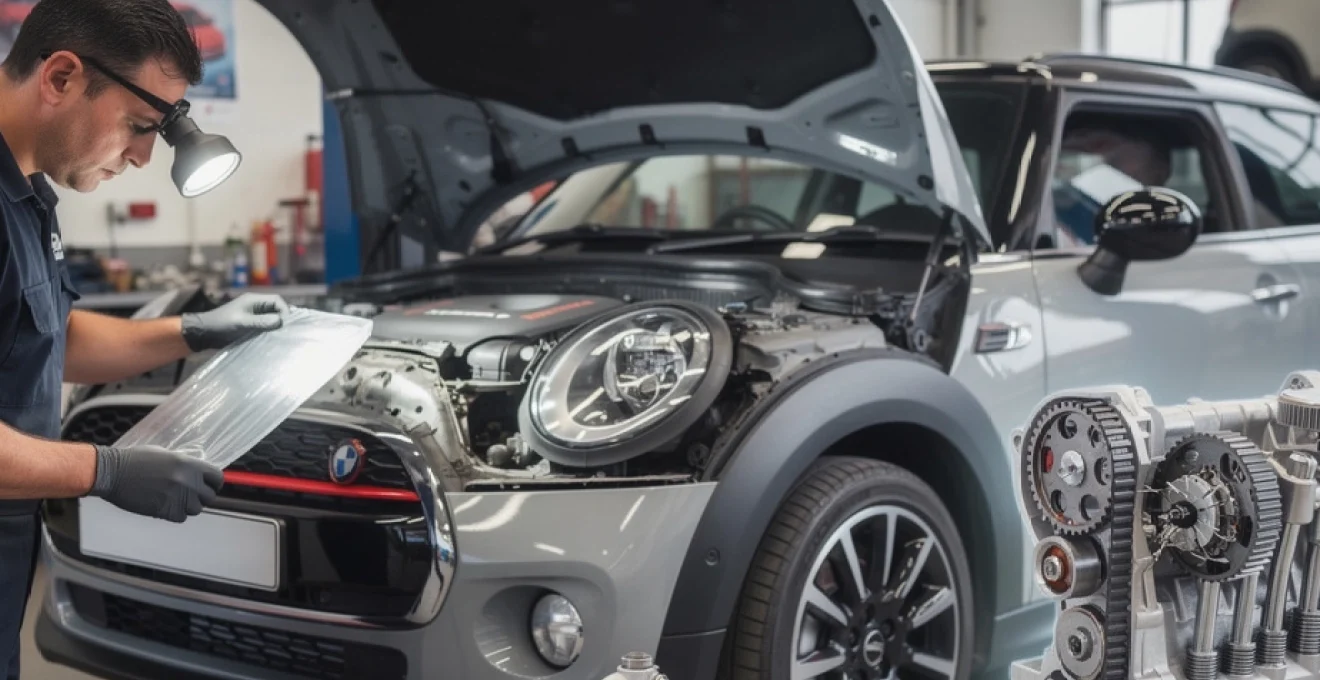
Timing belt and timing chain problems are among the most expensive failures a Mini Cooper owner can face. A snapped belt or a stretched chain can turn a perfectly good engine into an uneconomical repair in a split second, especially on the interference 1.6 petrol units used across much of the Mini range. Understanding whether your Mini has a belt or a chain, when it should be replaced, and what the warning signs look like gives you real control over long‑term running costs and reliability.
UK Minis see a tough life: short trips, cold starts, speed bumps and endless stop‑start traffic. That combination is brutal for any timing system, whether it uses a rubber belt or a metal chain. Taking a proactive approach to your Mini Cooper timing belt, rather than waiting for a breakdown, is often the difference between a straightforward scheduled service and a four‑figure engine rebuild.
Mini cooper timing belt vs timing chain: model years, engine codes, and UK market variations
Identifying timing belt mini coopers by VIN, engine code (N12, N16, W10), and production year
One of the most confusing points for owners is whether a particular Mini Cooper uses a timing belt or a timing chain. Early BMW Minis with the Tritec engines (codes like W10 and W11) use a chain, not a belt. Later Prince engines such as N12, N14, N16 and N18 also use chains. By contrast, PSA‑derived 1.6 HDi/DV6 diesel units use a belt‑in‑oil system, which is effectively a wet cambelt running inside the engine.
To confirm what your specific car has, it is best to work from the VIN and engine code. The 10th digit of the VIN gives the model year, while the engine code is stamped on the block and often printed on a label under the bonnet. Any UK Mini Cooper diesel with a DV6‑family code such as DV6TED4, 9HZ or 9HY has a timing belt. Most UK petrol Minis from 2001 onwards, including Cooper, One and JCW variants, are timing‑chain engines and follow a completely different maintenance strategy focused on oil quality and chain health rather than belt replacement intervals.
Differences between R50, R52, R53, R55, R56, R57, R58, R59, and F55/F56 timing drive designs
The first‑generation R50, R52 and R53 Minis use the Chrysler/Tritec four‑cylinder with a robust duplex timing chain. On these models, outright chain failure is rare, but tensioners and plastic guides can age, leading to the classic cold‑start rattle. Second‑generation R55–R59 cars switched to the BMW/PSA Prince petrol engines. These also use chains, but the design is lighter and more sensitive to poor servicing, which is why timing chain stretch and guide wear are more common on R56‑era cars.
Third‑generation F55 and F56 Minis moved to the modular BMW B37, B38, B47 and B48 engines. These retain timing chains, often mounted at the rear of the engine, which makes replacement more labour‑intensive. The key takeaway for a UK buyer or owner is that the majority of R‑ and F‑series petrol models rely on chains, while diesel models, particularly those with 1.6 HDi roots, use timing belts that have defined replacement intervals.
Petrol vs diesel mini cooper timing systems: 1.6 HDi/ DV6 belt-in-oil vs BMW prince chain engines
On the petrol side, the famous Mini “death rattle” is associated with Prince engines such as N14 and N18. These use a metal timing chain running in the oil, tensioned hydraulically. Poor oil quality, extended drain intervals, or short‑trip use can lead to chain stretch and worn guides. While the chain is marketed as “lifetime”, that assumes textbook servicing and ideal conditions that many UK cars never see.
Diesel Minis using the 1.6 HDi/DV6 unit are different. Here, the timing belt runs in oil inside the engine – a belt‑in‑oil design. This improves noise and efficiency but is very sensitive to the correct specification of oil and change intervals. Inferior oil can attack the belt material, shortening its life. For UK owners of diesel Mini Coopers, the timing belt replacement interval is a hard maintenance item, not an optional extra.
Cooper, cooper S, one and JCW timing belt configurations in UK-spec models
Most UK‑spec Mini Cooper, Cooper S and John Cooper Works (JCW) petrol models run timing chains rather than belts across the R50/R53, R56 and F56 generations. The Cooper S and JCW variants share the chain layout with their lower‑powered siblings but often operate at higher temperatures and loads, making chain and guide condition even more critical. Here, listening for early noise and dealing with chain tensioner issues promptly can save substantial money.
Mini One petrol models follow the same pattern as the equivalent Cooper of the same era, usually with a timing chain. However, some entry‑level and fleet‑focused UK diesel Minis branded One D, Cooper D or Cooper SD use PSA‑based 1.6 HDi engines with a timing belt. For these cars, a clear record of cambelt replacement by time and mileage is essential when assessing maintenance history or planning future servicing.
Recommended mini cooper timing belt replacement intervals in the UK (years and mileage)
Official MINI service schedule guidance for timing belt replacement (time and distance limits)
Official MINI documentation is clear that most petrol engines are chain‑driven and do not have a routine cambelt interval. For Mini diesel engines with a belt‑driven camshaft, the schedule typically specifies replacement somewhere between 100,000 and 125,000 miles, or around 10 years, whichever comes first. PSA documentation for DV6 engines has historically quoted long intervals, but many UK specialists consider those figures optimistic for real‑world conditions.
Industry data shows that timing belt failures account for a significant proportion of catastrophic diesel engine failures in cars over 10 years old. In independent garages, a common recommendation for DV6‑equipped Minis is a belt change between 80,000 and 100,000 miles or at 8–10 years as preventive maintenance. That advice reflects experience across thousands of UK cars rather than purely laboratory testing or marketing targets.
Real-world UK driving conditions: short trips, stop-start london traffic, and their impact on belt life
UK timing belt life is heavily influenced by driving pattern. Short trips where the engine barely reaches full temperature, combined with damp, salty winters and heavy urban traffic, create much harsher conditions than the controlled benchmarks used for official intervals. The belt sees more cold starts, more rapid temperature swings and more idling, all of which accelerate ageing of the belt material and tensioner components.
Statistics from several UK roadside assistance providers regularly show that vehicles used predominantly in city environments suffer more frequent belt‑related failures once past 8–10 years of age, even at relatively modest mileage. If your Mini Cooper diesel spends its life crawling through central London or doing nursery and supermarket runs, treating the cambelt as a 7–8 year component, regardless of miles, is a sensible way to control risk.
Adjusting timing belt intervals for high-mileage motorway use vs low-mileage city use
High‑mileage motorway Minis live a different life. A car that covers 20,000 miles a year, almost all at stable temperatures on the M1 or M6, will often show less wear at 100,000 miles than a city car at 60,000. Continuous running is easier on both the belt and auxiliary components. For these vehicles, sticking to the upper end of the recommended mileage window, but watching the calendar limit closely, is usually appropriate.
By contrast, the low‑mileage city Mini that only covers 4,000–5,000 miles each year but is 11 or 12 years old is well outside the comfort zone for an original belt. Rubber degrades with time as well as use. For such cars, a “time‑based” timing belt replacement interval of 8–10 years is more important than odometer readings. That approach aligns with the pattern UK specialists see when inspecting original belts from older diesel Minis.
When to replace “lifetime” timing belts on PSA-based mini diesel engines (DV6TED4, 9HZ, 9HY)
Marketing references to “lifetime” or “maintenance‑free” belts on PSA‑based DV6 engines can be misleading. Here, “lifetime” often means “for the intended design life of the vehicle”, typically around 10–12 years in ideal conditions. In practice, UK fuel, climate and service habits vary greatly. Engine codes such as DV6TED4, 9HZ and 9HY have all been seen with belt issues well before the official limit when oil changes have been stretched or the wrong oil grade used.
For these engines in a Mini Cooper D or One D, a prudent replacement point is around 90,000 miles or 9 years, with earlier change if there is any sign of oil contamination, noise from the belt area, or incomplete service history. When a belt‑in‑oil system fails, it can shed debris into the lubrication system, so treating “lifetime” as a marketing phrase rather than an engineering guarantee is a wise stance for long‑term owners.
Warning signs a mini cooper timing belt is failing and must be replaced immediately
Audible symptoms: belt squeal, ticking, whining, and cold-start noises from the timing side
A failing timing belt on a Mini diesel rarely snaps without warning. More often, it announces trouble with new noises from the timing cover area. A high‑pitched squeal at start‑up, rhythmic ticking, or an unusual whining sound that rises with engine speed can all suggest that the belt, tensioner or idler pulleys are deteriorating. These sounds are distinct from the metallic rattle associated with timing chains on Prince petrol engines.
If noise appears suddenly, particularly after a cold night or following an oil leak, treating it as urgent is essential. Continued driving on a noisy belt can take it from marginal to catastrophic failure in a matter of miles. Think of it like a wobbling bicycle chain: as soon as the tension is lost, things escalate quickly. Once the belt jumps a tooth, valve timing is lost and internal engine damage becomes a real risk.
Visual inspection clues: cracking, glazing, fraying, tooth wear, and oil contamination on the belt
Direct visual access to the timing belt on a Mini is limited, but a trained technician can inspect sections of the belt when the covers are removed. Classic wear signs include surface cracking, glazed or shiny patches, frayed edges, and worn or rounded teeth. Any evidence of belt material in the lower cover area or sump is a red flag, particularly on belt‑in‑oil DV6 units where debris can circulate with the engine oil.
Oil contamination is another major factor. A small leak from a camshaft or crankshaft seal that leaves the belt wet with oil will rapidly degrade the rubber compound. If your mechanic notes oil inside the timing cover during servicing, the belt and seals should be addressed together. Ignoring contamination is one of the most common precursors to unexpected timing belt failure on older Minis.
Engine performance changes: misfires, rough idle, poor acceleration, and ECU fault codes (P0016, P0341)
As a timing belt wears or jumps slightly, valve timing drifts. You might notice rough idle, hesitation on acceleration, or an overall loss of performance. Fuel economy can suffer because the engine management system is compensating for the mistimed valves. On modern Minis, the ECU will often log timing correlation faults such as P0016 (crankshaft/camshaft correlation) or P0341 (camshaft position sensor range/performance).
These codes do not automatically mean the belt has slipped, but they are strong indicators that the relationship between crankshaft and camshaft is no longer precise. Combined with any history of belt age, noise or oil contamination, they should trigger a thorough inspection of the entire timing drive. Continuing to drive with repeated timing correlation faults can turn a manageable belt job into a full cylinder head rebuild.
Oil and coolant leaks from camshaft seals and water pump affecting mini timing belt longevity
Timing belts dislike both oil and coolant. On Minis where the water pump is driven by the timing belt, a leaking pump can allow coolant to seep onto the belt, softening the rubber and affecting grip on the pulley teeth. Similarly, worn camshaft or crankshaft oil seals can allow engine oil to saturate the belt. In both cases, the chemical attack accelerates cracking and tooth wear, even if the belt is relatively young in mileage terms.
During routine servicing, any sign of staining or dampness around the timing cover area is worth investigating. Many experienced technicians treat oil tightness as a non‑negotiable prerequisite for long cambelt life. Replacing the belt without sorting the underlying leak is a false economy that often leads to another major job within a few years.
Consequences of ignoring mini cooper timing belt replacement intervals
Interference engine damage: bent valves, damaged pistons, and cylinder head failure on 1.6 petrol units
Most Mini petrol and diesel engines are interference designs, meaning there is no safe clearance between valves and pistons when timing is lost. If a timing belt snaps or jumps significantly, valves can collide with pistons at high speed. The usual result is bent valves, damaged valve guides, and in some cases cracked pistons or broken rockers. On 1.6 petrol units, even a brief loss of timing can be enough to bend multiple valves.
Repairing this level of damage typically involves removing the cylinder head, replacing valves and often valve stem seals, skimming the head, and fitting a full new timing kit. Labour times quickly run into double figures, and on older Minis the total cost can exceed the vehicle’s market value. In those situations, owners are often forced into scrappage or engine swaps, both of which are far more disruptive than a planned belt change.
Typical repair costs in UK garages for timing belt failure vs scheduled belt kit replacement
Across UK independent garages, a scheduled timing belt kit and water pump replacement on a Mini diesel typically costs a few hundred pounds, depending on region and the quality of parts used. By contrast, a belt failure that causes internal engine damage can easily run to four figures. Industry surveys often cite an average of £900–£1,500 for belt‑related engine repairs on small diesels, with more complex cases exceeding £2,000.
From a purely financial perspective, proactive timing belt replacement offers a very favourable risk profile. Paying £400–£600 every 7–10 years for a full belt and pump job is significantly cheaper than the probability‑weighted cost of catastrophic failure, especially if you plan to keep the car long term. Professional experience across BMW and Mini specialists strongly supports the view that preventive cambelt replacement is one of the best value interventions you can make on a higher‑mileage Mini Cooper D.
Secondary damage to water pump, tensioners, and auxiliary components after belt breakage
When a timing belt fails, it rarely does so in isolation. Tensioners can seize or collapse, idler pulleys can lose bearings, and the water pump can lock up, all of which contribute to the belt shredding. Debris from the belt and pulleys can damage timing covers, oil seals and even the crankshaft nose. In belt‑in‑oil systems, fragments can enter the oil galleries, risking damage to the turbocharger and crankshaft bearings.
That kind of contamination forces a much wider repair scope: sump removal and cleaning, oil pump inspection, and sometimes replacement of the turbo if foreign material has passed through. Real‑world cases in UK workshops show that what started as a neglected belt can end up consuming half the value of the vehicle once all secondary damage is addressed properly.
Impact on MOT outcomes, resale value, and dealer trade‑in offers when belt history is unknown
Although the MOT test does not directly assess timing belt condition, related issues such as excessive exhaust smoke, poor emissions or engine warning lights triggered by timing problems can lead to failures or advisories. More subtly, an unknown or obviously overdue timing belt can have a marked effect on resale value. Savvy private buyers increasingly ask about cambelt history on diesel Minis, and dealers often factor an immediate belt change into trade‑in offers.
From a valuation perspective, a stamped invoice confirming a recent belt, tensioner and water pump replacement can add several hundred pounds of perceived value to a used Mini Cooper D. On the flip side, lack of documentation often becomes a bargaining chip for buyers to negotiate the price down. For anyone planning to sell or part‑exchange, having clear, recent evidence of timing belt work is a straightforward way to present the car as a lower‑risk purchase.
What to replace with the mini cooper timing belt: complete kit and related components
Timing belt kit components: belt, tensioner, idler pulleys, and OEM vs aftermarket brands (gates, dayco, INA)
A proper Mini Cooper timing belt replacement is not just about the belt itself. A complete kit will include the main belt, automatic or manual tensioner, and any idler pulleys involved in the timing path. High‑quality brands such as Gates, Dayco and INA supply kits that meet or exceed OEM specifications and are widely used by independent BMW and Mini specialists.
Using a full kit rather than reusing old tensioners is essential for long‑term reliability. Belt failures are often triggered by a seized pulley rather than the belt material alone. From a professional standpoint, fitting only a new belt to old hardware on a Mini diesel is considered poor practice and exposes the owner to unnecessary risk well before the next scheduled interval.
Water pump replacement strategy on mini cooper engines with belt-driven pumps
On many Minis with belt‑driven water pumps, the coolant pump is replaced at the same time as the timing belt. The reasoning is straightforward: the pump’s bearings and seals age at a similar rate to the belt and tensioner, and the additional parts cost is modest compared to the labour required to access the area. Industry estimates suggest that replacing the water pump during a cambelt job adds only 10–20% to the total invoice, yet significantly reduces the chance of a future coolant leak compromising the new belt.
In workshops specialising in BMW and Mini, the default recommendation is to treat the water pump as part of the timing kit unless there is clear, recent evidence that it has already been renewed using high‑quality parts. For high‑mileage Minis covering long motorway distances, this combined approach helps keep the cooling and timing systems in sync from a maintenance perspective.
Camshaft and crankshaft oil seals, auxiliary belts, and hardware to renew during the same service
A thorough timing belt service on a Mini Cooper D often includes new camshaft and crankshaft oil seals, especially on engines with any history of oil misting or seepage. Replacing seals while access is available is efficient and prevents oil from degrading the new belt. Auxiliary drive belts, which power the alternator and air conditioning, should also be inspected closely and replaced if there is any sign of cracking or glazing.
Experienced technicians also pay attention to single‑use fixings such as crankshaft pulley bolts and engine mount stretch bolts. Reusing these hardware items can compromise clamping force and lead to subtle timing drift or vibration issues. Using the correct new bolts to the specified torque and angle is part of doing a Mini timing belt job to a professional standard rather than simply “getting the belt on”.
Coolant flush and refill specifications for mini cooper engines after timing belt and pump replacement
Where the water pump forms part of the timing system, draining and refilling the coolant is unavoidable. That creates an ideal opportunity to ensure the correct, manufacturer‑approved coolant or antifreeze is used. For Mini engines, using the proper BMW/MINI‑approved coolant mixture protects aluminium components and maintains the right corrosion and cavitation protection over time.
A full coolant flush, rather than a simple top‑up, clears any old or contaminated fluid and helps stabilise operating temperatures. Stable running temperature is beneficial for both the timing belt and the rest of the engine. After refilling, careful bleeding of the system to remove air pockets is crucial to avoid local hotspots around the cylinder head and belt area, particularly on compact engine bays like the Mini’s where space and airflow are limited.
DIY vs professional mini cooper timing belt replacement: tools, procedures, and common mistakes
Specialist locking tools for mini camshaft and crankshaft alignment (BMW/MINI timing kits)
Replacing a Mini Cooper timing belt at home is technically possible but demands a high level of mechanical skill and access to specialist tools. The most critical items are engine‑specific locking tools that hold the camshaft and crankshaft in precise alignment. Generic paint marks on pulleys are not sufficient on modern Minis, where even a degree or two of mis‑timing can trigger fault codes and rough running.
Professional BMW/MINI timing kits include crankshaft locking pins, camshaft plates and, where required, fixtures for the high‑pressure fuel pump. Using these tools correctly ensures that when the new belt is fitted and tensioned, the valvetrain timing matches factory specifications. Attempting the job without them is one of the main reasons DIY belt changes sometimes end with flatbed recovery and a visit to a specialist.
Correct torque settings, timing marks, and belt tensioning procedure on r‑series mini engines
On R‑series Minis with timing belts, correct torque and angle settings for key fasteners such as the crankshaft pulley bolt are non‑negotiable. Under‑tightening can allow the pulley to slip on the crank nose, while over‑tightening risks damaging the threads or distorting the pulley. Factory documentation specifies not only the torque values but also the order in which components should be tightened and the belt tension checked.
Belt tension itself is usually set using a specific torque on the tensioner or by aligning a calibrated pointer. Guesswork, or relying on how tight the old belt felt, is unreliable. A belt that is too tight can overload bearings and lead to a noisy, short‑lived installation; too loose and it risks jumping teeth under sudden load, especially when cold. Following the exact tensioning procedure is one of the hallmarks of a professional Mini timing belt job.
Common DIY errors: mis-timing, reused stretch bolts, incorrect tension, and skipped calibration steps
Common DIY mistakes on Mini timing belt replacements include mis‑timed camshafts, reusing single‑use stretch bolts, failing to renew contaminated or glazed pulleys, and skipping post‑installation checks such as slowly rotating the engine by hand through two full cycles. Mis‑timing by even a single tooth can produce subtle but damaging detonation under load, poor fuel economy and persistent engine management warnings.
Another frequent oversight is neglecting to clear and recheck ECU fault codes, or failing to verify that the engine reaches normal operating temperature without leaks or unusual noises. From a professional perspective, the job only ends when the vehicle has completed a proper road test, all adaptive values have settled and live data confirms stable timing correlation. Without those steps, you are relying on luck rather than evidence that the new belt is functioning correctly.
Choosing a specialist mini or BMW-independent garage in the UK for timing belt replacement
For most owners, using a specialist Mini or BMW‑independent garage is the most efficient and reliable way to handle timing belt work. Key indicators of a good workshop include access to the official MINI technical portal, familiarity with engine codes like DV6TED4, willingness to use quality brands such as Gates, Dayco or INA, and a clear policy on replacing water pumps, seals and stretch bolts as part of the job.
Asking for a written quote that itemises belt kit, pump, coolant, hardware and labour time gives transparency and allows fair comparison between garages. A technician who can explain how they lock the engine, what torque values they follow and how they test the car afterwards is usually someone who approaches the task methodically. When you treat timing belt replacement as a critical investment in your Mini Cooper’s long‑term health rather than just another bill, choosing the right specialist becomes an easy decision.