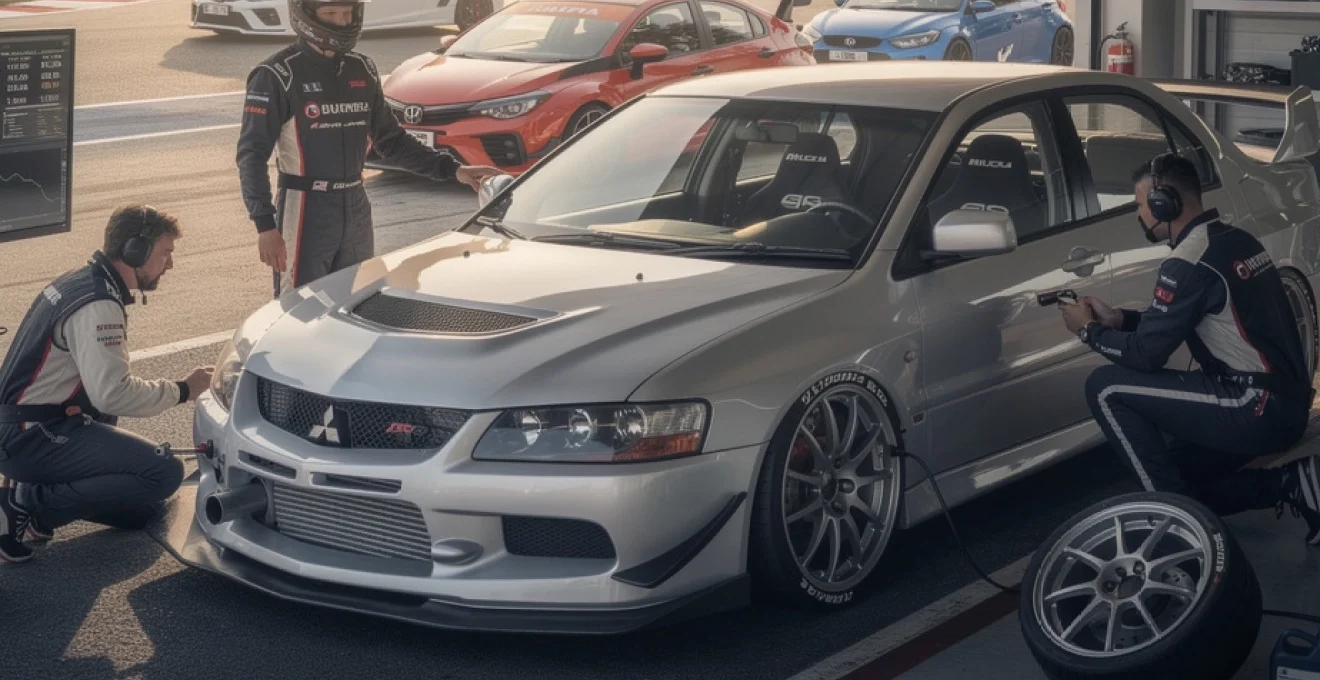
The Mitsubishi Lancer Evolution 9 sits at a fascinating crossroads: modern enough to feel fast and exploitable, old enough to be regarded as a modern classic. For many enthusiasts, it represents the peak of turbocharged, rally-bred four-door performance, long before the era of oversized touchscreens and overprotective driver aids. The question in 2025 is simple but important: can an Evo 9 still hold its own against the latest hot hatches, compact sports cars and club-level race builds you see at track days and time attack events?
If you are considering buying, restoring or building an Evo 9 for competitive use, the answer depends on how deeply you understand its engineering strengths, its ageing weak points and its huge tuning potential. Treated as a complete package – engine, drivetrain, chassis, brakes and running costs – the car still offers a blend of pace, feel and adaptability that many newer machines struggle to match.
Mitsubishi lancer evolution 9 technical overview: engine, drivetrain and factory performance figures
4G63T 2.0-litre turbo engine architecture, MIVEC valve timing and stock power output (UK FQ-300, FQ-320, FQ-340)
At the heart of the Evo 9 is the legendary 4G63T 2.0‑litre turbocharged four-cylinder, an iron-block, aluminium-head unit that traces its roots back decades. By the Evo IX generation, this engine had been refined extensively, gaining MIVEC variable valve timing on the intake side and detail improvements to the turbocharger and breathing. In standard European trim, power outputs hovered around 286 bhp, while the UK FQ models pushed this further from the factory.
The UK range typically offered FQ‑300, FQ‑320 and FQ‑340 variants, with quoted figures of roughly 300, 320 and 340 bhp respectively. Actual dyno numbers often exceeded brochure figures, with many healthy FQ‑340 cars showing 350 bhp at the flywheel. Torque sits in the 290–320 lb ft region, giving brisk in‑gear acceleration that still feels urgent next to modern turbo engines. The combination of compact displacement, robust internals and an efficient intercooler allows sustained high-load use, provided fuelling and cooling are in good order.
One key reason the Evo 9 engine remains so respected is the blend of responsiveness and strength. Compared with many newer 2.0‑litre turbo units, the 4G63T feels more mechanical and raw, yet still refined enough for daily use. Turbo lag exists, but it is relatively modest with the stock TD05‑16G turbocharger and sensible boost levels, especially in FQ‑320 and FQ‑340 trims.
AYC vs ACD: active yaw control, active centre differential and super AYC behaviour in real-world grip
The Evo 9’s drivetrain is dominated by its sophisticated all‑wheel‑drive system. Depending on market and trim, you will find a combination of ACD (Active Centre Differential) and AYC or Super AYC on the rear axle. The ACD electronically varies the locking of the centre diff, juggling torque front to rear based on throttle, steering angle and ABS inputs. In simple terms, it helps the car rotate into a corner yet still punch hard out of the exit.
Active Yaw Control sits in the rear differential housing and can send more torque to either rear wheel to help the car pivot. Super AYC on later models increases torque transfer range and durability. In real‑world grip terms, the system lets you carry surprisingly high entry speed, use the brakes deep into the apex, then apply throttle earlier than instinct suggests. Rather than pushing wide into understeer, the Evo tightens its line, giving that signature “point and squirt” feel that makes it formidable in wet or mixed conditions.
On track, the effect is clear when comparing lap traces: corner entry speeds are comparable to many modern AWD hot hatches, but mid‑corner yaw and exit traction often exceed them, especially on bumpy surfaces. For a driver who learns to “lean” on the system, the AYC and ACD together offer an advantage that still feels almost like mild traction-control magic.
GSR vs RS specification: gear ratios, weight reduction, mechanical LSDs and homologation components
The Evo 9 was sold in two fundamental flavours: GSR and RS. The GSR is the more road‑focused car, packed with creature comforts, AYC, ACD and longer gear ratios that suit everyday driving. The RS, effectively a homologation shell, strips much of this away. Air‑con, sound deadening and some luxuries were deleted, weight was trimmed by roughly 70–90 kg depending on spec, and mechanical plated limited‑slip differentials were often fitted instead of AYC.
Shorter gear ratios in many RS models give improved acceleration at the expense of higher cruise rpm. In competition use, especially tarmac rally and sprint events, that trade‑off can be favourable. RS shells also came with thinner glass, simpler interiors and in some cases different final drives, making them ideal starting points for dedicated race or rally builds. For a driver chasing class wins, the RS remains a highly desirable base, while the GSR tends to be the better all‑round fast road Evo 9.
The homologation components and mechanical LSDs in the RS also offer greater long‑term durability in harsh use than ageing AYC systems, though at the cost of day‑to‑day refinement. Choosing between the two depends on how much road comfort you are prepared to sacrifice for sharper, more direct behaviour on circuit or stage.
Factory suspension and brembo braking package: Bilstein/Eibach setup, geometry and stopping performance
From the factory, the Evo 9’s suspension uses a Bilstein/Eibach combination on many variants, with inverted monotube dampers and stiff but well‑judged spring rates. Geometry is relatively aggressive for a road car, with decent static camber and a chassis that responds predictably to trail braking and mid‑corner throttle adjustments. The result is a car that feels alive at medium speeds but can still cope with broken roads and wet B‑roads.
The braking system uses Brembo four‑piston front calipers and two‑piston rears with sizeable ventilated discs. Independent testing at launch saw 60–0 mph stopping distances in the low 30‑metre range on good tyres, figures that still compare well with many modern performance cars. Under repeated track‑day use, the standard pads and fluid will eventually show fade, but the hardware itself is a strong base. With quality pads and high‑boiling‑point fluid, the factory Brembos support serious lapping without drama.
Even in stock form, the Evo 9 offers an unusually complete out-of-the-box package for track-day use: strong engine, intelligent AWD and brake hardware that responds very well to minor upgrades.
Stock evo 9 performance in 2025: acceleration, lap times and handling versus modern hot hatches and sports cars
0–60 mph, quarter-mile and in-gear acceleration versus FK8/FK8.5 honda civic type R, GR yaris and golf R
A healthy stock Evo 9 GSR typically records 0–60 mph in around 4.7–5.0 seconds on a dry surface, with the quarter mile completed in the mid‑13‑second range at roughly 100–105 mph. FQ‑340 versions often dip into the low‑13s with strong launches. Compare this to a modern FK8 Honda Civic Type R at roughly 5.3 seconds to 60 mph, a GR Yaris at around 5.5 seconds and a Mk7.5 Golf R DSG at about 4.6 seconds, and the Evo still looks quick.
In‑gear acceleration is where the Evo 9 feels especially urgent. 30–70 mph in fourth gear can be dispatched in roughly 6.5 seconds in an FQ‑340, similar to a tuned contemporary hot hatch. The combination of short gearing, punchy mid‑range torque and AWD traction means real‑world overtakes remain effortless,particularly on damp roads where front‑wheel‑drive rivals struggle for grip.
Of course, a brand‑new FK8.5 Civic Type R or latest Golf R will deliver speeds with less fuss, more refinement and better emissions, but the raw pace remains comparable. If your priority is pure acceleration rather than tech-laden comfort, an unmodified Evo 9 still belongs firmly in the modern performance conversation.
Track comparisons: evo 9 lap time data from nürburgring, tsukuba, brands hatch indy and bedford autodrome
When looking at lap times, context is everything: driver skill, tyres and weather matter. That said, period tests and modern track‑day data put a stock or lightly modified Evo 9 close to today’s benchmark hot hatches. At the Nürburgring Nordschleife, published times in the 8:10–8:20 BTG (Bridge to Gantry) range on road tyres are common for well-driven cars, similar to an early FK2 Civic Type R or Mk7 Golf R on comparable rubber.
At Tsukuba Circuit, magazine tests in Japan saw stock Evo 9s run roughly 1:04–1:06 laps, with mild tuning and semi‑slicks quickly pulling times down below the one‑minute mark. On UK circuits such as Brands Hatch Indy, a near‑standard Evo 9 with decent pads and tyres can circulate in the 54–56 second range in the right hands. At Bedford Autodrome, expect GT configuration lap times broadly on par with a modern GR Yaris on track‑focused tyres.
If you intend to chase podiums in series such as UK Time Attack or club‑level sprints, a stock Evo 9 will not be enough. However, as a base to build from, it gives a level of pace that is still extremely relevant in 2025, especially on technical or low‑grip tracks where its AWD traction shines.
Chassis balance, turn-in and traction compared with subaru impreza WRX STI hawkeye and GRB hatch
The comparison with Subaru’s WRX STI Hawkeye and later GRB hatch is unavoidable. Both share rally heritage, AWD and turbo power, but the feel is quite different. The Evo 9 tends to offer sharper turn‑in and more neutral mid‑corner balance, with the AYC actively helping to rotate the car. The steering is lighter but more communicative, and the chassis feels more eager to change direction.
The Hawkeye STI counters with a strong front differential and more traditional mechanical balance, while the GRB hatch brings a stiffer shell and improved refinement. However, traction out of tight corners on poor surfaces remains an Evo stronghold. On equal tyres and with drivers of similar skill, lap times are often neck and neck, but feedback from track regulars consistently praises the Evo for feeling more agile and adjustable at the limit.
For you as a driver, this means the Evo 9 rewards commitment and confidence. The car will happily respond to trail braking, throttle steering and subtle line changes mid‑corner. If you enjoy a car that feels “on its toes” rather than locked down, the Evo’s chassis character still feels special.
Braking distances and fade resistance compared with BMW M2 (F87), toyota GR86 and hyundai i30 N
Against newer rear‑ and front‑drive rivals, braking and heat management become crucial. Independent tests show an Evo 9 with fresh pads and tyres stopping from 62 mph in approximately 32–34 metres, very close to an F87 BMW M2 and Toyota GR86. The Hyundai i30 N, with its modern ESC calibration and tyre technology, can occasionally shave a metre or two in perfect conditions.
Fade resistance on standard equipment is where age begins to show. A stock Evo 9 on factory‑type pads will experience softening pedal feel after a handful of flat‑out laps, especially on heavier circuits. Modern cars benefit from more advanced ABS algorithms, better ducting and larger disc packages straight from the showroom. However, a simple switch to high‑friction pads, racing brake fluid and, ideally, braided lines transforms the Evo. With those changes, fade becomes comparable to many current track‑ready hot hatches.
From a pure deceleration and control standpoint, an Evo 9 with upgraded pads and fluid brakes as hard as most modern performance cars, even if the factory ABS calibration feels slightly more intrusive.
Evo 9 tuning potential: typical stage upgrades, power ceilings and engine reliability limits
Stage 1 ECU remap, intake and exhaust upgrades: boost targets, AFR optimisation and safe torque levels
One of the main reasons the Evo 9 remains competitive is simple: tuning potential. A basic Stage 1 package – typically an ECU remap, freer‑flowing panel filter or intake, decat or high‑flow sports cat and cat‑back exhaust – can elevate power from stock to roughly 330–360 bhp, with torque in the 330–360 lb ft range on pump fuel. Boost targets usually rise from around 1.1 bar to 1.4–1.5 bar, depending on turbo health and fuel quality.
Careful AFR optimisation and ignition timing are critical. A good mapper will prioritise mid‑range response and safe torque levels over headline peak figures, especially on an older engine. For regular track use, many specialists recommend capping torque at 350 lb ft to prolong the life of the gearbox and transfer box. When mapped well, a Stage 1 Evo 9 will feel dramatically quicker than stock from 3,000–6,000 rpm while still behaving like a usable road car.
Think of this as the “sweet spot” for many owners: enough thrust to embarrass modern rivals, without pushing the 4G63T or driveline beyond their comfortable limits. Fuel economy will drop, but not catastrophically, if you drive sensibly between bursts of boost.
Turbocharger options: stock TD05-16G vs FP green, HKS GT RS and blouch upgrades for street and track
The stock TD05‑16G turbo is a great all‑rounder but will typically top out around 380–400 bhp on pump fuel. For more serious builds, popular upgrades include FP Green, HKS GT RS and various Blouch hybrid turbos. Each has its own balance of spool, flow and heat management. For a fast road car that still needs strong low‑rpm response, units in the 49–54 lb/min flow range hit a sweet spot.
On 99 RON fuel and conservative timing, 420–450 bhp is realistic with these turbos, while an E85 conversion can push output beyond 500 bhp with correct supporting mods. The trade‑off, of course, is lag: a bigger turbo will start to pull hard closer to 4,000 rpm rather than the 3,000 rpm region typical of a healthy stock unit. For time attack or drag‑oriented builds, that is acceptable. For tarmac rally or mixed‑use cars, a slightly smaller turbo often makes for quicker stages and more enjoyable road manners.
Fuel system and cooling upgrades: injectors, walbro pumps, intercooler cores and oil cooler solutions
Beyond about 340–350 bhp, the Evo 9’s standard fuel system becomes a limiting factor. Most tuners will specify larger injectors – often 1,000–1,300 cc/min to leave headroom – along with a Walbro or similar high‑flow in‑tank pump. On E85 or high‑ethanol blends, expect to run even larger injectors due to the higher fuel volume required.
Cooling upgrades are equally important. A quality front‑mount intercooler with a dense but efficient core helps maintain intake temperatures during repeated pulls or hot track days. Many owners also fit an upgraded oil cooler and improved ducting to reduce oil temperatures by 10–20°C under sustained load. If you plan repeated 20‑minute sessions, treating cooling as seriously as power will save you significant expense over time.
For street‑biased cars, subtle solutions – improved radiator, shrouding, and a slightly larger intercooler – often suffice. For competition use, more aggressive cores and, in some cases, auxiliary spray systems are used, especially in hotter climates.
Forged internals and 4G63T bottom end strength for 400–600 bhp builds on pump fuel and E85
The 4G63T bottom end has a reputation for strength, and for good reason. Stock internals can handle around 400–450 bhp with a sensible tune and good maintenance. Once you look beyond that, forged pistons and rods, upgraded bearings and sometimes a closed‑deck or braced block are wise investments. Many reputable builders construct 500–600 bhp engines that see multiple seasons of competition use.
On pump fuel, 450–500 bhp is usually the reasonable ceiling before detonation margins become uncomfortably tight. E85 or high‑ethanol blends significantly improve knock resistance, allowing higher boost and more aggressive timing at similar or lower cylinder pressures. Well‑specced E85 Evo 9 builds with 600 bhp are now common in time attack paddocks around the world.
Mechanical sympathy remains essential. Even with forged internals, sustained high rpm, poor oil quality or inadequate cooling can shorten engine life dramatically. For a dual‑purpose road and track car, many specialists advise keeping things around 450 bhp on pump fuel and focusing next on chassis and braking improvements instead of chasing ever‑bigger dyno numbers.
ECU platforms: ECULink, ECUTek, haltech and motec M1 for advanced boost control and data logging
Tuning the Evo 9’s electronics has never been more flexible. Popular ECU platforms include reflash-based solutions such as ECULink and ECUTek, and standalone systems from Haltech and Motec M1. For a typical Stage 1–2 road car, ECULink or ECUTek offer ample control over boost, fuel and ignition, along with useful extras such as launch control, flat‑shift and map switching.
For serious track and rally builds, standalone units shine. Haltech and Motec allow advanced boost‑by‑gear or boost‑by‑gear‑and‑rpm strategies, traction strategies tailored to different surfaces, and detailed data logging via CAN. Being able to overlay throttle, boost, wheel‑speed and lambda data from a full session transforms the way you analyse performance and reliability.
If you intend to run complex anti‑lag, switchable fuel maps or integrate modern dashes and telemetry systems like AIM or VBOX, a standalone ECU is often the smartest long‑term choice. The learning curve is steeper, but the control and protection it provides for an expensive engine build are significant.
Chassis, suspension and braking modifications that keep the evo 9 competitive on modern circuits
Coilover setups: öhlins road & track, bilstein B16 and KW V3 for time attack and fast road use
The standard Bilstein/Eibach setup is capable, but a quality coilover kit elevates the Evo 9 to another level. Popular options include Öhlins Road & Track, Bilstein B16 and KW V3. All three are height‑ and damping‑adjustable, with spring rates that support both fast road and track‑day driving when set up correctly. The key is careful corner‑weighting and geometry alignment, not just bolting on stiffer springs.
A typical fast‑road and track‑biased setup uses moderate spring rates and slightly firmer compression than stock, improving body control without making the car intolerable on rough tarmac. The Evo responds very well to increased rebound damping at the rear to tame squat and sharpen rotation. For time attack and semi‑slick tyres, stiffer rates and more aggressive damping become viable, though comfort naturally suffers.
Alignment and geometry: camber, toe and caster settings for track, tarmac rally and mixed-use setups
Geometry is a powerful tuning tool on the Evo 9. For track‑day use on 17‑ or 18‑inch tyres, many specialists recommend front camber in the –2.0° to –2.5° range, rear camber around –1.5° and a small amount of front toe‑out (0.05–0.10° total) to sharpen turn‑in. Rear toe is often set close to zero for stability under power. Caster can be increased slightly with adjustable top mounts to improve self‑centering and mid‑corner feel.
For tarmac rally, where surface changes and bumps are more severe, slightly softer spring rates, less static camber and a touch more rear toe‑in help keep the car stable at high speed. Mixed‑use road and track setups sit between these extremes. If you intend to daily‑drive the car, it is worth accepting a small performance compromise to preserve tyre life and straight‑line stability on the motorway.
Bushing and arm upgrades: polybush kits, spherical bearings and anti-roll bars from whiteline and cusco
Over time, factory rubber bushes degrade, leading to vague steering and inconsistent alignment under load. Replacing worn components with quality polybush kits or, for more extreme builds, spherical bearings, dramatically tightens the Evo’s responses. Brands such as Whiteline and Cusco supply full arm kits, adjustable anti‑roll bars and subframe inserts that bring the chassis back to, or beyond, its original precision.
For a fast road Evo 9, a combination of polybushed control arms, fresh OEM engine mounts and a slightly thicker rear anti‑roll bar gives a crisp, responsive feel without excessive NVH. For time attack or sprint competition, spherical bearings at key points (front lower arms, rear toe links) keep geometry stable at high lateral loads. Just be prepared for more noise and shorter service intervals.
Brake upgrades: AP racing and alcon big brake kits, pad compounds and high-temperature fluids
Once pace increases, so do braking demands. The standard Brembos respond well to uprated pads, such as fast‑road/track compounds and high‑temperature fluid rated above 300°C dry boiling point. For many drivers, this combination is enough for regular track days. However, sprint or endurance use often justifies a big brake kit from AP Racing or Alcon.
A typical BBK for the Evo 9 uses 330–355 mm two‑piece discs and six‑piston calipers, improving thermal capacity and pedal feel. This not only reduces fade but also shortens stopping distances by allowing later, more confident braking. Matching front and rear pad friction levels is vital to maintain balance; a too‑aggressive front pad can make the car feel nervous under heavy braking.
Tyre selection: semi-slick vs UHP tyres (toyo R888R, yokohama A052, michelin pilot sport 4S)
Tyre choice is one of the most cost‑effective performance upgrades. For track‑focused Evo 9 builds, semi‑slicks such as Toyo R888R or Yokohama A052 offer immense grip and consistent heat tolerance. Expect lap time reductions of 2–4 seconds on many UK circuits compared with regular UHP tyres. The trade‑offs include more road noise, tramlining and reduced wet‑weather safety at motorway speeds.
For mixed‑use cars, high‑performance road tyres such as Michelin Pilot Sport 4S, Goodyear Eagle F1 Supersport or similar remain an excellent compromise. They provide predictable behaviour in rain, good longevity and enough dry‑grip performance for occasional track days. If you push hard in all seasons, running two sets of wheels – one with UHP road tyres, one with semi‑slicks – is an efficient way to keep your Evo 9 competitive without sacrificing year‑round usability.
Reliability, maintenance and weak points of an ageing mitsubishi evo 9 under competitive use
4G63T known issues: head gasket, crankwalk myths, timing belt service intervals and oil starvation
Despite its strong reputation, the 4G63T is not indestructible. Head gasket failures can occur on higher‑mileage or repeatedly overheated engines, especially if coolant maintenance has been neglected. Fortunately, failure rates are relatively low compared with some rivals, and upgraded multi‑layer steel gaskets with ARP head studs provide robust insurance on tuned builds.
The infamous “crankwalk” myth, largely associated with earlier 7‑bolt DSM engines, is rarely an issue on Evo 9s. Much more critical are timing belt service intervals – ideally every 5 years or 60,000 miles, whichever comes first, including tensioners and idlers. Oil starvation can also occur during prolonged high‑g corners if oil levels are allowed to drop or if the sump design is not optimised. Many track‑focused cars use baffled sumps and, at higher levels, accusump systems to maintain pressure.
Maintaining clean, high‑quality synthetic oil, checking levels religiously and respecting warm‑up and cool‑down procedures go a long way towards keeping the 4G63T healthy. Treat the engine like the competition unit it essentially is, and it will reward you with remarkable longevity.
Drivetrain wear: AYC pump failures, transfer box issues, clutch life and gearbox synchro problems
As Evo 9s age, drivetrain issues begin to surface more frequently. AYC pump failures are a common complaint, often due to corrosion and lack of fluid changes. Rebuilds or replacement units are available but not cheap, which is one reason some competition builds convert to mechanical diffs. Transfer boxes and rear diffs can also suffer if subjected to aggressive launches and high‑torque maps without adequate servicing.
Clutch life depends heavily on use. A stock clutch can last 40,000–60,000 miles on a gently driven road car, but hard launches, drag‑style starts and high‑grip tyres can shorten that dramatically. Upgraded multi‑plate clutches cope better with big torque but usually bring extra noise and a firmer pedal. Gearbox synchros, particularly in second and third, can wear when subjected to repeated high‑rpm shifts; proper gearbox oil and careful driving when cold help here.
Rust hotspots and chassis fatigue: rear arches, sills, chassis rails and subframe mounting points
Rust is now a serious purchasing consideration. Common hotspots on Evo 9 shells include rear wheel arches, inner and outer sills, chassis rails near jacking points and subframe mounting areas. Cars used in harsh winter climates or on salted roads will show problems earlier. Before committing to a track build, a thorough inspection and, where necessary, professional rust repair and underbody protection are strongly advised.
Chassis fatigue can also emerge on high‑mileage or heavily used rally shells, with stress cracks around suspension turrets and mounting points. Weld‑in reinforcement plates and seam‑welding are common solutions for serious competition cars. For your own build, catching corrosion early is far cheaper than extensive structural restoration later.
Cooling and lubrication management in repeated track sessions and tarmac rally stages
Under competitive use, the Evo 9’s cooling and lubrication systems are worked hard. Repeated track sessions in summer can push coolant temperatures over 100°C and oil temperatures beyond 120–130°C if the system is marginal. Upgraded radiators, improved ducting and additional oil cooling capacity keep things under control, preventing heat‑soak and power loss.
Monitoring is crucial. Oil temperature and pressure gauges, along with coolant temperature and wideband AFR display, give vital feedback during long sessions. Think of this like a pilot’s instrument panel: if you can see trends early – dropping oil pressure, rising temperatures – you can back off before damage occurs. For tarmac rally stages with limited service intervals, this kind of data becomes the difference between finishing and retiring.
Cost, regulations and class eligibility: where the evo 9 fits in modern motorsport and track-day scenes
Entry costs and running budgets versus GR yaris, civic type R and BMW m240i track builds
Market values for good Evo 9s have climbed steadily. In 2025, clean, largely stock cars often command prices similar to, or above, early GR Yaris or FK8 Civic Type R examples. Entry cost, therefore, is not the bargain it once was. However, many owners already have a strong base car, and even from scratch, running budgets can be surprisingly competitive if modifications are planned sensibly.
Compared with a BMW M240i track build, for example, consumables like pads and tyres on a lighter Evo 9 can be cheaper, although fuel usage at full pace is comparable. Insurance and road tax may be higher depending on market. Ultimately, your budget split will differ: older car purchase cost plus more maintenance, versus newer car finance and depreciation but lower remedial work.
Time attack and sprint series: class rules for UK time attack, global time attack and super lap battle
The Evo 9 remains a fixture in time attack paddocks worldwide. In UK Time Attack, cars are often seen in Club, Club Pro and even Pro classes, depending on modification level and tyre choice. Rules frequently distinguish between road‑legal tyres and slicks, as well as aerodynamic aids such as splitters and wings. The Evo’s four‑door shell and AWD layout can land it in highly competitive categories with modern turbo hatches and GT‑style coupés.
In Global Time Attack and Super Lap Battle, Evo 9 builds often appear in Limited or Street classes when retaining a full interior and road tyres, and in more extreme classes once stripped, caged and on slicks. Its combination of short wheelbase, strong drivetrain and tunable engine make it a popular choice for those chasing outright one‑lap pace.
Rally homologation and historic eligibility in group N, r4-style builds and national tarmac championships
From a rally perspective, the Evo 9 enjoys strong homologation credentials. Many national series still allow Group N or R4‑style builds based around this platform, often with balance‑of‑performance measures to keep competition close against newer machinery. In some jurisdictions, the Evo 9 is beginning to edge towards “historic” eligibility, opening extra avenues for competition, especially in tarmac championships.
For someone entering rallying today, an Evo 9 offers robust parts availability, a wealth of setup knowledge and a dependable AWD package. The main caveats involve body shell condition and compliance with modern safety requirements – cages, seats, harnesses and fuel systems must meet current regulations, which can add to build cost but also significantly improve safety.
Track-day restrictions: noise limits, emissions regulations and road legality in the UK and EU
On track days, the main regulatory headaches relate to noise and emissions. Many aftermarket exhausts for Evo 9s are too loud for typical 98 dB drive‑by limits at UK circuits, so a resonated system or additional silencer may be needed. High‑flow sports cats ease emissions while retaining reasonable performance, but full decats can cause MOT/inspection issues and prevent road legality in many EU countries.
As emissions rules tighten, especially in low‑emission zones, an ageing turbocharged saloon can face extra road‑use restrictions. If you intend to drive the car to and from circuits rather than trailering it, planning an exhaust and mapping package that balances flow, noise and legality is critical. The reward is a car you can still enjoy on the road, not just on the trailer and pit lane.
Real-world benchmarks: evo 9 case studies from tuners and track-focused builds
Roger clark motorsport, litchfield and norris designs evo 9 builds and dyno-verified outputs
Across the UK and beyond, specialist tuners have demonstrated just how far a well‑prepared Evo 9 can go. Workshops such as Roger Clark Motorsport, Litchfield and Norris Designs have produced builds ranging from 400 bhp daily drivers to 700+ bhp time attack weapons. Dyno‑verified outputs in the 500–600 bhp range on E85 are now almost routine, provided the supporting hardware and mapping are up to scratch.
What stands out in many of these case studies is not only peak power but also the shape of the torque curve and the reliability achieved. Engines that hold strong torque from 3,800 to 7,500 rpm on track, season after season, prove that the 4G63T architecture still competes with modern offerings when engineered correctly. For you as a prospective builder, these examples offer blueprints and, crucially, proven parts combinations.
Sub-1-minute brands hatch indy and sub-55-second tsukuba evo 9 builds: spec breakdowns
At the sharp end of lap‑time chasing, Evo 9 builds have achieved impressive benchmarks. Sub‑1‑minute laps around Brands Hatch Indy and sub‑55‑second times at Tsukuba have been recorded by extensively modified cars. Typical specifications include 500–600 bhp engines, wide semi‑slicks, aggressive aero with large front splitters and rear wings, and full coilover suspension with spherical joints throughout.
Brake packages usually feature large AP Racing front calipers and rotors, with ducting to manage heat. Weight reduction is significant: stripped interiors, polycarbonate windows and lightweight body panels often bring kerb weights down towards 1,250 kg or even below. Telemetry from these cars shows very high minimum corner speeds and short braking zones, demonstrating how effectively the Evo’s AWD and aero can be leveraged with modern components.
Daily-drivable 400 bhp evo 9 configurations balancing reliability, comfort and lap time
Not every owner wants a bare‑shell time attack machine. Many aim for a daily‑drivable 400 bhp Evo 9 that can commute, handle weekend trips and still set respectable lap times. A typical configuration might include a conservative remap on the stock turbo or a small upgrade unit, 1,000 cc injectors on pump fuel, a mild exhaust, improved intercooler and a clutch upgrade.
Chassis changes would focus on refreshed bushes, quality road‑biased coilovers, upgraded pads and fluid, and UHP tyres. Retaining most of the interior, working air‑conditioning and a sensible noise level keep the car civilised. With this formula, 1:00–1:02 laps at Brands Hatch Indy or mid‑8‑minute BTG times at the Nürburgring are entirely within reach for a committed driver, all while preserving comfort and reasonable longevity.
Data-logging comparisons: telemetry from AIM and VBOX showing evo 9 versus GR yaris and FK8 type R
Modern data logging has made performance comparisons more objective. AIM and VBOX telemetry from well‑driven Evo 9s versus GR Yaris and FK8 Civic Type R examples often show similar straight‑line speeds on like‑for‑like power. The primary differences emerge in how each car manages corner entries and exits. The Evo tends to brake slightly earlier due to less sophisticated ABS and sometimes smaller brakes, yet regains time at corner exit thanks to AWD traction and active differential behaviour.
On tighter circuits, exit‑drive advantages can result in lap times that match or edge out more recent machinery, especially in damp or cold conditions. On fast, flowing tracks with long braking zones, newer platforms with wider tyres and more refined aero often hold the edge. For a driver who values an engaging, adjustable chassis and the satisfaction of hustling a rally-bred icon at modern pace, the Evo 9 still offers a compelling and very competitive platform in 2025.