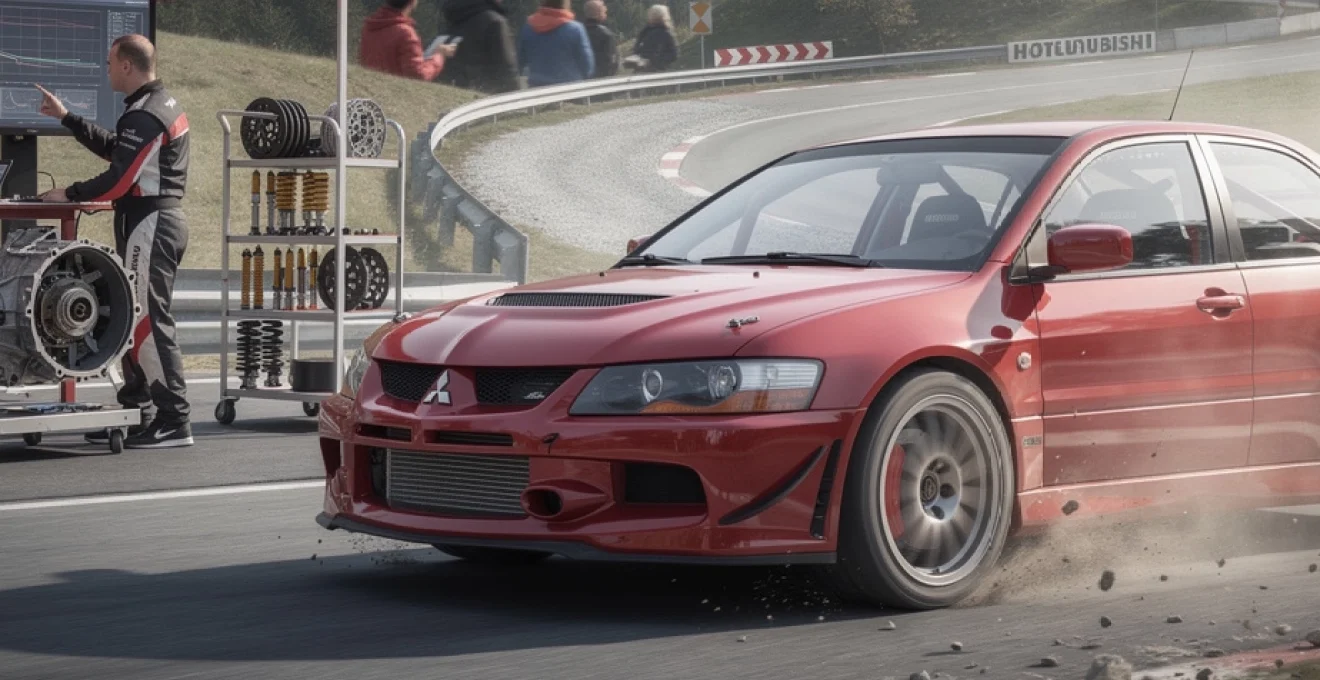
The Mitsubishi Lancer Evolution IX sits at a unique crossroads between old-school Group A aggression and more modern World Rally Car thinking. For many enthusiasts, it represents the last “pure” evolution of the classic 4G63T platform before the Evo X changed direction. If you care about authentic rally DNA, real mechanical grip and an all-wheel-drive system that feels alive beneath you, the Evo 9 remains one of the most compelling homologation specials ever built. Understanding how this car came to be, and how its technology connects directly to the stages, helps you appreciate why values are surging and why serious drivers still chase well-kept examples.
Evolution of the mitsubishi lancer 9 evolution from group A roots to WRC legend
From galant VR-4 to lancer evo I–III: early group A homologation strategy
The story of the Mitsubishi Lancer Evolution IX begins long before its 2005 launch, back in the Group A era with the Galant VR‑4. Mitsubishi’s first serious four-wheel-drive rally challenger combined a turbocharged engine with a rugged AWD system and quickly proved competitive. However, the Galant’s size and weight limited its ultimate pace, prompting a shift toward the lighter Lancer platform. That strategic decision gave birth to the Evo I–III, leaner machines that carried the same 4G63T turbo engine but wrapped it in a more agile chassis.
Homologation rules required manufacturers to sell road-going versions, which is why you can drive what is essentially a rally car in a suit. The early Lancer Evos used a classic Group A recipe: robust iron-block engine, mechanical differentials and relatively simple aerodynamics. You still see that DNA in the Evo 9’s architecture, especially in the way it delivers boost and traction on poor surfaces. For anyone looking to trace the Evo 9’s rally heritage, those early Group A Lancers show the template that was refined over more than a decade.
Evo IV–VI tommi mäkinen era and the transition from group A to world rally car regulations
The move from Evo III to Evo IV marked a fundamental shift. The engine rotated 180 degrees, the driveline layout changed, and the chassis gained a wider track and more aggressive suspension geometry. During the Evo IV–VI period, the car achieved iconic status in world rallying, taking multiple drivers’ titles with Tommi Mäkinen. Those victories were not just about power; they were about traction, stability and an ability to change direction brutally quickly on loose surfaces.
As the FIA prepared to move from Group A to World Rally Car rules, manufacturers gained more freedom in aero, suspension pick-up points and component materials. Mitsubishi responded by pushing the Lancer platform to its limits. The Evo VI Tommi Mäkinen Edition, considered by many as a high point in the road-car series, encapsulated that approach. Its success on the stages, and later at auction where it set record prices, underlined how closely the road versions mirrored works rally machinery in spirit and specification.
Influence of WRC technical rule changes (turbo restrictors, active diffs, aero) on evo 9 development
World Rally Cars were constrained by strict turbo restrictor sizes, typically 34 mm, which limited peak airflow and forced engineers to chase torque and drivability. That same philosophy appears in the Evo 9’s power delivery. Even if your Evo 9 is not literally running a 34 mm restrictor, many Group N and national-spec cars use similar setups, inspired directly by WRC regulations. The focus shifted from headline horsepower to broad, usable torque that would launch the car hard out of hairpins and tight chicanes.
Active centre and rear differentials also evolved under WRC rule changes, with tighter restrictions on active systems over time. Mitsubishi’s road-car technologies such as ACD and AYC mirrored what engineers had learned while racing within those constraints. Aero rules encouraged cleaner, more efficient bodywork, which influenced the Evo 9’s revised bumper design, rear wing profile and underbody flow. If you compare an Evo III to an Evo 9, the later car clearly shows the effect of a decade of incremental rule-driven refinement.
Factory ralliart and mitsubishi motors motor sports (MMSP) engineering programmes
Behind every successful Lancer Evolution generation stood the combined expertise of Ralliart and Mitsubishi Motors Motor Sports (MMSP). These factory and satellite programmes ran parallel: one focused on WRC, the other on Group N and regional championships. That dual-track development meant the Evo 9 benefited from a constant stream of engineering feedback from real stages in Europe, Asia-Pacific and beyond. The result was a car that worked equally well as a road-going performance sedan and as a base for full Group N competition builds.
Factory engineering programmes also fed data into production updates. Braking performance, cooling capacity and drivetrain durability all improved over the years, partly due to hard-earned lessons from long rallies and hot-weather events. If you plan to build a Lancer Evolution IX for tarmac or gravel competition, the clearest shortcut is to study those factory Group N specifications and FIA homologation papers. They provide a blueprint for what works under the harshest conditions.
4G63T powertrain architecture in the lancer 9 evolution and WRC-derived engineering
Twin-scroll turbocharger, intercooler layout, and anti-lag system concepts inspired by rally stages
The Evo 9’s 4G63T is the culmination of over a decade of rally-engine evolution. One of its most important upgrades is the factory twin-scroll turbocharger. By separating exhaust pulses from pairs of cylinders, the twin-scroll design improves turbine efficiency and reduces lag. On tight rally stages, where exits from second-gear hairpins can decide seconds, that faster spool provides a clear advantage. It also makes the car feel far more responsive on the road, even at modest engine speeds.
The front-mount intercooler layout reflects classic rally thinking: short charge pipes, efficient cooling and easy access for service. While the road-going Evo 9 does not ship with a full-blown stage anti-lag system, its turbo and manifold design are compatible with motorsport-grade ALS setups. Competition builds using rolling-bearing turbos, 34 mm restrictors and Motec-type ECUs often rely on 3–4 stage adjustable anti-lag. If you are considering such upgrades, treat heat management and turbo lifespan as critical engineering challenges rather than mere tuning details.
Forged internals, compression ratio, and ECU mapping differences between evo 9 and earlier evo VIII
Compared with the Evo VIII, the Lancer Evolution IX benefits from a revised compression ratio and stronger internals, supporting both improved factory performance and greater tuning headroom. Mitsubishi used forged pistons and robust rods to cope with sustained high boost pressures, just as Group N rally cars endure high-load operation for entire stages. The stock engine outputs around 286 hp (depending on market) but is engineered with a significant margin of safety when properly maintained.
ECU mapping is another key differentiator. The Evo 9’s calibration uses more sophisticated ignition and fuelling strategies, partly influenced by lessons from competition engines. This yields a more linear torque curve and better off-boost drivability. For you as an owner or tuner, that means a relatively simple remap can unlock substantial gains without sacrificing reliability, provided the supporting systems—fuel, cooling, lubrication—are upgraded in parallel. Many reputable tuners treat 350–380 hp at the crank as a realistic, durable target on stock internals.
MIVEC variable valve timing integration on the 4G63T and its impact on torque curve and spool
The big technical step for the Evo 9 engine is the adoption of MIVEC variable valve timing on the intake side. MIVEC allows the camshaft timing to advance or retard dynamically, optimising airflow at both low and high engine speeds. In simple terms, it lets the engine breathe like a smaller, responsive unit down low and like a larger, high-flow motor at the top end. This dual personality is central to the Evo 9’s everyday usability and on-stage flexibility.
On a gravel or tarmac rally, where gears and revs constantly change, MIVEC helps keep the turbo spooled and the engine in its sweet spot. The broader, flatter torque band reduces the need for frantic gear changes and provides more consistent traction. For a road car, the same technology translates into smoother part-throttle behaviour and slightly improved fuel efficiency when driven sensibly. If you compare an Evo VIII and Evo IX back-to-back, the 9 feels more eager from lower revs and less “on/off” in its delivery.
Cooling system upgrades, oil surge control, and lubrication solutions for gravel and tarmac rally use
High-performance turbo engines are only as strong as their cooling and lubrication systems. Under rally conditions, coolant and oil temperatures can exceed safe limits quickly if not managed correctly. The Evo 9 platform typically benefits from an uprated aluminium radiator, improved thermostats and high-flow fans, especially for track days or hill climbs in hot climates. Many competition cars also run enlarged intercoolers and ducting to maintain charge-air temperatures within a narrow window.
Oil surge is another major concern under high lateral loads. To protect the 4G63T, serious tarmac cars often adopt baffled sumps, oil coolers and sometimes accusump or dry-sump systems. For a fast road or mild track Evo 9, a quality baffled oil pan and frequent high-quality oil changes already reduce risk dramatically. Think of oil control as the car’s equivalent of a good hydration strategy for an endurance athlete: without it, even a strong engine will suffer prematurely.
AWD drivetrain, differential technology, and chassis dynamics on the lancer 9 evolution
Active centre differential (ACD) operating modes (tarmac, gravel, snow) and torque distribution logic
The Evo 9’s Active Centre Differential is one of its defining technologies. Instead of a fixed mechanical split, ACD uses an electronically controlled hydraulic clutch to vary torque distribution between front and rear axles. Modes such as Tarmac, Gravel and Snow adjust the base locking strategy to suit surface grip. On Tarmac, the system allows more slip to aid corner entry rotation, while on Gravel or Snow it increases lock for traction and stability.
From the driver’s seat, the effect is subtle but significant. You feel the car dig out of low-traction corners with an almost uncanny sense of grip. For rally drivers, being able to tailor the centre diff logic to each stage can save precious tenths per kilometre. For you as an enthusiast, understanding how these modes work lets you get more from the car in mixed conditions. A key tip: match tyre choice and pressures carefully to the chosen ACD mode for consistent behaviour.
Super AYC (active yaw control) rear differential, yaw moment control, and on-stage handling balance
Super AYC expands on the earlier AYC system by increasing torque transfer capacity across the rear axle. Instead of merely locking both wheels together, it can actively send more drive to the outer rear wheel to help rotate the car. The result is artificial “rear-wheel steering” generated by controlled torque bias. On a winding stage, this helps the Evo 9 attack apexes more aggressively without sacrificing stability on exit.
From a physics standpoint, Super AYC generates yaw moment—rotational force around the car’s vertical axis—whenever it senses the need for additional rotation. In practice, that means the Evo 9 can feel both neutral and agile, rather than understeery like many AWD sedans. If you are tuning suspension and alignment, treating Super AYC as an active partner rather than a background system yields better results. Setting the car too stiff or too tail-happy mechanically can fight the AYC strategy and reduce net performance.
Getrag 6-speed manual gearbox ratios, close-ratio gearing, and rally-style shift strategy
The Getrag 6-speed manual fitted to many Lancer Evolution IX models uses relatively close ratios designed to keep the engine in its boost window. Gear spacing is short enough that upshifts do not drop revs far, which is ideal for maintaining turbo pressure on a special stage. First gear is short for launches and hairpins, while sixth remains short by motorway standards, reflecting the car’s performance bias. It is not a long-legged cruiser but rather a tool for rapid point-to-point driving.
For clubman rally use, many teams upgrade to sequential gearboxes with column shifters and dog engagement, as seen in full Group A tarmac cars. Those units allow flat upshifts and rapid downshifts without the synchro lag of a road ‘box. However, for fast road and track use, the factory Getrag gearbox offers an excellent compromise of strength, shift quality and usability. A well-chosen final drive and careful shift strategy—short-shifting on loose surfaces, extending revs on tarmac—can transform stage times without major hardware changes.
Macpherson strut front, multi-link rear suspension geometry and rally-spec alignment settings
The Evo 9 chassis uses a familiar MacPherson strut front and multi-link rear suspension layout. While that sounds conventional, the geometry and pick-up points are tuned to deliver substantial camber gain and roll resistance. The platform responds strongly to alignment changes, which is why rally and track setups differ so markedly from factory street settings. As an analogy, think of the stock alignment as an all-round running shoe and a tarmac rally setup as a specialised racing spike.
For spirited road driving, a mild increase in negative camber, slight toe-out at the front and neutral to mild toe-in at the rear can significantly sharpen response. Tarmac rally cars typically run more aggressive camber and lower ride heights, along with stiffer springs and 3-way adjustable dampers. Gravel setups go the opposite way: higher ride height, softer rates and more compliance to absorb ruts and jumps. If you are building an Evo 9 for dual use, aiming for a compromise setup and using adjustable damping offers welcome flexibility.
Brembo braking system, brake bias tuning, and fade resistance for special stages
Brembo four-piston front and two-piston rear calipers are standard on the Lancer Evolution IX, paired with large ventilated discs. Out of the box, this system provides strong stopping power and decent fade resistance. Under repeated hard use, however, pad choice, fluid specification and cooling ducts become critical. Motorsport-grade pads with high-temperature compounds, fresh DOT 4 or DOT 5.1 fluid and stainless steel lines are highly recommended for track days or competition.
Brake bias is another powerful tuning lever. Adjusting the front-to-rear balance via pad selection, proportioning valves or pedal-box setups allows fine control over turn-in behaviour. More rear bias can help rotate the car under trail braking but increases the risk of instability in low-grip conditions. A balanced approach that suits your driving style and event type is essential. For many fast road users, simply upgrading pads and fluid, then learning to modulate pressure precisely, delivers all the braking performance needed.
Aerodynamics and body-in-white design: from lancer IX road shell to evo 9 rally weapon
The Lancer Evolution IX may share its basic shell with the standard Lancer, but the body-in-white receives extensive reinforcement and aerodynamic refinement. Mitsubishi’s engineers added bracing, thicker steel in key areas and strengthened suspension mounting points to cope with rally abuse. Compared with many compact saloons of its era, the Evo 9 offers noticeably higher torsional rigidity. That stiffness allows the suspension and differentials to work accurately instead of wasting energy flexing the shell.
Aero changes between Evo VIII and IX are more than cosmetic. The revised front bumper, splitter and undertray improve airflow to the radiator and intercooler while reducing lift at speed. The large rear wing is not just a styling cue; in tarmac trim, it can contribute meaningful downforce that stabilises the car above 100 mph. Rally cars often swap to lighter composite panels—bonnet, boot lid, bumpers—and add lamp pods, roof vents and gravel guards, turning the road shell into a purpose-built weapon. For a track or hill-climb build, similar lightweight and aero modifications can shave seconds from lap times while preserving the original silhouette that enthusiasts love.
| Feature | Road Evo 9 | Typical Rally Evo 9 (Group N) |
|---|---|---|
| Body panels | Steel with aluminium bonnet | Mix of steel, fibreglass & carbon |
| Downforce focus | Stability & cooling | High-speed grip & brake cooling |
| Weight | ~1,400 kg (market-dependent) | ~1,250–1,300 kg (event spec) |
For you as an owner, subtle aero upgrades—functional splitters, canards, diffusers—can deliver real performance benefits if paired with proper suspension tuning. However, aggressive styling without consideration for balance often leads to undesirable high-speed behaviour. Treat the body as part of a complete system, not a separate styling exercise.
Mitsubishi lancer 9 evolution in international and national rally championships
The Lancer Evolution IX enjoyed particular success in Group N and production-based rally championships around the world. While top-level WRC campaigns shifted towards bespoke World Rally Cars, the Evo 9 dominated classes that required closer adherence to production specifications. Statistics from several national series during the mid-2000s show Evo IX entries regularly filling more than 40% of Group N grids and taking a majority of class wins in some seasons. That level of participation reflects both performance and reliability in demanding conditions.
In regions like the Asia-Pacific Rally Championship and many European national series, Evo 9s competed fiercely with Subaru Impreza WRX STIs. Event results often illustrate how small setup differences or tyre choices made the difference between victory and defeat. For example, on tarmac rounds, correctly tuned ACD/AYC strategies and brake packages could swing stage times by several seconds over a loop. On gravel, suspension valving, ride height and differential mapping became critical. If you plan to campaign an Evo 9, studying historical pace notes and in-car footage from those championships provides invaluable insight into effective setups.
“Production-based rally cars succeed not just because they are fast, but because they can be driven at 95% of their limit all day without failing.”
That philosophy underpins the Evo 9’s reputation as both a competitive rally tool and a robust track-day car. Many examples have completed multiple seasons of national or regional championships with only routine rebuilds, highlighting the platform’s inherent toughness when maintained correctly and driven with mechanical sympathy.
Legacy, tuning culture, and collector market for the mitsubishi lancer 9 evolution
The legacy of the Mitsubishi Lancer Evolution IX is now firmly established, and the market has responded accordingly. Over the last five to seven years, sale prices for clean Evo 9s have risen sharply. Auction data from the UK, US and Japan shows some low-mileage or rare-spec cars appreciating by 40–60% over that period. Limited editions and cars with documented motorsport history, or pristine original-condition road cars, attract the highest premiums. A well-preserved Evo 9 now sits firmly in modern classic territory rather than simple used performance car status.
Tuning culture around the Evo 9 remains vibrant. The 4G63T engine, with its forged internals and MIVEC system, supports power levels well beyond stock when built correctly. Owners frequently target streetable 400–450 hp setups using upgraded turbos, injectors and ECUs, combined with strengthened clutches and improved cooling. For more extreme builds—600 hp and beyond—comprehensive engine work, fuel system overhauls and drivetrain reinforcement become essential. A sensible strategy is to set a clear power goal, then build the car as a balanced package rather than chasing peak figures alone.
- Define intended use: fast road, track day, tarmac rally or gravel rally.
- Set a realistic power target matched to budget and reliability expectations.
- Prioritise handling, braking and cooling upgrades before maximum boost.
- Plan regular inspection intervals for gearbox, diffs and suspension.
From a driver’s perspective, one of the Evo 9’s greatest strengths is how transparent and communicative it feels, even when heavily modified. Many modern performance cars rely on complex electronic aids that can numb feedback. In contrast, the Lancer Evolution IX uses its electronics to enhance an already capable mechanical core. That balance between analogue sensation and digital assistance is rare, and it explains why you may find the Evo 9 more rewarding than newer, theoretically faster machinery.
“A well-sorted Evo 9 behaves like an extension of the driver’s intent: think about the line and the car is already there.”
If you are considering joining the Evo 9 ownership community, several practical factors deserve careful attention. Rust in rear arches and chassis rails, worn AYC pumps, tired dampers and neglected timing belt services are common issues on cheaper examples. Pre-purchase inspections by specialists familiar with the platform pay for themselves quickly. Once you own the car, sticking to short oil-change intervals, regular drivetrain fluid changes and preventative maintenance on cooling and braking systems will preserve both performance and value.
| Aspect | Recommendation for Enthusiast Owners |
|---|---|
| Oil change interval | 5,000–6,000 miles (or yearly) with quality synthetic |
| Diff & gearbox fluids | Every 20,000–25,000 miles or after heavy track use |
| Timing belt service | Approx. 60,000 miles or 5 years, whichever comes first |
| AYC/ACD system checks | Annual inspection and fluid refresh as needed |
For collectors, originality is becoming increasingly important. Unmodified or lightly modified Evo 9s with full history files are already commanding significant premiums, and that trend is likely to accelerate as more cars are turned into high-power builds or dedicated competition machines. If you are more interested in driving than concours perfection, tasteful reversible modifications—bolt-on suspension, wheels, exhaust and ECU tuning—offer the best balance between enjoyment and future resale flexibility. Either way, the Mitsubishi Lancer Evolution IX remains a cornerstone of modern rally-derived performance, delivering a depth of engineering and driver engagement that continues to set benchmarks for all-wheel-drive sports saloons.