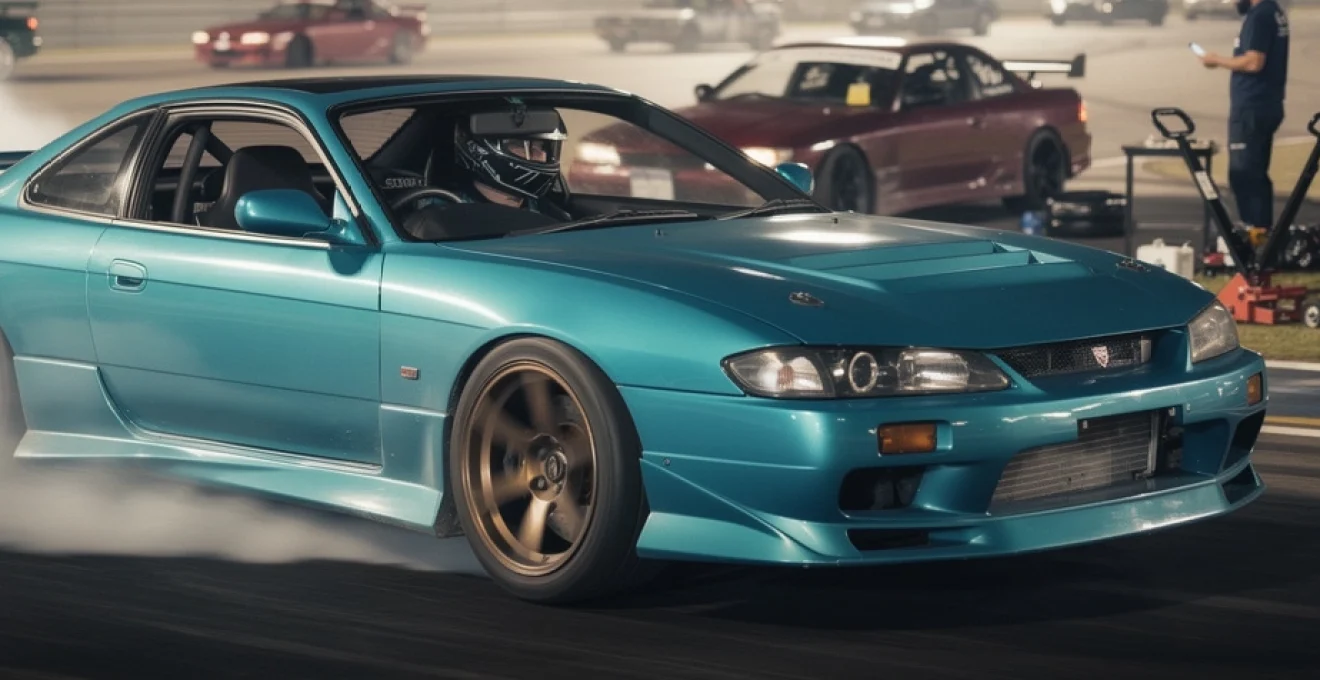
The Nissan 200SX S14 Silvia earned legendary status long before “JDM” became a mainstream buzzword. Lightweight, front‑engine and rear‑wheel drive, it offered the perfect base for affordable drifting at a time when purpose‑built competition cars were out of reach for most drivers. Today, clean S14s attract a serious drift tax, yet enthusiasts still hunt them down, rebuild them in cramped garages and send them sideways on circuits, mountain passes and airfield layouts across the world. If you are looking for a car that blends mechanical simplicity with huge tuning potential, the S14 Silvia sits near the top of any shortlist.
Part of the wider Nissan S‑platform family, the S14 combined a punchy turbocharged four‑cylinder, a balanced chassis and robust drivetrain into a package that still feels relevant. Whether your goal is grassroots practice days, competition drifting or a street‑driven track car, understanding how the 200SX S14 Silvia is put together helps you plan a reliable and enjoyable build instead of an expensive money pit.
Nissan 200SX S14 silvia overview: chassis codes, model years and UK vs JDM variants
Nissan launched the S14 generation Silvia in late 1993 in Japan, with European sales (badged as the Nissan 200SX) starting in 1994. Underneath the coupe styling, most cars share the same fundamental chassis, usually referred to by enthusiasts as S14 or S14a. In Japan, this platform continued the Silvia nameplate introduced in the 1960s, while in the UK the turbocharged version carried on the 200SX branding used by the earlier S13. Production broadly ran from 1993 to 1998 for Japan, with some markets selling stock into 1999.
Despite regional differences, all turbo S14 and S14a models used the 2.0‑litre SR20DET engine and a front‑engine, rear‑wheel drive layout. You might hear people talk about “Zenki” (early) and “Kouki” (late) cars; in practice, these terms describe the facelifts rather than a radical mechanical change. The essential recipe stayed intact: a relatively light shell, multi‑link rear suspension and a drivetrain that accepts power increases without immediate failure, at least if treated with some mechanical sympathy.
S14 vs s14a (kouki) identification: front-end design, lighting and aero differences
Spotting an S14 versus an S14a (often called Kouki) is straightforward once you know the front‑end changes. Early S14 models feature softer, more rounded headlights and a smoother front bumper, which gives the car a slightly understated 1990s GT look. In 1996–1997, Nissan introduced the facelifted S14a with sharper, more aggressive headlights and a more angular grille and bumper design that many enthusiasts associate with classic drift car styling.
Along with the headlight redesign, S14a models gained different indicators, side lights and in some markets a factory front lip or small aero revisions to reduce lift. The rear lights also changed to incorporate clear indicator sections and a subtle internal layout tweak. Mechanically, S14 and S14a models are broadly interchangeable, so you often see Kouki front conversions on earlier shells, especially on drift‑focused projects where visual impact matters as much as originality.
UK 200SX vs JDM silvia: SR20DET specs, emissions equipment and factory power ratings
The UK‑market Nissan 200SX S14 used a slightly different SR20DET configuration to many Japanese‑domestic‑market Silvia versions. UK cars typically carried a factory rating of around 200–205 bhp to satisfy emissions and fuel requirements, while JDM Silvia K’s models were quoted at approximately 220–250 ps depending on year and trim. These power differences came from ECU mapping, turbo specification, boost levels and the presence of more restrictive emissions equipment such as EGR systems and catalytic converters.
JDM models often benefitted from higher octane fuel, allowing more timing advance and slightly higher boost pressure safely. In practice, once you fit a freer‑flowing exhaust, uprated intercooler and a remap, both UK and JDM SR20DET engines end up in a similar power window. It is worth noting that many imported Silvias have already been modified, so if you buy used, you should inspect for non‑standard ECUs, boost controllers and aftermarket intake hardware before assuming stock figures.
Trim levels and options: touring, club, k’s, q’s, sunroof, LSD and ABS configurations
UK S14 and S14a 200SX models were commonly sold in “Touring” and “base” trim levels. Touring versions usually included leather seats, ABS, an LSD and sometimes a sunroof, while base models were slightly lighter but lacked certain comforts. In Japan, the Silvia line‑up followed the traditional Q’s (non‑turbo) and K’s (turbocharged) hierarchy, with optional aero packages, spoilers and different interior fabrics. The S14 was effectively based on the earlier S13 “King” package in coupe form, sitting at the top of the Silvia tree.
From a drifting perspective, factory LSD fitment and ABS presence are particularly important. Many UK Touring cars used a viscous LSD that works adequately for mild driving but becomes inconsistent once hot. Some drivers prefer non‑ABS shells for simplified brake setups and easier pedal modulation. If you value comfort or plan mixed road and track use, a well‑equipped Touring or Silvia K’s with air‑conditioning and sunroof can make a very usable dual‑purpose car without sacrificing drift potential.
Production timeline 1993–1999: key facelifts, running changes and regional differences
The S14 story starts in late 1993 with the introduction of the Zenki Silvia in Japan. European and UK markets received their first cars around 1994–1995, powered by the same basic SR20DET but tuned to local regulations. In 1996, Nissan rolled out the Kouki facelift (S14a), bringing revised lights, minor interior updates and, in some regions, tweaks to crash protection and emissions. Japanese production wound down by 1998 as the S15 Silvia prepared to take over.
Regional differences extended beyond power ratings. Some markets received additional underbody rust protection and different gearing, while others omitted safety features to keep costs down. As a result, the used‑car market today contains a patchwork of specifications: UK rust‑prone shells, low‑mileage but heavily modified JDM imports and European cars with unique option mixes. For anyone planning a long‑term drift build, starting with the cleanest shell available often matters more than chasing a particular year or minor equipment variation.
SR20DET powertrain: turbocharged four-cylinder tuning platform for drift applications
The 2.0‑litre SR20DET engine sits at the heart of the Nissan 200SX S14 Silvia’s appeal. Alloy‑headed, iron‑blocked and turbocharged from the factory, it responds extremely well to intake, exhaust and ECU upgrades. Stock power for UK cars hovers around 200 bhp, but a simple “stage one” package – free‑flow exhaust, uprated fuel pump, front‑mount intercooler and remap – reliably pushes output into the 260–280 bhp range on pump fuel. For most beginner and intermediate drifters, that level of power already feels more than lively enough.
Statistics from tuning houses across Europe suggest that well‑maintained SR20DETs often exceed 150,000 miles even when run at 300 bhp, as long as oil changes are regular and detonation is avoided. That blend of durability and tunability explains why this engine remains so popular in grassroots drifting, despite newer turbo four‑cylinders arriving from other brands. You can build a responsive, mid‑boost SR20DET that pulls out of corners strongly without the lag and weight penalty associated with large six‑cylinder swaps.
Black-top vs red-top SR20DET: internal components, compression ratios and reliability
When enthusiasts talk about black‑top and red‑top SR20DET engines, they usually refer to the colour of the cam cover, but the story is more complex. Early S13 Silvias featured “red‑top” SR20DETs with different port designs, compression ratios and ancillary layouts compared with later “black‑top” variants used in the S14 and S15. In factory trim, these differences affected torque delivery, turbo response and, in some cases, emissions performance. However, many S14 owners repaint their valve covers for aesthetics, so paint colour alone proves nothing.
Internally, S14 black‑top SR20DETs are robust, with forged‑style rods and pistons that comfortably handle moderate power increases. Compression ratios around 8.5:1 to 9.0:1 (depending on specific variant) allow safe boost on 98 RON fuel while maintaining off‑boost drivability. Some tuners argue that the earlier red‑tops offer a slightly more aggressive character, but for a street‑driven drift S14, the black‑top combination of reliability, parts availability and ECU support is usually the most sensible foundation.
T28 turbocharger, boost control and intercooler system on S14 and s14a models
Most S14 and S14a turbo models left the factory equipped with a Garrett‑built T28 turbocharger, a significant step up from the smaller units found on earlier S13s. This turbo provides a responsive boost curve suitable for circuit and drift use, spooling by around 3,000 rpm and holding useful pressure towards the redline. On a stock engine with proper mapping, the T28 comfortably supports 260–280 bhp, making it a strong starting point for a reliable “stock‑frame” build.
Factory side‑mount intercoolers and restrictive pipework do, however, limit intake temperature control during long drift runs. A front‑mount intercooler upgrade keeps charge temperatures stable, especially during summer events or repeated back‑to‑back laps. Pairing that with an electronic boost controller allows you to fine‑tune boost delivery, avoiding dangerous spikes that can damage the SR20DET under sustained high‑rpm sideways driving. Treat the turbo as a consumable component: track abuse and poor oil changes will eventually wear seals and bearings.
Common drift-focused SR20DET upgrades: garrett GTX turbos, nistune, link ECU and injectors
Once you move beyond a simple stage‑one setup, more serious SR20DET tuning revolves around turbo, fuel and ECU changes. Popular choices include modern Garrett GTX or G‑series turbos for improved response at 350–450 bhp levels, combined with 740–1000 cc injectors, uprated fuel pumps and adjustable fuel pressure regulators. These components let you run consistent mixtures under high load, crucial for engine longevity in competition drifting where throttle is often pinned for seconds at a time.
On the management side, solutions such as Nistune daughterboards, standalone Link ECU units or similar modern systems provide precise control over ignition timing, boost, launch control and protection strategies. A well‑tuned ECU setup can include knock monitoring and boost cut features that save engines from detonation or over‑boost events. For most S14 owners targeting 350 bhp, a balanced combination of turbo upgrade, 740 cc injectors and quality ECU tuning forms a sweet spot between power, response and cost.
Supporting hardware for sustained drifting: oil cooling, baffled sumps and aluminium radiators
Sustained drifting imposes unique stresses on the SR20DET, particularly in terms of oil and coolant control. Continuous high‑rpm operation and long lateral G‑loads can cause oil to surge away from the pickup, starving the engine of lubrication. To mitigate this, many drift‑prepared S14s run baffled sumps or additional oil control plates that keep oil where it belongs during sideways driving. An external oil cooler with a thermostatic sandwich plate further stabilises temperatures during hot summer sessions.
Cooling system upgrades carry similar importance. A performance aluminium radiator, higher‑flow electric fans and proper ducting ensure consistent coolant temperatures during repeated laps. Simple details like using quality coolant, bleeding air thoroughly and monitoring temperatures on a dedicated gauge often keep engines alive where neglected cars fail. Treat oil and cooling as non‑negotiable foundations before chasing headline power figures; a reliable 320 bhp drift car always beats a 450 bhp machine parked with a spun bearing.
Engine swap alternatives: RB25DET, 1JZ-GTE, LS V8 conversions in competition s-bodies
For drivers chasing higher power ceilings or a particular sound, engine swaps into S14 shells remain very popular. Straight‑six options such as Nissan’s RB25DET and Toyota’s 1JZ‑GTE deliver 400–600 bhp with relative ease, along with a broad torque curve ideal for third‑gear and fourth‑gear drifting. These swaps increase front‑end weight, so suspension tuning and corner weighting become vital to retain balance and steering feel. Gearbox and prop‑shaft modifications are also required, adding to cost and complexity.
In recent years, LS V8 conversions gained traction in competitive drifting due to their reliability, instant torque and relatively low maintenance demands. A well‑built LS‑powered S14 can run a full season on fewer spares than a high‑boost turbo build, which explains their dominance in some professional series. Nevertheless, for many enthusiasts, the character of a revvy turbo SR20DET still defines the Nissan Silvia drift experience, especially in grassroots and street‑legal builds.
FR layout and S14 chassis dynamics: why the silvia became a drift icon
The fundamental reason the Nissan 200SX S14 Silvia became a drift icon lies in its front‑engine, rear‑wheel drive architecture combined with a well‑sorted suspension design. The chassis strikes a rare balance: nimble enough for switchbacks, yet stable enough at higher speeds on fast circuits and highway on‑ramps. For anyone entering the “drift scene”, this mix of agility, predictability and parts availability feels like the automotive equivalent of starting with a quality, mid‑range guitar instead of a toy instrument.
From the factory, the S14 delivers a weight distribution of roughly 55/45 front to rear, which becomes even more neutral once unnecessary weight is removed and batteries or coolers are relocated. That distribution, combined with the relatively long wheelbase, allows progressive breakaway and smooth transitions – traits that inspire confidence when you are learning to link corners or experimenting with new entry techniques such as clutch kicks and feints.
Front-mid engine, rear-wheel drive architecture and 55/45 weight distribution
Although often described simply as “front‑engined”, the SR20DET in an S14 sits fairly far back in the bay, edging towards a front‑mid engine layout. This positioning keeps more mass inside the wheelbase, improving rotation and reducing the pendulum effect when the rear steps out. With around 55% of the weight on the front axle and 45% on the rear in stock trim, the car delivers reassuring turn‑in while still offering enough rear traction for controlled slides.
For drifting, that 55/45 balance offers a friendly learning platform. You can provoke oversteer with throttle or steering inputs, yet recover the slide without sudden, snappy behaviour typical of some shorter‑wheelbase cars. As you strip interior weight, fit bucket seats and perhaps relocate the battery to the boot, distribution often creeps closer to 53/47, bringing the feel even nearer to higher‑end sports cars built explicitly for track use.
Macpherson strut front and multi-link rear suspension geometry for controlled oversteer
The S14 uses a combination of MacPherson strut front suspension and a sophisticated multi‑link rear setup. While MacPherson struts are inexpensive and simple, Nissan tuned the geometry to deliver strong camber gain and steering feedback. Out back, the multi‑link arrangement allows the rear wheels to maintain a favourable contact patch under squat and roll, even when heavily modified with coilovers and adjustable arms.
This geometry translates into predictable breakaway characteristics. Under load, rear camber and toe curves help the car slide progressively instead of jolting into oversteer. For you as a driver, that means more time to catch the slide, adjust angle and apply corrections mid‑drift. Modern competition angle kits and arms build on this solid foundation, enabling extreme lock while preserving the core handling traits that made the S14 so popular in the first place.
Standard viscous LSD vs aftermarket 1.5-way and 2-way clutch differentials for drift
Many factory S14 and S14a models came fitted with a viscous limited‑slip differential. While acceptable for spirited road driving, these units overheat quickly in drift conditions, leading to inconsistent locking and surprise one‑wheel peels. For reliable, repeatable oversteer, most serious drift builds move to a mechanical 1.5‑way or 2‑way clutch‑type LSD. These diffs use friction plates to provide predictable lock during acceleration and, in the case of 2‑way units, during deceleration as well.
A 1.5‑way LSD often suits mixed road and track cars, offering strong forward traction while remaining slightly calmer under braking. A 2‑way LSD prioritises maximum lock for aggressive entries and transitions, which can feel nervous on wet roads but shines in competition. The difference in driver confidence is dramatic: with a quality diff, you can initiate earlier, hold more angle and apply throttle knowing both rear wheels will receive consistent torque.
Wheelbase, track width and steering angle characteristics compared with S13 and S15
Compared with the earlier S13, the S14 features a slightly longer wheelbase and wider track, contributing to greater high‑speed stability. Many drivers describe the S14 as the “grown‑up” Silvia: still playful, but calmer during big‑angle drifts in third and fourth gear. The later S15 sharpened responses further but remained relatively similar beneath the skin, sharing much of the same rear suspension architecture and drivetrain layout.
From the factory, steering angle on all S‑bodies is modest by modern drift standards. However, the S14’s geometry responds well to extended lower arms, modified knuckles and rack spacers, unlocking far more lock than stock. This extra angle reduces spin‑outs during aggressive entries and helps you recover from mistakes. Think of it as widening the safety net while retaining the underlying balance that made the chassis so approachable originally.
Suspension and steering modifications for competitive drifting in an S14
Transforming a road‑going Nissan 200SX S14 Silvia into a competitive drift car centres on suspension and steering upgrades. While power attracts attention, chassis setup determines how easily you can place the car on line, maintain angle and transition between corners. Modern coilovers, angle kits and adjustable arms allow you to tune handling much like a race engineer would on a professional car, albeit at a fraction of the cost. The goal is a setup that feels predictable enough to push hard without constantly fighting snap oversteer or sudden grip loss.
Drift-specific coilovers: spring rates, damper valving and ride-height setup
Drift‑specific coilovers form the backbone of any serious S14 suspension package. Compared with road‑biased kits, dedicated drift coilovers use stiffer spring rates and firmer damper valving to control body roll and weight transfer under aggressive inputs. Typical starting points range from 8–10 kg/mm front and 6–8 kg/mm rear springs for dual‑purpose cars, with competition builds running stiffer again. Adjustable damping lets you fine‑tune responses to specific circuits and tyre choices.
Ride height also matters. Slamming the car purely for aesthetics can ruin geometry, especially bump‑steer and roll centre. A practical approach keeps the car low enough to lower the centre of gravity and reduce roll, yet high enough to avoid constantly hitting bump stops. Corner weighting further refines balance by equalising diagonal loads, giving you consistent behaviour in both left and right‑hand drifts. Treat coilover setup as an ongoing process rather than a one‑time job.
Angle kits and knuckles: WiseFab, driftworks and HSD solutions for increased steering lock
One of the most transformative upgrades you can add to an S14 is an angle kit. Solutions from brands such as WiseFab, Driftworks and HSD re‑engineer lower arms, knuckles and tie‑rod positions to increase maximum steering lock while correcting issues like bump‑steer. Stock steering angle allows only modest drift angles, making it easier to spin if you mis‑judge entries. With a quality angle kit, you can hold much more extreme angles and still steer out of trouble.
Most kits also improve Ackermann geometry, so the inside and outside front wheels turn at more suitable angles for drifting. The result is smoother steering feel and more consistent front‑end grip. Combined with rack spacers and modified steering stops, a well‑chosen kit turns the S14 into a far more forgiving platform for both practice days and competition runs, particularly when linking tight technical layouts or shallow‑radius corners.
Adjustable arms and alignment: camber, caster and toe settings for initiation and stability
Once coilovers and angle kits are installed, adjustable suspension arms complete the package. Front tension rods, rear camber arms, toe arms and traction rods allow precise control over alignment settings, which is crucial for consistent drift behaviour. Think of alignment like the fine‑tuning of a musical instrument: small adjustments dramatically change how the car reacts under initiation, mid‑corner and transitions.
Typical drift‑oriented setups might use increased front caster for better self‑steer, moderate front negative camber for turn‑in grip, and slightly positive rear toe to stabilise the car under power. These values vary depending on driving style and tyre choice, so logging tyre wear and how the car feels over multiple events helps refine your personal baseline. A professional alignment with printouts is one of the best investments you can make once hardware upgrades are in place.
Bushes, subframe locking and roll centre correction for precise chassis feedback
Factory rubber bushes and soft subframe mounts contribute to comfort but dull steering feedback and rear‑end response. Over time, these components deteriorate, causing clunks, vague responses and inconsistent alignment. Replacing worn bushes with polyurethane or solid items, and fitting subframe locking collars or solid mounts, removes much of this slop. The trade‑off is increased NVH, but in a drift‑focused S14, the sharper feedback normally feels worthwhile.
Roll centre correction components, such as extended ball joints or revised knuckles, address the geometry issues that arise from lowering the car. These parts restore proper suspension angles, improving front‑end grip and reducing the tendency to understeer on corner entry. When combined with a good alignment and quality dampers, the S14 chassis starts to feel like a precision tool rather than an ageing road coupe.
Braking, wheels and tyre setups on drift-prepared nissan 200SX S14
Braking, wheel and tyre choices strongly influence how controllable an S14 feels on track. Factory brakes are adequate for light road use but struggle with the repeated high‑speed entries common in modern drift practice days. Many owners upgrade to larger front calipers from later Nissan models or aftermarket four‑pot setups, combined with performance pads and high‑boiling‑point brake fluid. A reliable handbrake – often converted to a hydraulic system for track use – remains essential for precise initiation and mid‑run line corrections.
Wheel dimensions and tyre selection define the car’s grip envelope. Common drift setups involve 17‑ or 18‑inch wheels with widths between 8J and 10J, wrapped in mid‑range performance tyres at the front and slightly harder compounds at the rear to balance slide controllability and longevity. Tyre pressures become a key tuning tool: higher pressures at the rear make initiating easier and reduce grip, while lower pressures add traction but can overheat tyres faster during long sessions.
| Component | Street/Practice Drift | Competition Drift |
|---|---|---|
| Front brakes | Uprated pads, braided lines | Big brake kit, race pads |
| Rear brakes | Stock with good pads | Hydraulic handbrake, dual calipers |
| Wheel size | 17×8–9J | 18×9–10J |
| Tyre type | Mid‑range performance | Semi‑slick front, harder rear |
Track data from drift events shows that consistent braking performance can shave several seconds off practice runs simply by allowing later, more confident entries. In the same way, carefully chosen tyre combinations reduce the number of “off‑line” corrections you need mid‑drift. Treat wheels and tyres as core tuning components, not just styling accessories, if you want your S14 Silvia to feel composed rather than chaotic at the limit.
Aero, cooling and weight reduction: track-ready S14 silvia body preparation
Aero, cooling and weight optimisation turn the S14 from a quick road car into a focused track tool. Body kits from BN Sports, Origin Lab, Vertex and other JDM brands do more than alter appearance; many designs widen track, vent hot air and reduce front lift at speed. For mountain passes or high‑speed circuits, front splitters and subtle rear wings help stabilise the chassis under sustained sideways loads, especially when strong crosswinds or elevation changes come into play.
Under the bonnet, ducting and venting matter as much as radiator and intercooler choice. Bonnet vents, front bumper cut‑outs and under‑trays encourage airflow through heat exchangers instead of allowing air to stagnate. Weight reduction strategies – stripping rear seats, sound deadening and unnecessary interior plastics – commonly remove 80–120 kg from an S14 without resorting to extreme measures. The result is a more responsive car that places less stress on brakes, tyres and drivetrain components.
Purposeful aero and intelligent weight reduction turn the S14 Silvia into a car that feels lighter on its feet and easier to catch when the rear steps out.
In competitive environments, composite panels, lexan windows and rear‑mounted radiators take this philosophy further, but for most enthusiasts, a measured approach retains enough comfort for occasional road use. Think of aero and weight reduction as ways to let your existing power and suspension upgrades work more efficiently, rather than as cosmetic afterthoughts.
Iconic drift builds and motorsport pedigree: S14 silvia in D1GP, BDC and grassroots events
The motorsport pedigree of the Nissan 200SX S14 Silvia stretches from early D1 Grand Prix days to present‑day grassroots drift matsuri events across Europe and the UK. During the late 1990s and early 2000s, Japanese demo cars showcased what was possible with the S‑platform, inspiring countless home‑built replicas worldwide. As professional series evolved, power levels and chassis modifications escalated, but the core silhouette of the S14 remained a familiar sight on start lines and in paddocks.
Recent statistics from club‑level drift organisers show that S‑body Nissans still account for a significant percentage of entries, even as newer platforms like the BMW E46 and Toyota GT86 gain popularity. The continued presence of S14 Silvias reflects not only nostalgia, but also the wealth of knowledge, parts and second‑hand components circulating within the community. For a driver building a budget‑conscious competition car, the ability to learn from decades of existing setups represents a major advantage.
Kazama auto and signal auto S14 demo cars in early D1 grand prix competition
Early D1 Grand Prix seasons featured several influential S14 Silvia demo cars from well‑known Japanese tuners. Machines from Kazama Auto and Signal Auto, among others, demonstrated how far the chassis could be pushed with cage work, mid‑400 bhp SR20DETs and refined suspension geometry. These builds ran aggressive aero kits, low ride heights and loud liveries that helped cement the S14’s image as a purpose‑built drift weapon rather than just a modified road coupe.
The tuning approaches showcased in those early D1 cars – emphasis on balance, response and driver feel rather than raw dyno numbers – remain relevant today. If you study footage from those seasons, you will notice how composed the S14s look mid‑drift, particularly during transitions and tandem battles. That composure comes from the same fundamentals available to you now: quality coilovers, mechanical LSDs, sorted geometry and engines built for usable torque rather than headline peak figures.
UK and european drift legends: phil morrison driftworks S14 and notable BDC builds
In the UK and wider Europe, the S14 and S14a 200SX became synonymous with the rise of organised drifting through series like the British Drift Championship (BDC). The Driftworks S14, famously piloted by Phil Morrison in the mid‑2000s, showcased how a well‑developed SR20DET‑powered car could compete at the highest national level. That car transitioned through several specification phases, from relatively simple turbo setups to more extreme power and chassis configurations as the sport evolved.
Across Europe, many notable BDC and regional builds adopted similar formulas: robust cages, 350–450 bhp engines, angle kits and distinctive aero styling. These cars inspired countless enthusiasts to save for their own 200SX S14 projects, often starting from tired road cars and transforming them in home garages over months and years. The enduring visibility of these builds online continues to drive demand, keeping the S14 firmly planted in the drift community’s collective imagination.
Street-legal drift s14s: BN sports, origin lab and vertex aero-clad silvia examples
Street‑legal drift S14s bridge the gap between competition machines and daily drivers. Many feature widebody kits from BN Sports, Origin Lab or Vertex, combined with functional stance – enough low and width for stability, but not so extreme that the car becomes undriveable on typical roads. These builds often retain full interiors, audio systems and heating, allowing owners to enjoy scenic routes to mountain passes or circuits before letting the rear tyres earn their keep.
For you as an enthusiast, this hybrid approach can be highly satisfying. A well‑set‑up, road‑registered S14 Silvia lets you explore “touge”‑style roads, drift‑friendly roundabouts and organised practice events without maintaining a separate trailer and tow vehicle. It embodies the spirit many associate with classic Japanese street culture: cars driven to the limit on real roads, then repaired, upgraded and personalised in small workshops and home garages late into the night.
Sim racing and pop culture representations: S14 silvia in gran turismo and initial D
The cultural impact of the S14 extends beyond real‑world circuits into sim racing and pop culture. Appearances in racing games such as Gran Turismo, Forza Motorsport and Assetto Corsa, often with downloadable drift tune presets, introduced entire generations to the Silvia platform before they were old enough to drive. In anime and manga, the S14 frequently appears alongside its S13 and S15 siblings in street racing and drift narratives, reinforcing its status as a go‑to sideways hero car.
The virtual S14 Silvia you practise with in sim racing titles closely mirrors the real chassis dynamics that made the car so beloved in grassroots drifting.
Sim racing provides a valuable training ground: you can experiment with virtual spring rates, alignment and power levels to understand how changes affect behaviour, then apply those lessons when setting up a physical car. This feedback loop between digital and real‑world drifting helps keep the Nissan 200SX S14 Silvia relevant, even as newer models enter both game garages and real paddocks. For any driver today, the S14 represents not just a car, but a long‑standing icon of accessible, controllable oversteer.