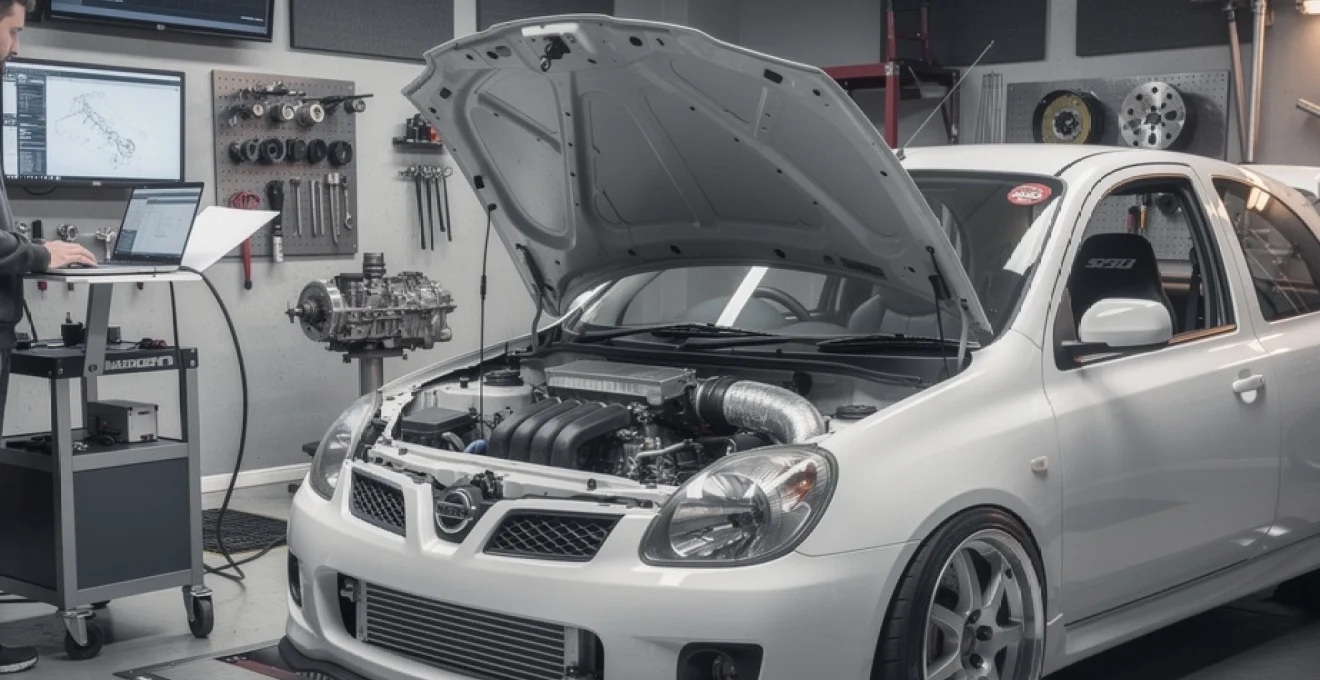
The Nissan March Super Turbo has become a cult icon for enthusiasts who appreciate tiny engines delivering big performance. With a kerb weight around 770 kg and a twincharged 930 cc engine, it combines old-school boost antics with the character of a classic hot hatch. For anyone chasing more power while keeping the car’s unique personality, the real challenge lies in extracting reliable gains from rare hardware rather than simply bolting on oversized turbos. If you want a March that can embarrass modern hot hatches yet stay drivable on the street, understanding the strengths and limits of the MA09ERT platform is essential.
Nissan march super turbo overview: factory specifications, MA09ERT engine and unique twin-charger layout
The Nissan March Super Turbo was built primarily for motorsport homologation in the late 1980s, with around 10,000 units produced for the Japanese market. Power comes from the all‑aluminium MA09ERT engine, a 930 cc SOHC eight‑valve four‑cylinder with a quoted output of about 110 bhp (81 kW) and 130 Nm. Considering the tiny displacement and modest 7.7:1 compression ratio, this equates to more than 115 bhp per litre, a figure that still looks respectable compared with many modern turbo engines. Pair that with the 770 kg chassis, and you get a factory 0–100 km/h time in the high seven‑second range, squarely in “giant‑killing” territory for the era.
The real party trick is the unusual twin‑charger arrangement. At low to mid rpm, the engine uses a positive displacement supercharger delivering up to roughly 7 psi for instant torque and minimal lag. Above about 4,500 rpm, a relatively large turbocharger takes over, pushing boost to around 13–14 psi while an electro‑magnetic clutch disengages the blower and opens a bypass route. The transition is surprisingly smooth for such an early system, and in everyday driving the car can feel docile off‑boost yet ferocious when the revs climb. For anyone considering tuning the Nissan March Super Turbo, this clever yet complex layout is both the biggest advantage and the main constraint.
Stock MA09ERT engine architecture and known tuning constraints
Forged internals, compression ratio and safe boost thresholds on the MA09ERT
The MA09ERT is often assumed to be indestructible simply because it is a motorsport‑inspired design, but the reality is more nuanced. The engine uses strong bottom‑end architecture with a short stroke and robust rods, yet factory pistons and ring lands are still over three decades old in every surviving car. The static compression ratio of around 7.7:1 is deliberately low to support combined supercharger and turbocharger boost, which helps tuning headroom but also means the engine can feel lazy if you remove too much low‑rpm assistance. For street builds targeting safe reliability, most experienced tuners aim to keep peak boost under 16–17 psi on pump fuel unless upgraded fuelling and intercooling are in place.
If you plan a high‑boost March Super Turbo build, think in terms of pressure ratio rather than arbitrary boost figures. Stock, the engine already sees an effective pressure ratio near 2.0 under full turbocharger load. Pushing beyond a 2.4–2.5 pressure ratio without internal upgrades and precise mapping risks detonation, especially as intake temperatures skyrocket. A sensible ceiling for a mostly stock long block is roughly 120–130 bhp with conservative ignition timing and good charge cooling. More is possible, but the margin for error rapidly narrows and tuning mistakes tend to be punished with cracked ring lands or head gasket issues.
OEM turbocharger and supercharger characteristics, boost response and flow limits
The factory turbo on the MA09ERT is relatively large for such a tiny engine, which explains its strong top‑end and the need for supercharger assistance at low rpm. The blower itself is a positive‑displacement unit designed to deliver instant boost from a light throttle opening, giving up to 7 psi almost as soon as you touch the pedal. This makes the car feel much punchier than a typical 930 cc hatchback, and in urban driving it can out‑accelerate many larger naturally aspirated engines purely through midrange torque. However, both the turbo and supercharger are dimensioned around the stock 110 bhp output plus a small reliability margin.
Once you start demanding higher flow rates, the standard turbocharger quickly becomes a restriction. It tends to run out of efficient compressor map around the mid‑teens psi, and trying to force more boost simply generates extra heat rather than real power. The supercharger, meanwhile, is speed‑limited and not designed to be spun significantly faster than stock for long durations. For moderate upgrades, optimising the control strategy and improving intake and exhaust flow can give noticeable gains without hardware changes. For higher power goals, especially beyond 150 bhp, both the turbo and blower will almost certainly need attention or replacement.
Fuel system capacity: injectors, in-tank pump and factory ECU fuelling strategy
From the factory, the Nissan March Super Turbo fuelling system is sized for roughly 120–125 bhp total capacity with a modest safety margin. OEM injectors are relatively small and operate at high duty cycle when the engine runs full boost at higher rpm. Decades of age do not help, and flow imbalance between injectors is common on untouched cars. The in‑tank fuel pump is also a weak link; once voltage drops under load or the pump gets hot, fuel pressure can sag, causing lean spikes under sustained boost. That is a recipe for detonation, especially when charge temperatures are already high.
The original ECU uses a fairly straightforward control strategy with limited resolution and no real‑time knock feedback by modern standards. Fuelling is mapped around the unique twin‑charger boost curve, and the engine management was never designed to cope with significantly revised airflow or boost levels. If you upgrade injectors and pump, you cannot rely on the stock ECU to self‑correct beyond a narrow window. For any build where you target more than about 120 bhp, a programmable solution or at least a well‑integrated piggyback becomes essential to maintain safe air–fuel ratios across the rev range.
Cooling system limitations: intercooler, radiator and charge temperature management
The March Super Turbo uses a compact top‑mount intercooler, which is adequate for short bursts of acceleration but quickly heat‑soaks in warm weather or during repeated pulls. Positioned above the engine, it absorbs radiant heat, so intake air temperatures can rise dramatically after only a few seconds of sustained high boost. This was acceptable for 1980s urban driving and one‑make racing with cool‑down laps, but it is a limiting factor for modern track days or spirited touge runs where you might do several hard pulls in close succession. High inlet temperatures also force any tuner to pull ignition timing, sacrificing power to protect the engine.
The radiator, meanwhile, was specified with budget hatchback duty in mind. When you increase boost and load, coolant temperatures can creep up, especially in traffic after a hard drive. At that point both engine oil and coolant are running hotter, undermining reliability. Upgrading to a larger front‑mount intercooler, improving ducting, and fitting a thicker aluminium radiator are three of the most effective thermal management steps for a tuned MA09ERT. Think of the standard intercooler and radiator as just sufficient for stock power, but marginal the moment you begin to push the twin‑charged layout harder.
Turbo and supercharger upgrades for the nissan march super turbo
Hybrid turbo options for the MA09ERT: upgrade cores, compressor wheels and housings
For many owners, a hybrid turbocharger is the most attractive option because it allows the retention of the factory twin‑charger architecture while unlocking extra flow. A typical March Super Turbo hybrid build might involve a larger billet compressor wheel in the stock housing, a clipped turbine wheel, and stronger bearings. This setup can comfortably support around 140–160 bhp with improved spool compared with a crude big turbo swap. You benefit from the OEM‑style fitment and avoid extensive fabrication, which is appealing if you want a reversible upgrade on such a rare engine.
When specifying a hybrid, aim for a compressor map that remains efficient in the 1.8–2.4 pressure ratio range, which corresponds roughly to 10–20 psi on the MA09ERT. Oversized turbos that only wake up beyond this zone will feel dead below 4,000 rpm, even with supercharger help. A well‑matched hybrid should keep intake temperatures down and reduce back‑pressure on the exhaust side. If you plan to exceed 160 bhp, a custom manifold and a fully modern turbo (such as a small ball‑bearing unit) might be worth considering, but at that point the character of the car starts to move away from the factory twincharged feel.
Supercharger pulley ratio changes, clutch control and twin‑charger synchronisation
Altering the supercharger pulley ratio is a straightforward way to increase low‑rpm boost and sharpen throttle response. A slightly smaller pulley will spin the blower faster, delivering more than the stock 7 psi in the lower rev range. However, the positive‑displacement design responds linearly to speed, so it is easy to overshoot safe levels and create excessive inlet temperatures. On a classic engine like the MA09ERT, that extra heat is often more harmful than the small power gain it might provide. If you decide to change pulley ratios, treat the modification as part of a broader package that includes improved intercooling and revised mapping.
The electro‑magnetic clutch that disconnects the supercharger at higher rpm is another critical component. If clutch engagement and disengagement are not synchronised with turbo spool and bypass valve operation, you can end up with flat spots or awkward torque transitions. Modern programmable ECUs can control a staged twin‑charger system far more precisely than the original management, allowing you to fine‑tune the rpm and load points at which the blower is active. Handled correctly, this lets you retain the instant punch off‑boost while smoothing the crossover to turbo power, making the car feel more like a contemporary twincharged hot hatch than a quirky 80s experiment.
Boost control strategies: wastegate actuators, boost solenoids and dual-stage setups
Stock boost control on the March Super Turbo is fairly basic, relying mainly on a mechanical wastegate actuator and the inherent characteristics of the turbo and supercharger. For higher power builds, a modern electronic boost control solenoid controlled by a standalone ECU or advanced piggyback gives far greater flexibility. You can map boost targets by rpm, throttle position and gear, which is invaluable on such a light, front‑wheel‑drive chassis prone to wheelspin. Dual‑stage or multi‑stage setups allow a conservative “street” mode and a more aggressive “track” or “drag” mode without physically changing hardware between runs.
Realistically, a tuned MA09ERT will operate somewhere between 12 psi for mild builds and 18+ psi for ambitious projects with supporting hardware. Managing the transition between supercharger‑only, twin‑charger overlap, and turbo‑only boost is the key challenge. Poorly coordinated boost control can cause turbo surge, compressor stall, or unpredictable torque steps that upset the car mid‑corner. A good tuner will log manifold pressure, turbo shaft speed (if available), and throttle position to refine the control tables. Think of this process as the digital equivalent of balancing two different engines under one bonnet.
Target power levels: 120 bhp, 150 bhp and 180+ bhp builds with supporting mods
Different owners will have different goals, so it helps to categorise Nissan March Super Turbo tuning into three broad targets. For a 120 bhp build, the focus should be on reliability and driveability: refresh the fuel pump, clean or lightly upgrade injectors, fit a freer‑flowing exhaust and intake, and improve intercooling. Stock boost can remain, with only minor tweaks to fuelling and ignition timing. This level retains almost all the original character while sharpening response and mid‑range torque. It also keeps stress on the ageing MA09ERT hardware comfortably within reasonable limits for regular use.
A 150 bhp build typically requires a hybrid turbo, larger injectors, a front‑mount intercooler, stronger clutch and at least a piggyback ECU with proper mapping. At this point the car becomes seriously quick given its low mass, and traction starts to be the limiting factor in first and second gear. Pushing beyond 180 bhp usually demands forged pistons, upgraded rods, a fully modern turbo solution and a full standalone ECU. This kind of power level is tractable on the road only with excellent boost‑by‑gear tuning and a capable limited‑slip differential. Owners pursuing 180+ bhp should think of the MA09ERT more like a motorsport engine with shorter service intervals than a fit‑and‑forget daily driver.
Engine management and electronics: ECU tuning solutions for the super turbo
Standalone ECUs (haltech, link, MegaSquirt) versus piggyback controllers
The original ECU was never designed to accommodate big changes in airflow, fuelling hardware or boost levels. Modern standalone ECUs such as those from Haltech, Link or MegaSquirt give full control over fuel, ignition, boost, and auxiliary outputs like the supercharger clutch and bypass valve. For serious twincharged Nissan March Super Turbo builds, a standalone solution is arguably the most future‑proof investment. It also allows you to add features like closed‑loop lambda control, knock monitoring and data logging, which dramatically reduce the risk of engine damage when pushing the MA09ERT beyond factory figures.
Piggyback controllers still have a place, especially for owners who aim for modest gains and want to retain some OEM behaviour. A well‑configured piggyback can intercept and adjust signals from airflow meters, injectors and ignition to fine‑tune fuelling and timing. However, on a twin‑charger system where the relationship between load, rpm and boost is non‑linear, piggybacks can become difficult to calibrate accurately across the full range. For builds targeting around 120–130 bhp, they can work acceptably. Once you move into 150+ bhp and twin‑charger timing becomes more critical, standalone management becomes increasingly attractive.
MAP sensor conversions, knock sensing and ignition timing optimisation
Many tuners choose to convert the March Super Turbo to a manifold absolute pressure (MAP) sensing strategy rather than relying on the original airflow‑based approach. MAP‑based load calculation is generally more flexible for boosted engines, especially when boost levels and turbo characteristics have been altered. It also simplifies plumbing, removes an ageing airflow meter from the intake tract, and can improve throttle response. With a standalone ECU, you can pair a high‑quality MAP sensor with an intake air temperature sensor to calculate a speed‑density model tailored to the MA09ERT.
Ignition timing on a high‑boost, small‑displacement engine is always a balancing act between performance and detonation safety. Knock sensing, whether via the ECU’s built‑in algorithms or external modules, is the primary safety net. For a tuned Nissan March Super Turbo, conservative timing under high charge temperatures and high boost is better than chasing the last 2–3 bhp at the risk of ring land failure. Tuning on modern 98 RON fuel allows more aggressive advance curves than period 80s petrol, but always validate timing under load with knock headphones or calibrated sensors. Detonation on such a small combustion chamber can destroy a piston in seconds.
Wideband AFR monitoring, datalogging and road versus dyno tuning workflows
A high‑quality wideband lambda sensor is arguably the single most important tool when tuning a MA09ERT engine. Controlling air–fuel ratios across the twin‑charger transition zone prevents lean spots that can easily go unnoticed on a narrowband gauge. Datalogging systems integrated with the ECU enable you to review boost, AFR, ignition timing and knock activity after each pull. Repeated measurement and refinement is how you turn a “roughly mapped” Super Turbo into a crisp, predictable performance car with consistent behaviour in all conditions.
Dyno tuning remains the safest way to explore the full load range and map steady‑state points. However, road tuning is equally important for a car that will spend most of its life on real streets rather than a dyno cell. Factors like heat‑soak, rising coolant temperatures in traffic, and varying fuel quality all influence how a tuned Nissan March Super Turbo behaves day to day. An ideal workflow uses the dyno for baseline calibration and power verification, followed by structured road logging to refine part‑throttle and transient response. In both cases, a trusted tuner with experience in small‑capacity forced‑induction engines is worth seeking out.
Boost-by-gear, launch control and flat-shift strategies for MA09ERT drivetrains
Given the car’s 770 kg weight and short wheelbase, outright boost is not always the limiting factor in real‑world acceleration. Traction often is. Boost‑by‑gear is an effective solution: by limiting boost in first and second gears, you can preserve driveline components and reduce wheelspin while still using full boost in third and higher. For example, setting first gear to 10 psi, second to 14 psi and the rest to 18 psi can deliver faster, more controllable acceleration than a single all‑gear boost target. This approach also reduces torque shock on the ageing gearbox, extending its life.
Launch control and flat‑shift (no‑lift shift) are tempting features for any turbocharged performance build, but they must be used carefully on the Nissan March Super Turbo. Aggressive launch strategies that build high boost at standstill can stress the clutch, driveshafts and gearbox beyond their design limits. If you choose to run launch control, set moderate RPM targets and keep ignition cut strategies conservative. Flat‑shift can shave time off upshifts on track, but repeated use on the street risks accelerated wear. As a general rule, map these functions as optional tools rather than relying on them for every traffic light sprint.
Drivetrain, suspension and braking upgrades to support higher output
CG10/CG13 gearbox swaps, LSD options (cusco, quaife) and clutch upgrades
The stock March Super Turbo gearbox was designed for a 110 bhp, 930 cc engine in period racing conditions, not for repeated modern abuse at tuned power levels. Many owners explore CG10 or CG13 gearbox swaps from later Micra models to gain stronger internals and better parts availability. These boxes can handle torque more comfortably and offer ratios that suit both daily driving and occasional track use. Any swap should be planned carefully, as driveshaft compatibility, mount positions and speedometer drive can all require attention. However, the long‑term benefit in durability is often worth the initial effort for a high‑power build.
A limited‑slip differential (LSD) is almost mandatory once power rises above around 130–140 bhp. Options from manufacturers such as Cusco or Quaife transform traction and front‑end grip, especially when combined with sticky tyres. An LSD also improves stability under power mid‑corner, allowing you to exploit the twincharged torque instead of simply spinning an inside wheel. Clutch upgrades are equally important: a quality uprated organic or ceramic clutch rated 30–40% above your target torque figure gives a sensible buffer. Over‑specifying the clutch with a very aggressive paddle setup can make daily driving unpleasant and shock the gearbox, so balance is key.
Coilovers, anti-roll bars and chassis bracing for circuit and touge setups
The March’s basic chassis architecture, including a beam rear axle, reflects its budget origins. That does not mean it cannot handle; it simply requires thoughtful suspension tuning. Decent coilovers with adjustable damping allow you to set spring rates and ride height appropriate for your intended use. Slightly stiffer rates at the front, combined with a well‑matched rear, can reduce understeer and help rotation. For fast road and touge driving, moderate lowering and good damper control are often more effective than extreme drops that ruin geometry and bump travel.
Upgraded anti‑roll bars and chassis bracing address the body flex and roll that the 1980s shell was never designed to contain. A front strut brace and underbody bracing at key points can give the steering a more precise feel and reduce mid‑corner “wobble”. However, stiffening everything without considering ride quality and tyre contact can make the car skittish on poor surfaces. A balanced package that respects the light weight and short wheelbase of the Nissan March Super Turbo is more rewarding than chasing maximum stiffness for the sake of appearance or spec sheets.
Brake conversions: vented disc upgrades, caliper swaps and pad compound choices
Braking is one area where period hot hatches often show their age most clearly. The March Super Turbo uses front ventilated discs and rear drums, a layout that was adequate for short sprints but marginal for repeated high‑speed stops. When power and speed increase, the first step should be quality brake pads matched to your driving style. Fast‑road compound pads can improve bite and fade resistance without needing a full big‑brake conversion. Fresh brake fluid with a higher boiling point and braided lines help maintain a consistent pedal under hard use.
For more serious use, larger vented discs and upgraded calipers are worth considering. Some owners adapt parts from later Nissan models, but careful attention to master cylinder sizing and brake balance is essential. Excessive front bias can actually lengthen stopping distances and destabilise the car into corners. Rear disc conversions exist, yet the gains on such a light car are mostly in pedal feel and aesthetics rather than outright stopping power. A well‑sorted front setup with correct pad choice, combined with good tyres, already delivers a dramatic improvement over the original 1980s specification.
Wheel and tyre fitment: lightweight 13–15 inch setups for grip and response
From the factory, the March Super Turbo rolled on 13‑inch alloy wheels with 175/65 tyres, which are extremely narrow by modern hot hatch standards. For a tuned car, moving to 14‑ or 15‑inch lightweight wheels allows a broader choice of performance tyres without compromising steering feel. Avoid excessively large diameters or heavy rims, as unsprung mass and rotational inertia can blunt the engine’s lively response. A 14×6 or 15×6.5 wheel with quality 185/55 or 195/50 tyres strikes a good balance between grip, comfort and feedback for fast road use.
Tyre choice is arguably more important than many mechanical upgrades because it defines the contact patch that translates twincharged power into actual acceleration. Ultra‑high‑performance summer tyres provide noticeably better traction and shorter stopping distances compared with budget rubber, especially in the wet. When combined with an LSD and well‑tuned suspension, they allow you to carry more speed through corners and exploit the MA09ERT’s wide torque band. Tyre pressures also deserve attention; small changes can significantly alter turn‑in sharpness and traction on such a light platform, so experimentation is worthwhile.
Reliability engineering and maintenance strategies for tuned nissan march super turbos
Preventing detonation and heat soak with improved intercooling and thermal management
Heat management is the single biggest reliability factor on a tuned, twincharged March Super Turbo. Detonation typically arises from a combination of high intake temperatures, insufficient fuelling and overly aggressive ignition timing. Upgrading to a front‑mount intercooler with proper ducting directly tackles intake temperature, often dropping charge temps by 20–30°C compared with the heat‑soaked stock top‑mount. Shielding the exhaust manifold and turbine housing with heat wrap or ceramic coating further reduces under‑bonnet temperatures that would otherwise soak into surrounding components and wiring.
Coolant system upgrades also play a vital role. A thicker all‑aluminium radiator, high‑flow thermostat, and a modern electric fan controller provide more stable operating temperatures under sustained load. Consider adding venting to the bonnet or improving airflow through the engine bay to enhance heat rejection. These changes are not just about preventing dramatic failures; they also preserve consistent performance. An MA09ERT that runs cool and knock‑free will deliver repeatable lap times and acceleration figures rather than one impressive run followed by a noticeable drop‑off.
Oil system enhancements: high-quality lubricants, coolers and catch cans
Oil is the lifeblood of any forced‑induction engine, and the March Super Turbo is no exception. High boost levels, elevated exhaust temperatures and the extra load of driving a supercharger place added stress on the lubrication system. Using a high‑quality synthetic oil with the correct viscosity rating for the climate helps maintain stable pressure and film strength. Regular oil changes at shorter intervals than factory recommendations are wise on a tuned MA09ERT; think in terms of 5,000–7,000 km for spirited use rather than extended service intervals suited to modern commuter cars.
An external oil cooler can be beneficial for track‑oriented builds, particularly in hot climates. By lowering oil temperature, you reduce oxidation and viscosity breakdown, which in turn protects bearings and turbocharger components. A well‑configured catch can system on the crankcase ventilation circuit helps prevent oil vapour and blow‑by from contaminating the intake charge and intercooler. This keeps combustion more consistent and reduces the risk of carbon build‑up and sludge formation, especially under frequent high‑boost operation.
Scheduled inspection points: boost leaks, belt condition and twin-charger hardware
Reliability on a highly stressed, 30‑plus‑year‑old engine depends on disciplined inspections as much as on clever upgrades. Boost leaks are a common issue; cracked hoses, loose clamps or ageing gaskets can all erode performance and upset fuelling by altering the actual versus measured airflow. Regularly pressure‑testing the intake tract is a simple yet powerful way to maintain consistent performance. Supercharger and accessory belts also merit close scrutiny. A worn or slipping belt can reduce boost, generate heat, and in the worst case strand you at the roadside.
The twin‑charger hardware itself requires periodic checking. Inspect the supercharger clutch for smooth engagement, listen for bearing noise, and monitor any unusual changes in boost onset. The turbocharger should be checked for shaft play and oil leakage, especially on higher‑boost setups. Exhaust manifold cracks and downpipe leaks not only affect performance but can also increase under‑bonnet temperatures. Approaching the car as a piece of motorsport‑grade machinery, with a checklist mentality, helps catch small issues before they escalate into major failures.
Common MA09ERT failure modes and preventative reinforcement techniques
Like any highly stressed small‑capacity turbo engine, the MA09ERT has a few characteristic weak points when pushed hard. The most commonly reported problems on poorly tuned or heavily modified engines include cracked piston ring lands, head gasket failures and worn big‑end bearings. These are usually linked to detonation, inadequate fuelling, or sustained over‑revving rather than inherent design flaws. Preventative measures include using quality head gaskets and head bolts during rebuilds, ensuring accurate torque procedures, and avoiding unnecessary rev limits beyond the power band where volumetric efficiency starts to drop.
Reinforcement techniques for serious builds can include forged pistons with stronger ring lands, upgraded connecting rods and improved bearing materials. Blueprinting the engine during a rebuild—checking clearances, balancing the rotating assembly and ensuring consistent compression across cylinders—provides a robust foundation for high‑boost operation. Treating the Nissan March Super Turbo’s powertrain as a system, where fuelling, cooling, lubrication and control all support each other, is the most effective way to enjoy increased performance without sacrificing the long‑term health of the rare and charismatic MA09ERT engine.