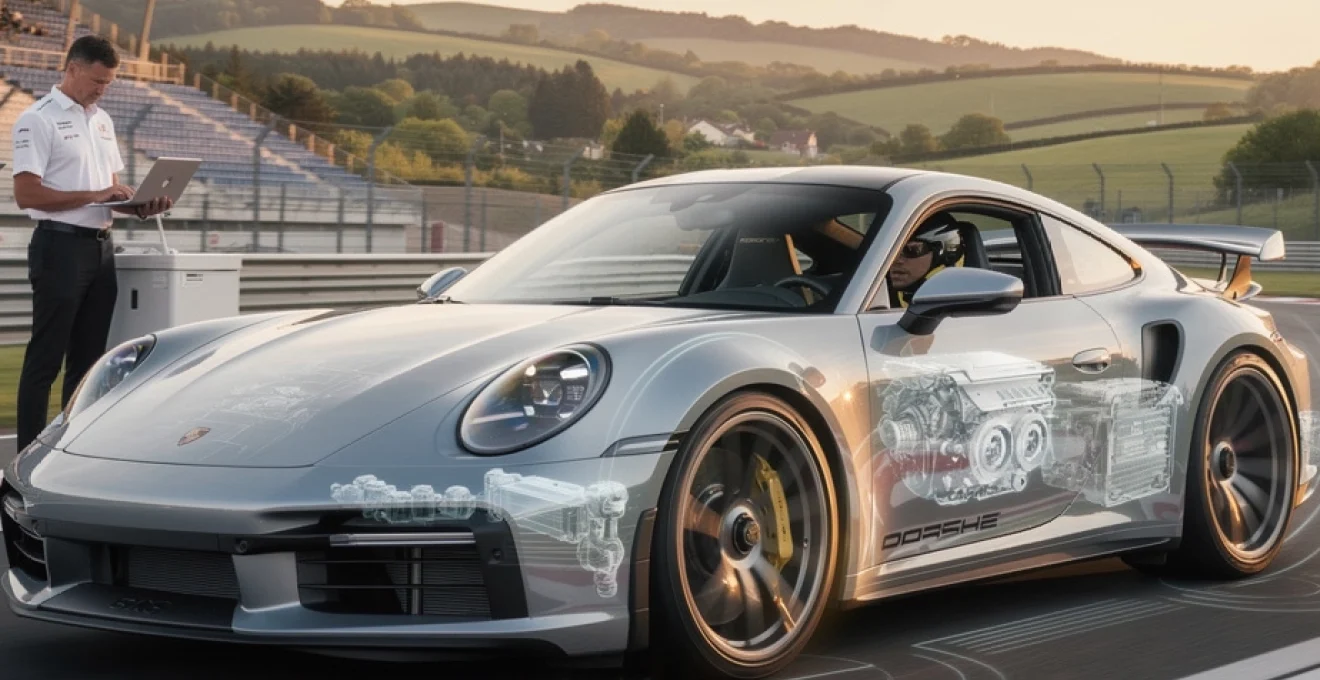
The Porsche 911 Turbo has long been the default answer to a very particular question: which car can crush a Nürburgring lap, dispatch a 200 mph autobahn blast and still tackle the daily commute in comfort? The new 992.2 Turbo S pushes that brief further, adding cutting‑edge hybrid tech, sharper aerodynamics and even more bandwidth between road and track. With 711 PS, 800 Nm and a Nürburgring Nordschleife time around 14 seconds quicker than its predecessor, this flagship 911 blends supercar performance with genuine GT usability. For anyone considering one car to do everything from wet laps at Hockenheim to long motorway runs, understanding how the 992.2 Turbo S behaves in detail is essential.
Porsche 992.2 turbo S powertrain architecture: engine, turbocharging and hybrid-assist strategy
3.8-litre twin-turbo flat-six evolution from 992.1 to 992.2: hardware changes, compression, internals
The heart of the 992.2 Turbo S is a heavily revised twin-turbo flat-six, now displacing 3.6 litres and paired with a 400 V hybrid architecture. Outputs climb to a system 523 kW (711 PS) and 800 Nm, a 61 PS increase over the previous Turbo S. That might not sound dramatic on paper, yet the way this engine delivers its power is transformed. Porsche has reworked the block and heads, integrated the hybrid hardware and eliminated the traditional belt drive for ancillaries, making space for a true dual exhaust layout that gives the car a more distinct, gruffer soundtrack under load.
Internal changes mirror high-end motorsport thinking. The combustion side is optimised for sustained high-load use, with reinforced internals and cooling passages designed to cope with track temperatures. Compared with the 992.1 Turbo S, the engine looks so different physically that it almost appears to belong to another platform altogether. The absence of conventional alternator, starter and belt-driven HVAC systems also reduces parasitic losses, allowing the flat-six to spin up more freely, particularly at the top end between 6,500 and 7,000 rpm where peak power is held.
Variable-geometry turbochargers, intercooler layout and charge-air cooling efficiency at sustained track loads
The 992.2 Turbo S continues the Turbo tradition of using innovative turbocharging hardware to set the pace. Porsche pioneered VTG (variable turbine geometry) on the 997 Turbo, and the latest car doubles down on responsiveness with e-turbo technology. Two electric exhaust-gas turbochargers replace the previous pair of conventional units. Each compressor is slightly smaller than before but can spin up to 20,000 rpm faster, and each carries an integrated electric motor/generator that can both accelerate the turbine and harvest energy when the engine is on boost.
For you on track, this translates into remarkably consistent charge pressure and cooler intake air temperatures during long stints. The reorganised intercooler and charge-air cooling layout, supported by active aero and cooling flaps, is optimised for sustained circuit use rather than just headline dyno numbers. Even under 20+ minute sessions at high speed, the system is designed to keep intake temperatures in a range that preserves power and prevents heat‑soak, a notable improvement on earlier generations where repeated hot laps could gently erode output towards the end of a stint.
48-volt mild-hybrid or e-boost integration (if adopted): torque-fill, launch control and overboost calibration
Unlike some mild hybrids that focus mainly on economy, Porsche’s T-Hybrid strategy is aimed squarely at performance. A 400 V lithium-ion battery and a compact electric motor integrated into the eight-speed PDK gearbox provide torque fill at low rpm. The system eliminates the traditional starter motor: the car simply “wakes up” instead of cranking, and the electric motor can add meaningful torque from the first throttle application. In daily driving, you feel this as instant response from idle, with none of the lag associated with older big-turbo engines.
During launch control, the hybrid system works with the e-turbos to deliver repeatable, near-violent standing starts. Porsche quotes 0–60 mph in about 2.4 seconds, though independent testing of the previous 992 Turbo S recorded 2.2 seconds; expectations for the 992.2 point towards similar or better real-world results. Calibrated overboost strategies give you a short window of maximum thrust for overtakes, while still keeping thermal loads within safe limits for repeated use on track days.
8-speed PDK dual-clutch transmission ratios, shift logic and thermal management on circuit use
The eight-speed PDK dual-clutch transmission is central to how the Turbo S feels both on road and circuit. Gear ratios remain tightly stacked for strong in-gear acceleration, with a relatively short second and third gear that allow the car to fire out of slow corners without dropping off boost. On fast circuits, fourth and fifth provide an ideal blend of flexibility and control, keeping the engine in its broad torque plateau from 2,300 to 6,000 rpm. The top ratios remain tall enough to enable a top speed around 200 mph while helping keep fuel consumption in check during steady motorway cruising.
On track, the PDK’s logic in Sport Plus is one of the biggest performance enablers. Shifts are close to instantaneous and the gearbox correctly anticipates downshifts under heavy braking, often selecting the lowest possible gear without bouncing off the limiter on corner entry. Thermal management has been uprated, with cooling circuits and software mapped for extended high-load use. For you, that means consistent shift quality and no noticeable degradation in response, even late in a session when engine, gearbox and hybrid systems are running at elevated temperatures.
Real-world performance metrics: 0–100 km/h, 0–200 km/h and in-gear acceleration against 992 GT3 and 991.2 turbo S
Headline performance remains staggering. Officially, the 992.2 Turbo S coupé covers 0–100 km/h in about 2.5 seconds and the quarter-mile in around 10.3 seconds. Given that the outgoing car has recorded 0–100 km/h in 2.4 seconds and 400 m in 10.1 seconds in independent testing, the new model is expected to shave a few tenths in the real world. More revealing is 0–200 km/h, which falls comfortably into the sub‑9 second bracket, putting it ahead of most rivals and leaving naturally aspirated models like the 992 GT3 trailing on straight-line pace.
In-gear acceleration is where the Turbo S feels almost surreal on road. From 80–120 km/h in a suitable gear, the car responds like a high-speed train, shrugging off inclines and overtakes with the casual ease of a 750S or 296 GTB. Compared with the 991.2 Turbo S, the new hybridised drivetrain delivers a broader plateau of torque and stronger response at the bottom of the rev range, even if the absolute difference in top-end punch feels more incremental from the driver’s seat.
Chassis dynamics and aerodynamics of the 992.2 turbo S on road and track
PASM adaptive dampers, PDCC active anti-roll and dynamic engine mounts tuning for nürburgring-level pace
The 992.2 Turbo S uses the latest generation of PASM adaptive dampers, optional PDCC active anti-roll control and dynamic engine mounts to deliver high-speed composure. The 400 V system powers a new chassis control brain that can react to surface changes in as little as five milliseconds. Over undulating roads, the effect is a sense of “glide” combined with sharp body control, allowing you to carry serious pace without the vertical bobbing associated with softer GT cars.
At Nürburgring-level speeds, where quick load changes can unsettle lesser cars, the combination of PDCC and fast-acting dampers keeps roll angles tightly in check. Engine mounts stiffen under aggressive driving to improve precision, yet relax in Normal mode to reduce vibration. The result is a chassis that comfortably supports the car’s 3,829 lb (coupé) kerb weight while still delivering lap times around 14 seconds quicker than its already rapid predecessor.
Rear-axle steering, front-axle geometry and wheelbase effect on turn-in and high-speed stability
Rear-axle steering remains a cornerstone of the Turbo S dynamic toolkit. At low to medium speeds, the rear wheels steer in the opposite direction to the fronts to virtually shorten the wheelbase, helping the car pivot into tight bends and hairpins. At higher speeds, the rears steer in the same direction as the fronts, effectively lengthening the wheelbase and greatly enhancing stability in fast sweepers and high-speed lane changes.
The front-axle geometry is tuned to work with this system, emphasising crisp turn-in without the nervousness that would normally accompany such agility in a rear-engined car. You can feel the front biting firmly while the rear calmly follows, a trait that inspires confidence in tricky conditions and encourages earlier throttle application out of medium-speed corners.
Active aerodynamics: adaptive front spoiler, rear wing profiles and underbody airflow optimisation
Active aerodynamics play a significant role in both performance and stability. The 992.2 Turbo S is about 10% more aerodynamically efficient than the previous model, thanks to revisions including active cooling flaps, a reprofiled rear diffuser and an evolved adaptive front spoiler. The rear wing now offers multiple profiles, balancing low drag for straight‑line speed with high downforce settings for corners and heavy braking zones.
Underbody airflow management has also been optimised. Movable flaps in the wheel wells and undertray help balance pressure zones around the car. This not only boosts efficiency but also improves brake cooling and intercooler performance. For you as a driver, the benefit is a car that feels firmly keyed into the tarmac at speed, without the need for the extreme wing angles and drag penalties seen on more track-centric models.
Track-specific setups: alignment (camber/toe), ride height and tyre pressures for circuits like spa and silverstone
Owners using the 992.2 Turbo S on track days at circuits such as Spa-Francorchamps or Silverstone GP will gain from a specific setup rather than running factory alignment. A slightly more aggressive front camber helps the car resist understeer in long, loaded corners like Pouhon or Copse. Mild rear toe-in provides stability on high-speed straights while maintaining good traction under power. Ride height can remain at the standard Turbo S level for mixed road/track use, but a modest drop within factory tolerances sharpens response further on smoother surfaces.
Tyre pressures are another crucial variable. Starting slightly above the recommended cold pressures and allowing for build-up during the first few laps avoids overinflation that can reduce grip and degrade tyre wear. On a cool day at Silverstone, for example, aiming for hot pressures in the low 30s psi range will usually yield a good compromise between lateral grip, braking performance and durability over a 20-minute session.
Tyre and wheel packages: michelin pilot sport cup 2 R vs pilot sport 4 S and their impact on lap times
The 992.2 Turbo S can be specified with a range of tyre options, but two stand out for performance use: Michelin Pilot Sport 4 S and Michelin Pilot Sport Cup 2 R. The PS4 S remains the ideal everyday choice, offering excellent wet grip, low noise and predictable behaviour in cold British conditions. For occasional track use, it is more than capable, but it will ultimately run out of grip earlier than a more aggressive tyre.
The Cup 2 R transforms the car for dedicated track days, offering substantially higher peak grip and improved steering precision. On a dry, warm circuit, lap time differences of 2–4 seconds per lap compared with PS4 S tyres are entirely realistic, particularly at demanding venues like the Nürburgring or Hockenheim GP. The trade-off is higher noise, greater sensitivity to temperature and reduced performance in the wet, so choosing the right tyre depends on how you balance everyday usability against ultimate pace.
Braking performance and thermal resilience in repeated circuit sessions
PCCB carbon-ceramic brake system: rotor dimensions, pad compounds and unsprung mass reduction
Standard on the Turbo S, Porsche Ceramic Composite Brakes (PCCB) are central to its track capability. Larger rotors and lightweight carbon-ceramic construction help cut unsprung mass, improving both ride and steering response. Rotors measure well over 400 mm at the front and are clamped by multi-piston calipers designed for consistent performance at very high temperatures. For you, that translates directly into shorter braking distances and more repeatable pedal feel across a session.
Pad compounds are chosen to balance cold bite on the road with high-temperature resilience on circuit. While not as hardcore as pure racing pads, the PCCB setup in the Turbo S tolerates repeated heavy stops from high speed far better than conventional steel discs. In daily driving, the reduction in brake dust and corrosion is a welcome side benefit, especially on cars used year-round in European climates.
Brake cooling ducts, airflow management and fade resistance during 20+ minute track sessions
Effective brake cooling is critical when a car repeatedly decelerates from 250 km/h or more. The 992.2 Turbo S integrates specific brake cooling ducts, using carefully sculpted front bumper inlets and underbody channels to direct airflow to the discs and pads. Combined with the active aero hardware, this airflow management allows the system to shed heat quickly between braking events.
On track, this translates into impressive fade resistance over 20+ minute stints. While any 400+ mm disc and high-friction pad combination will eventually reach thermal limits if abused, the Turbo S package keeps temperatures in a range that maintains firm pedal feel and consistent stopping power for the vast majority of enthusiastic drivers. For those planning particularly demanding use, such as multiple hot sessions in Mediterranean summer conditions, periodic cool-down laps remain advisable.
ABS and PSM calibration in track mode: trail braking behaviour and stability under threshold braking
Advanced driver aids contribute heavily to the confidence the 992.2 Turbo S inspires under braking. ABS and Porsche Stability Management are calibrated to work in harmony with PCCB, offering a finely judged balance between intervention and driver control. In Track-orientated modes, ABS allows a degree of slip at the tyre contact patch, helping you rotate the car slightly under trail braking without triggering abrupt corrections.
Threshold braking from very high speeds remains approachable even for non-professional drivers. The car tracks straight and faithfully follows steering inputs when you begin to release brake pressure approaching a corner apex. That composure makes it easier to exploit the Turbo S pace at circuits with heavy braking zones, such as Silverstone’s Stowe or Hockenheim’s hairpin.
Comparison of braking distances with 992 GT3 RS and 718 cayman GT4 RS
Compared with more focused siblings like the 992 GT3 RS and 718 Cayman GT4 RS, the Turbo S carries significantly more mass, yet its braking distances remain competitive. Independent testing of the previous 992 Turbo S registered 100–0 km/h stopping in the low 30-metre range, similar to a GT3 and better than many rival supercars. The 992.2, with its upgraded hybrid powertrain and refined PCCB system, is expected to at least match those figures.
The GT3 RS and GT4 RS still hold a small edge in ultimate stopping distances due to lower kerb weights and track-biased tyres, but for a car offering this level of luxury and everyday usability, the Turbo S remains within a remarkably narrow margin. For you on a track day, the limiting factor is rarely the brake hardware itself; it is more likely to be tyre choice, surface conditions and driver confidence in braking late enough.
AWD torque distribution and traction systems in the 992.2 turbo S
PTM all-wheel-drive control logic: front/rear torque split in wet, dry and mixed-grip conditions
Porsche Traction Management (PTM) gives the Turbo S its trademark all-weather capability. The electronically controlled multi-plate clutch distributes torque between front and rear axles in milliseconds, varying the split according to throttle position, steering angle and available grip. In dry conditions on the road, the system sends most power to the rear, preserving classic 911 handling traits while still using the front axle for stability and traction under heavy acceleration.
In wet or mixed-grip conditions, PTM reacts quickly to any slip, sending more torque forward to pull the car out of trouble. On a damp country lane in the UK, you can lean on the throttle earlier than expected, feeling the front tyres quietly help drag the car out of a corner while the rears continue to push. The effect is a blend of rear-engined character and all-wheel security that makes the Turbo S exceptionally fast even when the weather is far from ideal.
Launch control strategy, torque management and repeatability of sub-3.0 s launches
Launch control showcases the integration between engine, hybrid system, PDK and PTM. Once engaged, the car pre-loads the drivetrain, optimises clutch slip and torque distribution, then fires itself off the line with minimal drama. The combination of electric torque-fill, e-turbos at full readiness and all-wheel traction enables repeated sub‑3.0 second 0–100 km/h sprints with impressive consistency.
Torque management strategies are designed to protect the drivetrain while still giving you maximum acceleration. Power delivery is carefully ramped to avoid excessive wheelspin or axle tramp, even on less than perfect tarmac. Abuse the system repeatedly and thermal limits will eventually trigger a reduction in performance, but in typical enthusiast use, the Turbo S will deliver supercar-launches again and again.
Interaction of PTV plus, e-differential locking and rear-axle steering on corner exit traction
Porsche Torque Vectoring Plus adds another layer of sophistication to the way the Turbo S finds traction out of corners. By selectively braking the inside rear wheel and varying rear differential lock, the system helps the car rotate into the corner, then maximise grip on exit. Combined with rear-axle steering and PTM, the result is remarkable composure when you apply throttle earlier than feels reasonable.
On circuits with slow to medium-speed exits, such as Hockenheim’s stadium section or Silverstone’s Luffield, you can feel the car dig in and launch itself onto the next straight. Rather than simply smothering power to control slip, the electronics actively work to put as much of the 800 Nm to the ground as conditions allow, making the Turbo S faster and easier to drive for a wide range of skill levels.
Behaviour on low-friction surfaces: wet laps at hockenheim and country-road driving in the UK
Low-friction surfaces reveal how well the traction systems are calibrated. In heavy rain at Hockenheim or on a soaked British B-road, the 992.2 Turbo S remains impressively transparent to drive. Power delivery softens slightly in the lower modes, allowing you to exploit the car’s grip without feeling like the electronics are constantly cutting in. Subtle interventions nudge the car back into line when grip suddenly changes, such as crossing painted lines or patches of standing water.
For enthusiastic drivers, the ability to adjust the car with small steering and throttle corrections remains intact, even when PSM is left fully active. Select the more permissive settings and the Turbo S will allow mild, controllable slip angles on corner exit, giving you the satisfaction of managing the balance without risking a sudden loss of control.
On-road usability, comfort and grand-touring capability
Ride comfort in normal vs Sport/Sport plus, NVH levels and long-distance refinement
Despite the performance, the 992.2 Turbo S remains a consummate grand tourer. In Normal mode, PASM softens off, PDCC relaxes and the engine mounts ease their stiffness, giving a supple ride that copes well with patchy tarmac and motorway expansion joints. NVH levels are impressively low for a 700+ PS car, with wind and tyre noise well-contained and the hybridised flat-six humming away unobtrusively at cruising speeds.
Switch to Sport or Sport Plus and the car tightens around you, yet the ride never becomes punishing in the way of some track-specials. Long-distance drives across Europe, from UK motorways to Alpine passes, feel entirely plausible in a Turbo S packed with luggage and passengers. If you are coming from a GT3 or similar, the refinement difference will feel immediately apparent; the Turbo S trades some of that raw edge for comfort without losing its sense of connection.
Interior ergonomics, seating (18-way adaptive sports seats vs full buckets) and visibility in daily driving
The 992.2 interior blends technology with classic 911 ergonomics. Major controls sit exactly where you expect, and visibility remains excellent for a low-slung sports car. The driving position is a highlight: low, centred and with fine steering wheel and pedal alignment, making long stints less fatiguing. You sit “in” the car rather than “on” it, a subtle but important detail for both road and track confidence.
Seat choice plays a big role in daily usability. The 18-way Adaptive Sports seats offer wide adjustment and impressive support, ideal if you use the car as a daily driver or frequently share it with others of different sizes. Full bucket seats provide additional lateral support for hard track work but can feel less forgiving over rough surfaces and when climbing in and out frequently. For many UK owners, the adaptive seats strike the best balance between comfort and control.
Infotainment, driver-assistance systems and connectivity in real-world commuting
Modern connectivity and driver-assistance systems are integral to the Turbo S everyday appeal. The latest infotainment system brings a responsive touchscreen, clear digital instruments and integration with online services. Navigation, media and vehicle settings are logically arranged, so you can adjust chassis, exhaust or assistance settings without digging through endless sub-menus. It feels like a premium GT as much as a track weapon.
Driver aids such as adaptive cruise control, lane-keeping assistance and traffic sign recognition reduce fatigue when you are slogging through motorway traffic rather than carving up your favourite road. For commuting or business trips, the car behaves with the same ease and polish as a luxury saloon, yet a flex of the right foot reminds you that 711 PS is always on standby.
Fuel consumption, WLTP figures and real-world mpg on mixed motorway and b-road routes
Official WLTP fuel consumption for the 992.2 Turbo S sits around 11.7–11.5 l/100 km, with CO₂ emissions between 266 and 262 g/km. These numbers place the car firmly in the higher tax brackets, particularly in the UK, but the hybrid system does eke out efficiency gains compared with what such performance once required. In mixed real-world driving, combining motorway cruising with occasional B-road runs, owners can reasonably expect mid‑20s mpg in UK terms if restraint is shown.
Drive the car in the way the spec sheet encourages and consumption will rise sharply, but that is true of any 700+ PS supercar. The advantage of the T‑Hybrid layout is that it supports ancillary systems and improves low-speed efficiency without resorting to heavy plug‑in batteries or large electric-only ranges, keeping weight gain to around 85 kg over the previous model despite the additional hardware.
Track testing and comparative performance against key rivals
Lap times and telemetry analysis at nürburgring nordschleife, silverstone GP and hockenheim GP
On paper and in the real world, the 992.2 Turbo S sets a new benchmark for the everyday supercar. A Nürburgring Nordschleife time around 14 seconds quicker than the outgoing 992 Turbo S places it deep into territory previously reserved for track-focused machinery. At circuits like Silverstone GP or Hockenheim GP, telemetry shows the car gaining time primarily on straights and fast sweeps, thanks to its combination of power, all-wheel-drive traction and aerodynamics.
Cornering G levels remain extremely high for such a heavy car, particularly when equipped with Cup 2 R tyres and an aggressive alignment. Brake traces reveal strong, consistent deceleration deep into the braking zones, while throttle application points demonstrate how early you can use the power without overwhelming the rear tyres. Data-logging confirms the subjective impression: the Turbo S feels every bit as fast as the numbers suggest.
Against McLaren 750S and ferrari 296 GTB: straight-line performance and handling balance
Compared directly with rivals like the McLaren 750S and Ferrari 296 GTB, the 992.2 Turbo S holds its own in straight-line performance and often surpasses them in real-world conditions. While the McLaren and Ferrari may offer marginal weight advantages and slightly sharper circuit focus, the Turbo S counters with superior all-weather traction and usability. On a damp circuit or cold road, it is often the Porsche that pulls away first and continues to build a gap.
Handling balance differs subtly. The 750S and 296 GTB can feel more delicate at the limit, with a stronger preference for mid-corner adjustability and a touch more immediacy in turn-in. The Turbo S, by contrast, majors on stability and confidence. You can push very hard without the sense that the car is waiting to bite if you overstep. For experienced drivers, that calm competence becomes a major asset when chasing lap times consistently rather than just in hero laps.
Contrasting character with 992 GT3, GT3 RS and 991.2 turbo S for circuit-focused drivers
For circuit-focused drivers trying to choose between a 992.2 Turbo S and cars like the 992 GT3 or GT3 RS, the key question is what kind of experience you value. The GT models deliver a more raw, communicative, high-revving feel, with less mass and more mechanical grip from their bespoke suspension and aero packages. They are ultimately more rewarding for drivers who relish listening to every nuance of tyre and chassis behaviour lap after lap.
The Turbo S offers a different, equally compelling character: monumental pace delivered with less drama. Compared with the 991.2 Turbo S, the new car adds hybrid torque-fill, sharper responses and significantly higher agility. If you already own or have driven a GT3 extensively, the Turbo S might initially feel more aloof; spend time tuning setup and getting used to its pace, and the depth of capability becomes clear. For many owners, the idea of using one car for daily duties and occasional track days makes the Turbo S the more versatile option.
Braking, lateral G and tyre wear data from independent tests (sport auto, AutoBild sportscars)
Independent tests from specialist publications often quote figures such as 1.2+ g lateral acceleration on Cup 2 R tyres, 32–34 m 100–0 km/h braking distances and lap times that closely shadow or surpass dedicated track cars. Tyre wear data shows that the Turbo S is relatively kind on rubber considering its power, with even wear patterns when alignment and pressures are optimised. Heavier weight does consume front tyres faster under repeated heavy braking, but within the range expected for a 700+ PS AWD machine.
For you as an owner, these numbers translate into predictable running costs for track days. Cup 2 R tyres may last 3–5 hard days depending on driving style and circuit layout, while PS4 S rubber extends that window significantly. PCCB discs typically last for many tens of thousands of road miles and numerous track sessions, meaning replacement intervals are infrequent if the car is used sensibly.
Ownership, maintenance and track-prep considerations for the porsche 992.2 turbo S
Service intervals, consumables (tyres, pads, discs) and running costs for frequent track use
Owning a 992.2 Turbo S with regular track use in mind requires realistic expectations around maintenance and consumables. Service intervals align broadly with other high-performance 911 models, yet more frequent oil changes and inspections are advisable if you run repeated high-load sessions. Tyres represent the largest recurring expense: a set of PS4 S or Cup 2 R on Turbo S-sized wheels is a significant outlay, and enthusiastic track use accelerates wear, especially at the front.
Brake pads on PCCB systems tend to last longer than those on steel discs, but they remain a cost to budget for, particularly if you are fond of late braking. Ceramic discs themselves can deliver extremely long service lives as long as chips and cracks are avoided, reinforcing the importance of warm-up laps, cool-down laps and avoiding kerb impacts where possible. Fluid changes, particularly brake fluid with a high boiling point, are essential for maintaining performance and safety during hot sessions.
Recommended factory options for enthusiasts: sport chrono, lightweight package, clubsport kit
From a performance and track-prep perspective, certain factory options make the 992.2 Turbo S even more compelling. Sport Chrono remains highly recommended for access to the full suite of driving modes, performance displays and optimised launch control. Any available Lightweight or weight‑reduction package helps offset some of the hybrid-related mass, improving responsiveness without compromising structural integrity or warranty cover.
Clubsport-orientated equipment, where offered, adds features such as harness-ready seats or fire-extinguisher provision, useful if you intend to run frequent track days or club events. For UK owners planning occasional circuit work rather than full-time track usage, prioritising chassis options (PASM, PDCC, rear-axle steering) and suitable seats usually returns the greatest real-world benefit.
Aftermarket upgrades: suspension kits, exhaust systems and ECU calibration within warranty limits
Aftermarket tuning for the 992.2 Turbo S will inevitably expand, but the hybridised drivetrain and complex electronics require a cautious approach. Suspension kits from reputable suppliers can refine body control further or add adjustability for camber and ride height while remaining within sensible limits. High-quality exhaust systems may reduce weight and free some sound character without triggering errors, though noise regulations at many European circuits are increasingly strict.
ECU calibration is where restraint is most important. The factory 711 PS output already stretches traction and thermal envelopes. Significant power hikes risk pushing the hybrid system, turbos and cooling beyond their designed window, as well as compromising long-term reliability and warranty coverage. For most owners, focusing on setup, tyre choice and driver coaching will deliver bigger and safer gains on track than chasing headline dyno figures.
Resale values, depreciation trends and collectability relative to 992 GT models
Residual values for Turbo models have historically been strong, and the 992.2 Turbo S is unlikely to be an exception. While 992 GT3 and GT3 RS variants may enjoy slightly higher collectability among purists, the Turbo S appeals to a broader audience seeking a single car capable of fulfilling multiple roles. Early signs suggest demand comfortably outstrips supply, supporting firm used-market pricing in the short to medium term.
Long-term, potential buyers may differentiate between hybrid and non-hybrid eras of 911, just as some enthusiasts today favour hydraulic-steering 997 models over early electric-steering cars. For you as a current buyer, the 992.2 Turbo S offers a compelling mix of performance, technology and usability. Careful specification, sensible maintenance and thoughtful use on track and road will help preserve both enjoyment and value over many years of ownership.