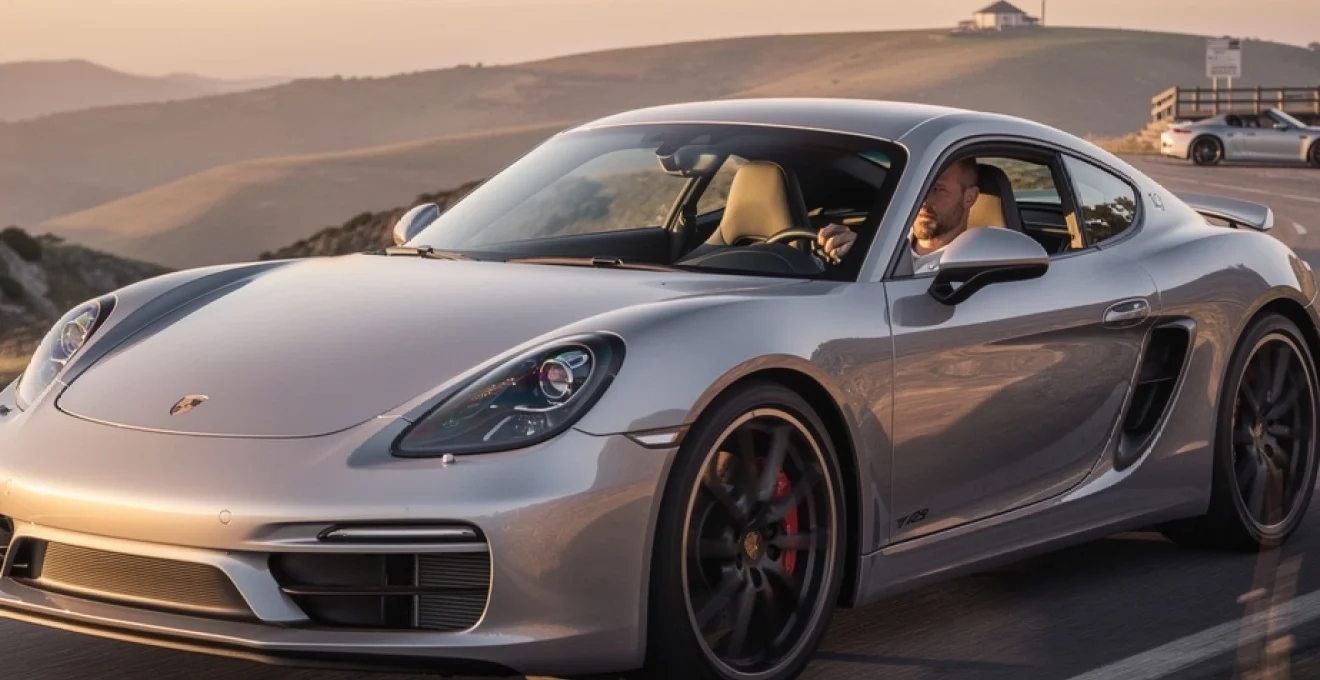
The Porsche Cayman 981 S sits in a rare sweet spot. It mixes mid-engined precision with everyday usability, pairs a naturally aspirated flat-six with modern safety systems, and delivers a driving experience that still feels analogue in an era of touchscreens and turbo torque. If you are looking for a sports coupé that can do track days, long motorway hauls and the school run with equal ease, the 981 Cayman S is one of the most complete choices on the used market. Values have stabilised as enthusiasts recognise it as the last six-cylinder Cayman generation before the four-cylinder 718 era, and its reputation for reliability and mechanical robustness continues to grow.
Porsche cayman 981 S overview: positioning in the porsche lineage and sports car segment
The Porsche Cayman 981 S arrived for the 2013 model year as the second-generation Cayman, sharing its aluminium-intensive platform with the 981 Boxster and 991-generation 911. Compared with the 987 Cayman S, it became longer in wheelbase, stiffer by around 40% in torsional rigidity and up to 30 kg lighter in equivalent specification. That engineering progress allowed Porsche to sharpen both comfort and handling, rather than forcing a compromise in one direction. In the brand’s hierarchy, the 981 S sat just below a base 991 Carrera in price, yet many testers felt it eclipsed the contemporary 911 for steering feel and chassis cohesion.
Within the wider sports car segment, the Cayman 981 S occupied a niche between purist machines such as the Lotus Evora and high-powered GT cars like the BMW M3 and early F-Type R. Period road tests often commented that on a typical British B-road, the mid-engined Porsche could carry speed with a flow and security that heavier front-engined rivals simply could not match. It also offered real-world practicality with two luggage compartments and a refined cabin, meaning you could treat it as a daily driver rather than a weekend toy.
Engine, flat-six character and performance figures of the porsche cayman 981 S
3.4-litre naturally aspirated flat-six (MA1) architecture, displacement and compression ratio
At the heart of the Cayman 981 S is the 3.4-litre MA1 flat-six, a horizontally opposed engine derived from the 991 Carrera family. Displacement is 3436 cc, achieved via a 97 mm bore and 77.5 mm stroke, and the compression ratio sits at a relatively high 12.5:1. Fuel is delivered by direct injection, and variable valve timing plus variable intake geometry ensure the engine breathes efficiently from low revs to the 7,400 rpm redline. Unlike earlier M96/M97 units, this MA1 architecture ditches the troublesome IMS bearing and bore-scoring-prone cylinder liners.
The engine is mounted just ahead of the rear axle in a transverse orientation, giving the Cayman its characteristic low centre of gravity and compact overhangs. Aluminium construction for the block and heads helps keep weight in check, while integrated dry-sump-style oil management offers consistent lubrication under sustained lateral loads. For a buyer coming from a turbocharged hot hatch or modern four-cylinder coupé, the mechanical refinement and smoothness of this naturally aspirated flat-six make a strong impression.
Power and torque delivery: 321 bhp, 370 nm and the 7,400 rpm redline in real-world driving
The official figures for the Porsche Cayman 981 S are 321 bhp at 7,400 rpm and 370 Nm of torque at 5,800 rpm. On paper, that does not sound outrageous by current standards, but real-world performance tells a more nuanced story. The torque curve is broader than the peaks suggest, with over 300 Nm available from just under 3,000 rpm and a steady build of power all the way to the limiter. This linear delivery means you can meter out acceleration precisely on a wet B-road or exploit the last 2,000 rpm on a track straight without an abrupt turbo spike.
In daily use, this flat-six feels flexible enough for relaxed commuting but clearly encourages you to explore the upper third of the rev range. Think of it less as a torque-rich muscle engine and more as a responsive, naturally aspirated powerplant that rewards commitment. On a flowing A-road, third and fourth gears cover most situations, and you will notice how the car loves to carry speed into corners rather than relying purely on straight-line thrust.
PDK vs 6-speed manual performance: 0–62 mph times, in-gear acceleration and launch control
The Cayman S offers a choice between a 6-speed manual gearbox and the 7-speed PDK dual-clutch transmission. Officially, the manual car reaches 0–62 mph in around 5.0 seconds, while the PDK with Sport Chrono and launch control trims that to approximately 4.7 seconds. Top speed is quoted at 176 mph for the manual and just under that for PDK due to gearing and drag. In practice, the difference you will feel more often is in-gear response and the way PDK can seamlessly drop multiple ratios under hard acceleration.
On a tight circuit or during overtakes from 40–70 mph, the dual-clutch box is quicker and more consistent, especially in Sport Plus mode where it holds lower gears aggressively. However, the manual offers a uniquely mechanical connection, with a precise, short throw and an ideal pedal layout for those who enjoy heel-and-toe downshifts. Many enthusiasts prefer the manual not because it is faster, but because it makes every journey more involving and turns each well-executed shift into a small satisfaction.
Exhaust systems and sound: standard sports exhaust vs porsche sports exhaust (PSE) acoustics
Sound is a huge part of the Cayman 981 S experience, and the factory offered both a standard exhaust system and the optional Porsche Sports Exhaust, often referred to as PSE. Even the base system delivers a classic flat-six timbre, with a metallic yowl above 5,000 rpm that few modern turbo engines can match. For many buyers, though, PSE is the must-have option. It introduces a switchable valve that alters back pressure and routes gases through less silencing under load, giving a deeper idle, crisper mid-range bark and a more aggressive top-end wail.
From inside the cabin, PSE-equipped cars feel more alive without descending into drone on the motorway. It is common for used buyers to prioritise this option, and retrofitting an OEM or quality aftermarket exhaust has become a popular upgrade. If you enjoy the idea of a naturally aspirated engine that really “comes on song” at high revs, the PSE system enhances that character significantly and adds to the overall sense of drama.
Fuel consumption, CO₂ emissions and reliability trends of the 981 S powertrain
Despite the performance on offer, the 3.4-litre Cayman S is reasonably efficient. Official combined fuel consumption figures sit in the 32–34 mpg range for the PDK and just below that for the manual, though most owners report real-world averages closer to 27–30 mpg with mixed driving. CO₂ emissions are quoted at 188 g/km for a PDK-equipped Cayman S, which was impressive for a 174 mph sports car at launch and still competitive today.
Reliability of the 981 S powertrain has been a strong point. The MA1 engine family has not shown the systemic issues that afflicted early 987s, and there are few widespread mechanical failures reported. Routine servicing every two years or 20,000 miles, spark plugs around 40,000 miles and PDK fluid changes roughly every six years keep the drivetrain healthy. Some owners experience ignition coil failures or air-conditioning condenser corrosion over time, but these are wear items rather than fundamental design flaws, and high-mileage examples continue to prove robust when maintained correctly.
Mid-engined chassis balance and handling dynamics of the cayman 981 S
Mid-engine layout and weight distribution compared with 911 carrera 991 and boxster 981
The 981 Cayman S uses a mid-engined layout with the flat-six positioned just ahead of the rear axle, giving a weight distribution of roughly 46:54 front to rear. Compared with a rear-engined 991 Carrera, which typically sits closer to 38:62, the Cayman offers a more neutral balance and a slightly lower polar moment of inertia. The result is a car that rotates willingly into a corner yet remains stable if you trail the brakes or adjust the throttle mid-bend.
Against its open-top sibling, the 981 Boxster, the Cayman benefits from a stiffer, closed roof structure that further improves torsional rigidity. The coupé body also tends to generate less wind noise and subtle aerodynamic advantages, making the 981 S feel a touch more precise on fast, undulating roads. Many experienced drivers describe the car as “telepathic” in the way it responds to small steering and throttle inputs, a quality that becomes obvious when you switch from a more nose-heavy front-engined sports car.
Steering feel and front-axle precision: electro-mechanical rack, geometry and alignment setups
Porsche moved to electro-mechanical steering assistance for the 981 generation, replacing the older hydraulic racks. Early scepticism soon faded as owners discovered that the Cayman’s steering remained one of the benchmarks for feedback and accuracy. The rack is relatively quick but not nervous, and the geometry yields a strong sense of front-tyre contact even in poor conditions. For British B-roads with their cambers and patchy surfaces, that clarity encourages you to commit with confidence.
Alignment setup plays a big role in how sharp the front axle feels. A factory-standard geometry is already excellent, but if you plan regular circuit use, a mild increase in negative camber at the front and rear can make turn-in even crisper and improve mid-corner grip. Think of geometry changes as a fine-tuning tool rather than a fix; the underlying chassis is so well balanced that only small adjustments are usually needed to tailor the car to preference.
Suspension configuration: MacPherson struts, PASM adaptive damping and anti-roll bar tuning
The Cayman 981 S uses MacPherson struts at each corner, combined with carefully tuned anti-roll bars and coil springs. While “MacPherson” might sound basic, the execution here is anything but. The long wheelbase, wide tracks and low centre of gravity allow the suspension to work smoothly over bumps without excessive roll. Standard passive dampers already provide an excellent compromise between comfort and control on UK roads that can be both lumpy and fast.
The optional Porsche Active Suspension Management, or PASM, adds adaptive damping with Normal and Sport modes. PASM tightens body control in fast direction changes and reduces pitch under hard braking, yet in Normal mode can be surprisingly compliant over broken surfaces. Anti-roll bar tuning helps maintain composure without making the car feel skittish; there is just enough roll to communicate weight transfer, which is invaluable if you want to explore the chassis at and beyond the limit.
Tyre and wheel packages: 19-inch vs 20-inch, pirelli P zero vs michelin pilot sport 4S grip characteristics
Factory wheel sizes for the Cayman 981 S typically span 19 and 20 inches. On 20s, the car certainly looks more aggressive, and with the right tyres offers formidable lateral grip. However, on poor-quality tarmac you may prefer the slightly more forgiving ride of 19-inch rims, especially if you combine them with PASM. Many UK owners consider 19s with adaptive damping the sweet spot for daily usability and weekend fun.
Tyre choice matters just as much as wheel diameter. Original equipment often included Pirelli P Zero or similar high-performance rubber. More recently, many owners have moved to Michelin Pilot Sport 4S, which tend to offer better wet grip, progressive breakaway and improved longevity. For a driver who enjoys spirited back-road runs plus occasional track days, the right tyre can transform confidence. It is worth budgeting for a full set of premium N-rated tyres when evaluating a used example.
Braking system: 4-piston aluminium monobloc callipers, disc dimensions and fade resistance on track
The Cayman S features 4-piston aluminium monobloc calipers front and rear, clamping ventilated steel discs. Front disc diameters are typically 330 mm, with slightly smaller rears, giving substantial thermal capacity for road use. Pedal feel is firm and consistent, with short travel and excellent modulation, making it easy to trail-brake into a corner or subtly shed speed mid-bend without unsettling the chassis.
On track, fade resistance is generally very good for a standard road car, especially if the fluid is fresh and the pads are in good condition. For repeated lapping at circuits with heavy braking zones, switching to a higher-temperature pad compound and performance brake fluid is a sensible upgrade. Some owners also opt for additional cooling ducts, but for most drivers, the stock braking package provides more than enough stopping power with reassuring repeatability.
Transmission, drivetrain and differential technologies in the cayman 981 S
6-speed manual gearbox ratios, shift mechanism feel and clutch engagement characteristics
The 6-speed manual gearbox in the 981 S has become something of a benchmark among modern sports cars. The lever action is tight and short, with a well-defined gate that makes missed shifts rare when you are pushing hard. Ratios are relatively long, especially in second, which can see more than 80 mph at the limiter, but they are spaced to keep the engine within its broad power band on fast roads or longer autobahn runs.
Clutch engagement is progressive and light enough for stop-start commuting, yet offers enough feedback at the bite point for precise launches on track. For those who enjoy the process of driving as much as the outcome, this manual transmission adds a layer of interaction that modern automated gearboxes cannot fully replicate. It is one reason why manual 981 S models often attract a small premium on the used market among enthusiasts.
7-speed PDK dual-clutch logic, sport plus calibration and manual mode responsiveness
The optional 7-speed dual-clutch gearbox transforms the Cayman S into an extremely rapid and effortlessly fast machine. In normal mode, PDK shuffles unobtrusively into higher gears, chasing economy and refinement. Switch to Sport or Sport Plus, especially in cars equipped with the Sport Chrono Package, and the mapping becomes much more aggressive, holding gears close to the limiter and downshifting smartly under braking.
In manual mode, shift times are effectively instantaneous, with paddles offering a tactile click that encourages frequent use. Launch control, available with Sport Chrono, uses an optimised traction algorithm and preloaded clutches to deliver repeatable 0–62 mph sprints close to the quoted 4.7 seconds. If you intend to track the car regularly or value effortless cross-country pace, PDK offers clear advantages, while still allowing full manual control when you are in the mood.
Porsche torque vectoring (PTV) and mechanical limited-slip differential behaviour on road and circuit
Porsche Torque Vectoring, or PTV, was an option on the Cayman S and combined selective rear-brake intervention with a mechanical limited-slip differential on manual cars. Under cornering, PTV can lightly brake the inside rear wheel, helping the nose to turn and improving agility. The mechanical LSD then ensures traction as you feed power in, reducing single-wheel spin and allowing you to drive off tight apexes more assertively.
On a dry road, you will notice PTV as a subtle willingness to rotate under throttle, rather than any dramatic slide. On circuit, especially in slower corners, the system allows you to exploit the chassis balance at higher slip angles with a safety net in place. There is a small trade-off in rear-brake wear due to the torque vectoring function, but many drivers consider PTV one of the most valuable dynamic options for an enthusiast-focused 981 S.
Traction and stability systems: PSM, ABS and intervention thresholds in spirited driving
Porsche Stability Management (PSM) and ABS work in the background to keep the Cayman’s impressive performance accessible to a wide range of drivers. PSM constantly monitors steering angle, yaw rate and wheel speeds, subtly trimming power or applying individual brakes when necessary. Importantly, the calibration allows a noticeable degree of slip and rotation before intervention, especially in Sport mode, so you still feel in charge when driving briskly on a favourite road.
For track days, you can partially or fully disable PSM, though it will still step back in under extreme conditions such as emergency braking with ABS. This layered approach means you can gradually explore the limits of grip and balance, gaining confidence without feeling smothered by electronics. In damp or cold conditions, PSM becomes an invisible ally, preventing simple mistakes from escalating while still letting the flat-six and mid-engined layout shine.
Interior ergonomics, driving position and usability in daily use
Seat options: standard sports seats, adaptive sports seats plus and bucket seat support
The cabin of the Porsche Cayman 981 S reflects a focus on driving without sacrificing comfort. Standard sports seats offer good lateral support and a broad range of manual adjustment, suiting a surprising variety of body shapes. For buyers who value long-distance comfort and fine-tuning, the adaptive Sports Seats Plus add electric adjustments, adjustable side bolsters and, in some cases, memory functions.
For more track-oriented use, lightweight bucket seats, similar to those seen in GT models, were available in certain markets. These dramatically increase lateral support and give a more focused feel, but can be a compromise in daily use, particularly if you are tall or frequently climb in and out in tight parking spaces. When shopping used, it is worth sitting in each seat type to gauge suitability, as the right seat can make the difference between a merely good and an outstanding driving position.
Cabin ergonomics: steering wheel adjustment, pedal placement and visibility over the front wings
Ergonomically, the 981 Cayman S hits a sweet spot that many taller drivers appreciate. The steering wheel adjusts for both reach and rake over a generous range, and the pedals are aligned naturally with the driver’s seat, avoiding the offset sometimes found in older sports cars. The centre console rises gently to meet the dashboard, placing key controls within easy reach while giving a subtly cocooned, cockpit-like feel.
Visibility is excellent for a low coupé. You sit low between the axles, yet can clearly see the front wings, which helps when placing the car on narrow country lanes or clipping an apex at a track day. Rearward vision is adequate, though the mid-engined layout naturally limits rear glass height; well-adjusted mirrors become important when merging or reversing. Overall, the Cayman S feels like a car designed by people who drive quickly themselves.
PCM infotainment, navigation and connectivity limitations in the 981 generation
The 981 generation uses Porsche Communication Management (PCM) with an integrated touchscreen, offering navigation, media playback and Bluetooth connectivity. By current standards, the interface feels dated, with modest screen resolution and comparatively slow response times. You can, however, stream music via Bluetooth and handle calls easily, which covers the majority of everyday needs. Some later cars gained incremental software updates that improve usability slightly.
If you are coming from a newer vehicle with wireless CarPlay or Android Auto, PCM may feel like a step back. Many owners choose to retrofit modern head units that integrate seamlessly into the dashboard while providing current connectivity standards. For purists or those keen to preserve originality, the standard PCM remains perfectly usable for navigation in Europe and the UK, even if the graphical polish falls short of current expectations.
Practicality: front and rear boot capacity, cabin storage and long-distance touring comfort
One of the Cayman 981 S’s most underrated qualities is practicality. With a front boot (“frunk”) and a rear boot above the engine, total luggage capacity exceeds that of some compact hatchbacks. The front compartment is deep enough for several soft bags or even garden-centre trips if you happen to need four bags of compost, while the rear shelf and boot space easily swallow weekend luggage for two people.
Inside, storage includes door pockets, a lidded cubby under the armrest and small trays around the centre console. Long-distance touring is aided by low wind noise, solid sound insulation and a stable, planted ride at motorway speeds. With the standard or PASM suspension in Normal mode, the Cayman S is perfectly capable of crossing a continent without leaving you fatigued, making it a very viable choice as an only car if you can live with two seats.
Option packs, special equipment and notable porsche cayman 981 S configurations
Sport chrono package: dynamic engine mounts, performance displays and lap timing
The Sport Chrono Package is one of the most desirable factory options for the 981 Cayman S. Beyond the distinctive dashboard stopwatch, it introduces dynamic engine mounts that stiffen under load, reducing drivetrain movement and sharpening turn-in under hard cornering. It also adds extra driving modes, including Sport Plus on PDK cars, which further sharpens throttle response, gearbox mapping and PSM thresholds.
For track-day use, Sport Chrono provides onboard lap-timing functions and performance displays, allowing you to monitor acceleration runs or sector times. The dynamic mounts, in particular, make the car feel more tied down when pushing hard, yet soften in relaxed driving to maintain refinement. If you are choosing between two similar cars on the used market, the presence of Sport Chrono often tips the balance in favour of the better-equipped example.
Porsche active suspension management (PASM) vs standard suspension for UK b-roads
The decision between PASM and standard suspension is especially relevant for UK buyers facing broken tarmac and undulating rural routes. Standard steel springs and passive dampers already offer an impressive blend of compliance and control, and on 19-inch wheels can feel almost ideally judged. For many owners, particularly those who favour simplicity and lower replacement costs, the non-PASM setup is more than sufficient.
PASM, however, adds flexibility. In Normal mode, it can ride more softly than the passive car, taking the edge off sharp ridges and potholes, while Sport mode reins in body movement on smoother surfaces or circuits. The trade-off is higher replacement cost for adaptive dampers should they fail or suffer damage. If you regularly mix commuting with weekend blasts and occasional track days, PASM remains a very attractive option, especially paired with 19-inch wheels and quality tyres.
Sport design package, aero kits and factory body styling enhancements
The 981 Cayman S could be specified with various factory styling packages, including the Sport Design package and more overt aero kits. These add features such as a more pronounced front splitter, a different rear diffuser and sometimes a fixed rear wing, echoing the look of the GT4 while remaining more subtle. Visually, these options sharpen the car’s stance and can slightly improve stability at high speeds by reducing lift.
From a used-buying standpoint, tasteful factory styling packages often enhance desirability without the resale complications that can come with aftermarket body kits. When inspecting a car with aero additions, ensure that all components are genuine Porsche items and that paint quality matches the rest of the bodywork. Well-executed Sport Design elements can make a 981 S feel a little more special every time you walk up to it.
Interior trim options: leather packages, alcantara and porsche exclusive manufaktur details
Interior personalisation is another area where the Cayman S can feel genuinely bespoke. Extended leather packages cover the dashboard, door tops and centre console in fine hide, lifting perceived quality significantly over the already solid standard cabin. Alcantara trims on the steering wheel, gearlever and seat centres not only look purposeful but also improve grip, particularly if you drive enthusiastically with bare hands rather than gloves.
Porsche Exclusive Manufaktur (previously Exclusive) offered custom stitching, unique colour combinations and special inlays, allowing you to tailor the interior to an individual taste. On the used market, subtle, well-chosen options such as contrast stitching, embossed headrests or carbon trim can enhance appeal and make a car stand out without feeling gaudy. When you are sitting behind the wheel for hours, the tactile quality of leather, Alcantara and solid switchgear plays a bigger role than any spec sheet figure.
Used market analysis, common issues and buying advice for the porsche cayman 981 S
The Cayman 981 S has become one of the most sought-after modern Porsches on the used market, thanks to its naturally aspirated flat-six, mid-engined balance and strong reliability record. Prices vary widely depending on age, mileage, condition and specification. In many regions, higher-mileage cars now sit in the mid-£30,000s, while low-mileage, well-optioned examples can stretch significantly higher. Manual cars with Sport Chrono, PASM, PSE and PTV tend to command premiums, as do rare colours and tastefully optioned interiors.
When considering a used example, focus first on service history. A full record from Porsche main dealers or respected independents, with evidence of correct oil-change intervals, spark plug replacement and, for PDK cars, transmission fluid changes around six years, is essential. Examine brakes, tyres and suspension carefully; worn dampers or tired bushings can dull the car’s superb chassis. Brake discs should not show heavy lips or scoring, and all tyres should be a quality N-rated brand with at least 3 mm of tread and no sidewall damage.
Common age-related issues include stone chipping on the nose and side intakes, peeling headlight UV coatings and air-conditioning condenser corrosion behind the front grilles. Interiors are generally hard-wearing, though some cars show shrinkage of leather dash tops or minor trim rattles. Electronic gremlins are rare but can include faulty alarm modules or sticking exhaust valves on PSE systems. A pre-purchase inspection by a marque specialist, including a diagnostic scan using Porsche’s PIWIS system, provides valuable reassurance and can reveal over-rev data or mileage discrepancies.
If you plan regular track work, budget for enhanced pads, fluid and perhaps additional geo tuning to maximise the car’s natural potential. For predominantly road use, a well-maintained, largely standard Cayman 981 S already offers a deeply satisfying blend of performance, involvement and everyday usability. Choosing carefully, prioritising documented maintenance and driving several examples back-to-back will help you identify the car whose condition, specification and driving feel best match how you intend to use this exceptionally balanced sports car.