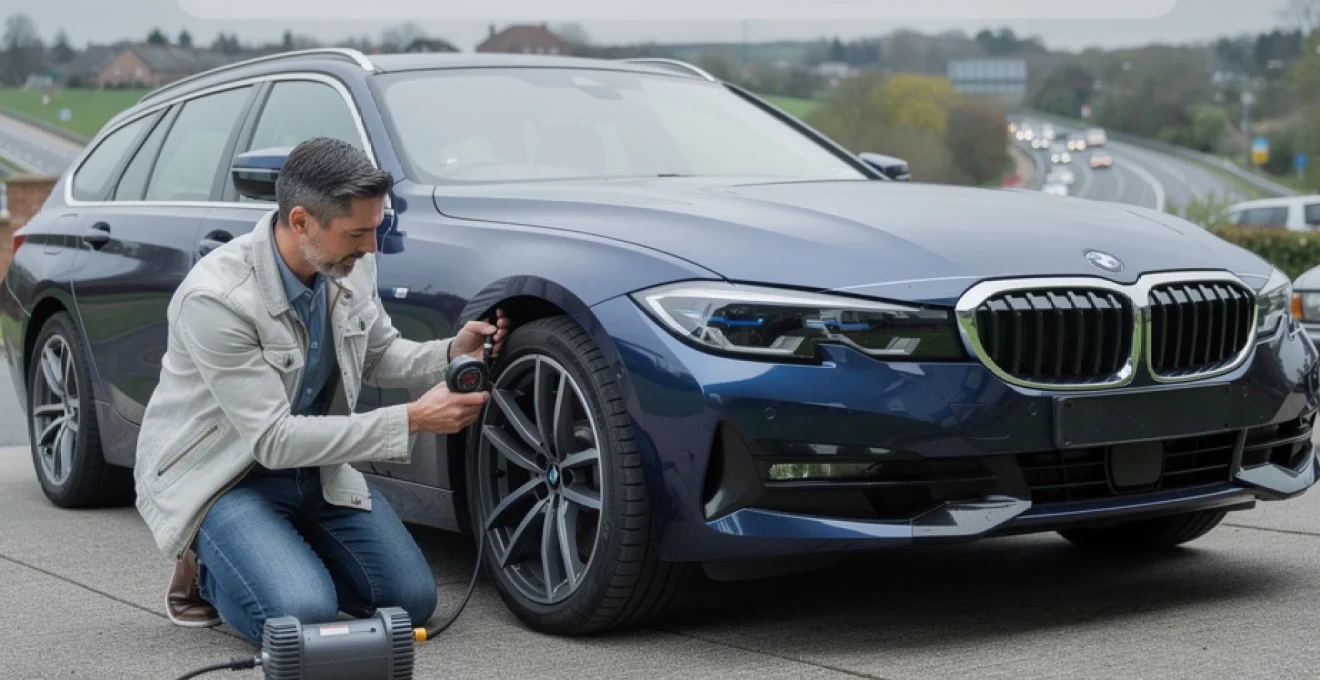
Your BMW 320d can feel sharp, safe and efficient, or vague, noisy and thirsty, depending on one simple setting: tyre pressure. A difference of just 3–4 psi can change braking distance, motorway stability and how long a set of tyres lasts. For a diesel saloon or touring that often mixes town use with long motorway runs, getting tyre pressures right is as important as regular servicing. Tyres naturally lose around 0.1 bar (1.5 psi) per month, so if you leave them unchecked, the car gradually becomes less precise and more expensive to run. Understanding the recommended tyre pressure for a BMW 320d by model, wheel size, load and driving style helps you keep the car feeling “right” every time you drive it.
Factory‑specified tyre pressures for BMW 320d by generation (E90, F30, G20)
BMW 320d E90 (2005–2012) front and rear tyre pressure chart for 16–18 inch wheels
The E90‑generation 320d is often found on 16–18 inch wheels, with common sizes such as 205/60 R16, 225/45 R17 and 225/40 R18. BMW’s factory tyre pressure sticker typically shows separate values for “up to 3 persons” and “full load” (five passengers plus luggage). For standard 16–17 inch wheels, a typical unloaded recommendation is about 2.1–2.2 bar front (31–32 psi) and 2.4–2.6 bar rear (35–38 psi). When fully loaded, this can increase to around 2.5–2.9 bar front (36–42 psi) and up to 3.4–3.5 bar rear (49–51 psi) on some run‑flat setups.
Forum owners who checked their pressures after months of driving often report tyres sitting 4 psi low, with a dramatic improvement in grip and steering once corrected. One E90 320d driver moved from roughly 28 psi to the correct 32/34 psi and noticed both stronger traction and a firmer, harsher ride on broken country lanes. That trade‑off between comfort and precision is exactly why the BMW sticker specifies a range and separate values for different loads.
| Wheel size (E90 320d) | Typical everyday front | Typical everyday rear | Full‑load rear (run‑flat) |
|---|---|---|---|
| 205/60 R16 | 2.1 bar / 31 psi | 2.4 bar / 35 psi | ≈3.0 bar / 44 psi |
| 225/45 R17 | 2.2 bar / 32 psi | 2.5 bar / 36 psi | ≈3.2 bar / 46 psi |
| 225/40 R18 | 2.3 bar / 33 psi | 2.6 bar / 38 psi | ≈3.4–3.5 bar / 49–51 psi |
Values vary slightly by engine weight and body (saloon vs touring), but these figures keep most E90 320d models within BMW’s intended handling and braking envelope. If you fit 18‑inch wheels to a car that originally came on 16s, using the 320d tyre pressure chart for the larger size is crucial rather than sticking to the old sticker values.
BMW 320d F30/F31 (2012–2019) ECO PRO vs sport tyre pressure values
On the F30/F31 BMW 320d, tyre pressure settings became more closely tied to efficiency modes such as ECO PRO and to the wide choice of wheel and tyre combinations, including popular 225/45 R18 and 225/40 R19 setups. Owners commonly report door‑jamb labels recommending around 2.2 bar front and 2.5 bar rear (32/35 psi) for up to three occupants on 18–19 inch run‑flats, increasing to roughly 2.9 bar front and 3.4 bar rear (42/49 psi) when fully loaded.
Some drivers find that using the “full load” pressures day‑to‑day actually suits them better, especially for more precise steering feedback on fast A‑roads. Others experiment with 1–3 psi above the label values, discovering improved fuel economy and sharper turn‑in at the expense of a slightly firmer ride. The key is to start from BMW’s figures, then fine‑tune in small steps to match your typical load and driving style rather than guessing from generic online advice.
BMW 320d G20/G21 (2019–present) standard and M sport tyre pressure specifications
The latest G20/G21 320d runs larger wheel options as standard, and M Sport cars with staggered setups need particular attention. With common sizes such as 225/45 R18 all round or 225/40 R19 front and 255/35 R19 rear, factory data for a lightly loaded car is typically around 2.2–2.3 bar front (32–33 psi) and 2.5–2.6 bar rear (36–38 psi). Fully loaded figures often move up to roughly 2.8–2.9 bar front and 3.2–3.4 bar rear (41–49 psi).
Modern diesel 3‑Series models are often driven at higher sustained motorway speeds, so BMW calibrates these recommendations to maintain stability at Autobahn pace. Raising pressures beyond the higher “full load” values gives diminishing returns and can lead to a nervous ride on UK B‑roads. For a G20 320d on 18‑inch M Sport wheels, a sensible everyday baseline for comfort and control is about 35 psi front and 38 psi rear from cold, adjusting upwards slightly for frequent five‑up motorway use.
Run‑flat (RSC) vs non run‑flat (non‑RSC) BMW recommended pressures on 320d
Many BMW 320d models left the factory with run‑flat tyres (RSC), which have stiffer sidewalls. When owners switch to conventional non‑run‑flat tyres on the same size and load rating, the question always appears: should the pressure change? In practice, BMW’s recommended tyre pressure for a BMW 320d generally remains the same, because the pressure is set according to axle load, not construction type.
However, run‑flats tend to feel harsher, so a non‑RFT at the same pressure will usually feel more supple. Enthusiasts often report that non‑run‑flats feel best around 1–2 psi lower than the original RFT recommendation, while some high‑performance tyres subjectively prefer a couple of psi more. Treat the label values as the reference point, then adjust in 1 psi increments, always checking wear patterns and handling before changing further.
For safe road use, tyre construction type rarely changes the core pressure range: the starting point should always be the official BMW recommendation for that size and load.
Where to find the official BMW 320d tyre pressure label (b‑pillar, fuel flap, owner’s handbook)
Every BMW 320d has an official tyre pressure guide from the factory. The primary label sits on the driver‑side B‑pillar, visible when you open the door. On some markets and generations, the chart may also appear on the inside of the fuel flap. This sticker shows a small diagram of the car with icons indicating which values apply to the front and rear axles, along with separate rows for normal and full loads.
If the car has had non‑standard wheels fitted, the original sticker might not cover the exact size. In that case, the most reliable sources are the owner’s handbook and reputable tyre selectors, complemented by professional advice for unusual combinations. When in doubt, matching front and rear axle loads to similar factory‑approved sizes gives a good baseline pressure for the 320d chassis.
Tyre size, load index and speed rating effects on BMW 320d pressure settings
Recommended bar/PSI for common BMW 320d sizes: 205/60 R16, 225/50 R17, 225/45 R18, 225/40 R19
The recommended tyre pressure for BMW 320d models varies with tyre size because the contact patch and sidewall volume change. A larger diameter wheel with a lower profile tyre has less air volume and generally runs higher pressures. For common 320d sizes, owners’ reports and BMW charts align around the following everyday “up to three occupants” figures:
| Tyre size | Typical front (bar / psi) | Typical rear (bar / psi) |
|---|---|---|
| 205/60 R16 | 2.1 / 31 | 2.4 / 35 |
| 225/50 R17 | 2.2 / 32 | 2.5 / 36 |
| 225/45 R18 | 2.3 / 33 | 2.6 / 38 |
| 225/40 R19 | 2.3–2.4 / 33–35 | 2.6–2.8 / 38–41 |
Small deviations of 2–3 psi either way sit comfortably within typical manufacturer tolerance and can be used to tune comfort or response. What matters most is avoiding chronic under‑inflation, which generates excessive heat, inside‑edge wear and longer stopping distances, particularly at higher speeds.
Adjusting pressures for XL (reinforced) tyres with higher load index on a 320d
Many premium and mid‑range tyres for the BMW 320d are sold as XL or reinforced, meaning they carry a higher load index, for example 94Y XL instead of 91Y. The extra load capacity does not automatically require higher everyday pressure; rather, it allows the tyre to operate safely at manufacturer‑specified pressures under heavier load.
For day‑to‑day driving with just a driver and one passenger, XL tyres on a 320d typically use the same pressures as standard‑load versions of the same size. When regularly carrying five adults and a full boot, or towing, raising pressures to the “full load” values on the BMW sticker makes full use of the XL construction, controlling sidewall flex and heat build‑up over long distances.
Matching tyre pressure to speed rating (H, V, W, Y) for autobahn‑level cruising
Speed ratings such as H, V, W and Y define the maximum speed a tyre can safely sustain under correct load and pressure. For a 320d, most OE and replacement tyres carry at least a V rating, allowing up to 149 mph. At higher cruising speeds, under‑inflation becomes a serious risk: heat builds up faster, and the car can start to feel “floaty” or imprecise in fast lane changes.
If you frequently use high‑speed roads in Europe, increasing pressures towards the upper end of BMW’s range, or by 2–3 psi above the everyday setting, is a sensible precaution. This modest increase reduces sidewall deflection at speed, improves motorway stability and can slightly boost fuel economy, while still staying within the tyre’s maximum inflation rating printed on the sidewall.
Staggered setup pressures: 225/45 R18 front and 255/40 R18 rear on 320d M sport
Staggered setups, where the BMW 320d runs wider tyres at the rear (for example 225/45 R18 front and 255/40 R18 rear), require careful rear pressure management. The wider tyre spreads the load over a larger area, so the pressure difference between front and rear helps maintain the correct rolling radius and load distribution. Owners of xDrive models often run at least 2 psi more at the rear to keep rolling diameters balanced and protect the all‑wheel drive system.
A common and effective everyday setting for a staggered 18‑inch M Sport 320d is around 36 psi front and 38–40 psi rear from cold. This gives neutral steering, good rear‑axle support under acceleration and reduces the tendency for the inner shoulders of the rear tyres to wear prematurely due to negative camber. For heavy loads or fast motorway use, moving to the label’s full‑load pressures is advisable.
Cold inflation pressure, temperature compensation and UK climate considerations
Defining “cold tyre pressure” for a daily‑driven BMW 320d in the UK
Cold tyre pressure does not mean freezing; it simply means the tyres have not heated up from driving. For a BMW 320d in typical UK weather, “cold” is defined as the tyre temperature after the car has been parked for at least two hours and driven less than two miles at low speed. Measuring pressure at a petrol station after a 20‑minute A‑road blast will typically show 3–5 psi higher than true cold values.
Checking first thing in the morning at home is best practice, using an accurate digital gauge. If you must use a forecourt airline, try to stop at the first services after a short, gentle drive and adjust by roughly 1–2 psi lower than the hot reading to approximate the cold specification. Consistently using true cold pressures is one of the simplest ways to keep a 320d riding and handling as intended.
Pressure correction per 10°C temperature change between summer and winter
Tyre pressure changes with temperature according to basic gas laws: as air warms, it expands; as it cools, it contracts. A useful rule of thumb for a BMW 320d is that pressure changes by about 0.1 bar (1.5 psi) for every 10°C change in ambient temperature. So a tyre set to 2.3 bar at 20°C might read only 2.1 bar on a frosty 0°C morning if left unadjusted.
Because UK weather regularly swings 10–15°C between seasons, a 320d that feels perfect in late spring can easily be several psi low by mid‑winter. Adjusting pressures every month or at least at each major seasonal change helps maintain consistent steering weight, braking performance and tread wear, especially if the car covers high annual mileage.
Adapting BMW 320d pressures for winter tyres (e.g. 225/50 R17 94H) on wet and icy roads
Many owners fit winter or all‑season tyres such as 225/50 R17 94H to keep their BMW 320d usable on wet, icy or snowy roads. Winter rubber uses softer compounds and often has deeper tread blocks, which can feel less precise if under‑inflated. BMW’s own data often suggests slightly higher pressures for some winter sizes, especially on the rear axle.
For example, where a summer 225/50 R17 might run at 2.2 bar front and 2.5 bar rear (32/36 psi), a winter tyre of the same size may be recommended at 2.3 bar and 2.6–2.7 bar respectively. That extra 1–2 psi sharpens steering response and reduces excessive block movement in slushy conditions. Higher winter pressures also help disperse standing water more effectively, supporting shorter wet‑road stopping distances.
Impact of pressure on warm‑up times, rolling resistance and diesel fuel economy
Tyre pressure has a direct impact on how quickly tyres warm up and how much energy they waste as heat. Under‑inflated tyres flex more, taking longer to stabilise in temperature and increasing rolling resistance. Industry data suggests that tyres inflated just 0.5 bar (7 psi) below recommendation can increase fuel consumption by around 3–5%, which is significant on a high‑mileage diesel.
For a BMW 320d covering 15,000 miles a year, optimised pressures can save tens of litres of diesel annually and reduce CO₂ emissions accordingly. Several owners report mild but noticeable gains in indicated MPG after raising pressures by 2–3 psi from previously low values. Of course, going too far the other way—over‑inflation—reduces grip and comfort, so the aim is always to stay within BMW’s specified range while avoiding the lower extremes.
Load, passengers and motorway usage: dynamic tyre pressure adjustment for BMW 320d
Solo driver vs fully loaded 320d: pressure ranges for boot cargo and rear passengers
Tyre pressure labels on the BMW 320d typically show two main load conditions: light load (up to three people, little luggage) and full load (up to five people plus full boot). For mainly solo commuting, the lighter‑load settings keep the ride more comfortable and maximise grip on uneven roads. As soon as you regularly add two adults and a full boot, though, using the full‑load settings becomes important.
A practical approach is to adopt a “middle ground” if driving patterns vary. For example, on a 320d saloon that recommends 32/35 psi for light load and 38/45 psi for full load, running around 34–35 psi front and 38–40 psi rear can work well when the car sees a mix of conditions. For a big holiday trip with the boot packed to the parcel shelf, setting the exact full‑load pressures from the sticker before departure is strongly recommended.
Long‑distance motorway driving (M1, M6, M25): high‑speed pressure recommendations
Long motorway journeys on routes like the M1, M6 or M25 subject tyres to continuous high‑speed loading and heat. For a BMW 320d that frequently cruises at 70–80 mph, modestly higher pressures within BMW’s range can improve stability, reduce shoulder wear and trim fuel consumption. Many experienced owners find that running 2–3 psi above the everyday town setting on the rear axle works well for extended motorway use.
If your normal baseline is 33 psi front and 36 psi rear, moving to about 35/38 psi for a long weekend of motorway miles is a sensible tweak. The car will feel a little firmer over expansion joints but more planted in lane changes and less “squirmy” in fast, sweeping bends. Just remember to check that these values stay below the tyre’s own maximum inflation pressure molded into the sidewall.
Towing with a BMW 320d: trailer nose weight, rear axle load and pressure increase
Although not every 320d tows regularly, the model is capable of pulling a modest caravan or trailer. Towing places extra static and dynamic load on the rear axle through nose weight and vertical oscillations at the tow ball. In this scenario, using at least the full‑load rear tyre pressure is important, even if there are only two people in the car.
Raising rear pressures by around 4–6 psi from the light‑load setting stiffens the sidewalls, controlling rear‑end movement and helping the car resist trailer sway. Some drivers also increase the front by 2 psi to maintain balance. As with any unusual use, re‑checking pressures after the first 50–100 miles of towing is wise, as a safety cross‑check and to confirm there is no unexpected pressure rise due to excessive heat.
Urban stop‑start commuting vs mixed a‑road mileage: fine‑tuning for comfort and control
Urban commuting is tough on tyres: lots of braking, steering lock, speed bumps and potholes. For mainly city use in a BMW 320d, staying close to the lower end of BMW’s recommended pressure range often preserves comfort and grip on wet manhole covers and broken tarmac. A slightly softer setup also helps the tyres conform to imperfections rather than bouncing over them.
If your weekly pattern is more of a mixed A‑road and dual‑carriageway drive, a more neutral, mid‑range pressure (often 34–35 psi front, 36–38 psi rear on 18s) strikes a better balance. This configuration keeps the sidewalls supported for faster direction changes but avoids the harsh, restless ride that comes with unnecessary over‑inflation. Small, deliberate changes and a mental note of how the car feels on a regular route are invaluable tools in personalising tyre pressure for your real‑world driving.
Handling, comfort and wear patterns: what incorrect pressure does to a BMW 320d
Incorrect tyre pressure affects a BMW 320d in three main areas: handling, comfort and tyre wear. Under‑inflation makes the steering feel slow and rubbery, increases body roll and lengthens braking distances, especially in the wet. Over‑inflation sharpens initial turn‑in but reduces ultimate grip and stability, particularly over mid‑corner bumps. Both conditions reduce the safety margin in emergency manoeuvres.
In terms of comfort, too little pressure can make the car feel oddly floaty yet crashy, as the sidewall collapses into potholes, while too much pressure transmits every imperfection directly into the cabin. From a tyre‑life perspective, low pressure tends to wear the outer shoulders and inside edges (especially on negatively cambered rears), whereas high pressure wears the centre of the tread more quickly.
Consistently running even 4 psi below the recommended tyre pressure for a BMW 320d can cut tyre life significantly and degrade both safety and economy long before the MOT tester notices anything amiss.
Regularly inspecting tread across the full width of each tyre, and feeling for feathering or cupping, gives early warning of pressure‑related issues. If the centre is clearly higher than the edges, pressure is probably too high; if the shoulders are scrubbing away faster than the middle, increase pressure by 2–3 psi and re‑check after a thousand miles.
Using the BMW tyre pressure monitoring system (TPMS) on the 320d
Direct vs indirect TPMS on E90, F30 and G20 BMW 320d models
Over its generations, the 320d has used both indirect and direct TPMS systems. E90 models largely rely on an indirect system that monitors wheel speed sensors: if one tyre deflates and its rolling radius shrinks, the system detects a relative speed change on that corner. F30 and G20 models increasingly use direct TPMS, with pressure sensors inside each wheel sending live data to the car’s ECU and iDrive display.
Indirect systems are simpler and cheaper but cannot provide actual pressure values, only a warning if one tyre differs significantly from the others. Direct systems show individual pressure and temperature readings and can flag a gradual leak on one corner before it becomes a safety concern. Both types need to be “reset” or “re‑initialised” after adjusting pressures, so the system learns the new baseline.
Step‑by‑step TPMS reset procedure via idrive on F30 and G20 320d
Whenever you set tyre pressures on a BMW 320d with iDrive‑based TPMS, resetting the system ensures it correctly recognises the new baseline. The exact wording may vary slightly by iDrive version, but the general process is similar:
- Park the car safely with the engine running or ignition on, and ensure all tyres are set to the chosen cold pressures.
- Using the iDrive controller, navigate to
Vehicle SettingsorVehicle Status, then selectTyre Pressure MonitororTyre settings. - Select
Reset TPMSorPerform reset, confirm the prompt, and start driving. - Drive at a steady speed above 20 mph for several minutes; the system will learn the new pressures and confirm when calibration is complete.
If the system does not complete its learning cycle, check for large pressure differences or a possible fault with one of the sensors. Direct TPMS sensors have internal batteries that typically last 5–10 years; failure often shows as a persistent TPMS error rather than a pressure‑related alert.
Common BMW 320d TPMS warnings and diagnostic checks after pressure adjustment
On a 320d, the most common TPMS warnings after adjusting pressures are a persistent “tyre pressure low” message or a system fault icon. If a low‑pressure warning appears soon after you have inflated the tyres, first confirm the actual pressures with an independent gauge; tyre shop airlines are not always accurate. If all four tyres are equally under‑inflated, indirect TPMS may not trigger straight away, because it looks for differences, not absolute values.
If the pressures are confirmed as correct and the TPMS still shows an error, consider the following checks: has the reset procedure been completed properly; are there any signs of bead leaks or valve damage; has any recent wheel or tyre work disturbed a sensor? Direct systems can lose communication with a sensor if it is damaged or its battery is exhausted, in which case a diagnostic scan or sensor replacement will be needed.
When TPMS readings conflict with workshop gauges: calibration and verification
Sometimes the live pressures in the iDrive TPMS display do not match the reading from a workshop or petrol station gauge. Differences of 1–2 psi are common and usually within tolerance; larger discrepancies suggest one of the measurement devices is out of calibration. To verify, use a good‑quality digital gauge at home and compare it with the car’s TPMS readings after the tyres have cooled.
If the TPMS consistently reads higher or lower by the same amount, treat that offset as a known characteristic when checking pressures. However, if there is sudden, erratic variation on one wheel, suspect a failing sensor. In that case, using a trusted standalone gauge to maintain the recommended tyre pressure for your BMW 320d is safer until the TPMS hardware can be inspected and, if necessary, replaced.
Best practices for measuring and maintaining BMW 320d tyre pressure
Effective tyre pressure maintenance on a BMW 320d comes down to consistent habits and small, informed adjustments. Checking pressures at least once a month, and always before long journeys, keeps under‑inflation at bay and maximises tyre life. Using your own calibrated digital gauge removes uncertainty from variable forecourt equipment, and always measuring from cold ensures that adjustments genuinely match BMW’s specifications rather than a temporary hot‑running value.
A simple routine of inspecting tyres for cuts, bulges and uneven wear when checking pressure also pays dividends. Spotting inside‑edge wear early on a rear tyre, for example, can prompt both a pressure correction and a geometry check before the carcass is compromised. Making small 1–2 psi adjustments based on how the car feels on a familiar stretch of road is much more effective than chasing “magic numbers” from strangers online.
Thinking of tyre pressure as a tuning knob, not just a maintenance chore, helps you get the best from the 320d chassis. The right settings keep the steering communicative, the ride controlled and the diesel engine operating at peak efficiency, whether the car is gliding down a wet B‑road on winter tyres or cruising the motorway fully loaded for a family holiday.