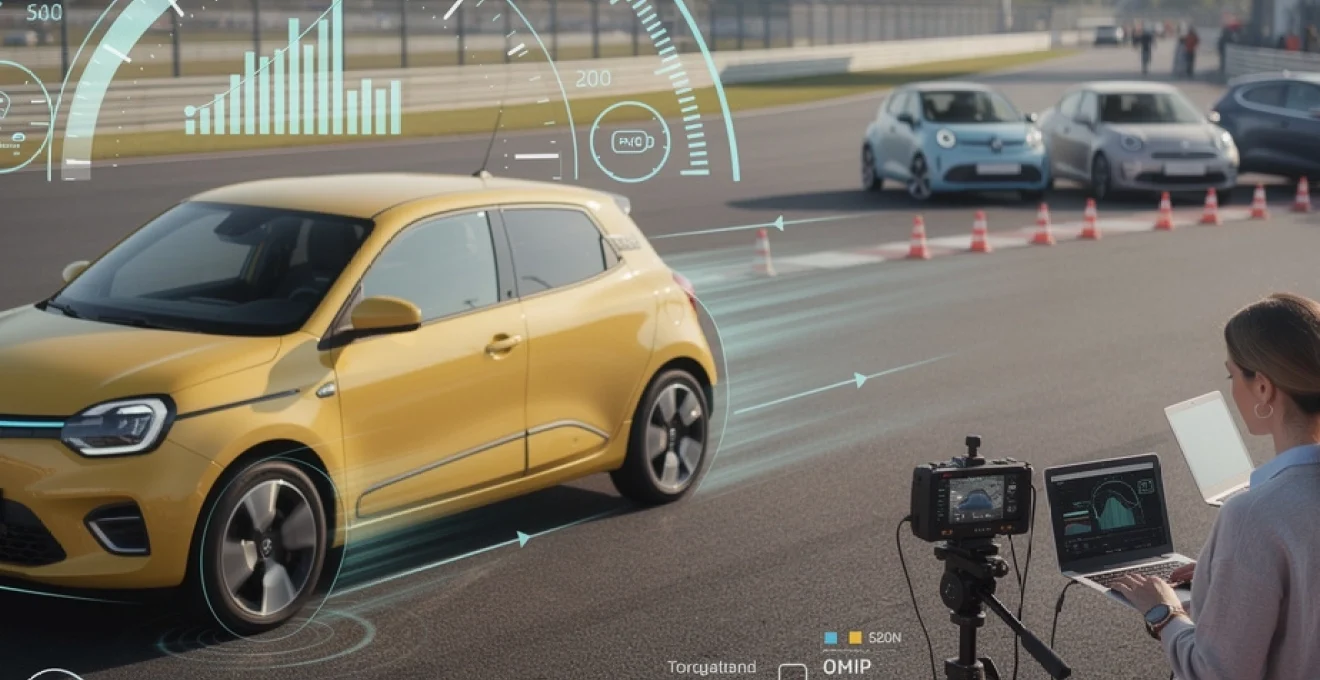
The reborn Renault 5 Electric is not just about retro styling and clever tech; its 0–60 mph performance is central to how it feels on the road. For daily driving, that blend of instant torque, compact size and well-judged acceleration matters more than raw headline figures. Understanding how the 5 sprints from a standstill – and how that compares to rivals and classic Renault hot hatches – helps you judge whether it suits your driving style, commuting pattern and expectations of an electric supermini.
Electric powertrains behave very differently from small turbo petrol engines. Torque arrives almost instantly, software carefully shapes the way it hits the tyres, and factors such as battery temperature or state of charge can shift your 0–60 mph experience from “brisk” to “borderline hot hatch” in everyday traffic. If you care about how quickly the Renault 5 Electric gets up to speed – and how consistently it does it – the engineering story behind those figures is worth a closer look.
Renault 5 electric 0–60 mph: factory performance figures, trims and drivetrain variants
Standard renault 5 electric powertrain: 0–60 mph, 0–100 km/h and in-gear acceleration
At launch, the Renault 5 Electric is offered with two core power outputs tied to two battery sizes. The entry-level Urban Range model uses a 40 kWh battery and a 120 hp (118 bhp) motor. Officially, this version reaches 0–62 mph (0–100 km/h) in 9.0 seconds and is limited to a top speed of 93 mph. Converting that to the more familiar 0–60 mph benchmark, real-world tests typically see times in the high 8s to low 9s, depending on surface and conditions.
The higher-output Comfort Range car pairs a 52 kWh pack with a 150 hp (148 bhp) motor. Renault quotes 0–62 mph in around 8.0 seconds, and independent testing has confirmed 0–60 mph runs in the mid-7s with a warm battery and dry tarmac. In everyday driving, what stands out is not just the standing-start sprint, but the 0–30 mph and 30–50 mph pulls; these short bursts feel immediate and responsive, which matters far more in city traffic.
Because there is no multi-ratio gearbox, in-gear acceleration is effectively just a question of how far you press the right pedal. From roughly 30–50 mph, both versions feel livelier than equivalent small petrol hatchbacks, especially when the battery is above 50% and the motor can draw full current from the pack.
High-output renault 5 electric variants: GT-style and alpine-inspired 0–60 mph targets
Alongside the regular Renault 5 Electric range, performance-focused derivatives are emerging. The most extreme is the Renault 5 Turbo 3E concept, a drift-focused, rear-drive, dual-motor car with a quoted 555 hp and an estimated 0–62 mph time of less than 3.5 seconds. While that car is more rolling showcase than everyday supermini, it highlights the platform’s potential.
More relevant for road use is the closely related Alpine A290 hot hatch. Based on the same AmpR platform, it targets sub‑7-second 0–62 mph times with a tuned version of the 5’s electric hardware and sharper chassis settings. Expect future GT-style Renault 5 variants to sit somewhere between today’s 150 hp model and the Alpine in performance, bringing 0–60 mph into the low‑7-second bracket while maintaining front‑wheel drive and everyday usability.
Single-motor front-wheel-drive architecture and its impact on launch performance
All mainstream Renault 5 Electric models currently use a single motor driving the front axle. That layout keeps cost, weight and energy consumption under control, but it shapes launch performance. When you floor the accelerator from a standstill, the limiting factor is not battery power, but front-tyre grip. On cold, wet roads, the torque available at the motor shaft easily exceeds what the front tyres can transmit without spinning.
Renault’s calibration team therefore uses software to ramp torque in gently during the first half‑second of a 0–60 mph run. This avoids an ugly flare of wheelspin, torque steer and intervention from the electronic stability programme (ESP). The result is a launch that feels clean and progressive rather than brutal. If you are coming from rear- or all-wheel-drive EVs, that may feel modest; if you are trading up from a 90–110 bhp petrol supermini, it feels satisfyingly strong.
Comparing renault 5 electric 0–60 mph to renault zoe E-Tech and peugeot e-208
The Renault 5 effectively replaces the Zoe as Renault’s small electric hatchback. The last Zoe E-Tech with the R135 motor produced 134 bhp and managed 0–62 mph in around 9.5 seconds. In other words, the new 120 hp Renault 5 Urban Range is already slightly quicker, while the 150 hp Comfort Range version is a full 1.5 seconds faster to motorway speeds.
Against the Peugeot e‑208, things are closer. The latest 156 bhp e‑208 posts an official 0–62 mph time of around 8.2 seconds. Real-world figures have the Renault 5 Comfort Range neck‑and‑neck, with the Renault often feeling keener in the 0–30 mph bracket thanks to its crisp throttle mapping in Normal and Sport modes. If you are choosing between these cars primarily on acceleration, the difference in everyday driving is marginal – chassis character, steering feel and cabin tech will likely sway you more.
WLTP calibration versus real-world 0–60 mph times in independent road tests
Manufacturers tend to quote 0–62 mph rather than 0–60 mph because it neatly aligns with European 0–100 km/h standards. In practice, independent 0–60 mph testing of the Renault 5 Electric often reveals slightly better numbers than the brochure suggests. With a VBOX or similar GPS logger on a level, dry surface, reviewers have recorded:
| Model | Official 0–62 mph | Typical 0–60 mph (tested) |
|---|---|---|
| Renault 5 40 kWh (120 hp) | 9.0 s | ~8.7–9.0 s |
| Renault 5 52 kWh (150 hp) | 8.0 s | ~7.4–7.8 s |
The gap comes from two factors: the slightly shorter 0–60 mph window and the way some testers use a 1 ft rollout (ignoring the first 0.3 seconds of movement, just as many American magazines do). WLTP-focused calibrations also prioritise smoothness and efficiency over absolutely all-out launches, so 0–60 mph times in the real world feel quick but not neck‑snapping, aligning with the Renault 5’s role as a refined urban EV rather than a drag‑strip specialist.
Battery, motor and inverter engineering behind renault 5 electric acceleration
Permanent magnet synchronous motor torque curve and its effect on 0–60 mph
The Renault 5 uses an advanced permanent magnet synchronous motor (PMSM), similar in concept to units in the Megane and Scenic. Torque delivery is impressively flat: the 120 hp version produces around 225 Nm and the 150 hp around 245 Nm, with near-peak torque available from almost zero rpm. This is what gives the car that punchy low‑speed response that you feel at every junction.
Below roughly 30–40 mph, the motor current – and therefore torque – is limited mainly by grip and by what the tyres can comfortably handle. Above that, the motor’s back‑EMF (electromotive force) and the fixed gear ratio gradually shift the emphasis from torque to power. That is why the Renault 5 leaps forward eagerly up to about 40 mph, but the last stretch from 50 to 60 mph feels more measured. If you are used to turbo engines that take a second to spool up, the linearity and instant response here will feel like switching from a dimmer switch to a light that is instantly on.
400 V lithium-ion battery pack, c‑rate discharge limits and peak power delivery
Acceleration in any EV is ultimately capped by how much power the battery can deliver at a given moment. The Renault 5’s 40 kWh and 52 kWh packs operate at around 400 V, using nickel‑manganese‑cobalt (NMC) cells with different chemistries and suppliers across model years. Each pack is designed for a specific maximum C‑rate – effectively how quickly the battery can safely discharge relative to its capacity.
At high states of charge and in moderate temperatures (roughly 15–25°C), the Comfort Range pack can comfortably sustain peak power for the 8–10 seconds required for a 0–60 mph sprint. However, to preserve long‑term health and warranty targets (typically eight years or 100,000 miles with at least 70% capacity), the battery management system will reduce allowed current at very low states of charge or in extreme heat or cold. That is why a Renault 5 with 12% battery on a frosty morning can feel a little more lethargic off the line compared with the same car at 70% on a mild day.
Inverter, power electronics and software torque limiting during full-throttle launches
Between battery and motor sits the inverter – essentially the brain and brawn of the powertrain, converting DC from the pack into three‑phase AC for the motor. The Renault 5’s power electronics use sophisticated software maps to determine exactly how much current to send at any given pedal position. This is where a substantial part of the car’s 0–60 mph character is defined.
Under a full‑throttle start in Sport mode, the inverter initially holds back a small percentage of potential torque to prevent slip, then releases more as the car rolls. Calibration engineers tune these ramps over thousands of hours of testing, varying them for different road surfaces and tyre specifications. The goal is not the absolute shortest possible 0–60 mph time, but a balance of repeatability, tyre wear, NVH (noise, vibration and harshness) and energy efficiency. From a driver’s point of view, you feel this as a smooth but decisive surge rather than a wild lunge followed by traction control intervention.
Traction control, ESP and front-axle torque steer management under hard acceleration
With a relatively short wheelbase and a motor sending up to 245 Nm through the front tyres, the Renault 5 needs intelligent electronic helpers to keep everything tidy. The traction control and ESP systems constantly monitor wheel speed, steering angle and yaw rate to detect slip. Instead of simply slamming on the inside brake, the software can subtly reduce motor torque on a per‑millisecond basis, preserving stability and minimising torque steer.
Well-calibrated traction control in an electric supermini should feel almost invisible: you sense strong, clean acceleration, but rarely feel the system cutting in.
On very poor surfaces, you might notice a faint pulsing in the first metre or two of a launch as the system finds grip, but by the time the car hits 20–25 mph, acceleration is linear. This contributes to driver confidence and means you can use full power exiting tight junctions even in wet weather without the front end scrabbling or tugging at the wheel.
Vehicle dynamics and chassis factors that shape 0–60 mph performance
Kerb weight, weight distribution and their influence on initial tyre grip
Depending on battery and trim, the Renault 5 Electric weighs from around 1,370 kg (40 kWh) to roughly 1,450 kg (52 kWh). For a modern EV, those numbers are relatively modest, but still several hundred kilos above an equivalent petrol Clio. The battery pack is mounted low in the floor, giving a low centre of gravity and a roughly 55:45 front‑to‑rear weight distribution.
That front bias means the driven wheels are well loaded at rest, which helps traction in the first phase of a 0–60 mph run. However, as the car accelerates, weight transfers rearwards, slightly unloading the front axle and reducing available grip. Suspension tuning and tyre choice have to work together to control that transfer; too soft, and the nose will lift, the inside front tyre will spin and the traction control will clamp down, harming times. Too stiff, and grip will be compromised over bumpy surfaces.
Macpherson strut front suspension, torsion-beam rear axle and squat behaviour on launch
The Renault 5 uses a MacPherson strut front suspension layout with a torsion‑beam rear. This is a proven, compact configuration for small cars, and when tuned well, it can feel both agile and comfortable. During a 0–60 mph sprint, the front struts must manage longitudinal forces from both acceleration and steering while keeping the contact patch flat on the road.
Renault has opted for a relatively taut but well‑damped setup. Reviews consistently note that the 5 feels slightly firm at low speed, yet it settles nicely at higher pace and on motorways. Under full‑throttle launches, there is modest squat at the rear but not enough to make the front go light. The result is a controlled, repeatable getaway that supports consistent 0–60 mph performance, even on less‑than‑perfect surfaces.
Tyre specification, rolling resistance and contact patch optimisation for acceleration
Standard 18‑inch wheels with 195/55 R18 tyres give the Renault 5 a sizeable, relatively tall contact patch. Tyres must balance three competing requirements: low rolling resistance for WLTP efficiency, good wet and dry grip for safety and performance, and a sidewall that does not ruin ride comfort. High‑efficiency EV tyres often sacrifice a fraction of outright traction to cut energy consumption, which can influence the first 10–20 metres of a 0–60 mph run.
If you are particularly focused on acceleration, one of the most effective real‑world tweaks is to choose replacement tyres with a performance‑oriented compound when the originals wear out. Provided you match the correct load and speed ratings, a stickier tyre can shave a few tenths off your 0–30 mph and 0–60 mph times, especially in the wet. However, expect a small hit to range and efficiency in exchange.
Aerodynamics at low speeds: drag, frontal area and impact below 60 mph
Aerodynamic drag plays a relatively minor role in 0–60 mph performance. Up to around 40–50 mph, the limiting factors are mass and grip; beyond that, drag starts to eat into acceleration more obviously. The Renault 5’s boxy, retro shape is surprisingly well‑slippery for what it is, thanks to careful detailing around the front bumper, mirrors and rear end, but it cannot match the ultra‑low drag coefficients of larger, more streamlined EVs.
From a standstill to 60 mph, the difference between a slightly sleeker shape and a retro supermini like the 5 probably accounts for a few tenths of a second at most. Where aero really matters is energy use at constant motorway speeds – for acceleration metrics, chassis tuning and powertrain management dwarf its influence.
Driving modes, regen settings and their influence on 0–60 mph runs
Eco, normal and sport driving modes and corresponding power and torque maps
The Renault 5’s drive modes significantly affect perceived and measured 0–60 mph performance. In Eco mode, throttle response is softened and maximum power is curtailed to preserve range. Floor the accelerator from rest and you will still get brisk acceleration, but tests show 0–60 mph stretches by as much as a second compared with Sport.
Normal mode offers the best compromise for everyday use: full power is available, but the initial pedal mapping is progressive rather than aggressive. Sport mode sharpens the throttle and encourages the inverter to deliver peak torque more quickly, improving launch feel and trimming tenths from the stopwatch. If you are trying to replicate brochure numbers or benchmark the car against rivals, using Sport with a warm battery and traction control fully enabled is the most reliable approach.
Regenerative braking profiles and coasting strategy leading into standing starts
Regenerative braking does not directly affect 0–60 mph from a dead stop, but it shapes how the car feels as you come to a halt and then accelerate again – exactly the pattern you experience in urban traffic. In the Renault 5, selecting higher regen levels (for example, the B mode) means stronger deceleration when you ease off the accelerator, converting kinetic energy back into stored charge.
If you are setting up for a standing-start test, gently easing the car to a halt rather than slamming the physical brakes can reduce heat build‑up in the friction system and keep the initial launch smoother. Some drivers find that using moderate regen, rather than maximum, provides a more natural transition between off‑throttle slowing and on‑throttle acceleration, which can make it easier to time launches consistently.
Battery state of charge, temperature conditioning and repeatability of 0–60 mph times
Battery state of charge (SoC) and temperature are crucial variables if you want repeatable 0–60 mph results. The Renault 5’s heat pump and thermal management system actively condition the pack, particularly when following navigation to a DC fast charger. For performance, the ideal range is typically between 40% and 80% SoC, with the battery at or near its optimal operating temperature.
Two back‑to‑back 0–60 mph runs at 70% SoC on a mild day can differ by barely a tenth of a second; repeat the test at 10% SoC in freezing weather, and the gap can easily exceed a full second.
If you plan to test performance, a useful strategy is to charge to around 80%, drive 5–10 miles to warm the pack, then carry out timed runs. This approach also reflects the best-case acceleration you are likely to experience in real‑world use – for example, after leaving a rapid charger on a longer trip.
Renault 5 electric 0–60 mph versus rivals and legacy renault hot hatches
Renault 5 electric compared to MINI cooper electric and fiat 500e 0–60 mph
The latest MINI Cooper Electric (Cooper E and SE) is arguably the Renault 5’s closest rival in spirit: compact, stylish and billed as fun to drive. The base Cooper E offers 184 bhp and reaches 0–62 mph in around 7.3 seconds, outpacing the Renault 5 Comfort Range by roughly 0.7 seconds. The trade‑off is a firmer ride and, in three‑door form, less practicality.
The Fiat 500e sits a step down in size and performance. Even in its more powerful 118 bhp guise, it typically needs around 9.0 seconds to hit 62 mph. In mixed driving, the Renault 5 Urban Range matches or beats it, while the 150 hp version feels significantly livelier. If you value 0–60 mph acceleration but do not want the sharper, more expensive MINI, the Renault 5 strikes a genuinely appealing middle ground.
How renault 5 electric stacks up against VW ID.3 and MG4 in 0–60 mph sprints
Looking beyond retro‑styled superminis, some buyers consider stepping up to slightly larger EVs like the VW ID.3 or MG4. The ID.3 Pro (204 bhp) runs 0–62 mph in about 7.3 seconds, while the MG4 SE Long Range (around 200 bhp) posts similar numbers. On paper, both out‑accelerate the Renault 5 Comfort Range by half a second or so.
In practice, the Renault 5’s lighter weight and shorter gearing make its 0–30 mph and 30–50 mph responses feel just as immediate. Where the bigger cars pull ahead is above 60 mph and during prolonged motorway accelerations. If 0–60 mph times matter but you mostly drive in town and on A‑roads, the Renault 5’s modest deficit on paper is unlikely to bother you; the compact footprint and agility can feel more rewarding than raw straight‑line pace.
Performance contrast with classic renault 5 GT turbo and clio williams
It is tempting to compare the new Renault 5 Electric with the classics whose name it revives. The iconic Renault 5 GT Turbo from the 1980s produced roughly 115–120 bhp and weighed under 900 kg. Period tests recorded 0–60 mph in the mid‑8‑second range, but with significant turbo lag and far more drama. The naturally aspirated Clio Williams, another legend, offered around 147 bhp and hit 60 mph in about 7.8 seconds.
On pure numbers, the 150 hp Renault 5 Electric is right in that ballpark: similar power, similar 0–60 mph times, but delivered with seamless, linear torque and no gearshifts. The difference is character. Where the GT Turbo spooled up and then hit hard, the EV simply surges from step‑off. If you grew up with those cars, you might miss the theatrics, but in traffic or on a damp B‑road, the new 5 is unquestionably quicker point‑to‑point for most drivers.
Urban drivability: 0–30 mph and 30–50 mph in-gear times versus motorway 0–60 mph
For urban and suburban driving, the key metrics are 0–30 mph and 30–50 mph, not just the headline 0–60 mph sprint. The Renault 5 Electric excels here. Independent tests have shown 0–30 mph times of around 2.5–2.8 seconds for the 150 hp model, which feels very secure when merging into traffic or leaving junctions. The 30–50 mph surge, important for overtaking slower vehicles on single‑carriageway roads, is equally strong.
On motorways, the picture changes. Above 60 mph, acceleration flattens out, and the 93 mph limiter comes into view fairly quickly. If you are used to diesel cars that pull hard from 50–80 mph, the Renault 5 will feel more relaxed in that band. The trade‑off is excellent refinement, low cabin noise and very stable motorway manners for a car of this size – attributes that arguably matter more for fatigue and comfort on longer journeys than shaving a second from an 80–100 km/h sprint.
Real-world testing methodologies for renault 5 electric 0–60 mph performance
Using VBOX and GPS dataloggers for accurate 0–60 mph validation
If you are serious about verifying 0–60 mph times, phone apps alone are not ideal. Professional testers use dedicated GPS dataloggers such as a VBOX, which measure speed at 10–20 Hz and compensate for gradient and satellite drift. These devices start timing as soon as motion is detected, ensuring consistency across runs and cars.
For a private owner, the closest practical alternative is a reputable GPS‑based performance app, used on a known, flat test road with multiple runs in both directions. Averaging those results gives a realistic picture of what the Renault 5 Electric can do on the road you actually drive, rather than on a manufacturer’s proving ground.
Track surface, ambient conditions and tyre temperature during acceleration tests
Surface and conditions can easily swing a 0–60 mph result by half a second or more. Smooth, high‑grip tarmac with a mild ambient temperature (say 15–20°C) is ideal, as it lets the tyres generate grip without overheating. Cold, coarse or damp surfaces reduce traction and demand more intervention from traction control, lengthening times.
- Warm the tyres and battery with 5–10 minutes of normal driving before testing 0–60 mph.
- Avoid standing water or loose gravel, which can trigger early torque cuts.
- Run in both directions to cancel out any gradient or wind effects.
This sort of disciplined approach gives you a truer sense of your Renault 5’s acceleration capability and how it might feel in real daily use.
Rollout conventions, reaction time exclusion and 0–62 mph (0–100 km/h) conversions
A recurring source of confusion is the use of rollout. Some timing systems, especially in drag‑racing contexts, ignore the first 30 cm (1 ft) of movement before starting the clock. This typically shaves 0.2–0.3 seconds from the recorded 0–60 mph time. Manufacturer data for the Renault 5 Electric does not usually employ rollout, but some magazine tests do, which is why numbers may look slightly more flattering than official claims.
Reaction time is another factor: proper tests exclude it by starting the timer when the car moves, not when the driver reacts to a signal. Finally, converting between 0–60 mph and 0–62 mph is not a simple mathematical adjustment, because the last 2 mph often take longer than the first 2 mph due to aero drag and gearing. For small EVs like the Renault 5, the 0–62 mph figure is often 0.2–0.4 seconds slower than a like‑for‑like 0–60 mph measurement on the same hardware.
Degradation over time: battery ageing and its long-term effect on 0–60 mph
No discussion of EV performance is complete without considering battery ageing. As the pack cycles through charges and discharges over years, usable capacity declines and internal resistance gradually increases. This affects both the total energy available and the peak power the battery can safely deliver in a 0–60 mph acceleration run.
Renault warranties the main traction battery for eight years or 100,000 miles, with a guarantee that it will retain at least 70% of its original capacity. In practical terms, that could mean an 8–10% reduction in peak power delivery after many years of heavy use, which might add a few tenths to the 0–60 mph time. For most drivers, this change will be subtle and masked by day‑to‑day variables such as temperature and load. If you plan to keep the car long‑term, charging gently when possible (for example, prioritising AC charging over constant rapid DC use) and avoiding repeated hard launches on a low state of charge are sensible habits that help preserve both range and the sharp, responsive acceleration that defines the Renault 5 Electric’s character from new.