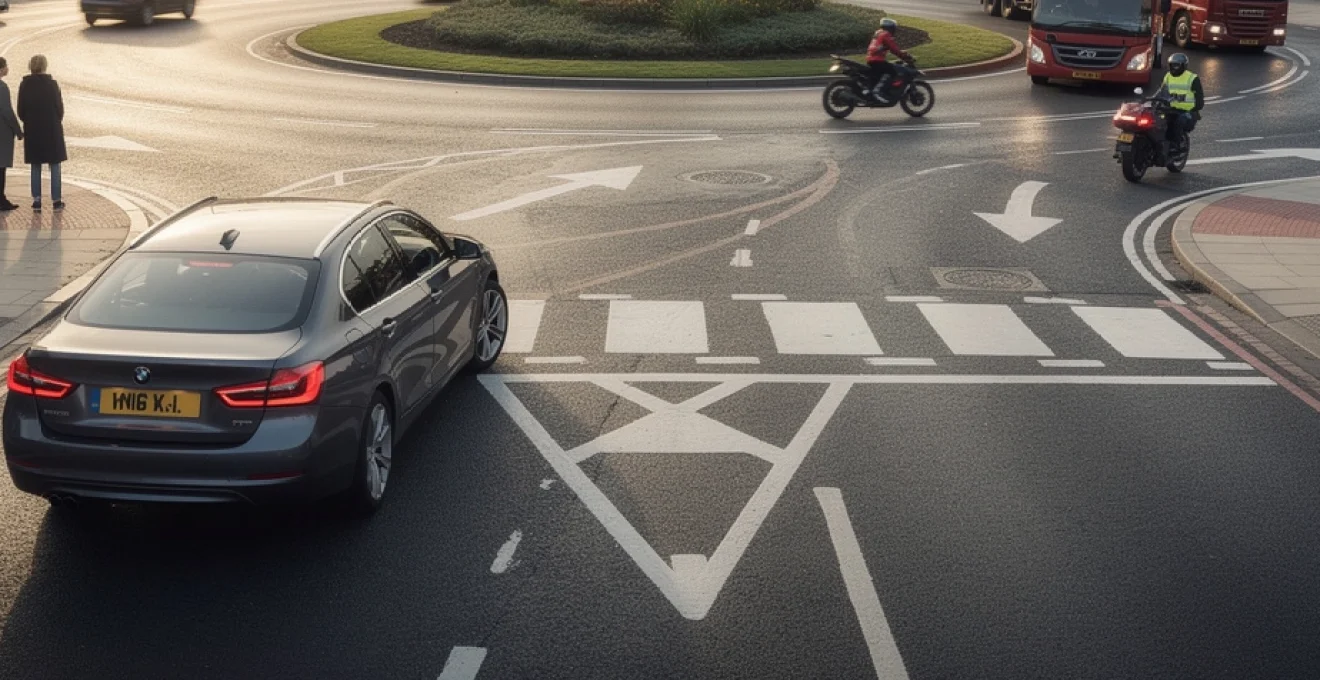
Roundabouts are meant to keep traffic flowing smoothly, cut congestion and reduce serious crashes. Yet for many UK drivers and riders, the question “who actually has priority here?” still causes hesitation, arguments and, in the worst cases, collisions. Understanding when to give way at roundabouts is not just about passing a driving test; it shapes everyday safety, journey times and even how an insurer assesses blame after an impact. With more spiral, signal-controlled and compact designs appearing on UK roads, a solid grasp of give-way rules is more important than ever if you want to drive confidently and avoid expensive mistakes.
Highway code fundamentals: core UK roundabout priority rules and terminology
Decoding highway code rules 184–190: signalling, positioning and giving way at roundabouts
The starting point for roundabout priority in the UK is Highway Code Rules 184–190. These establish three core ideas: prepare correctly on approach, give way at the line, then signal and position clearly as you exit. On approach, you are expected to use the classic MSM or MSPSL routine—mirrors, signal, position, speed, look—to choose a suitable lane and speed. Rule 184 stresses that you should be reading traffic signs, lane arrows and any traffic lights well before you reach the give-way line, rather than making last‑second lane changes.
Rule 185 then sets the headline rule most learners know: give priority to traffic approaching from your right, unless signs, markings or traffic lights clearly say otherwise. That priority only applies at the point you reach the give-way line. Once circulating, you are expected to keep a predictable line, use the appropriate lane and signal in time for your chosen exit. Rules 186–190 refine that for first exits, intermediate exits, right turns, mini-roundabouts and multiple linked layouts.
Understanding “priority” vs “right of way”: legal meaning at UK circular junctions
In everyday conversation, many drivers talk about having “right of way” at a roundabout. Legally, UK road law and the Highway Code prefer the word priority. That difference matters. You never have an absolute right to proceed regardless of circumstances; you instead enjoy priority provided it is safe and you are not driving without due care. A driver approaching from the right who accelerates aggressively and forces others to brake harshly is not exercising priority sensibly.
Think of priority as the traffic system’s default setting, not a licence to bully others. Courts and insurers look at whether a “reasonable and competent” driver, in the same position, would have expected another vehicle to give way. If you push into a marginal gap and cause a crash, claiming “I had right of way” carries little weight. The expectation to drive defensively and avoid collisions sits above the roundabout priority convention.
Give-way line markings, broken white lines and traffic islands: how road markings dictate priority
Roundabout priority is not just about the shape of the junction; it is written on the tarmac. A standard roundabout entry usually has a single broken white line across the lane. That is the give-way line: you must be prepared to stop at or before that line if there is traffic from your right that would be affected by your entry. At some larger junctions, you may see double broken lines, or a combination of triangles and the word “GIVE” to reinforce the need to yield.
Occasionally, rule 185 allows a lane to “flow free” across the entry: for example, if a slip road from a dual carriageway has its own continuous lane through the roundabout. In that case, road markings and arrows indicate that you may proceed without giving way. Even so, the Code still expects you to check to the right before crossing any part of the circulating lane. Traffic islands and splitter islands between lanes also guide where you should position and help separate opposing flows, but they do not change the basic give-way principle at the line.
Mini-roundabouts versus full-size roundabouts: different layouts, same give-way principles
Mini-roundabouts, with a painted circle or small dome at the centre, often generate the most confusion. Rule 188 is very clear: treat them in the same way as normal roundabouts. That means giving way to the right, using appropriate signals and circulating clockwise around the central marking. All vehicles must pass around the centre unless physically too long to do so safely. Cutting straight over the white circle because it is “only paint” counts as poor driving and can easily lead to blame if there is a crash.
Because mini-roundabouts are small, there is less time to indicate and less space to change lane or adjust position. That demands slower approach speeds and earlier observation. When two vehicles face each other at opposite entries and both move at once, neither has automatic priority; the give-way principle still relates to what is happening on the right at the instant you reach the line. In practice, patience and eye contact often resolve these stand‑offs more smoothly than rigid rule‑quoting.
Approach and entry: when to give way at UK roundabouts in real traffic scenarios
Scanning to the right and ahead: observation routines before crossing the give-way line
Effective observation is the difference between smooth, confident circulation and last‑second braking at the give-way line. A good routine actually starts several seconds before that point. As you see the roundabout warning sign, check your mirrors, confirm what is behind and beside you, then ease off the accelerator so you have time to look to the right as the view opens up. On open layouts, you might gain a clear view of circulating traffic 50–100 metres before the line, letting you plan your entry much earlier.
Closed roundabouts—where hedges, walls or buildings block the view until the last moment—require more caution. Here, you may only see vehicles on your right as you reach the final few metres of the approach, so your speed should be low enough to stop comfortably at the line. The key test is simple: can you still stop smoothly behind the line if something appears on your right? If the answer is “not without slamming on the brakes”, the approach speed is too high.
Gap selection and speed adjustment: judging safe entry windows in urban roundabouts
Choosing a safe gap at a busy junction is as much about speed control as it is about space. In urban 30 mph zones, typical circulating speeds may be 15–25 mph at peak times. A practical rule of thumb is that if a vehicle on your right would need to brake or swerve for you, then the gap is not safe. You are expected to wait, even if a more assertive driver might have squeezed out. In DVSA tests, missing one marginal opportunity is usually a minor fault; forcing traffic to slow sharply can be marked as serious.
National surveys suggest that around 20% of at‑junction collisions relate to misjudged gaps, often involving drivers who assume others will give way to them. To avoid becoming part of that statistic, adjust your approach speed early so that you can accelerate gently into a gap without having to stop completely unless necessary. If traffic is nose‑to‑tail on the roundabout, sometimes the safest strategy is to wait for a naturally larger gap created by a slower HGV or a stream of vehicles leaving at the exit before yours.
Lane discipline on approach: using road signs and diagrammatic arrows to choose the correct entry lane
Priority conflicts often arise not because someone fails to give way, but because they join in the wrong lane. Modern roundabouts, especially large ones, rely heavily on advance signs and lane arrows to route drivers into the correct position. A diagrammatic sign before the junction usually shows each exit labelled, with lane guidance underneath. Ignoring that information and diving across lanes at the last second is one of the most common careless driving behaviours seen on dashcam clips.
A useful mental model is the “clock face” rule often taught by instructors: approach in the left lane for exits up to roughly 12 o’clock, and in the right lane for exits after 12, unless markings say otherwise. That rule is not written explicitly in the Code but it aligns with the official diagrams. If arrows on the road show, for example, left lane for “left and straight on” and right lane for “straight on and right”, either lane may legally be used to go ahead, but you must follow the lane you select all the way to the exit to avoid cutting across others.
When traffic is circulating but there is no vehicle on your immediate right: edge cases in sparse traffic
One of the trickiest judgement calls comes when there is traffic on the roundabout, but nothing directly on your right as you reach the give-way line. Suppose you arrive from the south at a mini-roundabout while a car is midway between the northern and western exits. Do you go, or wait? The Code asks you to give priority to traffic approaching from the right that would be affected by your entry. If a normal, gentle entry would still leave that other vehicle having to brake, then waiting is expected.
However, you are not required to treat any vehicle somewhere on the circle as an automatic stop signal. If the other driver is clearly exiting before they would cross your path, or is so far around that you can enter and clear the conflict point in good time, you may proceed. Collision data from UK mini-roundabouts shows that many low‑speed shunts come from drivers assuming others will stop for them “because I was already on the roundabout”, while the entering driver judged—rightly or wrongly—that there was still a gap. When in doubt, holding back avoids becoming part of a dispute.
Dealing with hesitant or aggressive drivers: defensive driving strategies at busy roundabouts
Real traffic rarely behaves like textbook examples. Some drivers stop at a clear roundabout even when the way ahead is open; others charge through from the right at full speed, barely acknowledging the give-way line. Defensive driving around circular junctions means planning for both types. With a hesitant driver ahead, maintain extra separation and be prepared for them to brake unexpectedly at the line or on the roundabout itself. With an aggressive driver behind, smooth deceleration and early brake lights give them maximum time to react.
At multi-lane entries, expect a minority of drivers to swap lanes at the last moment to avoid queues. That behaviour is poor, but confronting it rarely ends well. If someone signals late and tries to move across, easing back slightly and allowing them in is usually safer than insisting on your priority. A serious fault on the driving test is often recorded where candidates “block” another road user’s safe lane change even when they technically had the better position. Priority rules exist to reduce risk, not to score points.
Complex roundabout layouts: multi-lane, spiral and signal-controlled systems
Multi-lane roundabouts like hanger lane gyratory: lane allocation and priority conflicts
Large multi-lane gyratories such as Hanger Lane in London or the A720 Sheriffhall in Edinburgh introduce an extra layer of complexity: several circulating lanes, multiple sets of traffic lights and high speeds. The give-way principle still applies at each entry, but once inside, lane discipline becomes critical. Road studies indicate that side‑swipe conflicts and late exit dives are much more common here than simple failure‑to‑yield crashes. The only realistic strategy is to choose the correct approach lane well in advance and then commit to following that lane’s path.
Because entries and exits are closely spaced, always look for overhead gantry signs and lane markings that show which lane continues around and which are dedicated to specific exits. If you miss your intended lane, the safest choice is usually to continue around another full circuit rather than cut across in front of others. This “go round again” tactic is specifically endorsed by many instructors as the low‑stress option for less experienced drivers.
Spiral roundabouts (e.g. magic roundabout in swindon): following lane arrows and circulating flow
Spiral roundabouts and so‑called “magic” designs are essentially a series of mini-roundabouts linked together around a central island. Swindon’s Magic Roundabout is the best‑known UK example, with five mini-roundabouts feeding a large central area. The underlying rule is still to give way to the right at each mini-roundabout separately. This breaks the junction into manageable chunks; you are never dealing with all entry arms at once, just the one you are currently approaching.
Lane arrows and destination signs are more important here than the abstract shape of the junction. Many drivers find it helpful to choose a route that uses only clockwise movements around the outer ring the first few times they navigate such a layout. Cutting across via the central area is permitted where marking allow it, but only when you are confident you understand the flows and can judge gaps from multiple directions.
Signal-controlled roundabouts (e.g. coventry ring road junctions): integrating give-way rules with traffic lights
Signal-controlled roundabouts combine standard give-way behaviour with traffic-light sequences. At some junctions, every entry is controlled by signals, creating a series of short platoons of vehicles on the circle; at others, only certain approaches are signalised. The red/amber/green rules take precedence over give-way markings. You must stop at a red light even if the roundabout itself appears clear, and you must not enter a box junction at a signalised roundabout unless your exit is clear.
One common misunderstanding arises when drivers treat a green light as granting absolute right to proceed around the circle. In reality, Rule 198 still expects you to give way to anyone already on a pedestrian or cycle crossing, and Rule 185 reminds you to look to the right for circulating traffic that may have its own different signal phase. In recent years, several urban schemes have introduced separate cycle signals and advanced stop lines around roundabouts; understanding how these phases interact reduces close passes and near misses.
Turbo roundabouts and continental-style designs: UK adaptations and priority conventions
Turbo roundabouts, imported from the Netherlands and increasingly used in the UK, incorporate raised lane dividers and strongly guided lanes that “lock in” your path through the junction. They are designed to reduce the number of potential conflict points by preventing late lane changes. From a give-way perspective, each arm still has a standard line where you must yield to circulating traffic, but once inside, you are committed to your lane until the exit indicated by arrows and kerbing.
Because lane changes are restricted, choosing the correct lane at the start is even more critical than on a conventional multi-lane roundabout. If you end up in the wrong lane, you may have no legal way to reach your intended exit safely and must instead follow the lane to its signed destination, then find a safe place to turn around further along the road network. Attempts to cross solid dividers or swerve into adjacent lanes undermine the entire safety benefit of the turbo design.
Staggered and linked roundabouts: navigating chained junctions without losing lane priority
Staggered and double mini-roundabouts appear where two nearby junctions need separate control. Rules 189–190 state that each roundabout must be treated independently, with give-way to the right applied afresh at every entry. That can feel counterintuitive if you have just circulated around one mini-roundabout and are facing a second only a few metres away; nevertheless, you are expected to adjust your speed and observation for the new give-way line, not treat the whole layout as a single circle.
Lane priority also resets between linked roundabouts unless explicit arrows show a continuous lane. For example, if the left lane from the first junction becomes a dedicated left‑only lane at the second, you cannot simply continue straight ahead claiming “I was here first”. Diagrams on approach usually show which lane is best for continuing through the chain in one smooth movement. In heavy traffic, taking a slightly longer but more clearly marked route can avoid stressful merges and last‑second decisions.
Special vehicle categories: buses, HGVs, cyclists, motorcyclists and horse riders
Long vehicles and HGVs: wide turning lines, lane straddling and giving way to off-tracking trailers
Heavy goods vehicles, coaches and other long vehicles behave differently on roundabouts because of their off‑tracking—the tendency of trailers to cut inside the path of the tractor unit. Rule 187 explicitly warns that long vehicles may need to straddle lanes either on approach or while circulating. That is not poor discipline; it is a deliberate technique to avoid clipping kerbs, street furniture or other vehicles with the trailer.
If you are following or alongside such a vehicle, the safest policy is to hold back and give it plenty of room, especially if it signals late or appears to move wide before a turn. Around 10–15% of HGV collisions at roundabouts involve smaller vehicles attempting to sneak up the inside as the truck swings out. If a large vehicle indicates right and adopts a position away from the kerb, assume it may still exit left at the next opportunity as part of a wide turn.
Advanced stop lines and cycle lanes: interacting with cyclists at urban roundabouts
The updated Highway Code places stronger responsibilities on drivers to protect cyclists, particularly at junctions. Rule 186 now states that drivers should give priority to cyclists on the roundabout, and should not attempt to overtake them within their lane. In practice, this means giving a rider time and space to move across your path as they circulate, rather than diving past and cutting in front to reach an exit.
Advanced stop lines (ASLs) at signalised roundabouts create a space for cyclists to wait ahead of motor traffic. As a driver, you must stop at the first white line when the lights are red or amber, leaving the cycle box clear. On green, allow riders in that area time to set off and establish their position before you accelerate. Close‑passing a cyclist or turning across them, even if you technically have priority from the right, can easily be classed as careless or even dangerous driving in modern enforcement.
Motorcycle visibility and “SMIDSY” risk: adjusting your give-way decisions for vulnerable users
Motorcycles are over‑represented in roundabout collision statistics. A common driver excuse after a crash is “Sorry mate, I didn’t see you” (SMIDSY). The issue is not only about visibility; it is also about how the brain judges speed and distance. Smaller objects can appear farther away than they really are, leading drivers to accept gaps that are too small. To counter this, consciously double‑check for bikes during the final look right before entering and be cautious about squeezing into tight spaces when a motorcycle is approaching.
If you are a rider yourself, positioning and speed choice make a significant difference. Staying out of blind spots, avoiding unnecessary filtering between lanes at the approach, and using clear, early signals all help drivers understand your intentions. The give-way rule still protects you on paper, but proactive visibility and anticipation often make the difference between a near miss and a serious injury.
Horse riders and animal-drawn vehicles: low-speed circulation and extended gap acceptance
Equestrians and animal‑drawn vehicles are legitimate road users and are specifically mentioned in Rule 186. They may choose to stay in the left-hand lane even when going all the way around the roundabout, signalling right to show they are not taking the first exit. As a driver, you are expected to give them plenty of room and to avoid cutting across their path, even if the Highway Code’s basic priority rule would ordinarily let you do so.
Practical implications include reducing speed significantly when approaching a roundabout where horses are present, waiting for a much larger gap before entering, and refraining from revving the engine or sounding the horn. Sudden noise or close passes can spook a horse and create unpredictable movements into your path. Enforcement guidance increasingly treats failure to account for the behaviour of animals as part of a wider careless driving offence.
Pedestrians and crossings at and around UK roundabouts
Zebra, pelican and puffin crossings near roundabouts: sequencing priority between pedestrians and circulating traffic
Many urban roundabouts incorporate formal crossings on their approach or exit roads. Rule 195 makes it clear that at zebra crossings, drivers should give way to pedestrians waiting to cross and must give way once a person has stepped onto the crossing. For pelican and puffin crossings, standard traffic light rules apply: red means stop, and drivers must let anyone already on the crossing finish before proceeding on green.
When such crossings are located close to a roundabout, priority can feel ambiguous. A useful mindset is to treat each control separately: first obey the crossing rules, then apply the roundabout give-way principle when you reach the line. Blocking a crossing or stopping across a pedestrian refuge because “the roundabout was clear” is poor practice and can lead to penalties. National casualty data shows that around 10% of pedestrian injuries near roundabouts occur at or near formal crossings blocked by queuing traffic.
Informal crossing points on splitter islands: driver responsibilities at entry and exit
Even without zebra markings, many roundabout approaches feature dropped kerbs and central refuges where pedestrians naturally cross. The Code expects drivers to watch for people stepping off the kerb, particularly where rows of queuing vehicles may hide them. Rule 170 adds that drivers should give way to pedestrians crossing or waiting to cross a side road into which they are turning. That principle applies just as much to roundabout exits as to ordinary T‑junctions.
From a practical point of view, scanning for pedestrians on the approach and exit should be part of the same observation routine as looking for cyclists and motorcyclists. If a person is clearly waiting to cross at a refuge and you can safely slow slightly to create a gap in the traffic stream, that simple courtesy often improves overall flow and reduces risky dashes between vehicles.
Shared-space and compact roundabouts in 20 mph zones: low-speed courtesy-based yielding
Recent urban design trends have produced more compact roundabouts and shared-space junctions in 20 mph residential or town‑centre zones. These are often deliberately small, with tight radii that force drivers to slow right down, and minimal lane markings. While the formal give-way rule to the right still exists, local signing and road layouts encourage more eye contact and informal negotiation between users, including pedestrians walking across the mouth of the junction.
In these environments, aggressive assertion of priority tends to undermine the scheme’s safety goals. A better approach is to treat everyone else as having equal claim to the space, drive at a pace where you could comfortably stop for an unexpected movement, and yield where doing so avoids stand‑offs. Crash data from early shared-space pilots shows substantial reductions in serious injuries compared with traditional signals‑and‑barriers layouts, largely because everyone travels slower and reads the situation more carefully.
Common mistakes, test failures and enforcement related to UK roundabout give-way rules
Typical DVSA driving test faults: rolling over the give-way line and late lane changes
Roundabouts remain one of the top locations for DVSA test faults and serious errors. Examiners regularly mark candidates down for creeping past the give-way line when the approach from the right is not yet clear, or for stopping unnecessarily when there is a plainly safe gap. Both issues reflect weak observation and poor confidence in judging priority. Another frequent minor fault involves failing to signal correctly: either indicating too early and confusing others, or forgetting to cancel an indicator after leaving.
Late lane changes are more serious. Swerving from the left lane to the right at the last moment on approach, or drifting across lanes on the roundabout itself, can trigger a serious fault if it causes another road user to brake or adjust course. DVSA guidance effectively treats such manoeuvres as breaches of the give-way principle because they ignore the established paths and expectations of those already circulating in the chosen lane.
Failing to give way and careless driving: potential penalties, fines and insurance implications
Outside the test environment, failure to give way at a roundabout can amount to careless driving under the Road Traffic Act 1988. Typical penalties include a fixed penalty of three points and a fine, or more substantial sentencing by a court if the behaviour led to serious injury or death. Police forces increasingly review dashcam submissions from the public and may issue warning letters, fixed penalties or invitations to driver improvement courses where priority breaches are clear on video.
Insurance consequences can be long‑lasting. In a collision where you pulled out from a give-way line into the path of traffic from the right, your insurer will often accept primary liability, even if the other driver was speeding or driving assertively. Premium increases after an at‑fault roundabout claim can easily exceed the original fine and points in cost over several years. From a risk‑management perspective, erring on the cautious side when judging priority is usually the most economical option as well as the safest one.
Dashcam evidence and collision liability: how priority breaches are assessed after an incident
Dashcams have transformed how priority disputes are resolved. Instead of conflicting statements about who was “already on” the roundabout, insurers can replay footage frame by frame, examining speed, position and timing. Key questions include: did the entering driver cross the give-way line when traffic from the right was close enough to be affected? Did the circulating driver change lane or cut across in a way that contradicted markings or indicators? Were vulnerable users such as cyclists given reasonable space?
Investigators also look at subtle cues, such as whether brake lights were already on before impact, suggesting that the circulating driver anticipated a problem, or whether the entering driver was looking to the right at the critical moment. In borderline cases, liability may be split—for example, 70/30—if both parties failed to apply the roundabout give-way rules competently. From a driver’s point of view, assuming that every move is being recorded encourages a more disciplined, Code‑compliant approach to priority at circular junctions.