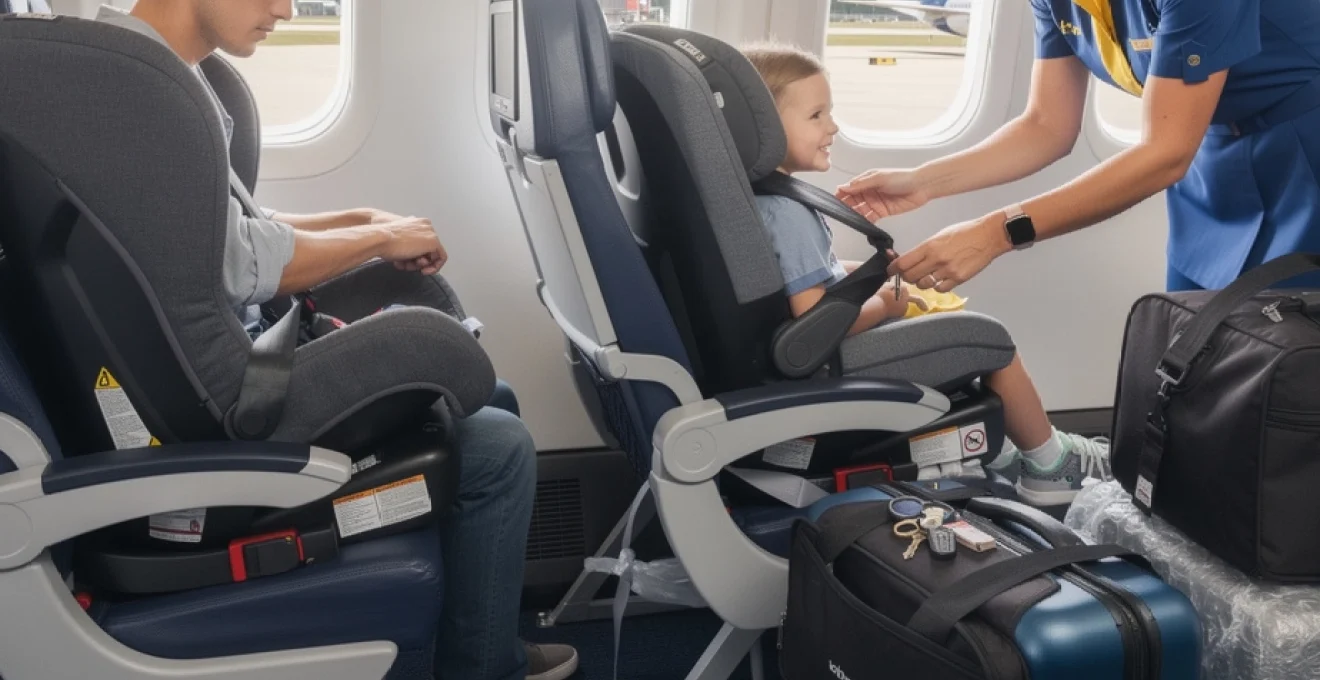
Flying with a car seat on a low-cost carrier can feel like trying to translate two sets of safety rules at once: aviation standards on one side, road traffic regulations on the other. For travelling drivers, especially those heading straight from a Ryanair flight to a hire car, understanding exactly what is allowed in the cabin and in the hold is essential. A correctly used child restraint system dramatically reduces injury risk in a crash, and the same principle applies to turbulence at 35,000 feet as it does to a sudden stop on the motorway. Getting the details right before booking helps you avoid stress at the gate, unexpected fees and, most importantly, ensures that your baby or toddler travels in a familiar, properly installed seat door-to-door.
Ryanair car seat policy overview for travelling drivers and families in 2025
Ryanair’s car seat policy in 2025 is built around one core idea: infants under two are expected to sit on an adult’s lap unless you proactively book a separate seat and bring an approved car seat. The airline permits you to take two items of baby equipment per child free of charge, such as a pushchair, booster seat, travel cot or car seat, in addition to your own small personal bag. This “three item” combination is extremely useful if you are travelling as a driver who also needs a child seat for the hire car on arrival, because it allows a car seat to travel without a checked baggage fee when used as baby equipment rather than standard luggage.
Those free items need to be tagged at check-in or at the boarding gate, and the pushchair can normally be used right up to the aircraft steps. Ryanair specifies that only forward‑facing car seats are allowed for in-flight use, and the seat must fit within a 17‑inch (43 cm) width limit. Any additional baby equipment beyond the two free pieces can be checked in up to 20 kg for a modest fee, which is significantly cheaper than hiring a high-end child seat from many car rental desks across Europe. For drivers, that means a practical choice: travel with your trusted, certified seat from home or rely on whatever the car hire desk has available on the day.
Ryanair cabin safety regulations for child restraint systems (CRS) and car seats
Definitions: forward‑facing, rear‑facing, booster and harness car seats under ryanair rules
Ryanair’s documentation refers mainly to car seat and booster seat, but the underlying aviation safety framework distinguishes several types of CRS. A forward‑facing car seat is designed for children who sit upright, facing the front, usually with a built‑in 5‑point harness. A rear‑facing seat positions the child facing the back of the vehicle and is considered the safest orientation for infants on the road; however, Ryanair does not permit rear‑facing models for use on board. Booster seats come in two forms: backless boosters and high‑back boosters, both intended for older children who can use the aircraft seat belt directly. Harness car seats combine a shell with an integrated harness up to a certain weight or height.
For Ryanair flights, only a forward‑facing, harnessed car seat that meets specific certification rules can be installed on a passenger seat. Boosters are typically carried as checked baby equipment or as part of the free allowance, then used later in the hire car. That means if you are travelling with a baby or young toddler on your lap, the booster can still come with you free, but it will not replace the cabin seat belt system in flight. This distinction matters because some parents assume any child seat approved for cars is automatically acceptable for take‑off and landing, which is not the case.
ECE R44/04 and UN ECE R129 (i‑size) certification requirements for use on ryanair aircraft
To use a car seat in the cabin on Ryanair, the seat must be “purpose‑designed” for children, have a 5‑point harness and carry specific approval markings. In Europe, that usually means an orange ECE label. Most current models will show either ECE R44/04 or UN ECE R129 (the i‑Size regulation). Under Ryanair’s policy, the seat needs to be approved for use in motor vehicles and aircraft. Typical wording on the label might include “European Standard Mark” or, on some transatlantic models, the US legend “Certified for use in motor vehicles and aircraft”. Without such a label, cabin crew are entitled to reject the seat on safety grounds.
As of 2024, ECE R44/04 is slowly being phased out for new products in Europe, but millions of seats on the road and in family garages still carry that approval. For flying drivers, that is not a problem as long as the seat is in good condition, within its usable age range and the label is intact. Newer i‑Size seats, governed by UN ECE R129, focus more on height and side‑impact performance, but are not automatically more “aircraft‑friendly”; many are bulkier and may exceed the 43 cm shell width limit. Checking both the regulation label and dimensions before booking can save frustration at the gate.
Weight, height and age limits for car seats on ryanair routes (UK, ireland, spain, italy)
Ryanair does not publish a detailed weight and height chart in the way car seat manufacturers do. Instead, the airline focuses on age categories and the physical ability of the child to sit safely in the seat with a 5‑point harness. Infants from eight days to 23 months are regarded as lap infants by default, but you can purchase a separate seat if you wish them to travel in their car seat. From age two upwards, a child is treated as an ordinary passenger and must have their own seat, but may still use an approved forward‑facing CRS if it fits.
On UK–Europe routes such as London to Spain or Ireland to Italy, road safety rules vary slightly, but aviation practice remains consistent: a properly installed CRS can be used up to the upper weight or height limit stated by the manufacturer, typically around 18 kg or 105 cm for harnessed seats. For drivers combining flight and hire car usage, a Group 0+/1 or i‑Size seat that covers roughly birth to four years offers the best continuity. However, it must still be forward‑facing in the cabin, even if it is capable of rear‑facing in the car.
Car seat dimensions, shell width and base depth compatible with ryanair boeing 737‑800 seats
Ryanair’s standard Boeing 737‑800 economy seat is narrow by design, maximising capacity to keep fares low. The airline therefore sets a strict maximum width of 17 inches (43 cm) for any car seat used on board. This measurement usually refers to the widest part of the shell where it contacts the airline seat, not including removable cupholders or side‑impact wings that can flex slightly. Base depth is less critical, but deep reclined shells may interfere with the seat in front, so choosing a compact, upright‑install model is advisable for regular flying drivers.
When assessing whether a seat will fit, measure both the plastic base and the fabric shell at their widest points. Some popular UK combination seats marketed for long road use are simply too wide, even if technically R44/04 or R129 compliant. In practice, many airline‑friendly models are those originally designed with European city cars in mind: slim, high‑density foam shells, limited side wings and straightforward belt paths. Thinking of the aircraft seat like the rear bench of a supermini is a useful analogy for choosing the right CRS for Ryanair flights.
Differences between ryanair policy and IATA / EASA general CRS recommendations
IATA and EASA, the global and European aviation bodies, generally recommend that young children use an approved CRS during flight, and recognise both forward‑facing and rear‑facing seats, as well as certain alternative harness devices, under specific technical conditions. They often encourage airlines to accept a wider range of equipment, including some US‑style FAA‑approved seats. Ryanair, by contrast, has opted for a narrower, more standardised approach: forward‑facing only, 5‑point harness, width capped at 43 cm.
This conservative policy simplifies cabin checks and speeds up boarding, which is crucial for a high‑turnover low‑cost carrier. However, it means that even if a seat is accepted on another airline within Europe, such as a full‑service flag carrier, it may still be refused on Ryanair. For you as a travelling driver, that creates a strong incentive to own one “airline‑friendly” seat for regular trips and possibly a different, more substantial rear‑facing model for everyday road use at home.
Booking a seat for your car seat on ryanair: fares, seat reservation and check‑in workflow
Adding an infant or child car seat at booking via ryanair.com and the ryanair app
The most efficient time to plan your Ryanair car seat use is at the booking stage. When adding an infant under two, you can choose either lap infant (no separate seat, lower fee) or book a full child fare with a dedicated seat. To use a car seat on board, a separate seat must be reserved, and the child’s date of birth must show that they are within the manufacturer’s age/weight limits. On Ryanair’s website and app, that typically means choosing “Child” rather than “Infant on lap” for the passenger type.
Once the booking is created, the car seat itself does not need a unique ticket or registration code, but the airline recommends bringing documentation that shows its approval for aircraft use. Some frequent‑flying parents keep a picture of the label on their phone, which can be helpful if the underside of the seat is awkward to access on the aircraft. Adding the infant as a seat‑holding passenger also enables standard seat selection options, including paid “family seating” that keeps you together.
Choosing suitable seat locations: window seat requirement, exit row exclusion and bulkhead rows
Like most European carriers, Ryanair requires that any car seat be installed on a window seat. This rule ensures that in an emergency evacuation, other passengers in the same row can exit without obstruction. Seats with car seats cannot be placed in exit rows or immediately adjacent to emergency exits, because the rigid shell and harness could interfere with evacuation procedures. Bulkhead rows are not automatically off‑limits, but legroom and tray table design can affect how comfortably the CRS fits.
For travelling drivers, a window seat over the wing is often the most stable option, with less sway and noise than the rear cabin. If you are travelling as a pair with one child in a car seat, the typical configuration is child at the window, adult in the middle, leaving the aisle free. With two adults and one CRS‑using child, avoid split bookings that might automatically allocate one adult across the aisle, as that makes supervision and installation more complicated.
Paid seating options for car seats: priority rows, front of cabin and extra‑legroom seats
Ryanair sells a range of paid seating options, from extra‑legroom rows by the exits to priority boarding seats at the front of the aircraft. Car seats, however, cannot be installed in exit rows, which removes some of the high‑legroom options from consideration. Front‑of‑cabin seats are generally compatible, provided the window seat is chosen, and can reduce the time spent manoeuvring a bulky CRS down the aisle. Priority boarding can also be worthwhile, giving you more time to install the seat without blocking other passengers.
From a driver’s perspective, investing a small amount in a reserved window seat for the car seat is similar to paying for a better parking spot near the terminal. It does not change the core service but can dramatically reduce stress at critical moments. Families who fly several times a year frequently report that the combination of seat reservation and early boarding is worth far more in calm nerves than it costs in pounds or euros.
Online check‑in, boarding passes and verifying car seat details before airport arrival
Ryanair’s online check‑in opens several days before departure and is mandatory for most passengers. When checking in a booking that includes an infant with their own seat, carefully verify the name, age category and seat assignment, particularly that the child is actually in the window position. If a system change or aircraft swap has disturbed seating, it is far easier to resolve this via the app or call centre the day before than at a crowded gate.
Printing or saving digital boarding passes for all passengers, including the child, speeds up security and boarding. It is also wise to keep a simple checklist: car seat label visible, harness functioning, buckle accessible, no sharp edges or cracks. Thinking of this like a pre‑MOT check for your CRS ensures that small issues are caught at home rather than under pressure beside the aircraft steps.
Handling multi‑leg journeys and connections with separate ryanair bookings
Ryanair typically sells point‑to‑point legs rather than true interlined connections. Many drivers, especially from regional UK airports, stitch these together manually, for example, Manchester–Dublin–Faro on two separate tickets. In such cases, each sector is treated as a separate flight for baby equipment rights. The two free items of infant equipment per child apply per journey, but timings between flights must be generous enough for you to collect and re‑tag any gate‑checked pushchairs or car seats.
If your itinerary involves collecting a hire car mid‑journey, for instance flying to Milan Bergamo, driving across the border, then flying home from a different airport, pre‑planning where the car seat will travel (cabin vs hold) on each leg avoids last‑minute scrambles. Printing a simple table of flights, airports and car seat usage mode can be surprisingly effective at keeping the family logistics under control.
Travelling with infants and toddlers: car seat rules for UK–Europe ryanair routes
For UK–Europe travel, Ryanair applies the same infant and child policies across core markets such as Ireland, Spain and Italy. Infants must be at least eight days old to fly, and up to 23 months are considered lap infants unless a full seat is booked. A lap infant does not receive a standard cabin baggage allowance but may have a 45 x 35 x 20 cm baby bag of up to 5 kg for essentials, including milk, nappies and baby food. Baby changing facilities are installed in the rear or middle lavatories, and crew can warm bottles but cannot heat baby food, which is worth bearing in mind for evening flights.
One lesser‑known advantage for drivers is that baby food, formula and sterilised water are exempt from the usual 100 ml liquid rule, up to around two litres per container in UK and EU security guidelines. That makes it feasible to carry enough liquid feeds for a multi‑leg day of travel rather than relying on airport shops. Statistics from several European aviation safety agencies show that properly restrained children have significantly lower injury rates in turbulence events, which have increased in frequency over the last decade. Using a car seat for a toddler who dislikes sitting still can therefore feel less like an optional extra and more like a non‑negotiable safety belt for the sky.
Transporting car seats in the hold: ryanair checked baggage policy for drivers
Free baby equipment allowance versus paid checked baggage for additional car seats
Ryanair’s allowance of two free infant items per child (for example, a pushchair and a car seat) covers many scenarios where one car seat is enough. The items are checked in at the bag drop or at the gate and typically travel in the aircraft hold. If you need to transport additional car seats—common for larger families or for drivers carrying a spare seat for a relative abroad—these count as standard checked baby equipment up to a maximum of 20 kg each, with a set fee at booking and a slightly higher tariff at the airport.
For comparison, the cost of a single infant equipment fee is often less than a weekly hire charge for a child seat at destination car rental desks, especially in holiday hotspots such as Malaga or Faro. From a cost–benefit viewpoint, bringing your own, known‑history seat is usually the safer and often cheaper option. It also avoids the not‑uncommon problem of arriving to find that the rental company has run out of the size you reserved.
Packaging and protection: using padded car seat travel bags, bubble wrap and rigid covers
Checked car seats are exposed to the same baggage handling process as suitcases: conveyor belts, stacking in hold containers, and occasional rough treatment. Data from consumer reports and insurance claims indicate that visible damage to child seats in transit is not rare, particularly cracked plastic or bent belt guides. To reduce risk, many experienced travelling drivers use padded travel bags, foam, bubble wrap or even rigid flight cases around higher‑value CRS models. Labelling the package clearly as “Child Car Seat – Fragile” can help, although it is not a guarantee.
When packing, keep the approval labels on the seat itself accessible so that, if the bag needs to be opened for security inspection, airport staff can quickly see what it is. If your seat has detachable inserts or impact shields, consider bagging those separately inside the main cover to prevent loss. The goal is similar to packing an expensive helmet or camera: treat it as safety equipment, not just another piece of luggage.
Declaring high‑value child restraint systems and managing damage claims with ryanair
Some premium extended‑rear‑facing or i‑Size seats represent an investment of several hundred pounds. For those, the standard airline liability limits for baggage loss or damage—often around €1,300 under the Montreal Convention—may or may not fully cover replacement cost, especially once depreciation is applied. If you are travelling with such a seat in the hold, consider documenting its condition with photos at check‑in and retaining purchase receipts or bank statements as proof of value.
In the event of visible damage at arrival, report the issue at the Ryanair baggage desk immediately, before leaving the secure area, and obtain a Property Irregularity Report (PIR). Continuing to use a structurally compromised child seat, even with minor cracks, is not recommended. Some families carry a lightweight backup booster in their luggage precisely to avoid being stranded without any restraint if the main seat is written off after a flight.
Gate‑checking a car seat versus standard bag drop at london stansted, dublin and madrid
Gate‑checking allows you to keep the seat with you through the airport and hand it over just before boarding, usually at the aircraft steps. At major Ryanair bases such as London Stansted, Dublin and Madrid, gate‑checking is common for pushchairs and is often extended to car seats as part of the free baby equipment allowance. The advantage is lower risk of loss in transfer and the ability to use the pushchair right up to the gate; the disadvantage is handling a bulky item through security and the terminal.
Standard bag drop, by contrast, sends the seat into the baggage system earlier, freeing your hands but increasing the number of conveyor belts and loading points it encounters. For shorter direct routes with reliable baggage handling records, standard drop may be perfectly acceptable. On tightly timed connections or late‑night rotations, gate‑checking often gives greater confidence that your car seat will arrive on the same aircraft you do.
Combining car seat transport with hire car pick‑up at faro, malaga, alicante and milan bergamo
At Mediterranean hubs heavily served by Ryanair—Faro, Malaga, Alicante, Milan Bergamo—car hire is a major part of the passenger flow. Using your own car seat both in the cabin (for infants) and then in the rental car provides a consistent safety environment for your child across the whole journey. Collection procedures at these airports usually involve walking to a multi‑storey car park or shuttle bus; having your child strapped into their familiar seat on a lightweight travel stroller or trolley can make that transition far smoother.
Another advantage of bringing your own CRS is regulatory certainty. Road rules on child restraints differ slightly across Portugal, Spain and Italy, but an ECE‑approved seat from the UK or Ireland is recognised throughout the EU. Statistics from European road safety bodies show that misuse rates—incorrect belt routing, loose harnesses, wrong recline angle—are significantly lower when parents use their own familiar seat compared with unfamiliar rental seats provided at collection desks.
Installing a car seat on a ryanair flight: step‑by‑step configuration for travelling drivers
Fitting a car seat using a two‑point lap belt on ryanair boeing 737‑800 aircraft
Ryanair’s 737‑800 fleet is equipped with two‑point lap belts only in standard economy seats, without shoulder sections. Many car seats designed for both lap and three‑point belts have specific routing guides for lap‑only installations. Installation on board usually follows a simple sequence that will feel familiar if you have ever installed a seat in the centre of an older car bench.
- Place the forward‑facing car seat on the window seat, flush against the seatback, and adjust the aircraft seatback to an upright position.
- Thread the lap belt through the forward‑facing belt path indicated by the seat manufacturer, ensuring no twists or kinks, and click the buckle into place.
- Press your weight into the car seat while pulling the lap belt tight, removing slack, then lock any built‑in belt clamp or tensioner if the CRS provides one.
- Check that the seat moves less than an inch side‑to‑side at the belt path and that the aircraft buckle is accessible but not resting directly under the child’s back or thighs.
Crew will often visually inspect the installation, but the primary responsibility lies with the parent. Thinking of turbulence as the airborne equivalent of an emergency stop is a useful mental image: if the lap belt would not keep the seat stable in a 30 mph crash, it is probably too loose for flight.
Restrictions on ISOFIX and load‑leg bases and how to adapt standard UK car seats for air travel
ISOFIX bases and load‑leg systems rely on rigid anchorage points between the seat and vehicle chassis, which are not present in standard Ryanair seats. As a result, most ISOFIX‑only bases cannot be used on board, and load‑legs must never be deployed onto the aircraft floor. If your everyday UK car seat is installed on a base at home, check whether the child seat shell itself can also be fitted using a seat belt alone. Many combination models support both methods and are therefore more flexible for flying drivers.
If your current seat is base‑dependent and cannot be belt‑installed, consider acquiring a secondary travel‑friendly CRS that is explicitly approved for lap belt use. These are generally lighter and narrower, making them easier to carry down the aisle and more compatible with the 43 cm width rule. Treat this travel seat like a dedicated set of winter tyres: not always in use, but invaluable for certain conditions.
Rear‑facing car seat orientation, tilt adjustment and recline angles on narrow aircraft seats
Ryanair’s policy against rear‑facing car seats in the cabin can feel counter‑intuitive, especially for parents who follow extended rear‑facing guidance on the road. In aviation, however, operational constraints such as limited seat pitch, tray table mechanics and evacuation routes complicate rear‑facing installations. Rear‑facing shells often require more recline and space, which clashes with the tightly optimised cabin layout of a 737‑800.
For very young infants who still benefit from a slight recline, some forward‑facing seats offer adjustable angle bases or wedge inserts. On an aircraft, these must be used within the manufacturer’s limits and without compromising the stability of the lap belt routing. A good rule of thumb is that the child’s head should not flop forward when they fall asleep, but the seatback must remain within the angle range approved for take‑off and landing. If in doubt, testing the seat in a similar upright chair at home provides a reasonable approximation.
Using ryanair‑approved harnesses and CARES‑type restraints as alternatives to car seats
Beyond traditional CRS, aviation regulators also recognise specialised harness systems such as the CARES harness, designed for children aged around 2–4 years who can sit upright but still benefit from extra upper‑body restraint. While Ryanair’s public guidance focuses on forward‑facing car seats, CARES‑type devices occupy a grey area that may require confirmation from customer services before travel. They use the standard lap belt plus a torso strap engaged around the seatback, providing a four‑point harness effect without the bulk of a separate shell.
For frequent flyers who also drive, harness systems can be attractive because they pack down small and do not need to be checked in. However, they do not provide the same side‑impact protection in the car as a full CRS, so they are better viewed as an in‑flight safety upgrade rather than a complete replacement for a road‑legal car seat. As with any specialised restraint, written proof of approval can minimise disputes at boarding.
Cabin crew safety checks, rejection scenarios and on‑the‑spot troubleshooting
Cabin crew on Ryanair are trained to verify that any CRS in the cabin meets key conditions: forward‑facing, within width limits, properly labelled, installed on a window seat and not impeding access. If the seat fails any of these checks, staff can require that it be removed and either checked into the hold or left behind, with the child reverting to lap mode. Although such incidents are relatively rare compared with the vast number of flights, they are disruptive and stressful when they happen.
Common rejection scenarios include missing labels, excessively wide shells, rear‑facing orientation, or seats that cannot be stabilised with a lap belt alone. To reduce the risk, arrive early, be prepared to demonstrate the approval label and manufacturer’s lap‑belt installation instructions, and remain open to crew suggestions. Most crew recognise that parents using car seats are trying to enhance safety and will do their best to help find a workable configuration within policy.
Route‑specific and country‑specific considerations for drivers flying with ryanair car seats
Although Ryanair’s internal policies are consistent across the network, local practices at airports in the UK, Ireland, Spain and Italy can influence the practical experience of travelling with a car seat. For example, some Spanish and Portuguese airports are more accustomed to holiday‑season surges of families with pushchairs and may have dedicated oversized‑baggage lanes for baby equipment, while smaller regional airports may handle such items manually at the standard check‑in desk. Understanding these nuances can help you choose not only your flights but also your departure and arrival points more intelligently.
On routes popular with self‑drive holidays, such as Stansted to Malaga or Dublin to Faro, car rental desks often have long queues and variable stock of child restraints. Bringing your own car seat that has already performed reliably on years of UK motorways or Irish country roads turns the flight into just one part of a seamless, familiar safety chain. For business drivers who occasionally extend a trip into a family mini‑break, keeping a slim, airline‑approved CRS in the loft or garage ready for short‑notice bookings is an efficient way to stay flexible without compromising child safety or comfort.