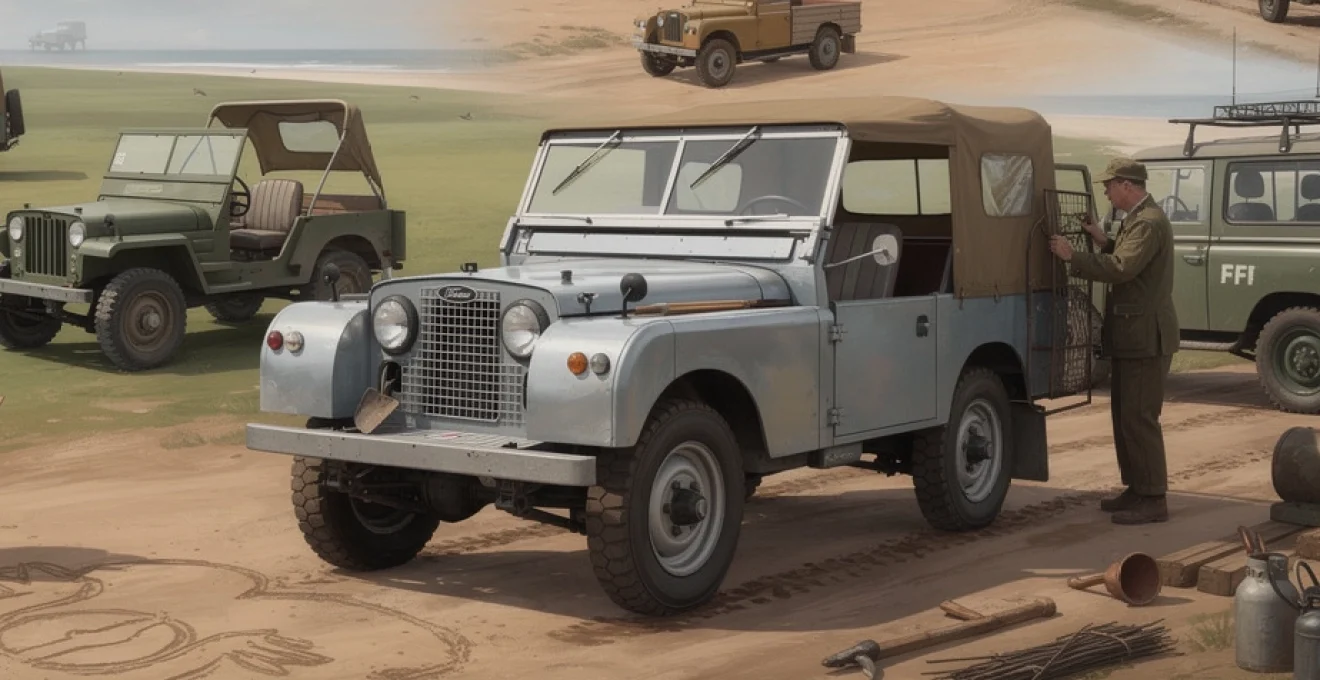
The Series 1 Land Rover is one of the few vehicles that genuinely changed how people worked, travelled and explored. Conceived in the austerity of post‑war Britain yet now equally at home outside a country pub, it bridges a remarkable gap between farm tool and cultural icon. For you as an enthusiast, engineer or prospective owner, understanding where it came from and how it was built unlocks why this square, simple 4×4 still feels relevant more than 75 years on. From the 1947 sketch in the sand at Red Wharf Bay to today’s meticulously restored examples, the Series 1 story is a study in pragmatism, ingenuity and enduring appeal.
Genesis of the series 1 land rover: post‑war britain, maurice wilks and the 1947 red wharf bay sketch
From military surplus to farm tool: adapting willys jeep concepts for british agriculture
In 1947, Britain was still under rationing, with fuel, steel and foreign currency all tightly controlled. Many farmers, including Rover’s chief engineer Maurice Wilks, were relying on ex‑military Willys Jeeps to mechanise smallholdings. Those Jeeps were cheap but tired, and parts support was limited. Wilks’s own Jeep, working hard on his Anglesey farm, sparked the question that changed 4×4 history: could a purpose‑built civilian workhorse do the job better?
On Red Wharf Bay, Wilks famously sketched a boxy utility vehicle in the sand, essentially a Jeep reimagined for British agriculture. It needed to pull a plough, drive a saw bench, haul livestock and still take the family to church. Power take‑offs front and rear were seen as crucial so it could act as a mobile power unit, not just a truck. That vision of a “mechanical farm dog” shaped every early Series 1 decision, from its ladder chassis to hose‑down interior.
Rover company strategy in a rationed economy: engineering pragmatism and export‑driven design
Before the war, Rover built refined saloons; after it, luxury cars were almost impossible to sell in volume. The government’s “export or die” policy pushed manufacturers to create products attractive to overseas markets, especially within the Commonwealth. A rugged 4×4, ideal for developing territories, ticked every box. For Rover’s board, an all‑purpose vehicle was not a niche project; it was a survival strategy.
Engineering choices reflected that hard reality. Steel was scarce, but aircraft‑grade aluminium alloy was relatively plentiful thanks to wartime production overhangs. Reusing the Rover P3 saloon’s 1.6‑litre engine, gearbox and many components reduced tooling costs and risk. The aim was not a glamorous off‑roader, but a dependable, easily exportable utility vehicle that could earn dollars and stabilise the company’s finances.
Prototype development at solihull: centre steer, pre‑production trials and technical iterations
The first prototype, built on a Jeep chassis, introduced the intriguing centre steer concept. The steering wheel sat in the middle of the dashboard so a single design could serve both left‑ and right‑hand‑drive markets. It looked clever on paper and worked in basic testing on Wilks’s farm, but access was awkward and packaging compromised. Very quickly, Solihull engineers accepted that conventional side‑mounted steering was more practical.
Development moved fast. Between late 1947 and early 1948, a small team iterated chassis design, transfer box layout and bodywork. Pre‑production vehicles with galvanised chassis and simple flat‑panel bodies were hammered over rough Welsh farmland and factory test tracks. Feedback from those brutal trials led to strengthening of cross‑members, fine‑tuning of the freewheel four‑wheel drive system and small but important usability tweaks like door aperture sizing and seating position.
Launch at the 1948 amsterdam motor show: reception, early orders and first production constraints
The Land Rover’s public debut came at the Amsterdam Motor Show on 30 April 1948. Surrounded by more traditional cars, the slab‑sided, paint‑bare prototype stood out as something entirely different. Visitors were struck by its obvious ruggedness, the clever use of aluminium and its frankly agricultural interior. Yet that stark focus on function resonated; within months, orders from both domestic and overseas markets far exceeded Rover’s conservative expectations.
Early production realities were less glamorous. Output in 1948 and 1949 was constrained by supply of steel and skilled labour. The first 80‑inch Series 1s were built with minimal trim, often sprayed in whatever green paint was available. Yet demand from farmers, the British Army and export distributors rapidly pushed totals towards 8000 vehicles in the first year. That momentum confirmed that the Red Wharf Bay sketch had tapped a genuine global need for a compact, durable 4×4 workhorse.
Chassis, body and drivetrain engineering of the series 1: ladder frame, aluminium panels and four‑wheel drive architecture
Box‑section ladder chassis design: steel gauge, crossmember layout and corrosion weaknesses
Underneath every Series 1 sits a conventional yet cleverly optimised ladder‑frame chassis. Fabricated from box‑section steel of modest gauge, it used multiple crossmembers to provide torsional stiffness while keeping weight manageable. The design prioritised simplicity: straight rails, easy‑to‑fabricate joints and plenty of flat surfaces for body mounts and power take‑off brackets. For hard off‑road work and towing, this traditional architecture proved ideal.
Corrosion, however, has always been the chassis’s weak point. Mud and moisture collect inside the boxed sections, especially around spring hangers, front dumb irons and rear crossmembers. Even though early builds sometimes featured galvanised frames, many later Series 1s now require significant welding or full replacement. For you as a restorer or buyer, thorough inspection of the chassis, inside and out, is non‑negotiable if structural integrity and originality matter.
Birmabright aluminium bodywork: panel construction, galvanic corrosion and restoration challenges
The body panels are one of the Series 1 Land Rover’s most distinctive engineering solutions. Made from Birmabright aluminium alloy, the flat panels are light, corrosion‑resistant and simple to manufacture. Basic constant‑radius folds meant panels could be hand‑beaten and repaired with limited tooling, a huge advantage in remote locations. The boxy silhouette was not just a styling choice; it was a production and serviceability strategy.
Yet aluminium brings its own issues. Where it meets the steel frame, galvanic corrosion can occur, bubbling paint and thinning metal. Straightening dented Birmabright without stretching or cracking it is a specialist skill that good bodyshops charge accordingly for. Replacement panels are widely available, but for a collector‑grade restoration, preserving original metal – with honest patina – is often more desirable than simply bolting on new skins.
Powertrain options: 1.6 and 2.0 petrol “spreadbore” engines, 2.0 diesel and crankcase design evolution
Early 80‑inch Series 1 Land Rovers used Rover’s 1.6‑litre inline‑four, delivering around 50 bhp and excellent low‑end torque. This relatively understressed unit, derived from the P3 saloon, prioritised reliability and ease of maintenance over outright speed. From 1952, displacement grew to 2.0 litres with the so‑called spreadbore design, giving a useful boost in flexibility and making the Land Rover more capable as a fully loaded people carrier or tow vehicle.
In 1957, one of the first high‑speed diesel engines for road use appeared in the Series 1 range. The 2.0‑litre diesel offered improved fuel economy and enviable longevity, but gained a reputation for noise and vibration compared with the smoother petrols. Crankcase and bearing design evolved steadily through this decade, lessons that would directly inform the later 2.25‑litre units so closely associated with Series II and III models. Many working Series 1s today have those later engines transplanted for real‑world usability, even if that hurts top‑tier collectability.
Four‑wheel drive system: transfer box, selectable 4WD, freewheel mechanism and low‑range gearing
At the heart of the Series 1’s off‑road capability sits a robust two‑speed transfer gearbox. Mated to a four‑speed main gearbox with synchromesh on third and fourth, it provides both high and low ratios for road and field work. Early vehicles used a freewheel arrangement to manage drive to the front axle, enabling a quasi‑permanent four‑wheel‑drive feel without the wind‑up associated with locked systems on high‑grip surfaces.
By the early 1950s, this gave way to fully selectable two‑ or four‑wheel drive, better suited to mixed on‑ and off‑road use. Low range gearing allows controlled progress over rough ground, while the short wheelbase maximises breakover angle. For anyone used to modern electronic traction aids, the Series 1’s purely mechanical system feels beautifully direct: if you can judge grip and choose the right gear, the vehicle will climb and crawl in a surprisingly composed manner.
Suspension, steering and braking: semi‑elliptic leaf springs, recirculating ball steering box and drum brake systems
Suspension on all Series 1 Land Rovers is via semi‑elliptic leaf springs and beam axles front and rear. This arrangement is undeniably firm, especially on early 80‑inch models, yet offers impressive articulation off‑road. Long‑travel shackles and the inherent simplicity of leaves mean the system copes well with heavy loads, rough tracks and the kind of agricultural abuse few modern SUVs could withstand. Ride quality improves noticeably with the later, longer wheelbases.
Steering is by recirculating ball box, with some early 80‑inch vehicles using aluminium housings that can crack under stress. Later cast‑iron boxes proved far more durable. On a well‑maintained vehicle, steering should not feel excessively vague or heavy; sloppiness usually indicates worn linkages or tired boxes. Braking relies on hydraulically actuated drum brakes all round, typically 9‑inch on early models. Correctly set up, they are adequate, though not modern‑car sharp, making mechanical condition and driving anticipation crucial for safe use in modern traffic.
Model evolution of the series 1 land rover: wheelbases, body variants and key model years (1948–1958)
80‑inch early production (1948–1950): narrow track axles, basic trim and pioneering agricultural equipment
The first production Land Rovers used an 80‑inch wheelbase, narrow track axles and almost minimalist trim. Roofs and doors were optional extras, usually in canvas, and interiors were painted metal with simple seat cushions. Yet these early models already offered innovation such as power take‑offs to drive farm machinery and winches, making them true replacements for small tractors in many contexts.
Collectors now prize 1948–1950 80‑inch models for their purity of concept. Lights behind the grille, the distinctive “ring‑pull” gearbox linkage and early chassis numbers all contribute to desirability. From a usability perspective, the short wheelbase gives agile off‑road manners but a notably choppy ride on tarmac, something you will immediately notice if coming from a later 86‑ or 88‑inch Series Land Rover.
Transition to 86‑inch and 107‑inch (1954): payload upgrades, long‑wheelbase design and export focus
By 1954, Rover recognised that customers needed more space and better payload capability. The original 80‑inch chassis grew to 86 inches, while an all‑new 107‑inch long‑wheelbase (LWB) model joined the range. The extra length allowed for greater load area and improved weight distribution, particularly important for export markets using Land Rovers as light trucks in challenging terrains.
The 107‑inch chassis also underpinned the first true five‑door Station Wagon capable of carrying up to ten passengers. Instead of the earlier, coachbuilt Tickford bodies, these station wagons used simple metal panels and were marketed as dual‑purpose commercial and people‑carrying vehicles. For anyone interested in classic overland travel, these mid‑1950s long‑wheelbase Series 1s offer one of the most practical vintage 4×4 platforms.
Introduction of the 88‑inch and 109‑inch (1956): rationalised wheelbases and global market adaptation
In 1956, wheelbases were rationalised again to 88 and 109 inches, dimensions that would define Land Rover for decades. The 88‑inch short‑wheelbase (SWB) model struck a compromise between nimbleness and improved ride, while the 109‑inch LWB gained further refinements for payload and stability. Design adjustments around the front chassis crossmember made way for the forthcoming diesel engine installation.
These changes reflected both technical evolution and market feedback from around the world. In Africa, Australia and the Middle East, customers wanted a rugged 4×4 that could carry heavier loads and stand up to day‑long corrugations. The 88/109 pairing proved so successful that it became the template for Series II, Series III and the later Defender line, embedding the Series 1’s engineering DNA deep into Land Rover history.
Body configurations: soft top, hard top, station wagon, fire tender, ambulance and coachbuilt specials
The standard Series 1 body styles covered most needs: soft‑top “canvas hood” utilities, hard‑top panel vans and station wagons. But the design’s simplicity also invited a vast number of specialist conversions. Fire tenders with integrated pumps, ambulances with raised roofs and tailored interiors, and mobile workshops all appeared based on the same fundamental chassis and drivetrain.
Coachbuilt specials, notably the Tickford Station Wagon of the early 1950s, added a degree of luxury with leather upholstery and wooden frameworks beneath aluminium skin. Although expensive and subject to purchase tax, these vehicles hinted at the eventual idea of a more comfortable 4×4, a concept fully realised decades later by the Range Rover. For today’s collector, such specials and correctly documented coachbuilt vehicles sit at the very top of the Series 1 value tree.
Series 1 land rover in global deployment: expedition use, military service and colonial administration
Overland expeditions: oxford and cambridge far eastern expedition, “the first overland” and trans‑africa routes
By the mid‑1950s, the Series 1 Land Rover had already proved itself far beyond British hedgerows. Student‑led expeditions such as the Oxford and Cambridge Far Eastern Expedition – often referred to as “The First Overland” – drove Series Land Rovers from London to Singapore, crossing deserts, jungle tracks and rudimentary mountain roads. Those journeys, widely reported in contemporary media, showcased the vehicle’s toughness and straightforward field reparability.
Trans‑Africa routes, from Cairo to Cape Town, also became testing grounds. Here, the combination of leaf‑spring durability, high ground clearance and simple, air‑cooled‑friendly mechanicals paid dividends. Fuel quality varied wildly, parts supply was thin, yet many Series 1s completed such journeys with only basic workshop tools and improvisation. If you are considering a classic overland project today, these early exploits remain persuasive case studies in what a well‑prepared Series Land Rover can achieve.
British and commonwealth military variants: FFR (fitted for radio), field ambulance and specialist conversions
The British Army and Commonwealth forces quickly saw the Land Rover’s potential as a light 4×4 platform. Series 1 variants included FFR (Fitted For Radio) models with screened ignition and heavy‑duty electrical systems, field ambulances with extended bodies and multiple stretcher racks, and gun‑towing or reconnaissance versions with modified stowage. Military procurement helped push Land Rover production upwards, with the 500,000th vehicle leaving the line by 1966.
These military Series 1s often saw harsh service in climates ranging from the North German Plain to Malayan jungles. For you as a buyer, ex‑military examples today offer fascinating provenance but can hide hard lives. While chassis and drivetrains were maintained to strict schedules, bodies may have been patched or modified in unit workshops, so careful documentation and inspection are vital when assessing originality and value.
Colonial and remote‑area operations: series 1 in east africa, australia’s outback and middle eastern oil fields
Across East Africa, Series 1 Land Rovers became the default vehicle for game wardens, farmers and colonial administrators. Their ability to carry people and supplies into the bush, then return at the end of the day, made them indispensable. In Kenya and Tanzania, many early Land Rovers stayed in front‑line use for decades, gaining a reputation for toughness that still influences classic buyers’ perceptions today.
In Australia’s Outback, the Land Rover competed with trucks and later Japanese 4x4s on stations spanning thousands of square kilometres. Long‑wheelbase diesel Series 1s hauled tools, fencing materials and water tanks across punishing corrugated tracks. In Middle Eastern oil fields, the combination of simple mechanics and good sand performance made them a common sight in exploration and pipeline support roles, proving that this small British 4×4 could handle some of the harshest environments on earth.
Humanitarian and NGO use: red cross, mission stations and early UN field logistics
Humanitarian organisations and mission stations also gravitated towards the Series 1. The Red Cross and medical charities used ambulance conversions to reach remote clinics, while church and development missions relied on Land Rovers to bring supplies, teachers and nurses to isolated communities. Early UN operations in post‑colonial territories frequently deployed Land Rovers in peacekeeping and logistics roles.
For NGOs, the key attractions were reliability, ease of maintenance with minimal tools and the ability to traverse rough or non‑existent roads. In many regions, the sight of a battered green Land Rover arriving signalled help, news from the outside world or evacuation in an emergency. That humanitarian legacy still shapes how many people emotionally respond when seeing a Series Land Rover today.
Collectability, restoration and preservation of series 1 land rovers in the modern era
Originality versus sympathetic modification: matching‑numbers engines, period accessories and patina preservation
As values have climbed, questions of originality versus usability have become central to Series 1 ownership. For top‑tier collectors, a matching‑numbers engine, original chassis and period‑correct details command a clear premium. Factory body configurations, correct gauges and even the right type of seat covering can all influence the final price at sale or auction.
Yet many owners prefer sympathetic modifications that make regular use more enjoyable: later 2.25‑litre engines, upgraded brakes, discreet power steering or improved lighting. Period accessories such as capstan winches, PTO‑driven equipment and correct canvas hoods can bridge the gap between originality and functionality. If you intend to drive rather than display, preserving honest patina and thoughtful upgrades can offer a more satisfying experience than chasing concours perfection.
Common restoration challenges: bulkhead rot, chassis repairs, birmabright panel straightening and parts sourcing
Restoring a Series 1 Land Rover is straightforward in concept but demanding in practice. Bulkhead rot is a notorious issue: water traps around vent flaps, footwells and pillar bases lead to extensive corrosion that often requires complex fabrication. Chassis repairs, especially at spring hangers and rear crossmembers, must be done carefully to maintain alignment and structural strength.
Straightening creased or stretched Birmabright panels without thinning or cracking them calls for experience; amateur attempts can create more work than replacement. On the positive side, parts support is exceptionally strong for a vehicle of this age. Reproduction chassis, panels and mechanical components mean that even tired, ex‑farm wrecks can be brought back to life if you have the time, budget and patience.
Key suppliers and clubs: dunsfold collection, series one club, john craddock, P.A. blanchard and paddock spares
One of the biggest advantages you have as a modern enthusiast is the ecosystem around classic Land Rovers. Specialist collections preserve reference vehicles and documentation, while dedicated clubs provide technical advice and a sense of community. Large parts suppliers and military surplus dealers ensure a steady flow of both new‑old‑stock and reproduction components for most Series 1 projects.
Joining a marque‑specific owners’ club also opens access to registers, build data and period literature scans, invaluable when researching a particular chassis number or specification. For anyone tackling a ground‑up rebuild, participation in these networks often saves both money and frustration, highlighting correct fasteners, finishes and running changes that generic workshop manuals never fully capture.
Market values and provenance: ex‑military units, early 80‑inch models and rare station wagons
Market data from recent years shows a consistent rise in values for sound Series Land Rovers, with Series 1 examples leading the curve. Early 80‑inch models from 1948–1949 can carry a 20% premium over later Series 1s in equivalent condition, and particularly early chassis‑number runs can command even more. Coachbuilt Tickford Station Wagons occupy an even higher tier, sometimes trading at prices comparable to rare sports cars when restored correctly.
Usable, well‑sorted examples without concours pretensions often represent the sweet spot if you want to drive your Land Rover regularly. At the lower end, project vehicles still change hands, but the cost of proper restoration can easily exceed their eventual market value. Provenance – documented military service, a continuous ownership chain or use in a famous expedition – can significantly affect prices, making thorough history checks a wise investment before you commit.
Enduring legacy of the series 1: design DNA in defender, new defender L663 and the wider 4×4 landscape
Design lineage from series 1 to series II, series III and the classic defender 90/110/130
Although the badges changed from Series I to II, III and eventually to Defender 90, 110 and 130, the design DNA remained strikingly consistent. Each generation refined the recipe – broader bodywork, more powerful engines, coil springs on later models – but the core principles of a separate chassis, simple body panels and all‑terrain capability endured. A Series III built in the early 1980s is, in many ways, a direct evolution of the 1948 original rather than a wholly new design.
The classic Defender line that ended production in 2016 still shared the same visual language: flat sides, upright glass, exposed hinges and an interior designed to be washed out rather than pampered. If you park a well‑preserved Series 1 next to an early Defender 90, the family resemblance is immediately obvious, down to details like the clamshell bonnet and the general stance on its axles.
Influence on competitor 4x4s: toyota land cruiser J40, jeep CJ, nissan patrol and Mercedes‑Benz G‑Wagen
The Series 1 did not just define Land Rover; it helped set expectations for the whole 4×4 utility segment. Rival manufacturers noted how effectively this compact, box‑section 4×4 served colonial administrations, farmers and militaries. Toyota’s early Land Cruisers, especially the J40 series, adopted similar separate‑chassis construction and rugged simplicity. Nissan Patrols and later Mercedes‑Benz G‑Wagens also followed the blueprint of a tough, work‑led body‑on‑frame vehicle with selectable four‑wheel drive.
Of course, each brand added its own character, but the idea that a utility 4×4 should be durable, repairable in the field and as capable off‑road as a tractor can be traced directly to the Land Rover concept. For anyone comparing classic off‑roaders today, understanding that shared heritage sheds light on why these vehicles feel so different from modern crossovers and soft‑roaders.
Series 1 in popular culture: film, television, advertising and british rural iconography
Few vehicles evoke “the British countryside” as instantly as a slightly battered Series Land Rover in a TV drama or advert. From period detective shows set in rural villages to modern lifestyle campaigns, the Series 1 silhouette signals authenticity, practicality and a certain understatement. It often appears alongside stone barns, sheepdogs and muddy lanes, reinforcing an image of a working landscape rather than a polished lifestyle.
In film, Series Land Rovers have played roles in safari scenes, wartime flashbacks and expedition narratives. Their visual honesty makes them believable in almost any rugged context, from Highland estates to African savannahs. If you drive a Series 1 in a city today, that same anti‑style aesthetic can, paradoxically, make you stand out more than any supercar, especially in poor weather where its go‑anywhere stance looks almost defiant.
Continuation, restomod and EV conversions: twisted, everrati, land rover classic and modern reinterpretations
The end of traditional Defender production and the launch of the new Defender L663 have triggered a surge of interest in both restoration and reinvention. Specialist firms now offer restomod builds that combine early Land Rover looks with modern engines, upgraded brakes, revised suspension and luxurious interiors. Electric conversions, using battery packs and electric motors in place of the original drivetrain, are also emerging as a niche but growing trend for Series and Defender models.
Land Rover’s own heritage division has demonstrated “Reborn” programmes that meticulously restore early utility models to as‑new specification, proving that the original concept still resonates with contemporary buyers. For you as a future owner or admirer, this coexistence of factory‑correct restorations, sympathetic upgrades and radical EV reinterpretations shows how robust the original Series 1 idea remains. A simple, box‑section 4×4 that can be endlessly rebuilt, reimagined and reused is a rare thing in automotive history – and that may be the most enduring part of its legacy.