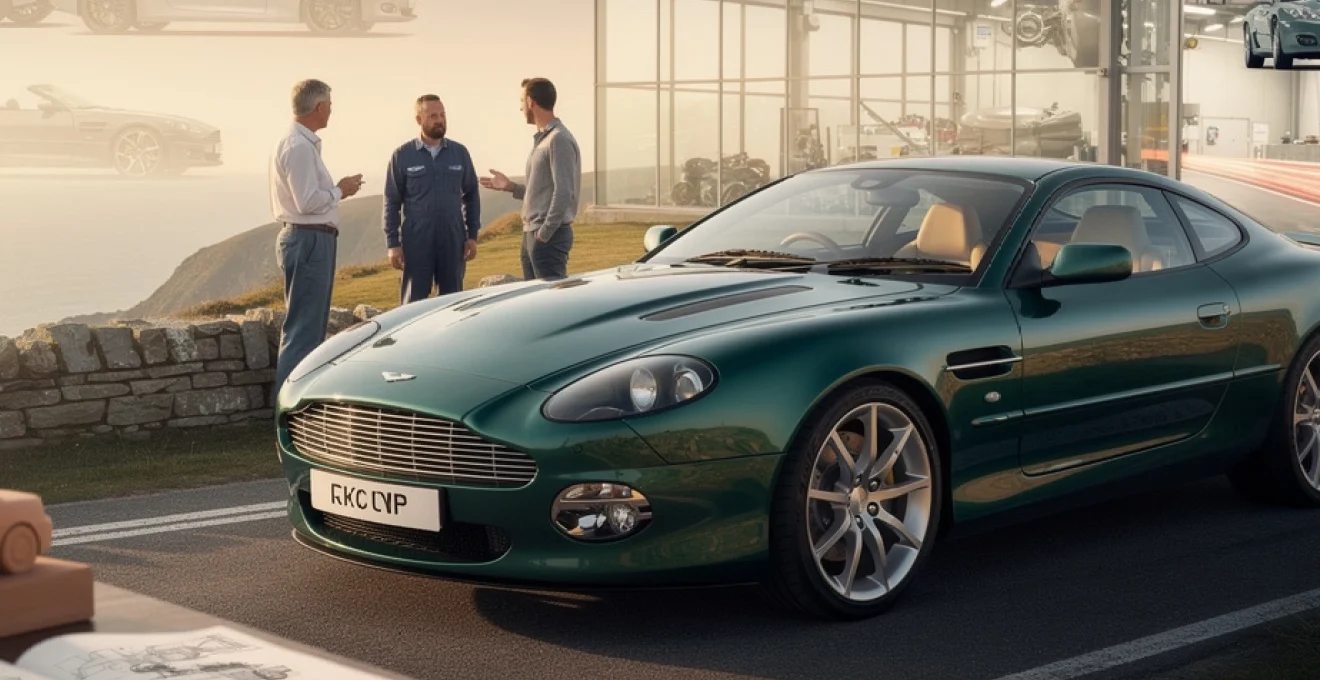
The Aston Martin DB7 V12 sits at a pivotal crossroads in modern GT history. It bridged hand-built Newport Pagnell tradition with a new era of industrial scale, introduced a charismatic V12 that would power Aston flagships for decades, and gave a new generation of drivers access to a genuinely exotic grand tourer. For anyone considering ownership, investing in a modern classic or simply understanding why a front‑engined British coupé from the late 1990s still matters in 2025, the DB7 V12 offers a compelling blend of design purity, performance and long-term significance that very few rivals can match.
Aston martin DB7 V12 development timeline and ian callum’s design language
From jaguar XJ-S underpinnings to DB7 V12: TWR, ford platform sharing and project code NPX
The DB7 story begins in the early 1990s, when Aston Martin needed a more accessible model to secure its future. Under Ford’s ownership and within the wider Premier Automotive Group, the answer emerged as project NPX, developed in partnership with Tom Walkinshaw Racing (TWR). Rather than start from a blank sheet, TWR re‑engineered the proven Jaguar XJ‑S platform, itself derived from the XJ saloon, to create a steel monocoque tailored to a compact 2+2 GT. This intelligent platform sharing kept development costs under control while allowing significant changes to suspension geometry, crash structures and body hardpoints.
The first production DB7 launched in 1994 with a supercharged 3.2‑litre inline‑six, but the chassis was conceived from the outset to accept a larger powertrain. By the time the Aston Martin DB7 V12 Vantage debuted at the 1999 Geneva Motor Show, the car had evolved from promising newcomer to serious Ferrari rival. The V12 variant was more than just an engine swap; it brought uprated brakes, revised suspension and a more muscular stance, turning the NPX concept into a genuine high-performance grand tourer.
Ian callum’s exterior design: proportion, surfacing and the evolution of the aston martin grille
Ian Callum’s design language is one of the main reasons the DB7 V12 still looks contemporary. Proportion was the starting point: a long bonnet, cab‑rearward stance and tight rear overhang created the classic front‑engined GT layout. The surfacing is remarkably clean, with gently swollen front wings, a subtle shoulder line and restrained use of ornamentation. On the V12, Callum enlarged the traditional Aston grille aperture and re‑profiled the bumper to create a lower, wider visual signature that previewed later cars such as the DB9.
The evolution of the Aston grille on the DB7 Vantage illustrates how a design cue can be modernised without losing identity. The V12’s deeper opening, integrated driving lamps and re‑sculpted bonnet vents balanced aggression with elegance. For you as an enthusiast, it means a car that still photographs beautifully from any angle and feels special even parked next to much newer machinery. Many designers and journalists continue to rank the DB7 among the best‑proportioned GTs of the last 40 years.
Engineering collaboration with tom walkinshaw racing (TWR) and the bloxham production facility
TWR’s role extended far beyond platform selection. The group handled much of the DB7’s engineering and development, drawing on endurance racing experience to refine suspension kinematics, high‑speed stability and cooling. Early prototypes were pushed hard on road and circuit, with iterative changes to bushing, spring rates and steering geometry. The result was a car that felt lighter on its feet than its Jaguar origins suggested, with a blend of ride comfort and body control suited to long‑distance touring.
Production moved away from traditional Newport Pagnell methods to the Bloxham facility, previously used for the Jaguar XJ220. This brought semi‑industrial build processes to an Aston Martin for the first time, yet retained a high level of hand finishing. Around 7,100 DB7s of all types were built between 1994 and 2004, with roughly half being V12s. For anyone used to true mass‑production sports cars, the DB7 offers a more artisanal feel without the fragility sometimes associated with low‑volume exotics.
Positioning the DB7 V12 between the supercharged DB7 i6 and the later DB9 and vanquish
The DB7 V12 effectively sits between two eras. Compared with the earlier supercharged DB7 i6, the Vantage brought 420 bhp from its 5.9‑litre engine, along with stronger brakes, wider tyres and subtle exterior changes. Performance jumped from approximately 5.8 seconds 0–60 mph to around 4.9 seconds in manual guise, firmly placing the car in Ferrari 456M territory. The character also changed: the whine and urgency of the blown six gave way to a smoother, more cultured V12 soundtrack.
Against its successors, the aluminium‑intensive DB9 and Vanquish, the DB7 V12 feels more analogue and less insulated. Some drivers regard it as the sweet spot: quick enough to be exciting, yet simple enough to maintain without the complexity of later transaxle gearboxes and bonded structures. If you are looking for a front‑engined Aston that delivers a classic GT experience with modern reliability, the DB7 Vantage occupies a unique and appealing middle ground.
V12 powertrain architecture: 5.9‑litre engine design, performance figures and drivetrain layout
Cosworth and ford PAG influence on the AM05 5.9‑litre V12 block, heads and valvetrain
The DB7’s V12, known internally as AM05, was conceived within Ford’s powertrain organisation in Dearborn. It essentially combined design principles from the contemporary Duratec V6 family into a bespoke 60‑degree aluminium block. Myths persist that Cosworth “designed” the engine; in reality, Cosworth manufactured early components and contributed know‑how, but the architecture was driven by Ford engineers to Aston Martin specifications. The 5,935 cc unit used aluminium alloy for both block and heads, with four valves per cylinder and dual overhead camshafts per bank.
A 60‑degree bank angle made the V12 naturally well balanced, reducing the need for heavy countermeasures. Bore and stroke (89 mm x 79.5 mm) gave an oversquare layout that favoured high‑rev breathing while still delivering ample torque at low revs. In the DB7 Vantage, compression ratio was set at around 10.3:1, helping the engine produce 420 bhp at 6,000 rpm and 400 lb ft at 5,000 rpm. Later DB7 GT versions nudged this to 435 bhp with detailed breathing and ECU changes.
Induction, bosch engine management and exhaust tuning in the DB7 vantage and DB7 GT
Induction on the DB7 V12 relied on twin intake plenums feeding six individual runners per bank, managed by Bosch Motronic engine electronics. This system coordinated fuel injection, ignition timing and knock control, allowing the engine to meet late‑1990s emissions standards while retaining sharp throttle response. The GT’s modest power increase came from revised cam profiles, improved intake flow and a more assertive calibration, rather than from hardware such as variable valve timing.
Exhaust tuning played a major role in the DB7 V12’s character. The standard Vantage system prioritised refinement, with twin rear silencers and intermediate resonators. Many owners later opted for aftermarket sports exhausts to release a more intense V12 soundtrack. The factory DB7 GT system moved subtly in that direction, with freer‑flowing silencers and a slightly deeper note under load. If you are choosing between cars, a well‑sorted exhaust is one of the easiest ways to enhance involvement without harming reliability.
Gearbox options: ZF 5HP automatic vs tremec T‑56 manual, gear ratios and drivability
Two main gearboxes were offered on the DB7 V12: the ZF 5HP automatic and the Tremec T‑56 six‑speed manual. The auto, later branded Touchtronic, used a torque converter with manual override via the selector, offering relaxed cruising and smooth shift quality. Ratios were spaced to keep the engine within its broad torque band, with a tall fifth gear allowing under 2,000 rpm at motorway speeds. For urban use and long‑distance grand touring, it remains the more effortless choice.
The Tremec T‑56 brought greater driver engagement, shorter gearing and slightly faster acceleration. First to third gears are relatively short, giving strong in‑gear shove, while sixth functions as a true overdrive. Shift quality is not as slick as some contemporary Italian gearboxes, but improves markedly with fresh linkage bushes and the right fluid. Enthusiasts often prefer the manual for its involvement, and manual DB7 GTs in particular command a premium in today’s modern classic car market.
Performance data: 0–60 mph, top speed and in‑gear acceleration compared with ferrari 456M and porsche 911 (996) turbo
Factory performance figures for the DB7 V12 Vantage (manual) quote 0–60 mph in approximately 4.9 seconds and a top speed of 186 mph. The automatic version typically recorded 5.1–5.2 seconds to 60 mph and around 165 mph due to different gearing and drag from the torque converter. The later DB7 GT trimmed a few tenths off the sprint time thanks to its slightly higher output and revised final drive, edging close to 4.7 seconds in independent tests.
Compared with period rivals, the Aston sat in a competitive if not class‑leading position. A Ferrari 456M GT recorded about 5.1 seconds 0–62 mph and 192 mph flat‑out, while a Porsche 911 (996) Turbo could drop below 4.0 seconds to 60 mph thanks to all‑wheel drive traction and turbo torque. However, in‑gear flexibility from the DB7’s naturally aspirated V12 impressed many testers; overtaking from 50–70 mph in fourth gear felt effortless, which matters more on real roads than headline sprint numbers.
Cooling, lubrication and known V12 reliability concerns in high‑mileage DB7 examples
Like any complex V12, the DB7’s engine benefits from diligent maintenance. Cooling is a key area: the front‑mounted radiator, electric fans and auxiliary coolers must be in top condition to avoid overheating in traffic or hot climates. Blocked radiators, aged thermostats or weak fans can lead to elevated temperatures that, if ignored, risk head gasket issues. A healthy car should stabilise comfortably below 100°C in normal driving, with fans cycling predictably.
Lubrication is via a conventional wet‑sump system, with 10,000‑mile or annual oil changes recommended by many specialists, regardless of mileage covered. Known concerns in higher‑mileage DB7 V12s include coil‑pack failure, oil leaks from cam covers and, on neglected cars, timing chain tensioner wear. None of these are unmanageable if you budget correctly. If you are considering purchase, a pre‑purchase inspection by a marque specialist and oil analysis on the engine can give invaluable insight into long‑term health.
Chassis, suspension and braking: adapting the XJ‑S structure for V12 grand touring
Steel monocoque construction, torsional rigidity and DB7 V12 weight distribution
The DB7’s chassis is a steel monocoque with additional subframes for the suspension and driveline. Although based conceptually on the XJ‑S, extensive re‑engineering increased torsional rigidity and shortened the wheelbase. For the V12, further bracing was added around the front bulkhead and transmission tunnel to cope with higher torque outputs. Kerb weight for a DB7 V12 Vantage sits around 1,800 kg, with a roughly 57:43 front‑to‑rear weight distribution in coupé form.
This front‑biased balance shapes the handling character. Turn‑in is secure rather than razor sharp, but the chassis offers progressive breakaway and a stable high‑speed personality, exactly what a GT buyer expects. As you drive faster, the car rewards smooth inputs and measured braking, more akin to a classic GT than a modern track‑focused coupé. For long journeys on mixed roads, that slightly relaxed composure becomes a real strength.
Front and rear suspension geometry: double wishbones, anti‑roll bars and spring/damper tuning
Suspension layout consists of double wishbones at all four corners, with coil springs, telescopic dampers and anti‑roll bars front and rear. TWR revised the original Jaguar geometry to reduce camber change and improve tyre contact during hard cornering. Spring and damper rates were tuned for a compromise between comfort and control, with the V12 cars running firmer settings than the earlier six‑cylinder models to counter increased mass and speed potential.
The DB7 GT went a step further with uprated springs and re‑valved dampers, targeting more precise body control and reduced roll. On typical UK B‑roads, the standard Vantage setup delivers a supple ride that suits imperfect surfaces, while the GT can feel tauter but still usable. If you are looking at aftermarket suspension kits from specialists such as R.S. Williams or others, quality dampers matched to appropriate spring rates can significantly refresh a tired chassis without sacrificing refinement.
Braking systems: brembo four‑pot calipers, disc sizing and the DB7 GT braking upgrade
Braking hardware on the DB7 V12 Vantage features Brembo four‑piston calipers at the front and single‑piston sliding calipers at the rear, acting on ventilated discs. Front discs measure approximately 355 mm in diameter, with 330 mm items at the rear on later cars. ABS and electronic brake‑force distribution manage stability under heavy stops, and period tests recorded respectable fade resistance for repeated high‑speed braking on fast roads.
The DB7 GT introduced a more serious braking package. Larger, grooved discs, aluminium bell assemblies and revised pad compounds improved both pedal feel and fade resistance. For owners of standard Vantage models, retrofitting GT‑spec hardware or high‑quality performance pads and braided lines is a common upgrade path. In spirited use, especially on Alpine passes or occasional trackdays, a well‑maintained braking system transforms confidence in this front‑engined grand tourer.
Wheel and tyre packages: 18‑inch vantage alloys, pirelli P zero fitments and alignment settings
The V12 Vantage moved to 18‑inch alloy wheels as standard, typically wrapped in 245/40 front and 265/35 rear tyres. Period cars often left the factory on Bridgestone S‑02 or Pirelli P Zero tyres, and modern equivalents such as P Zero PZ4 or Michelin Pilot Sport 4S sharpen both grip and steering response. Correct tyre choice has an outsized effect on DB7 dynamics; a switch from budget rubber to a premium performance tyre can feel like a major chassis upgrade.
Alignment settings are equally critical. A touch of additional negative camber at the front and slightly increased toe‑in at the rear can yield more precise turn‑in and better stability without uneven tyre wear, when combined with regular rotation. If you buy a DB7 V12 and want an immediate improvement in drivability, a professional geometry setup should sit high on the to‑do list alongside a thorough service.
Interior craftsmanship and GT usability: connolly leather, ergonomics and touring capability
Open the door of a DB7 V12 and the ambience is unmistakably British. Connolly leather covers almost every surface, from the seats to the door cards and dashboard. Wilton carpet lines the cabin and boot, while the fascia can be specified in rich wood veneer or more contemporary carbon‑fibre trims. This craftsmanship gives the car a warmth that many modern, screen‑heavy interiors lack. Some switchgear is shared with contemporary Ford models, but the overall impression remains genuinely luxurious.
From a usability perspective, the DB7 V12 was engineered as a true grand tourer. The front seats offer generous adjustment and long‑distance comfort, while the 2+2 layout provides occasional rear seating for children or short journeys with adults. Boot space is adequate for weekend luggage, and the Volante adds the appeal of open‑air touring without sacrificing too much practicality. Noise levels at motorway speeds are low, with the V12 humming unobtrusively in the background until you choose to explore the upper rev range.
If you are planning continent‑crossing trips, a DB7 Vantage can deliver 20–23 mpg on steady cruising, depending on gearbox choice, which is respectable for a 5.9‑litre V12 grand tourer. Ergonomics are largely straightforward, though taller drivers may find headroom tighter in the coupé than in more modern Astons. Regular use of HVAC, seat motors and hood mechanisms (on the Volante) is advisable to keep everything working smoothly, as inactivity can be more harmful than gentle, consistent use.
DB7 V12 model variants: vantage, volante, GT and zagato special editions
DB7 vantage coupé and volante: specification, options and market positioning
The DB7 V12 Vantage launched in coupé form in 1999, with the Volante convertible following shortly after. Standard specification was generous for the time: climate control, electric seats, leather throughout, premium audio and 18‑inch wheels. Buyers could choose between manual and automatic transmissions, multiple leather colourways and different fascia finishes. The car was positioned as a more attainable Aston Martin, with list prices undercutting bespoke Newport Pagnell models yet still reflecting its exotic status.
In today’s terms, the Vantage coupé offers perhaps the best balance between usability and value. The Volante introduces extra drama at the cost of some torsional rigidity, but for many owners the roof‑down experience is worth that trade‑off. If you are shopping the market, documentation of service history, corrosion repairs and any engine or gearbox work will matter more to long‑term satisfaction than colour or minor options, although rare specifications can influence collectability.
DB7 GT and GTA: uprated power output, chassis tweaks and cosmetic identifiers
Introduced in 2002, the DB7 GT and GTA represented the final evolution of the DB7 line. The GT, available only with a manual gearbox, featured a 435 bhp version of the V12, a twin‑plate clutch, stiffer suspension and the uprated braking system mentioned earlier. Aston Martin built only around 190 GTs, making them among the rarest and most sought‑after DB7 variants. Visually, the GT can be identified by a framed mesh grille with “GT” badging, bonnet vents, unique five‑spoke wheels and a subtle lip spoiler with revised bootlid.
The GTA carried most of the cosmetic and chassis upgrades but retained the automatic transmission and 420 bhp rating. With approximately 112 examples produced, it is even rarer than the GT, although collector focus tends to favour the manual. For you as an investor or enthusiast, both GT and GTA offer a more focused driving experience and stronger long‑term desirability. As values of 1990s and early‑2000s performance cars continue to rise, these halo DB7s are increasingly recognised as key modern classics.
DB7 zagato (2002): shortened wheelbase, unique bodywork and limited‑run exclusivity
The DB7 Zagato, unveiled in 2002, revived the historic partnership between Aston Martin and Italian coachbuilder Zagato. Built on a shortened DB7 platform, it adopted a two‑seat layout and bespoke aluminium bodywork. Signature styling cues included the “double‑bubble” roof, muscular rear haunches and a distinctive rear treatment that divided opinion even when new. Underneath, the car used a version of the V12 powertrain with manual transmission, tuned for a slightly more agile, sporting character.
Production of the DB7 Zagato was limited to just 99 units, all of which sold quickly to favoured clients. This rarity, combined with the Zagato name and unique body, has ensured strong collectability. Driving impressions suggest a more intimate, responsive car than the standard DB7, with the shorter wheelbase trading a little high‑speed stability for increased agility. If you are drawn to limited‑run coachbuilt specials, the Zagato sits near the top of the DB7 hierarchy.
DB AR1 (american roadster 1): US‑market focus, coachbuilt construction and production numbers
The DB AR1 (American Roadster 1) was a further collaboration with Zagato, aimed primarily at the US market. Based on the DB7 Vantage Volante, it featured unique open‑top bodywork with no conventional roof, trading all‑weather usability for pure, sun‑seeking appeal. Just 99 examples were built, making it as rare as the coupé‑bodied Zagato. Power came from the familiar V12, and most cars used the Touchtronic automatic for relaxed cruising.
Because of its roofless concept, the DB AR1 is not a car for every climate or every buyer. However, for collectors in suitable regions, it offers a highly distinctive way to experience the DB7 V12 platform. Values reflect its rarity and design pedigree, and well‑preserved examples are increasingly viewed as blue‑chip modern collectibles within the broader Aston Martin landscape.
Market impact, motorsport outings and the DB7 v12’s role in aston martin’s modern revival
Sales performance, pricing strategy and the DB7’s contribution to aston martin’s profitability
The DB7 range, including both six‑ and twelve‑cylinder versions, was the most successful Aston Martin model to date at the time of its discontinuation, with over 7,000 units produced. For context, earlier models such as the DB5 and DB6 sold in the hundreds rather than thousands. This step‑change in volume, enabled by platform sharing and Bloxham production, was instrumental in returning Aston Martin to profitability and justifying investment in the Gaydon facility and VH platform that followed.
Pricing strategy placed the DB7 V12 below full‑fat exotics from Italy but above mainstream GTs from Germany. That middle‑ground helped attract a wider audience, including buyers who might otherwise have opted for a 911 or a Mercedes SL. For you as a modern buyer, the fact that the DB7 was produced in meaningful numbers means good availability on the used market, while still retaining enough rarity to feel special in any car park.
Brand repositioning: from newport pagnell hand‑built heritage to a global GT manufacturer
Beyond raw sales, the DB7 V12 played a crucial role in repositioning Aston Martin’s brand. Previously known for low‑volume, hand‑built cars from Newport Pagnell, the company needed to become a global GT manufacturer capable of competing with Ferrari, Porsche and Maserati on the world stage. The DB7 demonstrated that Aston could deliver modern engineering, consistent quality and contemporary performance without abandoning craftsmanship or style.
The move towards a more industrialised production process laid the groundwork for Gaydon and the VH architecture, which underpinned the DB9, V8 Vantage and later derivatives. The V12 developed for the DB7 became the core of Aston’s flagship powertrains well into the 2010s, appearing in everything from the original Vanquish to the DBS Superleggera. In many ways, if you admire the current generation of Aston models, you are seeing the long shadow cast by the DB7’s commercial and technical success.
Motorsport and one‑off projects: DB7 vantage racing conversions and endurance appearances
While the DB7 V12 was never a factory works racer in the mould of the later DBR9, several notable motorsport projects emerged. TWR and Prodrive developed DB7‑based GT cars to explore the potential for one‑make or GT racing, including two “DB7 GT” prototypes with stripped interiors, roll cages and performance‑focused suspension. These cars demonstrated the platform’s underlying capability, even if the full programme did not progress.
Privateers also campaigned modified DB7s in endurance events and national GT championships, often with uprated brakes, cooling systems and safety equipment. For enthusiasts, these one‑off and low‑volume racers add an extra layer of credibility to the model’s legacy. They show that beneath the Connolly leather and Wilton carpet lies a structure and powertrain capable of handling serious competition use when prepared correctly.
Influence on subsequent models: DB9, V8 vantage and VH platform design philosophy
The visual and mechanical DNA of the DB7 V12 is unmistakable in subsequent Astons. The DB9, launched in 2003, evolved Ian Callum’s design cues with crisper surfacing and a cleaner, more modern interior, but the proportions and grille treatment clearly trace back to the DB7. Under the skin, the DB9’s bonded aluminium VH platform and rear‑mounted transaxle represented a technological leap, yet reused the same basic V12 block introduced in the DB7, further refined and lightened.
The smaller V8 Vantage that followed in 2005 adopted a shorter‑wheelbase version of the VH architecture but continued the DB7’s emphasis on timeless design and muscular yet refined performance. For you as a buyer or enthusiast, understanding the DB7 V12 provides a foundation for understanding Aston Martin’s entire 21st‑century line‑up. It is the hinge between old‑world craft and the modular, globally viable sports‑car range that followed.
Collectability, maintenance and long‑term legacy of the aston martin DB7 V12
Current and future values: auction trends for DB7 vantage, GT, zagato and DB AR1
Market data from leading auction houses and specialist dealers indicates that DB7 V12 values have stabilised and, in many cases, begun to appreciate. Over the last five years, well‑maintained Vantage coupés have typically moved from the low‑teens (in £000s) into the mid‑ to high‑teens, with exceptional low‑mileage cars surpassing £30,000. Volantes usually track slightly below equivalent coupés, reflecting a combination of supply, demand and perceived structural differences.
At the top of the tree, DB7 GT and GTA values have risen more sharply, often exceeding £60,000 for strong GT examples and climbing higher for rare colours or delivery‑mileage cars. DB7 Zagato and DB AR1 models, thanks to their 99‑unit production runs, routinely sit beyond the £150,000 mark and have shown some of the strongest percentage growth within the DB7 family. If you are considering the DB7 as a long‑term investment, targeting the best possible car within your budget and maintaining it diligently offers the strongest chance of future appreciation.
Common maintenance issues: corrosion, electrical systems and V12 service intervals
From a maintenance standpoint, the DB7 V12 behaves like what it is: a hand‑finished, low‑volume GT with mainstream engineering roots. Corrosion is a primary concern. While outer panels make extensive use of composite materials, the underlying steel structure, sills and subframes can rust, especially in climates where salt is used on roads. Professional inspection of the sills and chassis rails is vital, as repairs can be labour‑intensive if rust has spread.
Electrical systems mix Aston‑specific looms with donor‑car components. Age‑related issues such as failing window regulators, tired alternators, intermittent central locking and sensor faults are not unusual, but are usually solvable with quality parts and careful diagnosis. For the V12, realistic service intervals for an enthusiast‑owned car look like this:
- Annual oil and filter changes with high‑quality synthetic lubricant
- Coolant and brake fluid replacement every two years
- Coil packs and plugs inspected or replaced around 50,000–60,000 miles
- Regular checks of belts, hoses and cooling hardware, especially radiators and fans
Budgeting accordingly will help you enjoy ownership without unwelcome surprises. A good rule of thumb is to set aside a contingency fund of 10–15% of the car’s value for the first year of ownership, especially if history is incomplete.
Aftermarket upgrades: exhaust systems, ECU remaps and suspension kits from specialists like R.S. williams
The DB7 V12 responds well to thoughtful aftermarket upgrades, provided they respect the car’s original character. Quality stainless‑steel exhaust systems can reduce weight, sharpen throttle response and release a more evocative V12 soundtrack. Reputable ECU remaps, when combined with a freer‑flowing intake and exhaust, can add modest gains in mid‑range torque and improve drivability, although headline power increases are usually modest without more extensive mechanical changes.
Suspension upgrades from recognised specialists, including revised dampers, bush kits and subtle geometry changes, can modernise the driving experience. Think of it as giving the car a tailored suit rather than a racing harness: the goal is to restore or enhance composure, not to make the DB7 something it was never meant to be. If you are considering modifications, focusing on reversible changes preserves both enjoyment today and resale value tomorrow.
Enthusiast community, owners’ clubs and the DB7 v12’s status in modern classic rankings
The DB7 V12 benefits from an active enthusiast ecosystem, including marque‑specific owners’ clubs, online forums and regional groups. These communities provide a wealth of shared knowledge on topics ranging from parts cross‑referencing to recommended specialists and paint codes. For a new owner, tapping into this network can save substantial time and money, as common issues and effective fixes are well documented by people who have lived with the cars for years.
In modern classic rankings, the DB7 Vantage increasingly appears alongside icons such as the Ferrari 550 Maranello, BMW 850CSi and early Porsche 996 Turbo. Its mix of timeless design, naturally aspirated V12 performance and relative affordability has made it especially attractive to enthusiasts looking for a usable, appreciating asset. If you value a car that still turns heads, delivers authentic grand touring ability and connects directly to the rebirth of a legendary British marque, the Aston Martin DB7 V12 deserves a prominent place on any serious shortlist.