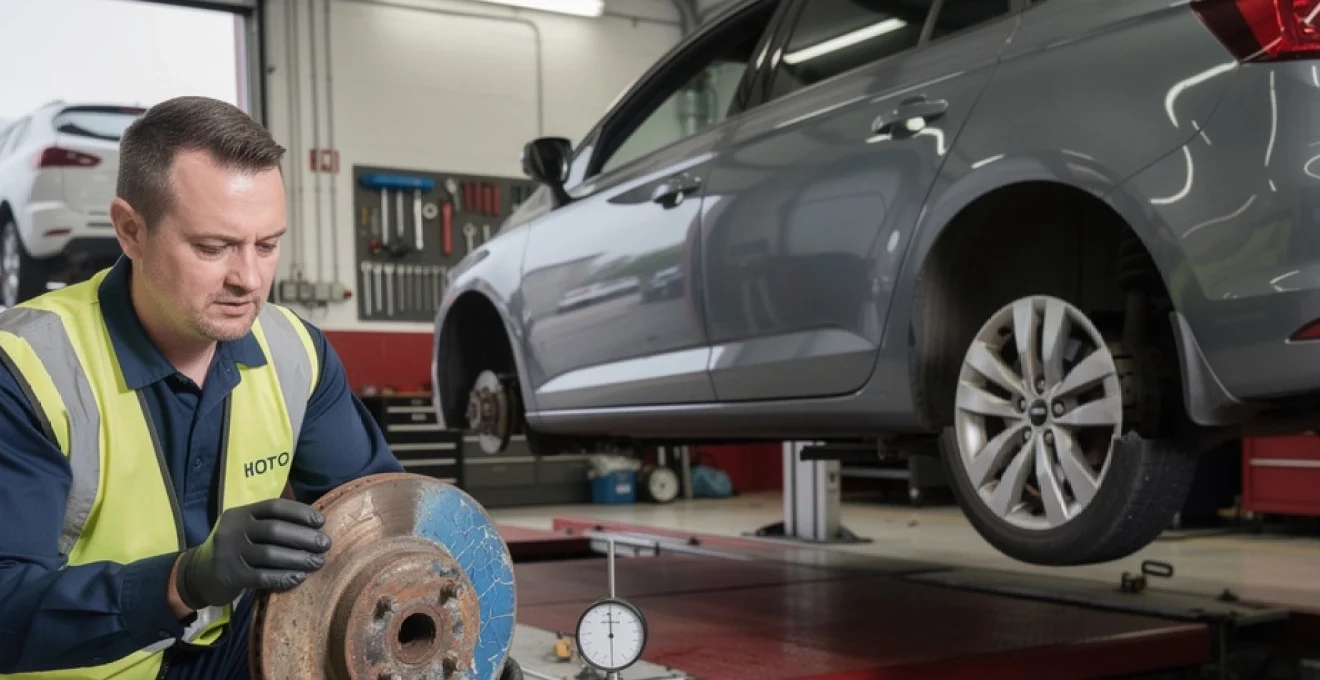
When you rely on a car every day, the MOT can feel like a pass-or-fail judgement on how safe that vehicle really is. Few components influence that verdict more than the braking system, and the brake discs in particular. Although discs are just slabs of metal at first glance, their condition directly affects stopping distances, stability and whether the DVSA MOT tester records only an advisory, a major defect or a dangerous failure. Under the UK MOT Testing Guide, even a disc that looks acceptable from the outside can hide severe corrosion on the inner face, poor pad contact or performance below the required thresholds on the brake tester. Understanding how testers assess discs, and how to spot problems early, gives you a real advantage in avoiding unexpected MOT failures and expensive last‑minute repairs.
DVSA MOT criteria for brake disc failure under UK MOT testing guide section 1.1.14
Under Section 1.1.14 of the DVSA MOT Testing Guide, brake discs and drums are judged on their structural integrity and how likely they are to fail under load. The guidance is clear that a disc must be significantly worn before it justifies rejection. That means simply being below the manufacturer’s nominal wear limit is not, by itself, an automatic MOT failure. Instead, the tester looks for clear signs that the disc is seriously weakened, heavily damaged or insecure. The official defect categories reflect this, with anything that suggests imminent failure – such as cracked or fractured discs – classed as a dangerous defect because of the immediate risk to braking safety.
Disc condition is only one part of the picture. The tester also considers contamination from oil or grease, missing friction surfaces, and any back plate issues on drum brakes. These problems sit alongside the wider brake system checks in Sections 1.1.10 to 1.1.21, where flexible hoses, rigid pipes, calipers and servo operation all contribute to whether your car’s brakes are considered safe. For many drivers, this explains why a car can fail its MOT on braking performance even when the discs themselves appear relatively clean and free from corrosion at first glance.
Advisory vs major vs dangerous: how MOT testers categorise brake disc defects
From 2018 onwards, MOT defects for brake components are classified as Minor, Major or Dangerous, which has changed how many garages report worn discs. A disc that is clearly worn but not yet “significantly and obviously worn” will usually attract an advisory, especially if a lip is visible or the remaining thickness is approaching the stamped MIN TH value. This advisory warns you that replacement will be needed soon, even though the disc still meets minimum safety requirements on the day of the test.
Once a disc is “significantly and obviously worn”, it becomes a Major defect under reference 1.1.14(a)(i) and the car fails its MOT. If the disc is insecure, fractured or otherwise likely to fail in service, the defect is upgraded to Dangerous under 1.1.14(a)(ii). In practice, this might involve a vented disc with chunks missing from the cooling vanes, a disc with a visible crack from centre to edge, or a disc loose on the hub. A Dangerous defect means the car should not be driven on the road until repaired, because the risk of a catastrophic loss of braking is considered unacceptable.
Minimum brake performance thresholds on the roller brake tester (RBT) and plate brake tester
Even if discs pass a visual inspection, the vehicle can still fail due to poor performance on the roller brake tester or plate brake tester. The DVSA sets specific minimum efficiencies for the service brake, typically 50% for most passenger vehicles in category M1 registered before 1 September 2010, rising to 58% for newer M1 cars with brakes on at least four wheels. For most N1 light vans the efficiency target is also 50%. The MOT testing service automatically calculates these figures on the basis of axle brake forces and the measured or stated vehicle test weight.
On a non‑ATL RBT, if more than half of the wheels in a system lock up during the test, the efficiency requirement is considered met. This rule is especially important for heavier Class 7 vehicles, where the front wheels locking and a minimum recorded force at each rear wheel can still satisfy the DVSA thresholds. On plate brake testers, the presented weight is used for Class 3 and 4 vehicles, while Class 7 efficiency is calculated using the design gross weight or a nominal 2,600 kg where appropriate. If the recorded brake effort is too low, even perfect‑looking discs cannot prevent a Major or Dangerous defect for inadequate braking.
Recording brake disc failures on the MOT testing service (MTS) with defect codes and comments
When a brake disc fails under Section 1.1.14, the MOT tester records the defect on the MOT Testing Service with a specific code and brief description. For example, “1.1.14(a)(i) Brake disc significantly and obviously worn – Major” or “1.1.14(a)(ii) Brake disc insecure – Dangerous”. In practice, testers often add comments such as “inner face heavily corroded” or “disc cracked at outer edge” to help you understand exactly what prompted the failure, and to provide a permanent record for future reference.
Performance‑related failures, such as poor service brake efficiency or serious brake imbalance, are recorded under Section 1.2.1 or 1.2.2. For example, “1.2.1(a)(i) Braking effort inadequate at a wheel – Major” or “1.2.2(a)(i) Service brake efficiency below minimum requirement – Major”. These codes matter if you are comparing quotes or discussing the failure with a second garage, because they distinguish between cosmetic‑looking disc issues and actual performance deficits measured on the tester.
Common MOT failure wording for discs: “seriously weakened”, “significantly pitted”, “excessively scored”
Certain phrases appear repeatedly on MOT certificates and advisory sheets relating to discs. Terms such as “seriously weakened”, “significantly pitted” or “excessively scored” tend to be linked to the Major defect in 1.1.14(a)(i). They indicate that the friction surface has deteriorated beyond what the DVSA considers acceptable, even if the disc has not physically cracked or broken away yet. Heavily pitted inner faces, where corrosion has eaten into the metal, are a frequent cause, especially on low‑mileage cars used mostly in urban traffic.
Another common phrase is “corrosion lip to outer edge of disc”, often recorded as an advisory rather than a failure. The lip itself is not the problem; instead it is a symptom of the friction surface wearing away. Where the lip combines with deep grooves across the pad contact area, the tester might record wording such as “disc worn, lip and heavily scored” and categorise this as a Major defect. That judgement depends on how much metal remains and whether the surface condition is likely to compromise stopping power or structural integrity.
Types of brake disc defects that trigger MOT failures
Severe corrosion and pitting on the friction surface, particularly inner faces hidden by alloy wheels
In the UK climate, corrosion is one of the fastest routes to a brake disc MOT failure. Road salt, standing water and long periods of inactivity combine to attack the disc surface. The inner face, tucked away behind alloy wheel spokes and splash shields, often suffers worst because it receives less airflow and cleaning from pad contact. Many MOT testers report that more than half of disc‑related failures they see are driven by inner face corrosion rather than obvious outer surface defects.
Corrosion starts as a light rust film which is quickly cleaned off by normal braking, but if a car sits for weeks at a time, that film can develop into deep pitting. Once pitting affects the area under the pad, the effective contact area shrinks and the friction surface becomes uneven. The DVSA wording “brake disc significantly and obviously worn” is often used in these cases. For you as a driver, the first symptom may be a pulsing pedal, grinding noise on light brake application, or a longer‑than‑usual stopping distance in the wet.
Excessive scoring, lips and wear ridges measured against manufacturer disc thickness specifications
Scoring, grooves and the familiar lip on the disc edge are driven by a combination of normal wear and abrasive contamination. Grit, rust flakes and worn pad material can embed into the pads and cut channels into the disc surface. Over tens of thousands of miles, this process removes material and leaves a clear ridge where the pad does not sweep. When the disc gets close to its engraved MIN TH value, most professional technicians recommend replacement even if the MOT does not yet demand it.
MOT testers are not required to measure disc thickness with a micrometer, but many will note when a disc is clearly below the manufacturer’s minimum. Industry data from several major brake manufacturers indicates that running discs thinner than specified can increase stopping distances by up to 10% because the disc heats and fades more quickly. Additionally, thinner discs are more prone to cracking under hard use, such as repeated motorway emergency stops. For these reasons, a combination of heavy scoring and obvious thinning often leads to a Major failure for safety rather than a mere advisory.
Heat checking, blueing and thermal cracks from heavy braking or towing (e.g. VW transporter, ford transit)
Heat‑related damage is another route to MOT failure, especially on vehicles that tow heavy trailers or run constantly loaded, such as VW Transporter and Ford Transit vans. When a disc overheats, the surface can show a blue or purple tint known as blueing. Fine surface cracks, called heat checking, can appear in a cross‑hatch pattern. While light heat checking is not always a reason for rejection, the DVSA specifically notes that discs must be rejected if they become insecure, fractured or otherwise likely to fail.
Thermal cracks radiating from the centre or following the drilling on performance discs are a particular concern. If a crack reaches the disc edge or joins with adjacent cracks, the risk of a piece of disc breaking away under braking increases dramatically. On an MOT, this would normally be recorded as “disc fractured, likely to fail – Dangerous”. For you, the warning signs might include severe brake judder at motorway speeds or a sharp change in pedal feel after one very hard stop, especially on long downhill descents or when towing a caravan.
Edge flaking, chunking and delamination of vented discs on vehicles like BMW 3 series and audi A3
Modern vented discs, common on cars such as the BMW 3 Series and Audi A3, can suffer from edge flaking and delamination as they age. Moisture and corrosion attack the internal vanes and the bond between inner and outer faces. Over time, chunks of material can break away at the disc edge, leaving a jagged, flaky circumference. The DVSA regards this as a serious structural issue because those vanes are essential for both cooling and strength.
On an MOT, such damage is often written up as “disc edge fractured” or “vented disc seriously weakened”, almost always as a Major or Dangerous defect. Technically, the disc may still deliver some braking effort, but the risk is that a further piece breaks away unpredictably. If you see pieces missing from the disc edge, or hear a rhythmic knocking noise that changes with wheel speed but not engine speed, a detailed inspection is essential before the next MOT test.
Brake disc run‑out and warping causing pedal judder and imbalance on the brake roller test
Disc run‑out, often described as warping, relates to how true the disc runs as it rotates. Excessive lateral run‑out causes the pads to alternately grip and release, which you feel as a pulsing pedal or steering wheel vibration when braking from higher speeds. On the roller brake tester, this appears as excessive fluctuation in the recorded brake effort per wheel revolution, a clear reason for rejection under Section 1.2.1(e).
Run‑out can be caused by a distorted disc, a corroded hub face, incorrect torque sequence on wheel nuts, or even contamination trapped behind the disc during fitting. While a slightly warped disc may only generate an advisory, serious brake fluctuation or imbalance between sides quickly leads to a Major failure. From a safety standpoint, judder not only reduces confidence but can also lengthen stopping distances because the tyres are not gripping the road consistently throughout the braking event.
Diagnosing brake disc issues before an MOT test
Visual inspection through alloy spokes vs wheel‑off inspection on a two‑post or scissor lift
Early diagnosis of brake disc issues is one of the most effective ways to avoid MOT failures and the rush for same‑day parts. A quick visual inspection through the alloy wheel spokes can show you obvious problems such as heavy outer face corrosion, major scoring or cracks. However, it is only half the story. The inner disc face, where many failures occur, is almost invisible without removing the wheel entirely or raising the vehicle on a two‑post or scissor lift.
If you suspect braking issues – perhaps due to noise, vibration or longer stopping distances – arranging a pre‑MOT inspection where the wheels are removed is often worthwhile. Many garages offer fixed‑price brake checks, and experienced technicians can usually spot the early signs of MOT‑threatening disc issues within minutes. For DIY enthusiasts, jacking the car safely, using axle stands and turning the wheels with the gearbox in neutral allows a more thorough check for lips, pitting and damage around the full circumference.
Using a micrometer or vernier calliper to measure disc thickness against stamped MIN TH
Every quality brake disc has a specified minimum thickness, normally stamped on the disc hub or edge as MIN TH followed by a value in millimetres. Measuring the actual disc thickness with a micrometer or vernier calliper and comparing it to this value is a simple but powerful diagnostic tool. If the disc is already at or below the minimum, replacement is strongly recommended, regardless of whether it would scrape through the next MOT.
From a technical standpoint, thinner discs have less thermal mass and less structural strength. Industry testing has shown that discs worn 20–25% below their original thickness can reach fade temperatures up to 30% faster under repeated heavy braking. For you, that might mean an extra car length or two in an emergency stop. While the DVSA does not mandate thickness measurement during the MOT, bringing discs that close to the limit almost always results in at least an advisory and often prompts a recommendation for immediate replacement.
Checking lateral run‑out with a dial indicator and identifying hub vs disc distortion
When you feel brake judder, it can be tempting to assume the disc is “warped”, but professional diagnosis is more precise. A dial indicator, mounted to the suspension and placed against the disc face, measures lateral run‑out as the disc is rotated. Typical acceptable values range from 0.05 to 0.1 mm depending on vehicle manufacturer. Anything beyond this suggests a problem that, left unchecked, could lead to MOT failure for brake fluctuation or imbalance.
If the disc is refitted to a different position on the hub and the high spot moves with it, the disc itself is distorted. If the high spot stays in the same position relative to the hub, the hub face or bearings are suspect. This distinction matters because replacing discs alone will not cure judder caused by a bent hub or contaminated mounting face. Treat run‑out like a wobbly vinyl record: unless both the record and the turntable are true, the needle – in this case the pads – will keep jumping.
Evaluating pad contact pattern to detect partial seizure of sliding calipers or guide pins
Brake disc condition is closely linked to how well the pads contact the surface. Uneven pad contact can create hot spots, tapered wear and localised corrosion, all of which may drive future MOT failures. When pads are removed, the wear pattern tells a story. A pad worn heavily at one end suggests a seized or sticking caliper slider pin. A pad worn more on one side of the vehicle than the other hints at a partially seized piston or hose restriction.
If you see a distinct line across the pad where contact stops, the disc may have a high rust ridge or a band of pitting. Over time, this reduced contact area leads to lower measured braking effort on the RBT and a greater risk of imbalance between sides. Solving these issues typically involves cleaning and lubricating slider pins with the correct high‑temperature grease, checking piston travel and, if necessary, replacing calipers alongside new discs and pads to restore even braking.
How poor braking performance leads to MOT failure even with “OK‑looking” discs
One of the most confusing situations for drivers is an MOT failure for brake performance when the discs and pads appear visually acceptable. Under Sections 1.2.1 and 1.2.2, the DVSA focuses on how effectively the brakes actually slow the car, not just how the components look. On the roller brake tester, low readings at one or more wheels, or an overall efficiency below the required percentage, constitute a Major defect even if the discs are not corroded or cracked.
Several factors can cause this. Glazed pads, for example, develop a hardened, glassy surface from gentle urban driving or repeated light braking. This glaze dramatically reduces friction, leading to brake efficiencies 10–20% below where they should be, despite discs that still look relatively smooth. Contaminated friction surfaces from leaking wheel cylinders, split caliper seals or hub oil seals can have a similar effect. In some published DVSA statistics, brake performance issues represent around 15–20% of all MOT failures in the light vehicle category, underlining how common this hidden problem is.
Hydraulic issues amplify the problem. Air in the brake fluid, internal leakage in a master cylinder or a partially collapsed flexible hose can all reduce the pressure reaching the calipers. Because the RBT measures only the final brake force at the tyres, these upstream issues show up as low readings without any obvious external defect. For you, the key sign is often a spongy or sinking pedal. Addressing such problems – by bleeding the system, replacing hoses or renewing a tired master cylinder – can turn a marginal MOT failure into a comfortable pass even without touching the discs themselves.
Vehicle usage patterns that accelerate brake disc MOT failures in the UK climate
How and where you drive has a powerful influence on brake disc life and MOT outcomes. Short, stop‑start trips in town, where discs never get truly hot, tend to promote surface rust that is not fully cleaned away. Over months, this can turn into the inner face corrosion that so often triggers MOT advisories or failures. Conversely, regular sustained runs at A‑road or motorway speeds, with occasional firm braking, help keep the friction surfaces clean and dry.
Low annual mileage is a double‑edged sword. Many drivers assume fewer miles means less wear, but DVSA data and independent fleet studies show that low‑use cars can experience more severe disc corrosion than high‑mileage vehicles. In the UK, where average annual mileages for private cars have dropped below 7,500 miles in recent years, this pattern is becoming more visible in MOT test lanes. Cars that sit outside near the coast, exposed to salty air, are especially vulnerable, with some requiring new discs at three or four years old despite relatively low odometer readings.
Driving style matters as well. Heavy right‑foot braking from high speeds generates extreme heat cycles that can accelerate cracking and blueing, especially on loaded vans, SUVs and cars used for towing. Repeated steep descents in hilly regions, or spirited driving on performance models, impose similar stress. Professional observation over the last decade suggests that vehicles regularly used for towing or fast A‑road driving are significantly more likely to show heat‑related disc defects by mid‑life, compared with identical models driven mainly in slow urban traffic.
Repair options after a brake disc MOT failure and best practices for replacement
Once a brake disc has triggered an MOT failure, replacement is almost always the only sensible repair option. Skimming discs in situ was more common in the past, but modern discs are thinner to begin with and leave less margin after machining. Because the MOT failure typically arises from significant wear, cracking or corrosion, removing even more material rarely meets best practice. In addition, DVSA guidance on “unacceptable repairs” to braking components makes clear that makeshift fixes to discs and pressure lines are not permitted.
Brake discs and pads should always be replaced in axle pairs to maintain balance. Mixing an old disc on one side with a new disc on the other is a fast route to brake imbalance on the roller tester and uneven pad wear. At the same time, many professionals recommend renewing pads whenever discs are changed, even if the pads appear half‑worn, to ensure correct bedding‑in and maximum friction. For performance‑orientated drivers, upgrading to high‑quality discs and pads from reputable brands can improve fade resistance and longevity, particularly on vehicles that tow or regularly carry heavy loads.
During replacement, attention to detail pays off. Cleaning the hub face thoroughly with a wire brush and checking run‑out after fitting the new discs helps prevent future judder and MOT issues. Correct torqueing of wheel nuts in a star pattern, using a calibrated torque wrench, avoids distorting the disc or hub. Flushing old brake fluid – which absorbs moisture and lowers boiling point over time – restores pedal feel and reduces the risk of vapour lock under heavy braking. Industry guidance often suggests replacing brake fluid every two years, and several surveys show that a large proportion of cars on UK roads exceed this interval, leaving safety margins smaller than many drivers assume.
Finally, consider how the vehicle will be used after the repair. Gentle bedding‑in, using progressive stops rather than harsh emergency‑style braking for the first 200–300 miles, allows new discs and pads to mate correctly. This procedure reduces noise, minimises the chance of hot spots and ensures the friction surfaces develop an even transfer layer. Think of it like wearing in a new pair of shoes: rushing straight into a marathon invites blisters, whereas a steady start leads to better comfort and longer life. Applying the same principle to braking hardware helps extend the time between MOT‑related brake failures and keeps stopping performance at its safest for longer.