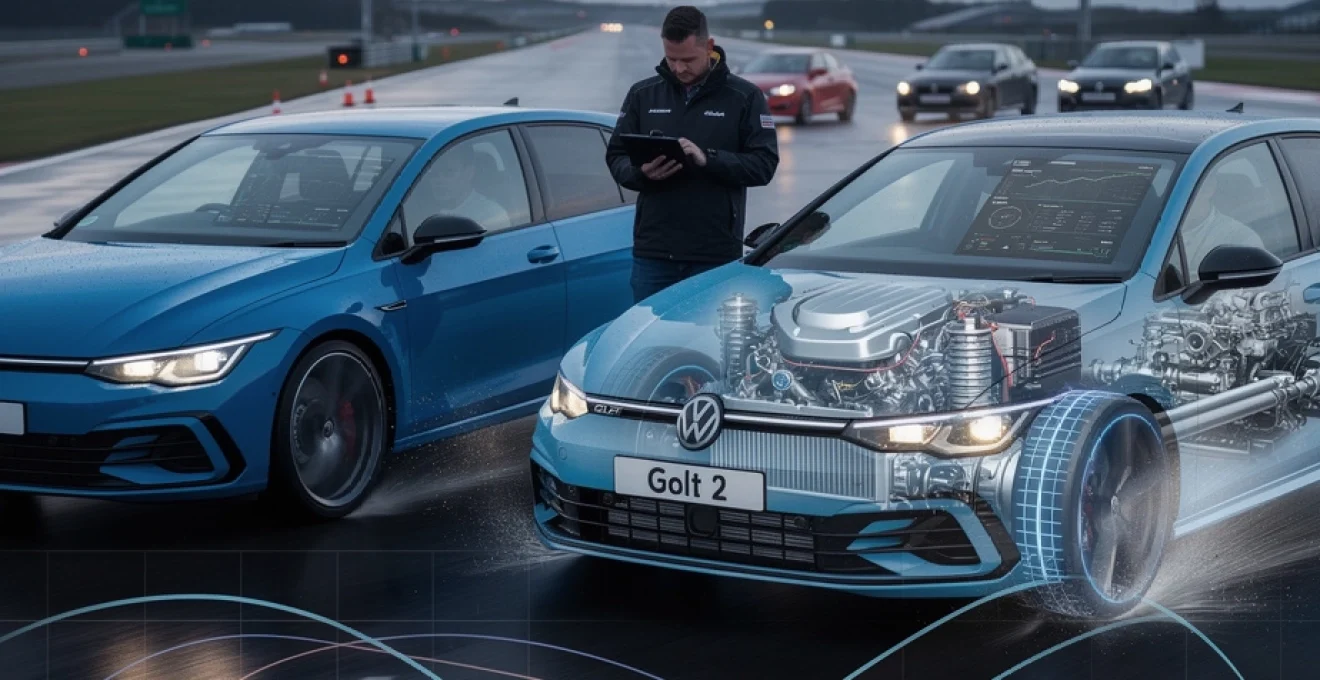
The VW Golf R occupies a rare space in the performance car world: a family hatchback that can outrun yesterday’s supercars, shrug off a wet January commute and still feel calm on the motorway. For many enthusiasts it has become the default answer to the question, “What is the best all‑round fast car you can live with every day?” Whether you are comparing a used Mk7 Golf R against the latest Mk8.5, or planning a 400+ bhp build, understanding how the engineering fits together helps you choose the right specification and upgrades.
Beyond the headline figures, the Golf R story is about how the EA888 2.0 TSI engine, 4Motion all‑wheel drive, DSG gearbox and adaptive chassis combine to deliver accessible speed. The latest models add more sophisticated torque vectoring, a heavily revised infotainment system and sharper driving dynamics, which is why they keep appearing on “best hot hatch” and “Car of the Year” shortlists. For anyone cross‑shopping an Audi S3, Mercedes‑AMG A35 or BMW M135i, a closer look at the Golf R’s evolution is essential.
MK7 vs MK8 VW golf R: generational evolution of the performance hot hatch
Platform and chassis changes from PQ35 to MQB evo in the VW golf R lineage
Early fast Golfs such as the Mk6 R still relied on the older PQ35 platform. The big step came with the Mk7 Golf R, which moved to the modular MQB architecture, and then again with the Mk8 Golf R on the updated MQB Evo platform. For you as a driver, this evolution means a stiffer body shell, more sophisticated crash structures and more freedom for engineers to tune suspension geometry without adding weight.
The Mk7 Golf R already felt light on its feet, typically weighing just under 1,500 kg, yet the MQB Evo car manages to add more technology and safety equipment while keeping mass tightly controlled. Revised mounting points and subframes give the Mk8 R a more precise front end and help refine high‑speed stability. If you are used to an older hot hatch, the calmness the Golf R maintains at 80 mph on a European autobahn can be genuinely surprising.
Engine development from EA113 to EA888 evo4 in golf R models
The Golf R bloodline stretches back to R32 models using the narrow‑angle VR6, but the modern era is dominated by the turbocharged four‑cylinder. Early R models used the EA113 2.0 TFSI; from the Mk7 onwards, everything revolves around the EA888 family. Output climbed from 300–310 PS in early Mk7 cars to 320 PS in the pre‑facelift Mk8, with the latest Mk8.5 Golf R now rated at 328–333 hp depending on market.
This power increase has not come from simply turning up the boost. Each generation added refinements like variable valve timing on both cams, improved knock control and more efficient cooling. A key point for anyone considering a remap: the newer EA888 Evo4 in the Mk8 R is highly boost‑tolerant, which is why reputable tuners confidently push Stage 1 cars towards 370–380 bhp on stock internals.
Design and aero differences between golf R mk7, mk7.5 and mk8
Visually, the Golf R has always followed a subtle, almost sleeper‑like formula. The Mk7 introduced the quad exhausts and R‑specific bumpers; the Mk7.5 facelift sharpened the LED lighting signatures and wheel designs. The Mk8 R goes further, with more aggressive bumpers, a deeper front splitter and a larger rear spoiler, especially when specified with the R Performance Pack.
Aerodynamically, these changes are more than styling tweaks. The latest Golf R benefits from more controlled airflow under the car and better brake cooling, helping with repeated high‑speed runs or track use. At the same time, it still avoids the wild-looking wings found on rivals like the Honda Civic Type R, which suits anyone who wants a fast car that does not shout about it in the office car park.
Comparing factory performance figures: 0–62 mph and top speed across golf R generations
Factory figures tell a clear story about how the Golf R has evolved. The table below compares key performance metrics across recent generations of the hatchback version:
| Generation | Power | 0–62 mph | Top speed |
|---|---|---|---|
| Mk7 Golf R (2014–2016) | 300 PS | 5.1 s (DSG) | 155 mph (limited) |
| Mk7.5 Golf R (2017–2019) | 310 PS | 4.6–4.7 s (DSG) | 155 mph (limited) |
| Mk8 Golf R (2020–2023) | 320 PS | 4.7 s (DSG) | 155 mph (168 mph with Performance Pack) |
| Mk8.5 Golf R (2024–) | 328–333 hp | 4.6 s (official, often quicker in tests) | 155 mph (168 mph with Performance Pack) |
Independent testing has repeatedly shown that modern Golf R models match or beat the claimed acceleration times, even in damp conditions. A contemporary Mk8 car timed at 4.4 seconds to 60 mph in the wet underlines just how effective the launch control and 4Motion system are. For everyday overtakes, this depth of performance matters more than the raw top speed.
EA888 2.0 TSI powertrain: turbocharged performance engineering in the golf R
Single-scroll vs twin-scroll turbocharger architecture in the EA888 golf R engine
The heart of every modern Golf R is a turbocharged EA888 2.0 TSI engine. Early versions used a single‑scroll turbocharger, but higher‑output later cars adopted improved turbine and compressor designs with optimised exhaust manifold routing. Although still described as a single‑scroll unit, the latest turbochargers behave much like a compact twin‑scroll setup, separating exhaust pulses to improve spool.
For you, the benefit is minimal lag and a broad usable powerband. The engine starts to pull strongly from around 2,000 rpm and keeps delivering right up to the 6,500 rpm redline. On a fast B‑road, that flexibility means fewer downshifts and more confidence when overtaking, because the engine responds almost instantly when you squeeze the accelerator.
Direct injection, compression ratio and knock control strategies in the golf R
To hit both performance and emissions targets, the Golf R relies on high‑pressure direct injection, sophisticated ignition timing and robust knock control. Compression ratios around 9.3–9.6:1 are relatively high for a turbo motor running up to ~1.5 bar of boost, but careful combustion management allows this safely on 98 RON fuel.
Modern EA888 engines constantly monitor cylinder pressure and knock activity, pulling timing or reducing boost if low‑octane fuel is detected. That explains why you can run a Golf R on standard premium unleaded yet notice an extra edge when filling with super unleaded. If you are chasing consistent lap times or a safe Stage 1 remap, using high‑quality fuel and sticking to recommended oil change intervals is non‑negotiable.
Cooling system, intercooler layout and charge-air management in the mk8 golf R
A key weakness of many tuned turbo cars is heat soak. VW addressed this in the Mk8 Golf R with an upgraded cooling circuit and a more efficient front‑mounted intercooler. Coolant flows through multiple circuits to manage engine block, turbocharger and transmission temperatures, while airflow through the bumper and grille has been optimised to feed both the radiator and the charge‑air cooler.
On a spirited drive, you feel this as consistent performance: back‑to‑back full‑throttle runs produce near‑identical acceleration, rather than the softening response seen in less well‑cooled engines. For track days, many owners still choose an aftermarket intercooler, but the factory setup in the latest R is robust enough for enthusiastic UK road use.
Torque curve, overboost functions and in-gear acceleration characteristics
One of the most impressive aspects of the EA888 in Golf R tune is the torque plateau. Peak torque of around 400 Nm (295 lb ft) is available from roughly 2,000 to 5,500 rpm, giving the car serious in‑gear punch. Short bursts from 30–70 mph or 50–90 mph are where the car feels closest to genuine sports machinery.
Certain calibrations also employ an overboost function, allowing slightly higher torque for a few seconds in specific gears. The result is that impressive 0–60 sprint and strong mid‑range thrust when merging onto motorways. The flip side is that tyres and clutches, particularly in tuned cars, have a harder life than in a milder GTI‑spec EA888.
Real-world fuel consumption vs WLTP figures for the EA888-powered golf R
Official WLTP figures for the latest Golf R sit at around 34–35 mpg combined, which is respectable for a 330 hp all‑wheel drive hatchback. Real‑world consumption depends heavily on how you drive. Many owners report averaging 28–32 mpg in mixed use, dropping to the high teens during hard driving or on track.
On a steady motorway cruise at 70 mph, 36–38 mpg is achievable thanks to tall gearing and low engine revs. To keep running costs sensible, three practical tips make a noticeable difference: use Eco or Comfort mode for steady journeys, keep tyre pressures at the recommended values, and avoid short, cold‑start trips where the engine never reaches full operating temperature.
4motion all-wheel drive and torque vectoring in the VW golf R explained
Haldex coupling vs torque-split rear differential in mk7 and mk8 golf R
All recent Golf R models use some form of 4Motion all‑wheel drive, but the hardware has changed significantly. The Mk7 and Mk7.5 employ a Haldex‑type clutch pack on the rear axle, allowing the car to run mostly front‑wheel drive in steady cruising, then send up to around 50% of torque rearwards when slip is detected.
The Mk8 Golf R moves beyond this with an R‑Performance rear differential that can actively distribute torque between the left and right rear wheels. Instead of simply sharing drive across the axle, it can send almost all available rear torque to one side. On the road this makes the car feel more agile and less prone to safe, dull understeer when pushed hard into a corner.
Selective wheel torque vectoring and the drift mode system in mk8 golf R
Using the rear differential, the Mk8 R introduces selective wheel torque vectoring. In fast bends, the system can overdrive the outside rear wheel, helping the car rotate and effectively tightening the line. The much‑talked‑about Drift mode is really an extreme calibration of this principle.
In Drift mode the stability control slackens right off, and the all‑wheel drive system sends the majority of power rearwards, biasing it to the outside rear wheel. On a closed circuit or skid pan, this allows controlled oversteer that feels far removed from a traditional all‑wheel drive hatch. For everyday UK road use, Race or Individual modes give a more sensible blend of agility and security.
Traction, launch control and stability control calibration for road and track
Launch control is one of the party tricks that make a Golf R feel supercar‑quick from a standstill. With the DSG gearbox, simply selecting the right drive mode, pressing the brake and flooring the throttle preloads the turbo, then the car fires off the line with minimal wheelspin. Independent tests around 4.5 seconds to 62 mph are common on stock cars.
The traction and stability control calibration is deliberately conservative in Comfort and Eco modes, intervening early to keep things tidy in poor conditions. Switch to Race or a more aggressive Individual setting, and the systems allow more slip before stepping in. A long press of the ESC button engages ESC Sport or partial off, which keen drivers use on track to balance safety with the freedom to explore the chassis.
Winter driving, wet grip and all-weather usability of 4motion in the UK
For UK owners, the biggest day‑to‑day benefit of 4Motion is not lap times but confidence in poor weather. Standing water, greasy B‑roads and occasional snow are handled with a composure that front‑wheel drive hot hatches struggle to match. If you live in a rural area or commute at unsociable hours, that extra security can be a strong reason to choose a Golf R over a GTI.
Pairing 4Motion with a good set of all‑season or winter tyres transforms the car’s ability in cold, wet or icy conditions. While the Golf R remains more about fast‑road performance than off‑road ability, the reassurance it offers when a surprise frost hits in March is one of its most under‑rated qualities.
DSG vs manual: transmission choices and gear ratio analysis in the golf R
DQ250 and DQ381 DSG gearboxes: launch control, shift speeds and reliability
Dual‑clutch DSG gearboxes have become synonymous with the Golf R experience. Early Mk7 cars used the six‑speed DQ250, while later Mk7.5 and Mk8 models switched to the seven‑speed DQ381. Both offer lightning‑quick shifts and support full launch control, but the seven‑speed unit brings closer ratios and a longer top gear for relaxed cruising.
Shift times measured in tens of milliseconds make manual gear changes feel almost slow by comparison. From a reliability perspective, regular oil changes and sensible torque limits in tuned applications are crucial. Stage 1 remapped cars are generally fine on stock hardware, but higher‑power builds benefit from an uprated DSG software calibration to raise clutch clamping pressure.
Six-speed manual golf R: clutch feel, gearing and driver engagement
Manual Golf R models, offered on many Mk7 and some early Mk8 markets, appeal strongly to purists. The six‑speed gearbox has a positive, medium‑throw action and a clutch that is light enough for traffic yet weighty enough to feel substantial. For those who enjoy heel‑and‑toe downshifts and absolute control, it adds an engaging layer missing from the latest DSG‑only cars.
The trade‑off is outright speed. Without launch control and with slightly longer shift times, manual cars are typically 0.3–0.5 seconds slower to 62 mph than their DSG equivalents. For many drivers that difference matters less than the more interactive feel of working through the gears on a favourite road.
Gear ratio spread and motorway cruising rpm at 70 mph
Both manual and DSG Golf R models use relatively short lower gears to emphasise punch off the line and out of slow corners, then a taller top gear to keep revs low at motorway speeds. A typical Mk7 DSG car sits just under 2,500 rpm at 70 mph in seventh, whereas a manual Mk7 runs closer to 2,800 rpm in sixth.
On long journeys this translates into slightly better fuel consumption and reduced cabin noise for DSG cars, though the difference is modest. If you frequently cover hundreds of motorway miles, the relaxed nature of the seven‑speed DSG might suit you better; if most driving is on local B‑roads, the additional engagement of a manual could be more rewarding.
Quarter-mile performance and 0–100 mph tests: DSG vs manual golf R
Independent timing has repeatedly shown DSG Golf Rs running quarter‑mile times in the low‑12 to mid‑13 second range in stock form, depending on conditions and generation. Manual cars are usually a few tenths behind due to less perfect launches and slower shift times. In 0–100 mph testing, the gap widens slightly, often approaching a full second.
For drag‑strip enthusiasts or anyone who simply wants the most effortless real‑world performance, DSG remains the obvious choice. However, if you value driver involvement more than headline numbers, the manual still delivers the core Golf R character with added interaction—particularly relevant in a world where new hot hatches are increasingly automatic‑only.
Adaptive chassis, suspension geometry and braking hardware on the golf R
DCC (dynamic chassis control) adaptive dampers and ride modes in the golf R
Most Golf R models are available with DCC (Dynamic Chassis Control), VW’s adaptive damping system. This allows continuous adjustment of damper force based on vehicle speed, steering input and drive mode. Comfort mode softens the ride for urban use, while Sport and Race ramp up body control for enthusiastic driving.
In the latest cars, DCC offers up to 15 individual steps of firmness within the Individual profile, letting you fine‑tune the compromise between ride and handling. For UK roads, a popular setup is pairing a slightly softer damper setting with the sharper throttle and steering response from the sportier modes, giving compliance over broken surfaces without sacrificing response.
Macpherson strut and multi-link rear suspension tuning for handling balance
Under the skin, the Golf R sticks with a proven combination: MacPherson strut suspension up front and a multi‑link rear axle. The R‑specific tuning includes stiffer springs, unique damper valving and thicker anti‑roll bars compared with a standard Golf. Ride height is lower, helping reduce weight transfer and improve turn‑in.
The result is a handling balance that feels neutral and secure in most situations, shifting towards mild understeer at the absolute limit unless you provoke the car or rely on the torque vectoring of the Mk8. For fast road driving, that predictability is a strength, allowing you to build confidence quickly even in tricky conditions.
OEM brake systems, disc sizes and pad compounds on mk7 and mk8 golf R
The factory brake package on the Golf R is powerful enough for everyday use and occasional spirited driving. Typical specifications include 340 mm front discs with single‑piston sliding calipers on Mk7 cars, upgraded further in later models for improved heat management. Rear discs are smaller but still vented, supporting the all‑wheel drive system’s torque distribution.
On track, the limiting factor is usually pad compound and fluid rather than outright disc size. Owners who regularly visit circuits often upgrade to performance pads, high‑temperature brake fluid and stainless braided lines. For fast road use in the UK, keeping the OEM system in top condition and avoiding cheap aftermarket pads maintains strong, consistent braking.
Tyre choices (michelin pilot sport 4S, pirelli P zero) and their impact on lap times
Tyres are a critical, and often underestimated, part of the Golf R package. Many cars leave the factory on Pirelli P Zero or Bridgestone Potenza tyres, which provide decent grip but can feel nervous in colder, wetter conditions. Switching to a tyre like the Michelin Pilot Sport 4S is one of the most effective upgrades you can make.
On independent tests, a high‑quality UHP tyre can cut lap times by over a second compared with an average performance tyre, while also improving braking distances and steering feel. For UK road driving, a premium all‑season tyre might even make more sense, extending usable performance into low‑temperature months without a big penalty in summer.
Interior tech, infotainment and driver assistance in the modern golf R
Digital cockpit pro, performance gauges and configurable displays
Modern Golf R interiors revolve around the Digital Cockpit Pro, a fully digital instrument cluster that replaces traditional dials. You can configure layouts to prioritise a central rev counter, navigation maps or performance gauges such as boost pressure and G‑meter readings. For fast driving, having a clear, legible rev counter and speed read‑out directly in front of you is a genuine benefit.
The latest 12.9‑inch central display in the Mk8.5 R integrates smoothly with the cluster, and shortcut buttons help access drive modes and key functions more quickly than in the early Mk8. While some users still criticise the touch‑sensitive steering wheel buttons, the overall interface is much improved compared with the 2020 launch cars.
Discover pro infotainment, navigation and smartphone integration
The Golf R typically comes with VW’s Discover Pro infotainment system, including built‑in navigation, online services and over‑the‑air updates in newer cars. Wireless Apple CarPlay and Android Auto are supported, turning the car into an extension of your smartphone. Voice control has grown more capable in recent model years, particularly when paired with connected services.
Some owners have experienced occasional smartphone connectivity glitches, especially on early Mk8 software, but VW has issued updates to improve stability. For long‑distance driving, integrating streaming services, real‑time traffic and route planning into a single interface adds genuine convenience, especially when combined with the optional head‑up display.
Driving assistance systems: ACC, lane-keep assist and travel assist in the golf R
Driver assistance is another area where the Golf R punches above its “hot hatch” billing. Standard kit in many markets includes adaptive cruise control (ACC), lane‑keeping assist and traffic sign recognition. Together, these systems ease the workload on motorway slogs or congested A‑roads.
More recent cars add semi‑autonomous features under the umbrella of Travel Assist, blending ACC and lane‑centering to maintain speed and position in marked lanes. While not a substitute for attentive driving, these systems help reduce fatigue, especially if you cover serious mileage. The key is to treat them as intelligent aids rather than autopilots.
Tuning potential, stage upgrades and reliability considerations for the VW golf R
Stage 1 ECU remaps from revo, APR and mountune on the EA888 golf R
The EA888 engine in the Golf R is famously tuneable. A reputable Stage 1 ECU remap from specialists such as Revo, APR or Mountune typically lifts power from stock levels to around 360–380 bhp and torque to 450–500 Nm on 98 RON fuel. No hardware changes are needed, making this the most cost‑effective route to serious gains.
From a drivability perspective, a good Stage 1 map should feel OEM‑plus: stronger mid‑range, sharper response but still smooth, with factory‑like cold‑start and part‑throttle behaviour. Choosing a tuner with a strong track record on Golf R models is essential to protect both engine longevity and emissions equipment.
Stage 2 hardware upgrades: downpipes, intercoolers and intake systems
Stage 2 tuning moves beyond software to let the EA888 breathe and cool more effectively. Typical upgrades include a freer‑flowing downpipe (with a high‑flow sports catalyst), larger front‑mounted intercooler and less restrictive intake system. Together with revised software, power figures around 400 bhp are common.
The main benefit you feel is consistency: less heat soak after repeated pulls, stronger top‑end power and a more characterful exhaust note. However, such modifications can affect warranty coverage and MOT emissions compliance, so it is important to consider local regulations and choose quality components from reputable brands.
Hybrid turbo and stage 3 builds: 400+ bhp golf R street and track setups
For those chasing supercar‑rivaling numbers, hybrid turbo and Stage 3 builds are the next step. By fitting a larger turbocharger with upgraded internals, along with higher‑capacity fuel pump and supporting hardware, 450–500 bhp Golf Rs on stock bottom ends are now relatively common.
At this level, the character of the car changes. Low‑rpm response can soften slightly, but the surge from 4,000 rpm to the redline is intense. Traction, brake and cooling upgrades become essential, and you must accept a higher level of mechanical stress and running cost. For a dual‑purpose street and track car, targeting around 430–450 bhp is often a sensible sweet spot.
Clutch, DSG software and drivetrain reinforcement for tuned golf R models
As torque climbs beyond stock levels, the standard clutch or DSG calibration often becomes the limiting factor. Manual Golf Rs running strong Stage 2 or Stage 3 maps benefit from an uprated clutch and sometimes a lightened flywheel to handle repeated hard launches without slip.
DSG cars respond well to a TCU (transmission control unit) tune, which increases clutch clamping pressure, raises torque limits and refines shift behaviour under load. Beyond this, some high‑power builds upgrade engine mounts, propshafts or differentials for durability. Treating the drivetrain as a complete system rather than focusing only on power is the best way to maintain reliability.
Common reliability issues and preventative maintenance strategies on tuned cars
Tuned or not, the Golf R is generally robust, but a few areas deserve attention. High boost and heat can accelerate wear on coil packs, spark plugs and PCV systems, so proactive replacement with quality parts is wise. Oil change intervals of 10,000 miles or less using the correct VW‑approved oil help protect the turbo and timing chain components.
On heavily modified cars, regular inspection of boost hoses, intercooler clamps and exhaust mounts prevents small issues becoming track‑ending problems. Keeping the cooling system in top condition and monitoring oil and coolant temperatures during spirited driving also extends engine life. In short, treat the car like a compact performance machine rather than a regular hatchback and it responds with impressive durability.
VW golf R vs rivals: audi S3, Mercedes-AMG A35 and BMW m135i compared
Power, weight and performance metrics vs audi S3 8V and 8Y
On paper, the Golf R lines up closely with its premium cousins. The latest Audi S3 8Y shares much of the MQB Evo architecture and EA888 engine, producing a similar 333 hp in recent updates. Kerb weights are broadly comparable, and 0–62 mph claims sit in the 4.6–4.7 second region for both cars.
Where the Golf R tends to edge ahead is value and subtlety. Equivalent performance often comes at a lower price point, particularly on the used market, and the VW badge attracts less attention than an S‑line Audi for those who prefer to fly under the radar. For pure badge appeal and interior finish, the S3 still has an advantage, but dynamically the gap is small.
Handling characteristics vs Mercedes-AMG A35 4matic and BMW m135i xdrive
The Mercedes‑AMG A35 4Matic and BMW M135i xDrive offer similar all‑wheel drive hot hatch performance, but each feels different behind the wheel. The A35 has a firmer, more aggressive character, with a soundtrack that adds drama but can become tiring on long trips. The M135i majors on stability and comfort, though some enthusiasts find it less playful at the limit.
The Golf R occupies a middle ground: firmer and more engaging than the BMW in its sportier modes, yet more rounded and refined than the AMG in everyday use. The Mk8’s torque‑vectoring rear differential also gives it a distinct advantage when exploiting tight, twisty roads, making the car feel more rear‑biased and adjustable than previous generations.
Everyday usability, running costs and insurance groups in the UK market
Hot hatchbacks gained popularity because they blend performance with practicality, and the Golf R exemplifies that. Boot space of 341 litres in the hatch (or over 600 litres in the Estate version) is enough for pushchairs, luggage or bulky shopping, while rear legroom accommodates adults comfortably. For many UK buyers, it replaces both a family car and a weekend toy.
Running costs reflect the performance on offer. Expect insurance groupings around the low‑30s (group 33 for some recent Rs), fuel economy in the high‑20s to low‑30s in mixed driving, and higher tyre and brake costs than a regular Golf. Factoring in these expenses from the start helps you enjoy the car fully rather than resenting its appetite for premium fuel and quality rubber.