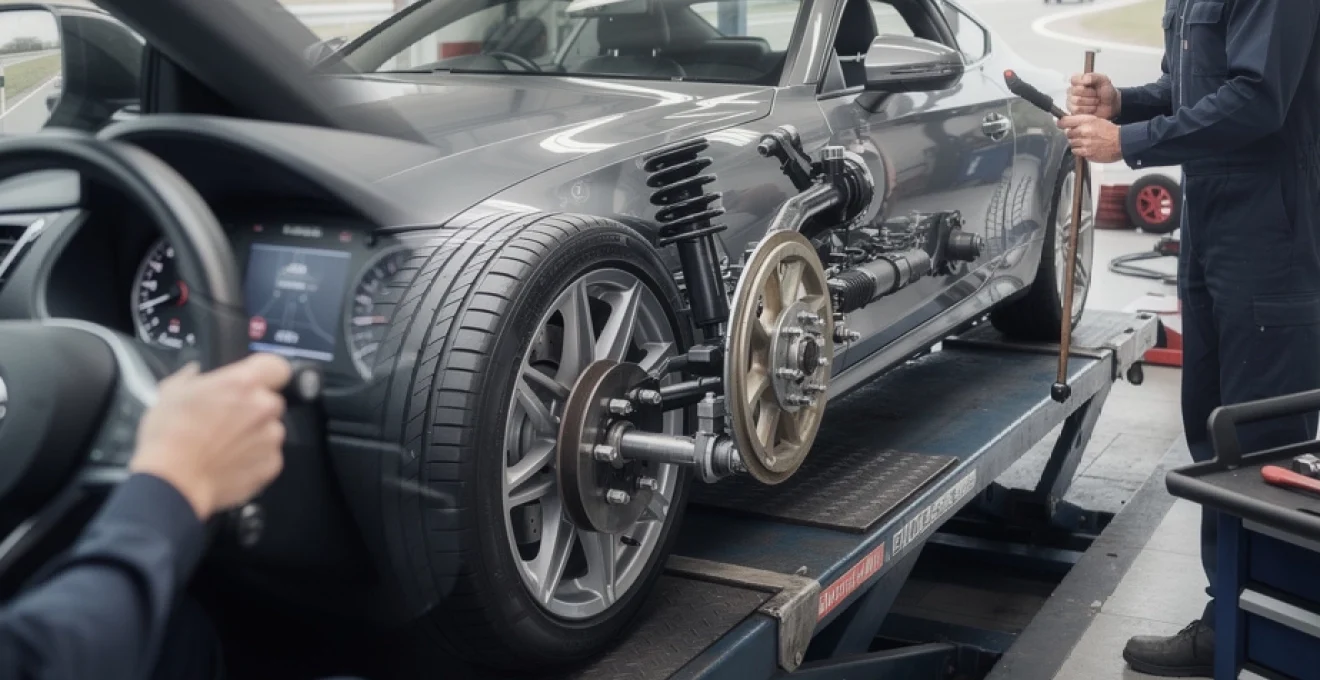
A wobble, shake or vibration through the steering wheel is one of those faults you feel instantly. It can turn an otherwise smooth drive into something that feels nervous, imprecise and, in some cases, unsafe. For many drivers, the first instinct is to blame the road surface, especially on pothole‑scarred UK routes, but a persistent steering wheel wobble almost always points to an underlying mechanical issue. Understanding those causes helps you decide whether you can drive to a garage, or whether the car should be recovered immediately. It also helps you talk confidently with a technician, so you get a proper diagnosis rather than guesswork or repeated part-swapping.
Steering wobble is rarely “just one thing”; tyres, wheels, brakes, suspension and even the chassis geometry all interact. Think of the steering system as your fingertips on the front axle: anything that upsets the tyres’ contact with the road will be transmitted straight back to you. Once you know how speed, braking and road conditions change the symptoms, you can narrow down the root cause far more quickly.
Common mechanical causes of steering wheel wobble at different speeds
Wheel imbalance and out-of-round tyres causing speed-specific steering shake (e.g. 60–70 mph)
By far the most common cause of steering wheel vibration at motorway speeds is simple wheel imbalance. When a wheel and tyre assembly is not evenly weighted around its circumference, centrifugal force builds as speed rises. Around 60–70 mph this imbalance often hits a “resonance” point, and you feel a shimmy through the steering wheel even on a smooth surface. Below 40 mph you may feel nothing at all, which is why a wobble only at high speed is such a classic symptom of imbalance.
Fresh from the factory, wheels are balanced with small clip‑on or adhesive weights. Hit a pothole or kerb and one of those weights can fly off, turning a previously smooth setup into a wobbler overnight. Tyres that are slightly “out-of-round” amplify the problem, acting like a rolling hammer on the suspension. If you have recently fitted tyres and now notice vibration, a re-check of wheel balance is usually the first, fastest and cheapest diagnostic step.
Persistent vibration at a specific speed band almost always points to a rotating mass problem – usually wheel balance, sometimes a tyre defect, and much less often a driveshaft issue.
Bent alloy wheels and buckled rims from pothole impacts on UK roads
Modern low‑profile tyres and big alloy wheels look good but offer little protection from the sharp edges of potholes. A heavy impact can bend the inner rim of the wheel by a few millimetres, even if the face still looks perfect. That small buckle is enough to cause cyclical vibration that feels a lot like an imbalance, but repeated balancing never quite cures it. In the UK, insurance data suggests wheel and suspension damage from potholes runs into tens of thousands of claims each year, with some regions reporting a 20–30% rise in winter months.
A bent alloy wheel often produces a wobble that is felt both at moderate speeds and on braking. In some cases, you may notice a slight hop or “thump-thump” noise. A tyre professional will usually spin the wheel on a balancing machine and watch the rim for lateral (side-to-side) or radial (up-and-down) run-out. Minor buckles can sometimes be straightened by a specialist; severe damage usually means replacement for safety reasons, especially if cracks are visible near the spokes or bead seat.
Tyre defects: separated belts, flat spots and irregular tyre wear patterns
Not every steering vibration is down to alignment or balance; the tyre structure itself can fail. Inside a radial tyre, steel belts provide stiffness and shape. If one of these belts separates from the rubber – sometimes after a heavy impact, sometimes from age or manufacturing defects – the tread can become lumpy or develop a visible bulge. That bulge contacts the road once per rotation and sends a sharp vibration straight into the steering wheel.
Flat spots are another culprit. Leaving a car standing for weeks or months, especially in cold weather, can deform the tyre where it contacts the ground. Initially you will feel a rhythmic wobble at low to medium speeds; mild flat spots may “drive out” as the tyre warms up, but severe ones remain. Irregular wear, such as “cupping” or “feathering” of tread blocks, usually suggests worn shocks or poor alignment and creates a buzz or light shake at various speeds. Any visible bulge, exposed cords or severe uneven wear is a cue to replace the tyre immediately, as the risk of blowout is high.
Brake disc run-out and warped rotors causing wobble under braking
Steering wheel shake only when you brake is almost always related to the front brakes. Overheated or poor‑quality discs can develop thickness variation or lateral run-out – often described as “warped discs”. In practice, this usually means the disc face is no longer perfectly flat, or has uneven deposits of pad material. As the pads clamp on, the caliper is pushed back and forth, sending a pulsation up the steering column. You will usually feel this from about 40 mph downward, and the brake pedal may pulse in time with the steering wobble.
Contrary to popular belief, heavy braking from high speed once or twice rarely causes warping on its own. More often, incorrect installation, rust on the hub face, or seized slide pins prevent the disc from running true. Over time, this leads to uneven heating and pad transfer. Replacing discs and pads, cleaning hub faces properly and checking torque on wheel bolts is the professional fix. Leaving brake judder unchecked increases stopping distances and can trigger ABS early, especially on wet roads.
Loose or worn wheel bearings generating steering vibration and droning noise
Wheel bearings allow the hub and wheel to rotate freely while supporting the car’s weight. When they wear, play develops between the hub and the knuckle, and the rolling elements begin to pit. Early symptoms are often a humming or droning noise that increases with speed and may change when you steer gently left or right. In more advanced cases, you might feel a vague, wandering sensation through the steering, or a light wobble that is hard to pin down to a particular speed.
On many modern cars, the bearing is an integrated hub unit, so replacement is the only option. Ignoring a noisy bearing is risky: if it collapses, the wheel can tilt or, in extreme cases, detach. For diagnosis, a technician will usually jack the wheel, grip it at 12 and 6 o’clock and check for play while listening for grating sounds when the wheel is spun. Any noticeable movement in a sealed hub unit is usually grounds for immediate replacement.
Steering and suspension component wear that transmits vibration to the steering wheel
Worn track rod ends and inner tie rods introducing steering play and shimmy
The track rods and tie rod ends link the steering rack to the hub. Their ball‑and‑socket joints allow the wheels to pivot for steering while maintaining precise control. Over time, these joints wear, especially on cars that regularly hit potholes or speed bumps at speed. Once a joint loosens, the wheel can “steer itself” by a few millimetres as it hits bumps, causing a shimmy or shake in the steering wheel, often described as a wandering or on-centre vibration.
You might notice a clunk over rough surfaces, or that small steering inputs feel vague before the car reacts. In extreme cases, the steering wheel may oscillate left and right lightly at certain speeds. Because worn tie rods affect toe angle, they can also cause uneven tyre wear. Technicians typically use a pry bar to load the joint while watching for movement, or feel for play by hand while an assistant rocks the steering.
Failing lower control arm bushes and wishbone bushes on models like VW golf or ford focus
Lower control arms (wishbones) locate the wheel fore and aft and control its movement as the suspension compresses. The rubber bushes at their mounting points are designed to flex, isolating vibration. On popular models such as the VW Golf, Ford Focus or Vauxhall Astra, these bushes are a known wear item, often deteriorating between 60,000 and 100,000 miles depending on driving conditions. Once cracked or torn, they allow the whole hub to move backwards slightly under braking or acceleration.
From the driver’s seat, this can feel like a dull thud on take‑off, a pull under braking, or a light wobble when hitting mid‑corner bumps. Uneven tyre wear on the inner or outer shoulders is common. Because these bushes control geometry under load, worn items can mimic alignment or tyre issues. Replacing them with quality parts, sometimes upgraded “hydro” or stiffer bushes, restores precision and often transforms the car’s stability.
Play in ball joints and top mounts affecting steering stability and wheel alignment
Ball joints act as pivot points where the suspension connects to the wheel hub. Many front suspensions use a lower ball joint plus a strut top mount, which combines a bearing and rubber mount. Wear in either can introduce play, leading to vague steering, knocking noises and, in some cases, steering wheel vibration over rough surfaces. A worn top mount bearing can “snag” during low‑speed turning, creating a graunching sound and a twitchy feel in the wheel.
Because ball joints are safety‑critical, any detectable play usually means replacement. Road safety organisations routinely highlight ball joint failures as a cause of serious incidents, particularly on heavily loaded vehicles. Technicians test ball joints using lever tools and by observing movement while the suspension is unloaded. Fresh joints and top mounts help maintain correct camber and caster, which directly affects steering feel and stability at speed.
Ageing shock absorbers and struts failing to damp oscillations from wheels
Shock absorbers (dampers) do not support the car’s weight; they control the speed at which the springs compress and rebound. When dampers lose effectiveness – either by leaking or internal wear – the wheels can bounce more than they should. That extra oscillation allows any small wheel or tyre imbalance to be felt much more strongly through the steering wheel, especially on uneven surfaces. Studies have shown that worn shocks can increase braking distances by up to 20% on bumpy roads, and MOT statistics regularly list damper issues among common advisories.
If the front of the car continues to bob after a speed bump, or if the body feels “floaty” at motorway speeds, the shocks are likely tired. On some cars, you can see oil misting down the outside of the damper body. Replacing dampers in axle pairs (both fronts together) is best practice, as mismatched damping left-to-right can itself cause a steering pull or mild vibration under certain conditions.
Steering rack wear, column joints and universal joints adding free play and vibration
The steering rack converts the rotary motion of the steering wheel into the side‑to‑side motion that turns the wheels. Between the wheel and the rack sit several universal joints and, in some designs, a collapsible column. Any wear in these joints adds free play, so the steering wheel can move without immediately moving the wheels. That slack allows vibrations from the road to rattle the column, especially over sharper bumps.
Symptoms can include a light knock from under the dashboard, a slightly off‑centre shimmy, or a “notchy” feel as the wheel passes through centre. On electric power steering systems, worn components can confuse the torque sensor, leading to inconsistent assistance and exaggerated wobble. Diagnosis typically involves feeling each joint while the wheel is gently rocked, and checking for movement of the rack relative to its mounts. In severe cases, a replacement rack or column section is the only safe remedy.
Wheel alignment, geometry and chassis factors behind steering vibration
Incorrect toe, camber and caster settings leading to steering wobble and tramlining
Wheel alignment – sometimes referred to as geometry – controls how the tyres meet the road. Toe, camber and caster settings are all specified to within fractions of a degree. While misalignment is more commonly associated with tyre wear and pulling to one side, extreme errors can also contribute to steering shake. Excessive toe‑out, for example, makes the car feel nervous on the motorway and can cause the steering wheel to twitch as the tyres follow grooves in the tarmac, a sensation known as tramlining.
Camber outside specification concentrates load on the inner or outer shoulders of the tyre, accelerating wear and sometimes causing “stepped” tread patterns that buzz through the steering. Caster affects self‑centring; low caster can make the steering feel light and unstable around the straight-ahead. If you feel that the car wants to dart with every small input, or that you are constantly correcting on a straight road, an alignment check is advisable.
Misaligned subframes and accident damage affecting front-end geometry
Sometimes, a simple four‑wheel alignment cannot bring values back within specification. In these cases, underlying structural issues such as a shifted subframe or previous accident damage may be to blame. Modern cars bolt the engine, gearbox and suspension arms to a front subframe; a heavy kerb strike or poorly executed repair can move this structure by several millimetres. That is enough to change camber and caster beyond what the adjusters can compensate.
From the driver’s point of view, this might show up as a car that feels “crabbed”, where the rear seems to follow a different line to the front, or a persistent steering wheel offset even after multiple alignments. Body shops and advanced alignment centres sometimes use datum measurements from manufacturer data to check subframe and chassis leg positions. In serious cases, precision jig work or subframe replacement is the only route back to correct geometry and stable steering behaviour.
Hub-centric vs lug-centric wheel fitment and the role of spigot rings
Wheel fitment details can seem trivial until vibration appears after changing wheels. Many factory wheels are hub-centric, meaning the wheel centre bore exactly matches the hub spigot, so the hub carries the weight and automatically centres the wheel. Some aftermarket wheels have a larger generic bore and rely on spigot rings to adapt to the car. If those rings are missing, damaged or made of poor‑quality plastic that deforms, the wheel becomes effectively lug-centric, centred only by the wheel bolts.
Even if such a wheel can be balanced on a machine, slight miscentring when bolted to the car can cause a persistent high‑speed wobble. Drivers often notice this immediately after fitting new alloys or swapping between summer and winter sets. Ensuring the correct centre bore size and using quality, snug‑fitting spigot rings – ideally aluminium on performance vehicles – is a small but critical detail in eliminating steering wheel shake.
Effects of aftermarket wheels, spacers and incorrect offset (ET) on steering feel
Aftermarket wheels and spacers change the effective offset (ET) and scrub radius of the front axle. Pushing the wheels further outboard with spacers or low‑offset rims can improve stance, but it also increases leverage on bearings, bushes and steering components. That extra leverage can exaggerate any existing play and make previously unnoticed vibrations quite obvious. On cars with sensitive suspension design, incorrect offset can also alter bump steer characteristics, leading to twitchiness over undulations.
Some drivers report that adding spacers introduces a new shimmy around 60 mph even though the wheels are balanced. In many of those cases, the combination of spacer quality, hubcentricity and bolt torque is the root problem. High‑quality hubcentric spacers, correctly torqued wheel bolts and alignment checks are essential if you plan to modify factory wheel fitment and still enjoy a smooth, confidence‑inspiring steering feel.
Diagnosing steering wheel wobble by driving conditions and symptoms
Wobble only at motorway speeds: differentiating wheel balance issues from tyre defects
When a steering wheel only wobbles at motorway speeds – typically between 60 and 75 mph – the first suspects are wheel balance and tyre condition. If the vibration builds gradually with speed, peaks within that band, then fades slightly at very high speeds, imbalance is likely. This kind of high‑speed steering vibration rarely changes much with braking or cornering, and may be worse on smooth sections of road where the suspension is not already working hard.
Tyre defects often add extra clues. A separated belt may cause the steering wheel to wobble at multiple speeds, sometimes accompanied by a visible wobble of the tyre sidewall when viewed from outside. You might also feel a rhythmic thump rather than a pure buzz. If swapping front and rear wheels moves the vibration from the steering wheel to the seat, a tyre or wheel issue is almost certain. That simple “cross-rotation” test is a powerful diagnostic tool any driver can request.
Vibration only when braking: separating warped discs from seized calipers and pad deposits
If you only feel vibration when you press the brake pedal, the brake system is under suspicion. Classic “warped disc” symptoms are a pulsation that gets faster with road speed and stronger with harder braking, often felt both in the steering wheel and in the pedal. However, seized caliper slide pins or sticking pistons can mimic this by causing uneven pad pressure and hot spots on the disc. Heavy use followed by a firm hold at a standstill – like coming down a motorway slip road to a stop – can imprint pad material unevenly onto the disc face.
A professional will look for blueing or darker patches on the disc surface, check caliper movement and measure disc run-out with a dial indicator. If vibration occurs even under very light braking, and disappears when coasting, brake‑related causes move to the top of the list. If, on the other hand, the wobble changes little with brake application, the root may lie in tyres, wheels or suspension instead.
Low-speed wobble on roundabouts or parking: identifying suspension joint and bush wear
Low‑speed wobble – especially when manoeuvring, taking tight roundabouts or creeping over uneven surfaces – points more toward suspension joints and bushes than to wheel balance. At these speeds, centrifugal forces are low, so imbalance is less relevant. Instead, any slack in track rod ends, lower arm bushes, top mounts or anti‑roll bar links is allowed to move freely as the steering changes direction, and that movement is transmitted back as a knock, clonk or shudder in the wheel.
You might also notice the steering not returning smoothly to centre, or hear creaking as the suspension articulates. In car parks, full‑lock manoeuvres exaggerate these loads, making worn parts easier to spot. If the car passed an MOT some months ago but has covered high mileage or taken repeated pothole hits since, an interim suspension inspection is wise whenever these low‑speed steering vibrations start to appear.
On-centre shimmy vs vibration under load: interpreting feedback from the steering wheel
Not all steering shake feels the same, and the character of the vibration can be a useful clue. An on-centre shimmy – a light, rapid wobble when driving straight at a steady speed – often points towards balance, tyre uniformity or light play in steering linkages. Vibration under load, such as when accelerating hard or cornering at speed, can instead indicate driveshaft issues, engine mount problems or geometry changes under suspension compression.
As an example, if you feel nothing at 60 mph on a straight road, but a pronounced vibration appears during a fast sweeping bend, a worn hub bearing or overloaded bush may be allowing the wheel to move relative to the chassis in that specific condition. Thinking about when you feel the problem – straight ahead, under throttle, while coasting or on rough surfaces – is one of the most valuable contributions you can make when describing the fault to a technician.
Describing not just “what” you feel through the steering wheel, but “when” and “how strongly”, is often the difference between a quick first‑time fix and weeks of frustrating part‑swapping.
Workshop diagnostic procedures and tools used to trace steering wheel wobble
Dynamic and static wheel balancing with hunter road force and similar balancers
Modern workshops use sophisticated balancing machines to tackle steering vibration. Traditional static and dynamic balancers measure where weights should be applied to counter imbalance. More advanced systems, such as road force balancers, go further by pressing a roller against the spinning tyre to simulate load. This can reveal hidden issues like stiff spots in the tyre carcass or minor wheel run-out that do not show up on a simple spin test.
For stubborn cases where a standard balance has failed, a road force measurement can identify which tyre should be matched to which wheel, or whether a tyre is simply beyond saving. Some manufacturers specify maximum allowable road force values; tyres above these limits are more likely to cause steering shimmy, especially on sensitive suspensions.
Using four-wheel laser alignment and 3D geometry rigs to verify chassis settings
Alignment equipment has evolved significantly in recent years. Four‑wheel laser and 3D camera rigs can now measure toe, camber, caster and thrust angle within minutes, comparing live readings to manufacturer data. For a car with steering wheel wobble and uneven wear, a full geometry check can reveal if something more fundamental than tyre pressure and balance is wrong.
On modern multi‑link suspensions, adjusters on rear axles can affect the straight‑ahead feel of the steering just as much as front settings do. A competent alignment technician will centre the steering wheel, lock it in place, then adjust toe to bring both wheels equally into specification. In some cases, minor steering vibration has been traced to a bodged track‑rod length adjustment after previous repairs, leaving the rack slightly off‑centre in normal driving.
Run-out measurements on hubs and brake discs using dial indicators
Dial indicators are precision tools that measure tiny deviations in rotation – ideal for checking wheel hubs and brake discs. Mounted to a fixed point, the indicator’s probe touches the disc or hub while it is turned slowly by hand. Any side‑to‑side wobble shows on the gauge as run-out. Figures as low as 0.05–0.10 mm can cause noticeable steering shake when multiplied through the wheel and tyre.
Technicians often check hub run-out before fitting new discs; a clean, true hub gives the new disc the best chance of running perfectly. If hub run-out exceeds specification, cleaning rust from the mating surfaces, re‑torquing or, in rare cases, replacing the hub may be necessary. Skipping this step risks premature brake judder even with high‑quality new components.
Lever tests and pry-bar inspection of ball joints, track rod ends and control arm bushes
Many steering and suspension issues cannot be diagnosed by eye alone. Lever tests use a pry bar to apply force to each joint and bush while an assistant watches or feels for excessive movement. On a lift, a technician may support the control arm and then lever under the tyre to see if a ball joint moves relative to the arm, or insert the bar between subframe and arm to assess bush flexibility.
Because some play is normal in rubber bushes, experience matters in judging what is acceptable. As a general rule, any clunking, visible cracking around a bush or obvious lateral movement of a joint under moderate lever force is a sign that replacement will improve stability and likely reduce steering wobble or knocks.
NVH (noise, vibration, harshness) analysis tools and test drives for complex cases
For particularly stubborn steering vibrations, workshops increasingly turn to NVH analysis tools. These devices use accelerometers and microphones attached to the body, steering column or suspension components, combined with software that analyses vibration frequency. Because different components resonate at different frequencies, the data can help pinpoint whether a shake originates from tyres, drivetrain, engine or exhaust.
On a structured test drive, data loggers can record vibration levels at various speeds and loads. For example, a 12–14 Hz vibration might correlate with wheel rotation at 70 mph, whereas a lower‑frequency shake could tie back to propshaft or driveshaft issues. While such tools are more common in dealer or specialist environments, they are powerful allies when conventional balancing, alignment and component checks have not fully resolved the steering wobble.
When a steering wheel wobble is dangerous and immediate garage inspection is required
Not every hint of steering vibration demands an emergency stop, but some symptoms do warrant immediate attention. A sudden, strong wobble that appears out of nowhere – especially accompanied by knocking noises, a burning smell or visible tyre damage – should be treated as urgent. If the steering wheel shakes violently above a certain speed, to the point that you struggle to hold a straight line, underlying causes such as a loose wheel, failed suspension joint or severe tyre defect become real possibilities.
Any wobble that arrives directly after hitting a large pothole or kerb at speed also deserves quick inspection. In those moments, components like track rod ends, ball joints, wheel bearings and alloys are subjected to forces far beyond normal use. Continuing to drive hard with compromised parts increases the risk of sudden failure. Likewise, if vibration under braking grows noticeably worse within a short time, stopping distances may already be lengthening. Treat the steering wheel as an early warning sensor: when something feels significantly different, especially around the straight-ahead or during braking, the safest approach is to slow down, reduce unnecessary trips and arrange a thorough check by a qualified technician as soon as practical.