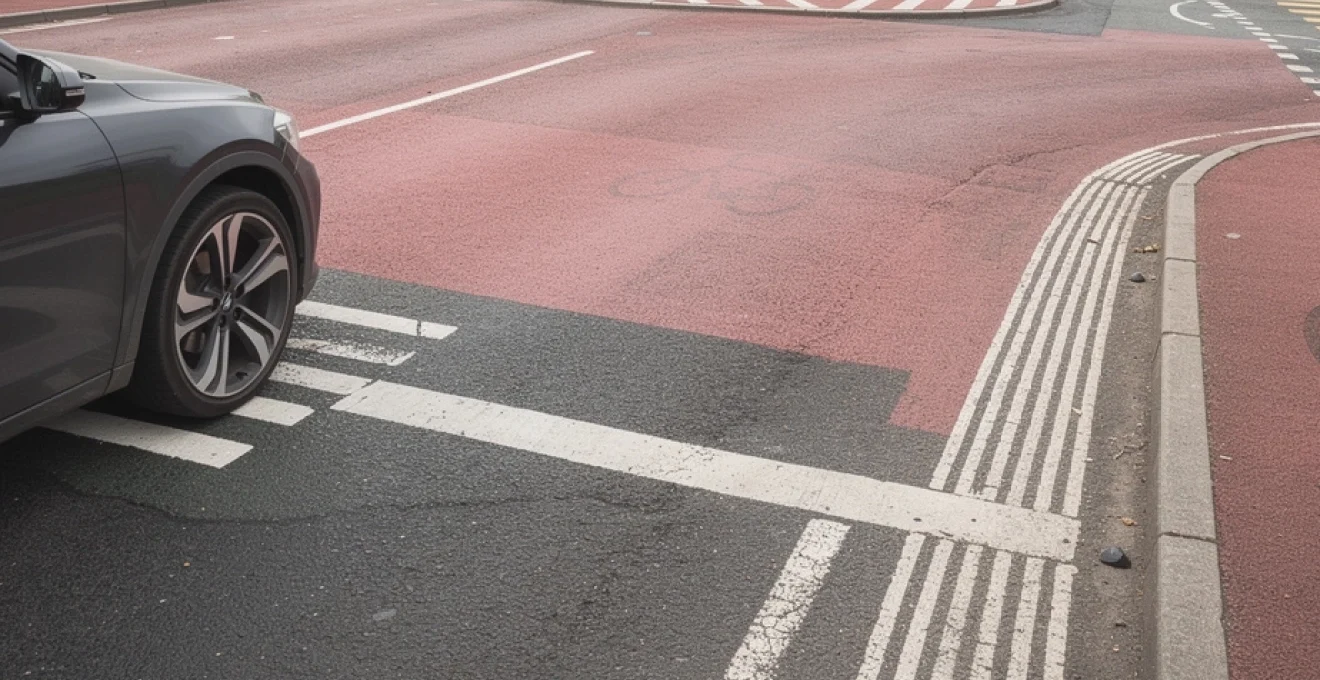
Rumble strips and red road lines can feel dramatic when you first meet them: the steering wheel starts to buzz, the tyres roar, or the whole lane suddenly turns a bold shade of red. None of this is an accident. These features are engineered signals, designed to cut through distraction, fatigue and bad weather to keep you – and everyone around you – alive. Understanding what they mean in the UK context helps you read the road surface as fluently as the traffic signs above it, and gives you a real advantage whether you are a learner, an experienced driver, an engineer or a fleet manager responsible for road safety.
Regulatory standards defining rumble strips and red road lines in the UK highway code
In the UK, rumble strips and coloured surfacing are not purely decorative extras. They sit within a detailed legal and technical framework that links the Highway Code, the Traffic Signs Regulations and General Directions (TSRGD), and design standards in the Design Manual for Roads and Bridges (DMRB). When you feel a rumble device before a junction or see red tarmac between white hatching, you are experiencing a carefully controlled design response to a known collision problem, not a random choice by a contractor with leftover paint.
TSRGD diagrams define how markings such as double white lines, red route lines and bus lanes must appear, while the Highway Code explains what you must do in response. DMRB then adds design guidance: how long transverse bars should be, how far apart edge-line ribs are spaced, and how red surfacing should be used at high-risk sites. If you want an accessible narrative explanation of these markings from a learner-driver perspective, the style of the DVSA and motoring-organisation guides is often more digestible than raw standards, and complements the legal framework that professionals work to day-to-day.
TSRGD and DMRB specifications for rumble strip geometry, spacing and placement
Transverse rumble strips – the bands you drive across before a hazard – are governed by TSRGD provisions on road markings and by DMRB notes on speed management and rural-junction safety. Typical layouts use three or more sets of bars, often with spacing that decreases as you approach the hazard. The geometry is tuned so that, at realistic approach speeds, drivers get a rising pattern of noise and vibration that says “slow down now” far more effectively than an extra sign.
Longitudinal rumble strips or raised rib lines along the hard shoulder or centre line are specified in DMRB chapters dealing with cross-sections and lane discipline. Ribs are usually 8–15 mm high and spaced at regular intervals so that the vibration is noticeable yet controllable when struck at motorway speeds. Placement rules try to balance safety gains against the needs of cyclists, motorcyclists and residents, which is why these profiles are very common on motorways and rural A‑roads but much rarer on narrow urban streets.
BS EN 1436 and BS EN 1317 requirements for retroreflectivity, skid resistance and containment
Two European–British standards play a quiet but crucial role in how safe rumble strips and red lines feel under your tyres. BS EN 1436 covers road-marking performance, including retroreflectivity and skid resistance. Rumble devices and coloured surfacing must achieve minimum friction levels so that braking on a red high-friction patch before a crossing feels at least as grippy as normal asphalt, even in heavy rain.
BS EN 1317 deals mainly with vehicle restraint systems, but its containment and impact-performance concepts feed into how designers think about lane departure and edge lines. When a driver hits an edge rumble strip instead of drifting into a verge or barrier, the aim is controlled correction rather than loss of control. That is why many current systems combine profiled thermoplastic lines that meet BS EN 1436 with barrier layouts designed in line with BS EN 1317 containment classes at high-risk motorway sites.
Differentiating red road lines from standard white/yellow markings under TSRGD diagrams
Red road lines often cause uncertainty, especially when seen for the first time on a trip into a big city. Under TSRGD, the classic yellow kerbside lines control waiting, while red lines define stricter stopping controls on designated corridors. A double red line means no stopping at any time; a single red line applies during signed hours. Both cover the carriageway, the verge and the footway, not just the running lane.
By contrast, the red surfacing you see inside white hatch markings or ghost islands is not a separate legal restriction but a strong visual cue. It highlights an area that should be kept clear or used only for turning, reinforcing the standard white diagrams for hatched areas. For a driver, the practical takeaway is simple: treat the red as an extra “high alert” layer on top of the white or yellow marking rules, not as a replacement for them.
Compliance obligations for local highway authorities and national highways
Local authorities and National Highways have a legal duty to maintain safe roads and to use lawful signs and markings. Non-compliant rumble strips or red lines can create liability issues and undermine enforcement. Because of this, schemes involving profiled markings, village gateways or red routes typically go through internal sign-off and, for trunk roads, formal approval processes to check TSRGD and DMRB compliance.
Maintenance teams must also monitor performance over time. Retroreflectivity decays, high-friction red surfacing can polish under heavy braking, and rumble profiles wear down where drivers constantly track over them. Asset-management systems now often log the age, specification and last inspection date of rumble devices and coloured surfacing so that resurfacing or renewal can be scheduled before safety performance drops below standard.
How rumble strips function: tactile, acoustic and vehicle-dynamics engineering
From a driver’s point of view, rumble strips are simple: the car shakes, the noise rises, and you snap back to attention. Underneath, there is surprisingly sophisticated engineering. Designers tune the height, width and spacing of each rib or groove so that the tyre–surface interaction produces a specific band of vibration frequencies, audible “rumble” and steering-wheel feedback at likely approach speeds. The goal is to be impossible to ignore, but not so aggressive that vehicles lose stability or drivers overreact.
Tyre–surface interaction and vibration frequencies at 30, 50 and 70 mph
Think of a rumble strip as a series of tiny speed bumps. As your tyre rolls over each rib, it deflects and rebounds. At 30 mph, the impacts arrive at a lower frequency and sound more like a rough road. At 50 or 70 mph, the same geometry can create a much higher-frequency buzz that cuts through cabin noise, music and conversation. Engineers model these tyre–road interactions, then confirm performance with on-road trials.
Studies on UK schemes have shown that well-designed edge-line rumble strips can be detected by drivers within around 0.3 seconds at 70 mph, triggering an immediate steering correction. The lateral acceleration and vertical vibration are deliberately kept below thresholds that might unsettle a small car or laden motorcycle, so although the effect feels dramatic, the dynamic impact on the vehicle remains controlled.
Transverse versus longitudinal rumble strips on UK motorways and a‑roads
Transverse rumble strips run across the lane and are used as hazard warnings: gateways into villages, high-risk rural junctions, sharp bends or approaches to roundabouts. You experience a rapid series of jolts and noise that says “slow down” far more viscerally than a static sign. These are common on single-carriageway A‑roads and on approaches to some motorway diverges.
Longitudinal rumble strips, usually as profiled edge lines or centre lines, manage lane departure. On motorways like the M1, M6 and M25, hitting the hard-shoulder rib line is often the first sign a drowsy driver gets that they are drifting. On two-lane rural roads, centre-line ribs cut the risk of head-on collisions by warning drivers they are straying towards oncoming traffic. Longitudinal systems tend to reduce fatigue-related crashes, while transverse systems have more impact on high-speed approach casualties.
Profiled thermoplastic, milled grooves and raised rib line technologies
Most UK rumble markings use one of three technologies. Profiled thermoplastic involves laying a molten material in a ribbed form which cools into a durable raised profile. It is relatively quick to install, highly visible and easy to renew. Milled grooves cut shallow channels into the asphalt; when traffic passes over them, the tyre vibration and noise are similar to raised ribs but the profile is inverted. This method is more common in some other countries but is used selectively in the UK.
Raised rib lines, sometimes called audio‑tactile edge lines, combine a painted line with regular ribs along its length. They are particularly effective in wet conditions because the 3D profile remains visible under water and reflects light better than a flat line. For drivers, all three systems feel similar, but for engineers the choice affects initial cost, maintenance strategy and how easily future resurfacing can be integrated.
Empirical crash-reduction data from highways england and transport scotland pilots
Evidence from pilot schemes strongly supports the safety value of rumble devices. Highways England schemes on rural single-carriageway A‑roads with centre-line rumble strips have reported reductions of around 20–30% in fatal and serious collisions related to lane departure. Some transverse-rumble treatments at high-risk junctions have shown speed reductions of 5–10 mph at the point of hazard, which can make the difference between a survivable collision and a fatal one.
Transport Scotland trials on trunk-road bends and village gateways have similarly found meaningful improvements. In several case studies, the introduction of rumble gateways and coloured surfacing coincided with a cut of around one-third in serious injury crashes over a multi-year period, even when traffic volumes remained stable or increased. While not every site performs identically, the overall pattern is clear enough that rumble devices now feature regularly in safety-improvement programmes across the network.
Where rumble strips are used on UK roads: hard shoulders, village gateways and high‑risk bends
Once you start looking, rumble strips appear in a surprisingly wide range of locations. The pattern is far from random. Designers target spots where either fatigue and inattention are common – such as motorways and long rural straights – or where the consequence of an error is severe, such as a high-speed bend, a crossroads with poor visibility, or the entry to a small village from a 60 mph road. Understanding where to expect rumble devices gives you advance clues that something about the environment needs extra attention.
Hard shoulder edge-line rumble strips on the M1, M6 and M25
On busy motorways such as the M1, M6 and M25, hard-shoulder and left-edge rumble strips are now a familiar feature. They support lane discipline and combat driver fatigue on long journeys, particularly at night. If you drift left towards the verge, the immediate rumbling feedback is often enough to wake a drowsy driver or snap a distracted one back to the task.
Data from motorway schemes indicate that shoulder rumble strips can cut run-off-road crashes by up to 40% on some sections. That impact is especially valuable in an era when long-distance freight and night driving are increasing. For you as a driver, a good habit is to treat any contact with these ribs as a serious warning sign about your concentration level and consider an early rest stop.
Rumble strip gateways at rural settlements such as burford and chipping norton
Rural villages like Burford or Chipping Norton often sit on former trunk roads where national speed limits still apply right up to the settlement boundary. Rumble-strip gateways, sometimes combined with red surfacing and village-name signs, create a strong sensory cue that the environment is changing from rural to urban. Transverse bars, narrowing visual features and coloured patches all work together to encourage a real reduction in approach speed.
Speed surveys at such gateways commonly show reductions of several mph in mean speed and a larger drop in the proportion of vehicles exceeding the limit by big margins. For residents, this can mean quieter streets and safer conditions for walking and cycling. For you, any rumble experience when entering a place with houses and driveways should be a prompt to scan for pedestrians, side-road traffic and parked vehicles.
Chevron‑linked rumble strips on high‑severity bends in wales and the scottish highlands
High‑severity bends on roads in Wales or the Scottish Highlands often combine chevron signs, barrier upgrades and rumble treatments. Designers may link a series of short transverse strips with road-edge chevrons and, occasionally, coloured surfacing within the lane. The intent is to catch your attention early, stabilise your speed before the curve and keep you in lane throughout the manoeuvre.
Crash data for these bends often show a history of loss-of-control collisions, especially in wet or icy conditions. After treatment, many sites report substantial reductions in single-vehicle injury crashes. From a driving perspective, feeling rumble bars ahead of a bend is a clear sign to set an appropriate speed before turning the wheel, rather than relying on braking while cornering.
Approach rumble strips at pedestrian crossings, roundabouts and stop lines
Approach rumble strips are widely used in advance of pedestrian crossings, mini-roundabouts and priority junctions where drivers have historically failed to slow or stop. The Department for Transport describes these as visual, audible and vibratory devices intended to alert drivers to a hazard ahead and encourage a speed reduction, especially in rural locations where a crossing or stop line can come up suddenly.
At pedestrian crossings, especially on fast approaches, combining approach rumble strips with red high-friction surfacing gives vulnerable users an additional measure of protection if a driver is inattentive. For you, any sensation of repetitive bumps approaching a crossing or junction is a clear instruction from the road itself: check mirrors, ease off the accelerator and be prepared to stop well in advance of the marked stop or give-way line.
What red road lines and red surfacing signify in different UK contexts
Red is used sparingly on UK roads precisely because it is so visually powerful. When an entire lane, hatch area or bus corridor turns red, the intention is to shout, not whisper. However, the exact meaning depends on context: a red bus lane signifies something very different from a red high-friction patch on an uphill bend. Reading that context correctly helps you avoid penalties, keep vulnerable users safe and understand where traffic-space priorities change.
Red bus lanes in london, manchester and birmingham under local traffic orders
Many major cities, including London, Manchester and Birmingham, use red surfacing to highlight bus lanes created under local traffic orders. The legal restriction comes from the white bus-lane road marking and upright signs; the red background simply makes the lane unmistakable. Operating hours, exemptions for taxis, cyclists or motorcycles and camera enforcement details are all defined in the traffic order rather than by the colour alone.
For everyday driving, the rule is clear: unless signs explicitly say otherwise, bus lanes are off-limits during their operational hours. Entering a red bus lane at the wrong time can result in a civil penalty. Treat the red as a visual “do not drift here by accident” warning, especially in heavy traffic or poor visibility where lane boundaries can be harder to judge.
Red mandatory cycle lanes and contraflow cycle facilities in cities like cambridge
Cycling cities such as Cambridge often use red surfacing to reinforce mandatory cycle lanes or contraflow cycle routes. The lane line and cycle symbols define the legal space; the red background emphasises that drivers must not enter or park in that lane during its hours of operation. On contraflow schemes, where cycles travel against the main traffic flow, red surfacing dramatically increases conspicuity.
If you drive into one of these streets, look for the combination of road markings and signs. When you see a continuous line with cycle symbols and a red background on what appears to be the “wrong side” of the road, expect oncoming cyclists and keep your vehicle strictly within the general-traffic lane. For cyclists, the red surface often gives a psychological sense of ownership and encourages more predictable positioning.
Red hatched areas, ghost islands and right‑turn pockets at complex junctions
At complex junctions with multiple turning movements, designers sometimes infill hatched areas, ghost islands or right‑turn pockets with red surfacing. The underlying white hatching or lane markings still define which movements are permitted. The red colour simply increases visual impact so that drivers recognise that these spaces are not for general running, overtaking or queuing, except where a right-turn pocket is clearly signed.
When you see a central red island with diagonal white hatching, treat it as a buffer or separation zone, not as spare carriageway to exploit. Enter such an area only when turning, and only in line with the Highway Code. This is particularly important on high-speed A‑roads, where misuse of ghost islands for overtaking can lead to severe head-on collisions.
Red high‑friction surfacing on approaches to zebra and signal‑controlled crossings
Red high-friction surfacing is widely used on approaches to zebra crossings, pelican crossings and signal-controlled junctions. The colour alerts you to the presence of a pedestrian or stop line ahead, while the special aggregate mix dramatically increases skid resistance. This combination helps drivers stop within shorter distances, even in the wet, and provides a safety margin if reaction times are delayed.
Field data suggest that high-friction surfacing can reduce wet-weather braking distances by 20–30% compared with standard asphalt. That advantage is particularly critical close to schools, on downhill approaches or at sites with a history of rear-end shunts. For drivers, planning to brake smoothly and early on these red patches not only improves comfort but also reduces the risk of locking wheels or triggering ABS at the last moment.
Urban clearways, red routes and loading controls on transport for london’s network
On networks like Transport for London’s, red lines define red routes – corridors where stopping is tightly controlled to keep traffic flowing and protect bus reliability. Double red lines indicate no stopping at any time; single red lines indicate restrictions during signed hours. These controls apply across the whole width from building line to building line: road, verge and pavement.
Red lines on key corridors are designed to keep traffic moving and reduce conflict, not to “catch drivers out”. Understanding the signs and markings makes compliance straightforward.
Loading, taxi ranks and disabled bays are provided in signed lay-bys or side roads, often clearly marked with contrasting colours or white bay outlines. When driving in London, treating any red-lined kerb as a potential enforcement hot spot encourages better route planning, use of designated loading areas and less risky stopping behaviour near junctions and crossings.
Decoding driver information: combining rumble strips with red lines, signage and road studs
Rumble strips and red surfacing rarely operate alone. They form part of an integrated language of road safety that also includes signs, cat’s eyes, reflective studs and sometimes active LED markings. The most effective schemes use multi-sensory cues: sight, sound and touch. If one channel is degraded – say, at night or in fog – others step in. When you learn to read these layers together, the road’s “story” about what is coming next becomes much clearer.
Human factors in driver alertness: auditory cues, steering-wheel vibration and conspicuity
Human-factors research shows that drivers under fatigue or cognitive load often miss visual information such as speed-limit changes or bend warning signs. Rumble strips add auditory and tactile channels that are harder to ignore. The sudden roar under the tyres and vibration through the steering wheel serve as a “wake-up call” that cuts through music, conversation or in-car distractions.
Importantly, rumble devices are designed to be unambiguous. On a normal road, you do not expect that sort of vibration, so your brain automatically labels it as a signal that something is wrong. Combined with high-visibility red or white markings, this makes key hazards highly conspicuous, even for drivers who are unfamiliar with the road or visiting from abroad.
Integration with cat’s eyes, reflective road studs and LED active markings
Night-time and bad-weather conditions reduce the effectiveness of flat paint markings. To compensate, many critical sites combine rumble strips with reflective studs – the traditional “cat’s eyes” – or with modern LED active studs. On motorways, for example, a raised rib edge line may be paired with bright amber studs between the main carriageway and the hard shoulder, guiding you even when spray and glare are severe.
LED active markings take this further by lighting up in response to signals or sensor data, for example at pedestrian crossings or lane-control systems. When combined with red surfacing and rumble devices, these technologies create layered defences: the surface texture talks to your tyres, the colour cues your eyes, and the lights guide your path and timing.
Co‑ordinating warning signs (diag. 562, 512) with rumble strips and coloured surfacing
Standard warning signs such as Diagram 512 (bend ahead) and Diagram 562 (give way ahead) are often used alongside rumble strips and coloured surfacing. The design logic is that each element plays a slightly different role. The sign provides formal information – type of hazard and, sometimes, an advisory speed. The coloured patch and rumble bars provide on-the-ground emphasis and help drivers judge where to begin slowing or changing lane.
Effective schemes use redundancy, not clutter. Multiple cues deliver the same message in slightly different ways, so if one is missed, another is likely to get through.
For designers, a key skill is avoiding overuse. If every minor junction had aggressive rumble strips and red surfacing, drivers would quickly become desensitised. Instead, guidance encourages focusing these stronger treatments on sites with proven collision histories or particularly difficult geometry, where the benefit of a strong message outweighs the risk of habituation.
Design, maintenance and safety audits for rumble strips and red markings
Behind every stretch of rumble devices or red surfacing lies a chain of design decisions, safety checks and maintenance plans. These features are not “fit and forget”; they must be justified, modelled, monitored and, when necessary, adjusted. For road users, this behind-the-scenes process matters because it shapes how comfortable, predictable and fair the road environment feels. Poorly designed rumble strips can annoy residents or intimidate motorcyclists; well-designed ones can save lives with very little downside.
Road safety audit (GG 119) stages for new rumble strips and red surfacing schemes
Most significant UK schemes pass through the GG 119 Road Safety Audit process. At Stage 1 (preliminary design), auditors consider whether rumble devices and red surfacing are appropriate responses to the identified crash problem. At Stage 2 (detailed design), they examine the exact layout, including distances to junctions, interaction with crossings and potential ambiguity for users.
Stage 3 audits occur after construction, using site visits, sometimes at night, to observe how drivers actually respond. A later Stage 4 monitoring review may analyse collision data over several years. If auditors note unexpected behaviour – for example, motorcyclists consistently swerving dangerously to avoid a rumble patch – designers may be asked to modify the scheme. For you as a user, this process is part of the invisible safety net that aims to catch unintended consequences early.
Noise, vibration and residential amenity constraints in suburban corridors
One of the main challenges with rumble strips is noise. The very quality that makes them effective at waking up a drifting driver – loud tyre roar – can disturb people living nearby. In suburban corridors, designers must balance casualty reduction against amenity. Traffic modelling, noise predictions and local consultation all feed into decisions about whether to use full-profile devices, reduced-height ribs, or alternative measures such as visual gateways and vehicle-activated signs.
Some authorities now specify “low-noise” rumble patterns near housing, with smaller ribs or fewer bars used in each series. In practice, that can still deliver meaningful driver alertness improvements while reducing the boom that can otherwise carry into bedrooms at night. If you experience rumble strips in a built-up area, their presence usually reflects a judgement that the collision history justifies a stronger countermeasure than signs alone.
Winter maintenance, snowplough damage and resurfacing cycles for profiled markings
Profiled thermoplastic and raised rib markings must withstand not only traffic wear but also winter maintenance. Snowplough blades and heavy gritting can damage raised profiles, particularly if equipment is set too low. Highway authorities therefore train winter crews on the presence and location of profiled markings, sometimes using route notes or on-board mapping to remind operators where to lift blades slightly.
Resurfacing cycles bring another challenge. When a road is planed and relaid, profiled markings and high-friction surfacing must be reinstated quickly to avoid leaving a “half-finished” safety treatment. Asset data and works planning aim to align surfacing works with funding for new markings so that safety performance is restored promptly rather than left to fade over multiple winters.
Adapting designs for motorcycles, equestrians and vulnerable road users
Good design for rumble strips and red surfacing must consider all users, not only car drivers. Motorcyclists, for example, can find aggressive transverse ribs unsettling, especially in wet or icy conditions. As a result, UK practice often specifies lower-profile ribs and limits the use of overly coarse textures on bends popular with riders. Where coloured surfacing is used, friction requirements aim to ensure that even when wet, the grip is comparable to or better than surrounding asphalt.
Equestrians and pedestrians also need consideration. On rural routes with horse traffic, rumble devices may be located away from common crossing points, and alternative calming measures may be preferred. For visually impaired pedestrians, the strong contrast of red surfacing at crossings can provide an additional orientation cue, complementing tactile paving. If you share the road with these vulnerable users, treating any combination of rumble strips and red surface as a prompt to slow, look and plan extra space makes the network safer and more predictable for everyone.