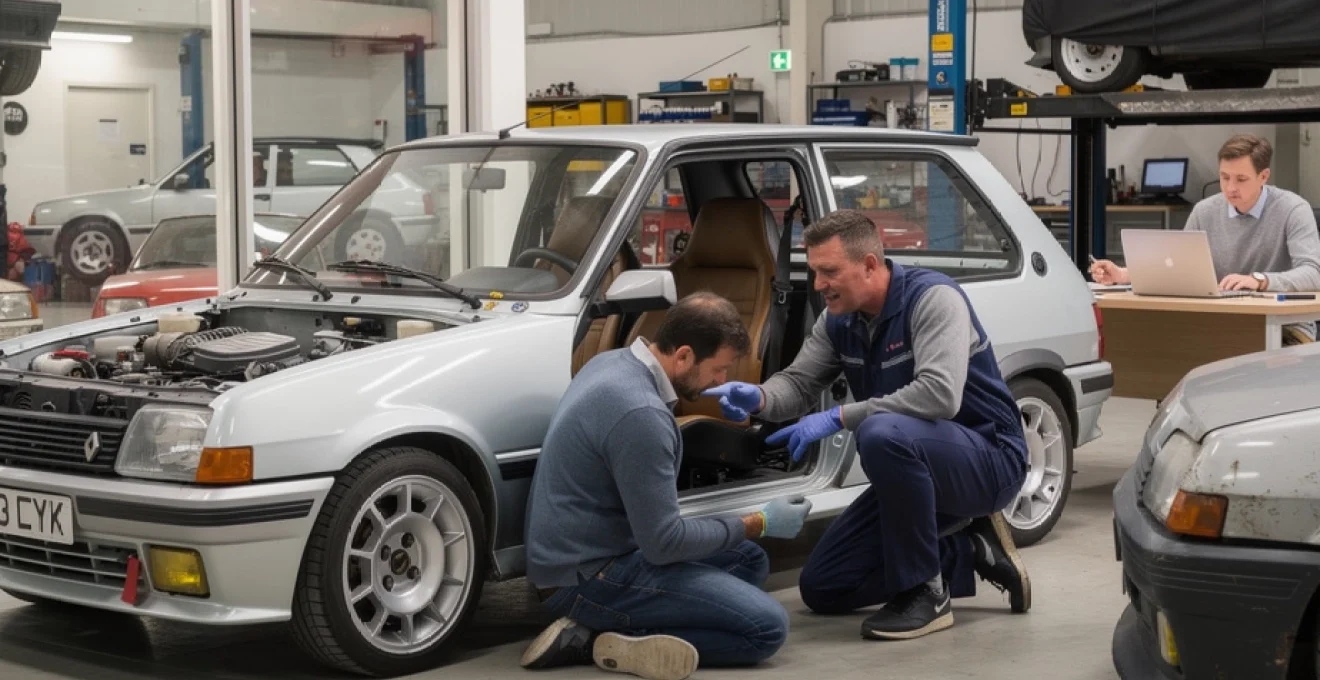
The Renault 5 GT Turbo sits in that sweet spot between affordable classic and cult icon. Values have risen sharply since 2020, auction data shows a median sale price around £14,900 with the very best examples exceeding £60,000, and only about 208 licensed on UK roads. For anyone who grew up around Group B rallying, 1980s hot hatch culture or modern retro builds, finding the right car now matters more than ever. Choosing where to buy a Renault 5 GT Turbo directly affects how much you pay, how original the car is, and how much you spend later putting things right. Understanding the current market, the main buying channels and what to inspect closely will help you secure a car that is both emotionally satisfying and financially sensible.
Understanding the renault 5 GT turbo market: pricing, scarcity and typical buyer profiles
Analysing UK and EU price ranges for renault 5 GT turbo phase 1 and phase 2 models
Renault produced the GT Turbo between 1985 and 1991, with Phase 1 and Phase 2 variants. The supply is now extremely limited: recent data suggests 208 licensed and about 1,307 on SORN in the UK, so fewer than 1,600 cars remain recorded. Since 2020, public auction results show a lowest recorded price of £3,375, a median price of roughly £14,912 and a top sale around £61,382. That spread illustrates how condition, originality and history transform a once-cheap hot hatch into a blue-chip modern classic. In mainland Europe, asking prices of €14,000–€20,000 for driver-grade examples are now common, with top restored Phase 2 cars advertised at €30,000–€35,000 or more.
Phase 1 GT Turbos, with their earlier trim and lighter feel, command a small rarity premium when in original condition. Phase 2 models, however, often fetch stronger money because of their improved refinement and slightly wider appeal. A reasonable rule of thumb for a UK buyer today is:
| Condition | Typical UK price range | Typical EU (LHD) price range |
|---|---|---|
| Project / non-running | £4,000–£8,000 | €5,000–€9,000 |
| Usable driver (modified) | £10,000–£18,000 | €12,000–€20,000 |
| Very good / lightly restored | £18,000–£30,000 | €20,000–€32,000 |
| Concours / high-spec resto | £30,000–£60,000+ | €32,000–€60,000+ |
Why the premium for the very best? The car’s 1980s motorsport heritage, scarcity and rising interest in analogue hot hatches from younger collectors all play a role. You are effectively competing with buyers who might also be looking at Mk2 Golf GTI, Peugeot 205 GTI or early turbocharged icons from the same era.
Assessing mileage, originality and documentation as key value drivers
Once you identify a realistic Renault 5 GT Turbo price band, three elements decide where a specific car sits: mileage, originality and paperwork. You will see low-mileage examples under 80,000 km in European adverts for €25,000–€35,000, whereas a 150,000-mile UK car with patchy history will sit closer to £10,000–£13,000. Mileage alone is not decisive; a well-maintained 140,000-mile example can drive better than a 40,000-mile car that has sat unused. Documentation proves which story is true.
Originality is arguably the single biggest value multiplier. Cars retaining OEM C1J turbo engines, correct Garrett T2 turbochargers, factory-spec alloy wheels and original interior fabrics attract the most serious collectors. Documentation that includes stamped service books, MOT history, tax discs, detailed invoices and period photos tells you how a GT Turbo has been treated across decades. A thick history folder will not only reassure you during purchase, it will also greatly simplify a future sale.
Recognising common market trends: barn finds, track-prepared cars and concours examples
The current Renault 5 GT Turbo market is divided into several clear segments. At the bottom are the barn finds and long-term projects: often SORN’d for years, missing trim, and carrying rust in the sills or floorpans. These appeal if you have restoration skills or plan a full restomod. Next, there are track-prepared and drag-focused cars, sometimes pushing far beyond the original 120–130 hp towards 200+ hp. These may feature stripped interiors, roll cages and uprated turbos, which are great for trackdays but harder to revert to stock.
At the top of the tree sit concours and magazine-featured examples. A typical high-end auction car might have more than £30,000 of expenditure documented, like a Glacier White GT Turbo that went through drag, circuit and show phases, finally becoming a multi-trophy showpiece. These cars demonstrate how far enthusiasts now go with nut-and-bolt restorations, often achieving a standard significantly better than new. Understanding which segment you want to be in ensures you do not pay concours money for a track-biased build.
Identifying red flags in too-cheap listings and misrepresented replicas
With a median public sale price close to £15,000 since 2020 and an 83% sell-through rate, a Renault 5 GT Turbo advertised substantially below that level deserves scrutiny. Very cheap listings may hide rot in structural areas, lack of documents, category C or D insurance history, or poorly executed modifications. If a car is priced at half the typical value, ask why before anything else. Does the seller acknowledge known issues? Is there evidence of accident damage, like mismatched panels or over-spray in the engine bay?
Misrepresented replicas or converted standard Renault 5s are another hazard. A genuine car should have the correct VIN prefix, factory GT Turbo body kit, proper dashboard layout and mechanicals to match. If anything seems inconsistent—like base-model brakes paired with a “GT Turbo” badge—walk away or price it as a non-original conversion. For serious collectors aiming for long-term value, originality is not negotiable; for a fun road car, a replica can work, but only if priced appropriately and described transparently.
Buying a renault 5 GT turbo from specialist dealers in the UK and europe
Renault 5 GT turbo specialists in the UK: K-Tec racing, BB performance tuning, cleeve wood garage
Dedicated Renault and RenaultSport specialists remain one of the most secure places to buy a Renault 5 GT Turbo in the UK. Names such as K-Tec Racing, BB Performance Tuning and Cleeve Wood Garage have long experience with GT Turbo engines, chassis upgrades and restoration work. Specialist dealers understand that buyers now treat these cars as investment-grade classics rather than cheap track toys, so stock is often carefully curated and prepped. You will typically see a mix of lightly modified driver cars and more original, collector-oriented examples.
Specialist garages also tend to know the car’s history before it hits the showroom. A GT Turbo they have serviced for years is a very different proposition from a fresh auction flip. Because they have reputations to protect in a small community, misleading descriptions or hidden faults are bad business. That said, a professional pre-purchase inspection by an independent expert still makes sense when the purchase price approaches or exceeds £20,000.
French and european specialists: GT turbo online, mecanic gallery, le bon coin partner garages
For left-hand drive examples, France and Belgium remain rich hunting grounds. Well-known European specialists like GT Turbo Online and Mecanic Gallery often advertise on enthusiast sites and at classic events. Many work closely with partner garages that list stock through major French classified platforms such as Le Bon Coin. When you search those platforms for a Renault 5 GT Turbo, dealer-backed cars with workshop facilities and proper invoices are usually safer than purely private listings with sparse descriptions.
An LHD import can represent better value, especially if you are comfortable with continental ownership history and slightly higher mileage. Prices in Italy, the Netherlands and Belgium often mirror France, with many cars showing 90,000–150,000 km. A good European specialist will provide detailed photo sets, including underbody shots, interior fabrics, dashboard condition and engine bay close-ups. If a seller limits images to exterior angles, request more before organising travel or a deposit.
Evaluating dealer warranties, pre-delivery inspections and workshop capabilities
When buying from a specialist, the quality of workshop backup matters as much as the shine of the paintwork. Classic car warranties are rarely as comprehensive as modern manufacturer cover, but a short-term warranty on engine, gearbox and major ancillaries is still valuable. Ask precisely what is included and whether labour is covered. A dealer with in-house GT Turbo expertise is more likely to stand behind the car, whereas a generalist may simply outsource issues.
Pre-delivery inspections (PDIs) should go beyond a basic oil change. For a turbocharged 1980s hatchback, a robust PDI ideally includes compression testing, leak checks on the intake and intercooler system, cooling system pressure testing and brake component inspection. Reviewing a written PDI checklist gives you insight into how seriously the dealer treats mechanical preparation. A workshop that can also handle future engine rebuilds, rust repair and interior refurbishment is a significant long-term asset for you as an owner.
Checking for dealer-supplied history files, dyno sheets and compression test reports
Strong documentation from a dealer is an excellent sign. A thick history file showing continuous MOT records, service invoices and photographs across decades builds confidence in the odometer reading and in the car’s life story. Ask specifically whether the dealer can provide recent compression test results; equal and healthy cylinder readings on the C1J turbo engine are a major plus. If the car has been tuned, dyno printouts are useful to verify claimed power figures and to assess how aggressively the engine has been mapped.
Receipts for turbocharger rebuilds, head gasket work, cooling system upgrades and brake overhauls all add value. When a seller documents £10,000–£30,000 of expenditure over time, as seen with some award-winning show cars, that spend explains a higher asking price. For a heavily modified example, confirm that engine internals and fuel system upgrades match the claimed horsepower, for instance, an uprated intercooler or fuel pump accompanying a high-boost tune.
Finding a renault 5 GT turbo on online marketplaces and auction platforms
Searching auto trader, PistonHeads and car & classic with advanced filters
General online car marketplaces remain powerful tools when hunting for a Renault 5 GT Turbo in the UK. Auto Trader, PistonHeads and Car & Classic all allow keyword searches, age filters and fuel type selection to narrow results. Using advanced filters such as maximum mileage, minimum owner rating or “private vs trade” helps focus your shortlist. For instance, filtering for 1985–1991 petrol Renaults and then adding keywords like “GT Turbo Phase 2” can surface cars that may be miscategorised but still accurately described in text.
Alerts and saved searches are particularly useful when chasing a rare model. With fewer than 250 or so road-registered examples, weeks may pass without a new listing, then two or three appear at once. Setting alerts for both “Renault 5 GT Turbo” and “R5 GT Turbo” catches different seller wording. Regularly reviewing completed listings also gives you a sense of real-world asking vs achieved prices, especially when private sellers update ads with “sold” or “deposit taken”.
Using bring a trailer, collecting cars and the market for online auctions
Online auction platforms have transformed how 1980s hot hatches change hands. Sites like Bring a Trailer, Collecting Cars and The Market (now often under the Bonhams umbrella) attract global audiences, which can push up strong examples but also create transparency. Each listing typically shows hundreds of photos, detailed write-ups, and public Q&A between bidders and seller. That format gives you a more complete picture than many static classified adverts.
From 2020 onwards, public auctions show an 83% sell-through rate for the Renault 5 GT Turbo, indicating robust demand. Observing a few auctions before bidding is wise, as it reveals how buyers react to rust, lack of history or heavy modifications. One 1991 Glacier White example, with more than £30,000 spent and 28 years in the same ownership, sold for around £12,900 despite a Category C insurance marker. That illustrates how provenance and condition can offset negative history in bidder calculations.
Leveraging LeBonCoin, mobile.de and autoscout24 for left-hand drive GT turbo imports
Continental platforms such as LeBonCoin (France), Mobile.de (Germany) and Autoscout24 (pan-European) host far more Renault 5 GT Turbo listings than the UK alone. Using these sites opens up access to lightly used, dry-climate cars from southern Europe and to enthusiasts’ collections across France, Belgium and Italy. When searching, combine model terms in different languages—“R5 GT Turbo”, “Renault 5 GT Turbo 1.4 turbo”, “Super 5 GT Turbo”—to avoid missing ads listed under local naming conventions.
When you find a promising LHD candidate, ask for high-resolution underbody photos, chassis rail close-ups and shots of typical rust hotspots. Google Translate can help with initial conversation, but once negotiations become serious, consider enlisting a bilingual agent or inspector. For imports, the purchase price is only one part of the total landed cost; transport, duty and VAT must be factored in, especially for non-EU origins.
Verifying seller identity, payment security and buyer protection on digital platforms
Buying a classic remotely introduces extra risk. Before sending any money, verify that the seller’s name matches the registration document and that the car exists at the advertised location. Video calls are invaluable: asking the seller to walk around the car, show the VIN plate, cold-start the engine and demonstrate the instruments will quickly expose fake listings. If a seller refuses live video or cannot provide a clear photo of the registration and VIN, treat that as a major red flag.
Use secure payment methods. Escrow services or platform-handled payment options add a layer of protection compared with bank transfers to unknown individuals. Some auction platforms hold funds until you confirm collection, while others use third-party escrow companies. As a rule, never pay the full amount before seeing the car in person or commissioning a trusted local inspection; for a rare Renault 5 GT Turbo, a few hundred pounds spent on verification can protect tens of thousands.
Locating renault 5 GT turbo examples through owners’ clubs, forums and social media groups
Using renault 5 GT turbo owners club UK and renault owners club classifieds
Owners’ clubs remain one of the richest sources of honestly described Renault 5 GT Turbos. The Renault 5 GT Turbo Owners Club UK and broader Renault Owners Club networks often run members-only classified sections. Cars advertised here usually have well-documented histories and long-term enthusiast ownership. Sellers care who the next owner will be, not just the last pound of sale price, which can lead to more sensible negotiations and more open disclosure of issues.
Club cars are also more likely to come with valuable spares, original parts and documentation such as period brochures or old show entry forms. When you buy from an engaged club member, you are effectively buying into a small community of knowledge and support. That can be incredibly useful when sourcing rare trim pieces or understanding how best to protect known rust-prone areas.
Monitoring facebook groups and discord servers for off-market GT turbo sales
Facebook groups and Discord servers have become the digital version of the classifieds page. Many Renault and hot hatch communities host closed groups where cars are offered “off-market” before being publicly listed. Joining these spaces puts you closer to enthusiast sellers who prefer dealing with informed buyers. It is common to see early “feeler” posts such as “may sell my GT Turbo later this year” that give you a chance to register interest before the car reaches wider platforms.
These channels also provide real-time feedback on market trends. Discussions around auction results, restored builds and problem cars will sharpen your ability to evaluate listings. As always, remain cautious: social media profiles can be faked, so verify identity and ownership as carefully as you would through any other route, and arrange to see the car in a safe, public place where possible.
Networking at cars & coffee meets, retro rides events and RenaultSport trackdays
Physical events can be even more productive than digital searches. Cars & Coffee meets, Retro Rides gatherings and RenaultSport trackdays attract exactly the kind of enthusiast who owns or wants a Renault 5 GT Turbo. Walking around the car park with an eye for period-correct alloys, retro graphics and distinctive body kits often leads to conversations that start with, “I used to own one,” or “I might be selling mine soon.”
Industry observations suggest that a significant proportion of the best classics change hands privately through word-of-mouth, never hitting public listings at all. Networking in person allows you to see how owners maintain and drive their cars, which is a better predictor of condition than any advert. Asking polite, specific questions about known GT Turbo weak points will also signal to potential sellers that you are a serious, informed buyer.
Contacting known builders and restorers for waiting lists and future stock
Specialist builders and restorers who regularly work on GT Turbos often know about upcoming cars months before they surface publicly. Some maintain informal waiting lists for clients seeking particular colours, phases or specification levels. If you aim for a high-end restored example, building a relationship with a restorer can be more effective than endlessly refreshing classifieds. These professionals can match your budget and goals—whether you want a concours GT Turbo or a sympathetic restomod suitable for trackdays.
Many restorers also handle sales on behalf of customers, especially after long-term build projects. Because they have invested substantial labour into the car, they can explain exactly what metalwork, paint and mechanical work was done. An honest restorer will also point out any compromises, such as re-used interior trim or non-OEM fasteners, which matter if you plan a top-level concours car.
Inspecting a renault 5 GT turbo before purchase: chassis, turbo system and originality checks
Rust inspection points: inner sills, rear arches, bulkhead, floorpans and chassis rails
Rust is arguably the Renault 5 GT Turbo’s biggest enemy. Even attractive paint can hide corrosion on the inner sills, rear arches, bulkhead, floorpans and chassis rails. A methodical inspection underneath the car and inside wheelarches is essential. Think of the body shell as the foundation of a house: once compromised, everything built on top becomes questionable, no matter how new the engine or interior may be.
Pay close attention to the join between sill and floor, the rear inner arch lips, and the front bulkhead around the heater box. Signs of patch repairs, differing underseal textures or fresh stonechip paint may indicate recent welding. Good welds are not a problem when documented; poorly executed patches and overlapping plates are. Use a torch and, if the seller agrees, a small magnet to detect filler-only repairs where metal should be.
Evaluating the C1J turbo engine, garrett T2 turbocharger and cooling system integrity
The 1,397cc C1J turbo engine is robust when correctly maintained, but abuse and poor tuning can shorten its life. During a viewing, start the car from cold and listen for bottom-end knocking, tappet noise and misfires. Blue smoke on boost suggests worn turbo seals or engine wear, while persistent white smoke may indicate head gasket issues. A smooth idle that settles quickly is encouraging; a hunting or rough idle can point to vacuum leaks or fuelling problems.
Inspect the Garrett T2 turbocharger for obvious oil leaks and excessive shaft play if accessible. The cooling system deserves similar attention: look for new or uprated radiators, evidence of recent coolant changes and any staining around hose connections. Overheating is particularly damaging on older turbo engines, so a stable temperature gauge during a test drive is non-negotiable. A simple analogy applies: the turbo system is like a set of lungs under pressure—any leaks or restrictions reduce performance and strain the heart of the engine.
Assessing originality: OEM interior trim, correct alloy wheels and factory-spec body kit
Originality checks should run from nose to tail. Start with exterior details: period-correct body kit, factory-style GT Turbo graphics and appropriate alloy wheels for Phase 1 or Phase 2. Aftermarket bumpers or incorrect wheels are not necessarily deal-breakers, but each deviation from stock reduces appeal to purists and can depress future resale values. Ideally, removed original parts accompany the sale, ready to be refitted.
Inside, look for original fabric patterns on the seats, correct steering wheel design, intact dashboard plastics and unmodified instrument clusters. Extra gauges hacked into the dash or centre console often signify harder use. Check for non-OEM pedals, gear knobs and audio installations that may have involved cutting factory trim. An un-cracked dashboard and original headlining are increasingly rare and add significantly to the feel of an authentic 1980s hot hatch cabin.
Reviewing service history, MOT records, VIN plates and engine number matching
Paperwork transforms a car from an unknown quantity into a traceable asset. Review service history chronologically, looking for long gaps in maintenance or sudden changes in mileage patterns. Continuous MOT records, even when the car was on SORN, can indicate a diligent owner who kept it roadworthy. Matching VIN plates on the scuttle, door jamb and V5C should all align; discrepancies require a very clear explanation, preferably backed by historic documentation.
Check the engine number against the V5C where recorded and against any invoices for engine swaps or rebuilds. A “numbers-matching” drivetrain remains a strong value indicator for collectors, while a documented, high-quality engine upgrade can appeal to those prioritising performance. Any signs of category insurance history—like a Category C marker noted in historic records—should be weighed against photos and invoices showing the extent and quality of repairs.
Importing a renault 5 GT turbo into the UK: compliance, registration and taxation
Navigating DVLA registration, NOVA declaration and UK V5C issuance
Importing a Renault 5 GT Turbo into the UK adds bureaucracy but also broadens choice. After purchase and transport into the country, the first step is completing a Notification of Vehicle Arrivals (NOVA) with HMRC. This confirms that VAT and any duties are handled, a prerequisite before applying to the DVLA. Failing to submit NOVA promptly can trigger penalties and delay registration, so timing matters.
Once NOVA is cleared, the DVLA application for registration usually involves a completed V55/5 form, foreign registration documents, proof of identity and address, and evidence of the car’s age such as a manufacturer’s letter or club dating certificate. The DVLA will then issue a UK registration and V5C logbook. For older vehicles like the GT Turbo, an age-related plate is common, avoiding the stigma of a Q-plate—as long as documentation is adequate.
Headlamp, emissions and speedometer conversions for UK road legality
Compliance modifications for an imported Renault 5 GT Turbo are relatively straightforward but must be done properly. Left-hand drive cars typically need headlamp beam pattern adjustments or replacement UK-spec lamps to avoid dazzling oncoming traffic. Using quality components here is safer than crude beam converters. Emissions standards for classics are generally more relaxed, yet the car still needs to pass an MOT appropriate to its registration date, so a healthy catalytic system (if fitted) and clean-running engine remain important.
The speedometer should read in mph for UK road use. Some owners fit combined mph/kph dials, while others install small digital converters. Ensure that any conversion keeps the odometer readings consistent and that changes are documented. Think of these upgrades as the administrative side of originality: they make the car legally usable in the UK without fundamentally altering its 1980s character.
Understanding classic car insurance, agreed value policies and valuation reports
Classic insurance for a Renault 5 GT Turbo differs from everyday policies. Many specialist insurers require limited annual mileage, secure overnight storage and membership of a recognised club. In return, premiums can be surprisingly affordable. The crucial aspect is an agreed value policy. Instead of the insurer guessing market value after a claim, both parties agree a figure upfront based on condition and supporting evidence.
Valuation reports from clubs, dealers or independent assessors play a central role. With auction results showing top examples reaching above £60,000 and average cars around £15,000, under-insuring a renovated GT Turbo would be a costly mistake. Updating the agreed value every couple of years is wise, particularly in a fast-moving market where 1980s hot hatches have risen sharply in the last decade and continue to feature prominently at major events like the NEC Classic Motor Show.
Estimating total landed cost: purchase price, transport, duty and VAT
Before committing to a European Renault 5 GT Turbo, estimating the total landed cost avoids nasty surprises. Start with the purchase price and add transport; enclosed transport from central Europe to the UK can range from £800 to £1,500 depending on distance and service level. If buying from within the EU post-Brexit, import duty and VAT may apply depending on the car’s age and historic status, though vehicles over 30 years old can sometimes qualify for reduced rates when correctly classified.
Also factor in registration fees, any immediate mechanical or compliance work and a contingency budget. A helpful analogy is to view the “sticker price” abroad as only the headline: the true cost-to-drive in the UK is often 20–40% higher once everything is added. Being realistic at the planning stage means you can focus on condition and history rather than pushing every last euro out of the purchase price and leaving no room to address inevitable classic-car niggles once the GT Turbo is on your driveway.