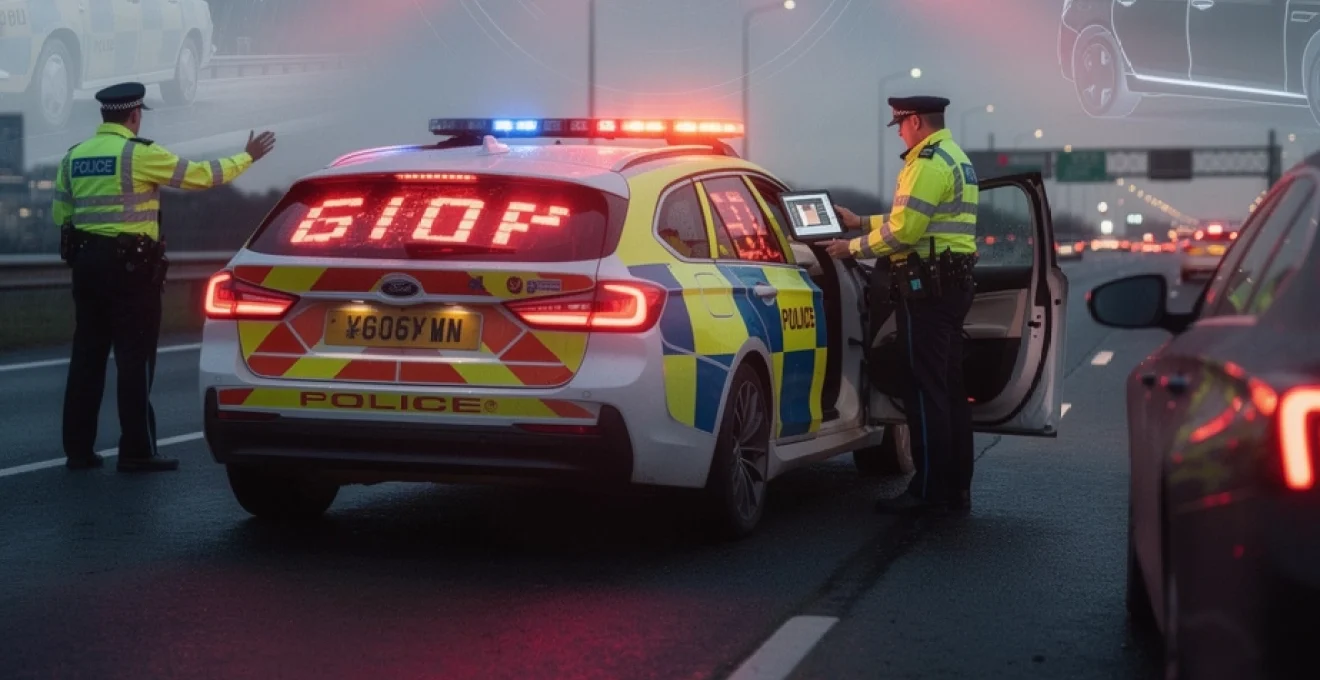
Red lights on police cars carry a strong psychological impact: when you see them, you instinctively think of danger, urgency and the need to stop. For road users, understanding what those red lights mean in different contexts is not just a curiosity; it directly affects how safely you respond on a motorway, at a collision scene or when an unmarked vehicle suddenly appears behind you. Modern police lighting blends law, optical engineering, human perception and digital control systems into a single, highly optimised warning package that you interact with every day, often without realising just how carefully it has been designed.
Behind a simple flash of red sits over half a century of evolution, from crude rotating beacons bolted to roofs to sophisticated LED lightbars talking to onboard computers. If you drive regularly, work near highways or simply want to know why a police BMW or Volvo behaves the way it does on the roadside, understanding red police lights gives you valuable context for safer and more confident decisions.
Historical evolution of red police lights from mechanical beacons to LED lightbars
From early rotating beacons to dual-colour domes on UK police vehicles in the 1950s–1980s
Early police warning lights in the mid‑20th century were simple mechanical beacons. A single incandescent bulb sat under a rotating mirror or lens, creating the classic sweeping flash that many people still associate with vintage police cars. In the UK, the first generations were often single-colour domes, typically blue, although some specialist or trial vehicles experimented with red segments in the lens to test different warning effects.
By the 1960s and 1970s, dual-colour domes started to appear on some emergency vehicles, pairing blue and red or blue and amber in a single housing. These early combinations tried to balance attention-grabbing power with a clear signal hierarchy. However, mechanical beacons were bulky, prone to failure and relatively dim by modern standards. Rotating mechanisms could seize, and incandescent bulbs were vulnerable to vibration, especially on high-speed motorway patrols, which pushed forces to look for more reliable options as traffic volumes grew.
Transition to integrated lightbars: federal signal, whelen and britax designs
The move from standalone beacons to integrated lightbars in the late 1970s and 1980s changed how red and blue lights were used. Manufacturers such as Federal Signal, Whelen and Britax pioneered bar-shaped housings stretching across the roofline. These bars combined multiple reflectors, coloured lenses and additional functions like alley lights or take-down lights into a single aerodynamic unit.
Instead of one rotating beacon, a lightbar could incorporate several rotating modules or strobe tubes, each tuned for specific coverage angles. Police vehicles could now project visible warning light over 360 degrees, making red rear signals and blue pursuit lights far more effective at motorway speeds. Integrated bars also reduced wind noise and drag compared with multiple standalone domes, which mattered once patrol cars routinely cruised at 70 mph and above for traffic enforcement.
Shift from incandescent bulbs to high-intensity LED modules and multi-channel controllers
The LED revolution in the late 1990s and 2000s transformed emergency lighting design. High-intensity LED modules replaced halogen and xenon strobe systems, allowing slimmer bars, far lower power draw and much longer service life. A typical LED emergency module can last 50,000 hours or more, compared with perhaps 1,000 hours for an incandescent bulb subjected to constant vibration.
LEDs also made multi-channel control viable. Instead of one circuit powering the whole bar, modern systems divide the bar into zones and channels: front blue, rear red, side amber, flood lighting and so on. Each channel can have its own flash pattern and intensity, controlled by a central electronic controller. This architecture is what allows a UK traffic car to show intense blue pursuit lighting one moment, then shift to a calmer pattern of rear red flashing lights for a static incident scene the next.
Standardisation of emergency lighting colours under UK road vehicle lighting regulations
As technology evolved, regulations had to catch up. In the UK, the Road Vehicle Lighting Regulations (RVLR) formalised which colours emergency services could use, and where on the vehicle each colour could appear. Red became strictly controlled: forward-facing red warning lights on a moving vehicle are not permitted for general emergency use, unlike in the United States, where red and blue often share equal prominence at the front.
Standardisation brought consistency for drivers. Motorists in the UK now expect blue flashing lights for emergency response, amber for caution and red primarily at the rear to indicate stopping, hazards or road closures. This regulatory clarity means you can interpret a police car’s light display much more reliably, even as the underlying technology has become increasingly sophisticated.
Legal frameworks governing red warning lights on police cars in the UK and worldwide
UK road vehicle lighting regulations 1989 and the restriction of red lights to rear-facing use
The UK Road Vehicle Lighting Regulations 1989 remain the primary legal framework governing emergency lighting colours. Under these rules, red is reserved almost entirely for rear-facing applications, such as tail lamps, brake lights and specific rear warning modules on authorised vehicles. For police cars, this means red flashing lights are typically used only at the rear, usually when the vehicle is stationary or moving slowly in the same direction as traffic.
For you as a driver, the practical takeaway is straightforward: seeing rear-facing red flashes on a police car on the hard shoulder usually signals a static or managed hazard ahead rather than an active pursuit. The intense blue front and side lights still indicate emergency response, but rear red is focused on communicating “hazard ahead” and “do not overtake” rather than requesting priority in traffic.
Differentiating UK practice from US states where forward-facing red and blue are mandated
Practice in the United States contrasts strongly with UK norms. Many US states mandate forward-facing red and blue lights for police vehicles, and sometimes even allow red-only configurations for fire or EMS. In some jurisdictions, forward red is the dominant colour, with blue used to distinguish law enforcement from other services. Each state sets its own rules, leading to a patchwork of colour allocations.
This difference matters if you drive abroad. In the UK, seeing red from behind means the police car is either stopped or controlling traffic in the same direction as you. In the US, red from ahead, behind or the side can indicate an emergency vehicle demanding immediate right of way. The legal emphasis on colour separation helps avoid confusion, but it also means imported vehicles and aftermarket kits must be carefully configured to stay compliant and avoid misleading drivers.
Home office and NPCC guidance on emergency vehicle livery, reflectors and rear light colour
Beyond the RVLR, Home Office and National Police Chiefs’ Council (NPCC) guidance shapes how red lights integrate with vehicle livery and reflective markings. The familiar Battenburg pattern, high-visibility chevrons and retro-reflective panels on the rear of traffic cars all work together with rear red lighting to maximise conspicuity. Studies commissioned by government bodies show that high-contrast rear markings can improve detection distances by several hundred metres at night under dipped headlights.
Guidance also covers how red rear warning lights should relate to standard brake lights and hazard lamps. For example, dedicated rear red modules on police vehicles are typically mounted higher than normal tail lamps to avoid confusion, and many forces specify flash patterns that clearly differ from standard hazards. This layered approach means you get consistent visual cues even under complex lighting conditions, such as urban environments with heavy signage and street lighting.
Compliance, enforcement and penalties for unauthorised red lighting on civilian vehicles
Using unauthorised red flashing lights on a civilian vehicle is not a harmless styling choice; it can be an offence that leads to fines, points on a licence or even vehicle seizure in serious cases. UK law treats the unauthorised use of emergency lighting colours as a public safety issue because it risks undermining the authority and clarity of real emergency signals. There are regularly reported prosecutions for drivers fitting red-and-blue light kits or misusing rear strobes to imitate police presence.
If you are considering any aftermarket warning lights for breakdown or utility work, the safest course is to keep strictly to amber and to consult relevant guidance before installation. Some commercial fleets also undergo compliance audits to ensure that any red lighting is limited to legally permitted rear marker lamps and not configured to flash. Staying within the law preserves the strong, unambiguous message that red police lights are intended to deliver.
Optical engineering behind red police warning lights and their visibility characteristics
Wavelength, luminous intensity and human eye sensitivity to red versus blue and amber
Police lighting designers work closely with optical engineers to optimise how red warning lights perform under real-world conditions. Red light typically sits in the 620–750 nm wavelength range, while blue falls around 450–495 nm and amber around 590 nm. The human eye is more sensitive to green-yellow light under daylight conditions, but under low light (scotopic vision), sensitivity shifts, and blue can appear more striking.
This is one reason blue is preferred for primary emergency response in the UK. Red, however, still plays a critical role: at night, red is less likely to cause discomfort glare and is traditionally associated with stopping and danger. Luminous intensity requirements for rear warning lights are set so that red modules are bright enough to be seen at hundreds of metres, yet controlled to avoid dazzling drivers following behind on confined roads or in queues.
Lens optics, fresnel patterns and reflector geometry used in rear red modules
Modern rear red LED modules use a combination of lenses and reflectors to shape their beams. Rather than relying solely on brute-force brightness, designers use Fresnel lenses, TIR (total internal reflection) optics and carefully modelled reflector geometries to spread light in specific patterns. You might notice that rear red police lights seem particularly strong directly behind but drop off to the sides; that is an intentional distribution designed to alert following drivers without overly distracting adjacent lanes.
Optical elements can also create distinctive signatures. Some forces specify particular flash shapes and sequences that make their vehicles instantly recognisable, even in a busy motorway environment. Engineers simulate these beams using optical software, testing how they interact with typical viewing angles at different distances, before a lightbar ever goes into production.
Photometric testing, ECE regulation 65 and BS EN standards for emergency lighting
To ensure consistency across manufacturers, emergency warning lights undergo formal photometric testing. In Europe, ECE Regulation 65 sets performance criteria for warning lamps, including minimum and maximum luminous intensity values, coverage angles and flash patterns. British and European standards such as BS EN 12352 and related documents provide additional guidance for variable message signs and beacons used on roads.
During testing, each red module is placed in a photometric lab, and its intensity is measured at a grid of angles using calibrated instruments. Data points ensure the light meets the required levels in a defined cone of visibility around the vehicle. Any module that fails cannot legally be marketed or used as an approved emergency warning device, which protects you from inconsistent or dangerously dim equipment on the road.
Glare management, night-time conspicuity and meteorological conditions such as fog and rain
Glare management is a subtle but vital part of red police light design. Excessive brightness at close range can cause disability glare, temporarily reducing a driver’s ability to see pedestrians or other vehicles. To mitigate this, some systems reduce output automatically when the car is stationary at night, or when specific “scene” modes are selected. Engineers also test how red light behaves in fog, rain and spray, where back-scatter can obscure the vehicle rather than revealing it.
Interestingly, red often performs better than blue in dense fog, because its longer wavelength scatters less. That said, no single colour is perfect in all conditions, which is why mixed red, blue and amber systems remain common. For you as a driver, the presence of strong, steady rear red lights on a police car in poor weather is a strong indicator to increase following distance and prepare for sudden changes in traffic flow.
Operational scenarios where UK police cars display red lights and what each pattern signals
Rear-facing red flashing lamps for ‘follow me’ and rolling roadblocks on motorways
On UK motorways, rear-facing red lights are essential tools for traffic management. When a police car conducts a rolling roadblock—gradually slowing traffic to create a safe gap ahead—the rear red modules often operate together with illuminated rear matrix signs. Messages such as “POLICE – SLOW” combined with alternating red flashes give you a clear, unambiguous instruction to reduce speed and maintain lane position.
In “follow me” scenarios, such as guiding traffic through contraflow systems or around debris, the rear red lights may flash in synchrony with arrow or chevron patterns. The distinctiveness of rear red compared with blue means you are less likely to mistake these manoeuvres for a pursuit. Instead, you see a controlled, managed traffic flow in which the police car effectively becomes a moving road sign at the head of a pack of vehicles.
Static road closures, collision scenes and integration with amber directional arrows
At static collision scenes or road closures, red police lights reinforce the message that the road ahead is blocked or severely restricted. Rear red strobes are often combined with amber directional arrow boards to show exactly where you should pass. For example, a traffic unit parked at an angle across Lane 3 might display right-pointing amber arrows with a strong, steady red rear pattern to make the closure unmistakable.
Research into incident scene safety consistently shows that clear, early warning reduces secondary collisions. By deploying red to signal “do not proceed” and amber arrows to guide safe movement, police officers create a layered warning environment. If you approach such a scene, the best response is early lane change and gentle deceleration rather than last-minute braking, which could cause rear-end collisions.
Use of rear red LEDs in tactical stops, ANPR checks and unmarked vehicle deployments
In more tactical situations, such as Automatic Number Plate Recognition (ANPR) checks or pre-planned stops using unmarked cars, rear red lights offer a discreet yet authoritative signal. An unmarked vehicle may activate low-profile red and blue LEDs at the rear when pulling a vehicle into a safe lay-by. Once both vehicles stop, the unmarked unit will sometimes switch from intense front blue lights to a combination of rear red warnings and softer scene lighting.
This approach preserves officer safety without creating unnecessary distraction for passing drivers. It also helps the stopped driver understand that remaining stationary is required. If you are ever signalled to stop by an unmarked police car, the change to rear red when stationary is a strong indicator that the interaction has shifted from dynamic pursuit to controlled roadside engagement.
Coordination of red lighting with sirens, blue lights and matrix signs on traffic cars
Red lights do not operate in isolation; they are part of a coordinated visual and acoustic system. On a modern traffic car, red, blue and amber lights, sirens and rear matrix signs are all controlled via a central unit. Officers can select modes such as pursuit, scene or rear-guard, each pre-programmed with different combinations of colours, flash rates and messages.
For example, a pursuit mode might maximise front and side blue output with wail and yelp siren tones, while rear red remains off to avoid misleading following traffic. Once the vehicle comes to a stop behind a stranded car, the officer can switch to a scene mode: front blue reduced, rear red activated and siren muted. This coordinated sequencing makes the visual signals you see correspond closely with the operational phase, improving both safety and clarity.
User interface, control systems and programming of red light functions in modern police fleets
Light control units (LCUs) from code 3, whelen and premier hazard in UK patrol cars
Behind the scenes, dedicated light control units (LCUs) from manufacturers such as Code 3, Whelen and Premier Hazard manage every aspect of a police car’s lighting. These LCUs take inputs from dashboard switches, vehicle speed sensors, gear selection and sometimes door status to decide which channels activate. For red lighting, the LCU might inhibit certain flash patterns above a given speed to comply with regulations or to prevent excessive glare.
Modern LCUs operate as small embedded computers, often running proprietary firmware. That is why a patrol car can support multiple complex modes without overwhelming the driver with separate switches for every light head. For maintenance teams, LCUs also allow diagnostics: fault codes can reveal if a rear red module has failed or is drawing abnormal current, prompting targeted repair before a critical failure on the road.
Programmable flash patterns, channel zoning and scene versus pursuit modes
Programmability is one of the biggest advantages of LED-based systems. Each lighting channel—front blue, rear red, side amber—can be configured with specific flash rates, duty cycles and synchronisation patterns. Many police fleets specify slower, more measured red flash patterns for static scenes to reduce driver stress, while allowing more aggressive patterns for rare situations where rapid attention is vital.
Zoning ensures that different parts of the lightbar respond independently. In a “scene” mode, front and side LEDs may shift from flash to continuous white for illumination, while rear red remains in a steady pattern to warn approaching traffic. In a “pursuit” mode, rear red may remain off until the vehicle slows below a threshold, at which point it can automatically activate to guard the rear. This automation reduces the mental load on officers, allowing more focus on driving and situational awareness.
In-cab switch panels, CAN‑bus integration and interoperability with telematics systems
In the cabin, officers control red and blue lights via touch panels, push-button consoles or integrated steering wheel controls. These interfaces communicate with the LCU over the vehicle’s CAN‑bus network, the same digital backbone that connects engine, ABS and stability systems. Tapping into the CAN-bus allows lighting systems to respond to vehicle state: shifting into reverse can trigger additional rear red or white scene lights, opening doors can bring on perimeter lighting and engaging the handbrake can automatically switch from pursuit to scene mode.
Many fleets also integrate lighting control with telematics and incident management systems. For example, an event log might record when rear red lights were activated, how long they operated and at what GPS location. This data informs post-incident analysis, training and even legal scrutiny, as precise records can demonstrate that a vehicle was displaying appropriate warnings at a collision or road closure.
Vehicle conversion standards and fit-out practices used by BMW 5 series and volvo V90 police cars
High-profile police models such as the BMW 5 Series and Volvo V90 are typically converted to police specification by specialised upfitters. These conversion standards detail everything from lightbar position to wiring gauge and fuse ratings. Rear red modules must be mounted at prescribed heights and angles to meet both legal and operational requirements.
Fit-out practices often involve custom mouldings and trim panels to conceal wiring and modules while maintaining good service access. In estate cars like the V90, rear light units may integrate directly into the tailgate frame, providing high-level red warning when the boot is open at an incident. For you approaching from behind, this means the visual impression remains consistent whether the vehicle is closed up or in active use, with officers working around the rear.
Future trends in police lighting: smart red signals, V2X communication and autonomous vehicle recognition
Adaptive lighting systems that adjust red output based on speed, ambient light and traffic density
Future police lighting systems are moving towards adaptive behaviour. Instead of fixed flash patterns, red light output will increasingly respond to conditions such as vehicle speed, ambient light and traffic density. At 3 am on an empty motorway, the system might run a lower-intensity rear red pattern to minimise glare, while still meeting minimum legal requirements. In heavy rain at rush hour, the same system could automatically boost intensity and widen the beam to cut through spray.
Some experimental systems also consider driver distraction. By monitoring speed and deceleration of approaching vehicles, controllers could switch from highly conspicuous patterns to calmer ones once drivers have visibly reacted. Think of it as the lighting equivalent of adaptive cruise control: the system constantly adjusts itself to elicit a safe response from human drivers without overloading them visually.
Vehicle-to-everything (V2X) alerts transmitting red-light status to navigation apps and dashboards
As connected vehicle technology matures, police lights will not just be visible; they will be *networked*. Vehicle-to-everything (V2X) communication allows a police car to broadcast its status—emergency running, stationary with rear red active, road closed—directly to nearby vehicles and infrastructure. Your navigation app or dashboard could then warn you of an incident ahead long before the red lights themselves come into view.
This has clear safety benefits. Early warnings can reduce sudden lane changes and last-second braking, both common causes of secondary collisions near incident scenes. For autonomous and semi-autonomous vehicles, digital signals from police cars will be as important as the physical lights, enabling software to interpret complex scenes and respond appropriately even when line-of-sight is limited or weather conditions are poor.
Machine-vision-friendly light signatures for driver assistance systems and autonomous vehicles
Another emerging trend is the design of machine-vision-friendly light signatures. Advanced driver-assistance systems (ADAS) and self-driving prototypes rely on cameras and sensors to detect emergency vehicles. Red and blue lights that are obvious to human eyes can sometimes confuse camera algorithms, especially when reflections from wet roads, shop windows or other vehicles create ghost images.
Future red police lights may incorporate specific modulation frequencies, patterns or even encoded signals that computer vision systems can reliably recognise. For example, a rear red module could pulse at a unique, standardised frequency that ADAS software looks for when deciding whether to slow down or move over. This machine-readable coding would sit on top of the human-visible pattern, ensuring that both you and your car’s systems understand the same message.
Energy efficiency, thermal management and sustainability in next-generation LED lightbars
Energy efficiency and sustainability are becoming central considerations in emergency lighting design. LED technology already offers major gains over halogen and xenon; some studies suggest up to 70–80% lower power consumption for equivalent luminous output. Lower draw means less load on alternators, better fuel economy and reduced CO₂ emissions over a fleet’s lifetime, particularly for vehicles that spend hours idling at scenes with lights running.
Thermal management is the next challenge. High-power LEDs generate heat that must be dissipated to maintain output and longevity. Modern lightbars incorporate heat sinks, conductive housings and sometimes even active cooling channels. As police fleets transition to hybrids and full EVs, efficient, thermally stable red and blue lighting systems will help preserve driving range while still delivering the conspicuity and authority that you instinctively respond to when those lights appear in your mirror.