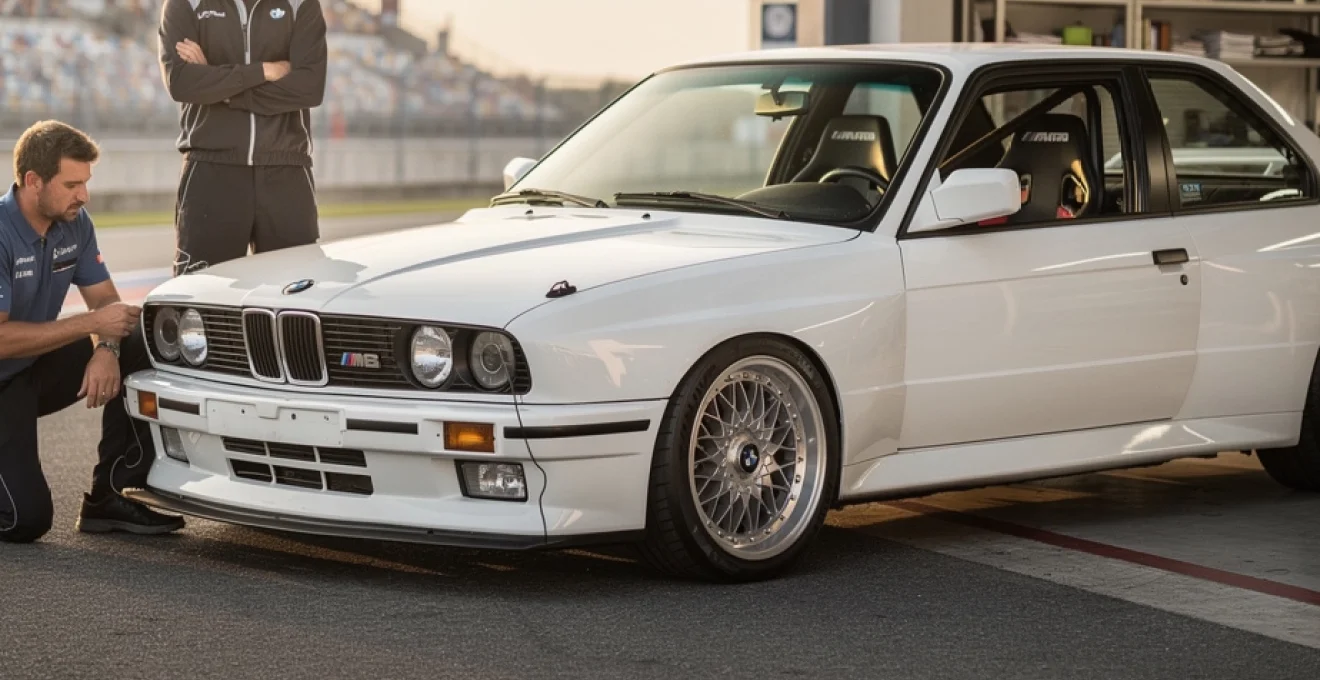
The white BMW E30 M3 occupies a unique space in automotive culture. It blends hard-edged touring car engineering with everyday usability, then wraps it all in a compact, box-arched silhouette that still looks razor sharp decades later. Among all the colours offered, a white E30 M3 — especially in Alpine White — seems to distil everything iconic about the shape: the swollen arches, the crisp shoulder line, the motorsport stance. For anyone who values feel over figures and authenticity over excess, a well-preserved white M3 remains one of the most compelling driver’s cars you can experience.
Origins of the BMW E30 M3: group A homologation and DTM heritage
FIA group A regulations and the engineering brief behind the original E30 M3
The E30 M3 exists because of homologation. To race in FIA Group A touring car series in the 1980s, manufacturers had to sell at least 5,000 road-going versions of the race car. That rule forced BMW to create something far more focused than a tuned 3 Series. The engineering brief was clear: lighter, wider, stiffer and more aerodynamic than the standard E30, with an engine capable of sustaining high revs in endurance racing. Instead of adapting a road car for the track, BMW essentially created a race car that happened to be road legal.
Group A also tightly restricted modifications, so anything that might be useful on track had to be baked into the production shell. That is why the E30 M3 gained bespoke body panels, a unique engine and track-ready suspension geometry. If you are wondering why this compact coupe feels so different from a regular 3 Series, the answer lies in these rulebooks: the car you drive is fundamentally the same architecture that dominated touring car grids worldwide.
BMW motorsport GmbH, paul rosche and the racing-led development process
The E30 M3 was developed by BMW Motorsport GmbH, the precursor to BMW M. Under engine wizard Paul Rosche, the project leveraged pure racing expertise rather than conventional road-car thinking. Rosche’s team already had experience with the legendary M10 and the six-cylinder S38 from the M1 and M5, so the M3 engine was conceived as a hybrid of proven race components and robust series-production hardware.
The development process mirrored competition programmes more than civilian product cycles. Chassis stiffness, engine response and serviceability in racing conditions mattered as much as showroom appeal. It is why elements such as glued-in windscreens, specific suspension pickup points and clutch-type limited-slip differential tuning appear in the road car. For you as an enthusiast, that means the car responds like a race car even at legal speeds, with communication and control that feel deliberately engineered rather than incidental.
Touring car dominance in DTM, BTCC and WTCC and its impact on M3 legend status
On track, the E30 M3 became one of the most successful touring cars ever built. Across DTM, BTCC, WTCC and various national series, the model racked up over 1,500 victories, including multiple championships and wins at endurance events like the Nürburgring 24 Hours and Spa 24 Hours. Few homologation specials can claim such breadth of success across different circuits and regulations.
This touring car dominance is a big reason values of clean E30 M3s have surged. Motorsport success translates directly into legend status: the car did not just look fast, it repeatedly proved it against factory-backed opposition. When you drive a white E30 M3 on a B-road or a track day, you are using essentially the same platform that was built to withstand full-race abuse for hours at a time, which explains the car’s remarkable robustness and consistency when pushed.
Homologation specials: evolution I, evolution II and sport evolution (evo3) variants
To keep the E30 M3 competitive as rivals evolved, BMW introduced several homologation specials. The M3 Evolution I arrived in 1987 with subtle aero tweaks and weight-saving measures. Evolution II followed with a revised engine tune, lighter glass and an even more focused specification. Finally, the Sport Evolution (often called Evo3) grew displacement to 2.5 litres and power to around 238 hp, alongside adjustable aerodynamics and further chassis refinement.
These models were built in limited numbers — for example, only 600 Sport Evolutions left the factory — and they are now at the top of the collector pecking order. Even if you are shopping for a standard white M3 rather than an Evo car, many of the lessons learned on those specials filtered back into later production updates, from suspension calibration to minor aerodynamic improvements.
Iconic liveries and teams: warsteiner, jägermeister, schnitzer and bigazzi E30 m3s
Part of the E30 M3’s magic lies in its visual association with iconic race liveries. The white-based Warsteiner DTM cars, the Jägermeister orange shells and the works Schnitzer and Bigazzi entries turned the E30 into a moving billboard for 1980s motorsport culture. Many of the most memorable cars ran white as a base colour, making Alpine White road cars feel especially close to those championship machines.
Today, numerous enthusiasts recreate those looks on track builds and historic racers, reinforcing the connection between a plain white road car and its flamboyantly liveried cousins. When you see a white BMW E30 M3 sitting low on period-correct BBS wheels, it is hard not to picture it with race numbers, sponsor decals and tyre pick-up on its arches.
Iconic exterior design: box-arched silhouette and alpine white aesthetics
Aerodynamic bodywork: box flares, wider track and wind-tunnel-optimised aero
Visually, the E30 M3 shares only its bonnet, roof and sunroof with a regular E30. Every other panel was redesigned to improve aerodynamics and accommodate a wider track. The boxy wheel arch extensions, deeper front valance, re-profiled C-pillars and more steeply raked rear window were all developed in the wind tunnel. This was not mere styling; each surface helped manage airflow, reduce lift and stabilise the car at speed.
The net effect is a compact coupe that looks both purposeful and cohesive. Those square arches, which might seem exaggerated in photos, make perfect sense in person because they trace the underlying suspension geometry. On a white car, these shapes are especially clear, like architectural lines highlighted on a blueprint.
Factory paint codes: alpine white I (146) vs alpine white II (218) on the E30 M3
When enthusiasts talk about a “white E30 M3”, they usually mean one of two factory paint codes: Alpine White I (146) or Alpine White II (218). Alpine White I has a slightly warmer, creamier tone, while Alpine White II is marginally cooler and cleaner, particularly noticeable under bright sunlight. Both finishes were popular, but colour distribution varied by year and market.
From a collector’s perspective, documenting the original paint code via the build sheet and VIN is essential. A car that left the factory in Diamond Black but is now repainted Alpine White will rarely match the long-term value of a genuine Alpine White shell, even if the respray is high quality. If you are evaluating a potential purchase, checking the paint code against the VIN is one of the first steps to understanding authenticity.
Distinctive details: dog-leg mirrors, raised bootlid, rear wing and front splitter design
Beyond the headline box flares, the E30 M3 bristles with functional details. The aerodynamic door mirrors, sometimes nicknamed “dog-leg mirrors”, were shaped to reduce drag. The raised bootlid and integrated rear wing improved rear downforce, while the front splitter and deeper bumper reduced lift over the nose. Together, these elements gave the car far more stability on the Autobahn and in high-speed corners than a standard 3 Series.
Look closely at a white M3 and these features stand out because the bright paint acts like a highlighter pen. The shadows under the wing, the line of the splitter and the contour of the mirrors are easier to read against a neutral body colour, which subtly reinforces the car’s motorsport intent every time you walk around it.
Impact of a white finish on proportion, shoulder line and motorsport-inspired stance
A white finish changes how your eye reads the E30 M3’s proportions. Darker colours can minimise the arches and make the car seem smaller, while Alpine White emphasises the contrast between the swollen fenders and the relatively slim glasshouse. The crisp shoulder line that runs from front indicator to tail-light becomes a defining feature, almost like the beltline on a tailored suit.
This clarity of form gives a white M3 a distinctly motorsport-inspired stance, similar to a primed race shell before livery is applied. For track-day drivers, that look carries an implicit promise: what you are about to drive has the same fundamental shape as the DTM machines that once slid through Hockenheim’s stadium section with flames licking from their exhausts.
Contrasting trim options: black shadowline, chrome details and period-correct decals
Trim choices have a big impact on how a white E30 M3 presents. Many cars feature shadowline (black) window surrounds, which sharpen the contrast and give a more aggressive, modern appearance. Others retain chrome trims, offering a slightly more classic, period-correct feel. Both approaches have merit, but shadowline with Alpine White is particularly striking, echoing the black window frames and white bodywork of period touring cars.
Period-correct decals — such as subtle BMW Motorsport striping or model designation badges — complete the look. From a collectability standpoint, factory-correct badges and stickers can add value, while overdone aftermarket graphics sometimes detract. If you want a subtle nod to heritage, small DTM-inspired decals or a discreet windscreen banner can reference the racing story without overwhelming the clean white canvas.
Powertrain engineering: S14 engine architecture and motorsport-derived hardware
Design lineage from M10 and S38: four-cylinder block with twin-cam 16-valve head
At the heart of the E30 M3 sits the S14 engine, a high-revving four-cylinder that blends the robust M10 block with a shortened version of the S38 six-cylinder’s twin-cam, 16-valve cylinder head. This hybrid architecture was no accident. The M10 block had decades of racing pedigree, from Formula 2 to turbocharged F1 applications, while the S38 top-end brought flow-optimised ports and four-valve breathing.
The result is an engine that feels unburstable yet eager. You can sense the racing lineage in the way it thrives at high rpm, yet retains the durability required for daily road use. For drivers used to modern turbo torque, the S14’s character — building power as revs rise rather than delivering a mid-range surge — can feel refreshingly analogue and interactive.
Displacement, compression ratios and rev characteristics across S14B23 and S14B25
Most road-going E30 M3s use the 2.3-litre S14B23, producing around 200 hp at 6,750 rpm and 170 lb ft at 4,750 rpm in European trim. North American versions were slightly detuned. Later homologation models gained the 2.5-litre S14B25 with around 238 hp in Sport Evolution guise. Compression ratios and cam profiles varied across special editions, but all maintained a distinctly rev-hungry nature.
Contemporary tests recorded 0–60 mph times in the mid-6-second range and top speeds between 143–151 mph depending on specification. By modern standards, those numbers are warm rather than scorching, yet the way the car delivers that performance — encouraging you to chase the redline and use every gear — is what makes the engine feel special.
Induction, exhaust manifold design and the E30 m3’s naturally aspirated throttle response
The S14’s induction and exhaust systems were designed for maximum efficiency without forced induction. Individual runners, a carefully tuned plenum and free-flowing exhaust manifolds help the engine breathe cleanly at high rpm. The absence of a turbocharger removes lag entirely, giving the car a sharp, linear response to your right foot.
On a good road or circuit, this naturally aspirated throttle response becomes addictive. You can precisely meter power mid-corner, adjust your line with small throttle changes and feel the engine’s contribution to weight transfer. In an era dominated by big turbo torque, the E30 M3 reminds you how satisfying it can be to work for speed, using gearing and revs as part of the driving craft.
Getrag 265 dog-leg gearbox, final drive ratios and limited-slip differential tuning
Most European E30 M3s left the factory with a Getrag 265 five-speed “dog-leg” gearbox, where first gear sits down and to the left, with second and third in a straight 2–3 plane. This layout suits performance driving, keeping the crucial 2–3 and 3–4 shifts aligned. North American cars generally used a conventional H-pattern. Either way, the ratios were closely stacked to keep the S14 in its power band.
A clutch-type limited-slip differential, typically with 25% lock-up, completed the drivetrain. The chosen final drive ratios balanced acceleration with cruising refinement, but the underlying philosophy was clear: maximise corner exit traction and keep the engine on song. On track, the combination of gearbox and diff allows you to lean on the rear axle and steer with the throttle in a way that feels both engaging and predictable.
Engine management evolution: bosch motronic and period ECU mapping strategies
The S14 used evolving generations of BOSCH Motronic engine management, combining ignition and fuel control in one ECU. Mapping strategies were conservative enough to protect reliability under poor fuel quality, yet sophisticated for the time, with load and rpm-based ignition advance tables and knock control. Motorsport variants often used more aggressive calibrations and raised rev limits for qualifying and sprint races.
For modern owners, this provides both security and tuning headroom. A healthy standard ECU and sensors will keep the car running reliably, while specialist tuners can refine maps to suit modern 98 RON fuel, freeing a little extra response. However, originality still matters; for investment-grade cars, retaining the correct ECU and part numbers helps preserve long-term value.
Chassis dynamics: suspension geometry, steering feel and track-day capability
Front MacPherson struts, rear semi-trailing arms and e30-specific geometry revisions
The E30 M3’s chassis layout appears simple on paper: MacPherson struts up front and semi-trailing arms at the rear. The magic lies in the details. BMW Motorsport revised geometry, roll centres and pickup points to reduce the standard E30’s tendency towards sudden lift-off oversteer. The stiffer shell and glued-in glass increased torsional rigidity, allowing the suspension to work more precisely.
Compared with a normal E30, the M3 feels more planted, with a greater sense of connection between steering input and chassis response. On a track day, you notice how progressive the breakaway is; the car telegraphs its limits well before it steps out, giving you time to adjust and learn.
Reinforced subframes, bushings and factory motorsport suspension settings
To cope with racing loads, subframes and suspension mounting points received reinforcement, and bushings were specified with a sportier, more durable compound. Factory Motorsport settings for camber, toe and ride height offered a good balance between agility and tyre life. Many period race cars ran near-stock mountings with only minor shimming and coil-over conversions.
For you as an owner today, this means the underlying hardware is inherently tough. After 30-plus years, most cars benefit from a full bushing refresh, but once renewed with quality parts, the chassis often feels remarkably tight, even by modern standards. That is a testament to the original engineering margin built in for touring car competition.
Steering rack, caster, camber and toe characteristics that define E30 M3 feedback
One of the E30 M3’s defining traits is steering feel. The rack is relatively quick for its era, and geometry choices — including increased caster and negative camber — contribute to strong self-centring and detailed feedback through the rim. You feel not only grip levels but also subtle changes in road surface and load transfer.
Modern electric power steering often filters out these nuances, leaving you guessing at the front tyres’ true state. By contrast, an M3 with a healthy steering system allows you to place the car with millimetric accuracy. For enthusiastic driving on a favourite road, that translates into greater confidence and higher sustainable pace without resorting to brute power.
Brake system specifications, pad compounds and fade resistance in circuit use
Braking hardware on the E30 M3 was uprated versus the standard 3 Series, with larger, ventilated discs front and rear and calipers chosen for consistent performance under heat. ABS was standard, an advanced feature for a mid-1980s sports saloon, helping make the car more forgiving in wet or mixed conditions.
On track, factory brakes are adequate for spirited use, but pad compound and fluid choice are critical. High-quality performance pads and fresh high-temperature fluid transform fade resistance, allowing 20–25 minute sessions without drama. Think of the factory system as a solid base that responds extremely well to minor upgrades rather than a weak point.
Aftermarket setups: bilstein, KW, H&R and OEM+ upgrades that respect original balance
Because the E30 M3 is so revered, the aftermarket for suspension is mature. Popular choices include Bilstein B6/B8 dampers, KW Variant coil-overs and H&R springs. The key is preserving the car’s inherent balance. Excessive lowering or ultra-stiff rates can actually reduce grip on real-world roads and spoil the trademark compliance that makes the M3 so usable.
For a road and occasional track car, an OEM+ approach works best: modestly stiffer springs, quality dampers, uprated bushes where necessary and an alignment that favours a little extra negative camber at the front. This respects the original chassis tuning while adding precision and stability for modern tyres.
| Component | Factory Specification | Typical OEM+ Upgrade |
|---|---|---|
| Dampers | BMW Motorsport gas shocks | Bilstein B8 or KW Variant 1 |
| Springs | Standard M3 progressives | H&R Sport (mild drop) |
| Bushes | Rubber, Motorsport spec | Fresh OEM rubber or comfort poly |
Cabin, ergonomics and driver interface in the white BMW E30 M3
Recaro sport seats, steering wheel options and period BMW motorsport accessories
Inside, the E30 M3 balances motorsport intent with everyday usability. Deeply bolstered Recaro front seats hold you securely without the hardness of modern bucket seats. A thick-rimmed three-spoke steering wheel — often leather-wrapped and sometimes adorned with subtle Motorsport stripes — feels just the right size and thickness for long drives and track sessions alike.
Period BMW Motorsport accessories, such as gear knobs, pedal sets and even auxiliary gauges, add to the atmosphere if they remain in place. When you sit in a well-kept example, you notice how little is superfluous. Everything from pedal spacing to gear lever height seems optimised for driving, not for impressing with technology for its own sake.
Analogue instrumentation, VDO gauges and driver-oriented dashboard layout
The E30 M3’s dashboard is a masterclass in driver-centric design. Clear VDO gauges for speed, revs, fuel and temperature sit directly in your line of sight, with ancillary warning lights and an on-board computer providing essential data. The centre console subtly angles towards the driver, reinforcing the idea that everything in this car exists to serve the person behind the wheel.
The analogue interface of the E30 M3 offers a level of transparency that modern digital clusters rarely match, allowing you to read the car’s mood at a glance.
If you are used to configurable screens and layered menus, the simplicity feels refreshing. There is a directness in glancing at a needle rather than decoding a graphic that fits perfectly with the car’s old-school mechanical honesty.
Interior colourways that complement alpine white: black, cardinal red and natur
Interior colour plays a significant role in the appeal of a white M3. Black leather or cloth provides classic contrast and helps the car feel purposeful, almost utilitarian in a positive sense. Cardinal Red leather offers a more extrovert, period-correct 1980s vibe that many collectors now prize highly. Natur (tan) interiors create a warmer, more GT-like ambience, softening the car’s visual hardness.
From a value standpoint, condition matters more than colour, but certain combinations — such as Alpine White over Cardinal Red — have become especially desirable. If you are searching for a car, consider not only the current fashion but also what cabin you want to spend hours in during long drives or European road trips.
Collectability, values and originality in the white E30 M3 market
Production numbers by year, market (UK, europe, US) and colour distribution
BMW built just under 18,000 E30 M3s between 1986 and 1991, including Evolution models and convertibles. That sounds like a healthy number until you account for attrition, accident damage and race conversions. Survivors in original condition are far fewer, and within that pool, Alpine White examples form only a subset, particularly in right-hand-drive markets such as the UK.
While precise colour-by-market data is patchy, industry estimates suggest that white accounted for a solid but not dominant share of production, with many German and Swiss cars specified in Alpine White and fewer in the US. This relative scarcity, combined with the strong visual identity of a white M3, helps explain the premium often commanded by factory Alpine White cars.
Alpine white E30 m3s in auction results: bring a trailer, collecting cars and RM sotheby’s
Over the last five years, auction platforms have provided valuable transparency on E30 M3 values. In 2020, a low-mileage 1991 E30 M3 sold for around $104,000 on Bring a Trailer, while in 2021 an exceptionally original 1988 example with minimal mileage fetched approximately $255,000, setting a new benchmark for the model. Although not all of these record cars were white, Alpine White examples frequently appear in the upper quartile of results.
Market data consistently shows that highly original, low-mileage E30 M3s — especially in desirable colours like Alpine White — have outperformed many contemporary classics in value appreciation.
Large auction houses and specialist online platforms regularly feature white cars as reference points for condition and originality. For you as a buyer, studying these results offers an invaluable education in how details such as panel gaps, underbody condition and interior wear correlate with final sale prices.
Matching-numbers verification, VIN decoding and factory options to prioritise
In a collector-grade E30 M3, matching numbers matter. That means verifying the original S14 engine, correct gearbox type and chassis stampings. VIN decoding, cross-referencing with factory build data and inspecting stamped numbers on the engine block are all essential steps before committing to a purchase.
Factory options that tend to enhance desirability include air conditioning, sunroof, limited-slip differential (standard in most markets), and in some cases, rare cloth trims such as M-Tech. Period accessories like original radios and on-board computers also add to the car’s authenticity. Missing or incorrect items can be sourced, but costs add up quickly, so factoring this into your budget is wise.
Impact of colour, condition and provenance on long-term appreciation
The three pillars of E30 M3 value are colour, condition and provenance. Alpine White scores strongly on the first metric thanks to its historic and visual appeal. Condition covers not only obvious cosmetic issues but also rust, accident repair, interior originality and mechanical health. Provenance includes documentation, service history and, where applicable, interesting prior ownership.
From an investment perspective, a straight, rust-free shell with original paint — even if lightly patinated — often trumps a freshly restored car with patchy history. As the model edges further into blue-chip classic territory, buyers increasingly prize originality and authenticity. A well-documented white M3 with consistent history is more likely to see steady long-term appreciation than a modified or colour-changed example.
Preservation, restoration and subtle modernisation of a white BMW E30 M3
Bodywork challenges: rust hotspots, paint-matching alpine white and OEM panels
Preserving a white BMW E30 M3 starts with bodywork. Common rust hotspots include the front wings around the arches, jacking points, sills, rear wheel arches, boot floor and around the front and rear windscreens. Preventive inspections and early intervention are critical; poor repairs here can be both costly and difficult to reverse.
Matching Alpine White can be deceptively tricky, especially on Alpine White I cars that may have mellowed slightly with age. Skilled paint shops use spectrophotometers and extensive blending to achieve invisible repairs. Wherever possible, using OEM panels — either new old stock or clean used items — helps maintain correct fit and panel contours, which are scrutinised closely in high-end sales.
Mechanical refresh: timing chain, bottom end, suspension and bushing overhauls
Mechanically, the S14 is robust if maintained properly, but any 30–40-year-old performance engine deserves a thorough inspection. Critical items include the timing chain and guides, rod bearings, head gasket integrity and cooling system health. A proactive refresh of these components can prevent far more expensive failures later.
Suspension and bushing overhauls transform the way the car feels. Replacing tired springs, dampers, bushes and ball joints with quality parts can make an M3 drive almost like new. If you plan regular track use, many specialists recommend uprated rod bolts and frequent oil changes with high-quality synthetic lubricants to safeguard the bottom end at sustained high rpm.
Sympathetic upgrades: period-correct BBS wheels, stainless exhausts and brake improvements
Subtle modernisation can enhance enjoyment without compromising originality. Period-correct BBS cross-spoke wheels in 15 or 16 inches suit the car perfectly and echo its DTM heritage. A high-quality stainless-steel exhaust system that retains factory diameters improves longevity and aural character while remaining reversible.
- Use performance brake pads and fresh high-temperature fluid for improved fade resistance.
- Choose mild suspension upgrades that preserve comfort and the car’s original balance.
- Keep all removed OEM parts carefully stored to retain the car’s full originality package.
Approached thoughtfully, these changes make the car more enjoyable and usable for you today, while still allowing a future owner to return it to full factory specification if desired.
Detailing techniques for white paint: decontamination, polishing and ceramic coatings
White paint rewards careful detailing. Over time, contaminants such as tar, iron particles and environmental fallout can dull the finish, making Alpine White look flat or yellowed. A structured process of chemical decontamination (iron removers and tar solvents), followed by clay barring and light machine polishing, restores clarity and gloss.
- Wash and chemically decontaminate to remove bonded contaminants from the white paint.
- Clay and polish with a fine compound to revive gloss while preserving clearcoat thickness.
- Protect with a high-quality sealant or ceramic coating to ease future maintenance.
Ceramic coatings are particularly useful on white cars, as they reduce staining from road film and make regular washing faster and more effective. When combined with careful trim restoration and glass polishing, a well-detailed Alpine White E30 M3 can look remarkably fresh, highlighting every crease, arch and line that made this homologation special a genuine design icon.