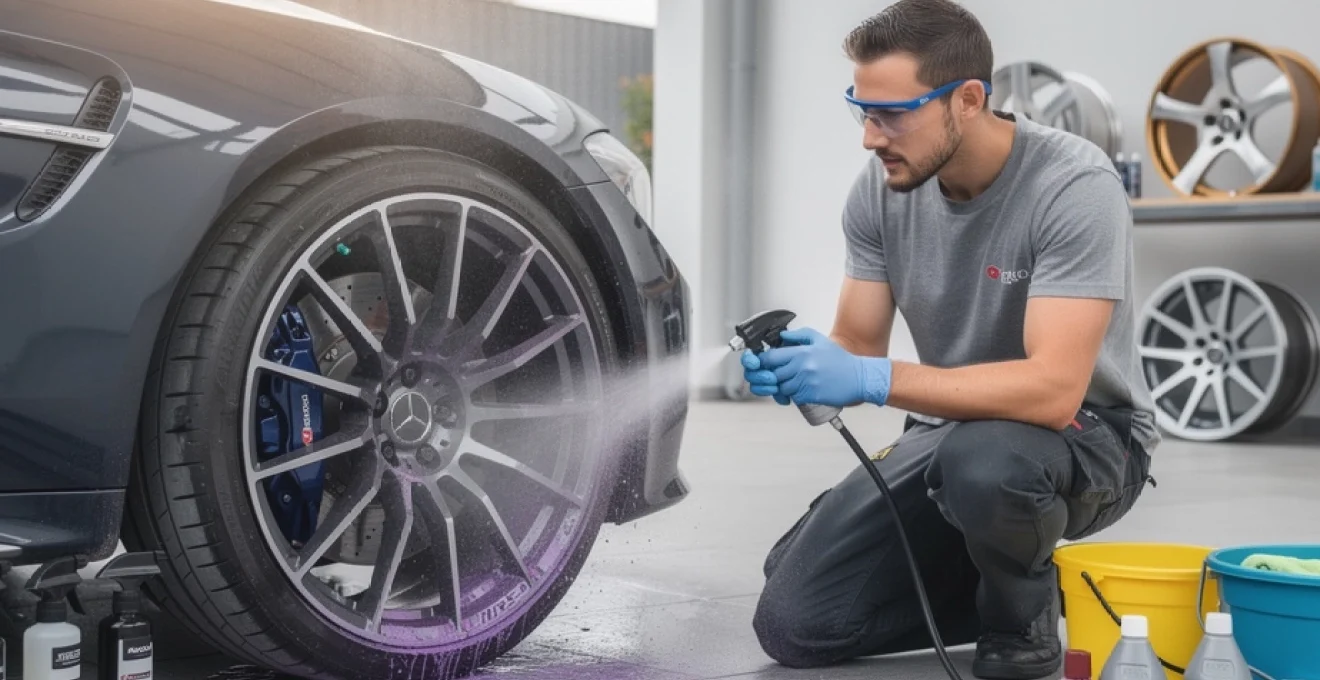
Clean, bright alloys change the entire look of a car, whether you drive a daily commuter or a highly tuned performance machine. Brake dust, road salt and iron fallout are brutal on wheel finishes, especially on UK roads where wet weather, winter gritting and stop‑start traffic create a perfect storm of contamination. Choosing the right alloy wheel cleaner, and using it correctly, makes the difference between wheels that stay glossy for years and wheels that need a full refurbishment long before their time. Wonder Wheels alloy cleaner and its related products sit at the centre of that decision, combining strong cleaning power with targeted chemistry that, when handled properly, becomes a very precise detailing tool rather than a blunt instrument.
Wonder wheels alloy cleaner overview: product variants, ph profile and chemistry
Wonder Wheels covers several very distinct wheel care products rather than a single formula. The flagship Wonder Wheels Original Alloy Wheel Cleaner is a multiple award‑winning, acid‑based cleaner used by many professional valeters and detailers because it cuts through dirt, grease and brake dust almost instantly. Alongside the original sits Wonder Wheels Colour Active Super Wheel Cleaner, an acid‑free, pH balanced gel that uses colour‑changing chemistry to attack iron fallout safely on a wider range of wheels. Then there are protection‑focused products like the Wonder Wheels Wheel Sealant and the All Black Tyre Gel, which are designed to seal surfaces after the heavy cleaning is done.
Acidic vs non-acidic wonder wheels formulas: standard, colour active and wheel sealant
The core distinction in the Wonder Wheels line is between the acid‑based original alloy cleaner and the pH balanced Colour Active cleaner. The original formulation uses strong acidic ingredients to dissolve baked‑on brake dust rapidly; for badly neglected wheels this can be invaluable. Independent tests in the UK retail sector have shown that effective acid wheel cleaners can cut cleaning times by up to 40% compared with mild shampoos when tackling years of bonded grime. The trade‑off is that those acids must be controlled with short dwell times and correct technique, particularly on sensitive finishes.
Colour Active takes a different route. Its acid free and pH balanced profile makes it suitable for chrome, unlacquered, split rims, anodised and even damaged wheels where harsh cleaners would be too risky. The formula reacts with iron particles and turns deep red as it dissolves contaminants, giving clear visual feedback. Wheel Sealant then adds a non‑cleaning layer of protection, using nano-surface technology to create a super‑repellent film. For you as an enthusiast, that means a logical progression: original Wonder Wheels for heavy restoration, Colour Active for regular maintenance and delicate finishes, and Wheel Sealant to lock in the result.
Surfactants, chelating agents and solvents in wonder wheels alloy cleaner
Under the label, Wonder Wheels leverages the same categories of chemistry seen in professional valeting products. Surfactants are the workhorses that loosen oily road film and grime; think of them as microscopic hooks that grab dirt and allow water to carry it away. Chelating agents are particularly important in wheel cleaners because they bind to metal ions in brake dust and iron fallout, preventing redeposition and making rinsing more effective. In Colour Active, these chelators are central to the visible colour‑change reaction.
Solvents play a more limited but still critical role in Wonder Wheels alloy cleaner. Light solvents help to break down greasy deposits and old tyre sling without compromising rubber or plastic trims. A common misconception is that “strong” cleaners rely purely on solvent power; in reality, carefully balanced surfactant and chelator packages do most of the cleaning heavy lifting. The Wonder Wheels Paint Touch-Up Restoration Kit also underlines how important controlled solvent action is, because the Touch-Up Pen needs to level paint without attacking surrounding lacquer.
How wonder wheels interacts with lacquered, diamond-cut and powder-coated alloys
Modern OEM alloys are rarely just bare metal. Lacquered wheels have a clear coat over the colour coat or machined face, diamond‑cut wheels have extremely fine machining lines under the clear coat, and powder‑coated alloys use a baked‑on plastic layer. Wonder Wheels Original Alloy Wheel Cleaner is formulated for use on lacquered wheels, steel wheels and plastic wheel trims, and in that context the lacquer acts as a barrier protecting the underlying paint. As long as the clear coat is intact, short contact with an acid cleaner followed by thorough rinsing is typically safe.
Issues arise when that clear coat has microcracks or stone‑chip damage. On diamond‑cut alloys, for example, water can creep under the lacquer and create “white worm” corrosion. Aggressive cleaning on already failing lacquer can speed up that process. Colour Active’s pH balanced profile is far kinder here, especially for frequent washes. Powder‑coated wheels usually tolerate Wonder Wheels products well because the coating is thick and resilient, but even there, long dwell times with any strong cleaner are unnecessary. Treat Wonder Wheels like a scalpel, not a pressure washer: targeted, brief and controlled.
Comparing wonder wheels with bilt hamber Auto-Wheel, autoglym clean wheels and meguiar’s hot rims
In the current detailing market, Wonder Wheels competes directly with well‑known products such as Bilt Hamber Auto‑Wheel, Autoglym Clean Wheels and Meguiar’s Hot Rims. Auto‑Wheel is non‑acidic, similar in concept to Colour Active, and is known for its strong iron‑reactive chemistry, albeit with a distinct odour that some users dislike. Autoglym Clean Wheels offers both acidic and non‑acidic versions, reflecting the same split seen in the Wonder Wheels range, while Meguiar’s Hot Rims includes separate formulas for factory and coated wheels, acknowledging that one formula rarely fits absolutely everything.
Across independent reviews and Auto Express Product Honours testing, Wonder Wheels has stood out, with the brand winning the category an impressive 13 times. From a professional point of view, the main advantage is flexibility: one brand offers an aggressive cleaner, a safer colour‑changing option, a tyre gel, a wheel sealant and even a Super Wheels Finishing Kit that packages the process in three steps. If you want a system that covers restoration, maintenance and protection without constantly mixing brands, Wonder Wheels offers a coherent workflow that rivals adopt only piecemeal.
Assessing wheel types and finishes before using wonder wheels alloy cleaner
Before reaching for any alloy wheel cleaner, the critical task is to identify what you are actually working on. Misidentifying a polished wheel as lacquered, or assuming a chrome‑plated rim is safe for harsh acids, is one of the fastest routes to permanent damage. The original Wonder Wheels cleaner is formulated for lacquered wheels, steel wheels and plastic wheel trims; other finishes need more caution and usually benefit from Colour Active or diluted products. As OEM wheel designs become more complex—with mixed finishes, tinted clear coats and intricate spoke patterns—visual assessment skills matter more than ever.
Identifying OEM alloy finishes: painted, machined, polished, anodised and chrome-plated
Painted alloys are the simplest to spot: a consistent colour, often silver or gunmetal, with a uniform gloss under the clear coat. Machined or diamond‑cut faces have a bright, almost “raw” metal look with fine radial lines visible under the lacquer, especially when viewed in direct sunlight. Polished wheels, by contrast, are usually bare or minimally protected metal that look like a mirror when freshly finished but tarnish quickly if uncoated. Anodised finishes, common on some performance and aftermarket wheels, tend to have a coloured metallic sheen, often with a satin rather than high‑gloss look.
Chrome‑plated alloys are highly reflective, almost like a bathroom tap, with a depth of shine that standard painted wheels never quite match. They are typically multi‑layer constructions—copper, nickel, then chrome—and any defect in that stack is vulnerable to attack from strong cleaners. For these sensitive surfaces, Colour Active’s acid‑free, pH balanced chemistry is the safer choice, and dilution combined with shorter dwell times adds another margin of safety. If you are unsure, treating a wheel as if it is more delicate than it actually is usually protects your investment without compromising cleaning results noticeably.
Diagnosing existing wheel damage: clear coat failure, white worm corrosion and kerb rash
Existing damage significantly affects how Wonder Wheels should be used. Clear coat failure often shows as milky, cloudy patches or peeling edges on the spokes or rim; using a strong acid cleaner on already lifting lacquer can accelerate flaking. “White worm” corrosion, common on diamond‑cut OEM wheels, appears as filigree white lines creeping under the lacquer from stone chips or centre caps. This is essentially moisture‑driven oxidation spreading beneath the clear coat, and while Wonder Wheels is not the cause, repeated harsh cleaning can worsen the appearance.
Kerb rash exposes raw metal along the lip of the wheel, often with sharp edges. On such areas, acid‑based products can stain or darken the bare aluminium.
The golden rule is simple: the more bare metal you see, the more gently the wheel should be cleaned chemically.
In these situations, Colour Active in combination with careful agitation and quick rinsing is far preferable to full‑strength acidic cleaners. After the wheel is stabilised, a touch‑up kit and sealant can mask the damage until a full refurbishment is viable.
Safe use of wonder wheels on sensitive finishes: diamond-cut, split-rim and aftermarket alloys
Diamond‑cut and split‑rim wheels deserve particular respect. On diamond‑cut alloys, the machining marks beneath the lacquer are part of the aesthetic, but they also provide extra pathways for moisture to creep in if the clear coat is compromised. For routine maintenance, a pH balanced cleaner like Colour Active is generally the best Wonder Wheels option, with the original acid‑based product reserved only for extreme cases and used sparingly. After cleaning, applying a dedicated wheel sealant or ceramic coating dramatically slows down further moisture ingress.
Split‑rim and multi‑piece wheels combine several materials—often polished lips, painted centres and stainless hardware. Here, one‑size‑fits‑all chemistry is rarely appropriate. Professional detailers frequently mask polished lips before using stronger cleaners on painted centres, or simply stick to pH neutral wheel cleaners across the whole assembly. Many aftermarket wheels, especially lightweight forged models, use thinner, more delicate coatings than mass‑market OEM rims. Treat those finishes as you would a high‑end paint job: gentle chemistry, plenty of lubrication and careful drying.
Compatibility of wonder wheels with performance brake systems: brembo, AMG and M sport
High‑performance brake systems such as Brembo, AMG and BMW M Sport produce heavier brake dust loads due to higher friction materials and larger rotor sizes. Studies in brake wear have shown that performance pads can shed up to 60% more particulate matter under aggressive use than standard pads, creating a thick layer of ferrous contamination on inner barrels. Wonder Wheels Original Alloy Wheel Cleaner is well suited to cutting through that baked‑on grime during periodic deep cleans, provided the calipers themselves are painted and not bare anodised aluminium.
For frequent washes—especially on brightly coloured calipers—Colour Active is often the smarter choice because its acid‑free profile is kinder to the paint. As a practical tip, always rinse calipers thoroughly and avoid long dwell times of any cleaner directly on hot metal. After a spirited drive, allowing the brakes to cool fully before spraying any Wonder Wheels product prevents flash‑drying and potential staining. Pairing Wonder Wheels cleaning with a dedicated caliper sealant or ceramic coating can cut cleaning time dramatically if you track the car or drive hard regularly.
Step-by-step wonder wheels cleaning process for daily drivers and performance cars
A controlled, stepwise process maximises the cleaning power of Wonder Wheels while minimising any risk to wheel finishes. Many enthusiasts treat wheels as an afterthought, yet survey data from UK valeting businesses indicates that wheels account for up to 30% of total wash time on heavily used cars. A structured workflow—pre‑wash, Wonder Wheels application, agitation, safe rinse and thorough drying—turns that time into consistent, repeatable results, whether you are cleaning a city runabout or a turbocharged track toy.
Pre-wash decontamination: snow foam, citrus pre-cleaners and pressure washer technique
Effective wheel cleaning begins before any wheel cleaner touches the surface. A good snow foam or citrus pre‑cleaner applied to the wheels and arches helps loosen loose grime, salt and traffic film so Wonder Wheels can focus on bonded contaminants rather than mud and dust. Think of it like soaking a greasy pan before scrubbing: the more you can remove gently up front, the less aggressive you need to be later. Use a pressure washer at a safe distance, around 30–50 cm, to rinse away as much initial contamination as possible.
On daily drivers, this pre‑wash step can remove up to 50% of visible dirt, according to data from detailing training centres, reducing the amount of chemical cleaner required. Always work from the top of the wheel down so dirt flows off rather than across cleaned sections. Avoid directly blasting valve stems, tyre sidewalls or wheel weights at point‑blank range, particularly on older wheels where adhesive weights may already be marginal. This sets a clean, lubricated stage for Wonder Wheels to perform optimally.
Correct wonder wheels dilution ratios, dwell times and panel-by-panel workflow
Wonder Wheels Original Alloy Wheel Cleaner is designed to be used as supplied for heavily contaminated wheels, but on well‑maintained alloys, many professionals dilute it to reduce chemical load while still achieving thorough cleaning. A common working ratio is 1:1 with water in a secondary bottle for maintenance washes. Dwell time should be kept short—typically 2–4 minutes—especially on warm days or darker wheels, and the surface should never be allowed to dry while the product is active.
Colour Active, with its pH balanced profile, allows slightly longer dwell times of up to 5 minutes, during which you will see the characteristic deep‑red bleeding effect as it reacts with iron particles. Always work wheel by wheel rather than soaking all four at once; this avoids over‑dwell and lets you focus attention on each corner. A logical order for a full wash is panel‑by‑panel around the car, leaving wheels until last, but within the wheel stage itself, sticking to a one‑wheel‑at‑a‑time workflow keeps things controlled and consistent.
Brushes, detailing swabs and wheel woolies optimised for wonder wheels application
Choosing the right tools multiplies the effectiveness of any alloy wheel cleaner. Soft‑bristled wheel brushes reach into barrels and between spokes, while smaller detailing brushes tackle lug nuts, valve recesses and logo caps. Microfibre‑covered “wheel woolies” are especially useful with Wonder Wheels Colour Active, as they help distribute the gel evenly along the inner barrel where most brake dust accumulates, without scratching sensitive finishes. Avoid stiff, cheap brushes that can mar clear coats, particularly on gloss black or high‑polish wheels.
Detailing swabs and microfibre mitts can be reserved for tight crevices and behind brake calipers.
Think of brushes and swabs as extensions of your fingertips, allowing Wonder Wheels to work where you physically cannot reach.
For performance cars with large multi‑piston calipers, slim barrel brushes become essential, allowing access between caliper and barrel without forcing or bending tools. Always rinse brushes thoroughly after use; spent chemical and metal contaminants left in the fibres reduce cleaning power and can inflict minor scratching during the next wash.
Safe rinsing, two-bucket method and drying to prevent water spotting on alloys
Once Wonder Wheels has dwelled and the wheel has been agitated, thorough rinsing is the safety net that protects finishes. Use a strong, fan‑shaped water jet from a hose or pressure washer and move methodically to chase suds and discoloured runoff off the wheel, tyre and arch. Many enthusiasts use a modified two‑bucket method on wheels: one bucket for wheel shampoo, one for rinsing brushes and mitts between passes, mirroring the process used on paintwork. This reduces the chance of dragging grit across the wheel face.
Drying is more than just aesthetics. Minerals in tap water can leave spots when allowed to dry naturally, especially on dark or gloss black alloys. Using a dedicated microfibre wheel towel or a small blower reduces spotting and makes any remaining contamination easier to see. If you live in a hard‑water area—over 60% of UK households do—this final step becomes especially important. Once dry, the wheel is ready for close inspection and, if needed, further decontamination or protection.
Post-clean inspection: spotting iron fallout, tar spots and embedded brake dust
After the first Wonder Wheels cycle and full drying, the wheel will be dramatically cleaner, but a trained eye will still look for stubborn deposits. Iron fallout often appears as tiny, dark specks, particularly on inner barrels and behind spokes. Tar spots are usually darker, slightly raised blobs, often towards the rear of the wheel where road tar is flung off tyres. Embedded brake dust may present as a roughness you can feel when running clean fingers or a glove over the surface, even though it looks clean.
At this stage, a colour‑changing iron remover can be re‑applied selectively to problem areas, or a dedicated tar and glue remover used to spot‑treat asphalt deposits. The goal is not necessarily a concours‑level finish every wash, but a gradual reduction of deep contamination over time. For track‑day cars or high‑mileage commuters, scheduling a more intensive decontamination every 3–6 months keeps wheels easier to clean with Wonder Wheels alone during regular washes.
Advanced decontamination: combining wonder wheels with iron fallout removers and tar removers
Wonder Wheels forms a strong foundation for alloy cleaning, but heavily contaminated wheels—especially those exposed to frequent motorway driving, winter salt or track use—benefit from layered chemical decontamination. Combining Wonder Wheels with dedicated iron fallout removers and tar and glue removers allows you to address different contaminant types sequentially rather than over‑relying on a single product. Industry training courses increasingly emphasise this multi‑stage approach because it delivers deeper cleaning with less physical abrasion than aggressive claying or repeated strong scrubbing.
Layered chemical decontamination: sequencing wonder wheels, iron X and tar & glue remover
A typical advanced decontamination sequence begins with a thorough pre‑wash and standard Wonder Wheels clean to strip away loose dirt, grease and most brake dust. Once the wheels are dry, a dedicated iron remover (often generically referred to as Iron X-type products) can be sprayed onto the surfaces and allowed to react, turning purple or red as it dissolves ferrous particles. This is rinsed thoroughly after a few minutes. A tar and glue remover is then applied sparingly to remaining tar spots and left briefly before being wiped away with a disposable microfibre.
The key principle is not to stack aggressive chemicals on the surface simultaneously. Each product targets a specific contamination class, and allowing one to do its work fully before introducing another keeps risks lower. For example, using a strong tar remover and an acid wheel cleaner together is excessive and can soften certain paints or rubber components. Treat the wheel like a layered system: remove what Wonder Wheels can handle first, then escalate only where needed.
Removing baked-on ferrous contamination from track-day wheels and high-performance road cars
Track‑day wheels and fast road cars often develop a grey, rough film on inner barrels that seems immune to normal washes. This is heavily baked‑on ferrous contamination, essentially microscopic metal shards fused to the clear coat by heat. Strong Wonder Wheels applications, even in multiple passes, may only partially shift this layer. Dedicated iron fallout removers, used after Wonder Wheels has cleared general grime, can break down this bonded contamination more deeply, especially when combined with careful agitation using soft brushes.
Some professionals also use clay bars or synthetic clay mitts on wheel faces after chemical decontamination, but this is where technique matters. Clay is mildly abrasive; using it on already compromised clear coat can introduce marring. When wheels are regularly protected with sealant or ceramic coatings, field reports from detailers suggest up to 70% less track‑day residue remains after events, making Wonder Wheels and iron removers more effective and reducing the need for abrasive measures altogether.
Hand-polishing alloys after wonder wheels with metal polishes such as autosol and britemax
Once chemical decontamination is complete, hand‑polishing can lift the appearance of alloys further, especially on polished lips, stainless bolts or exposed metal centre caps. Products like Autosol or Britemax metal polishes contain fine abrasives and chemical cleaners that refine the surface, restoring gloss and removing light staining. After thoroughly rinsing and drying off all traces of Wonder Wheels, a small amount of metal polish can be applied with a microfibre or foam applicator, worked until it hazes, and buffed clear.
On painted or lacquered surfaces, use paint‑safe finishing polishes rather than aggressive metal compounds.
Think of metal polish as a surgeon’s scalpel, not a sledgehammer—it should be used precisely, in small quantities, only where necessary.
Repeated heavy polishing on thin diamond‑cut faces, for example, can shorten the lifespan of the finish by gradually eroding the already minimal surface layer. Always follow polishing with a protective product such as wheel wax or ceramic coating to reduce future staining.
Avoiding chemical etching and staining on bare metal lips and polished rims
Bare metal and highly polished rims are the most vulnerable to chemical etching from strong cleaners. Unlike painted or lacquered wheels, there is no protective barrier between the metal and the product. Acid‑based Wonder Wheels should be avoided entirely on fully polished, uncoated surfaces; instead, rely on pH neutral cleaners, careful agitation and metal polishes. Even Colour Active, though pH balanced, should be used sparingly and not left to dwell excessively on bare metal lips.
Etching often appears as cloudy patches or rainbow‑like stains that do not wipe away when dry. Once etched, the only remedy is abrasion—either hand‑polishing or machine polishing—to remove a microscopic layer of metal and reveal fresh material beneath. To minimise risk, test any cleaner on a small, inconspicuous section of the lip first and monitor closely as it dwells. Rinse quickly, dry thoroughly and only scale up if the test patch shows no ill effects under good lighting.
Protecting alloys after cleaning: sealants, ceramic coatings and wheel waxes
Deep cleaning with Wonder Wheels is only half of the long‑term wheel care equation. Protection products—sealants, ceramics and waxes—create sacrificial layers on the wheel surface so future contamination sticks to the coating rather than the clear coat itself. That means easier cleaning, less chemical aggression and a longer lifespan for the finish. Industry data from detailing studios suggests that well‑maintained, protected wheels require up to 60% less contact time with strong cleaners compared with unprotected equivalents over a 12‑month period, especially when exposed to UK winter conditions.
Pairing wonder wheels with dedicated wheel sealants like poorboy’s wheel sealant and gtechniq C5
After a full Wonder Wheels clean and decontamination, applying a dedicated wheel sealant is a high‑value step. Products such as Poorboy’s Wheel Sealant offer traditional polymer‑based protection in paste form, creating a slick, glossy layer that repels brake dust and grime. Gtechniq C5, by contrast, is a ceramic wheel coating that bonds chemically to the surface and can last up to 12–18 months with proper maintenance. Both approaches reduce the frequency with which you need strong Wonder Wheels applications, especially the acid‑based formula.
For daily drivers, a sealant like Poorboy’s is often sufficient and easier to re‑apply seasonally. For performance cars, high‑end SUVs or vehicles running aggressive brake setups, a ceramic such as C5 offers more robust heat resistance and longevity. Always ensure wheels are fully dry and free of any Wonder Wheels residue before applying these products, as leftover surfactants or solvents can interfere with bonding. If you are new to ceramics, starting with a traditional sealant can be a good training ground in surface preparation and careful application.
Hydrophobic protection: ceramic spray coatings vs traditional wheel wax on UK roads
Hydrophobic behaviour—water beading and sheeting—is more than a visual party trick. On UK roads, where rain and road spray are frequent, a hydrophobic wheel surface sheds water more quickly, taking loosely attached grime with it. Ceramic spray coatings bridge the gap between full‑blown ceramic products and simple waxes, offering spray‑on application with weeks to months of protection. Traditional wheel wax, typically based on synthetic polymers and sometimes carnauba, provides good gloss and a slick feel but may last only 4–8 weeks in harsh winter conditions.
From a professional perspective, ceramic sprays have transformed maintenance for enthusiasts who clean cars regularly but do not want the full commitment of multi‑year coatings. Used on top of deeper Wonder Wheels cleans, they create an easily renewable shield. However, proper surface preparation remains non‑negotiable: cleaning with Wonder Wheels, decontaminating iron and tar, and thoroughly drying are still the foundation. A poorly prepped surface with a ceramic spray on top behaves like a dirty window with a water‑repellent film—functional, but far from optimal.
Extending cleaning intervals by layering protection on high-mileage commuter alloys
High‑mileage commuters often clock 12,000–20,000 miles per year, with wheels exposed to constant brake dust, diesel soot and road grime. For these cars, extending cleaning intervals without sacrificing appearance relies on layering protection intelligently. After a full Wonder Wheels deep clean and sealant or ceramic application, using pH neutral shampoos and, where necessary, Colour Active for maintenance helps preserve that protective stack. Many owners find that a thorough deep clean every 3–4 months, with lighter monthly washes in between, strikes a realistic balance.
Layering works much like a good winter clothing system: a base layer (the wheel’s clear coat), mid‑layer (sealant or ceramic) and outer “spray jacket” (maintenance wax or ceramic spray). Each Wonder Wheels session then becomes less aggressive because there is simply less contamination bonded directly to the clear coat. Over time, this approach reduces the need for refurbishments, which can easily cost £250–£400 for a full set of premium alloys in the UK market.
Protecting inner barrels and brake calipers after wonder wheels cleaning
Inner barrels and brake calipers are often neglected simply because they are harder to see and reach, yet they collect the majority of brake dust. After using Wonder Wheels with suitable brushes to restore inner barrels, applying a dedicated wheel sealant or ceramic coating on those surfaces pays significant dividends. Some professionals even remove wheels periodically to coat barrels fully, especially on enthusiast cars with open‑spoke designs where the barrel is highly visible.
Painted brake calipers can be treated similarly: once cleaned with a mild Wonder Wheels application and thoroughly dried, a high‑temperature‑resistant sealant or ceramic coating helps repel dust and makes future cleaning easier. On cars with branded calipers—Brembo, AMG, M Division—the visual improvement is striking when calipers stay bright rather than turning dull grey. Avoid getting strong cleaners on exposed rubber seals or bare metal hardware; instead, use mild APC (all‑purpose cleaner) and gentle brushes for those components.
Wonder wheels safety protocols, storage and environmental considerations
Safe, responsible use of Wonder Wheels products matters as much as aesthetics. Wheel cleaners are among the most chemically active products in a detailer’s arsenal, and improper handling can affect both personal safety and the environment. Regulatory focus on chemical runoff and urban drainage systems has increased in recent years, particularly across the EU and UK, prompting many professional valeters to tighten protocols. For home users, basic protective equipment, thoughtful working practices and sensible storage turn Wonder Wheels into a precise tool rather than a potential hazard.
Personal protective equipment: gloves, eye protection and ventilation when using wonder wheels
When handling acid‑based Wonder Wheels, nitrile or chemical‑resistant gloves should be considered essential, not optional. Prolonged skin contact with acidic or alkaline products can cause irritation or dermatitis, and gloves also protect against contaminants already on the wheel surface. Safety glasses or goggles are strongly recommended, particularly when using pressure washers that can flick cleaner back towards the user. Even pH balanced products like Colour Active benefit from basic PPE, as the iron‑reactive chemistry can be unpleasant if splashed into eyes.
Ventilation is primarily a concern in enclosed garages or detailing studios. Using Wonder Wheels in a well‑ventilated area reduces the concentration of any vapours and makes the experience more comfortable. If you are sensitive to chemical odours, a simple particulate mask can offer some relief, although most Wonder Wheels products are designed for consumer use and do not typically produce harsh fumes. Reading and following the manufacturer’s safety data sheet, where available, rounds out a professional approach to personal safety.
Using wonder wheels safely on driveways, block paving and resin-bound surfaces
Driveway surfaces vary widely, from plain concrete to block paving and resin‑bound aggregates, and strong wheel cleaners can sometimes discolour or strip sealants on those surfaces. When using Wonder Wheels, avoid letting runoff pool on decorative stone or porous blocks. Rinsing the working area with clean water before and after application dilutes any overspray or drips, reducing the chance of staining. On sealed resin‑bound drives, which are increasingly popular in new‑build estates, this pre‑wetting step acts like a sacrificial buffer layer.
If your driveway is particularly sensitive, working over a temporary rubber mat or in an area designed to handle chemical runoff—such as a wash bay or simply a tarmac section—offers additional protection. For block paving treated with colour enhancers or sealants, test Wonder Wheels overspray on a small, inconspicuous area and rinse immediately. Treat the driveway as another surface that deserves a degree of care, not just a disposable backdrop to the wash process.
Runoff management and environmentally responsible disposal of used wheel cleaner
Chemical runoff from washing cars flows either into surface water drains, which often lead directly to watercourses, or into combined sewers. Local regulations may restrict what can enter storm drains, particularly concentrated chemicals and oils. While Wonder Wheels products are designed for consumer use, minimising the amount that enters drainage systems is still a responsible practice. Using only as much product as needed, capturing heavily contaminated rinse water where feasible, and avoiding washing on unsealed ground near streams or natural water bodies are all practical measures.
Some enthusiasts use portable wash mats or drainage covers to capture and contain runoff during intensive detailing sessions. In professional settings, interceptors and separators are often mandated to prevent oils and heavy metals from entering the sewer system. At home, simple habits—such as pre‑wiping heavily soiled wheels with damp microfibres and disposable towels before full washing—can significantly reduce contamination in the rinse water. Even small changes, applied consistently, add up across thousands of home washes each year.
Storage stability, shelf life and temperature considerations for wonder wheels products
Proper storage keeps Wonder Wheels performing consistently from first spray to last. Most wheel cleaners, including Wonder Wheels Original Alloy Wheel Cleaner and Colour Active, should be stored in a cool, dry place, away from direct sunlight and extreme temperature swings. Prolonged exposure to high heat can destabilise surfactants and thickeners, while freezing can cause separation or reduced effectiveness. Ideally, keep products between 5°C and 25°C, mirroring general chemical storage guidelines.
Many detailing professionals rotate stock annually even if bottles are not fully empty, especially for high‑value coatings and sealants, because performance can taper off subtly over time. Wheel cleaners are usually more stable, but if a product has been sitting for several seasons, checking consistency, odour and performance on a test wheel is prudent. Always keep caps tightly closed, avoid contaminating original bottles with dirty sprayers or water, and label any diluted Wonder Wheels mixtures with the date and ratio used so you know exactly what you are spraying on your alloys.